
When I Press My Brake Pedal I Hear Air: Complete Guide to Air Brake Sounds for CDL Drivers
Hear air when pressing your brake pedal? 🎯 Learn what's normal vs. dangerous in air brake systems. CDL test prep included.

If you've ever asked yourself "when I press my brake pedal I hear air escaping," you're not alone — this is one of the most common questions commercial drivers ask about air brake system behavior. Air brakes operate on compressed air pressure, and some audible hissing or exhaust sounds are completely normal during routine braking. However, other air sounds can signal a dangerous pressure leak, a failing treadle valve, or a compromised brake line that demands immediate attention before you put the vehicle back on the road.
Understanding the difference between a normal air exhaust and a worrisome leak is a critical skill for every CDL holder. When you depress the brake pedal on a standard air brake-equipped truck, the foot valve — also called the treadle valve — opens a port that routes high-pressure air to the brake chambers. When you release the pedal, that air must go somewhere: it vents to atmosphere through an exhaust port, producing a characteristic hiss. This exhaust sound is engineered into the system and is not a fault condition under normal circumstances.
The situation changes when you hear continuous hissing while the pedal is held down and the truck is stationary, or when the governor cannot maintain system pressure above 100 psi despite the engine running. A slow leak anywhere in the supply or delivery circuit — from cracked hoses to worn O-rings in the relay valves — will gradually rob your system of the pressure needed for a full, controlled stop. On a vehicle as heavy as a fully loaded semi, that loss of braking power can be catastrophic within seconds of a pressure drop below 60 psi.
This article walks you through the full spectrum of air brake sounds you may encounter: what each sound means, where in the system it originates, how urgently you need to respond, and what the CDL air brake test expects you to know about diagnosing these conditions before you leave the inspection lane. Whether you're a seasoned driver refreshing your knowledge or a student preparing for the CDL air brake endorsement exam, the information here is grounded in FMCSA regulations and industry best practices.
The F-750 air brake treadle valve is a frequent point of discussion in both shop diagnostics and CDL classroom instruction because it is the driver's primary interface with the entire air brake circuit. A worn or misadjusted treadle valve can produce sounds that mimic a line leak, sending drivers and mechanics on expensive wild-goose chases. Knowing the mechanical behavior of this valve — and how to test it during a pre-trip inspection — saves time, money, and potentially lives.
Air brake antifreeze is another factor that influences sounds in the system. During cold weather, moisture that has accumulated in the air tanks can freeze inside valves and lines, causing partial blockages that create unusual gurgling or intermittent hissing sounds. Proper use of alcohol evaporators and air dryers helps prevent this buildup, and the CDL practice test frequently includes questions about winterizing procedures that directly relate to the sounds drivers may hear at the pedal.
By the end of this guide, you will know exactly which sounds warrant a pull-over and phone call to dispatch, which require a shop visit before the next trip, and which are simply the reassuring mechanical exhale of a healthy air brake system doing its job. You will also be well-prepared to ace every sound-related question on the air brake test and demonstrate professional-level inspection technique during your CDL skills evaluation.
Air Brake Sounds by the Numbers

What Happens Inside the System When You Press the Pedal
Pedal Depression Activates Treadle Valve
Air Travels to Relay and Quick-Release Valves
Brake Chambers Convert Air to Mechanical Force
Pedal Release Vents Air to Atmosphere
System Rebuilds Pressure via Compressor
Governor Cuts Out — System Holds Pressure
The treadle valve — commonly called the foot valve or brake pedal valve — is the mechanical heart of the driver's interaction with the air brake circuit. In vehicles like the Ford F-750, this component sits directly beneath the cab floor and translates pedal pressure into a precisely metered air signal.
The valve contains a graduating spring, an inlet seat, and an exhaust seat. When you apply partial pedal travel, the graduating spring holds the inlet partially open, delivering proportional pressure to the service brake circuit. This graduated response is what allows a skilled driver to feather the brakes smoothly rather than applying full pressure abruptly.
When drivers notice that pressing the brake pedal produces an immediate loud hissing from under the cab floor or from the firewall area, the treadle valve's exhaust seat is usually the culprit. The exhaust seat is a rubber or neoprene component that seals the atmospheric vent port when the pedal is depressed.
If this seat is worn, cracked, or contaminated with compressor oil, it will not seal completely, allowing supply-side air to bypass into the exhaust port even while the brakes are applied. The net effect is both audible — a persistent hiss during pedal application — and functional, as system pressure will slowly drop even with brakes held.
Diagnosing a treadle valve exhaust seat failure is straightforward during a pre-trip inspection. With the engine off and system pressure above 90 psi, apply the brake pedal firmly and hold it. Place your hand near the treadle valve exhaust port (typically a rubber-flapped hole in the cab floor area) and feel for airflow. Any detectable outward airflow while the pedal is held indicates the exhaust seat is not sealing. Compare this to the normal condition: during pedal hold, the exhaust port should be completely sealed with zero airflow escaping.
The FMCSA's air brake regulations specify that a single vehicle at rest with the engine off must not lose more than 3 psi per minute at normal operating pressure with brakes released, and no more than 4 psi per minute with full brake application. Exceeding these rates on a CDL road test or inspection is an automatic out-of-service condition. Understanding these numbers is essential for the air brake test cdl written exam, where leak rate questions appear consistently across state variants.
Beyond the treadle valve itself, the delivery hoses connecting the foot valve to the relay valves are a common source of audible leaks. These hoses are subject to chafing, heat cycling, and ozone degradation. A pinhole leak in a delivery hose will produce a steady, high-pitched whistle rather than the broader hiss of a valve seal failure.
The pitch is higher because air is forced through a smaller opening at higher velocity. Locating this type of leak requires a soap solution applied along the entire hose run while pressure is maintained — look for bubbles while an assistant holds the brake pedal down.
Air brake antifreeze — specifically, the alcohol evaporator systems used in colder climates — can occasionally cause valve sounds that new drivers mistake for leaks. Alcohol vapor drawn into the system slightly lubricates valve seats, which can temporarily change the sound profile of normal exhaust venting. If you notice a slight chemical smell alongside a softer-than-usual exhaust hiss after the antifreeze reservoir has been serviced, this is typically normal. However, if the smell is accompanied by a pressure drop or if the brakes feel soft or spongy, have the system inspected by a qualified brake technician before operating the vehicle.
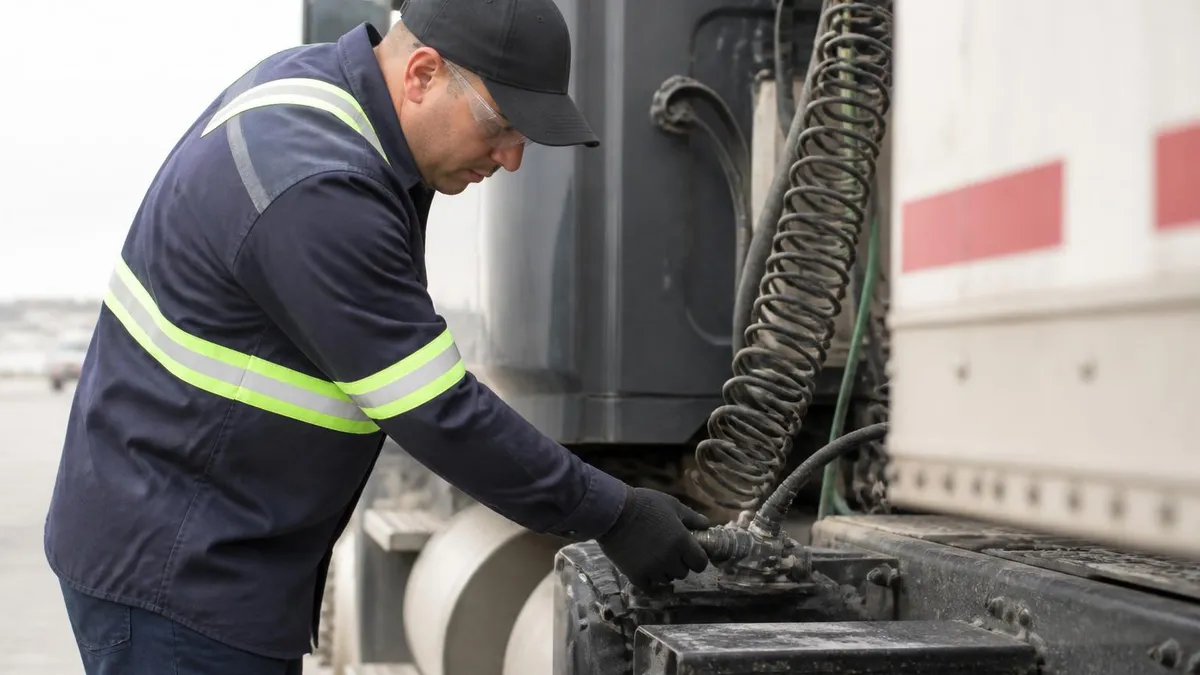
One often-overlooked source of pedal-area air sounds is the air line that feeds the trailer service connection — the blue gladhand. If the trailer service line has a cut or a loose coupling, air will escape every time the foot valve delivers pressure to the trailer circuit.
This sound may be localized near the rear of the cab or the fifth-wheel area rather than at the pedal, but because the pressure drop reaches the driver through the feel of the pedal, many drivers incorrectly assume the foot valve is the problem. Always walk the full length of the trailer brake circuit when diagnosing sounds that correlate with pedal application.
Air Brake Sound Diagnosis by Location
Sounds originating at or near the brake pedal almost always trace back to the treadle valve assembly. A hiss during pedal application points to a worn exhaust seat that won't seal under pressure. A grinding or scraping sensation combined with a faint hiss suggests the graduating spring has weakened or broken, preventing the valve from modulating properly. Always test this area with the engine off, holding a sustained pedal application while monitoring the system pressure gauge for drops exceeding 4 psi per minute.
If the hissing stops immediately when you release the pedal and system pressure stays stable, the treadle valve is almost certainly functioning within spec — the sound you heard was simply the normal exhaust of service air from the brake chambers venting through the foot valve's exhaust port. Drivers new to air brake vehicles frequently report this as alarming when it is actually the designed behavior. The CDL air brake test includes questions specifically testing whether candidates understand this normal exhaust cycle versus a genuine fault condition.

Normal Air Exhaust vs. Dangerous Leak: How to Tell the Difference
- +Normal exhaust hiss stops completely within 1-2 seconds of pedal release
- +System pressure holds steady above 100 psi after exhaust sound stops
- +Sound is localized to the treadle valve exhaust port, not from hoses or valves
- +Compressor rebuilds pressure quickly back to governor cut-out range
- +Low-pressure warning light stays off during normal brake cycles
- +Brakes feel firm and consistent with no sponginess or fade between applications
- −Dangerous leak continues hissing even with pedal fully released
- −System pressure drops more than 3-4 psi per minute at rest
- −Sound is diffuse or comes from chassis, frame rails, or trailer connections
- −Compressor runs continuously and cannot rebuild pressure to cut-out
- −Low-pressure warning buzzer activates at or below 60 psi
- −Brake pedal feels soft, travels farther than usual, or requires more force for same deceleration
Pre-Trip Air Brake Sound Inspection Checklist
- ✓Build system pressure to governor cut-out (typically 120–125 psi) before beginning any sound checks.
- ✓Turn off the engine and listen for 1 full minute — no hissing should be audible with brakes released.
- ✓Apply and hold the foot valve; verify pressure drop does not exceed 3 psi per minute.
- ✓Release the pedal and confirm the exhaust hiss stops completely within 2 seconds.
- ✓Fan the brakes repeatedly to drop pressure to 60 psi and verify the low-pressure buzzer activates.
- ✓Continue fanning to approximately 20–40 psi and confirm spring brakes apply automatically.
- ✓Walk the full chassis length and listen for any continuous hissing at frame-mounted valves or hose fittings.
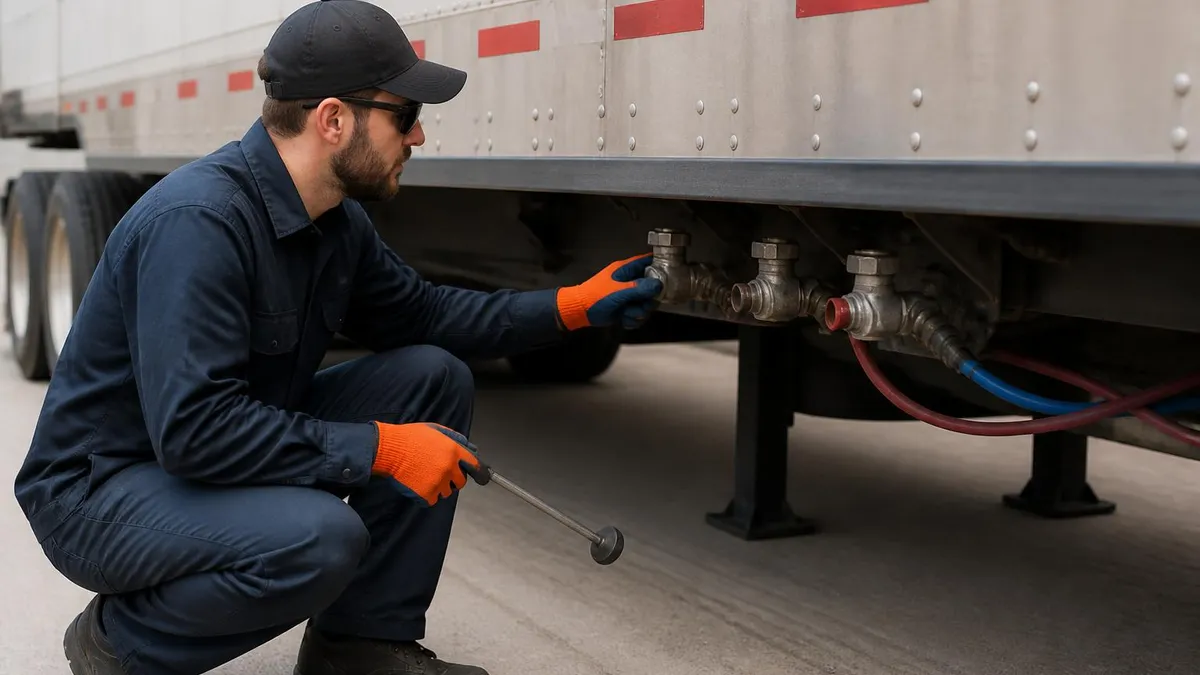
- ✓Check trailer gladhand connections for hissing after coupling — apply brakes and listen at the couplings.
- ✓Inspect the air dryer purge valve exhaust for continuous drip or hissing between purge cycles.
- ✓Document any out-of-spec sounds on the DVIR before operating the vehicle or reporting for dispatch.
The 1-Minute Silence Test Is Your Best Diagnostic Tool
After building pressure to governor cut-out and shutting down the engine, sit quietly in the cab for a full 60 seconds. A healthy air brake system is essentially silent during this period. Any audible hissing — no matter how faint — during this test indicates a leak that must be found and repaired before the vehicle enters service. This simple test catches the majority of dangerous leaks before they become emergencies on the road.
The CDL air brake test administered by each state's DMV draws heavily from the FMCSA's Commercial Driver's License Manual, sections 5 and 6. Questions about air brake sounds appear in multiple formats: identification questions that ask what a specific sound indicates, procedural questions that ask what a driver should do upon hearing a particular sound, and inspection questions that ask at what pressure the low-pressure warning should activate. Preparing specifically for these question types — rather than memorizing generic brake facts — is the most efficient path to a passing score on the CDL air brake test.
The new york air brake endorsement exam, like those in most states, requires a minimum score of 80% to pass. The state of New York uses a 25-question format for the air brake knowledge test, and questions about pressure gauges, warning systems, and audible indicators appear on virtually every version. Test-takers frequently report that sound-identification questions are the ones they missed most often during their first attempt, precisely because these questions require experiential knowledge that is difficult to gain purely from a textbook without time in an actual cab.
One of the most commonly tested scenarios on the CDL air brake endorsement exam involves what a driver should do if the low-pressure warning buzzer activates while driving. The correct answer sequence is: immediately and safely pull off the road, do not make any unnecessary brake applications that would further deplete pressure, apply the parking brakes to hold the vehicle, and call for mechanical assistance.
This procedure is designed to prevent a total loss of braking ability, which occurs when pressure drops below approximately 20–40 psi and the spring brakes apply automatically — potentially causing an abrupt stop in a traffic lane.
The air brake test also covers the distinction between a one-way check valve sound and a two-way check valve sound in dual-circuit systems. Modern commercial vehicles are required to have dual air circuits — a primary circuit serving the rear axle brakes and a secondary circuit serving the front axle brakes. A one-way check valve between the two circuits prevents a leak in one circuit from depleting the other.
When this valve opens due to a circuit imbalance, it produces a brief clicking sound. Test questions about dual circuits ask candidates to explain what happens to braking when one circuit fails, and the answer — that the driver retains partial braking ability through the intact circuit — is directly relevant to understanding why sound detection matters so much.
Practice tests that mirror the actual state exam format are the most effective preparation tool. The CDL practice test air brakes format typically presents scenarios where the candidate must choose between normal system behavior and a fault condition based on a sound description or pressure reading. Working through 200 or more practice questions exposes candidates to the full range of phrasings and scenario types that appear on the actual test, dramatically reducing the element of surprise on exam day.
F-750 air brake treadle valve questions appear on CDL knowledge tests in the context of identifying the function of the foot valve and understanding how it controls pressure delivery to the service brake circuit. Candidates are expected to know that the foot valve is a graduating valve — meaning it delivers pressure proportional to pedal travel — rather than an on/off switch. This distinction explains why partial pedal applications produce a softer, shorter exhaust hiss compared to full-pressure stops, and it forms the basis for understanding brake modulation technique in professional truck driving.
The air brake endorsement is separate from the standard CDL in most states and requires both a written knowledge test and a pre-trip inspection skills component. During the skills evaluation, the examiner will ask the candidate to perform the air brake inspection while narrating each step.
Correctly identifying the exhaust sound during the fan-down test, naming the pressure at which the warning activates, and demonstrating knowledge of spring brake application pressure are all evaluated during this practical component. Drivers who practice the narrated inspection — literally talking through each step aloud — consistently perform better than those who only study the written material.

If your air brake system loses more than 4 psi per minute with brakes applied or more than 3 psi per minute with brakes released, the vehicle is legally out of service under FMCSA 49 CFR Part 393 and applicable state regulations. Operating an out-of-service vehicle exposes the driver to a minimum $1,000 civil penalty and potential CDL disqualification. Never attempt to complete a trip and "fix it later" when leak rates exceed these thresholds — brake failure at highway speed is fatal.
Preventing air leaks — and the unusual sounds that accompany them — begins with a disciplined maintenance culture that treats the air brake system as the life-safety component it truly is. The most common source of preventable leaks in commercial fleets is improper fitting installation during line repairs.
Push-to-connect air fittings, which are standard on modern trucks, must be fully seated until an audible click is heard and the tube cannot be withdrawn without pressing the collet ring. A fitting that is 90% seated will hold pressure initially but will work loose under vibration, eventually producing the kind of intermittent hissing that is maddening to diagnose because it disappears when the vehicle is stationary and a technician is looking for it.
Air dryer maintenance is another cornerstone of leak prevention. The air dryer removes moisture from compressed air before it enters the main reservoirs. A saturated or failed desiccant cartridge allows wet air — and in winter, liquid water — to circulate through the entire brake system. Water in valve seats accelerates seal degradation, causing the very exhaust seat failures that produce hissing at the treadle valve. Most manufacturers recommend replacing the desiccant cartridge annually or every 300,000 miles, whichever comes first. In high-humidity climates or applications with extended engine idle time, more frequent replacement is advisable.
Air brake antifreeze systems, which inject isopropyl alcohol vapor into the supply line upstream of the first reservoir, provide a secondary defense against moisture-related valve damage in cold climates. These systems have a reservoir that must be refilled with dedicated air brake antifreeze — never automotive antiscreen fluid, which can damage rubber components.
A full antifreeze reservoir that empties unusually quickly is itself a diagnostic signal: it may indicate that the air dryer is not removing moisture effectively, causing the antifreeze to work overtime against incoming wet air. Investigating the dryer when antifreeze consumption spikes is faster than waiting for valve failures to manifest as hissing sounds.
Slack adjuster condition directly affects the sounds heard during brake application, though the relationship is less obvious than valve-related sounds. An automatic slack adjuster that has over-adjusted — pushing the pushrod beyond its designed stroke — will cause the diaphragm in the brake chamber to bottom out against the back plate.
This produces a metallic clang or clunk at the end of pedal travel, followed by a soft hiss as excess air bleeds through the diaphragm seam. Catching over-adjusted slack adjusters during pre-trip inspection prevents diaphragm damage and the associated leak sounds. The stroke measurement is performed with the brakes released: pushrod travel at 90 psi application should not exceed the maximum stroke marked on the chamber body.
Reservoir drain valves at the bottom of each air tank should be opened daily at the end of operation to expel any accumulated moisture. A properly functioning air dryer will keep the reservoirs dry, but the drain valves are a crucial backup verification step.
A driver who opens the drain valve and sees a significant stream of water — rather than just a brief puff of air — knows immediately that the air dryer is not functioning correctly. This moisture will work its way into every valve in the system over time, causing progressive seal degradation and the associated air sounds that signal impending component failure.
Hose routing and support clamps deserve attention during any preventive maintenance inspection. Air hoses that are allowed to contact hot exhaust components will eventually crack from heat cycling, producing pinhole leaks that are detectable as high-pitched whistles only at operating pressure. Hoses that lack adequate support will flex excessively at frame crossmembers, fatigue-cracking at the flex point after thousands of cycles. The investment of a few minutes to check clamp positions and hose routing during scheduled maintenance prevents the kind of on-road failures that leave drivers stranded and create unsafe conditions for surrounding traffic.
Finally, the holistic approach to air brake sound management includes driver training that emphasizes listening as a diagnostic skill. Experienced CDL drivers develop what fleet safety managers call "brake ear" — the ability to detect subtle changes in exhaust sound pitch, duration, or character that signal an emerging problem before it becomes a failure.
This skill is cultivated by paying deliberate attention to system sounds during pre-trip inspections and during the first few brake applications of each shift, when the system is cold and any moisture in the lines is most likely to cause unusual sounds. Fleets that invest in this kind of sound-awareness training consistently report lower rates of brake-related roadside breakdowns and inspection violations.
Mastering air brake sounds is ultimately about developing a calibrated mental model of what a healthy system sounds like so that deviations from that baseline register immediately. This calibration comes from repetition: performing the pre-trip air brake inspection the same way, in the same sequence, every single day. When you listen to the exhaust port vent on Monday, Tuesday, and Wednesday without incident, the slightly different pitch on Thursday will be noticeable even if you cannot immediately articulate why it sounds wrong. That gut-level recognition is what prevents small problems from becoming catastrophic failures.
The CDL pre-trip inspection sequence for air brakes is standardized for good reason. It begins with building pressure to governor cut-out, proceeds through the static leak test, the low-pressure warning check, and the spring brake application test, and concludes with a visual inspection of all visible components.
Candidates who skip steps to save time during a skills evaluation — or drivers who abbreviate the inspection on cold mornings — are the ones most likely to miss developing faults. The sequence is designed so that each step builds on information from the previous one, creating a comprehensive picture of system health that no single test can provide alone.
Understanding the relationship between ambient temperature and air brake system sounds is particularly valuable for drivers who operate year-round in variable climates. Cold air is denser than warm air, which means the compressor delivers a slightly different volume per stroke in winter versus summer.
Cold O-rings and diaphragms are stiffer and may produce slightly different exhaust sounds until they warm to operating temperature. Drivers who know this context won't panic when they hear a slightly harsher brake exhaust on a cold January morning, but they will correctly investigate if the sound persists after the system warms up to normal operating temperature after 15–20 minutes of operation.
The integration of electronic brake systems (EBS) and antilock braking systems (ABS) on modern commercial vehicles adds another layer of sounds to the air brake experience. ABS modulators cycle rapidly during a wheel-lock event, producing a staccato chattering sound at the wheels and a rhythmic pressure pulsation felt through the pedal.
This sound alarms drivers who have never experienced it, but it is entirely normal — it indicates the ABS is functioning correctly. ABS warning lights that illuminate without a wheel-lock event do warrant investigation, as they signal a modulator valve fault that could compromise ABS function without affecting the base air brake system's basic operation.
For drivers preparing for the CDL air brake test, the most valuable study strategy combines written knowledge review with hands-on time in an actual air brake-equipped vehicle. Reading about treadle valve exhaust sounds is useful; hearing and feeling them in context is significant. If you don't have access to a commercial vehicle for practice, many CDL training schools offer open-cab sessions specifically for air brake familiarization. During these sessions, focus on the sounds at each stage of the inspection sequence and ask the instructor to deliberately demonstrate both normal sounds and simulated fault conditions where possible.
Online CDL practice tests that focus specifically on air brake content are the next best preparation tool. The most effective practice sessions involve timed tests of 25–30 questions, reviewing every wrong answer immediately after completion, and repeating the test until scores consistently exceed 90%. At that score threshold, candidates have demonstrated mastery of not just the facts but the reasoning patterns that the exam tests. Sound-related questions, pressure threshold questions, and inspection procedure questions should all be answered correctly and confidently before scheduling the actual knowledge test appointment.
The combination of technical knowledge, practical inspection skill, and sound awareness that this guide covers represents the professional standard for commercial drivers operating air brake-equipped vehicles. Whether you're driving a school bus, a refuse truck, a flatbed semi, or a tanker, the physics of compressed air and the mechanical behavior of valves and chambers are the same.
The driver who understands those fundamentals — who knows why the brakes sound the way they do and what any deviation from normal means — is the driver who brings every load home safely, passes every inspection, and builds the kind of safety record that defines a professional CDL career.
Air Brake Questions and Answers

About the Author

Educational Psychologist & Academic Test Preparation Expert
Columbia University Teachers CollegeDr. Lisa Patel holds a Doctorate in Education from Columbia University Teachers College and has spent 17 years researching standardized test design and academic assessment. She has developed preparation programs for SAT, ACT, GRE, LSAT, UCAT, and numerous professional licensing exams, helping students of all backgrounds achieve their target scores.