
Air Brake Test 2026 October: Questions, Answers and Pre-Trip Guide
Pass the air brake test on your first attempt. 💡 Free 25-question practice, seven-step pre-trip walkthrough, and state-by-state CDL exam tips.
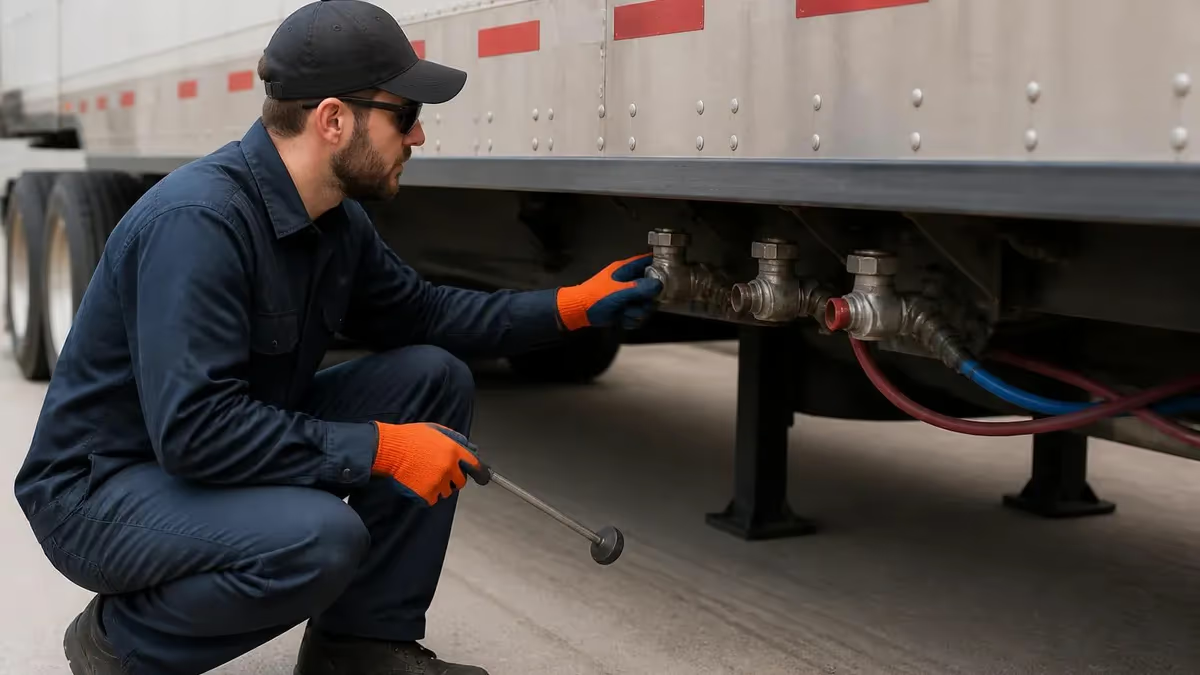
The air brake test is the gateway component of the Class A and Class B Commercial Driver's License process for any driver planning to operate a truck or bus equipped with an air brake system. Passing it is non-negotiable. Without the air brake endorsement on your CDL, you legally cannot get behind the wheel of most semi-trucks, dump trucks, fire engines, school buses, or motorcoaches.
You will not pass by guessing. The Federal Motor Carrier Safety Administration sets the framework, but each state writes its own version of the question pool, draws from the CDL Manual, and runs its own skills inspection. That means the air brake knowledge test can differ in length between Texas, California, Pennsylvania, and Florida, but the technical content is consistent across all 50 states.
This guide walks through every piece of the exam — written questions, the seven-step in-cab brake check, parking brake function, slack adjuster inspection, air loss rates, governor cut-in and cut-out, and the dual air gauge readings examiners specifically look for. Use it alongside the official manual issued by your state DMV.
Air Brake Test at a Glance

What Is the Air air brake test?
The air brake test is a two-part qualifier built into the CDL exam. The first part is a 25-question multiple choice section drawn from the CDL Manual's air brake chapter. You must score at least 80% to pass — that means you can miss no more than 5 questions in most states.
The second part is a skills inspection performed during the pre-trip portion of the driving test, where an examiner watches you identify air brake components on an actual vehicle and run a leak-down procedure in front of them. If you take the CDL skills test in a vehicle without air brakes, you receive an air brake restriction (code L) printed directly on your license.
That restriction blocks you from operating any commercial vehicle equipped with full air brakes or even air-over-hydraulic systems. Lifting the restriction later requires retaking both portions, so most drivers handle it correctly the first time. The CDL practice test system covers the broader exam, but air brake content alone is dense enough to deserve dedicated study sessions.
The skills portion is where applicants stumble most often. You will be asked to perform a static leak test, an applied leak test, listen for the low-air warning to activate, and continue pumping the brake pedal until the spring brakes engage automatically. Each of those checks has a specific pressure threshold the examiner will measure with the dash gauge.
Air Brake Restriction Code L
If your CDL skills test is taken in a vehicle without a functioning air brake system, an L restriction is added to your license. That code prohibits operation of any commercial vehicle with full air or air-over-hydraulic brakes — including most semi-trucks and tour buses. Removing the restriction requires retaking the air brake knowledge exam and the pre-trip air brake skills check in a properly equipped vehicle. Take the test right the first time and skip the headache.
Pass Rates and Examiner Expectations
State DMV reports across 2024 and 2025 placed the first-attempt failure rate for the air brake knowledge exam between 31% and 42%, depending on jurisdiction. Compare that to the general CDL general knowledge test, which sees roughly 25% first-attempt failures.
What separates a passing score from a failing one is rarely intelligence. It is repetition. Drivers who run through 200 to 300 practice questions over the two weeks before their exam pass at significantly higher rates than those who cram the night before. Use the free air brake questions bank to drill until your accuracy stays above 90% on three consecutive runs.
Examiners are not trying to trick you. They follow a state-issued scoring sheet with checkboxes, and they want to see specific phrases and actions. When you point to the slack adjuster and say "I would check for excessive travel beyond one inch when pulled by hand with the brakes released," that is the language they expect.
What's Inside the Air Brake Knowledge Exam
Compressor, governor, air tanks, dryer, foot valve, slack adjuster, brake chamber — naming and function questions form roughly one third of the knowledge bank.
Primary and secondary circuits, what fails if one drops, how the warning system reacts to a leak below 60 psi, why one circuit alone still allows controlled stops.
How parking brakes apply automatically when air pressure drops between 20-45 psi, why you should never push the parking brake knob when pressure is low.
Seven-step in-cab inspection: build pressure, governor cut-out, static leak, applied leak, low-air warning, spring brake activation, parking brake hold test.
Brake lag (0.5 second delay), proper downhill braking with light steady pressure, engine braking, stab braking versus controlled braking on slippery surfaces.
What to do if the low-air warning sounds while driving, how to identify a runaway truck ramp, brake fade recovery techniques, smoke detection during long descents.
How to Study for the Air Brake Test
The fastest way to fail is to read the CDL Manual once and assume the words will stick. They will not. Air brake terminology is dense — slack adjusters, S-cams, ratchet pawls, governor unloaders, treadle valves — and most of it is foreign vocabulary for new drivers.
You need active recall, not passive reading. Active recall means closing the book and writing down the seven steps from memory, then checking your answers. Repeat until you nail it three times in a row. Practice exams matter even more than the manual itself once you have read it twice.
Each timed run of 25 questions exposes a different weak spot. Most candidates discover within their first three practice tests that they are weak on either the dual air system rules or the pressure thresholds — two areas the real exam tests aggressively. Drill those gaps before drilling the topics you already know.
If you are studying for the broader endorsements at the same time, the combination vehicles test and tanker endorsement share thematic overlap with air brakes around braking technique, surge management, and emergency procedures.

Air Brake Test by State
Texas administers the air brake test through the DPS as part of the CDL Skills exam. The written portion has 25 questions; you may miss 5. The skills inspection follows the standard seven-step pre-trip but the examiner will ask you to demonstrate the low-air warning by pumping down from full pressure — expect to count out loud as you pump.
The Dual Air Brake System Explained
Federal regulations require every commercial vehicle built after March 1975 to have a dual air brake system — two completely separate air circuits, primary and secondary. If one fails, the other still operates enough brakes to bring the vehicle to a controlled stop.
Knowing what each circuit controls is exam material. The primary circuit typically powers the rear service brakes; the secondary circuit powers the front service brakes and the trailer brakes through the relay valve. When one circuit loses pressure, the low-air warning light activates on the dash and a buzzer sounds. At that point you must stop the vehicle as soon as it is safe.
Continuing to drive risks total brake failure. The exam will give you a scenario — perhaps "you are descending a hill and the low-air warning activates" — and the only correct answer involves pulling over safely, not attempting to limp to the next exit. Always choose the answer that stops the truck.
The dual gauge on the dash shows both circuits as separate needles. If you see one needle dropping while the other stays steady, you have a leak on the dropping circuit. Examiners on the skills test will sometimes ask you to point to the dual gauge and explain what abnormal readings look like.
One of the most common failure points on the air brake test is the answer to this question: should you apply the parking brake to stop a moving vehicle if you lose air pressure? The correct answer is no. The spring brakes will activate automatically as pressure drops between 20 and 45 psi. Manually pulling the knob during a low-pressure event can lock the wheels and cause loss of control. Examiners ask this question in multiple forms — get it right every time.
Slack Adjusters: The Most Failed Skills Question
The slack adjuster is the lever that converts the push from the brake chamber into rotational force on the S-cam, which spreads the brake shoes against the drum. Over time, brake lining wears down and the slack adjuster must take up the gap.
Automatic slack adjusters do this on their own, but they still fail. The examiner expects you to manually pull on each slack adjuster (engine off, parking brake off, chocks in place) and report any travel beyond one inch as a defect that puts the vehicle out of service.
This is the single most failed question on the skills inspection. Drivers often say "I would visually inspect for damage" — wrong. They want to see you physically grab the slack adjuster and pull, then tell them what acceptable travel looks like.
Practice the exact phrasing: "I would pull on the slack adjuster with the brakes released. Movement greater than approximately one inch indicates the brakes are out of adjustment and the vehicle is unsafe to operate." Memorize that sentence. Examiners do not paraphrase.
Seven-Step Pre-Trip Air Brake Inspection
- ✓Chock the wheels and release all brakes (parking brake off, foot off pedal)
- ✓Build air pressure to governor cut-out (typically 120-140 psi) and observe the gauge
- ✓Apply foot brake firmly, hold for 1 minute — pressure loss must not exceed 3 psi for single vehicle or 4 psi for combination
- ✓Pump brake pedal to reduce air pressure — low-air warning light and buzzer must activate around 60 psi
- ✓Continue pumping — spring brakes (parking brake knob) must pop out between 20-45 psi
- ✓Build pressure back to normal (85-100 psi minimum) within 45 seconds with engine at operating RPM
- ✓Test parking brake by releasing service brake, gently moving vehicle forward — should not move

Governor Cut-In and Cut-Out Pressures
The governor controls when the air compressor pumps and when it stops. Cut-out is the upper limit, typically 120 to 140 psi, where the compressor stops adding air to the system. Cut-in is the lower limit, usually 20 to 25 psi below cut-out, where the compressor starts pumping again.
These numbers matter because the exam tests them, but more importantly because abnormal cut-in or cut-out indicates a governor problem you need to recognize. To demonstrate governor function on the skills test, start the engine and watch the air pressure gauge climb. Note the cut-out pressure where the climb stops.
Then pump the brake pedal to bleed air down and note the cut-in pressure where the compressor restarts. The examiner will ask you these two numbers. Have the numbers ready before you start the procedure — guessing during the test wastes seconds and signals unfamiliarity. Pair this with the CDL pre-trip inspection drill so the procedure becomes second nature.
Common Trick Questions and How to Beat Them
Test writers love trick questions about parking brakes. The trick is always the same: when air pressure is low, the spring brakes apply themselves automatically — you do not push or pull the knob. Pulling the knob during a low-pressure event can cause the spring brakes to release violently if pressure suddenly returns, creating a runaway risk.
Another favorite is the difference between modulating valves and check valves. A one-way check valve protects the tanks from losing air backward through the compressor if the compressor fails. A modulating valve is the dash control that lets the driver gradually apply trailer brakes independent of the truck brakes.
Confusing the two is an instant point loss. If a question asks about controlled, gradual application from the dashboard, the answer involves the modulating valve. If it asks about preventing air backflow into a failed component, the answer involves the check valve.
Brake fade is another regular topic. Brake fade is the loss of braking effectiveness when brake drums overheat — usually during long downgrades when drivers ride the brakes instead of using engine braking and the proper snub technique.
The correct downhill procedure is to select a low gear before starting the descent, let engine compression do most of the work, and apply firm steady brake pressure for short bursts (3 to 5 seconds) to bring speed down 5 mph below the safe speed, then release. Repeat as needed. Never ride the brakes continuously.
Self-Study vs CDL School for the Air Brake Test
- +Self-study is free aside from the cost of the CDL manual
- +Practice tests online let you drill at your own pace and schedule
- +You can prepare while keeping your current job and income stream
- +Skills test prep needs vehicle access — a friend with a truck works fine
- −CDL school provides in-cab coaching that self-study cannot replicate
- −Schools often have testing partnerships that simplify the DMV experience
- −Solo prep risks missing common examiner-specific phrasing requirements
- −School costs $3,000 to $7,000 depending on region and program length
Pros and Cons at a Glance
| Pros | Cons |
|---|---|
| Self-study is free aside from the cost of the CDL manual | CDL school provides in-cab coaching that self-study cannot replicate |
| Practice tests online let you drill at your own pace and schedule | Schools often have testing partnerships that simplify the DMV experience |
| You can prepare while keeping your current job and income stream | Solo prep risks missing common examiner-specific phrasing requirements |
Test Day Strategy
Arrive at the DMV at least 30 minutes early. Bring your permit, a printed copy of your medical certificate, proof of insurance, and the vehicle registration for whatever truck or bus you are testing in. Examiners will not start the test if any paperwork is missing.
If you are using a school's vehicle, confirm with the instructor the night before that the truck has been pre-checked and the air system is in working order — a failed truck on test day cancels your slot. During the knowledge test, do not rush. You typically have 30 to 45 minutes for 25 questions.
Read each question fully before scanning the answers. Many wrong answers are technically correct in some scenarios but wrong for the specific question being asked. Eliminate two obviously incorrect choices first, then weigh the remaining two against the exact wording. The CDL general knowledge test uses the same multiple-choice trickery.
For the skills portion, speak out loud throughout the procedure. Examiners need to hear you identify components and announce what you are checking. Silent inspection earns zero points even if you are doing the right thing in your head. Practice the entire pre-trip in front of a mirror the night before.
Common Mistakes That Fail New CDL Drivers
The single biggest cause of skills-test failure is not understanding the equipment. Candidates show up after weeks of book study but have never physically touched a slack adjuster or watched the dual gauge needles move in real time. Get behind the wheel before test day. Find a driver who lets you sit in the cab, identify each component out loud, and run the seven-step procedure twice.
Another frequent failure is rushing the static leak test. The static check requires a full minute of holding pressure with the brakes off and the engine off. Many candidates wait 20 or 30 seconds and announce a result. Examiners count the time. Set a stopwatch on your phone and practice the 60-second hold until patience becomes automatic.
The third common trap is forgetting to chock the wheels before doing the in-cab inspection. The procedure starts with chocks in place to prevent rollaway risk. If you skip the chock step, the examiner will mark a critical deduction and the run is over before it began. Make it the very first thing you announce when you climb into the cab.
What Happens After You Pass
Once you clear both portions, the air brake endorsement is added directly to your CDL — no separate card or sticker. You can then operate any commercial vehicle equipped with full air brakes within the class limit of your license (Class A, B, or C).
The endorsement does not expire on its own, but you must renew your CDL on the state's schedule, typically every 4 to 8 years. Renewal does not require retesting the air brake portion unless you let your license lapse for more than a year.
If you fail either part, most states require a waiting period — usually 1 to 14 days — before you can retake. Some states limit you to three attempts before requiring a new application and fee. Track your weak areas after a failed attempt and drill them specifically.
Failing the knowledge test once does not mean you will fail again — most retakers pass on the second try because the question pool is finite and patterns become familiar.
One last point worth stressing: the air brake endorsement is one of the most valuable additions to a commercial driver's license because it unlocks the bulk of the heavy-vehicle freight market. Trucking companies hiring for over-the-road, regional, and local routes filter applicants by endorsements held. Passing this exam expands the pool of jobs you qualify for and typically lifts starting pay by several thousand dollars annually compared with restricted drivers.
Sample Air Brake Practice Questions
Try these questions from our free Air Brake practice tests. The correct answer and an explanation follow each question.
How should you test the service brakes during a pre-trip air brake check?
- A. Roll forward slowly and apply the brake pedal firmly
- B. Pump the pedal 20 times while parked
- C. Rev the engine to build pressure
- D. Disconnect the trailer line
Answer: A. Roll forward slowly and apply the brake pedal firmly
Move forward at low speed and apply the brakes to confirm they stop the vehicle and do not pull.
What is the acceptable pressure drop rate with service brakes applied during the pre-trip air brake leak test?
- A. Less than 3 psi per minute for single vehicles; less than 4 psi per minute for combination vehicles
- B. Less than 10 psi per minute for any vehicle type
- C. No pressure drop is acceptable in any vehicle
- D. Less than 5 psi per minute regardless of vehicle configuration
Answer: A. Less than 3 psi per minute for single vehicles; less than 4 psi per minute for combination vehicles
FMCSA/CVSA standards allow a maximum leak rate of 3 psi/min for singles and 4 psi/min for combinations with service brakes applied; anything above is cause for repair.
Why is brake adjustment important in an air brake system?
- A. To reduce air pressure.
- B. To ensure the brake system is correctly aligned and responsive.
- C. To increase braking power.
- D. To improve engine efficiency.
Answer: B. To ensure the brake system is correctly aligned and responsive.
Brake adjustment is crucial in an air brake system to ensure that the brake shoes or pads are correctly positioned relative to the drum or rotor. Proper adjustment guarantees that the brakes engage evenly and respond effectively when applied, providing consistent and reliable stopping power. This alignment is essential for optimal braking performance and preventing issues like pulling or reduced stopping distance.
What does it mean if the low air pressure warning activates while checking brake adjustment during a pre-trip?
- A. The air compressor or governor may not be functioning properly
- B. Brake lining thickness is at the minimum
- C. The spring brakes need adjustment
- D. Slack adjusters are over-tightened
Answer: A. The air compressor or governor may not be functioning properly
If the low air pressure warning activates during testing, it signals that the compressor is not maintaining adequate system pressure, pointing to a problem with the compressor or governor.
Air Brake Test Questions and Answers
About the Author

Educational Psychologist & Academic Test Preparation Expert
Columbia University Teachers CollegeDr. Lisa Patel holds a Doctorate in Education from Columbia University Teachers College and has spent 17 years researching standardized test design and academic assessment. She has developed preparation programs for SAT, ACT, GRE, LSAT, UCAT, and numerous professional licensing exams, helping students of all backgrounds achieve their target scores.