
Air Brake System Troubleshooting: Diagnose Leaks, Pressure Drops, and Valve Failures
Air brakes troubleshooting guide: 📚 diagnose air leak between master cylinder and brake booster, pressure drops, valve faults, and pass your CDL air
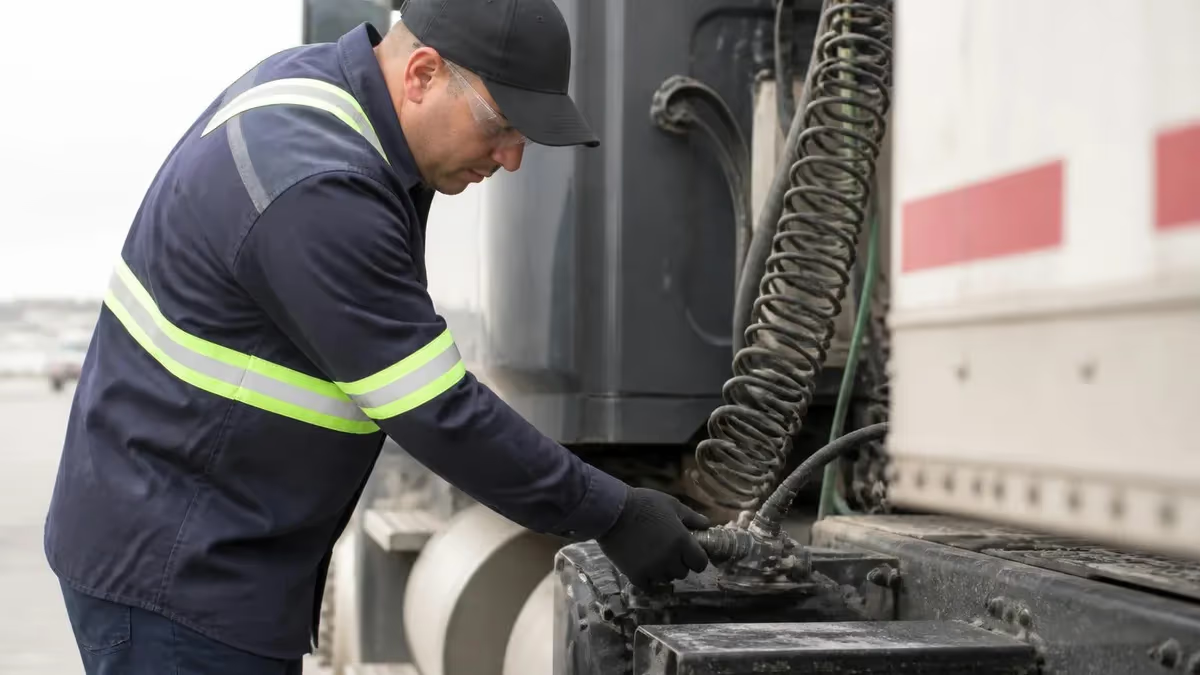
Air brakes are the backbone of every Class 8 truck, transit bus, and heavy trailer on American highways, and when something goes wrong the symptoms are rarely subtle. A spongy pedal, a hissing sound under the dash, or a low-air warning buzzer that will not quiet down all point to the same root cause: a system that has lost its ability to build or hold pressure. The most misunderstood failure on hydraulic-over-air rigs is an air leak between master cylinder and brake booster, which mimics low fluid, weak valves, and even bad foundation brakes all at once.
Troubleshooting starts with knowing what "normal" sounds and feels like. A healthy system builds from 85 to 100 psi in 45 seconds or less, holds pressure within a 2 psi drop per minute with the engine off and brakes released, and pops the low-air warning at roughly 60 psi. Anything outside those numbers is a flag. Drivers who memorize these benchmarks during their air brakes study sessions find leaks faster because they trust their gauges instead of their gut.
This guide walks you through the full diagnostic flow used by fleet mechanics: governor cut-in and cut-out checks, applied and static leak tests, treadle valve response, spring brake chamber inspection, and the often-overlooked moisture and antifreeze issues that disable a system in winter. You will learn the difference between a service leak and a supply leak, why a popped pressure protection valve is sometimes a feature rather than a bug, and how to isolate the exact circuit that is bleeding down.
Hydraulic-over-air systems, found on Ford F-650, F-750, International, and Freightliner medium-duty trucks, add a second layer of complexity. The air booster sits between the brake pedal and the master cylinder, and when the diaphragm tears or the seal at the booster-to-master interface fails, the truck behaves as if the brakes are dragging, even though the foundation hardware is fine. Misdiagnosing this leak is the single most common reason fleets replace good calipers and good master cylinders.
Whether you are prepping for the CDL air brake endorsement, running a pre-trip on a tractor you have never driven, or chasing an intermittent low-air alarm on your own rig, the framework here is the same. Listen, look, measure, then act. Every component has a known failure mode and a known test, and once you learn the sequence you can isolate almost any fault in under twenty minutes without pulling a single line.
We will also cover the regulatory side. Federal Motor Carrier Safety Regulations 393.40 through 393.52 spell out what a roadside inspector will check, what counts as an out-of-service condition, and why a 3 psi leak-down on a single vehicle is a violation that ends your trip on the shoulder. If you are pursuing the air brake endorsement, the same numbers appear on the written knowledge test, the pre-trip skills test, and the in-cab portion of the road exam.
By the end of this article you will have a step-by-step diagnostic checklist, a working knowledge of every major valve in the system, and a clear understanding of why air brakes remain the safest, most fail-tolerant braking technology ever fitted to a commercial vehicle, even when one circuit is leaking.
Air Brake Troubleshooting by the Numbers

Step-by-Step Diagnostic Flow
Listen Before You Look
Build & Time Pressure
Static Leak Test
Applied Leak Test
Warning & Spring Brake Check
The pressure build-up test is the first measurement that separates a healthy compressor from a tired one. With the engine running at governed RPM and the air system fully discharged, the gauges should climb from 50 to 90 psi in roughly three minutes, and from 85 to 100 psi in 45 seconds or less. If your truck takes a full minute or more to reach 100 psi, the compressor is either undersized for the leak rate, the discharge line is carboned up, or the governor is unloading early. Always rule out leaks before you condemn the compressor.
Federal regulations and the cdl air brake test both require you to demonstrate the static leak-down test correctly. The procedure is simple: charge the system to cut-out, kill the engine, chock the wheels, release the parking brake, and watch the supply gauge for one minute without touching the pedal. On a single vehicle the legal limit is a 2 psi drop; on a combination it is 3 psi. Anything more and you have a supply-side leak that must be found before the truck moves.
The applied leak test follows immediately. With the engine still off, press and hold a full brake application. Now you are pressurizing the service side of the system, which includes the treadle valve, service lines, relay valves, and brake chamber diaphragms. Allowable loss climbs to 3 psi single, 4 psi combination, in one minute. A faster drop while applied but a clean static test almost always means a service-side leak, and the most common culprit is a cracked diaphragm in one of the foundation chambers.
Many drivers skip the third test, the low-air warning and spring brake check, because it requires fanning the brakes down to dangerously low pressure. Do it anyway, in a safe area with the wheels chocked. The warning device, whether a buzzer, a red light, or a wig-wag, must activate by 60 psi. Keep fanning, and somewhere between 20 and 45 psi the tractor protection valve will pop and the spring brakes will set with a sharp thunk. If they do not, the safety system is dead and the truck is unsafe at any speed.
Compressor performance often masquerades as a leak problem. A worn unloader valve allows the compressor to pump continuously, building heat and pushing oil past the rings into the supply tank. The resulting carbon contamination then clogs the discharge line, causing slow build times that look exactly like a leak. The diagnostic key is the temperature of the discharge line: anything over 400 degrees Fahrenheit at the head means the compressor is working too hard for the demand.
Governor cut-in and cut-out values are equally diagnostic. Cut-out should occur at 120 to 130 psi, and cut-in at roughly 20 psi below cut-out. If the governor never reaches cut-out the supply system cannot keep up; if it cycles too rapidly, the differential is too narrow and the compressor will short-cycle itself to death. A simple shop gauge teed into the wet tank reveals both numbers in under two minutes.
Finally, do not overlook the air dryer. A saturated desiccant cartridge passes water and oil downstream, where they freeze valves, corrode lines, and ruin the rubber seats in every check valve in the system. A dryer that purges loudly every cycle is working; a dryer that is silent is either disconnected or full of water, and it is the cheapest part you will ever replace to prevent the most expensive failures.

Air Brake Practice Test Questions
Prepare for the Air Brake Test exam with our free practice test modules. Each quiz covers key topics to help you pass on your first try.
Air Brake Adjustment & Testing
Air Brake Exam Questions covering Adjustment & Testing. Master Air Brake Test concepts for certification prep.
Air Brake Air Pressure Regulation & Control
Free Air Brake Practice Test featuring Air Pressure Regulation & Control. Improve your Air Brake Exam score with mock test prep.
Air Brake Emergency Procedures & Safety Pr...
Air Brake Mock Exam on Emergency Procedures & Safety Protocols. Air Brake Study Guide questions to pass on your first try.
Air Brake Legal Requirements & Compliance
Air Brake Test Prep for Legal Requirements & Compliance. Practice Air Brake Quiz questions and boost your score.
Air Brake Pre-trip Inspection Procedures
Air Brake Questions and Answers on Pre-trip Inspection Procedures. Free Air Brake practice for exam readiness.
Air Brakes Basic
Air Brake Mock Test covering Air Brakes Basic. Online Air Brake Test practice with instant feedback.
Air Brakes (Reading)
Free Air Brake Quiz on Air Brakes (Reading). Air Brake Exam prep questions with detailed explanations.
Air Brake System Components & Functions
Air Brake Practice Questions for System Components & Functions. Build confidence for your Air Brake certification exam.
Air Brake Test Adjustment & Testing
Air Brake Test Online for Test Adjustment & Testing. Free practice with instant results and feedback.
Air Brake Test Air Brake Driving Technique...
Air Brake Study Material on Test Air Brake Driving Techniques & Vehicle Control. Prepare effectively with real exam-style questions.
Air Brake Test Air Brake Maintenance & Tro...
Free Air Brake Test covering Test Air Brake Maintenance & Troubleshooting. Practice and track your Air Brake exam readiness.
Air Brake Test Air Pressure Regulation & C...
Air Brake Exam Questions covering Test Air Pressure Regulation & Control. Master Air Brake Test concepts for certification prep.
Air Brake Test Emergency Procedures & Safe...
Free Air Brake Practice Test featuring Test Emergency Procedures & Safety Protocols. Improve your Air Brake Exam score with mock test prep.
Air Brake Test Legal Requirements & Compli...
Air Brake Mock Exam on Test Legal Requirements & Compliance. Air Brake Study Guide questions to pass on your first try.
Air Brake Test Pre-trip Inspection Procedures
Air Brake Test Prep for Test Pre-trip Inspection Procedures. Practice Air Brake Quiz questions and boost your score.
Air Brake Test System Components & Functions
Air Brake Questions and Answers on Test System Components & Functions. Free Air Brake practice for exam readiness.
Air Brake MCQ
Air Brake Mock Test covering MCQ. Online Air Brake Test practice with instant feedback.
Valve-by-Valve Troubleshooting Guide
The treadle valve, also called the foot valve, is the single most-used component in the entire system. On medium-duty trucks the F-750 air brake treadle valve is famous for sticking when its internal exhaust port becomes contaminated, leaving residual pressure on the service line and dragging the brakes after the pedal is released. Symptoms include hot wheel ends after a short run, a brake light that stays lit, and a faint hiss at the cab floor.
Diagnosis is straightforward. Apply and release the pedal while a helper listens at each wheel. If the chambers do not exhaust within one second of release, the treadle is hanging up. Most rebuilds cost under $90 in parts and an hour of labor, but ignoring the symptom warps rotors, glazes shoes, and overheats the slack adjusters within a few hundred miles.
Air Brakes vs Hydraulic Brakes: Why Heavy Trucks Choose Air
- +Fail-safe spring brakes apply automatically when air pressure is lost
- +Unlimited fluid supply — atmospheric air is the working medium
- +Easy trailer coupling with simple glad-hand connections
- +High force multiplication suits 80,000-pound combinations
- +Dual-circuit design lets one half stop the rig if the other fails
- +Standardized parts across manufacturers reduce roadside repair time
- +Built-in audible and visual warning systems alert the driver early
- −Slower application response — 0.4 to 0.9 seconds versus 0.25 for hydraulics
- −Requires CDL air brake endorsement to operate legally
- −Susceptible to moisture and freeze-up without proper antifreeze or dryers
- −More components mean more potential leak points across the system
- −Compressor parasitic drag reduces fuel economy by 1 to 2 percent
- −Heavier overall package adds 200 to 400 pounds versus hydraulic equivalents
Pros and Cons at a Glance
| Pros | Cons |
|---|---|
| Fail-safe spring brakes apply automatically when air pressure is lost | Requires CDL air brake endorsement to operate legally |
| Unlimited fluid supply — atmospheric air is the working medium | Susceptible to moisture and freeze-up without proper antifreeze or dryers |
| Easy trailer coupling with simple glad-hand connections | More components mean more potential leak points across the system |

Air Brake Pre-Trip Troubleshooting Checklist
- ✓Drain all air tanks fully and check for excessive water, oil, or rust contamination
- ✓Inspect compressor drive belt for cracks, glazing, and correct deflection tension
- ✓Verify governor cut-out at 120-130 psi and cut-in roughly 20 psi below that
- ✓Time pressure build from 85 to 100 psi — must be 45 seconds or less at governed RPM
- ✓Run static leak test: less than 2 psi drop per minute with engine off and brakes released
- ✓Run applied leak test: less than 3 psi drop per minute with full pedal application
- ✓Confirm low-air warning activates by 60 psi while fanning the brakes
- ✓Confirm spring brakes apply automatically between 20 and 45 psi
- ✓Measure push-rod travel at every wheel — most clamp-type chambers cap at 2 inches
- ✓Inspect every air line for chafing, kinks, swelling, and oil-soaked rubber
- ✓Check slack adjuster travel and confirm automatic adjusters self-correct after several stops
- ✓Verify air dryer purges audibly at each governor unload cycle
Two psi single, three psi combination — memorize it.
If your tractor loses more than 2 psi in one minute with the brakes released and the engine off, or more than 3 psi while held under full application, FMCSA 393.45 deems it out of service. Roadside inspectors check this in under 90 seconds, and it is the single most-cited air brake violation in the United States.
Winter is when air brake systems prove their worst weaknesses. Compressed air carries water vapor in suspension, and as that air cools inside the supply tank the vapor condenses into liquid. In summer the water simply drains out the petcock; in winter it freezes into ice plugs that block valves, jam relay diaphragms, and freeze the trailer service line solid at the glad hand. The single most effective preventive measure is a properly functioning air dryer with a fresh desiccant cartridge replaced every 12 months or 100,000 miles.
When a dryer fails or has been removed entirely, fleets historically reached for air brake antifreeze, an alcohol-based methanol injector that meters a small amount of de-icing fluid into the supply line. Modern engines with electronic dryers rarely need it, but pre-1995 trucks and many municipal vehicles still use alcohol evaporators, and they must be refilled and primed before every winter season. A dry evaporator does nothing; an over-filled one floods the system with methanol that swells rubber seals and ruins valves.
The forgotten winter check is the wet tank drain. A two-second pull on the petcock should produce a clean burst of air; if water sprays out, you have moisture downstream of the dryer. If oil sprays out, the compressor rings are worn and you are on borrowed time. If nothing comes out, the petcock is frozen shut and you must thaw it before the truck moves, because ice in the wet tank will migrate through the system within the first ten miles of operation.
Frozen treadle valves are a uniquely dangerous winter failure. The pedal sticks down, the brakes stay applied, and the driver discovers the problem at the bottom of the first grade when the wheels are smoking. Prevention is simple: never park overnight with the parking brake released, never leave the system charged when shutting down for more than 24 hours, and always blow the tanks down before parking in sub-freezing temperatures.
Rubber line failure also spikes in winter. Air lines that flexed easily at 70 degrees become stiff and brittle at minus 20, and any vibration can crack the outer jacket. Walk every line during pre-trip, and pay special attention to where lines cross the frame, pass through grommets, or loop near the exhaust manifold. A heat-damaged line that survived summer will often fail in the first cold snap.
For drivers running into Canada, the Dakotas, or any high-altitude mountain route, carry a spare glad hand seal, a length of 3/8-inch reinforced air hose, and a roll of self-fusing silicone tape. None of these is a permanent repair, but any of them will get you off the shoulder and to a shop where the real fix can be made. Roadside thawing of a frozen brake system is illegal in most states because of the fire risk; do not use a torch under any circumstance.
Finally, remember that brake balance changes with temperature. Cold cast-iron brake drums shrink and lose contact with the shoes, which means stopping distance from 60 mph can extend by 30 percent in the first mile after a cold start. Allow extra following distance, make a few light snubs to warm the foundation hardware before any descent, and treat the first hour of a winter shift as if you were driving a rig with half the brakes you had yesterday.
Caging the spring brakes is a shop procedure used to move a disabled vehicle, not a roadside fix for a failed compressor. A caged spring chamber has zero parking function, and if the service brakes also lose air the vehicle has no way to stop. If you cannot build pressure, call for a tow.
Passing the CDL air brake endorsement is the gateway to driving anything heavier than a straight truck, and the knowledge test draws directly from the troubleshooting concepts in this article. Expect 25 multiple-choice questions in most states, with a 80 percent passing score required. You will see at least three questions on the leak-down rates, two on governor settings, two on warning device trip points, and several on spring brake operation. There is no substitute for repetition, and a focused air brake study plan will close the gap in under two weeks.
The skills portion of the road test is where most candidates lose points. The examiner watches you perform the in-cab air brake check in a specific order: fully charge the system, check the governor, perform the static leak test, perform the applied leak test, fan down to the warning device, and continue fanning to confirm the spring brake apply. Reciting the order out loud as you perform it earns full credit and prevents you from skipping a step under pressure.
The pre-trip inspection portion adds visual checks at every wheel. You must point to and name each slack adjuster, measure push-rod travel, identify the brake chamber type, locate the air lines, and find at least one place where you could detect a leak by sound or feel. Examiners are trained to fail any candidate who confuses a service chamber with a spring chamber, so spend an afternoon at a yard learning to spot the difference at a glance.
Most state manuals are derived from the AAMVA Commercial Driver License Model Manual, which means the wording on your written exam is nearly identical to the wording in your study guide. Read the manual at least twice, and pay extra attention to the diagrams. A driver who understands the airflow path from compressor to wheel chamber can answer almost any troubleshooting question correctly even if the exact scenario was not in the practice tests.
For commercial drivers in upstate New York, New York Air Brake products appear on a large share of locomotives and rail vehicles, but the same engineering principles apply to highway trucks. Whether your career path leads to long-haul OTR work, transit, refuse, or rail, the diagnostic logic of build, test, isolate, and repair is universal. Master it once and you can troubleshoot any air-braked vehicle in any climate.
Practice tests are the highest-yield prep tool available. Run through a full timed exam at least three times before your appointment, and review every wrong answer until you can explain the correct one in your own words. The air brake test rewards understanding over memorization, and the test bank is large enough that pure rote learning will leave gaps.
Finally, treat your first 90 days behind the wheel as an extension of training. Every pre-trip is a chance to refine your eye, every leak test is a chance to sharpen your ear, and every roadside conversation with an experienced driver is free continuing education. The drivers who never have an air brake violation on their record are the drivers who never stopped learning after the test was passed.
Practical troubleshooting habits separate veteran drivers from rookies far more than raw mechanical knowledge does. Carry a small notebook in the cab and log every leak-down number, every build-up time, and every warning device trip point you observe. Within a month you will know your truck so intimately that a one-second delay or a half-psi anomaly will jump out at you instantly, long before the symptom becomes a roadside breakdown.
Soap-and-water in a spray bottle is the single most useful diagnostic tool in the toolbox. It costs nothing, fits in the door pocket, and will pinpoint a leak in seconds when the human ear cannot localize a faint hiss. Spray every fitting, every gladhand, every chamber port, and watch where the bubbles form. The bubble that grows fastest is the leak that matters most.
Build a relationship with a single shop and a single mechanic if you can. A tech who knows your specific tractor will spot trends across visits — a slowly degrading compressor, a creeping leak rate, a recurring trailer-line failure — that a stranger sees as isolated incidents. The same logic applies to logging your tank drains: a sudden change in the volume of water or oil is a real-time window into the health of components you cannot see.
When something does fail on the road, resist the urge to MacGyver a repair that puts the vehicle back into service. A piece of self-fusing tape can quiet a small leak long enough to limp to a shop, but it cannot restore the safety margin that the manufacturer engineered into the system. If the leak rate is over the legal limit, the vehicle is out of service no matter how clever your repair is.
Communication with dispatch and shippers also matters. A driver who calls in a brake problem early, before it becomes a tow, is the driver who keeps their job. Most fleets have hotline numbers and approved roadside vendors, and using them is always cheaper than a citation or, worse, an accident. Document every call, every part number, and every receipt for your DVIR records.
Continuous learning pays compounding returns. Subscribe to one trucking-mechanic YouTube channel, read one trade publication, and spend ten minutes a week reviewing a single component you do not fully understand. Within a year you will have a working knowledge of every valve, sensor, and chamber on your rig, and within five years you will be the driver others come to with questions.
If you have not yet passed the endorsement, build your study plan around the same logic this article uses: understand the airflow, memorize the numbers, practice the test sequence out loud, and take a fresh practice test every other day until your score is consistently above 90 percent. Once you cross that threshold, schedule your exam within the following week so the material stays fresh and the muscle memory of the in-cab check is locked in.
Sample Air Brake Practice Questions
Try these questions from our free Air Brake practice tests. The correct answer and an explanation follow each question.
What is the purpose of the foot valve (brake valve) in an air brake system?
- A. To modulate and control the air pressure delivered to the service brakes in proportion to how hard the driver presses the pedal
- B. To direct air to the spring brakes when the pedal is fully depressed
- C. To release air from the wet tank directly to the brake chambers
- D. To maintain constant pressure regardless of pedal position
Answer: A. To modulate and control the air pressure delivered to the service brakes in proportion to how hard the driver presses the pedal
The foot valve is a graduated control device that delivers more or less air to the service brakes depending on the force applied to the pedal, allowing the driver to modulate braking.
On a dual air brake system gauge, what does it mean when the air pressure for one of the two separate systems drops?
- A. Both systems instantly lose all pressure
- B. Only that one system is affected and the other still works
- C. The parking brakes release automatically
- D. The engine shuts off
Answer: B. Only that one system is affected and the other still works
A dual air brake system has two separate systems, so a loss in one still leaves the other operational.
What does the spring brake modulating valve (also called the hand control valve or inversion valve) do?
- A. It allows the driver to partially apply the spring brakes to control the vehicle if service brakes fail
- B. It converts foot brake signals into hand brake applications automatically
- C. It prevents spring brakes from applying when service brake air pressure is lost
- D. It balances air pressure between front and rear axles during braking
Answer: A. It allows the driver to partially apply the spring brakes to control the vehicle if service brakes fail
The spring brake modulating valve allows manual, graduated control of spring brake application, useful as a modulated emergency brake if the service brake system fails.
What is the primary function of the air pressure regulator in an air brake system?
- A. To release air when needed.
- B. To filter contaminants from the air.
- C. To regulate and maintain air pressure within safe limits.
- D. To increase the speed of the braking process.
Answer: C. To regulate and maintain air pressure within safe limits.
The primary function of the air pressure regulator in an air brake system is to control and maintain the air pressure within safe and optimal operating limits. It ensures that the compressor does not over-pressurize the system and that a consistent pressure is supplied to the brake components. This regulation is crucial for preventing damage and ensuring effective braking.
Air Brake Questions and Answers

About the Author

Educational Psychologist & Academic Test Preparation Expert
Columbia University Teachers CollegeDr. Lisa Patel holds a Doctorate in Education from Columbia University Teachers College and has spent 17 years researching standardized test design and academic assessment. She has developed preparation programs for SAT, ACT, GRE, LSAT, UCAT, and numerous professional licensing exams, helping students of all backgrounds achieve their target scores.