
Why Total Stopping Distance for Air Brakes Is Longer: Complete CDL Knowledge Guide
Total stopping distance for air brakes is longer than cars — learn why, exact numbers & tips. ✅ Pass your CDL air brake test.

Understanding why the total stopping distance for air brakes is longer than in passenger vehicles is one of the most critical concepts every commercial driver must master before sitting for the cdl practice test air brakes section.
Unlike a standard car that uses hydraulic brakes, a large commercial truck equipped with air brakes introduces a mechanical lag — called brake lag — between the moment you press the pedal and the moment the brakes actually engage. This delay alone can add 32 feet or more to your stopping distance at highway speeds, and that gap narrows no margin for error when a hazard appears suddenly.
Air brakes operate on compressed air pressure rather than hydraulic fluid. When a driver releases the brake treadle, air must travel through a series of lines, valves, and chambers before reaching the brake shoes at each wheel. This journey takes time — typically between 0.4 and 0.5 seconds under normal conditions. At 55 mph a truck is covering roughly 80 feet per second, meaning the vehicle can travel nearly 40 feet before the braking force even begins. That physical reality is baked into every stopping distance formula the Federal Motor Carrier Safety Administration (FMCSA) uses to set safety standards.
Total stopping distance is not a single measurement but a sum of three distinct phases: perception distance, reaction distance, and braking distance. Perception distance is how far the vehicle travels between the moment a hazard appears and the moment the driver's brain registers it.
Reaction distance covers the gap between recognizing the hazard and physically moving the foot to the brake pedal. Braking distance is the space the truck needs after the brakes are fully applied to come to a complete stop. Air brakes add brake lag as a fourth sub-component within the braking phase, making the overall figure substantially larger than most new drivers expect.
Federal guidelines and CDL study materials consistently show that a fully loaded tractor-trailer traveling at 55 mph on dry pavement requires approximately 450 feet to stop — that is longer than a football field including both end zones. At 65 mph that figure climbs closer to 525 feet.
Compare this to a standard passenger car, which stops in roughly 130 to 140 feet from the same speed, and the scale of the difference becomes immediately clear. This is not a flaw in the air brake system design; it is a physical consequence of the vehicle's mass and the compressibility of air as a medium for transmitting braking force.
Brake fade is another factor that separates air brake performance from hydraulic systems under sustained use. When brakes are applied repeatedly on long downgrades without proper use of the engine brake or exhaust brake, heat builds up in the drums and linings. Overheated drums expand and become less efficient at gripping, dramatically increasing stopping distance at the worst possible time. Understanding fade and how to avoid it — primarily through proper gear selection and graduated brake application — is a recurring topic on the CDL air brake test and a matter of genuine safety on the road.
Load state has a dramatic effect on braking performance as well. Many CDL candidates are surprised to learn that an empty truck can require more distance to stop than a fully loaded one under certain conditions. Empty trucks have less weight pressing the tires against the road, which reduces available traction. Brake adjustment, tire condition, and road surface texture all interact to produce the final stopping distance figure. Examiners test this knowledge specifically because drivers who assume an empty vehicle always stops faster are dangerously misinformed on slick or uneven surfaces.
Mastering stopping distance knowledge is not just about passing a written exam. It shapes every following distance decision, every entry speed into a curve, and every descent strategy on a mountain grade. Drivers who internalize these numbers develop a spatial awareness that becomes instinctive over thousands of miles, but that instinct must first be built on a solid factual foundation established during study and reinforced on the CDL exam.
Air Brake Stopping Distance by the Numbers

The Three-Part Stopping Distance Formula Explained
The distance a vehicle travels from the moment a hazard becomes visible to the moment the driver's brain recognizes the danger. At 55 mph, average perception time of 1.5 seconds equals roughly 120 feet of travel before the brain signals action.
The space covered between recognizing a hazard and physically moving the foot to the brake pedal. A well-rested driver averages 0.75 seconds of reaction time, adding approximately 60 feet at highway speeds. Fatigue or distraction can double this figure.
Unique to air brake systems, this is the distance traveled while compressed air journeys from the pedal through lines and valves to reach the brake chambers. Typically 0.4 to 0.5 seconds, adding up to 40 feet at 55 mph before any braking begins.
The distance from when brake shoes first contact the drums to when the vehicle reaches a full stop. This is where vehicle weight, tire traction, road surface, brake adjustment, and brake fade all converge to determine the final outcome.
Brake lag is the element of stopping distance that surprises most first-time CDL candidates, and it is also the factor that most clearly explains why total stopping distance for air brakes is longer than in a hydraulic system. In a car, hydraulic pressure transmits nearly instantaneously from pedal to caliper.
In an air brake system, a signal must open the foot valve, allow air to flow from the reservoir through supply lines, reach the relay valves, and finally pressurize the brake chambers at each axle. Even at the speed of sound through metal piping, this process introduces a measurable and legally significant delay.
Brake fade represents a different but equally serious threat to stopping performance. When drum brakes are applied repeatedly or held for extended periods — as happens during long mountain descents — the friction surfaces heat to extreme temperatures. Drum metal expands outward, increasing the diameter and reducing the contact force the brake shoes can exert.
The result is a brake that feels increasingly spongy and demands more pedal travel to achieve the same deceleration. If a driver on a steep grade relies solely on the service brakes rather than using proper gear selection and engine braking, fade can escalate quickly into a runaway situation.
The role of the air brake adjustment in stopping distance is often underestimated by student drivers. Automatic slack adjusters maintain proper brake shoe-to-drum clearance as linings wear, but they do not correct for linings that are worn beyond serviceable limits. An out-of-adjustment brake requires more air chamber stroke to move the shoe into contact, effectively increasing brake lag and reducing braking force. FMCSA regulations specify maximum pushrod travel limits, and violations are among the most common out-of-service violations cited by roadside inspectors. Understanding these limits is tested directly on the CDL air brake endorsement exam.
Load distribution across axles also affects total stopping distance in ways many drivers do not fully grasp. Federal bridge laws limit axle weights, and a load that shifts during transit can create uneven braking forces. When one set of axles locks up before others because of uneven weight, the risk of trailer swing or jackknife increases. Anti-lock braking systems (ABS) help manage this risk by modulating brake pressure to prevent wheel lock, but ABS does not shorten stopping distance — it primarily preserves steering control during hard stops on slippery surfaces.
Temperature and altitude also influence air brake stopping performance in ways that CDL candidates must understand. At higher altitudes, the air is thinner, which means compressors must work harder to maintain adequate reservoir pressure. Cold temperatures can cause moisture in air lines to freeze, particularly at fittings and valves, partially blocking airflow and extending brake lag. Using air brake antifreeze — a methanol-based solution injected into the air system — is an approved method for preventing freeze-up in cold climates, and it appears as a testable topic on the CDL air brake examination.
Road surface texture plays a decisive role in braking distance once the brakes are fully applied. Dry concrete offers the highest coefficient of friction, allowing brakes to work at near-maximum efficiency. Wet asphalt reduces available traction significantly. Packed snow, ice, or loose gravel can reduce traction to a small fraction of dry-road values, multiplying stopping distance by a factor of three to four times the baseline figure. Professional drivers account for these variables by increasing following distance and reducing speed before surface conditions deteriorate, not after the fact.
Understanding how all these factors interact is what separates a driver who has memorized stopping distance numbers from one who has internalized the physics behind them. The CDL written examination tests recall, but safe driving requires genuine comprehension — the ability to look at a road ahead, assess conditions, calculate a following distance, and make real-time speed adjustments based on the principles underlying every stopping distance formula in the federal study guide.
Speed, Surface & Weather Variables in Air Brake Stopping Distance
Speed has a squared relationship with kinetic energy, which means doubling your speed quadruples the energy your brakes must dissipate. A truck traveling at 30 mph requires roughly 110 feet to stop under ideal conditions. At 60 mph — double the speed — stopping distance increases to approximately 440 feet, not 220. This exponential relationship is why reducing speed by even 10 mph before entering a curve, merge zone, or construction area produces a disproportionately large safety benefit that novice drivers frequently underestimate.
FMCSA regulations build these physics into following distance requirements. Drivers operating vehicles over 10,000 pounds must maintain a minimum one-second following distance for every ten feet of vehicle length at speeds below 40 mph, and an additional second at speeds above 40 mph. For a typical 75-foot tractor-trailer, that translates to at least eight seconds of following gap at highway speeds — a gap most drivers instinctively find far wider than what they observe in traffic, yet physics demands nothing less for safe stopping performance.

Air Brakes vs. Hydraulic Brakes: Key Tradeoffs for CDL Drivers
- +Fail-safe design: spring-applied parking brakes engage automatically if air pressure drops below safe levels
- +Greater braking force available for heavy loads — air multiplies mechanical force far more efficiently than hydraulic fluid
- +Modular system with reservoirs allows sustained braking even if a hose develops a slow leak
- +Brake adjustment tolerances are standardized and federally regulated, making inspection and compliance straightforward
- +Air systems can supply multiple trailers in combination vehicles using glad-hand connections without additional hardware
- +Anti-compounding valve design prevents both foot and spring brakes from applying simultaneously, protecting drivetrain components
- −Brake lag adds a measurable delay not present in hydraulic systems, increasing total stopping distance at all speeds
- −Moisture contamination requires active management via air dryers and alcohol evaporators, adding maintenance complexity
- −Air compressors, governors, and safety valves must all function correctly — more components mean more potential failure points
- −Low air pressure warning systems can be ignored or misunderstood by inexperienced drivers until a dangerous pressure drop occurs
- −Brake fade risk is elevated on long downgrades if drivers do not use proper gear selection and engine braking technique
- −The system requires a significant build-up time after engine start before sufficient pressure is available for safe operation
Pros and Cons at a Glance
| Pros | Cons |
|---|---|
| Fail-safe design: spring-applied parking brakes engage automatically if air pressure drops below safe levels | Brake lag adds a measurable delay not present in hydraulic systems, increasing total stopping distance at all speeds |
| Greater braking force available for heavy loads — air multiplies mechanical force far more efficiently than hydraulic fluid | Moisture contamination requires active management via air dryers and alcohol evaporators, adding maintenance complexity |
| Modular system with reservoirs allows sustained braking even if a hose develops a slow leak | Air compressors, governors, and safety valves must all function correctly — more components mean more potential failure points |
| Brake adjustment tolerances are standardized and federally regulated, making inspection and compliance straightforward | Low air pressure warning systems can be ignored or misunderstood by inexperienced drivers until a dangerous pressure drop occurs |
| Air systems can supply multiple trailers in combination vehicles using glad-hand connections without additional hardware | Brake fade risk is elevated on long downgrades if drivers do not use proper gear selection and engine braking technique |
| Anti-compounding valve design prevents both foot and spring brakes from applying simultaneously, protecting drivetrain components | The system requires a significant build-up time after engine start before sufficient pressure is available for safe operation |
Air Brake Pre-Trip Inspection Checklist for CDL Drivers
- ✓Test low air pressure warning: with engine off, fan down brakes to below 60 psi and confirm warning light and buzzer activate
- ✓Check spring brake pop-out: continue fanning to below 20-40 psi and confirm tractor protection valve and spring brakes engage
- ✓Inspect all visible air lines, hoses, and fittings for cracks, abrasion, or moisture damage along the entire undercarriage
- ✓Test air pressure build rate: engine at high idle should build from 85 to 100 psi within 45 seconds
- ✓Check governor cut-out pressure: compressor should stop adding air between 120 and 135 psi on most systems
- ✓Test air leakage rate: with full pressure and brakes released, loss must not exceed 2 psi per minute in a single vehicle
- ✓Apply full service brakes and hold for one minute: pressure loss must not exceed 3 psi in single vehicle, 4 psi in combination
- ✓Inspect brake chamber pushrods for correct stroke length — compare against maximum allowable stroke for the chamber size installed
- ✓Check slack adjusters for correct free play by manually pulling each adjuster — should not move more than one inch at the clevis pin
- ✓Verify functioning of the parking brake by attempting to move the vehicle with spring brakes fully applied and drivetrain engaged
The 450-Foot Rule Every CDL Candidate Must Memorize
A fully loaded tractor-trailer traveling at 55 mph on dry pavement requires approximately 450 feet to stop — longer than one and a half football fields. This figure accounts for perception time, reaction time, brake lag, and effective braking distance combined. When road conditions degrade, this number grows. Building your following distance and speed management around this reality is not cautious driving — it is professional driving.
Preparing for the CDL air brake test requires a study strategy that goes beyond memorizing isolated facts. The written knowledge test administered at state driver licensing offices typically contains between 25 and 35 questions drawn from the air brakes section of the CDL manual, and passing requires a score of 80 percent or higher in most states. Questions about stopping distance appear frequently because the topic connects so many underlying concepts — physics, vehicle mechanics, federal regulations, and driver behavior — into a single testable package that examiners return to repeatedly.
The most effective study approach for stopping distance questions is to learn the three-part formula conceptually before memorizing specific distance figures. When you understand that perception plus reaction plus brake lag plus effective braking equals total distance, you can reconstruct any specific answer the exam might ask for, even if the exact number slips your memory under test pressure. Candidates who memorize raw numbers without understanding the underlying mechanics tend to freeze when a question is phrased differently than expected, while those who understand the physics can reason their way to the correct choice.
Practice tests are an invaluable supplement to manual reading, and the f-750 air brake treadle valve and related mechanical concepts appear in simulated question formats that closely mirror what state DMV examiners actually ask. Working through multiple practice sets helps identify which conceptual areas need additional review and builds the test-taking confidence that translates to fewer careless errors on exam day. Aim to complete at least three full-length practice tests before your scheduled exam appointment, reviewing every missed question against the relevant section of the official CDL manual.
State-specific variations exist in how the air brake endorsement is structured and tested. Some states — including New York — fold the air brake knowledge test into the general CDL knowledge exam, while others administer it as a separate endorsement test that must be passed independently. Regardless of your state's format, the underlying content is governed by federal CDL standards established by FMCSA, so the stopping distance principles, inspection procedures, and system component knowledge you study will apply universally across all fifty states and Washington D.C.
Time management during the exam is more important than many candidates realize. Air brake questions often present multiple plausible answer options that differ by small amounts — for example, whether a loaded truck at 55 mph stops in 300, 400, or 450 feet. Candidates who second-guess themselves cycle through options repeatedly, wasting time that should be spent on other questions. A disciplined approach is to read each question once, eliminate clearly wrong answers, select the best remaining option, and move forward. Return to flagged questions only after completing the entire test.
The practical air brake inspection skill test — required to remove the air brake restriction from a CDL — demands a different kind of preparation than the written knowledge exam. Examiners expect candidates to walk through an entire pre-trip inspection sequence aloud, naming each component, explaining what they are checking for, and demonstrating the correct procedure. Candidates who have only read about inspections but never performed them hands-on consistently underperform compared to those who have practiced the physical sequence on an actual vehicle multiple times before the test date.
Connecting classroom knowledge to real driving experience accelerates both comprehension and retention dramatically. If you have an opportunity to ride along with an experienced commercial driver on a route that includes highway driving and grade descents, observe how they manage following distance, speed reduction, and gear selection. Seeing the abstract numbers from the manual translate into actual spatial gaps on the highway reinforces the material in a way that reading alone cannot fully replicate, and that embodied understanding is exactly what separates drivers who pass with comfortable margins from those who need to retake the exam.

Drivers who pass the CDL knowledge exam but do not take the air brake knowledge test receive a CDL with an air brake restriction — meaning they are legally prohibited from operating any vehicle equipped with air brakes. This restriction does not automatically expire and must be actively removed by passing the air brake test. Operating a restricted CDL in an air-brake-equipped vehicle is a federal violation that can result in significant fines and jeopardize your entire commercial driving career.
Once a CDL is earned and a driver takes the wheel of a commercial vehicle in revenue service, the abstract knowledge from the examination must translate into habitual, automatic decision-making. Stopping distance awareness begins before a trip starts, with a thorough pre-trip inspection that confirms brakes are properly adjusted, air pressure builds to the correct range, and warning systems function as required. A brake problem identified in the yard is a maintenance ticket; the same problem discovered at highway speed is an emergency. Professional drivers treat the pre-trip inspection as the most important safety investment of the day.
Following distance management on the highway is where stopping distance knowledge becomes kinetic. The one-second-per-ten-feet rule provides a minimum baseline, but experienced drivers adjust upward for wet or icy roads, reduced visibility, heavy traffic that creates abrupt deceleration events, and their own fatigue level at late stages of a shift.
A practical technique is to choose a fixed reference point — a mile marker, overpass, or road sign — and count the seconds between when the vehicle ahead passes it and when your front bumper reaches the same point. If you reach the marker before counting to the required number, you are following too closely.
Downhill driving is the scenario where stopping distance knowledge most urgently becomes a survival skill. Mountain grades that look modest on a flat map can subject a 40-ton loaded truck to forces that overwhelm service brakes in minutes if the driver descends in too high a gear.
The correct procedure — selecting the appropriate gear before the descent, not after brakes begin to overheat — is embedded in both FMCSA regulations and every professional driver training program in the country. Runaway truck ramps exist precisely because this knowledge is sometimes applied too late, and they are a measure of last resort that no professional driver ever wants to need.
Emergency braking technique in an air-brake-equipped vehicle without ABS differs from what most drivers learned in a passenger car. Threshold braking — applying pedal pressure just below the wheel lockup point — requires sensitivity and practice to execute under stress. Full pedal depression that locks wheels eliminates steering control and can initiate a jackknife in combination vehicles. ABS-equipped trucks manage this automatically, but drivers must understand that ABS does not reduce stopping distance; it preserves directional control. Steering out of danger while braking is an ABS advantage, but the vehicle still needs the same physical space to stop.
Cargo securement interacts with stopping distance in a regulatory and physical sense simultaneously. A load that shifts forward during hard braking adds inertial force to the cab and can damage the headboard or injure the driver. A load that shifts laterally can alter weight distribution across axles and cause differential braking performance that triggers trailer swing. FMCSA cargo securement rules establish tie-down requirements by commodity type, but the underlying goal is always the same: keep the load where it was placed so the vehicle stops as predicted, not as modified by shifted mass.
Regular brake inspections beyond pre-trip checks are a regulatory requirement and a professional obligation. Annual inspections performed by qualified mechanics assess lining thickness, drum condition, chamber size versus stroke length, and the integrity of all valves and air lines in the system. Drivers who report brake symptoms — increased pedal travel, pulling to one side during stops, unusual hissing sounds — through proper channels contribute to a maintenance culture that catches problems before they become failures. This proactive communication is part of what distinguishes career professionals from drivers who treat safety compliance as a box-checking exercise.
Building mastery of air brake stopping distance concepts takes time, repetition, and honest self-assessment. Review your study materials systematically, take multiple practice exams, seek hands-on time with the equipment, and never allow familiarity with a route or a vehicle to breed complacency about braking margins. The physics of mass, speed, and distance do not make exceptions for experience, and the drivers who internalize that reality are the ones who build long, safe, and successful commercial driving careers.
Applying stopping distance knowledge in real-world driving situations requires more than recalling a number — it demands continuous situational awareness calibrated to the specific vehicle, load, road, and weather conditions present on every trip. Experienced CDL holders develop a mental model of their truck's stopping behavior that updates automatically as conditions change, allowing them to modulate speed and following distance without conscious calculation every few seconds. That mental model is built from the same factual foundation the CDL air brake test establishes, which is precisely why the examination exists.
One of the most practical habits a new commercial driver can build is counting out following distance every time they settle into a cruise-control speed on the highway. Pick a marker, watch the vehicle ahead pass it, count the seconds until you reach the same point, and compare that number to the required minimum for your vehicle length and speed.
This exercise takes less than five seconds, can be repeated as often as desired without any safety risk, and builds the spatial intuition for gap management that becomes automatic over thousands of repetitions. Drivers who practice this habit report that it dramatically changes how much space they maintain compared to what felt comfortable before they started counting.
Descent management on grades begins with preparation before the grade starts, not at the first sign of overheating brakes. Research your route for significant grades using state DOT resources, electronic logging device mapping tools, or experienced driver networks. Know the grade percentage, the length of the descent, the location of any runaway ramps, and the recommended gear for your loaded weight.
Arrive at the top of the grade in the correct gear — lower than you think you need — and maintain a steady speed by modulating the brakes in short, firm applications that allow heat to dissipate between applications rather than building continuously during a prolonged light squeeze.
The interaction between ABS and air brakes is a topic that confuses many CDL candidates who learned to drive in ABS-equipped passenger vehicles and assume the technology works identically at truck scale. In a car, ABS allows the driver to maintain full brake pedal pressure while steering around an obstacle.
In a combination vehicle with ABS, the same principle applies, but the driver must actively steer — ABS does not steer the vehicle, it only prevents wheel lockup to preserve the possibility of steering. On a truck without ABS, the driver must modulate brake pressure manually to stay just below the lockup threshold while simultaneously steering, a skill that requires genuine practice on a controlled surface before it can be executed reliably under emergency stress.
Night driving intensifies every stopping distance challenge. Headlights on a standard commercial vehicle illuminate approximately 250 to 300 feet ahead — a distance a fully loaded truck at 55 mph covers in about 3 to 4 seconds and cannot stop within if a stationary hazard suddenly appears at the edge of the beam.
This phenomenon, called overdriving headlights, means a driver is operating the vehicle at a speed that precludes stopping before reaching any obstacle at the limit of their visibility. Reducing speed at night is not timidity — it is physics-based adjustment to a real constraint that applies regardless of how familiar the route is.
Weather changes during a trip require real-time speed and following distance adjustments that cannot wait until the next scheduled rest stop. When rain begins, increase following distance immediately rather than waiting to observe traction loss. When temperatures near freezing and precipitation is falling, treat every bridge deck and shaded corner as potentially icy even if the surrounding pavement appears clear. These preemptive adjustments cost nothing in terms of schedule impact on most runs, but they represent the difference between arriving safely and becoming the subject of a post-crash investigation into why braking distance was inadequate for conditions.
Ultimately, the goal of studying air brake stopping distance — whether for the CDL written exam or for professional development — is to make you a safer, more predictable, and more confident driver. The numbers, formulas, and inspection procedures exist because physics is non-negotiable and the consequences of inadequate stopping distance are severe and irreversible.
Treat every practice question as rehearsal for a real decision, and treat every real decision on the highway as an application of the principles you studied. That connection between knowledge and action is what the CDL system is designed to establish and what professional driving culture is designed to sustain.
Air Brake Questions and Answers
Air Brake Practice Test
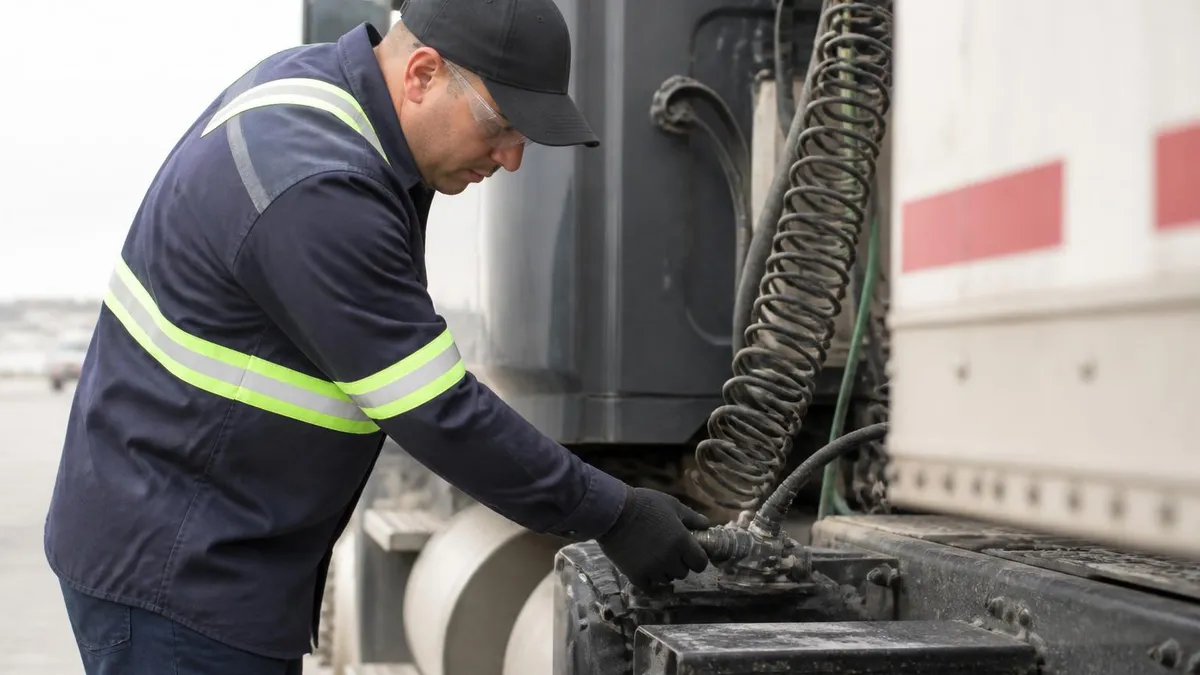
Air Brake System Troubleshooting: Diagnose Leaks, Pressure Drops, and Valve Failures

Air Brake Adjustment: Complete Guide for CDL Drivers
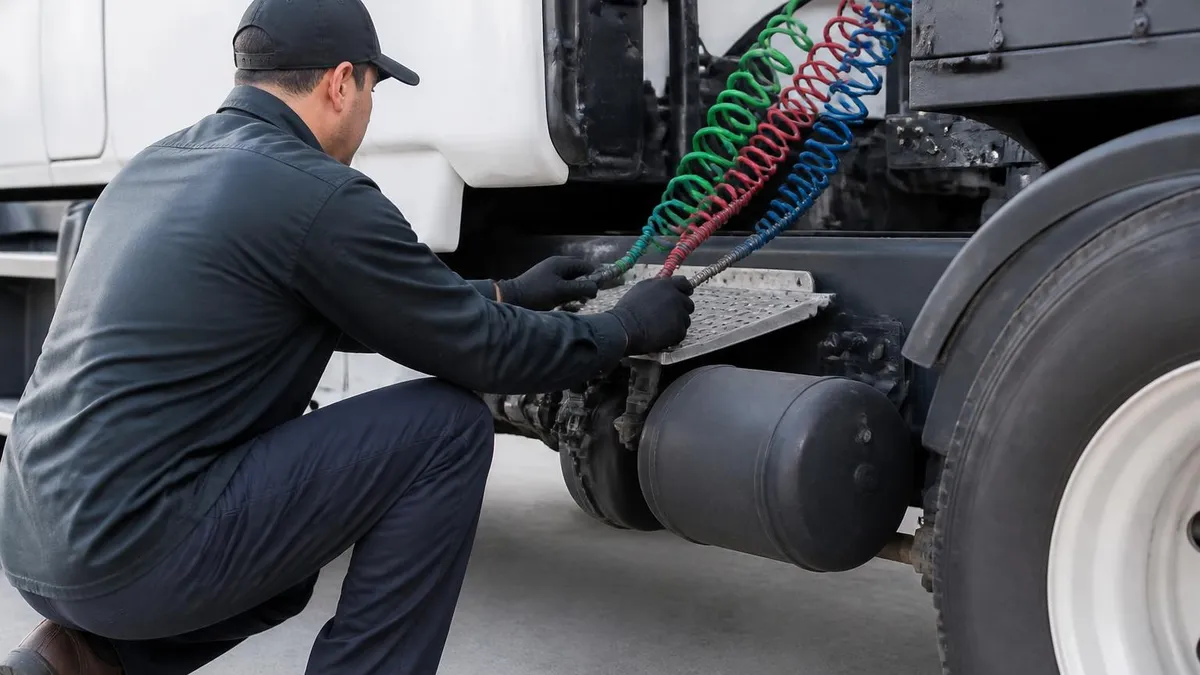
CDL Air Brake Test: Study Guide, State Rules, and How to Pass First Try
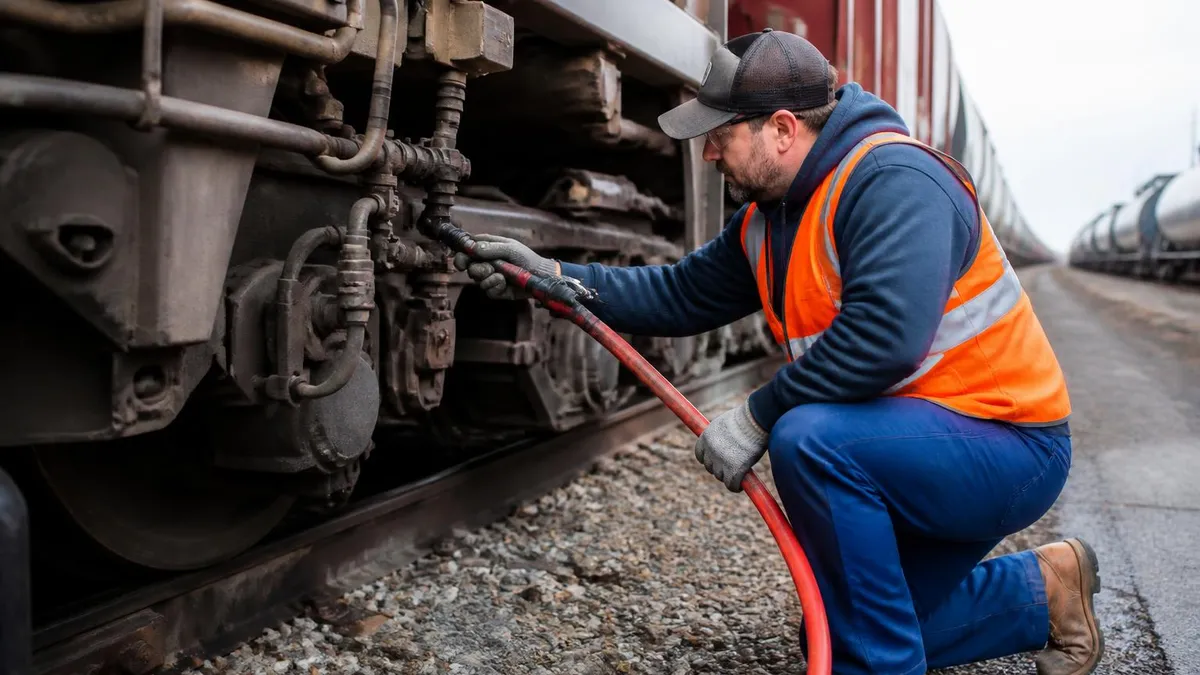
Air Brake Valve: Complete Guide for CDL Drivers and the Air Brake Test
About the Author

Educational Psychologist & Academic Test Preparation Expert
Columbia University Teachers CollegeDr. Lisa Patel holds a Doctorate in Education from Columbia University Teachers College and has spent 17 years researching standardized test design and academic assessment. She has developed preparation programs for SAT, ACT, GRE, LSAT, UCAT, and numerous professional licensing exams, helping students of all backgrounds achieve their target scores.