
Air Brake Adjustment Certification Card: Complete Training Guide and Requirements
Master your air brake adjustment certification card requirements. Study CDL air brake test topics, training steps, and exam prep tips. 🎯

Earning your air brake adjustment certification card is one of the most important milestones for any commercial driver who operates vehicles equipped with air brakes. Air brakes are the dominant stopping system on heavy trucks, buses, and trailers throughout the United States, and regulators at both the federal and state level require drivers to demonstrate genuine competency before operating these vehicles independently. The certification card serves as official proof that you have completed approved training and passed the required knowledge evaluation.
The process begins long before you ever sit for the CDL air brake test. You must first understand how the air brake system operates from the compressor and governor all the way through the brake chambers and slack adjusters that actually move the brake shoes against the drums. Knowing the theory is not enough — inspectors and examiners want to see that you can apply that knowledge during a pre-trip inspection, identify out-of-adjustment conditions, and explain what corrective action is required under FMCSA regulations and your state DMV guidelines.
Many candidates underestimate how broad the air brake adjustment topic really is. The certification covers automatic slack adjusters, manual slack adjusters, push-rod travel limits, brake-stroke indicators, and the difference between type 30 and type 24 brake chambers. Each of those components has specific adjustment thresholds defined in 49 CFR Part 393, and you are expected to know those numbers cold when you walk into the testing room. Examiners routinely ask about the maximum allowable push-rod stroke at various chamber sizes.
State-specific rules add another layer of complexity. A driver preparing for the new york air brake endorsement examination, for example, will encounter a written knowledge test administered by the New York DMV that closely mirrors the FMCSA federal standards but may include additional questions about state inspection requirements and local commercial vehicle regulations. Understanding which rules are federal minimums and which are state enhancements helps you study more efficiently and avoid surprises on test day.
The certification pathway also varies by the type of vehicle you intend to drive. Drivers seeking a full Class A CDL with an air brake endorsement face a more comprehensive examination than those adding the endorsement to a Class B license for straight-truck operations. Bus drivers, tanker operators, and double/triple trailer haulers each have additional endorsements layered on top of the air brake requirements, so mapping your personal certification path before you begin studying saves significant time and money.
Preparation resources have expanded dramatically in recent years. Online CDL practice test platforms, state-approved training programs, and employer-sponsored classroom instruction all contribute to a candidate's readiness. The most effective study strategies combine textbook knowledge of brake system theory with hands-on time under a real vehicle identifying components, measuring push-rod travel, and performing the static and dynamic brake tests that appear on the skills examination portion of the CDL process.
This guide walks you through every stage of the air brake adjustment certification process — from understanding the federal regulatory framework and state-specific requirements, to mastering the technical knowledge that examiners test, to building the inspection habits that keep you and everyone else on the road safe throughout your commercial driving career. Use the sections below as a structured study roadmap and practice with the free quizzes linked throughout to reinforce what you learn.
Air Brake Certification by the Numbers

How to Earn Your Air Brake Adjustment Certification
Review Federal and State Eligibility Requirements
Complete an Approved Training Program
Study the Written Knowledge Topics
Pass the CDL Air Brake Knowledge Test
Complete the Skills and Pre-Trip Inspection Evaluation
Receive Your Certification Card or License Endorsement
Understanding how air brake adjustment actually works is the foundation of every question you will encounter on the CDL air brake test. The adjustment process centers on the slack adjuster — a lever arm that connects the pushrod from the brake chamber to the S-cam or wedge mechanism that forces the brake shoes against the drum.
When the brake lining wears down over time, the distance the pushrod must travel to apply the brakes increases, and that extra travel is called brake lag. Excessive lag reduces stopping power and is one of the leading causes of truck brake failures cited in NHTSA accident reports.
Automatic slack adjusters (ASAs) are now required on all newly manufactured air-braked vehicles, but millions of older trucks and trailers still run manual slack adjusters that must be physically adjusted by a qualified mechanic at regular inspection intervals. The key difference is that ASAs continuously self-correct pushrod stroke as lining wears, while manual units require a technician to turn the adjustment nut until the correct stroke is achieved. Drivers are not permitted to adjust automatic slack adjusters themselves — if an ASA repeatedly requires adjustment, it indicates a mechanical defect requiring shop attention.
The maximum allowable pushrod stroke is defined by brake chamber size and type. For a standard type 30 brake chamber, federal regulations set the maximum stroke at 2.5 inches for long-stroke chambers. Type 24 chambers have a maximum of 2.0 inches. These numbers appear frequently on the CDL air brake test and on roadside inspection forms used by Commercial Vehicle Safety Alliance (CVSA) officers. Knowing them by heart — not just conceptually but as specific figures — is essential for passing the written examination.
The f-750 air brake treadle valve is a component many students encounter when studying medium-duty truck applications. The treadle valve, also called the foot valve or service brake application valve, modulates air pressure to the brake chambers in proportion to how hard the driver pushes the pedal. When the treadle valve malfunctions or leaks, the driver loses proportional braking control, which is why understanding this component's role shows up on both written knowledge tests and vehicle inspection evaluations.
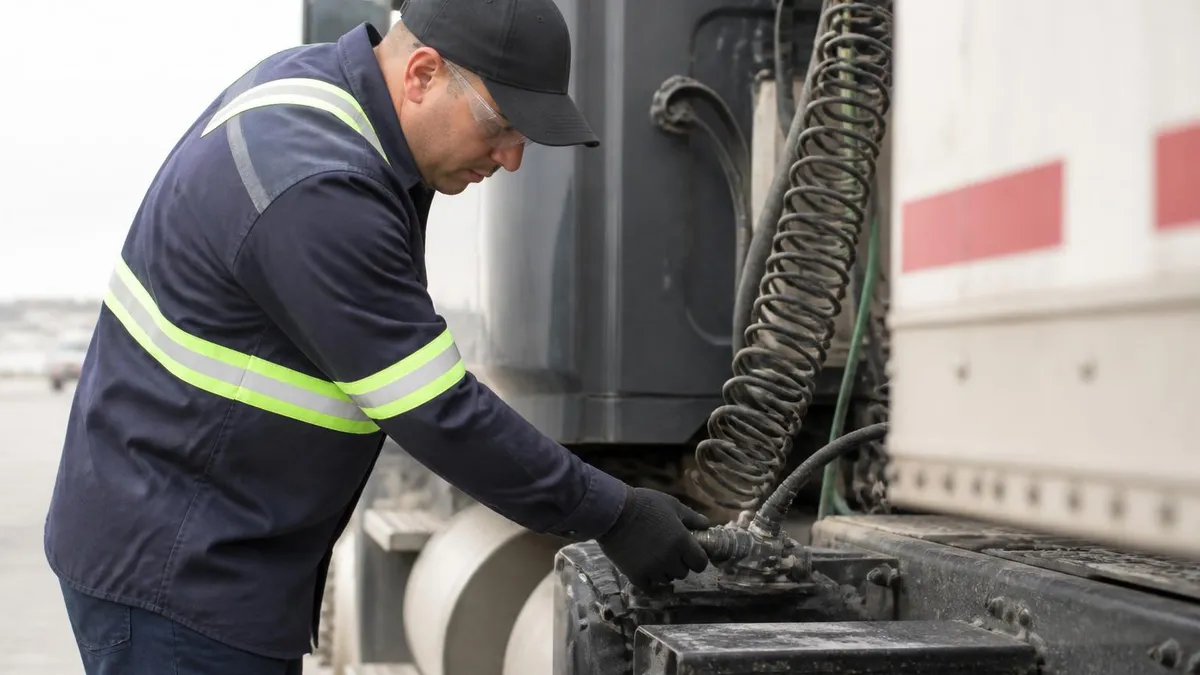
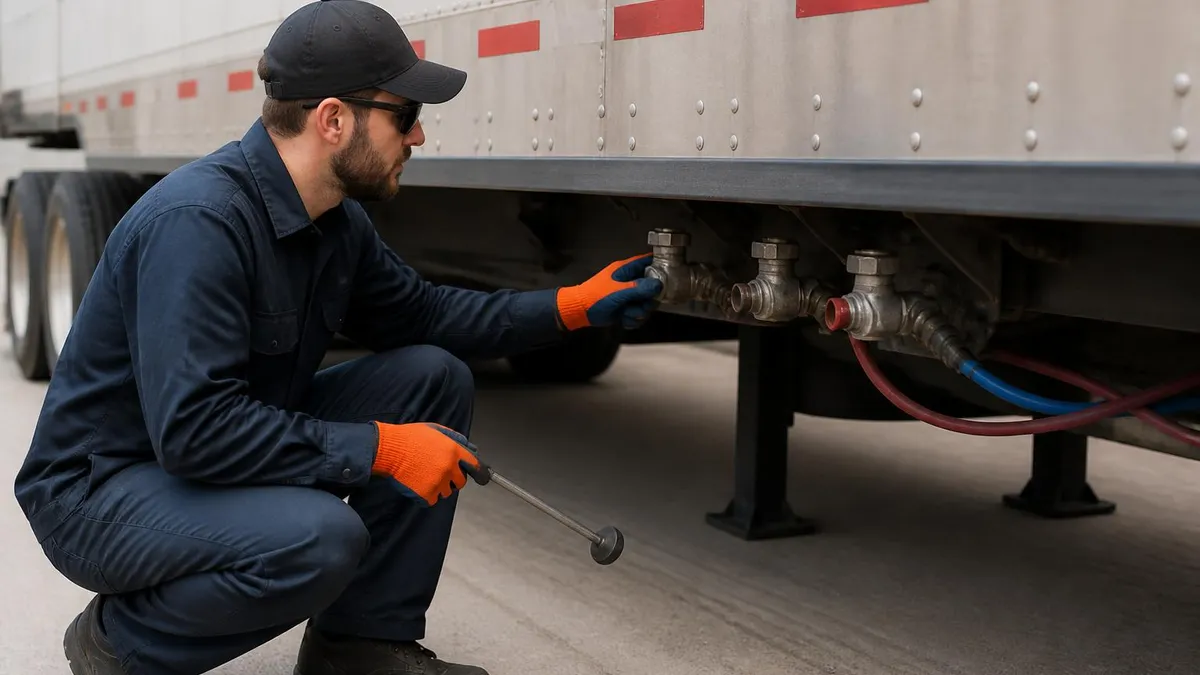
The inspection procedure for checking brake adjustment begins with a visual check of the pushrod with the brakes fully released. The rod should be fully retracted into the chamber. Then, with the parking brake released and the wheels chocked, the driver applies 90 psi of service pressure and measures the pushrod extension with a ruler or tape. If the stroke exceeds the limit for that chamber type, the brakes are officially out of adjustment and the vehicle must be placed out of service until repaired. This is exactly the scenario described in CVSA Level I inspection protocols.
Spring brakes, also called parking or emergency brakes, add another dimension to the adjustment topic. Spring brakes are held off by air pressure when the vehicle is in motion; when air pressure drops below approximately 20 to 45 psi (depending on manufacturer), the springs automatically apply the brakes.
Understanding the interaction between the service brake chambers and the spring brake piggyback units is crucial because a vehicle with an air leak will eventually apply its parking brakes automatically — a safety feature that can also become a hazard if the driver is not prepared for it on a steep grade or in traffic.
Proper use of air brake antifreeze is a maintenance topic that intersects directly with brake adjustment certification knowledge. In cold climates, moisture in the air system can freeze in brake lines, chambers, and valves, preventing proper adjustment and application. Alcohol evaporators and air dryers reduce moisture accumulation, but drivers operating in freezing conditions must understand how ice can affect brake response and why pre-trip inspections in winter demand extra diligence around the entire air system, not just the slack adjusters and push rods.
CDL Air Brake Test: What Each Section Covers
The CDL air brake test's component knowledge section covers every part of the air brake circuit, from the air compressor and governor that maintains system pressure between 100 and 125 psi, to the supply reservoir, wet tank, drain valves, and service lines running to each axle. Candidates must identify dual circuit systems, understand why two separate air circuits protect against total brake failure, and know how one-way check valves prevent a leak in one circuit from draining the other.
Beyond the basic circuit, candidates are tested on dual air systems (primary and secondary), quick-release valves, relay valves, limiting valves, and the tractor protection valve that seals off the trailer air supply if a trailer breaks away. Understanding the purpose and location of each valve type — not just its name — is what separates candidates who score in the 90s from those who barely pass. Practice tests that focus on component identification are among the most valuable study tools available for this portion of the exam.
Air Brake Endorsement: Is the Certification Worth the Effort?
- +Opens access to the full range of Class A and Class B CDL vehicle categories
- +Significantly increases earning potential — air brake-equipped vehicles carry higher-value freight
- +Federal law requires the endorsement, so completing it removes a major employment barrier
- +Knowledge gained improves your ability to identify dangerous brake conditions before they cause accidents
- +Automatic slack adjuster systems make modern air brakes more reliable and easier to maintain than older drum-only systems
- +Certification is recognized across all 50 states — no need to retest when changing state of residence
- −Written knowledge test covers technical detail that requires serious study time investment
- −Skills evaluation is conducted on an actual vehicle, which requires access to CDL training equipment
- −Entry-Level Driver Training (ELDT) requirements mandate use of a registered training provider, adding cost
- −Some states charge additional DMV fees for the endorsement beyond the standard CDL issuance fee
- −Brake adjustment rules and pressure thresholds require memorization of specific numbers, not just concepts
- −Failing the skills examination means waiting for a retest appointment, which can delay job start dates
Pros and Cons at a Glance
| Pros | Cons |
|---|---|
| Opens access to the full range of Class A and Class B CDL vehicle categories | Written knowledge test covers technical detail that requires serious study time investment |
| Significantly increases earning potential — air brake-equipped vehicles carry higher-value freight | Skills evaluation is conducted on an actual vehicle, which requires access to CDL training equipment |
| Federal law requires the endorsement, so completing it removes a major employment barrier | Entry-Level Driver Training (ELDT) requirements mandate use of a registered training provider, adding cost |
| Knowledge gained improves your ability to identify dangerous brake conditions before they cause accidents | Some states charge additional DMV fees for the endorsement beyond the standard CDL issuance fee |
| Automatic slack adjuster systems make modern air brakes more reliable and easier to maintain than older drum-only systems | Brake adjustment rules and pressure thresholds require memorization of specific numbers, not just concepts |
Air Brake Pre-Trip Inspection: 10-Point Certification Checklist
- ✓Build air pressure to at least 90 psi before beginning any brake inspection test
- ✓Turn off the engine and fan belts; listen for air leaks throughout the entire system
- ✓Check the low-pressure warning light and buzzer activate before pressure drops below 60 psi
- ✓Fan the brakes to drop pressure and confirm the spring brakes apply between 20–45 psi
- ✓Release the parking brake and measure pushrod stroke on each brake chamber with a ruler
- ✓Verify that automatic slack adjusters are not manually adjusted — refer out-of-stroke ASAs to maintenance
- ✓Inspect all visible air lines for cracks, kinks, worn spots, or improper routing near heat sources
- ✓Perform the static leakage test: with brakes applied, confirm pressure loss is under 4 psi per minute
- ✓Check drain valves on each reservoir are operable and drain moisture before driving in cold conditions
- ✓Test the tractor protection valve by pulling the trailer supply line and confirming air flow stops immediately
One Wrong Number Can Cost You the Test
The most common reason candidates fail the CDL air brake written test is not knowing the specific pressure thresholds and stroke limits — they understand the concept but cannot recall the exact figure under exam conditions. Write out governor cut-in/cut-out pressures (100/125 psi), the low-pressure warning threshold (60 psi), spring brake application range (20–45 psi), and chamber stroke limits (type 30 = 2.5 inches) on flashcards and drill them daily for at least two weeks before your test date.
State-by-state variations in air brake endorsement requirements create real confusion for drivers who have worked in multiple states or who move across state lines. At the federal level, FMCSA sets minimum standards through the Commercial Driver's License regulations found in 49 CFR Part 383, but states retain authority to add requirements on top of those minimums. This means a driver who passed the air brake knowledge test in one state may face slightly different question formats or additional procedural steps when transferring to another state's CDL system.
In practical terms, most states handle the air brake restriction the same way: new CDL applicants who do not take the air brake knowledge test receive a code L restriction on their license, prohibiting them from driving any CMV equipped with air brakes. Removing that restriction requires passing the air brake knowledge test and demonstrating proficiency during the skills examination in an air brake-equipped vehicle. The restriction removal is permanent — it does not expire with license renewals as long as the driver maintains continuous CDL validity.
Some of the most rigorous state programs are found in the Northeast and on the West Coast, where urban traffic density and steep mountain grades make air brake proficiency especially critical. California, for example, integrates air brake inspection requirements directly into its annual BIT (Basic Inspection of Terminals) program for motor carriers, which means drivers operating in California must be familiar not only with federal standards but also with California Highway Patrol inspection protocols.
Similarly, drivers seeking the air brake endorsement in Washington or Oregon will encounter state-specific bus driver certification requirements that layer on top of the standard CDL air brake test.
The Midwest presents a different set of considerations. States with large agricultural and construction fleets — Iowa, Nebraska, Kansas — see high volumes of air brake-equipped farm vehicles and heavy equipment transports that operate under intrastate exemptions. Drivers in those states may qualify for state-specific certifications that permit air brake operation on farm vehicles without a full CDL, but those certifications have strict mileage and cargo limitations and do not satisfy the federal CDL air brake endorsement requirements for interstate commerce.
Mountain states present unique training challenges related to brake adjustment certification. In Colorado, Wyoming, Montana, and Idaho, long downhill grades make proper brake adjustment a life-safety issue rather than merely a compliance matter. Driver training programs in these states typically include specific instruction on brake fade, the effect of heat on drum brakes during extended descents, and the correct use of engine braking and exhaust brakes to supplement air brake systems. Examiners in mountain states are more likely to include runaway ramp questions and brake heating scenarios in their oral evaluation components.
The Gulf Coast states — Texas, Louisiana, Florida — have large populations of air brake-equipped tanker and flatbed trucks serving petrochemical and port operations. Texas stands out because it administers its CDL testing through the Texas Department of Public Safety, which uses a particularly detailed pre-trip inspection rubric. Candidates in Texas must verbally identify and explain every air brake component during the vehicle inspection portion of the skills test, not just point to components when asked. That verbal explanation requirement catches many candidates who have memorized component locations but cannot articulate what each component does in plain language.
Regardless of the state, the most consistent advice from successful candidates is to study the federal CDL manual as the primary source, then download your specific state's CDL handbook and compare the two side by side. Highlight anything your state adds that the federal manual does not mention — those additions are the most likely source of state-specific questions that trip up otherwise well-prepared candidates. Pair that reading with structured practice using targeted CDL air brakes practice test resources to ensure your knowledge translates into correct answers under timed test conditions.

Since February 7, 2022, federal Entry-Level Driver Training rules require that all first-time CDL applicants and upgrade/endorsement seekers complete theory and behind-the-wheel training from a provider registered on the FMCSA Training Provider Registry (TPR). If your training school is not on the TPR, your state DMV cannot process your CDL application — even if you pass the written and skills tests. Verify your school's TPR status at fmcsa.dot.gov before enrolling and paying any tuition.
Exam day preparation for the CDL air brake test requires a combination of logistical readiness and mental sharpness that many candidates overlook in their final days of study. The most important logistical step is confirming exactly what identification documents your state DMV requires and bringing originals, not photocopies. Most states require proof of identity (passport or birth certificate plus Social Security card), proof of state residency (two utility bills or similar documents), your current medical examiner's certificate, and any applicable learner's permit. Missing even one document means a wasted trip and a rescheduled appointment.
The night before your test, avoid cramming new material. Your brain consolidates learned information during sleep, and attempting to absorb new content the night before typically results in confusion rather than confidence. Instead, spend 20 to 30 minutes reviewing your flashcards of key numbers — governor pressures, warning thresholds, stroke limits — then get at least seven hours of sleep. Candidates who arrive at the DMV tired and over-studied make careless errors on questions they actually know well.
On the morning of the test, eat a real meal before leaving home. Testing centers are rarely comfortable environments, and low blood sugar makes it genuinely harder to recall specific numbers under pressure. Arrive at least 15 minutes early to complete any paperwork and settle in before you begin. If your state allows a CDL manual in the waiting area but not in the testing room, use that time to do one final review of the brake adjustment section rather than scrolling your phone.
During the written test itself, read every question completely before looking at the answer choices. Air brake questions are frequently written with similar-sounding answers designed to catch candidates who skim. A question about the low-pressure warning device, for example, might offer answer choices of 40 psi, 60 psi, 80 psi, and 100 psi — all plausible numbers that appear in various parts of the air brake regulations. Only careful reading and solid prior knowledge will lead you to the correct 60 psi answer without second-guessing yourself into the wrong choice.
For the skills examination component, the pre-trip inspection of the air brake system is where most candidates either shine or struggle. Practice your verbal walk-around script until it becomes automatic. Examiners are trained to listen for specific terminology — they want to hear you say "air compressor," "governor," "supply reservoir," "wet tank," "primary circuit," "secondary circuit," "slack adjuster," and "pushrod" in context. Vague descriptions like "the thing that makes air" or "the brake part" signal inadequate training and will cost you points on the inspection rubric.
After the written test, many states schedule the skills exam on a different day, which gives you an additional window to practice your hands-on inspection routine. Use that time wisely. If your training school offers open lab hours, book a session and practice measuring pushrod stroke on a real vehicle until you can do it accurately and quickly without referring to notes. The skills examiner will time you on portions of the inspection, and hesitation or repeated measurement attempts create a negative impression even when the final numbers are correct.
Post-certification, your learning does not end with the card or the endorsement notation on your license. Federal regulations require that drivers inspect air brakes before every trip, and CVSA inspectors conduct thousands of roadside brake audits every year during Operation Airbrake enforcement events.
Drivers who internalize the certification knowledge rather than treating it as a test-and-forget exercise consistently perform better during inspections, avoid violations that trigger costly out-of-service orders, and build the professional reputation that leads to better job opportunities throughout their commercial driving careers. Resources like practice tests focused on air brake antifreeze maintenance and system troubleshooting help you stay sharp long after certification.
Building a structured daily study routine in the weeks leading up to your CDL air brake test dramatically increases your chances of passing on the first attempt. Research on skill acquisition consistently shows that distributed practice — studying for 45 to 60 minutes per day over several weeks — produces far better retention than marathon cramming sessions the week before the exam. For the air brake certification specifically, aim for a four-to-six week preparation window that covers all major topic areas in a logical sequence before consolidating and reviewing in the final week.
Begin your study program with the physical components of the air brake system. Use a printed diagram of a full air brake circuit and practice identifying every component by name and function. Start with the compressor and governor, trace the air flow through the supply and service circuits, identify each type of valve (relay, quick-release, limiting, tractor protection), and end with the brake chamber, slack adjuster, and foundation brake assembly. This component-first approach gives you a mental map that makes pressure and adjustment questions much easier to understand in context.
In weeks two and three, shift your focus to the regulatory numbers that appear most frequently on the CDL air brake test. Create a one-page reference sheet with governor cut-in and cut-out pressures, low-pressure warning activation, spring brake application range, maximum stroke limits by chamber type, and static leakage test allowances for single vehicles versus combination vehicles (3 psi per minute versus 4 psi per minute). Read that sheet every morning and quiz yourself every evening until the numbers are automatic.
Week four should introduce timed practice testing. Most state CDL air brake knowledge tests allow 60 to 90 minutes for 25 to 50 questions, which works out to roughly 90 seconds per question. Timed practice reveals which topics still need reinforcement and builds the pacing awareness you need to avoid running out of time on test day. After each practice test, review every question you missed — not just the ones where you guessed, but also ones where you were uncertain even if you answered correctly. Uncertainty is a study signal.
Week five is the ideal time to integrate practice with physical vehicle inspection, if your training program allows it. Walk around an air brake-equipped vehicle with your checklist and verbally narrate the pre-trip inspection as if an examiner were standing next to you. This narration practice is uncomfortable at first but pays dividends during the actual skills evaluation when the examiner asks you to explain each component as you identify it. The combination of physical familiarity and verbal fluency is what the skills examination is designed to test.
In the final days before your test, scale back new material and shift entirely to review and confidence-building. Take two or three full-length practice tests under realistic conditions — no phone, no pausing, timed from start to finish. Score them honestly and note your pass rate trend. If you are consistently scoring 85 percent or above on comprehensive practice tests covering all air brake topics, you are well prepared for the actual examination. If your score is still in the 70s, target the specific weak areas rather than reviewing everything again from the beginning.
Maintaining your certification knowledge after you pass is equally important. Federal regulations require that CDL holders stay current with brake system standards, and FMCSA periodically updates out-of-service criteria through CVSA rule changes that take effect in the fall of each year.
Subscribe to FMCSA safety bulletins, bookmark your state DMV's CDL updates page, and make a habit of reviewing the air brake section of CDL practice tests at least once per quarter to keep the critical numbers fresh. Drivers who let their brake system knowledge go stale are the same drivers who get placed out of service during roadside inspections that could have been avoided entirely with a few hours of annual review.
Air Brake Questions and Answers

About the Author

Educational Psychologist & Academic Test Preparation Expert
Columbia University Teachers CollegeDr. Lisa Patel holds a Doctorate in Education from Columbia University Teachers College and has spent 17 years researching standardized test design and academic assessment. She has developed preparation programs for SAT, ACT, GRE, LSAT, UCAT, and numerous professional licensing exams, helping students of all backgrounds achieve their target scores.