
Air Brake System Knowledge: Full Charge PSI, Components, and CDL Test Mastery for 2026 October
An air brake system is fully charged at what psi? Master system knowledge, 🎯 components, pressure rules, and CDL air brake test answers for 2026 October.

If you have ever wondered exactly what an air brake system is fully charged at what psi means in practical terms, the answer drivers must memorize is 120 to 140 psi, with most tractor-trailer combinations governed to cut out at roughly 125 psi. That single number anchors every other inspection step, leak test, and emergency procedure you will face on the CDL exam and on the road. Understanding the pressure thresholds, the parts that maintain them, and the warning systems that announce a loss of air is the entire foundation of safe heavy-vehicle operation in the United States.
Air brakes are not simply scaled-up hydraulic brakes. They use compressed air to push slack adjusters, which rotate the S-cam, which forces the brake shoes outward against a rotating drum. The system stores enough air in steel reservoirs to handle dozens of stops, but every stop draws that reserve down, and a healthy governor and compressor must replace the air faster than the foot valve removes it. Drivers who internalize that loop pass the cdl air brake test on the first attempt at a far higher rate than those who memorize trivia.
Federal Motor Carrier Safety Regulations require any commercial driver operating a vehicle with air brakes to hold the proper endorsement, and that endorsement is earned through both a written knowledge test and a hands-on inspection. The written exam draws roughly 70 percent of its questions directly from the system-knowledge section of your state CDL manual, which is why this article exists: to walk you through the exact mechanical and procedural facts the testers will quiz you on, from the dual air system to the spring brake chamber.
The phrase fully charged is deliberately precise. A system that has been sitting overnight may show 60 psi at the gauge, and a system that has just released the parking brake may dip to 90 psi before the compressor catches back up. Neither of those is fully charged. The number examiners want you to write down, and the number a roadside inspector wants to see before you release the trailer protection valve, is 120 to 140 psi, with cut-in typically at 100 psi.
Throughout this guide we will move from the broad pressure picture into the specific components that maintain it, then into the warning devices that alert you when something fails. By the time you finish reading, you should be able to explain the function of the governor, the safety valve, the supply reservoir, the foot brake valve, the spring brakes, and the low-air warning to a stranger in under two minutes. That fluency is exactly what the examiner is listening for during the pre-trip portion of the skills test.
This article also folds in the latest 2026 testing updates from the AAMVA model curriculum, which several states adopted last winter. Expect more pointed questions about modulating valve behavior, automatic slack adjuster wear limits, and the difference between service, parking, and emergency brake applications. We will cover each of those, plus the cdl practice test air brakes patterns that show up most often, the air brake antifreeze procedure for cold climates, and how the New York Air Brake company products fit into modern fleets.
Read each section in order, take the embedded practice quizzes, and by the end you will not just know that the answer is 120 psi — you will know why, how the system gets there, and what to do when it does not. That is the difference between passing the test and being a safe driver, and the federal examiners are increasingly designing their question pools to reward the second outcome.
Air Brake System Knowledge by the Numbers

Core Components of an Air Brake System
Engine-driven pump that pulls atmospheric air, compresses it, and feeds the reservoirs. Most compressors are belt-driven or gear-driven and lubricated by the engine oil supply, meaning a low oil light is also an air brake warning.
Controls when the compressor pumps air into the reservoirs. Cut-out at roughly 125 psi stops compression; cut-in around 100 psi resumes it. A failed governor produces wildly fluctuating gauge readings during normal driving.
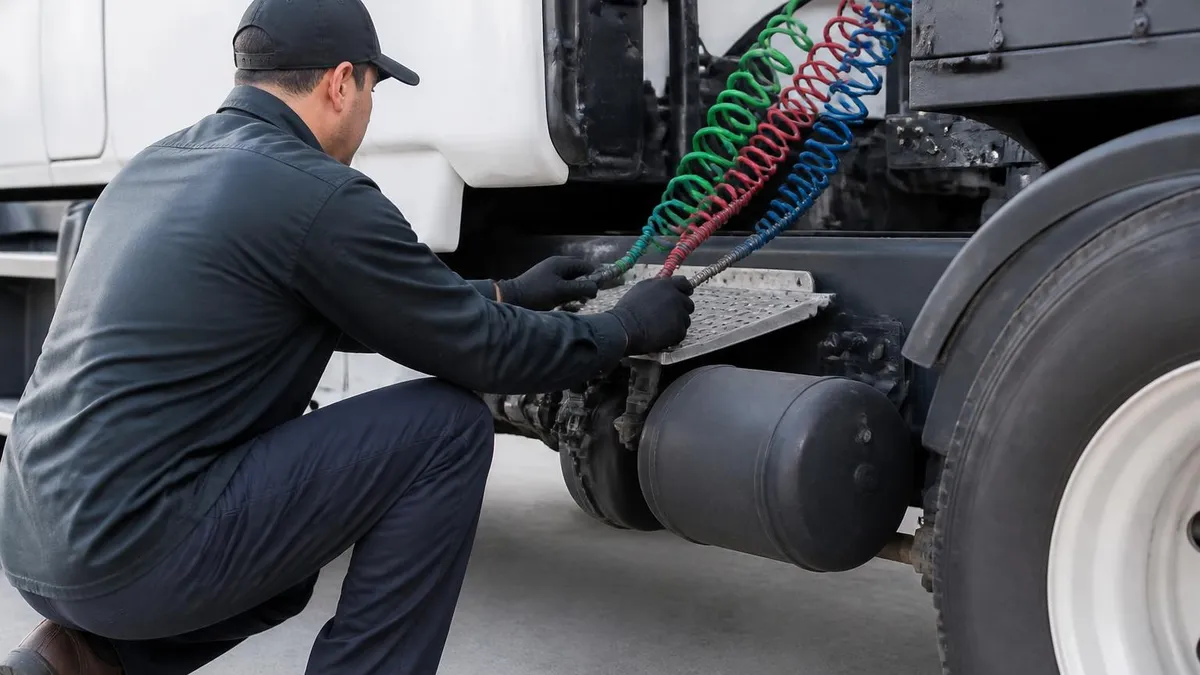
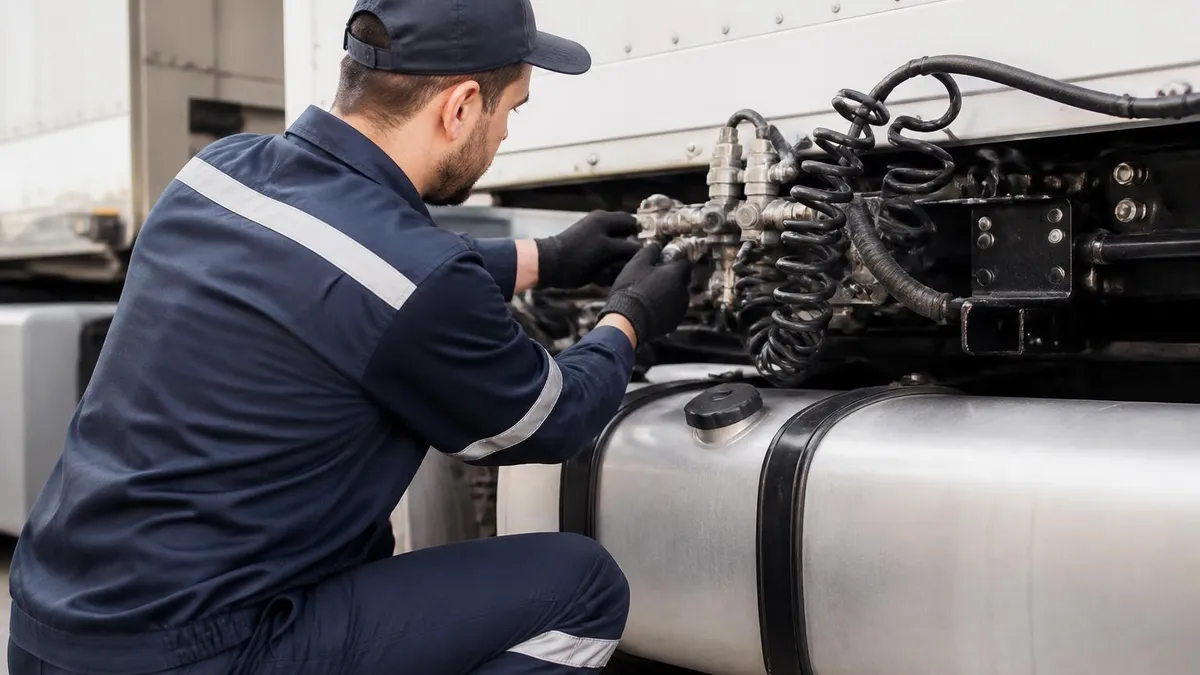
Steel tanks that store compressed air for brake applications. Trucks carry one supply tank and at least two service tanks, holding enough air for several full stops even if the compressor fails completely mid-trip.
The treadle valve under the driver's foot meters air from the service tanks to the brake chambers. Pressing harder sends more air, producing proportional braking. The f-750 air brake treadle valve is a common example.
Powerful mechanical springs held back by air pressure during driving. When system pressure drops below roughly 40 psi, the springs apply automatically, locking the wheels and preventing a runaway.
An air brake system reaches full charge when the governor signals the compressor to stop pumping, and the threshold for that signal is 120 to 140 psi on virtually every Class 8 truck sold in the United States since the late 1990s. The exact cut-out point is set by the manufacturer, recorded on the vehicle data plate, and verified by the technician during annual inspection. When a CDL examiner asks the fully charged question, they expect the 120 to 140 range as the textbook answer.
Reaching that pressure from cold takes roughly two to three minutes with a healthy compressor. If your truck takes longer than five minutes to build from 85 to 100 psi at governed engine rpm, the compressor or the governor is suspect and the vehicle should not be placed in service. This single timing test catches more pre-trip failures than any other procedure, which is why federal inspectors include it in the Level I roadside inspection criteria.
Once the system reaches cut-out, the governor blocks the compressor's discharge line and routes the compressor output back to the inlet. The compressor still spins, but no additional air enters the reservoirs. As the driver applies the brakes, air leaves the system and pressure drops. When the gauge falls to about 100 psi, the governor reopens the discharge line, the compressor refills the tanks, and the cycle repeats every few minutes during normal stop-and-go driving.
The dual-circuit design that became federally mandated in 1975 splits this storage into two independent service systems. One circuit handles the front axle, the other handles the rear axle and trailer. If either circuit develops a major leak, the other still provides braking, though the dashboard warning will illuminate and the low-air buzzer will sound. Understanding this redundancy is critical for the air brake endorsement examination.
Reservoir capacity is sized so that even with the compressor completely dead, the driver still has enough air for at least one full emergency stop plus enough residual pressure to keep the spring brakes released long enough to pull off the highway safely. That margin is why the low-air warning activates at 60 psi rather than at a lower number — it gives the driver roughly 20 psi of working pressure to find a safe location before the spring brakes self-apply.
Cold-weather operation introduces an additional variable: moisture. Compressed air always contains water vapor that condenses inside the reservoirs as the air cools. In freezing conditions that water turns to ice, blocks valves, and produces erratic pressure readings. This is why fleets use air dryers and, in extreme climates, methanol-based air brake antifreeze injected into the supply line during winter months.
Modern systems pair the air dryer with a heated purge valve and a desiccant cartridge that must be replaced every one to three years depending on duty cycle. A saturated desiccant cartridge is the single most common reason a fleet truck fails the leak-rate portion of the inspection, because moisture-contaminated valves seep air at the seals even when they look pristine externally.

Air Brake Practice Test Questions
Prepare for the Air Brake Test exam with our free practice test modules. Each quiz covers key topics to help you pass on your first try.
Air Brake Adjustment & Testing
Air Brake Exam Questions covering Adjustment & Testing. Master Air Brake Test concepts for certification prep.
Air Brake Air Pressure Regulation & Control
Free Air Brake Practice Test featuring Air Pressure Regulation & Control. Improve your Air Brake Exam score with mock test prep.
Air Brake Emergency Procedures & Safety Pr...
Air Brake Mock Exam on Emergency Procedures & Safety Protocols. Air Brake Study Guide questions to pass on your first try.
Air Brake Legal Requirements & Compliance
Air Brake Test Prep for Legal Requirements & Compliance. Practice Air Brake Quiz questions and boost your score.
Air Brake Pre-trip Inspection Procedures
Air Brake Questions and Answers on Pre-trip Inspection Procedures. Free Air Brake practice for exam readiness.
Air Brakes Basic
Air Brake Mock Test covering Air Brakes Basic. Online Air Brake Test practice with instant feedback.
Air Brakes (Reading)
Free Air Brake Quiz on Air Brakes (Reading). Air Brake Exam prep questions with detailed explanations.
Air Brake System Components & Functions
Air Brake Practice Questions for System Components & Functions. Build confidence for your Air Brake certification exam.
Air Brake Test Adjustment & Testing
Air Brake Test Online for Test Adjustment & Testing. Free practice with instant results and feedback.
Air Brake Test Air Brake Driving Technique...
Air Brake Study Material on Test Air Brake Driving Techniques & Vehicle Control. Prepare effectively with real exam-style questions.
Air Brake Test Air Brake Maintenance & Tro...
Free Air Brake Test covering Test Air Brake Maintenance & Troubleshooting. Practice and track your Air Brake exam readiness.
Air Brake Test Air Pressure Regulation & C...
Air Brake Exam Questions covering Test Air Pressure Regulation & Control. Master Air Brake Test concepts for certification prep.
Air Brake Test Emergency Procedures & Safe...
Free Air Brake Practice Test featuring Test Emergency Procedures & Safety Protocols. Improve your Air Brake Exam score with mock test prep.
Air Brake Test Legal Requirements & Compli...
Air Brake Mock Exam on Test Legal Requirements & Compliance. Air Brake Study Guide questions to pass on your first try.
Air Brake Test Pre-trip Inspection Procedures
Air Brake Test Prep for Test Pre-trip Inspection Procedures. Practice Air Brake Quiz questions and boost your score.
Air Brake Test System Components & Functions
Air Brake Questions and Answers on Test System Components & Functions. Free Air Brake practice for exam readiness.
Air Brake MCQ
Air Brake Mock Test covering MCQ. Online Air Brake Test practice with instant feedback.
Pressure Thresholds for the CDL Air Brake Test
The governor cut-out pressure on virtually every modern commercial truck is set between 120 and 140 psi. This is the upper limit that defines fully charged and is the number the examiner expects on the written test. Manufacturers tune the exact value to the compressor, the reservoir volume, and the duty cycle of the vehicle, but on the road the gauge should hover within this band during normal cruising.
Cut-in pressure sits roughly 20 to 25 psi below cut-out, so 100 psi is the standard restart point. When the gauge falls to about 100 psi after a series of brake applications, the governor commands the compressor to resume building air. The 20-psi gap prevents the compressor from short-cycling on every minor pressure dip, extending compressor life by tens of thousands of miles.
Air Brakes vs Hydraulic Brakes: A System-Knowledge Comparison
- +Air is free and inexhaustible, so a small leak does not disable the system the way a fluid leak ends hydraulic stopping
- +Compressed air storage in reservoirs provides multiple emergency stops even with a dead compressor
- +Spring brakes provide a fail-safe that automatically applies braking force if pressure drops critically
- +Trailer connections are simple glad hands that any driver can couple in under thirty seconds
- +Wear components like brake shoes and slack adjusters are easily inspected by sight without removing wheels
- +Heat dissipation is excellent because drum brakes have far more surface area than typical disc setups
- +Standardization across manufacturers means a Peterbilt driver can operate a Kenworth without retraining
- −Total system pressure must be built before the vehicle can move, adding two to three minutes to cold starts
- −Moisture buildup in reservoirs requires daily draining or a functional air dryer to prevent ice blockage
- −Application lag of roughly half a second means stopping distances are longer than hydraulic systems at low speeds
- −Compressor failures are expensive and often require a tow because of the spring brake self-application
- −Drivers must hold a separate air brake endorsement, adding cost and time to the licensing process
- −Brake fade on long downgrades is a real risk if drivers rely on service brakes instead of engine retarders
- −Air leaks at glad hands and fittings are common and produce noticeable hissing that customers sometimes report
Pros and Cons at a Glance
| Pros | Cons |
|---|---|
| Air is free and inexhaustible, so a small leak does not disable the system the way a fluid leak ends hydraulic stopping | Total system pressure must be built before the vehicle can move, adding two to three minutes to cold starts |
| Compressed air storage in reservoirs provides multiple emergency stops even with a dead compressor | Moisture buildup in reservoirs requires daily draining or a functional air dryer to prevent ice blockage |
| Spring brakes provide a fail-safe that automatically applies braking force if pressure drops critically | Application lag of roughly half a second means stopping distances are longer than hydraulic systems at low speeds |
| Trailer connections are simple glad hands that any driver can couple in under thirty seconds | Compressor failures are expensive and often require a tow because of the spring brake self-application |
| Wear components like brake shoes and slack adjusters are easily inspected by sight without removing wheels | Drivers must hold a separate air brake endorsement, adding cost and time to the licensing process |
| Heat dissipation is excellent because drum brakes have far more surface area than typical disc setups | Brake fade on long downgrades is a real risk if drivers rely on service brakes instead of engine retarders |

Air Brake System Pre-Trip Inspection Checklist
- ✓Check the air compressor drive belt for cracks, glazing, and correct tension
- ✓Verify the governor cuts out between 120 and 140 psi during initial build
- ✓Confirm the low-air warning activates before pressure drops to 60 psi
- ✓Drain each air reservoir until only clean air, no water or oil, escapes
- ✓Apply the parking brake and tug-test forward against the trailer brake
- ✓Measure pushrod travel on each slack adjuster against the manufacturer wear limit
- ✓Inspect all air lines for chafing, kinks, and signs of compressor oil seepage
- ✓Check the air dryer purge cycle for proper exhaust burst after cut-out
- ✓Verify dual gauge needles track within 5 psi of each other across the range
- ✓Test the emergency stopping distance at 20 mph on a level paved surface
Memorize 120 to 140 psi
If you remember only one fact from this article, make it the fully charged pressure range of 120 to 140 psi. This appears on virtually every state CDL air brake knowledge test, often phrased three different ways in the same exam. Pair it with the cut-in pressure of 100 psi and the 60-psi warning threshold to lock down three nearly guaranteed points.
The warning systems on a modern air brake truck are layered so that a driver receives at least three independent signals before a catastrophic failure occurs. The first is the dash-mounted pressure gauge itself, which a trained driver glances at every few miles to confirm the needles are dancing inside the normal operating band. A gauge that sits at cut-out and never moves indicates a stuck governor; a gauge that falls steadily indicates a major leak.
The second layer is the low-air warning device. Federal law requires it to be both audible and visual, and it must trigger before pressure drops below 60 psi in either service reservoir. On most trucks built after 2010 this is a flashing red triangle on the cluster paired with a steady buzzer. Older trucks may use a mechanical wig-wag arm that drops into the driver's line of sight, which is just as effective and often more reliable.
The third layer is the spring brake self-application. When system pressure falls to between 20 and 45 psi, the holdback air on the spring brake chambers is no longer sufficient to compress the powerful coil springs. The springs extend, push the pushrods, rotate the slack adjusters, and apply full mechanical braking force to the drive axle and trailer. This is the fail-safe of last resort and it should never be reached during normal operation.
Trailer protection valves add a fourth layer specific to combination vehicles. If trailer supply air drops too low, the protection valve automatically closes the supply line to the trailer and vents the trailer service line, applying the trailer brakes via the emergency portion of the relay valve. This is what the manuals mean when they say the trailer brakes apply automatically if the trailer breaks away.
Drivers preparing for the air brake test should be able to describe each of these layers in the order they activate. Examiners often phrase the question as a sequence: what happens first, what happens next, what is the final automatic protection. Answering in the wrong order signals that you have memorized facts without understanding the system, and many states will mark partial credit accordingly.
The New York Air Brake company, founded in 1890 and now a Knorr-Bremse subsidiary, manufactures many of the relay valves, treadle valves, and dryer modules referenced in modern fleet specifications. Their NYAB-stamped components are functionally identical to Bendix equivalents for purposes of the CDL exam, but recognizing the brand on a component during pre-trip can help a driver identify which technical service bulletin applies during a roadside repair.
A final warning system worth knowing is the Anti-lock Brake System, mandated on all air-braked trucks built after March 1, 1997, and all trailers built after March 1, 1998. ABS does not shorten stopping distance on dry pavement; it prevents wheel lockup on slippery surfaces and during panic stops, allowing the driver to maintain steering control. The ABS warning lamp on the dash and on the trailer must self-test at startup and remain off during driving.
If air pressure falls below roughly 40 psi while you are driving, the spring brakes will apply automatically on the drive axle and trailer. This is not a smooth stop — it locks the rear wheels and can cause a jackknife on a loaded combination at highway speed. Always pull over and shut down at the first low-air warning, never wait for the spring brakes to take the decision out of your hands.
Test preparation for the air brake knowledge exam should begin two to three weeks before your scheduled appointment at the DMV. The exam itself contains 25 to 30 multiple-choice questions in most states, and you must score 80 percent or higher to pass. Federal regulations require this endorsement on every CDL Class A, B, or C vehicle equipped with full or partial air brakes, so failing means losing your air brake privilege regardless of how you perform on the other knowledge tests.
The most effective study sequence starts with the official state CDL manual, available free at every DMV office and as a PDF download from your state Department of Transportation website. Read the air brakes section twice, then complete a focused practice quiz on each subsection: compressor, governor, reservoirs, warning devices, spring brakes, ABS, and inspection procedures. The f-750 air brake treadle valve family of questions appears frequently on the Texas, California, and Florida exams.
Plan to take at least three full-length practice tests in the final week before your real exam. Aim for a 90 percent score on each before scheduling the live test. If you cannot break 85 percent on practice, you almost certainly will not pass the live exam, because nerves and unfamiliar wording will drag your score down another five to seven points. Trust the practice data and reschedule if you need another week.
During the live exam, read every question twice and watch for the words always, never, must, and may. Air brake regulations are written in absolutes for safety reasons, so a question that asks what a driver must do is rarely answered by an option containing the word might. Eliminating answers that violate this rule cuts your remaining choices in half on roughly one third of the questions you will encounter.
After passing the knowledge test you will still need to complete the skills portion, which includes a vehicle inspection, basic control maneuvers, and an on-road driving evaluation. The inspection portion is where most candidates fail because they forget to verbalize what they are checking. Examiners cannot read your mind: if you check the slack adjuster but do not say slack adjuster, pushrod travel within limits, you receive no credit for the action.
Build the verbalization habit during every practice session. Walk around a real truck, point at each component, and say out loud what you are checking and what the acceptable result is. This kinesthetic-verbal pairing locks the information into long-term memory roughly four times faster than silent reading, according to the National Safety Council training research published in early 2024.
Finally, on the morning of the test, eat a light protein-forward breakfast, arrive thirty minutes early, and bring your permit, photo ID, medical card, and proof of residency. Examiners are required to deny testing to any candidate missing documents, and the rescheduling fee in most states is forty to seventy dollars. The smallest preparation details can preserve weeks of study effort.
Beyond the test itself, the system knowledge you build for the CDL exam translates directly into safer daily operation. Veteran drivers say the difference between a five-year safe driver and a five-year repeat offender is almost always the daily attention to air system health. The driver who drains the tanks every morning, listens for hisses at the glad hands, and watches the gauge during the first ten miles of each shift catches small problems before they become bills.
Air brake antifreeze is a winter-specific tool worth understanding even if you drive primarily in the South. Several southern states see hard freezes a few nights per winter, and a driver returning from a Tennessee delivery to a Georgia yard can encounter overnight ice in the supply lines. The methanol-based antifreeze is injected through a small reservoir on the air dryer or directly into the supply line, where it mixes with condensed water and prevents freezing down to roughly minus 40 Fahrenheit.
Modern air dryers with heated purge valves have reduced the need for antifreeze on long-haul trucks, but local delivery trucks that idle frequently and rarely build full pressure still benefit. If you operate a refrigerated unit that runs the truck engine continuously in summer and switches to short cycles in winter, ask your fleet maintenance manager about the dryer cartridge replacement schedule. A saturated cartridge releases water downstream regardless of how much antifreeze you add.
Slack adjusters are the wear component most often cited in roadside out-of-service violations. Manual slacks must be adjusted by a certified technician; automatic slacks self-adjust but still wear out and must be replaced when stroke exceeds the manufacturer limit. Knowing the stroke limit for your specific chamber size — typically 1.75 inches for type 20 chambers, 2 inches for type 24, and 2.5 inches for type 30 — is a guaranteed question on the inspection skills portion of the exam.
Drivers should also learn to recognize the symptoms of a failing compressor before it strands them. The earliest sign is a longer-than-normal build time from cold: if your truck used to reach cut-out in three minutes and now takes six, the compressor head gasket or the discharge valves are likely failing. A second sign is excessive oil in the reservoir drainings — a small film is normal, a measurable puddle is a head-gasket warning that demands shop attention before the next trip.
The newest 2026 testing materials emphasize electronic stability control, which integrates with the ABS controller to apply individual wheel brakes during understeer or oversteer events. ESC has been mandatory on new tractors since August 2017 and on new motorcoaches since June 2018. Expect at least one question on your written exam about the ESC warning lamp behavior, which mirrors the ABS lamp pattern: on at startup, self-test, then off during normal driving.
Finally, remember that the air brake endorsement is not a one-time achievement. Every two years at CDL renewal, and every time you upgrade between Class B and Class A, you reaffirm your competence with this system. Keeping your system knowledge sharp pays dividends every shift, on every renewal, and most importantly during the unexpected moments when the gauge starts dropping and you need to react without thinking.
Sample Air Brake Practice Questions
Try these questions from our free Air Brake practice tests. The correct answer and an explanation follow each question.
What is the purpose of the foot valve (brake valve) in an air brake system?
- A. To modulate and control the air pressure delivered to the service brakes in proportion to how hard the driver presses the pedal
- B. To direct air to the spring brakes when the pedal is fully depressed
- C. To release air from the wet tank directly to the brake chambers
- D. To maintain constant pressure regardless of pedal position
Answer: A. To modulate and control the air pressure delivered to the service brakes in proportion to how hard the driver presses the pedal
The foot valve is a graduated control device that delivers more or less air to the service brakes depending on the force applied to the pedal, allowing the driver to modulate braking.
What is the function of the brake pedal in an air brake system?
- A. To activate the hydraulic system.
- B. To control the brake application and release air pressure.
- C. To increase air pressure.
- D. To control the speed of the engine.
Answer: B. To control the brake application and release air pressure.
The brake pedal in an air brake system serves as the driver's primary interface for controlling the brakes. When pressed, it modulates the air pressure sent to the brake chambers, initiating the braking action. Releasing the pedal allows air pressure to be released, disengaging the brakes.
What should a driver do if the air brake system fails during the brake test?
- A. Continue driving until the issue resolves.
- B. Stop immediately, inspect for issues, and report to the supervisor.
- C. Use manual braking to continue operating.
- D. Increase air pressure and continue.
Answer: B. Stop immediately, inspect for issues, and report to the supervisor.
If the air brake system fails during a brake test, it indicates a critical safety defect that renders the vehicle unsafe to operate. The immediate and correct action is to stop the operation, thoroughly inspect the system for the cause of the failure, and report the issue to a supervisor or maintenance personnel. Continuing to drive or attempting to fix it without proper knowledge could lead to catastrophic accidents.
What is the purpose of the air tanks in the air brake system?
- A. To supply air for the engine.
- B. To store compressed air for the brake system.
- C. To store coolant for the system.
- D. To increase the engine power.
Answer: B. To store compressed air for the brake system.
The air tanks, also known as reservoirs, are crucial components in an air brake system. Their primary purpose is to store a sufficient volume of compressed air. This stored air is then readily available to be supplied to the brake chambers when the driver applies the brakes, ensuring consistent and effective braking power.
Air Brake Questions and Answers


About the Author

Educational Psychologist & Academic Test Preparation Expert
Columbia University Teachers CollegeDr. Lisa Patel holds a Doctorate in Education from Columbia University Teachers College and has spent 17 years researching standardized test design and academic assessment. She has developed preparation programs for SAT, ACT, GRE, LSAT, UCAT, and numerous professional licensing exams, helping students of all backgrounds achieve their target scores.