
Phlebotomy Technician Certification: Exam Routes, Costs & 2026 October Career Outlook
📝 Phlebotomy technician certification compared across 5 agencies. Eligibility, cost, exam format, and pass rates for the 2026 October testing cycle.
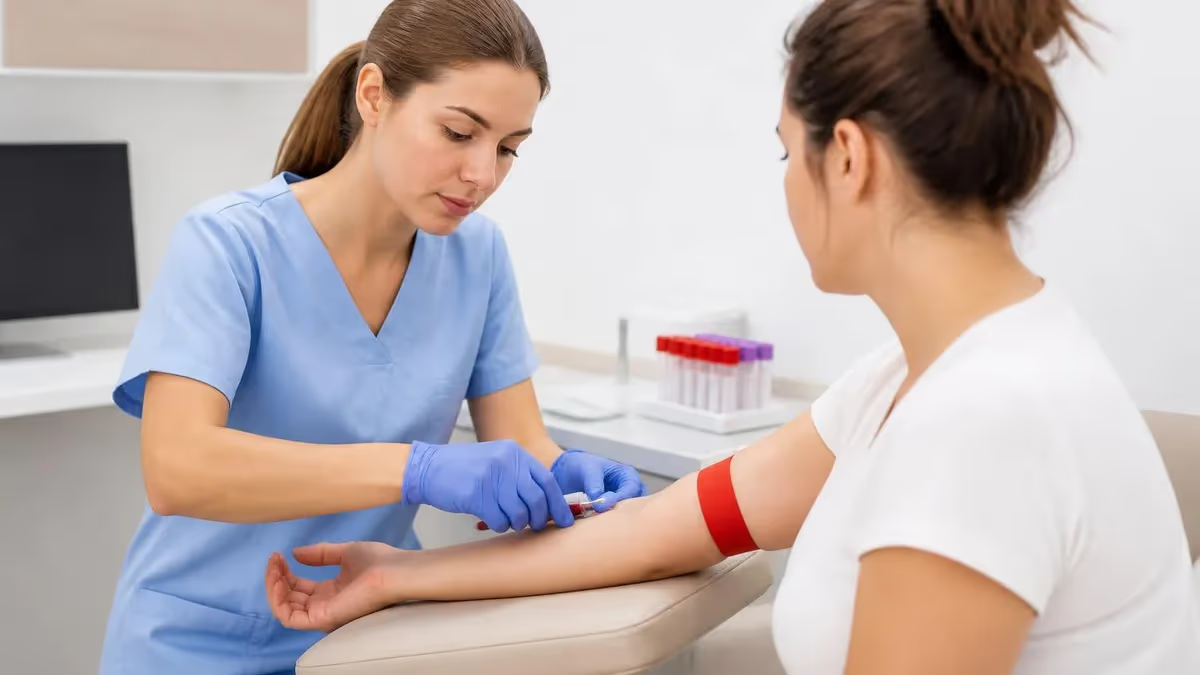
What phlebotomy technician certification actually proves
Phlebotomy technician certification is the credential most U.S. hospitals, reference labs, and donor centers look for before they hand you a tray of vacutainers and a patient list. It is not a license issued by a state board in most jurisdictions. It is a competency credential awarded by a private certifying agency once you pass a written exam and document a minimum number of supervised venipunctures and skin punctures. Employers care about it because malpractice carriers care about it, and because Joint Commission surveyors ask to see proof of competency during lab inspections.
The confusing part for new candidates is that five different agencies offer the credential, each with its own initials, its own fee schedule, and its own eligibility math. A graduate of a 120-hour community college program might qualify for the National Healthcareer Association exam on day one but still need 30 more sticks before the American Society for Clinical Pathology will let her test. Picking the wrong agency first is a common, expensive mistake, and the wait to retest can stretch four to six weeks.
This guide walks through what each agency requires, what the test actually looks like, and how the credential pays off once you have it. If you have not yet finished training, the companion phlebotomy certification programs comparison covers schools and curriculum. If you have, keep reading. You will leave with a clear answer to one question: which exam should I sit, and when.
Phlebotomy certification at a glance

The five agencies that actually matter to employers
Hospital HR systems usually pre-populate a drop-down of approved certifications. The same five show up almost everywhere: NHA, ASCP, AMT, NCCT, and the American Society of Phlebotomy Technicians. Each is recognized by the National Commission for Certifying Agencies or by the American National Standards Institute, which is the accreditation layer that satisfies most state employment rules. Anything outside this group is worth a phone call to your target hospital before you pay the application fee.
NHA Certified Phlebotomy Technician (CPT)
The NHA exam is the most widely accepted entry-level credential and the cheapest path for graduates of accredited classroom programs. The test runs 120 scored items plus 20 pretest items in 2 hours. NHA requires 30 successful venipunctures and 10 skin punctures documented in a clinical log. Detailed prep is covered in the NHA phlebotomy practice test guide.
ASCP Phlebotomy Technician (PBT)
Run by the American Society for Clinical Pathology, the PBT is the credential reference labs and academic medical centers prefer. Eligibility is stricter: 40 hours classroom plus 100 venipunctures and 5 skin punctures, or one year of full-time bench experience. The exam is 80 questions in 2 hours, computer-adaptive, and fee is $135.
AMT Registered Phlebotomy Technician (RPT)
American Medical Technologists offers the RPT, which is popular in physician office labs and pediatric clinics. AMT accepts military medical experience, which makes it the agency of choice for transitioning service members.
NCCT National Certified Phlebotomy Technician
NCCT is favored by career-college graduates because it bundles continuing education through Kaplan. It runs $90 for students testing within six months of graduation.
ASPT and state-issued certificates
The American Society of Phlebotomy Technicians issues a CPT credential at $40, the cheapest in the field. California, Louisiana, Nevada, and Washington layer state licensure on top of national certification.
Compare the five eligibility paths
Accredited program + 30 venipunctures + 10 skin punctures. Fee $117. Best general-purpose pick.
100 venipunctures + 5 skin punctures, or 1 year experience. Fee $135. Preferred by academic labs.
Program completion or 1,040 work hours. Fee $135. Military experience accepted.
Accredited program within last 6 months OR 12 months experience. Fee $90 student. Career-college focus.
100 venipunctures over 6 months. Fee $40. Budget-friendly first sit.
California, Louisiana, Nevada, Washington require state cert layered on top of national exam.
How to read your eligibility before you apply
The number that trips up most candidates is the documented-sticks count. Schools count differently. A 240-hour program might give you 30 supervised sticks in its clinical externship, which is enough for NHA but short of the ASCP threshold by 70. If your goal is the ASCP credential you may need to negotiate a longer externship or pick up volunteer hours at a plasma center before you apply. Plasma centers train fast, log everything, and most accept students at 18.
Read your program transcript. Look for two lines: successful venipunctures and successful skin punctures. Successful means the specimen reached the lab in usable condition, not just that you stuck someone. If your program does not separate them, ask the clinical coordinator for an itemized log on letterhead. Every certifying agency has rejected applications over insufficient documentation, and the application fee is non-refundable.
Some candidates also miss the recency clause. ASCP requires the 100 sticks to be earned within five years of application. NCCT requires graduation within six months for student pricing. If you trained two years ago and never sat the exam, your eligibility may have lapsed and you may need a refresher course before you can apply.
Exam format by agency
Two hours. 120 scored items plus 20 unscored pretest items. Score reported as scaled 200–500, passing 390. Content: safety and compliance 17%, patient prep 14%, routine blood collection 45%, special collection 15%, processing 9%. Pearson VUE testing centers or remote proctoring through PSI. Re-test wait is 30 days for two failures, 12 months after three.
Every certifying agency runs a criminal background check. Misdemeanor convictions involving fraud, theft, or violence can disqualify you for two to ten years depending on the agency. Pull your record before paying the application fee. NHA and ASCP both offer pre-application eligibility reviews for $25 that screen criminal history before you commit to the full exam fee. The review typically takes 5 to 10 business days and saves the full exam fee if eligibility is rejected. Convictions older than 7 years and sealed juvenile records are generally not disqualifying, but you must still disclose them on the application or risk credential revocation. Pending charges trigger an automatic hold on the application until disposition is documented in court records.
Score release timing and re-test policy by agency
Unofficial score on screen at test end. Official scaled score by email within 2 business days. Re-test wait: 30 days after first or second fail, 12 months after third.
Scaled score 0–999, pass at 400. Email notification within 24 hours, official transcript in 10 business days. Three attempts permitted in 3-year window.
200 items hand-reviewed. Score within 10 business days. Re-test wait 45 days, maximum 4 attempts before mandatory remediation course.
Instant unofficial pass/fail at test center. Official score 7 business days. Re-test wait 30 days, no lifetime cap on attempts.
Mail-in paper exam graded by ASPT board. Results 2 to 3 weeks. Re-test fee $25, no formal wait period between attempts.
California CDPH license adds 4 to 8 weeks of processing after national exam pass. Plan job start dates accordingly to avoid lost wages.

Full application timeline from training to credentialed
- ✓Week 0: Confirm program accreditation status with NAACLS, ABHES, or state department of health.
- ✓Week 1–16: Complete classroom hours, lab simulations, and clinical externship sticks.
- ✓Week 17: Request official transcripts, clinical log on letterhead, and program completion letter.
- ✓Week 18: Pull personal background check and credit report to flag disqualifying items early.
- ✓Week 19: Submit application to chosen certifying agency with all documentation and payment.
- ✓Week 20–22: Receive Authorization to Test, schedule exam at Pearson VUE or PSI center.
- ✓Week 23: Two-week focused study sprint using practice tests and content gap analysis.
- ✓Week 24: Sit the exam, receive unofficial result, await official transcript.
- ✓Week 25–26: Update LinkedIn, resume, and apply to hospital, lab, and donor center openings.
- ✓Week 26+: Begin state licensure application if working in California, Louisiana, Nevada, or Washington.
What actually moves your score
Pass rates for phlebotomy exams sit between 70% and 78% across agencies, which means roughly one in four candidates fails the first attempt. The failures cluster in three content areas: order of draw, additive function, and specimen-rejection criteria. These three areas account for about 60% of every exam, and they are also the three areas most poorly taught in short programs. Drill them.
Start with order of draw. The Clinical and Laboratory Standards Institute publishes the standard sequence, and almost every exam item that begins "a phlebotomist draws blood for a CBC, PT/INR, and BMP" is testing whether you can list the tubes in the correct order without hesitation. A full breakdown lives in the order of draw phlebotomy reference. Memorize the mnemonic, then practice on randomized panel combinations until you can list 8 tubes in under 30 seconds.
Move next to additives. Know what each color top contains, what it does to the specimen, and which test panels accept which tube. EDTA chelates calcium and is used for hematology. Sodium citrate binds calcium reversibly and is used for coagulation. Heparin inhibits thrombin and is used for chemistry STAT panels. Sodium fluoride is a glycolysis inhibitor used for glucose tolerance testing. Roughly 25 exam items will hinge on this knowledge.
Finally, rejection criteria. A hemolyzed specimen is rejected for potassium and LDH. A clotted EDTA is rejected for CBC. A short-draw blue top is rejected for PT/INR because the citrate-to-blood ratio is off. Learn the rule and the rationale. Examiners write distractors that look right if you only memorized the rule. Practice tests, like the phlebotomy practice test sets in our hub, are the fastest way to expose gaps in this area.
Two-week study sprint
- ✓Day 1–2: Memorize CLSI order of draw and rehearse with mixed panels until automatic.
- ✓Day 3–4: Build a flashcard deck for additives, color caps, and tube inversions.
- ✓Day 5–6: Drill specimen rejection criteria across hematology, coagulation, and chemistry.
- ✓Day 7: Full-length timed practice exam, then mark every miss.
- ✓Day 8–10: Re-study only the chapters covering missed items, no broad review.
- ✓Day 11: Second timed exam, target 80% or higher.
- ✓Day 12: Patient interaction and HIPAA scenarios, plus 10 pediatric-draw cases.
- ✓Day 13: Rest, review notes only, no new content.
- ✓Day 14: Exam day. Arrive 30 minutes early with two forms of ID.
What it costs, what it pays
Total cost to walk into a hospital with a usable credential runs $700 to $2,800 depending on whether you take community college or career college route. Tuition is the biggest line item. The exam itself is the smallest. Budget roughly $1,500 for a community college program, $1,800 for online hybrid programs covered in our online phlebotomy certification guide, and $2,500 for accelerated career college programs. Add the exam fee on top.
Median hourly pay for certified phlebotomy technicians runs $19 to $24 in metro areas, with experienced techs in lead roles reaching $28. Mobile phlebotomy contractors and donor center supervisors top out higher. Read the full salary breakdown by setting and state in the phlebotomy pay guide. A 12-month payback on training cost is typical for someone moving from a $15 retail job into a $21 hospital draw bay.
The credential also opens doors beyond the draw bay. Many laboratory assistant, medical assistant, and donor recruiter roles list CPT as preferred or required. Some critical-care nursing programs accept CPT hours toward prerequisite clinical experience. Long term, the credential is a useful step toward Medical Laboratory Technician (MLT) or Medical Laboratory Scientist (MLS) tracks because much of the order-of-draw and specimen-handling content carries over.
Recertification math
Most CPT credentials renew every two years. NHA requires 10 continuing education hours plus a $179 renewal fee. ASCP requires 9 CE points under its Credential Maintenance Program. AMT requires 3 CE points annually. Letting a credential lapse usually means re-sitting the full exam, so calendar your renewal date the day you pass.
Should you pursue phlebotomy technician certification?
- + —
- + —
- + —
- + —
- + —
- − —
- − —
- − —
- − —
- − —

Exam day logistics nobody tells you about
Pearson VUE and PSI handle most phlebotomy exam delivery. The check-in process at both vendors has tightened significantly since 2024. You will be photographed, palm-vein scanned at most PSI sites, and asked to turn your pockets inside out. Bring two forms of government-issued ID with matching names. If the names do not match exactly, you will be turned away and the fee is forfeit.
The testing room is monitored by camera and microphone. Whispering to yourself, mouthing answers, or leaving your seat without a proctor escort can trigger a security review and a voided score. Take the bathroom break the proctor offers at the halfway mark even if you do not feel you need it. The clock keeps running, but a five-minute reset on your eyes pays off over the second half.
Score reporting varies. NHA and NCCT release scores instantly at the test center. ASCP releases within 24 hours by email. AMT can take up to 10 business days because items are still hand-reviewed. If you pass, your credential is searchable in the agency verification portal within one to three business days, which matters because hospital HR systems often require verification before your start date.
Remote proctoring through PSI Bridge and Pearson OnVUE has expanded since the pandemic, but the rules are stricter than in-center. Your room must be empty of paper, electronics, and other people. Pets count. A toddler walking past in the background has voided more scores than candidates expect. If you live in a shared apartment, drive to the in-center option. The two-hour quiet block almost never works in a household with other adults moving around.
Exam day document and supply list
- ✓Two forms of government ID with identical names (driver license + passport works)
- ✓Exam authorization email printed or saved offline
- ✓Clear plastic water bottle, label removed
- ✓Light layers, testing rooms can be cold
- ✓Snack for the break, sealed packaging only
- ✓Glasses case if you need it, no soft pouches
- ✓Confirmation of testing center address with parking notes
State-by-state licensure overlay
California requires a state-issued Certified Phlebotomy Technician I license on top of national certification. The CDPH-LFS application is $100, and the agency wants to see proof of national certification plus completion of an approved 80-hour program. Renewals are biennial.
Louisiana mandates state licensure through the Louisiana State Board of Medical Examiners with a $50 application fee and a 100-stick clinical log. Nevada requires phlebotomists to register with the Nevada Bureau of Health Care Quality and Compliance and complete a fingerprint background check. Washington recognizes the credential through the Department of Health Medical Assistant-Phlebotomist registration at $45.
The remaining 46 states defer to national certification. Some, like New York and Texas, require certified phlebotomy techs in hospital settings to register with the state department of health, but the process is paperwork-only with no exam or fee. The detailed phlebotomy license guide covers each state and a current fee schedule.
Where graduates actually find first jobs
Hospital phlebotomy departments hire the largest share of new graduates, but the path in usually runs through a hospital lab assistant or PRN draw-team posting rather than a full-time CPT line. PRN means as-needed, often 12 to 24 hours per week with no benefits. Six months of solid PRN performance converts to full-time more often than not, and you build the resume needed for outpatient draw stations or surgery center roles.
Reference labs like Quest and LabCorp offer the most predictable schedules and the best training pipeline for techs aiming at MLT. Pay starts $1 to $2 lower than hospitals but tuition reimbursement is common after 90 days. Plasma centers train fast and pay reasonably, but turnover is high because of stick-volume pressure.
Mobile phlebotomy contracts are the highest-paying lane outside of hospitals, often $35 to $50 per hour for home draws and insurance physicals, but they require reliable transportation, a smartphone for digital signature capture, and the maturity to handle solo home visits. New graduates without a year of hospital experience rarely succeed in mobile roles. The phlebotomy guide walks through which job boards actually surface real CPT openings versus recycled medical assistant listings.
Donor centers, including the American Red Cross and Vitalant, hire aggressively year-round and run their own training programs that count toward CPT eligibility hours. Pay is modest, often $17 to $19, but the schedule is predictable and the work environment is low-acuity. A year at a donor center plus a national CPT credential is a strong springboard to hospital roles.
Specialty pediatric clinics and dialysis centers represent a smaller hiring lane, but the work is highly skilled and well compensated. Pediatric phlebotomy requires comfort with butterfly draws, capillary heel sticks on infants, and high-stakes patient interaction. Most clinics will not consider applicants without at least six months of adult-draw experience and an active pediatric phlebotomy training module on file.
Picking the right exam in 60 seconds
If you trained at a community college accredited program and have between 30 and 99 sticks logged, sit the NHA exam. It is the cheapest path with the widest hospital acceptance, and re-test policies are reasonable if the first attempt does not stick.
If you trained at a hospital-based program, an academic medical center, or you have at least 100 documented sticks and one year of bench time, sit the ASCP exam. The credential carries more weight in academic and reference-lab settings and signals seriousness to MLT program admissions committees.
If you are transitioning from military medical service or you have a wide range of clinical hours that do not fit a traditional accredited program, AMT is the most flexible reviewer and most likely to credit your experience.
If budget is the dominant constraint, sit the ASPT exam at $40 and use the credential to land an entry job, then have your employer pay for an NHA or ASCP upgrade once you are working. The strategy adds 12 months to your timeline but cuts upfront cost by 65%.
Whichever route you choose, register for the exam the same week you decide. Eligibility windows expire, motivation fades, and the candidates who pass on the first attempt are almost always the candidates who scheduled the test before they felt fully ready. A scheduled date forces the rest of your prep timeline into place and turns vague intentions into concrete study sessions on the calendar.
One last note on stacking credentials. Phlebotomy certification often shares testing windows and prep content with EKG technician and patient care technician credentials. NHA offers a Certified Patient Care Technician (CPCT) and Certified EKG Technician (CET) combo for candidates who finish a combined program. Stacking two credentials adds roughly $200 in exam fees but can raise starting pay by $2 to $4 per hour, and many hospital units prefer dual-skilled techs who can rotate between draw bay and telemetry duties.
Sample Phlebotomy Practice Questions
Try these questions from our free Phlebotomy practice tests. The correct answer and an explanation follow each question.
What is a primary eligibility requirement for the AMCA Phlebotomy Technician Certification exam?
- A. Completion of a formal phlebotomy training program
- B. Bachelor’s degree in a medical-related field
- C. One year of work experience in a non-medical role
- D. Supervisory experience in a clinical laboratory
Answer: A. Completion of a formal phlebotomy training program
To be eligible for the AMCA Phlebotomy Technician Certification exam, candidates must typically complete a formal phlebotomy training program. This requirement ensures they have received comprehensive instruction and practical experience in venipuncture techniques, safety protocols, and specimen handling. This foundational training is crucial for safe and effective practice.
Which of the following is a requirement to be eligible for the NCCT Phlebotomy Technician exam?
- A. Bachelor’s degree in a medical field
- B. Completion of a phlebotomy training program or relevant work experience
- C. State licensure as a laboratory technician
- D. Two years of supervisory experience in a clinical lab
Answer: B. Completion of a phlebotomy training program or relevant work experience
To be eligible for the NCCT Phlebotomy Technician exam, candidates must demonstrate foundational knowledge and practical skills. This is typically achieved through the completion of a recognized phlebotomy training program or by possessing relevant work experience in the field. These requirements ensure that applicants have a solid understanding of phlebotomy procedures and patient care before attempting certification.
How often must the AMCA Phlebotomy Technician Certification be renewed?
- A. Every 1 year
- B. Every 2 years
- C. Every 3 years
- D. Every 5 years
Answer: B. Every 2 years
The AMCA Phlebotomy Technician Certification (PTC) requires renewal every two years. To maintain active certification, professionals must typically complete continuing education requirements and pay a renewal fee. This regular renewal process ensures that certified phlebotomists stay updated with current best practices and advancements in the field.
What is the minimum educational requirement to pursue a phlebotomy certification through the APT?
- A. High school diploma or equivalent
- B. Associate degree in medical science
- C. Bachelor's degree in biology
- D. No formal education required
Answer: A. High school diploma or equivalent
To pursue a phlebotomy certification through the APT, the minimum educational requirement is typically a high school diploma or its equivalent. In addition to this, candidates must usually complete an approved phlebotomy training program. This ensures a foundational level of education and specialized training for the profession.
Phlebotomy Questions and Answers
About the Author

Registered Nurse & Healthcare Educator
Johns Hopkins University School of NursingDr. Sarah Mitchell is a board-certified registered nurse with over 15 years of clinical and academic experience. She completed her PhD in Nursing Science at Johns Hopkins University and has taught NCLEX preparation and clinical skills courses for nursing students across the United States. Her research focuses on evidence-based exam preparation strategies for healthcare certification candidates.