
Online Phlebotomy Classes: What Hybrid Programs Actually Offer 2026 October
Online phlebotomy classes — what hybrid programs can and cannot do, NAACLS accreditation, costs, certification exams and how to verify state requirements. 🗨️
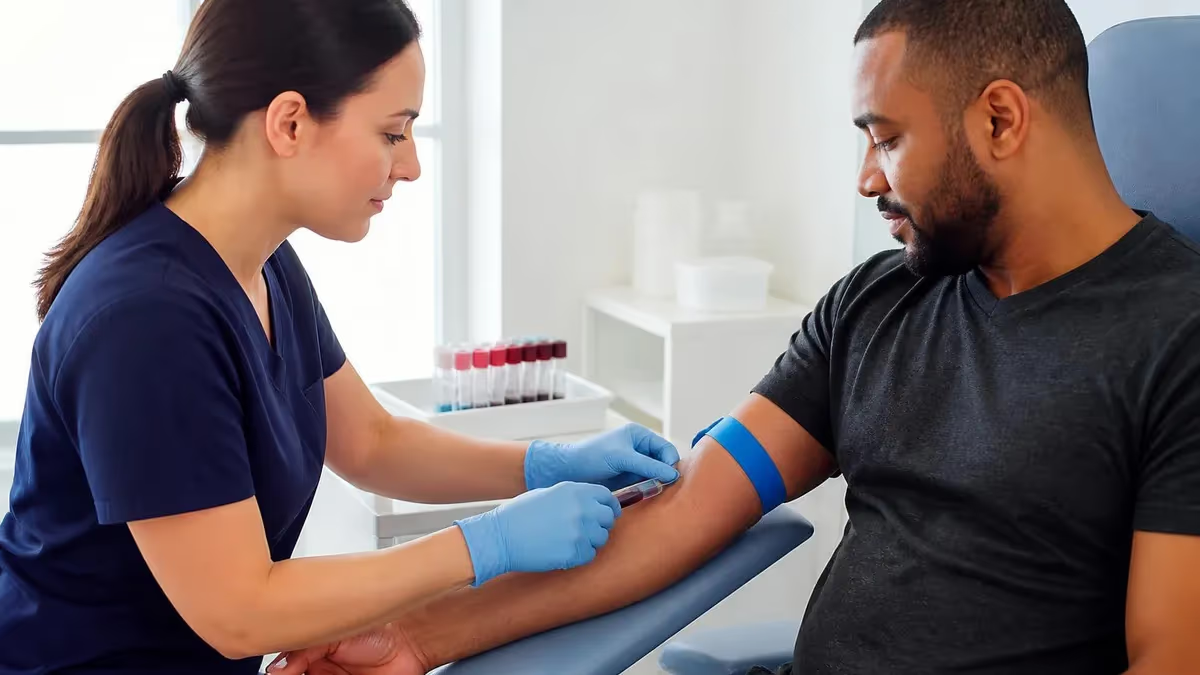
Online Phlebotomy Classes: The Honest Picture
The first thing to understand about online phlebotomy classes is that no legitimate program is fully online. Phlebotomy is a hands-on clinical skill that requires supervised practice drawing blood — typically 25 to 100 successful blood draws on real patients before certification eligibility — and that practice cannot happen through a webcam. What can be delivered online is the theoretical content: anatomy, infection control, equipment knowledge, regulations, patient interaction, complications and quality assurance. Programs marketed as online phlebotomy training are properly hybrid — online theory paired with mandatory in-person clinical work at a partner lab, hospital or training centre.
This guide explains what online phlebotomy classes actually deliver, where the in-person requirements come in, the certification options that recognise hybrid training, and the warning signs of programs that promise more than they can legitimately provide. The aim is to give honest information rather than the marketing version. Phlebotomy is a strong career entry — median pay around $40,000, steady demand across hospitals, labs and clinics, fast training timeline — but only if the credential you earn is actually recognised by employers and certification boards in your state.
Phlebotomy occupies an interesting niche in the healthcare workforce. The training is short and affordable compared to nursing or medical lab technology, the entry pay is modest but real, and the work itself is patient-facing and meaningful. Many people enter phlebotomy as a stable healthcare job in its own right; others use it as a stepping stone toward broader medical lab careers, nursing, or physician assistant programs. Understanding both paths shapes how to evaluate online phlebotomy programs because the strongest fit depends on which destination you have in mind.
Online phlebotomy classes at a glance
What can be online: theory, anatomy, equipment, regulations, infection control, patient interaction. What must be in-person: venipuncture practice on mannequins, then supervised live blood draws (25–100 sticks). Cost range: $500–$2,500. Duration: 3–12 months. Top accreditation: NAACLS. Required for certification: hybrid program completion plus passing a national exam (NHA CPT, ASCP PBT, AMCA CPT, NCCT NCPT). State licensure: required in California, Louisiana, Nevada, Washington — confirm before enrolling.
What the Online Portion Actually Covers
The online portion of a quality hybrid phlebotomy program covers the theoretical and procedural content that does not require physical practice. Anatomy and physiology cover the circulatory system, vein selection, common venipuncture sites and the structures phlebotomists need to recognise to perform safe draws. Infection control and standard precautions cover OSHA bloodborne pathogen rules, personal protective equipment, hand hygiene, sharps disposal and post-exposure procedures. Equipment lessons cover needle types, gauge sizes, evacuated tubes, butterfly sets, syringe systems and laboratory containers.
Other online content covers the order of draw — the standard sequence in which different tube types are filled to prevent cross-contamination — the legal and regulatory framework including HIPAA and CLIA, patient interaction and bedside manner, complications including hematomas, syncope and difficult-stick patients, and quality control around specimen labelling, transport and rejection criteria. Most programs structure the online content as 10 to 20 weekly modules with reading, video lectures, quizzes and discussion forums. The total online portion typically requires 60 to 100 hours of work, completed at the student's pace within program deadlines.
The pacing of online phlebotomy content varies widely between programs. Some self-paced programs let students fly through theory in a few weeks if they are motivated and have time to focus. Others impose strict weekly module deadlines that produce a 16- to 20-week timeline regardless of student speed. Cohort-based hybrid programs schedule the in-person clinical work to align with theory completion, which means the program length is set by the slowest portion of the cohort. Choosing a pacing model that fits your real schedule and learning style matters as much as the curriculum content itself.

What Hybrid Phlebotomy Programs Cover
Circulatory system, veins and arteries, common venipuncture sites in the antecubital fossa and hand. Foundation knowledge that supports safe vein selection and complication prevention. Delivered online through reading and video lectures.
OSHA bloodborne pathogen training, personal protective equipment, hand hygiene, sharps disposal, post-exposure procedures. Online theory plus in-person practice using actual PPE during clinical sessions.
Needle gauges, evacuated tubes, butterfly sets, vacutainer systems, capillary collection devices. Theory online; hands-on familiarisation in lab during the in-person component before live draws begin.
Standard CLSI sequence for filling different tube types: blood culture, sodium citrate, serum, heparin, EDTA, fluoride. Memorisation-heavy theory content well suited to online flashcard study and online quizzes.
Practice on synthetic arm mannequins followed by supervised real blood draws on classmates and clinical externship patients. Strictly in-person — no online substitute exists. Typically 25 to 100 successful sticks required for certification eligibility.
Communication, identification verification, consent, calming nervous patients. Theory and case studies online; real interaction practice during clinical externship at hospital, lab or clinic partner sites.
The Mandatory In-Person Component
The in-person component of any legitimate hybrid program covers everything online theory cannot: hands-on equipment familiarisation, mannequin practice, supervised peer practice and finally clinical externship at a partner facility. The clinical externship is where most of the actual learning happens — students rotate through outpatient lab, inpatient floor draws, paediatric or geriatric specialty draws depending on the partner site. Documented successful blood draws build toward the threshold required for certification eligibility, with logbooks signed by supervising preceptors as students progress.
Externship hours required for certification vary by certification body. The American Society for Clinical Pathology (ASCP) Phlebotomy Technician credential requires 100 documented successful venipunctures and 5 documented capillary draws. The National Healthcareer Association (NHA) Certified Phlebotomy Technician requires 30 venipunctures and 10 capillary draws. The American Medical Certification Association (AMCA) Certified Phlebotomy Technician requires similar thresholds. The exact number depends on which certification you pursue, which depends on which credentials your target employers and your state recognise.
Externship placement is one of the most variable parts of online phlebotomy programs. Some programs maintain partnerships with hospital systems, outpatient labs and physician offices in specific geographic regions and place students directly. Others require students to find and arrange their own externship locally, which can be challenging in markets with few clinical sites or in regions where existing programs have already booked the available externship slots. Always confirm the externship arrangement before enrolling — students who discover after paying tuition that their region has no available externship sites face frustrating delays.
Quality Hybrid Phlebotomy Programs
Self-paced online theory paired with externship that students arrange locally. Cost typically $700 to $1,000. Strong reputation among self-paced learners. Verify externship arrangements work in your area before enrolling because Penn Build does not directly place students at partner facilities — students arrange clinicals themselves.
Certification Exams After Training
Completing a phlebotomy program is the entry ticket to the certification exam, not the end of the credentialing process. Most US employers require certification from one of the major national bodies: National Healthcareer Association Certified Phlebotomy Technician (NHA CPT), American Society for Clinical Pathology Phlebotomy Technician (ASCP PBT), American Medical Certification Association Certified Phlebotomy Technician (AMCA CPT) or National Center for Competency Testing Certified Phlebotomy Technician (NCCT NCPT). The four credentials are roughly equivalent in employer recognition, although ASCP carries slightly more weight in academic medical centres and research labs.
Each certifying body sets its own eligibility requirements, exam content and renewal cycle. The NHA CPT exam runs 100 multiple-choice questions in 2 hours, with a 75 percent pass mark. The ASCP PBT exam is similar in length but typically considered more challenging. Application fees range from $90 to $135 per attempt. Renewal periods are typically two years with continuing education hours required. The certification choice depends on which credentials your target employers prefer and which credentials are recognised by your state cosmetology board if you live in a state with state-level licensing requirements.
Preparation for the certification exam typically starts during the program itself, with practice questions and review modules embedded in the online curriculum. Most students benefit from additional structured review in the final weeks before sitting the exam — the official review books published by each certifying body, third-party study guides like Mosby's Comprehensive Review of Phlebotomy, and online practice question banks like Phlebotomy Coach or PTG Phlebotomy Practice Tests. Plan to complete several hundred practice questions across the prep period for strong first-attempt pass results.

Some online programs market "online phlebotomy certification" with no in-person clinical requirement. These programs cannot legitimately produce certification because every recognised certifying body requires documented hands-on experience. Graduates of these programs find that employers will not hire them and certification bodies reject their applications. Always verify a program includes externship hours and is recognised by at least one major certifying body before paying tuition.
State Licensure Requirements
Most US states do not require phlebotomy-specific state licensure. Phlebotomists work under their employer's CLIA-certified laboratory authorization in those states, with national certification from one of the major bodies serving as the credential. Four states require phlebotomy-specific licensure: California, Louisiana, Nevada and Washington. California's California Department of Public Health regulates phlebotomy through three tiers — Limited Phlebotomy Technician (LPT), Certified Phlebotomy Technician I (CPT I) and Certified Phlebotomy Technician II (CPT II). Each tier has specific training hour requirements, externship documentation and exam expectations.
Confirming your specific state's requirements before enrolling in any program is essential. A program that produces a graduate qualified to work in Texas may not produce a graduate qualified to work in California, even though the underlying skill set is identical. The differences trace back to specific hour requirements, externship documentation standards, approved certification bodies and state-specific examinations. Phlebotomy programs marketed nationally vary in how well they meet the specific needs of high-licensure states, and the program's own marketing pages do not always make the distinction clear.
One often-overlooked detail is that working in a state's healthcare facilities sometimes requires additional employer-specific training beyond state licensure. Hospitals frequently mandate orientation programs, electronic health record training and facility-specific protocols that take new phlebotomists 1 to 4 weeks to complete after hire. The state license or national certification is the threshold that opens the door; the employer training is what makes you ready to start independent work in their specific environment.
Choosing an Online Phlebotomy Program
- ✓Confirm your state's licensure requirements before enrolling
- ✓Verify the program holds NAACLS accreditation or equivalent recognised approval
- ✓Confirm the program includes externship at a real clinical site, not virtual simulation
- ✓Check first-time pass rates on the relevant national certification exam
- ✓Confirm the program recognises at least one major certifying body (NHA, ASCP, AMCA, NCCT)
- ✓Verify externship hours meet the certification body's threshold for your target credential
- ✓Read recent student reviews on Reddit, school review sites, and the Better Business Bureau
- ✓Confirm tuition and any external externship fees in writing before paying
- ✓Check whether federal financial aid is available — only accredited programs qualify
- ✓Plan for the in-person portion — confirm a partner site exists in your geographic area
Cost, Time and Financial Aid
Total phlebotomy program cost typically runs $500 to $2,500. Community college hybrid programs sit at the lower end. Private vocational schools and specialty providers like Penn Build sit in the middle. National-network providers like Phlebotomy Training Specialists sit at the higher end because of the partner training centre infrastructure. Add another $200 to $500 for textbooks, kit (gloves, PPE, lab coat) and certification exam fees. The all-in cost from start to certification typically runs $700 to $3,000.
Federal Title IV financial aid is available at NAACLS-accredited programs that hold institutional accreditation. Pell grants for low-income students and Direct Loans for any eligible student can cover most or all of the tuition cost. Workforce development grants are available in many states for adults retraining into healthcare careers. Many hospitals also fund phlebotomy training for incumbent employees pursuing the credential, often with a service commitment in exchange. The combination of relatively low base cost and multiple aid sources makes phlebotomy training one of the more affordable healthcare entry credentials available.
The Realistic Career Outlook
The Bureau of Labor Statistics reports a median annual wage near $40,000 for phlebotomists, with the lowest tenth percentile around $30,000 and the highest tenth above $52,000. Geographic variation is significant — California, Massachusetts and New York pay near the top of the range, while many southern and rural markets pay closer to the bottom. The job is projected to grow faster than average through the rest of the decade, with consistent demand from outpatient labs, hospitals, blood donation centres, plasma collection facilities and physician offices.
Career trajectory beyond entry-level phlebotomist usually moves through specialty work or advanced credentials. Specialty phlebotomy roles include paediatric phlebotomy, donor phlebotomy at blood banks, mobile phlebotomy services and lead phlebotomy positions supervising a team. Many phlebotomists use the credential as a stepping stone toward broader medical laboratory careers — Medical Laboratory Technician (MLT), Medical Laboratory Scientist (MLS), or histotechnology — through additional formal education at community colleges or universities. Some pursue nursing through LPN or RN programs after working as phlebotomists. The hands-on experience with patient care and clinical environments transfers well to nursing programs.
Schedule and shift considerations also matter when evaluating phlebotomy as a career. Hospital phlebotomists work shifts including nights and weekends because blood draws happen 24 hours a day for inpatient care. Outpatient labs typically run business hours but may include early-morning shifts (5 to 7 AM start) because fasting blood draws need to happen before patients eat breakfast. Donor centres and plasma collection facilities run on different schedules entirely. Understanding which work setting fits your scheduling needs prevents the surprise that pushes some new phlebotomists out of the field within the first year.

Online Phlebotomy Numbers
Major Phlebotomy Certifications Compared
American Society for Clinical Pathology Phlebotomy Technician. Highest rigour. Requires 100 venipunctures and 5 capillary draws. Strongest recognition in academic medical centres and research labs. Renewal every three years with continuing education.
National Healthcareer Association Certified Phlebotomy Technician. Most widely held US phlebotomy credential. 30 venipunctures and 10 capillary draws required. Renewal every two years. Strong recognition across hospitals, outpatient labs and physician offices.
American Medical Certification Association Certified Phlebotomy Technician. Similar requirements to NHA. Recognised by most US employers. Renewal every two years with continuing education. Sometimes more flexible on documentation requirements than ASCP.
National Center for Competency Testing National Certified Phlebotomy Technician. Less common than NHA or ASCP but recognised. Lower exam fees in many cases. Renewal every year, which is more frequent than other certifications.
State-specific California licensure. CPT I covers basic venipuncture and skin puncture; CPT II adds arterial puncture. Required to work in California regardless of national certification status. State exam plus documented hours.
Paediatric Phlebotomy, Donor Phlebotomy, IV Phlebotomy and similar specialty credentials available through certifying bodies after the base certification. Each typically requires additional training hours plus a specialty exam.
Self-Study Resources to Supplement Online Coursework
Online phlebotomy classes benefit from supplementary self-study resources. Khan Academy's free anatomy and physiology content covers the circulatory system in more depth than most program lectures, with cleaner visuals and the ability to repeat sections at your own pace. ASCP Phlebotomy Technician Review books from major medical publishers (Saunders, Elsevier) provide additional practice questions and content review. The Bonewit-West Today's Medical Assistant textbook, while broader than phlebotomy specifically, covers the patient interaction and clinical communication skills that overlap heavily with phlebotomy practice.
YouTube channels run by working phlebotomists offer practical insight that program materials sometimes lack. Channels covering difficult-stick techniques, paediatric considerations, geriatric vein challenges, and real-world workflow tips supplement the academic content with the textures of actual clinical work. Quizlet flashcard decks for order of draw, tube colours, additives and complications cover the memorisation-heavy parts of the certification exam efficiently. The combination of structured online program content, self-study supplementation and committed in-person clinical work produces consistently stronger outcomes than any single resource on its own.
One particularly useful supplementary practice is to volunteer at a blood drive or donor centre during the externship period. Many blood centres welcome phlebotomy students for additional supervised practice that does not always count toward formal program externship hours but builds confidence and speed. The variety of donor venipunctures — different vein anatomies, different patient nervousness levels, different equipment configurations — produces real-world skill faster than the controlled environment of a hospital outpatient lab. Phlebotomy students who pursue this kind of supplementary practice often outperform classmates who rely strictly on program-required hours.
One final point worth emphasising: the difference between an excellent phlebotomist and a struggling one is mostly about practice volume during training, not about the program brand or tuition cost. Every certified phlebotomist completed the same minimum number of supervised draws. The phlebotomists who graduate confident and competent are the ones who pursued every available draw opportunity during externship rather than meeting the bare minimum threshold. Online theory programs that offer flexible scheduling support this kind of self-directed practice well, because the time freed from rigid classroom schedules can be invested in extra clinical hours when the partner site allows.
The pattern shows up consistently across cohorts: the phlebotomists who treat externship as their main investment, even when the program technically meets the minimum hours quickly, build careers more reliably than peers who optimised purely for fast completion.
That practice volume is the durable advantage that pays back across the rest of the career.
Investing in extra practice is always worthwhile.
Online Phlebotomy Classes: Honest Trade-offs
- +Online theory portion fits flexibly around work and family schedules
- +Lower tuition than in-person-only programs in many cases
- +Self-paced format suits motivated learners who can drive their own progress
- +Hybrid model still produces full national certification eligibility
- +Federal financial aid available at accredited hybrid programs
- −Online portion alone cannot produce certification — externship is non-negotiable
- −Self-paced format requires self-discipline that some learners struggle with
- −Externship arrangements may be the student's responsibility at some programs
- −Pure online programs that promise certification are usually not credible
- −State licensure requirements may not be met by national-network programs
Pros and Cons at a Glance
| Pros | Cons |
|---|---|
| Online theory portion fits flexibly around work and family schedules | Online portion alone cannot produce certification — externship is non-negotiable |
| Lower tuition than in-person-only programs in many cases | Self-paced format requires self-discipline that some learners struggle with |
| Self-paced format suits motivated learners who can drive their own progress | Externship arrangements may be the student's responsibility at some programs |
| Hybrid model still produces full national certification eligibility | Pure online programs that promise certification are usually not credible |
| Federal financial aid available at accredited hybrid programs | State licensure requirements may not be met by national-network programs |
Sample Phlebotomy Practice Questions
Try these questions from our free Phlebotomy practice tests. The correct answer and an explanation follow each question.
What is a key responsibility of a National Certified Phlebotomy Technician (NCPT)?
- A. Developing lab testing protocols
- B. Drawing blood samples and ensuring proper handling
- C. Supervising other laboratory staff
- D. Prescribing diagnostic tests
Answer: B. Drawing blood samples and ensuring proper handling
A National Certified Phlebotomy Technician (NCPT) is primarily responsible for performing venipuncture and other blood collection procedures accurately and safely. This includes proper patient identification, site preparation, sample collection, and ensuring specimens are correctly labeled and handled according to laboratory protocols. Their role is crucial for obtaining quality samples for diagnostic testing.
What additive is found in light blue top tubes and what is its primary use?
- A. EDTA; for complete blood count
- B. Sodium citrate; for coagulation studies such as PT and PTT
- C. Lithium heparin; for plasma chemistry testing
- D. Sodium fluoride; for glucose preservation
Answer: B. Sodium citrate; for coagulation studies such as PT and PTT
Light blue tubes contain sodium citrate, which reversibly binds calcium to prevent coagulation; this makes them essential for PT, PTT, and other coagulation studies requiring a precise 9:1 blood-to-additive ratio.
When performing quality control on a glucose meter, the QC result falls outside the acceptable range. What is the FIRST action the phlebotomist should take?
- A. Report the QC failure to the medical director immediately
- B. Repeat the QC test using fresh control solution
- C. Continue patient testing and document the failure
- D. Discard the meter and requisition a new one
Answer: B. Repeat the QC test using fresh control solution
The first step when QC fails is to repeat the test with fresh control solution to rule out an error with the original control sample.
What is the maximum recommended tourniquet application time before venipuncture?
- A. 1 minute
- B. 3 minutes
- C. 5 minutes
- D. 10 minutes
Answer: A. 1 minute
Tourniquets should not remain on longer than 1 minute to prevent hemoconcentration, which skews test results.
Phlebotomy Questions and Answers
About the Author

Registered Nurse & Healthcare Educator
Johns Hopkins University School of NursingDr. Sarah Mitchell is a board-certified registered nurse with over 15 years of clinical and academic experience. She completed her PhD in Nursing Science at Johns Hopkins University and has taught NCLEX preparation and clinical skills courses for nursing students across the United States. Her research focuses on evidence-based exam preparation strategies for healthcare certification candidates.