
Phlebotomy Program Guide: Length, Cost, Accreditation, Outcomes 2026 October
How to choose a phlebotomy program: length, cost, NAACLS accreditation, curriculum, clinical hours, certification pathways, and career outcomes. 🏆
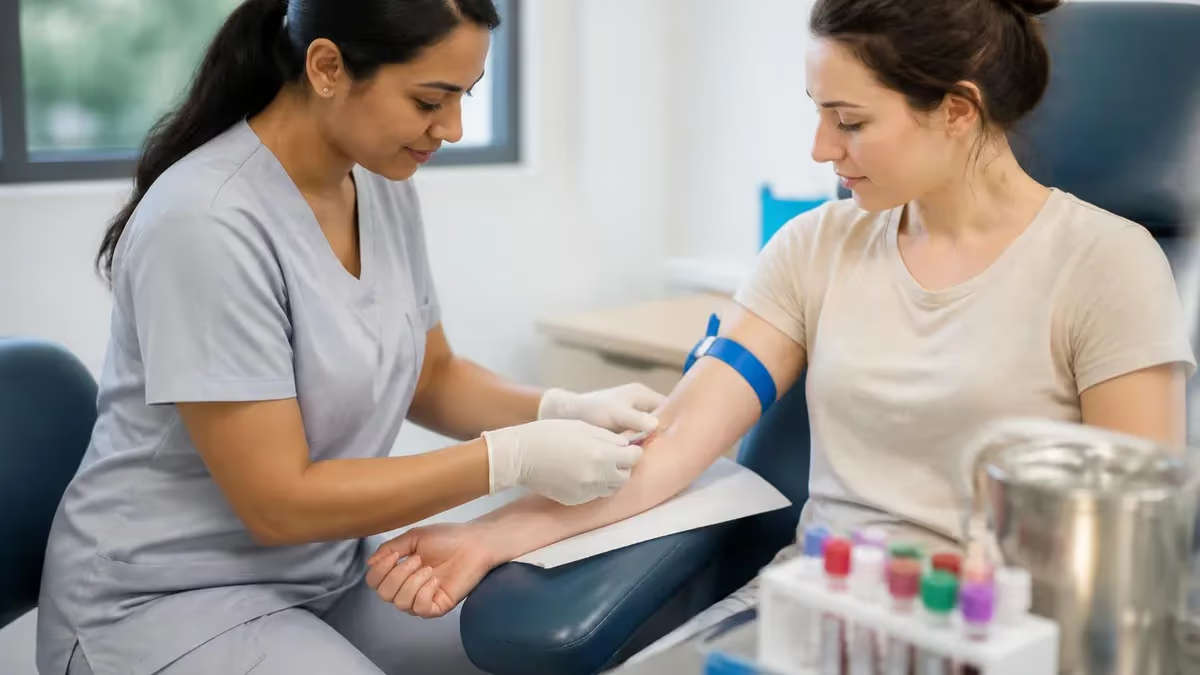
Phlebotomy Program: What to Know Before Enrolling
A phlebotomy program is the formal training that prepares you to draw blood, handle specimens, and work alongside clinical lab staff in hospitals, clinics, blood banks, and diagnostic labs. The good programs combine classroom instruction with supervised hands-on practice — venipunctures on real arms, capillary sticks on real fingertips, and enough clinical hours that you walk out actually competent rather than just credentialed. The weak programs cut corners on either side.
This guide breaks down the decisions that matter when picking a program: length, cost, accreditation, curriculum components, clinical hour requirements, state-specific rules, and the certification pathways your training should set you up for. If you're still gauging whether phlebotomy is the right path, the phlebotomy practice test gives a flavor of the knowledge base you'll need to master.
Phlebotomy is one of the most accessible healthcare careers — short training, modest tuition, no degree required, and steady demand from hospitals, labs, blood banks, and outpatient clinics. The trade-off is that pay sits at the lower end of the healthcare wage scale. That can be fine as an entry point, especially for students using phlebotomy as a stepping-stone into nursing, medical lab science, or healthcare administration. It works less well as a long-term destination unless you stack additional credentials.
Choose your program with the same scrutiny you'd apply to a four-year college decision. The cost is lower but the consequences of a bad program — wasted tuition, weak skills, certification ineligibility — still hurt. A 30-minute phone call with the program coordinator, asking pointed questions about clinical placement and pass rates, separates the legitimate programs from the marketing-heavy ones quickly.
Demand for phlebotomists is steady and broad-based. Hospitals, reference laboratories, blood donor centers, plasma collection clinics, urgent care chains, oncology infusion centers, dialysis units, and home-health draw services all hire phlebotomists. Geographic flexibility helps — markets with major hospital systems (Houston, Dallas, Phoenix, Atlanta, Chicago) tend to have stronger labor markets than smaller metro areas. Travel phlebotomy contracts are an option for credentialed workers willing to relocate temporarily, often paying $25-$40 per hour plus housing stipends.
Many phlebotomists eventually use the credential as a stepping stone into broader healthcare careers — nursing school, medical lab science, ultrasound technology, or physician assistant programs. The exposure to clinical environments, patient care, and medical terminology that phlebotomy provides is valuable preparation for those paths.
Treat program selection as your most important decision — it shapes the next several years of your career trajectory in healthcare.
Bottom Line
The right phlebotomy program is NAACLS-accredited (or state-approved in states that require it), runs at least 80 hours of classroom plus 100+ hours of supervised clinical practice, includes certification exam prep, and costs $500 to $2,500 for a short certificate or $1,500 to $8,000 for an associate-level program. Avoid programs that skip the externship or skip NAACLS accreditation in California, Washington, Louisiana, or Nevada — those states have specific approval requirements.
How Long Are Phlebotomy Programs?
Length varies wildly by program type. Short certificate programs at community colleges or vocational schools run 4 to 12 weeks for the classroom component, with another 4 to 8 weeks of externship layered on. Total time from enrollment to job-ready typically lands in the 3 to 6 month range for a full-time student. Part-time students taking the same coursework at half pace double that. Some programs market themselves as 'one weekend' or '5 days' — those are rarely sufficient and usually skip the clinical hours required for certification.
Longer programs include 1-year diploma options (often combining phlebotomy with related lab skills like EKG or specimen processing) and 2-year associate degree programs that fold phlebotomy into a broader Clinical Laboratory Technician or Medical Assisting curriculum. The associate path costs more time and tuition but opens more career options downstream — supervisory roles, cross-training into broader lab work, easier transition to advanced credentials. Most working phlebotomists hold the certificate, not the associate.
One often-overlooked factor: how flexible is the schedule? Most certificate programs offer day, evening, and weekend options at larger community colleges, but smaller schools may have only one cohort per quarter. If you're working a day job while training, evening and weekend cohorts let you keep income flowing during the program. Day cohorts move faster but require you to step away from full-time work for the duration.

Program Types Compared
4-12 weeks classroom plus externship. Tuition $500-$2,500. Often NAACLS-accredited. Strong externship partnerships with local hospitals and labs. Most popular path for new phlebotomists.
Similar length to community college but priced higher ($1,500-$5,000). Pros: faster cohorts, evening or weekend schedules. Cons: variable quality, some lack accreditation. Verify NAACLS status before enrolling.
Run by hospital systems for their own pipeline. Often free or low-cost, sometimes paid. Very competitive admission. Strong job placement (often you're hired by the hospital after passing). Length 6-16 weeks typical.
Online coursework with in-person clinical at a partner site. Length similar to traditional programs. Best for working students or rural areas. Verify clinical site availability before paying tuition.
Two-year program combining phlebotomy with broader lab science. Tuition $4,000-$12,000+ depending on in-state residency. Opens supervisory and cross-trained roles. Overkill for entry-level phlebotomy but worthwhile for long-term career upside.
Some blood bank organizations run focused phlebotomy programs tied to donor center hiring. Length 4-8 weeks. Free or very cheap. Narrow scope — graduates work primarily in donor blood collection rather than diagnostic lab draws.
What's in the Curriculum?
A solid phlebotomy curriculum covers six core domains. First, anatomy and physiology — focused on the circulatory system, vein and artery distinction, and the structures relevant to draws (antecubital fossa, dorsal hand veins, capillary beds). Second, venipuncture technique — the actual mechanics of needle insertion, vacuum tube use, butterfly setups, syringe draws, and patient positioning. Third, capillary puncture — fingerstick and heelstick techniques especially for pediatric and geriatric patients.
Fourth, the order of draw — the standardized sequence in which tubes are filled to prevent cross-contamination between additives. This shows up on every certification exam and on every clinical shift. The order of draw guide is worth bookmarking even after you finish your program. Fifth, specimen handling and transport — labeling, centrifuging, temperature control, transport conditions. Sixth, infection control and OSHA standards — bloodborne pathogen safety, PPE, sharps disposal, chain of custody for legal samples.
Patient communication is increasingly emphasized in modern phlebotomy curricula because soft skills directly affect job retention and patient outcomes. You learn how to introduce yourself, explain what you're about to do, manage anxious or needle-phobic patients, calm down children and parents simultaneously, and handle difficult patients without escalating tension. These skills matter clinically — a calm patient stays still during the draw, and stillness reduces failed sticks and hematomas.
The pharmacology and lab analyte content varies by program. Stronger programs spend time explaining what each common lab test measures and why — CBC, BMP, CMP, coagulation panels, hemoglobin A1C, lipid panels. You don't need to interpret results clinically, but understanding why patients are getting specific tube types drawn helps you catch labeling errors and ask intelligent questions when something looks wrong with a draw order.
Curriculum Components Deep Dive
Focused on the circulatory system. You learn the difference between arteries and veins (color, pressure, pulsation), the vein anatomy of the antecubital fossa (median cubital, cephalic, basilic), capillary beds in fingertips and infant heels, and the broader hematology basics — blood components, coagulation cascade, common abnormalities. Not the depth of a nursing program but enough to understand what you're drawing and why.
Clinical Hours and Stick Requirements
The hands-on component is what separates a real program from a paper credential. Certification bodies set minimums you must document before sitting for the exam. The NHA Certified Phlebotomy Technician (CPT) requires 30 successful venipunctures and 10 capillary sticks. The ASCP Phlebotomy Technician (PBT) requires 100 venipunctures and 5 capillary sticks under the route 2 pathway. The NCCT NCPT requires 50 venipunctures and 10 capillary sticks. AMT RPT requires 50 venipunctures and 10 capillary sticks.
Most solid programs build externships of 80 to 200 clinical hours into the curriculum so you exceed all of these minimums. The externship typically rotates you through inpatient draws, outpatient lab, donor center work, and pediatric or special-needs draws. Some programs only count practice sticks on training arms or classmates toward your clinical hours — that won't satisfy certification bodies. You need documented sticks on actual patients in a real clinical setting, signed off by a preceptor.
Programs differ significantly in how they document your sticks. The best programs use a structured logbook signed by your preceptor for each successful draw, with notation of patient age range, tube types used, and any complications. That documentation is what certification bodies request when verifying your eligibility. Programs that just hand you a generic completion certificate without stick-specific documentation can leave you scrambling later.
Most students need a few weeks of supervised practice before their sticks start being reliably successful. Expect failed draws early in your externship — this is normal and expected. Quality programs pair you with experienced preceptors who can diagnose what went wrong (angle, depth, vein selection, vacuum engagement timing) and walk you through it without making you feel incompetent. Bad programs leave you to figure it out alone.
Four states require phlebotomists to be licensed and require their phlebotomy programs to be state-approved: California (CDPH approval, three license tiers), Washington (DOH-approved program required), Louisiana (state-registered programs), and Nevada (state-licensed programs). If you live or plan to work in these states, NAACLS accreditation alone is not enough — verify the program is approved by the relevant state agency before enrolling. Hiring managers in these states will reject candidates from non-approved programs.
Accreditation: Why NAACLS Matters
The National Accrediting Agency for Clinical Laboratory Sciences (NAACLS) is the gold-standard accreditor for phlebotomy education programs in the US. NAACLS-accredited programs have been audited against curriculum standards, faculty qualifications, clinical site partnerships, and student outcome metrics. Roughly 80 NAACLS-accredited phlebotomy programs exist across the country, with concentration in community colleges and university-affiliated technical schools.
A non-NAACLS program isn't automatically a scam — many solid state-approved programs aren't NAACLS-accredited because the accreditation process is expensive for small institutions. But NAACLS accreditation is a useful filter, especially for online or distance programs where you can't easily visit and verify quality. It also matters for certification eligibility: completing a NAACLS-accredited program is often the cleanest path to qualify for the ASCP PBT or NHA CPT exams without additional work-experience requirements.
One nuance worth understanding: not all NAACLS programs are created equal. Accreditation verifies that minimum standards are met but says nothing about whether a program exceeds them. Two NAACLS-accredited programs can differ significantly in clinical hour quantity, externship site quality, and certification pass rates. Read program-specific outcome data when available. Many NAACLS programs publish annual report cards showing graduate certification pass rates — programs above 85 percent are above average; programs below 70 percent should raise concerns.
What to Look For in a Program
- ✓NAACLS accreditation OR explicit state approval if your state requires it
- ✓Minimum 80 hours of didactic (classroom) instruction
- ✓Minimum 100 hours of supervised clinical externship at real labs/hospitals
- ✓Documented stick requirements meet or exceed certification minimums
- ✓Certification exam prep built into curriculum or available as add-on
- ✓Clear pathway to NHA CPT, ASCP PBT, NCCT NCPT, or AMT RPT eligibility
- ✓Externship sites are real clinical settings, not just training labs
- ✓Transparent tuition with no hidden fees for textbooks or certification vouchers
- ✓Job placement assistance or hiring partnerships with local employers
- ✓Active student support — instructor accessibility, tutoring, makeup sticks if needed
- ✓Class size — smaller cohorts (10-20) generally provide better preceptor attention
- ✓Refund and withdrawal policies clearly stated before enrollment
What Programs Cost in 2026
Phlebotomy program tuition spans a wide range. The cheapest legitimate certificate programs run $300 to $800 at community colleges with in-state tuition. Mid-tier programs at vocational schools land between $1,500 and $3,500. Premium accredited programs at well-established institutions run $3,000 to $5,000. Associate-degree programs cost $4,000 to $12,000 depending on in-state versus out-of-state status. Most certificate students fall into the $1,000 to $2,500 range when you add tuition, textbooks, supplies, certification exam fees, and uniforms.
Watch out for programs priced below $300 that still claim to be comprehensive — they typically skip clinical hours, certification prep, or both. Watch out also for programs priced above $5,000 for a basic certificate; that's usually predatory tuition aimed at students who don't shop around. Financial aid availability varies. Federal aid (Pell grants, federal loans) is generally restricted to accredited programs at Title IV-eligible institutions. Workforce development grants, state vocational rehab funding, and employer tuition reimbursement (especially from hospital systems) can offset costs significantly.
Hidden costs catch many students by surprise. Beyond tuition, expect to spend $100-$300 on textbooks (the Phlebotomy Essentials by McCall is the standard), $50-$150 on uniforms (scrubs in school-specified colors), $40-$100 on a stethoscope and basic supplies, $100-$200 on background checks and drug screening required by clinical sites, and $90-$135 on the eventual certification exam. Total out-of-pocket beyond tuition can easily run $400-$800.
Workforce development boards and one-stop career centers in many counties offer training grants that can fully fund a phlebotomy certificate for eligible candidates. Check your state's American Job Center network for free vocational training options before paying tuition out of pocket.
Certification After Your Program
Most employers require national certification within 6-12 months of hire. The four major credentials are NHA Certified Phlebotomy Technician (CPT — most widely recognized for entry-level), ASCP Phlebotomy Technician (PBT — strongest reputation, slightly harder exam), NCCT National Certified Phlebotomy Technician (NCPT), and AMT Registered Phlebotomy Technician (RPT). Each has slightly different eligibility pathways, but all accept completion of an accredited training program plus documented clinical hours.
Exam fees range from $90 (NHA CPT) to $135 (ASCP PBT). The exams cover anatomy, venipuncture technique, order of draw, specimen handling, safety, patient interaction, and quality control. Most candidates pass on first attempt — pass rates hover between 70 and 80 percent depending on the certification body. The phlebotomy certification guide compares the four credentials in detail if you're deciding which to pursue.
The credential you choose has small downstream effects on employability. The NHA CPT is the most widely recognized at entry-level retail and outpatient settings. The ASCP PBT is preferred by larger hospital systems and reference labs because of its stricter eligibility requirements. The NCCT NCPT and AMT RPT are valid but less commonly required. If you have flexibility, start with the credential your program is built around — most programs partner with one specific certification body and structure their curriculum to that exam.

Phlebotomy Program Stats
Program Red Flags to Avoid
Programs that promise online-only training with no hands-on clinical hours cannot prepare you for certification or employment. The hands-on component is non-negotiable. Skip any program that lacks a real externship at real clinical sites.
If a program isn't NAACLS-accredited AND isn't state-approved AND isn't affiliated with an accredited college, that's a red flag. Cheap unaccredited credentials may be rejected by hiring managers.
Programs under $300 that claim full certification preparation are almost always skipping clinical hours or certification voucher inclusion. Real programs cost real money because real clinical placements cost real money.
Some programs train you to draw blood but never prepare you for the NHA, ASCP, NCCT, or AMT certification exam. You'll finish the program unable to actually work because employers require certification. Verify exam prep is included.
Marketing language like '100% job placement' or 'guaranteed employment' is usually misleading. Reputable programs share concrete placement data — number of graduates, percentage employed within 6 months, partner employers. Specifics matter.
Online vs In-Person Programs
Fully online phlebotomy programs don't exist in any meaningful sense. The clinical component requires physical presence at a clinical site for supervised practice. Hybrid programs that combine online didactic coursework with in-person clinical at a partner facility do exist and have grown significantly since 2020. The classroom content (anatomy, infection control, order of draw, safety standards) translates fine to online delivery. The skill component does not.
If you're considering an online or hybrid program, verify three things before paying tuition. First, that the clinical site is geographically reachable for you. Second, that the clinical site has actually agreed to host students (not just listed as a partner in marketing materials). Third, that the program will accept clinical hours documented at your chosen site. Some hybrid programs require you to source your own clinical placement, which can be very difficult without local connections.
One pragmatic note on hybrid programs: COVID-era expansion of online didactic content has made the classroom portion of phlebotomy training increasingly flexible. Many programs now offer fully asynchronous classroom modules that you complete at your own pace, with the in-person component compressed into a 4-6 week intensive externship. This format works well for working students and parents, but only if the program has actually secured the clinical placements upfront. Verify before paying.
A practical tactic: if you're considering a hybrid program in a smaller metro area, call local hospitals and reference labs directly to ask whether they accept externship students from that program. If the answer is no or unclear, you risk completing the didactic portion and being unable to finish clinical hours. This single phone call has saved many students from a wasted enrollment.
Short Certificate vs Associate Degree
- +Certificate: $500-$2,500 total cost vs $5,000+ for associate
- +Certificate: 3-6 months to job vs 2 years for associate
- +Certificate: lower opportunity cost — start earning sooner
- +Associate: opens supervisory and cross-trained lab roles
- +Associate: easier transition into broader healthcare credentials
- +Associate: financial aid options broader through federal Title IV
- −Certificate: limited career ceiling — may need additional credentials later
- −Certificate: some employers prefer associate-degreed candidates
- −Associate: significant time and tuition investment
- −Associate: overkill for entry-level phlebotomy roles
- −Both: certification still required separately for employment
- −Both: state-specific approval may override program length entirely
Pros and Cons at a Glance
| Pros | Cons |
|---|---|
| Certificate: lower opportunity cost — start earning sooner | Certificate: limited career ceiling — may need additional credentials later |
| Associate: opens supervisory and cross-trained lab roles | Certificate: some employers prefer associate-degreed candidates |
| Associate: easier transition into broader healthcare credentials | Associate: significant time and tuition investment |
| Associate: financial aid options broader through federal Title IV | Associate: overkill for entry-level phlebotomy roles |
Sample Phlebotomy Practice Questions
Try these questions from our free Phlebotomy practice tests. The correct answer and an explanation follow each question.
A laboratory's QA program identifies that STAT order turnaround times frequently exceed the 60-minute target. The MOST effective initial intervention is to:
- A. Purchase additional laboratory analyzers immediately
- B. Map the current STAT process to identify the specific step causing delay
- C. Mandate that all STAT specimens be run before routine tests without exception
- D. Increase the STAT TAT target to 90 minutes to reduce perceived failures
Answer: B. Map the current STAT process to identify the specific step causing delay
Process mapping visualizes each step in the STAT workflow, identifying the specific bottleneck causing delays before implementing targeted, effective interventions.
The Westgard 10x̄ rule is used to detect which type of QC error?
- A. Random error
- B. Systematic error (bias)
- C. Gross error
- D. Precision error
Answer: B. Systematic error (bias)
The 10x̄ rule detects systematic bias: when 10 consecutive control values fall on the same side of the mean, it indicates the method has shifted from its calibrated target.
Which federal regulation governs the handling of bloodborne pathogens and applies directly to phlebotomists?
- A. CLIA 1988
- B. OSHA Bloodborne Pathogens Standard 29 CFR 1910.1030
- C. HIPAA Privacy Rule
- D. FDA 21 CFR Part 606
Answer: B. OSHA Bloodborne Pathogens Standard 29 CFR 1910.1030
OSHA's Bloodborne Pathogens Standard (29 CFR 1910.1030) mandates safety practices to protect healthcare workers from exposure to infectious materials.
When is an icteric (jaundiced) specimen clinically significant in special collection protocols?
- A. It only affects CBC results
- B. It can interfere with spectrophotometric assays, causing falsely elevated or decreased results
- C. It causes hemolysis in all tube types
- D. It has no impact on laboratory testing
Answer: B. It can interfere with spectrophotometric assays, causing falsely elevated or decreased results
Bilirubin's yellow pigment absorbs light at wavelengths used in many chemistry assays, causing interference and inaccurate results.
Phlebotomy Questions and Answers
About the Author

Registered Nurse & Healthcare Educator
Johns Hopkins University School of NursingDr. Sarah Mitchell is a board-certified registered nurse with over 15 years of clinical and academic experience. She completed her PhD in Nursing Science at Johns Hopkins University and has taught NCLEX preparation and clinical skills courses for nursing students across the United States. Her research focuses on evidence-based exam preparation strategies for healthcare certification candidates.