
Certified Phlebotomy Technician: Career Path and Certification 2026 October
Certified Phlebotomy Technician (CPT) career: ✅ training programs, certification options (NHA, ASCP, AMT), eligibility, salary, and career progression.
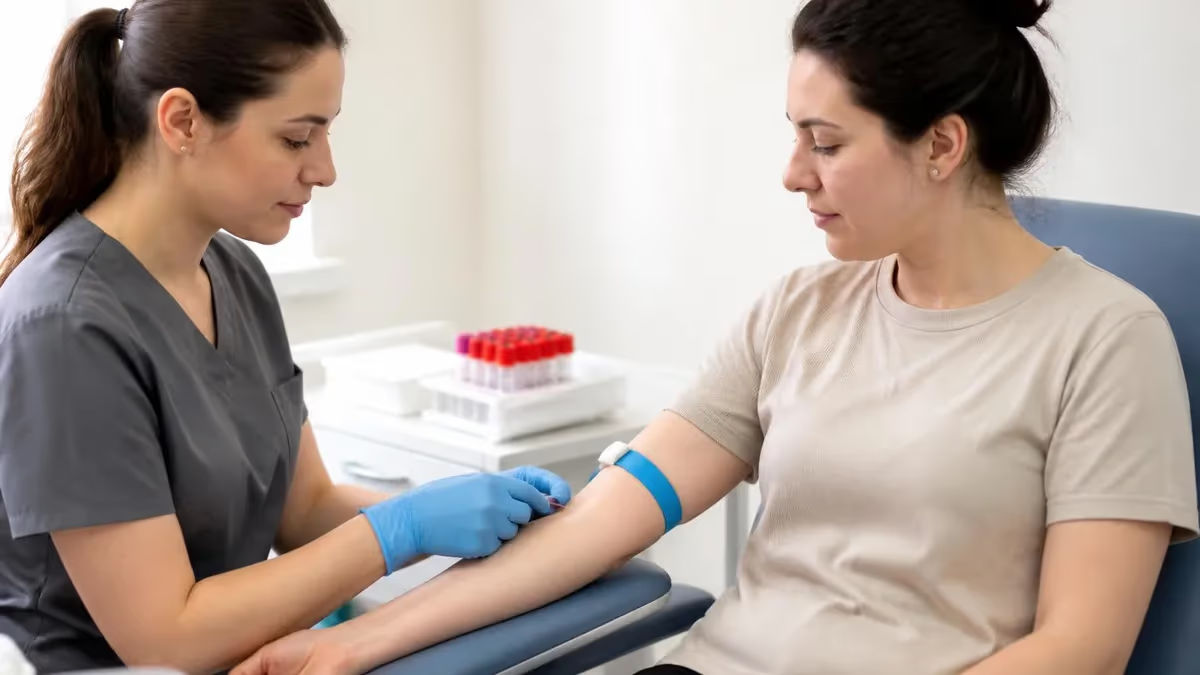
A Certified Phlebotomy Technician (CPT) is a healthcare professional who specializes in drawing blood for laboratory testing, donor blood collection, transfusions, and various medical purposes. The work combines technical skill in venipuncture and capillary collection with patient care abilities serving anxious patients across diverse populations and settings. Phlebotomists work in hospitals, clinical laboratories, blood donation centers, plasma collection facilities, physician offices, and various other healthcare contexts. The CPT credential validates competence in this specialized work through formal education and certification examination, supporting employment opportunities and professional advancement in clinical laboratory science.
Multiple certification organizations offer phlebotomy credentials with somewhat different processes and recognition. National Healthcareer Association (NHA) issues CPT credential. American Society for Clinical Pathology (ASCP) issues PBT credential. American Medical Technologists (AMT) issues RPT credential. National Phlebotomy Association issues CPT credential. Each credential validates similar fundamental competence with somewhat different organizational backing and regional recognition. Most healthcare employers accept multiple credentials, though specific employers may prefer particular organizations. Choosing certifying organization typically depends on training program affiliation, regional recognition, and personal preference among comparable options.

CPT Certification Quick Facts
Major certifying bodies: NHA (CPT), ASCP (PBT), AMT (RPT), National Phlebotomy Association. Eligibility: Approved training program completion plus documented experience hours (typically 30+ successful blood draws). Exam fee: $115-$165 typical. Training duration: 4-12 weeks typical for formal programs; 6-12 months on-the-job training pathways. Salary range: $32,000-$45,000 typical 2026 entry-level; experienced techs earn $40,000-$55,000+. Renewal: Every 2-3 years depending on certifying organization.
Phlebotomy training programs prepare students for both certification examinations and actual workplace performance. Programs typically combine classroom instruction in anatomy, physiology, infection control, specimen handling, and patient interaction with hands-on practice in venipuncture and capillary techniques. Clinical externship at affiliated healthcare facilities provides supervised practice on real patients.
Total program duration runs 4-12 weeks for intensive programs, longer for part-time programs. Programs vary substantially in quality — accredited programs through NAACLS or ASCP-recognized training provide structured education preparing students for certification success. On-the-job training pathways exist particularly in hospital settings hiring entry-level workers and training them to phlebotomy through internal programs.
Phlebotomy Certification Options
National Healthcareer Association Certified Phlebotomy Technician. Most popular for new grads of NHA-affiliated programs.
American Society for Clinical Pathology Phlebotomy Technician. Strong recognition in laboratory and hospital settings.
American Medical Technologists Registered Phlebotomy Technician. Long-established with solid healthcare recognition.
National Phlebotomy Association Certified Phlebotomy Technician. Specialized phlebotomy organization.
California requires state CPT certification (CPT1, CPT2, LPT) administered by Department of Public Health.
Some states (Louisiana, Nevada, Washington) have additional state requirements beyond national certification.
The technical skills phlebotomists develop include multiple venipuncture techniques (vacutainer system, butterfly needle, syringe method) for different situations and patient anatomies. Capillary blood collection (heel sticks for infants, finger sticks for various tests). Identifying suitable veins through visual inspection and palpation.
Specimen handling including proper tube selection for ordered tests, correct order of draw to prevent contamination between tubes, immediate labeling and processing requirements. Quality control verifying patient identity, specimen labeling accuracy, and specimen condition meeting laboratory requirements. Each skill requires substantial practice to develop competence — initial training builds foundation but field experience develops genuine expertise over months and years of practice.
Patient interaction skills matter substantially in phlebotomy work. Many patients are anxious about needles and blood draws; some have phobias creating significant fear responses. Professional, calm, reassuring approach helps anxious patients tolerate procedures. Working with diverse patient populations including children, elderly, frightened adults, intellectually disabled patients, and various other special populations requires adaptation. Communication skills explaining procedures, answering questions, and managing patient cooperation throughout draws develops over time. Quality phlebotomists develop reputation for excellent patient experience even with difficult patients — a skill that distinguishes long-term professionals from those who treat phlebotomy as purely technical task.
Difficult draws develop substantial professional skill over time. Some patients have small or rolling veins making access challenging. Dehydration affects vein visibility and access. Certain medications (chemotherapy particularly) can affect veins making draws difficult. Pediatric patients have small veins requiring specialized technique. Elderly patients may have fragile veins prone to collapse during draws. Phlebotomists develop strategies for these challenges including warming the site, hydrating patients before draws, using smaller-gauge needles, drawing from alternative sites when forearm veins aren't accessible, and various other techniques. The combination of technical skill and adaptive problem-solving distinguishes experienced phlebotomists from beginners.
Phlebotomy training pathways: Vocational schools and community colleges offer 4-12 week intensive programs combining classroom and clinical experience. Online programs combine theory online with arranged clinical externship. Hospital-based on-the-job training over 6-12 months. NAACLS-accredited programs provide highest quality assurance and best preparation for certification. ASCP-recognized programs similarly strong. Verify accreditation status before enrolling — non-accredited programs may not meet certification eligibility requirements. Cost varies $500-$5,000 for formal programs.

Salary ranges for phlebotomists reflect entry-level healthcare positioning with progression through experience. Entry-level positions typically pay $32,000-$40,000 annually in most markets. Experienced phlebotomists with 3-5+ years earn $40,000-$50,000. Lead phlebotomist and supervisory roles reach $50,000-$65,000+. Geographic variation matters substantially — coastal urban markets pay more than rural areas, with cost of living adjustments affecting purchasing power. Hospital positions sometimes pay differently than outpatient lab positions. Travel phlebotomy positions sometimes pay premiums for short-term assignments. Specialty work (oncology phlebotomy, pediatric specialty) sometimes pays modestly more than general adult phlebotomy.
The work environment varies substantially by employment setting. Hospital phlebotomists typically work shifts including early mornings, evenings, weekends, and holidays since blood draws happen 24/7. Commercial laboratories often have more standard daytime hours though Saturday work is common. Blood donation centers operate during convenient hours for donors including evenings and weekends. Plasma centers have similar donor-friendly hours. Each setting offers different work-life balance considerations. Phlebotomists with family obligations sometimes prefer outpatient settings; those wanting hospital experience accept the schedule demands. Career progression often involves trying multiple settings to find best personal fit.
Continuing education maintains certification over time. Most certifying organizations require continuing education credits (CEUs) within recertification cycles. Typical requirements range from 6-30 CEU hours depending on certifying body. CEU options include online courses through certifying organizations, employer-provided training, conferences, journal-based learning, and various other approved sources. Many employers cover CEU costs as professional development support. Active engagement with continuing education supports both certification maintenance and genuine ongoing professional development as practices evolve over time.
Don't choose training programs without verifying accreditation — non-accredited programs may not meet certification eligibility requirements. Don't ignore state-specific requirements — California, Louisiana, Nevada, Washington have additional requirements beyond national certification. Don't underestimate physical demands — phlebotomists are on feet substantially with repetitive motion. Don't overlook patient interaction skills — technical phlebotomy success depends substantially on patient cooperation. Verify employer-preferred certification before pursuing specific credential.
State-specific requirements affect phlebotomy practice in some states. California has the most stringent requirements with state-issued CPT certification (CPT1, CPT2, LPT levels) administered by Department of Public Health requiring specific training and examination. Louisiana, Nevada, and Washington also have additional state requirements beyond national certification. Most other states accept national certification as adequate for phlebotomy practice. Verify state requirements applicable to your target practice location before pursuing training and certification. Working in California particularly requires careful attention to state-specific requirements that differ from general national patterns.
For students considering phlebotomy as career, several factors warrant evaluation. Tolerance for blood, needles, and bodily fluids is essential — people uncomfortable with these aspects shouldn't pursue phlebotomy regardless of other interests. Manual dexterity supports the technical skills required. Patient interaction comfort with diverse populations including anxious, sick, or frightened patients matters daily. Physical stamina supports being on feet for extended periods with repetitive motion. Schedule flexibility for healthcare work including evenings, weekends, and holidays in many settings. Honest self-assessment about these factors supports successful career entry rather than discovering unsuitable fit after substantial training investment.
For career changers from other fields, phlebotomy offers reasonable healthcare entry with relatively quick training timeline. Compared to nursing or medical assisting requiring substantial education, phlebotomy programs of 4-12 weeks support rapid career change. Existing professional skills including customer service, attention to detail, and communication often transfer well into phlebotomy work. Many career changers from retail, hospitality, administrative roles, and various other backgrounds have successfully transitioned into phlebotomy. The compressed training timeline and reasonable salary range make it attractive entry point into healthcare for committed candidates.
Pursuing CPT Certification
- ✓Research training programs in your area for accreditation status
- ✓Verify state-specific requirements for practice location
- ✓Compare program costs and graduate employment outcomes
- ✓Choose certifying organization based on program affiliation and employer preferences
- ✓Plan for clinical externship requirements (typically 30+ documented draws)
- ✓Prepare for certification examination using official prep materials
- ✓Apply for certification through chosen organization after meeting eligibility
- ✓Begin job applications during certification process for fastest employment
Phlebotomy as foundation for further healthcare careers serves many practitioners well. Many phlebotomists eventually pursue nursing through ADN or BSN programs, applying healthcare experience to nursing school. Some progress to medical laboratory technology through additional education building on phlebotomy foundation. Medical assisting adds broader clinical duties for outpatient settings. Some pursue PA or NP programs eventually. Each progression path uses phlebotomy experience as legitimate healthcare entry point supporting subsequent advancement. The ability to work as phlebotomist while completing additional education supports financially sustainable healthcare career building over time rather than requiring full-time student status without income.
For specific specialty applications, phlebotomy work varies substantially. Hospital ED phlebotomy involves rapid draws on diverse patients in fast-paced environment. Pediatric phlebotomy requires specialized technique and behavioral management with children. Oncology phlebotomy involves working with patients undergoing chemotherapy with affected veins requiring specialized approach. Plasma collection involves longer donor interactions with strict regulatory oversight. Blood donation involves screening donors and collecting larger volumes than diagnostic draws. Each specialty requires somewhat different skills and offers different work experience. Many phlebotomists try multiple settings throughout careers finding personal fit and developing well-rounded experience.
Looking forward at phlebotomy workforce, several trends affect employment prospects. Aging population drives ongoing demand for diagnostic blood work supporting healthcare expansion. Point-of-care testing reduces some traditional phlebotomy needs but specialized laboratory testing continues growing. Mobile phlebotomy services expand outside traditional facility settings. Plasma donation industry continues growing creating dedicated employment beyond traditional clinical settings. Each trend affects specific employment niches differently but overall phlebotomy demand remains stable to growing through 2030 per Bureau of Labor Statistics projections. New phlebotomists entering the field face favorable employment markets in most regions.

Examination preparation strategies for phlebotomy certification follow general standardized exam preparation principles. Review the official Test Plan published by your chosen certifying organization describing content areas tested and approximate weighting. Use official certifying organization study materials. Practice exams build familiarity with question formats and identify weak areas. Hands-on practice through training program externship and continued practice supports both exam performance and actual workplace skills. Most candidates pass on first attempt with adequate preparation; those who don't can retake after waiting period (typically 30-90 days).
For internationally-trained phlebotomists seeking US certification, the pathway differs from US-trained candidates. Foreign training may not exactly match US requirements, requiring evaluation by certifying organization or credential evaluation services. Additional training or experience may be required to fill gaps between foreign training and US standards. English language proficiency examinations may be required before certification eligibility. The full pathway from foreign credentials to US certification can take 6-12 months including credential evaluation, gap-filling education, and certification examinations.
For people working in healthcare adjacent roles considering phlebotomy specialization, transition is generally smooth. Existing healthcare experience (CNA, MA, hospital scheduling, patient registration) provides foundation supporting phlebotomy training. Many healthcare employers offer internal training pathways for current staff transitioning to phlebotomy. The compressed training timeline (4-12 weeks plus certification) supports rapid specialization without leaving employment. Once certified, expanded duties or position transitions follow naturally. The combination of existing healthcare context plus phlebotomy specialization often produces strong workplace performance from day one of phlebotomy work.
Phlebotomy Career Quick Stats
Phlebotomy Employment Settings Comparison
Diverse patient populations. 24/7 schedule including nights, weekends, holidays. Fast-paced ED and ICU work.
Quest, LabCorp, regional labs. More predictable schedules. High volume routine draws on outpatients.
Red Cross, Vitalant. Screening donors, collecting larger volumes. Regular schedules including weekends.
CSL, Grifols. Repeat donor relationships. Strict regulatory environment. Often nights/weekends.
Outpatient practice draws. Predictable daytime schedule. Lower volume than hospital or commercial lab.
Travel to patient locations. Schedule flexibility. Premium pay for specialty service.
Documentation skills affect both daily phlebotomy work and overall career success. Accurate specimen labeling prevents catastrophic mismatches that can affect patient care. Proper documentation of difficult draws supports clinical decision-making and patient care continuity. Compliance documentation for various procedures supports regulatory compliance. Quality control documentation supports accreditation requirements at facilities. Strong documentation habits developed early in career support both safe patient care and professional reputation as detail-oriented quality phlebotomist. Documentation skills also transfer well to broader healthcare career advancement where attention to detail matters substantially.
Infection control practices represent essential phlebotomy competence with both patient and personal safety implications. Hand hygiene before and after every patient. Proper PPE including gloves for every draw. Sharps safety preventing needlestick injuries. Bloodborne pathogen awareness and exposure protocols. Specimen handling preventing exposure to others. Proper waste disposal of contaminated materials. These practices protect both patients from cross-contamination and phlebotomists from occupational exposure. Quality phlebotomists treat infection control as fundamental practice rather than optional inconvenience, supporting both immediate safety and long-term professional health.
Patient safety practices in phlebotomy work extend beyond infection control. Patient identification verification using two unique identifiers prevents specimens from wrong patients getting attributed incorrectly. Order verification confirming correct tests prevents unnecessary draws or missing requested tests. Specimen labeling immediately after collection prevents mislabeling that can cause catastrophic patient care errors. Quality control verifying specimen condition meets laboratory requirements prevents rejected specimens requiring redraws. Each safety practice protects patients while supporting accurate diagnostic results. Quality phlebotomists develop systematic safety habits that become automatic, reducing risk of errors that can have serious consequences for patient care decisions.
Communication skills with diverse patient populations develop through experience. Pediatric patients require child-appropriate language explaining procedures simply, behavioral techniques distracting from discomfort, and patience with anxiety responses. Elderly patients may need slower pace, careful explanation, and gentle handling of fragile veins. Patients with limited English proficiency require clear communication often through interpreters or visual demonstration. Patients with intellectual disabilities need adapted communication matching their understanding level. Patients with mental health conditions may need particular sensitivity. Quality phlebotomists develop adaptive communication serving all populations effectively, with personal interaction skills as important as technical phlebotomy abilities.
Safety considerations for phlebotomists themselves matter alongside patient safety. Needlestick injury prevention through proper sharps handling and disposal. Body mechanics protecting from repetitive strain injury through proper positioning and equipment use. Stress management for emotionally demanding patient interactions. Time management preventing rushing that increases error risk. Personal physical health supporting demanding standing work over years. Phlebotomists who attend to personal safety alongside patient safety sustain longer careers without health complications. Many career-long phlebotomists credit deliberate attention to ergonomics and stress management with sustaining their ability to work productively over decades.
Looking at phlebotomy as gateway to healthcare careers more broadly, many phlebotomists eventually pursue advanced training and credentials. Some progress to medical laboratory technician (MLT) requiring 2 years additional education. Others enter nursing through ADN or BSN programs. Some pursue medical assisting expanding clinical scope beyond just phlebotomy. A few pursue physician assistant or nurse practitioner training over many years. Each path uses phlebotomy experience as legitimate entry point with documented healthcare experience supporting subsequent applications.
The CPT credential serves both as terminal credential for those satisfied with phlebotomy work and stepping stone for those wanting advancement, providing genuine flexibility in career planning across many years of healthcare professional development for those committed to broader clinical careers beyond entry-level phlebotomy work across many years of progression into nursing or laboratory science careers throughout the broader healthcare workforce ecosystem.
Phlebotomy Career: Pros and Cons
- +Reasonable training timeline (4-12 weeks) for healthcare entry
- +Stable employment with continued demand through 2030
- +Foundation for further healthcare career advancement
- +Modest training cost compared to many healthcare programs
- +Variety of employment settings offering different work environments
- +Direct patient care experience valuable for many career paths
- −Entry-level salary lower than many healthcare careers
- −Physical demands including standing and repetitive motion
- −Patient interaction includes anxious or difficult patients
- −Some settings require nights, weekends, holidays
- −Exposure to bloodborne pathogens requires careful precautions
- −Career ceiling lower than nursing or other advanced healthcare roles
Pros and Cons at a Glance
| Pros | Cons |
|---|---|
| Foundation for further healthcare career advancement | Entry-level salary lower than many healthcare careers |
| Modest training cost compared to many healthcare programs | Physical demands including standing and repetitive motion |
| Variety of employment settings offering different work environments | Patient interaction includes anxious or difficult patients |
| Direct patient care experience valuable for many career paths | Some settings require nights, weekends, holidays |
Sample Phlebotomy Practice Questions
Try these questions from our free Phlebotomy practice tests. The correct answer and an explanation follow each question.
Which certification is commonly associated with the Association of Phlebotomy Technicians?
- A. Certified Phlebotomy Technician (CPT)
- B. Registered Medical Assistant (RMA)
- C. Clinical Laboratory Scientist (CLS)
- D. Certified Surgical Technician (CST)
Answer: A. Certified Phlebotomy Technician (CPT)
The certification most commonly associated with the Association of Phlebotomy Technicians (APT) is the Certified Phlebotomy Technician (CPT). This credential demonstrates that an individual has met specific standards of knowledge and skill in phlebotomy. Achieving CPT certification validates a phlebotomist's competency and professionalism in blood collection.
How many continuing education units (CEUs) must NHA-certified phlebotomy technicians complete before renewing their certification?
- A. 10 CEUs
- B. 15 CEUs
- C. 20 CEUs
- D. 25 CEUs
Answer: A. 10 CEUs
NHA CPT holders must complete 10 CEUs every two years to maintain their certification.
How often must the AMCA Phlebotomy Technician Certification be renewed?
- A. Every 1 year
- B. Every 2 years
- C. Every 3 years
- D. Every 5 years
Answer: B. Every 2 years
The AMCA Phlebotomy Technician Certification (PTC) requires renewal every two years. To maintain active certification, professionals must typically complete continuing education requirements and pay a renewal fee. This regular renewal process ensures that certified phlebotomists stay updated with current best practices and advancements in the field.
What is the minimum education requirement for AMT’s Registered Phlebotomy Technician (RPT) certification?
- A. Completion of a phlebotomy training program
- B. Associate degree in medical technology
- C. High school diploma only
- D. Bachelor’s degree in health sciences
Answer: A. Completion of a phlebotomy training program
For AMT's Registered Phlebotomy Technician (RPT) certification, the minimum education requirement is the completion of an approved phlebotomy training program. This program must include both theoretical instruction and practical clinical experience. This ensures candidates have the necessary specialized knowledge and hands-on skills for the role.
Phlebotomy Questions and Answers
About the Author

Registered Nurse & Healthcare Educator
Johns Hopkins University School of NursingDr. Sarah Mitchell is a board-certified registered nurse with over 15 years of clinical and academic experience. She completed her PhD in Nursing Science at Johns Hopkins University and has taught NCLEX preparation and clinical skills courses for nursing students across the United States. Her research focuses on evidence-based exam preparation strategies for healthcare certification candidates.