
Phlebotomy Programs: Types, Cost, Duration, and How to Enroll 2026 September
Compare phlebotomy programs by type, cost, and duration. 🏆 Learn what accredited programs cover, what certification to pursue, and how to start your career.
What Is a Phlebotomy Program?
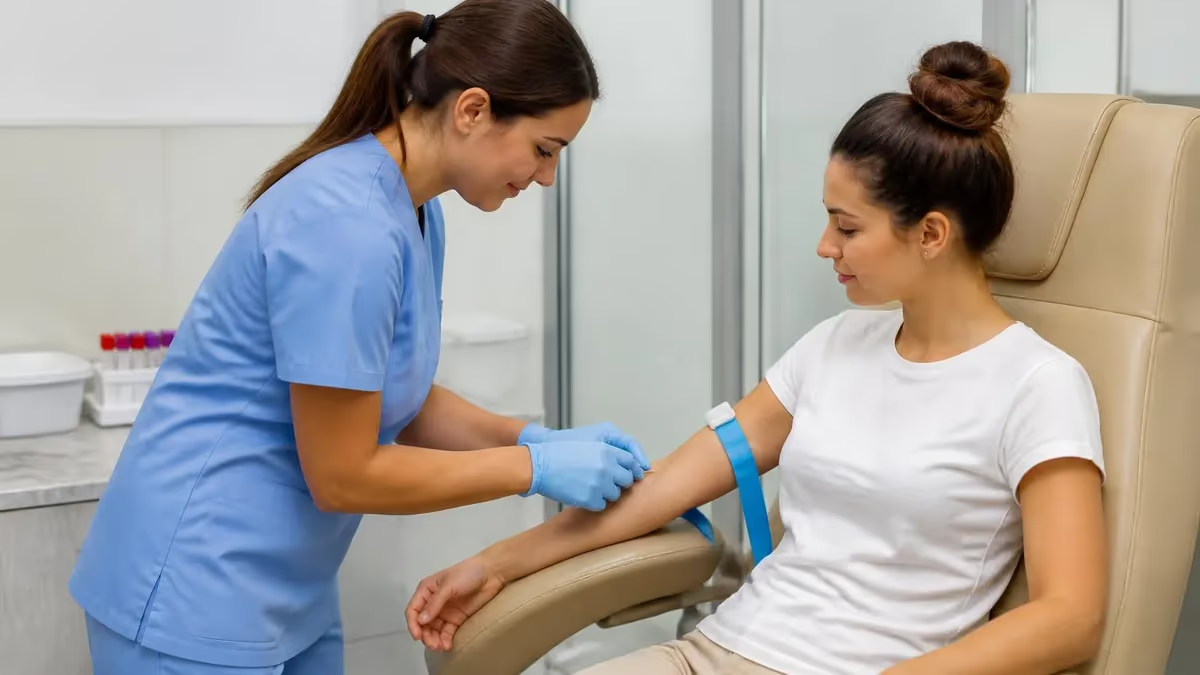
A phlebotomy program is a structured educational course that prepares students to work as phlebotomists — the healthcare professionals responsible for drawing blood from patients for laboratory testing, transfusions, research, and donation. Phlebotomy programs teach the technical skills, anatomy knowledge, infection control procedures, and patient communication abilities needed to safely and accurately collect blood specimens in clinical settings.
Phlebotomy is an entry-level healthcare career that doesn't require a nursing degree or years of college, making phlebotomy programs an accessible pathway into the medical field. Most programs can be completed in weeks to months rather than years, and costs are significantly lower than degree-level healthcare programmes. For people looking to build a healthcare career quickly without the time or financial commitment of a degree programme, a phlebotomy program that leads to national certification is one of the more efficient and reliable routes into consistent clinical employment in a growing field.
Programs are offered by community colleges, vocational and career schools, hospital-based training programmes, and online providers. The specific format — certificate, diploma, or associate degree — varies by institution, but all legitimate phlebotomy programs share the same core goals: teaching venipuncture and capillary puncture technique, ensuring students can work safely with blood and other biological specimens, and preparing graduates for the certification examination that most clinical employers require for hire.
To understand what is phlebotomy in full scope — the day-to-day work, the settings phlebotomists work in, and the skills involved — helps you evaluate whether a phlebotomy program aligns with what you're looking for in a healthcare career before you invest time and money in training.
- Program length: Certificate programs typically run 4-16 weeks; diploma programs 3-6 months; associate degrees 1-2 years
- Core skill: Venipuncture (drawing blood from a vein) — plus capillary puncture, specimen processing, and patient communication
- Certification exams after completion: NHA CPT, ASCP PBT, AMT RPT, and others — employers typically require at least one national certification
- Cost range: $700-$3,500 for certificate programs; associate degree programs cost more
- Accreditation to look for: NAACLS (National Accrediting Agency for Clinical Laboratory Sciences) or CAAHEP accreditation
- Clinical hours required: Most programs require 80-200 hours of supervised clinical experience with real patients
- Job outlook: 8% growth projected through 2033 (BLS) — demand driven by ageing population and expanding diagnostic testing
How to Enroll in and Complete a Phlebotomy Program
Step 1: Research and choose an accredited program
Step 2: Meet prerequisites and apply
Step 3: Complete classroom and lab instruction
Step 4: Complete supervised clinical externship

Types of Phlebotomy Programs
Not all phlebotomy programs lead to the same credential. Understanding the types helps you match the program to your career goals, timeline, and budget.
Certificate programs are the most common and most efficient pathway into phlebotomy employment. A phlebotomy certificate programme typically runs 4-16 weeks full-time (or longer part-time) and covers the core competencies — anatomy, venipuncture, capillary puncture, specimen processing, and patient interaction — plus the clinical externship hours needed for certification. Certificate programs at accredited schools typically qualify graduates to sit for national phlebotomy certification exams (NHA CPT, ASCP PBT, AMT RPT). Most phlebotomists in clinical settings hold a certificate rather than a degree-level credential — it's the standard pathway for entry-level employment.
Diploma programs are similar to certificate programs but may have slightly broader curricula, including more medical terminology, healthcare law and ethics, and administrative components. Some community colleges and vocational schools offer phlebotomy diplomas that take 3-6 months and position graduates more comprehensively for the healthcare workplace, though the core phlebotomy skills curriculum is essentially the same as in certificate programs.
Associate degree programs incorporate phlebotomy skills into a broader clinical laboratory or allied health curriculum. An Associate of Applied Science (AAS) in phlebotomy or clinical laboratory technology includes the phlebotomy skills curriculum plus foundational science courses, general education requirements, and often broader laboratory science content. Associate degrees take 1-2 years to complete and provide a more comprehensive education, but the time and cost investment is higher.
For people who are certain they want to stay in phlebotomy long-term without advancing to clinical laboratory science or nursing, an associate degree may be more education than the job requires — but for those who want to keep future options open toward more advanced lab roles, it provides a stronger foundation. Searching for phlebotomy training specialists in your area can help you compare the different program types available locally.
Hospital-based training programs are run by hospitals, large health systems, or blood donation organisations that train phlebotomists specifically for their own workforce. These programs may not issue a portable certificate but prepare students for national certification exams and often lead directly to employment with the sponsoring organisation. Some hospital-based programs are paid training positions — you're essentially an employee in training. If you're trying to enter phlebotomy quickly and already have a target employer, hospital-based training is worth investigating.
What Phlebotomy Programs Cover
The circulatory system, veins and arteries relevant to blood collection sites, blood composition (red cells, white cells, platelets, plasma), anticoagulation and coagulation basics, and the physiological reasons different specimen types are collected differently. Understanding the anatomy is what allows a phlebotomist to make good decisions when a routine collection site isn't accessible.
The core technical skills: proper vein selection, tourniquet application, needle insertion angle and technique, tube filling sequence (the 'order of draw'), capillary puncture technique for finger sticks and heel sticks (paediatric), and how to handle complications like rolling veins, haematoma, and fainting. Extensive hands-on practice is the only way these skills develop — training arm practice followed by supervised live patient draws.
Proper labelling, transport conditions, centrifugation of serum/plasma specimens, aliquotting, and understanding what different lab tests require in terms of specimen type and handling. Improper specimen handling is a leading cause of rejected specimens and repeated draws — meticulous technique from collection through processing is taught as a core quality standard.
Standard precautions, PPE use, needle safety and sharps disposal, bloodborne pathogen training (OSHA requirement), hand hygiene protocols, and how to handle accidental needle sticks or blood exposures. Infection control is non-negotiable — phlebotomists work daily with blood, and strict adherence to safety protocols protects both patients and the phlebotomist.
Accredited Programs vs. Non-Accredited Programs
Phlebotomy program accreditation by NAACLS (National Accrediting Agency for Clinical Laboratory Sciences) or CAAHEP (Commission on Accreditation of Allied Health Education Programs) is a significant quality indicator — and a practical requirement for some certification exam eligibility pathways.
Why accreditation matters in practice:
- Certification exam eligibility: Some national certifying bodies (particularly ASCP for the PBT credential) give preference to graduates of accredited programs, and may have different eligibility requirements for accredited vs. non-accredited programme graduates
- Employer recognition: Many hospitals and clinical labs specify graduation from an accredited program as a hiring requirement, particularly for positions in academic medical centres and large health systems
- Program quality assurance: Accredited programs are reviewed against standardised curricula benchmarks, minimum clinical hours requirements, and pass rate data — providing more predictable quality than unaccredited programmes
- Clinical site access: Accredited programs typically have established relationships with clinical externship sites; non-accredited programs may struggle to place students in quality externship experiences

Phlebotomy Program Cost and Financial Assistance
Phlebotomy programs are among the more affordable healthcare training pathways, but costs still vary significantly by type and provider. Certificate programs at community colleges typically cost $700-$2,500 including materials, clinical fees, and exam prep. Vocational school certificate programs often run higher — $1,500-$3,500 — though they may include certification exam fees in the total programme cost. Associate degree programs carry the full cost of two years of community college or university credits, ranging from $5,000 to well over $20,000 depending on the institution and whether you qualify for in-state tuition.
If you're looking for phlebotomy training specialists or community college programmes near you, compare the total cost of attendance — including materials, lab fees, clinical placement fees, and the certification exam — not just the listed tuition. Some programmes include the certification exam fee in their cost; others don't, and the NHA CPT or ASCP PBT exam adds $100-$155 depending on the certifying body.
Financial assistance for phlebotomy training is available through several channels. WIOA (Workforce Innovation and Opportunity Act) funding covers training costs for eligible unemployed or underemployed workers pursuing in-demand healthcare occupations at approved training providers — phlebotomy is commonly on the approved occupation list. Check with your local American Job Center about WIOA eligibility and which programmes in your area are approved for WIOA funding. Community college financial aid — including Pell Grants for eligible students — can offset certificate program costs at accredited community colleges that participate in federal financial aid.
Some hospitals and healthcare organisations offer tuition reimbursement or direct sponsorship for phlebotomy training for employees who are already working in other roles (e.g., medical assistants, CNAs, patient transporters) and want to add phlebotomy skills. If you're already employed in a healthcare setting, ask your HR department whether tuition assistance for phlebotomy training is available — it's a commonly offered employee development benefit that many eligible employees don't think to pursue. Searching for phlebotomy courses near me through employer connections can sometimes uncover sponsored training opportunities not advertised publicly.
How to Evaluate a Phlebotomy Program Before Enrolling
- ✓Check accreditation status: verify that the program holds NAACLS or CAAHEP accreditation, or confirm that its graduates are eligible for national certification exams without the accreditation pathway
- ✓Ask about the clinical externship: how many hours, at what types of clinical sites, and how many venipunctures students complete — this is the most critical preparation element
- ✓Ask the first-time certification exam pass rate: a quality program should have a high first-attempt pass rate on NHA, ASCP, or AMT exams
- ✓Understand the full cost: get the all-in total including materials, lab fees, clinical fees, and whether the certification exam fee is included
- ✓Check schedule and format options: some programs offer evening and weekend schedules for working students; others are full-time only
- ✓Verify your target certification's eligibility requirements: confirm graduates of the specific program you're considering meet the requirements for the certification exam you plan to take
- ✓Research the program's clinical site relationships: programs with established sites at hospitals and multi-draw labs give you better externship quality than programs that ask you to find your own site
Certificate Program vs. Associate Degree: Which to Choose?
- +A certificate program gets you into the workforce in weeks or months rather than years — for people who need to start earning quickly, the certificate pathway is significantly more efficient
- +An associate degree provides a broader healthcare education that keeps more career doors open — if you're uncertain whether you want to stay in phlebotomy or eventually move to clinical laboratory science or nursing, the additional coursework provides more flexibility
- +Certificate programs cost a fraction of associate degree programmes — the return on investment is faster and clearer for someone who's certain about a phlebotomy career
- +Associate degree programs may position graduates for laboratory technician roles in addition to phlebotomy, creating a broader range of job options at a similar education level
- −Certificate programs don't satisfy the education requirements for more advanced clinical laboratory roles — if you want to move into clinical laboratory scientist or medical laboratory technician work, you'll need additional education beyond the certificate
- −Associate degree programmes require a larger time and financial investment without meaningfully changing the entry-level phlebotomist job prospects in most markets — the certificate is the standard for clinical phlebotomy work
- −Some employers in major metro markets specify the same certification requirements regardless of whether the candidate holds a certificate or an associate degree — the degree may not distinguish you as much as you'd expect in the hiring process

Phlebotomy Certification After Program Completion
Completing a phlebotomy program is the first step — national certification is what most clinical employers require before hiring. The major national phlebotomy certifications are offered by the National Healthcareer Association (NHA CPT — Certified Phlebotomy Technician), the American Society for Clinical Pathology (ASCP PBT — Phlebotomy Technician), the American Medical Technologists (AMT RPT — Registered Phlebotomy Technician), and the National Center for Competency Testing (NCCT TPT). The NHA CPT and ASCP PBT are the most widely recognised in clinical hiring decisions.
Each certifying body has its own eligibility requirements — typically some combination of completed phlebotomy training and a minimum number of documented venipunctures (usually 100+ for NHA, 100 for ASCP). Your program's externship should be structured to meet these requirements, but verify the count before completing your programme — you don't want to discover you're 20 venipunctures short of certification eligibility after completing everything else. Programmes listed among reputable phlebotomy classes near me at accredited schools will typically ensure graduates meet the minimum counts.
Certification exams are typically computer-based and taken at a testing centre. They cover the content taught in phlebotomy programs — anatomy, venipuncture procedures, order of draw, specimen handling, infection control, and patient interaction. Most programs include exam preparation as part of the curriculum. First-time pass rates for graduates of accredited programs are generally high — the knowledge tested is what you've been studying throughout the programme. Preparing with practice test materials in the weeks before the exam reinforces the content and familiarises you with the question format.
Once certified, the typical maintenance requirement is completing continuing education credits and paying a renewal fee every 2-3 years to keep your certification current. Certifications lapse if not renewed, and some employers conduct periodic credential verification — tracking your renewal deadline and maintaining continuing education hours is a basic professional responsibility. Most hospitals and labs have credentialing departments that track expiration dates for all staff certifications and will notify you before renewal is due.
When comparing phlebotomy programs, ask specifically about certification exam preparation — whether the programme includes practice exams, which certifications their graduates most commonly pursue, and what their first-attempt pass rates look like. A programme that consistently produces graduates who routinely pass their first certification attempt is demonstrably delivering on its core training promises.
Phlebotomy Programs: Key Facts
Career Options After Completing a Phlebotomy Program
Most phlebotomy program graduates enter direct patient care roles drawing blood in hospitals, outpatient labs, physician offices, urgent care clinics, dialysis centres, or blood donation organisations. Entry-level phlebotomists in the US earn a median wage around $38,000-$42,000 annually according to BLS data, with significant variation by state, setting, and employer. Hospital positions typically offer the most comprehensive benefits and the highest base wages; private lab chains and physician offices may offer more predictable scheduling but sometimes at lower hourly rates.
With experience, phlebotomists can advance into senior or lead phlebotomist roles, phlebotomy supervisor positions, or specimen processing coordinator roles. Some experienced phlebotomists transition into healthcare training and education — teaching phlebotomy technique to new students or serving as clinical externship supervisors. Others use phlebotomy as the entry point into a longer healthcare education path, with phlebotomy providing income and clinical experience while they pursue CNA, nursing, or clinical laboratory science education concurrently.
The clinical laboratory field offers a natural adjacent career path for phlebotomists who want to advance without pursuing nursing. Clinical Laboratory Technicians (CLT/MLT) and Clinical Laboratory Scientists (CLS/MLS) perform laboratory testing on the specimens that phlebotomists collect. Moving from phlebotomy into clinical lab roles requires an associate or bachelor's degree in clinical laboratory science, but the familiarity with specimen types, clinical settings, and laboratory workflow that phlebotomists develop is genuinely useful preparation for those programmes. Some phlebotomists pursue evening or online degree programmes in clinical laboratory science while working full-time in phlebotomy roles.
The working environment in phlebotomy is different from most clinical roles in that it's physically mobile — hospital phlebotomists often spend their shifts walking from room to room, collecting specimens at patient bedsides throughout the facility. Outpatient and lab phlebotomists typically work from a fixed draw station. If you prefer the physical activity and variety of moving through a hospital to a more stationary clinical role, phlebotomy's typical work pattern is a meaningful quality-of-life consideration. Understanding how your target employment setting operates before committing to a programme helps you match your program choice to the specific environment you're aiming for.
Phlebotomists frequently work directly with patients who are anxious, in pain, or have a fear of needles — and patient communication skills are genuinely part of the job competency, not just a soft add-on. The best phlebotomists are calm, reassuring, and efficient, because a patient who trusts the person drawing their blood is easier to work with technically.
Training programmes teach these communication skills, but many graduates find the first weeks in externship — working with real patients for the first time — to be where these skills solidify in a way that classroom instruction alone can't replicate. This is another reason why the quality of a programme's clinical externship placement matters as much as the classroom curriculum when evaluating where to train.
Not all phlebotomy programs produce graduates who are immediately eligible to sit for national certification exams — and discovering this after completing the programme is an expensive problem to avoid. Before enrolling, contact the certifying body for the certification you're targeting (NHA, ASCP, AMT) and confirm that graduates of the specific programme you're considering meet their eligibility requirements. Requirements typically specify: completing an accredited or approved training programme, a minimum number of documented venipunctures (usually 100+), and sometimes a minimum number of clinical hours. If the programme doesn't hit these marks, you may need additional externship hours — or may have to pursue a second programme — before you're eligible to take the exam. This verification takes one phone call or email and is worth doing before any tuition payment.
Finding the Right Phlebotomy Program for Your Situation
The best phlebotomy program isn't necessarily the most expensive or the longest — it's the one that matches your timeline, budget, schedule, and career goals while meeting the quality and accreditation standards that certification and employers require. For most people, an accredited certificate program at a community college or vocational school near them — or one with a genuine online component with in-person clinical placement — is the right answer.
Start by checking accreditation: the NAACLS website maintains a searchable, publicly accessible database of accredited phlebotomy programs searchable by state and location. This accreditation database is the most reliable and verifiable first filter for programme quality — cross-reference any programme you're considering against it before paying a deposit. Then compare costs, clinical site quality, and schedule options among the accredited programs available to you. If budget and cost are the primary constraint, accredited community college programmes are typically the best overall value. If speed is the priority, look for programmes that run 4-6 weeks full-time and have rolling start dates.
If you're already employed in healthcare — as a CNA, medical assistant, patient transporter, or other role — ask your employer about tuition assistance before looking externally. Many health systems offer direct sponsorship or reimbursement for phlebotomy training for employees who want to add the skill, and employer-sponsored training often comes with guaranteed employment in a phlebotomy role after certification. This is the most financially efficient pathway if it's available to you.
Once you've shortlisted two or three programmes that meet the accreditation and cost criteria, visit in person if possible before enrolling. Talk to current students or recent graduates about the quality of the clinical externship placement, the accessibility of instructors, and how prepared they felt going into the certification exam. Programme websites often highlight success stories and highlight placements but a candid conversation with someone who recently completed the programme gives you a more honest picture of whether the training actually delivers what it promises.
Phlebotomy Programs Questions and Answers
About the Author

Registered Nurse & Healthcare Educator
Johns Hopkins University School of NursingDr. Sarah Mitchell is a board-certified registered nurse with over 15 years of clinical and academic experience. She completed her PhD in Nursing Science at Johns Hopkins University and has taught NCLEX preparation and clinical skills courses for nursing students across the United States. Her research focuses on evidence-based exam preparation strategies for healthcare certification candidates.