
Phlebotomy Practice Test PDF 2026 September
Prepare for the Phlebotomy certification. Practice questions with answer explanations covering all exam domains. 📝
Phlebotomy Practice Test PDF 2026
Phlebotomy certification exams test your knowledge of venipuncture technique, specimen processing, safety protocols, and the anatomy of the circulatory system. A phlebotomy practice test PDF lets you study offline, quiz yourself on realistic exam-style questions, and identify knowledge gaps before test day. Download our free printable phlebotomy study guide below and prepare for ASCP, NHA, or AMT certification.
Phlebotomy Certification Overview
Several national credentialing bodies offer phlebotomy certification, and understanding which credential matches your career goals is the first step in exam preparation. The three most widely recognized phlebotomy credentials are offered by the American Society for Clinical Pathology (ASCP), the National Healthcareer Association (NHA), and the American Medical Technologists (AMT).
The ASCP Phlebotomy Technician (PBT) exam is widely considered the most rigorous and nationally respected phlebotomy credential. The ASCP PBT exam consists of 80 questions (100 including 20 pilot questions) with a 2-hour time limit. Content areas include blood collection equipment, venipuncture technique, complications, specimen processing, quality control, and safety. Eligibility requires either graduation from an accredited phlebotomy program or a combination of education and documented blood collection experience.
The NHA Certified Phlebotomy Technician (CPT) exam has 120 questions (100 scored, 20 pretest) and a 2-hour time limit. NHA exams are widely accepted at hospital systems, physician offices, and reference laboratories. Content domains cover patient preparation, blood collection, specimen processing, workplace operations, and safety/compliance.
The AMT Registered Phlebotomy Technician (RPT) exam consists of 120 multiple-choice questions with a 3-hour time limit. AMT credentials are recognized nationally and the RPT is often accepted in states that require phlebotomy certification for employment.
Additional credentialing bodies include the National Center for Competency Testing (NCCT), which offers the NCPT credential, and the American Medical Certification Association (AMCA), which offers the CPT(AMCA). Regardless of which credential you pursue, the core knowledge domains — venipuncture technique, patient safety, specimen integrity, and laboratory operations — are substantially the same across all exams.
Venipuncture Technique
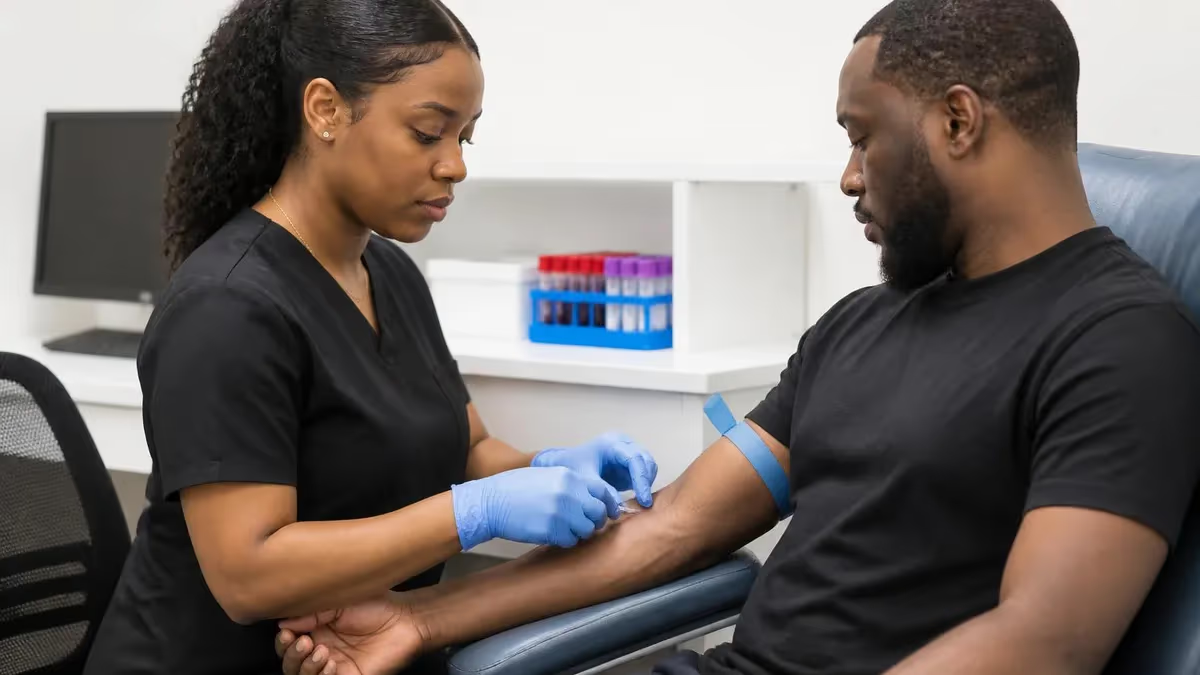
Venipuncture — the puncture of a vein to collect a blood specimen — is the core clinical skill of phlebotomy. The standard venipuncture technique using the evacuated tube system (ETS) involves a defined sequence of steps that must be performed correctly to obtain a quality specimen and protect patient safety.
The antecubital fossa (the area on the inside of the elbow) is the preferred venipuncture site for most patients. The three primary veins in the antecubital fossa are the median cubital vein (first choice — most stable, least painful), the cephalic vein (second choice — rolls easily but acceptable), and the basilic vein (third choice — close to the brachial artery and median nerve, higher complication risk). Selection among these veins follows a priority order based on palpation of vein size, stability, and depth.
The Evacuated Tube System (ETS) uses vacuum-sealed tubes to draw blood directly from the vein through a dual-pointed needle and holder assembly. The ETS eliminates the need to transfer blood from a syringe, reducing hemolysis risk and improving specimen quality. Needle gauges used in phlebotomy range from 21 gauge (most common for routine venipuncture) to 23 gauge (for smaller or more fragile veins).
Proper venipuncture technique requires: applying a tourniquet 3 to 4 inches above the site, cleansing with 70% isopropyl alcohol and allowing to dry, anchoring the vein with thumb traction, inserting the needle at a 15 to 30 degree angle bevel up, advancing smoothly until blood flows, filling tubes in order of draw, releasing the tourniquet before removing the needle, applying pressure with gauze, and labeling tubes immediately at the bedside before leaving the patient.
Order of Draw
The order of draw is one of the most heavily tested topics on all phlebotomy certification exams. The correct order prevents cross-contamination of tube additives between specimens, which can cause incorrect laboratory results.
The CLSI-recommended order of draw for ETS collection is:
- Blood culture tubes (yellow SPS or aerobic/anaerobic culture bottles) — always first to minimize contamination
- Light blue top (sodium citrate) — coagulation studies; must be completely filled to maintain the correct blood-to-additive ratio
- Red top (no additive, clot activator) or gold/SST top (serum separator tube with clot activator and gel)
- Green top (lithium heparin or sodium heparin) — plasma chemistry
- Lavender/purple top (EDTA) — CBC, blood bank
- Pink top (EDTA for blood bank/type and screen)
- Gray top (potassium oxalate/sodium fluoride) — glucose, lactate
A common mnemonic taught in phlebotomy programs is "Stop, Red Light! Go, Let's Look at Glucose" or similar variations. The key principle is that anticoagulant tube additives (EDTA, heparin) must not contaminate tubes drawn before them, which is why coagulation tubes (light blue) are drawn before EDTA tubes (lavender).
Dermal (Capillary) Puncture
Dermal puncture, also called capillary blood collection, is used when venipuncture is not appropriate — for infants and young children (venipuncture of small veins risks hematoma and injury), patients requiring micro-samples, point-of-care testing, and patients with fragile or inaccessible veins.
In adults, the recommended dermal puncture site is the fingertip — specifically the palmar surface of the 3rd or 4th finger (middle or ring finger), lateral to the centerline, away from the nail. The 1st finger (thumb) is avoided due to callus formation; the 5th finger (pinky) is avoided due to thin tissue and proximity to bone.
In infants under one year, heel sticks are performed on the medial or lateral plantar surface of the heel, never the posterior curve (which is too close to the calcaneus bone and risks osteomyelitis). CLSI standards define safe heel stick zones using distance measurements from anatomical landmarks.
Capillary blood has a different composition from venous blood — it is a mixture of arterial blood, venous blood, and tissue fluid. The first drop of blood is always wiped away to remove tissue fluid contamination. Capillary glucose values are slightly higher than venous glucose values in the fasting state.
Special Collections
Blood cultures require strict aseptic technique to prevent contamination of the specimen with skin flora. The collection site is cleansed with 70% isopropyl alcohol followed by 2% chlorhexidine gluconate (or povidone-iodine) and allowed to dry completely before puncture. Culture bottles are inoculated in the order of anaerobic first, then aerobic (to prevent air introduction into the anaerobic bottle). The typical collection volume is 8 to 10 mL per bottle.
Glucose tolerance testing (GTT) requires timed blood draws at specific intervals after ingestion of a glucose load. The standard 3-hour GTT for gestational diabetes screening involves a fasting draw, followed by 1-hour, 2-hour, and 3-hour post-glucose draws. Each draw must be collected at precisely the specified time interval. Gray-top tubes (sodium fluoride) are used to inhibit glycolysis and preserve glucose concentration during transport.
Other special collections include: arterial blood gas (ABG) collection from the radial artery (requires modified Allen's test to verify ulnar collateral circulation), therapeutic drug monitoring (timed collection relative to drug administration for trough/peak levels), and neonatal screening via heel stick onto filter paper cards (newborn metabolic screening).
Patient Identification and Safety
Patient misidentification is the most dangerous error in phlebotomy practice. The CLSI and Joint Commission require a minimum two-patient identifier verification before every collection: typically name + date of birth, or name + medical record number. Asking "What is your name and date of birth?" rather than asking leading questions is the standard approach. For inpatients, the wristband must be checked against the requisition at the bedside — never accept verbal identification alone for inpatients.
Pre-analytical variables — errors occurring before the specimen reaches the laboratory — are the most common source of laboratory result errors. Pre-analytical variables include patient misidentification, incorrect tube type, wrong additive ratio (under-filled tubes), hemolysis from traumatic collection or vigorous mixing, lipemia affecting test results, and incorrect labeling or transport conditions.
Specimen Processing and Centrifugation
Proper specimen processing begins with allowing appropriate clot formation time (30 minutes for red-top serum tubes at room temperature), followed by centrifugation to separate cellular components from serum or plasma. Standard centrifugation speed for most laboratory specimens is 1,000–1,200 × g for 10 minutes, though specific protocols vary by tube type and test requirements.
Specimens must be maintained at the correct temperature during transport: most chemistry specimens are transported at room temperature (18–22°C), ammonia and lactic acid specimens require ice water slurry transport (cold agglutinins require warming at 37°C), and specimens for cold agglutinin testing must be kept warm to prevent artifactual agglutination.
Hemolysis — the rupture of red blood cells releasing intracellular contents including potassium, lactate dehydrogenase (LDH), and hemoglobin — is the most common cause of specimen rejection. Causes of hemolysis include traumatic venipuncture, vigorous shaking instead of gentle inversion, drawing through a hematoma, using too small a needle, or exposing the specimen to temperature extremes.
OSHA Bloodborne Pathogen Standards
Phlebotomists work with blood and other potentially infectious materials (OPIM) daily and must follow OSHA Bloodborne Pathogen Standard (29 CFR 1910.1030) requirements. Key elements include: use of standard precautions (treating all blood as potentially infectious), use of appropriate personal protective equipment (gloves, mask, eye protection when splash risk exists), use of safety-engineered sharps devices with immediate activation after use, proper disposal of sharps in puncture-resistant containers, and prohibition of recapping needles by the two-hand technique.
Post-exposure protocol requires immediate first aid (wash with soap and water for skin exposures, flush mucous membranes with water), reporting to a supervisor, and following the facility's post-exposure procedure, which typically includes baseline testing and consideration of post-exposure prophylaxis (PEP) for HIV within 72 hours.
The hepatitis B vaccine series is required to be offered to all healthcare workers with occupational exposure risk. Workers may decline the vaccine but must sign a declination form. Phlebotomists who are unvaccinated and have a needlestick exposure from a hepatitis B-positive source may receive hepatitis B immune globulin (HBIG) plus the vaccine series as post-exposure prophylaxis.
Phlebotomy Exam Preparation Strategy
Effective phlebotomy exam preparation combines clinical knowledge review with extensive practice questions. The most efficient study approach covers: memorizing the order of draw with reasoning (not just the sequence), understanding tube additives and their effects on tests, practicing patient identification protocols, reviewing pre-analytical error types and prevention, and working through scenario-based questions about complications (hematoma, syncope, arterial puncture, nerve damage).
Our free phlebotomy practice test PDF covers all major certification exam domains — download it, print it, and work through it as a diagnostic to identify your weakest areas before your exam date.
Did You Know? Passing the Phlebotomy Test exam on your first attempt saves both time and money. Start with diagnostic practice tests to identify weak areas.

- ✓Confirm your exam appointment and location
- ✓Bring required identification documents
- ✓Arrive 30 minutes early to check in
- ✓Read each question carefully before answering
- ✓Flag difficult questions and return to them later
- ✓Manage your time — don't spend too long on one question
- ✓Review flagged questions before submitting
Phlebotomy Exam Difficulty
Phlebotomy exams are considered moderate difficulty. Candidates with clinical training who study order of draw, tube additives, and pre-analytical errors consistently pass on their first attempt.