
Phlebotomy Technician Jobs: Roles, Pay, and How to Get Hired in 2026 October
Phlebotomy technician jobs in 2026 October: hospital, lab, plasma and mobile roles, pay ranges, certifications, and a step-by-step plan to land your first offer. ❓
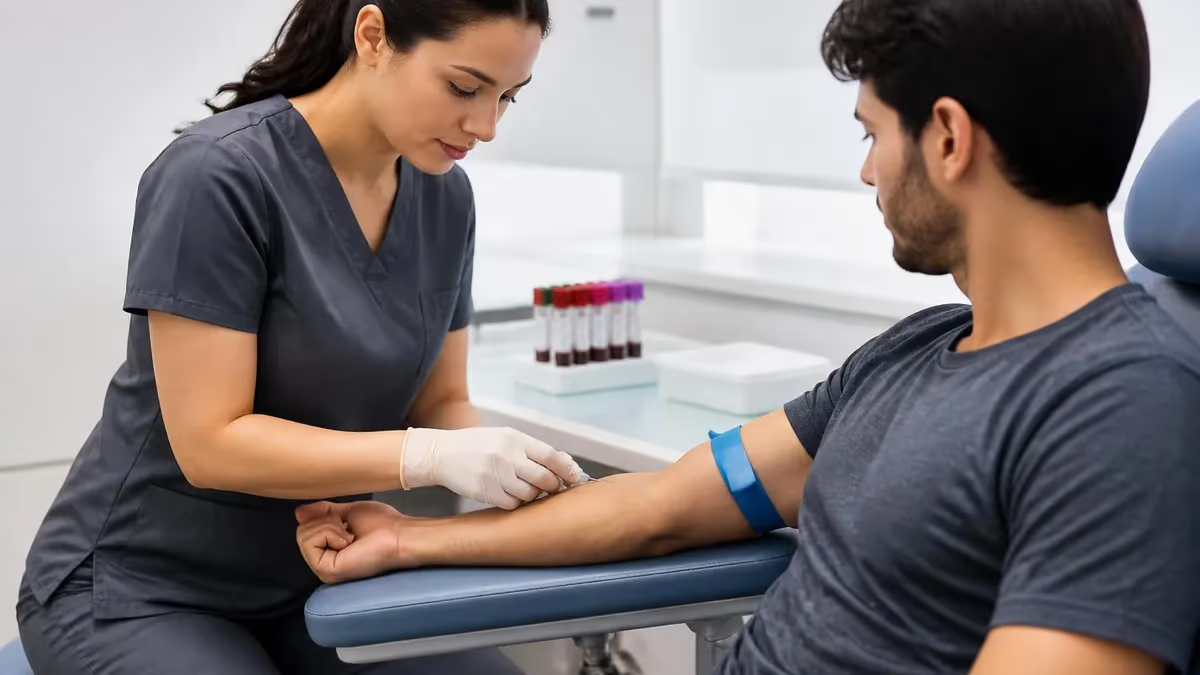
Phlebotomy technician jobs are one of the fastest ways into clinical healthcare. You finish a short training program, pass a national certification, and you're drawing blood for hospitals, reference labs, blood banks, plasma centers, or mobile teams within months. The pay isn't nursing money. But the runway is short, the demand is real, and the work moves you closer to patients than almost any other entry-level role in modern medicine.
This guide walks you through what phlebotomy techs actually do, where they get hired in 2026, what they earn, which certifications carry weight, and how to land your first offer without spending six months job hunting. If you're newly certified, finishing your externship, or just weighing whether the field is worth it, you'll find a clear, honest path here.
One thing up front. The phlebotomy job market is the friendliest it's been in over a decade. Hospitals are still rebuilding their lab teams after the post-pandemic exodus. Plasma centers are expanding into new metros every quarter. Mobile draw outfits are springing up to serve aging patients at home. If you're trained and certified, employers are competing for you, not the other way around.

Quick snapshot
Phlebotomy technicians collect blood specimens for testing, transfusion, donation, and research. Entry pay runs $17-$22/hr, mid-career $20-$28/hr, with travel contracts pushing $1,500-$2,500/wk. The U.S. Bureau of Labor Statistics projects roughly 130,000 phlebotomy openings over the next decade. Hospitals, Quest Diagnostics, Labcorp, plasma centers (BioLife, CSL, Grifols), and the American Red Cross are the largest employers.
Before we dig into settings and pay, it helps to understand what the job actually involves day to day. A phlebotomy technician is a healthcare professional who collects blood specimens, mostly through venipuncture (vein draws) and capillary punctures (finger sticks). With extra training, some perform arterial sticks for blood gas testing in ICU and pulmonary settings. You'll also process and label specimens, transport them to the lab, document collections in the EHR, restock supplies, and dispose of biohazard waste under strict OSHA rules.
You're also the patient-facing piece, which is bigger than most new phlebs realize. You verify the patient's identity by name, date of birth, and medical record number. You explain the procedure, calm nervous donors, distract pediatric patients, and handle the occasional fainter. The technical part of drawing blood gets easier with reps. The interpersonal part is what separates a great phleb from an average one, and it's the piece hiring managers screen for hardest in interviews.
The daily duty list is longer than most people expect. You're not just sticking arms. A typical shift includes verifying patient identity using two identifiers, explaining the draw and answering questions, applying the tourniquet, palpating veins, selecting the best site, cleansing with an alcohol pad, performing the puncture, collecting tubes in the correct order of draw, labeling at bedside (never away from the patient), processing and transporting specimens, documenting in Epic, Cerner, or Athenahealth, restocking your tray, sanitizing between patients, and complying with HIPAA, OSHA, and CLIA standards the whole time.
- ✓Verify patient identity using two identifiers (name, DOB, MRN)
- ✓Explain the procedure and address patient questions
- ✓Apply tourniquet, palpate veins, choose draw site
- ✓Cleanse site with alcohol pad and let dry
- ✓Perform venipuncture or capillary puncture safely
- ✓Collect tubes in the correct order of draw
- ✓Label every tube at the bedside before leaving the patient
- ✓Process, centrifuge, and transport specimens to the lab
- ✓Document collection in the EHR (Epic, Cerner, Athenahealth)
- ✓Maintain stock of needles, tubes, gauze, alcohol, and sharps containers
- ✓Dispose of biohazard waste per OSHA standards
- ✓Comply with HIPAA, OSHA, and CLIA at all times
Phlebotomy work splits into three broad settings, and the day looks very different in each. Hospital phlebs run morning rounds at 4-6 AM collecting from inpatients, then float to the ER, ICU, NICU, dialysis, or oncology as needed. Outpatient phlebs sit at a Quest or Labcorp patient service center drawing scheduled walk-ins all day. Mobile and specialty phlebs travel to nursing homes, occupational health clinics, plasma centers, or research trial sites.
The setting you choose drives your schedule, your pay, your patient mix, and your stress level. It also drives how quickly you can move into a leadership role or pivot into nursing or lab science. Pick the wrong setting first and you can still switch in a year, but picking right out of the gate saves time and pays more sooner.
Pay: $19-$32/hr. Hospital phlebs earn the most because the work is harder. You'll do early-morning rounding draws (4-6 AM is standard), then handle stat orders from the ER, ICU, NICU, oncology, and dialysis. Acuity is high. You'll meet patients with difficult veins, IV lines blocking access, anxiety, and sometimes hostility. Twelve-hour shifts and weekend rotations are common.
Major employers: HCA Healthcare, Kaiser Permanente, Cleveland Clinic, Mayo Clinic, AdventHealth, Ascension, CommonSpirit. Sign-on bonuses of $500-$5,000 are normal in 2026 because hospitals can't fill phlebotomy seats fast enough.
Best for: Phlebs who want variety, higher pay, full benefits, and a clear ladder into MLT, RN, or PA roles. Look for phlebotomy at hospital systems first if pay is your priority.
Now let's talk pay in plain numbers. Wages vary by setting, region, certification level, and shift. The figures below reflect U.S. medians for 2026, blended from BLS data, Indeed salary reports, and recruiter pay sheets we've seen this year. State of residence matters more than people realize. California phlebs earn 30-50% more than West Virginia phlebs doing the same job, partly because California requires a state license (CPT-1) on top of national certification, and partly because the cost-of-living adjustment is baked into hospital pay scales there.
Shift differential is another big lever. Hospital phlebs working overnight (11 PM-7 AM) typically pull a 10-15% premium on base hourly. Weekend shifts often add another 5-10%. A baseline $22/hr hospital phleb can clear $26-$28/hr by selecting nights and weekends, which is how a lot of newer hires accelerate their first-year earnings while waiting for a daytime opening.
Phlebotomy pay by experience level
- Hourly: $17-$22
- Annual: $35,000-$45,000
- Common settings: Plasma, Quest, Labcorp
- Sign-on bonus: $500-$1,500 typical
- Hourly: $20-$28
- Annual: $42,000-$58,000
- Common settings: Hospitals, mobile, blood banks
- Sign-on bonus: $1,500-$3,000 typical
- Hourly: $25-$35
- Annual: $52,000-$72,000+
- Common settings: Hospital lead, supervisor, instructor
- Sign-on bonus: Negotiable, often relocation
- Weekly: $1,500-$2,500
- Annualized: $80,000-$120,000+
- Contract length: 13 weeks typical
- Top agencies: Aya, Cross Country, Triage
Geography matters more than most resources admit. The highest-paying states for phlebotomy techs in 2026 are California, Massachusetts, Washington, Alaska, and New York. The lowest are West Virginia, Mississippi, Arkansas, and parts of Alabama. If you're certified and mobile, relocating from a low-pay state to a high-pay metro can add $10,000-$20,000 to your annual income overnight. Combine that with a hospital sign-on bonus and you've covered moving costs in your first month on the job.
The hiring market itself is the friendliest it's been in a decade. Hospitals are still climbing out of the post-pandemic staffing hole. Plasma centers are expanding aggressively because the FDA loosened collection rules and demand for plasma-derived therapies keeps growing year over year. Mobile and home draw services are scaling because more outpatient care is shifting into the home. Translation: if you're newly certified and willing to apply broadly, you should not be unemployed for more than a few weeks.
Certifications are the gatekeeper, so let's talk about them next. Most U.S. employers require a national phlebotomy certification before they'll hire you, and a few states (California, Washington, Nevada, Louisiana) require a separate state license on top. The good news is that all the major certifications are accepted across most of the country. Pick one that fits your training program's exam alignment, your geographic target, and your budget.
Recognized phlebotomy certifications
- Issuer: American Society for Clinical Pathology
- Reputation: Most respected nationally
- Exam fee: $135
- Renewal: 3 years, 36 CE units
- Issuer: National Healthcareer Association
- Reputation: Widely accepted, employer-friendly
- Exam fee: $117
- Renewal: 2 years, 10 CE units
- Issuer: American Medical Technologists
- Reputation: Strong in private labs
- Exam fee: $120
- Renewal: Annual + CE
- Issuer: National Center for Competency Testing
- Reputation: Solid budget option
- Exam fee: $95-$110
- Renewal: Annual + CE

If you don't know which certification to pursue, here's a fast rule. Going for hospital work in a major metro? Take the ASCP CPT, because hospital lab directors recognize it instantly. Heading for a Labcorp, Quest, or plasma center? The NHA or NCCT will get you in the door for less money. California, Washington, Nevada, and Louisiana applicants need to layer state licensure on top of any national cert. Don't skip the state step. Hiring managers in those states will pull your file the moment they see no license.
Renewal matters too, and a lot of new phlebs forget about it after their first hire. ASCP renews every three years and requires 36 continuing education units. NHA renews every two years with 10 CE units. AMT and NCCT both renew annually with smaller CE requirements. Most facilities will reimburse renewal fees and CE costs as part of your benefits package, so don't pay out of pocket if you don't have to. Track your CE hours in a simple spreadsheet from day one.
If you live in or plan to work in California, Washington, Nevada, or Louisiana, your national certification alone is not enough. California requires a CPT-1, CPT-2, or LPT depending on the role and tasks. Washington requires Medical Assistant-Phlebotomist credentialing. Nevada and Louisiana have their own permits. Apply for the state license the moment you pass your national exam. Processing can take 4-8 weeks and you cannot legally draw blood until it's issued.
So how do you actually become a phlebotomy technician from a standing start? The path is short and predictable. Most people go from zero to hired in three to six months if they push.
Step 1: Meet baseline requirements
Step 2: Complete a phlebotomy training program
Step 3: Finish your clinical externship
Step 4: Pass a national certification exam
Step 5: Apply for state licensure if required
Step 6: Apply to 10-15 employers
Once you're certified, the application process moves faster than most healthcare hiring. Lab corp positions can take you from application to start date in 10-14 days. Hospital roles run longer because of background, drug screen, and onboarding requirements, but four weeks from interview to first shift is normal. Plasma centers are often the fastest of all, since many train you on the job and skip a lot of the credentialing back-and-forth.
Don't let timing surprise you. Most hospital systems batch new-hire orientations every two weeks, so depending on when you sign your offer you might wait 5-15 days for your first official day. Use that gap to update your immunization records, refresh your BLS card, and read up on the EHR system the facility uses. Walking in already knowing how to navigate Epic or Cerner shaves a week off your floor training.
Apply online
HR phone screen
Department interview
Skills assessment
Background and drug screen
Onboarding and orientation
Employers screen for a specific bundle of skills and credentials. Most of them are non-negotiable. A few are soft skills that get you hired over a similarly-credentialed candidate. The checklist below is what hospital lab managers and Quest hiring leads scan for in the first 30 seconds of reading your resume.
- ✓Active national certification (ASCP, NHA, AMT, or NCCT)
- ✓State license where required (CA, WA, NV, LA)
- ✓Clean background, no recent felonies
- ✓Current BLS/CPR (American Heart Association preferred)
- ✓Updated immunizations: Hep B, MMR, varicella, Tdap, annual flu, COVID per facility policy
- ✓Documented externship hours and successful stick count
- ✓Calm, patient-friendly demeanor under stress
- ✓Detail orientation: a mislabeled tube can kill someone
- ✓EHR experience (Epic, Cerner, Athenahealth)
- ✓Reliable transportation, especially for mobile or early-shift hospital roles
Honest pros and cons next. Phlebotomy is a great job for the right person and a frustrating one for the wrong fit. Know what you're walking into before you commit to the training cost.
- +Short training timeline (1-6 months) and low upfront cost
- +Strong job security and growing demand through 2034
- +Direct, meaningful patient interaction every shift
- +Lower physical demands than nursing or CNA work
- +Clear bridge to MLT, MLS, RN, and PA programs
- +Travel and per diem options for higher pay
- +Variety of settings: hospital, lab, plasma, mobile, research
- +Sign-on bonuses common at hospital systems in 2026
- −Standing for most of an 8-12 hour shift
- −Real risk of needlestick injury and bloodborne exposure
- −Difficult patients: pediatric, elderly, combative, intoxicated
- −Anxious or fainting donors require constant vigilance
- −Repetitive motion can lead to wrist and shoulder strain
- −Early hospital rounds (4-6 AM) wreck sleep schedules
- −Emotionally heavy in ICU, NICU, oncology rotations
- −Lower pay ceiling than RN or MLS without further education
Pros and Cons at a Glance
| Pros | Cons |
|---|---|
| Direct, meaningful patient interaction every shift | Real risk of needlestick injury and bloodborne exposure |
| Lower physical demands than nursing or CNA work | Difficult patients: pediatric, elderly, combative, intoxicated |
| Clear bridge to MLT, MLS, RN, and PA programs | Anxious or fainting donors require constant vigilance |
| Travel and per diem options for higher pay | Repetitive motion can lead to wrist and shoulder strain |
| Variety of settings: hospital, lab, plasma, mobile, research | Emotionally heavy in ICU, NICU, oncology rotations |
One of the most common questions new phlebs ask is hospital versus lab corp. They pay differently, schedule differently, and demand different things from you. The structure cards below give you a side-by-side so you can pick the setting that matches your goals.

Hospital vs. lab corp work
- Pay: Higher hourly + sign-on bonus
- Benefits: Full medical, dental, 401k, tuition
- Variety: ER, ICU, NICU, dialysis, oncology
- Career ladder: Lead, supervisor, MLT bridge
- Schedule: Nights, weekends, on-call common
- Acuity: Critical patients, hard sticks
- Pace: Stat orders, fast turnover
- Stress: Higher emotional load
- Hours: Predictable Mon-Fri days
- Stress: Lower, healthy walk-in patients
- Onboarding: Often paid training programs
- Weekends: Mostly off
- Pay: Lower than hospital
- Variety: Repetitive draws, same scripts
- Bonuses: Smaller or none
- Advancement: Slower internal ladder
Plasma center work deserves its own section because it's the fastest entry into paid phlebotomy and the path most newly-trained techs underestimate. Plasma centers like BioLife, CSL Plasma, Grifols, Octapharma, and KEDPlasma run as production environments. Donors come in twice a week, plasma is collected over 60-90 minutes per session, and a single phleb may handle 10-30 donors per shift across a rotating bed assignment.
The work is more standardized than hospital phlebotomy. The same arms, the same tubes, the same automated machines. Pay starts at $18-$24/hr and climbs with production bonuses, attendance bonuses, and lead pay. Many centers don't require a prior phlebotomy certification at hire because they train you in-house. That makes plasma the realistic first job for thousands of new phlebs every year, especially in cities without a strong hospital lab market.
Career advancement is where phlebotomy gets interesting. The job is rarely a destination. It's a launchpad. The credentials, patient contact hours, and clinical exposure you build in two or three years as a phleb open doors to higher-paying healthcare careers without starting from zero. Plenty of RNs, MLTs, PAs, and even MDs began their clinical careers behind a phlebotomy tray, and they'll tell you the patient communication skills they built there pay dividends for the rest of their career.
Where phlebotomy can take you next
- Time to reach: 2-5 years
- Pay: $25-$35/hr
- New duties: Scheduling, training, QA
- Education: AAS (MLT) or BS (MLS)
- Time: 2-4 years
- Pay: $50,000-$80,000
- Education: ADN or BSN
- Time: 2-4 years
- Pay: $80,000-$120,000+
- Education: Bachelor + PA Master's
- Time: 6-7 years total
- Pay: ~$130,000 median
Travel phlebotomy is the fastest way to lift your income without going back to school. Agencies like Aya Healthcare, Cross Country, and Triage Staffing place experienced phlebs on 13-week contracts at hospitals nationwide. Total compensation, including taxable wages and tax-free housing and meal stipends, lands between $1,500 and $2,500 per week. Annualized that's $80,000-$120,000 for someone who started two years ago at $19/hr.
The catch is location flexibility, frequent moves, and being the new face every quarter. Travel phlebs need to onboard fast, learn a new EHR in a week, and earn the trust of a permanent staff that may or may not be friendly. The lifestyle isn't for everyone, but for single phlebs in their twenties or empty-nesters looking for a second-act adventure, it's a legitimate path to six figures with no degree required.
A typical 13-week travel contract pays $1,800/wk total comp. That's $23,400 per contract. Four contracts in a year (with 2-4 week breaks between) = roughly $93,000 in gross pay, much of it tax-advantaged through stipends. You'll need 12-18 months of solid hospital phlebotomy experience and an active CPT (ASCP or NHA) before agencies will represent you.
Where should you actually apply? Don't waste time on a single job board. The phlebs who land jobs fastest spread their applications across 5-7 channels and check daily for 7-10 days. Indeed and ZipRecruiter have the most listings overall. Hospital career sites have the highest-paying roles. Plasma center sites have the fastest hiring cycles. LinkedIn matters less for entry phleb roles than it does for nursing, but a polished profile still helps.
- ✓Indeed.com — largest U.S. job board for phlebotomy
- ✓ZipRecruiter — fast applications, alerts work well
- ✓LinkedIn — better for hospital and travel roles
- ✓Hospital career portals (HCA, Kaiser, Cleveland Clinic, Mayo, Ascension)
- ✓Quest Diagnostics careers page (questdiagnostics.com/careers)
- ✓Labcorp careers page (careers.labcorp.com)
- ✓Plasma center sites: BioLife, CSL Plasma, Grifols, Octapharma, KEDPlasma
- ✓American Red Cross careers (volunteer-to-job pipeline works well)
- ✓State workforce sites (jobs.ca.gov, careers.wa.gov)
- ✓Local staffing agencies for per diem and float pool roles
Interview prep matters. Phleb interviews are short, but the questions are predictable. Hospital interviewers want to know you can stay calm with hard sticks and difficult patients. Lab corp interviewers want to know you can handle high volume without cutting corners. Plasma interviewers want to know you'll show up for production shifts. Have specific examples ready. Generic answers get rejected.
- ✓Why do you want to be a phlebotomy technician?
- ✓Walk me through how you'd handle an anxious patient.
- ✓What do you do if you can't get a vein on the first attempt?
- ✓Have you ever had a needlestick injury or near-miss?
- ✓Why do you want to work for this hospital, lab, or center?
- ✓What EHR systems are you comfortable using?
- ✓Describe the order of draw and why it matters.
- ✓How do you verify patient identity before a draw?
- ✓What's your approach to a pediatric or geriatric patient?
- ✓Tell me about a time you caught a labeling or specimen error.
Training program cost varies more than people expect. A community college certificate runs $500-$2,000 for one semester. Vocational school accelerated programs charge $1,000-$3,000 for two to six weeks. Online-hybrid programs are usually $700-$1,500. Hospital-sponsored programs are often free if you sign a 12-month employment commitment, which is the best deal in the field if you can land one. Plasma center on-the-job training is genuinely free, and some centers pay you while you train.
Whatever route you choose, verify two things before paying. First, the program is recognized by your target certification body (NAACLS-approved is the gold standard for ASCP). Second, the program includes a real clinical externship. Programs that skip externships leave you uncertifiable in most states and unhirable everywhere else. If you're researching becoming a certified phlebotomy technician, check accreditation status before you sign anything or hand over a deposit.
If you're a first-time job seeker, here's the playbook that actually works in 2026. Apply broadly, not narrowly. Highlight your externship in concrete numbers. Network inside your externship site. Consider plasma centers as your fastest entry. Be flexible on shift in the first year. And don't undersell yourself in salary negotiations. The shortage is real, and a competent newly-certified phleb has more use today than at any point in the last decade.
- ✓Apply to 10-15 employers, not 1-2
- ✓List exact externship hours and successful stick count on resume
- ✓Name the certifications you hold (ASCP, NHA, AMT, NCCT)
- ✓Network with your externship preceptor and lab director
- ✓Add plasma centers to your application list for fast entry
- ✓Be open to nights and weekends in your first hospital year
- ✓Negotiate the offer: $1-$2/hr is often on the table
- ✓Confirm sign-on bonus terms in writing before accepting
- ✓Verify your immunizations are current before interview day
- ✓Keep BLS/CPR active and bring the card to interviews
The bottom line: phlebotomy technician jobs are abundant in 2026, the training is short, the pay covers entry-level living in most states, and the career ladder reaches well into six figures if you keep stacking credentials. Newly-certified phlebs who apply broadly and interview prepared rarely sit unemployed for long. If you're at the start of the path, pick a certification, finish your externship strong, prep with practice tests, and start applying the week your results land. Done right, you're working and earning before the end of the quarter.
Sample Phlebotomy Practice Questions
Try these questions from our free Phlebotomy practice tests. The correct answer and an explanation follow each question.
Which of the following is a key responsibility of a Registered Phlebotomy Technician (RPT)?
- A. Analyzing lab test results
- B. Drawing blood samples from patients
- C. Administering intravenous medications
- D. Supervising laboratory operations
Answer: B. Drawing blood samples from patients
A key responsibility of a Registered Phlebotomy Technician (RPT) is drawing blood samples from patients. RPTs are skilled in venipuncture and other blood collection techniques, ensuring patient comfort and sample integrity. Their accurate collection of samples is vital for proper diagnostic testing and patient treatment.
Which of the following is a primary responsibility of a Certified Phlebotomy Technician (CPT)?
- A. Prescribing medical tests
- B. Drawing blood and ensuring proper specimen labeling
- C. Interpreting laboratory test results
- D. Supervising laboratory operations
Answer: B. Drawing blood and ensuring proper specimen labeling
A Certified Phlebotomy Technician (CPT) holds the primary responsibility for accurately and safely drawing blood samples from patients. A critical aspect of this role is ensuring that all specimens are correctly labeled with patient information and collection details to prevent errors in laboratory testing. This meticulous attention to detail is vital for patient safety and accurate diagnoses.
Which phlebotomy procedure is most appropriate when a patient requires serial glucose monitoring every hour during a GTT?
- A. Arterial line sampling
- B. Repeated venipuncture at a new site each hour
- C. Capillary fingerstick using a lancet
- D. Indwelling peripheral IV catheter draw
Answer: C. Capillary fingerstick using a lancet
Capillary fingersticks minimize patient discomfort and vein damage during the multiple timed collections required for a GTT.
Which of the following represents a failure to adhere to the phlebotomy 'standard of care'?
- A. Informing the patient about the potential for bruising.
- B. Attempting to perform a venipuncture on a patient a third time after two unsuccessful attempts.
- C. Asking the patient to state their full name and date of birth.
- D. Disposing of the used needle in a sharps container immediately after use.
Answer: B. Attempting to perform a venipuncture on a patient a third time after two unsuccessful attempts.
The standard of care in phlebotomy, based on industry guidelines, generally recommends that a phlebotomist should not attempt a venipuncture on a patient more than twice. After two unsuccessful attempts, the phlebotomist should seek assistance from a more experienced colleague or notify the patient's nurse or physician. Continuing to attempt collection could cause unnecessary harm to the patient.
Phlebotomy Technician Jobs Questions and Answers
About the Author

Registered Nurse & Healthcare Educator
Johns Hopkins University School of NursingDr. Sarah Mitchell is a board-certified registered nurse with over 15 years of clinical and academic experience. She completed her PhD in Nursing Science at Johns Hopkins University and has taught NCLEX preparation and clinical skills courses for nursing students across the United States. Her research focuses on evidence-based exam preparation strategies for healthcare certification candidates.