
American Red Cross Phlebotomy Training: Complete Program Guide 2026 October
✏️ American Red Cross phlebotomy training: program structure, costs, certification, clinical externships, and career outcomes for new students in 2026 October.
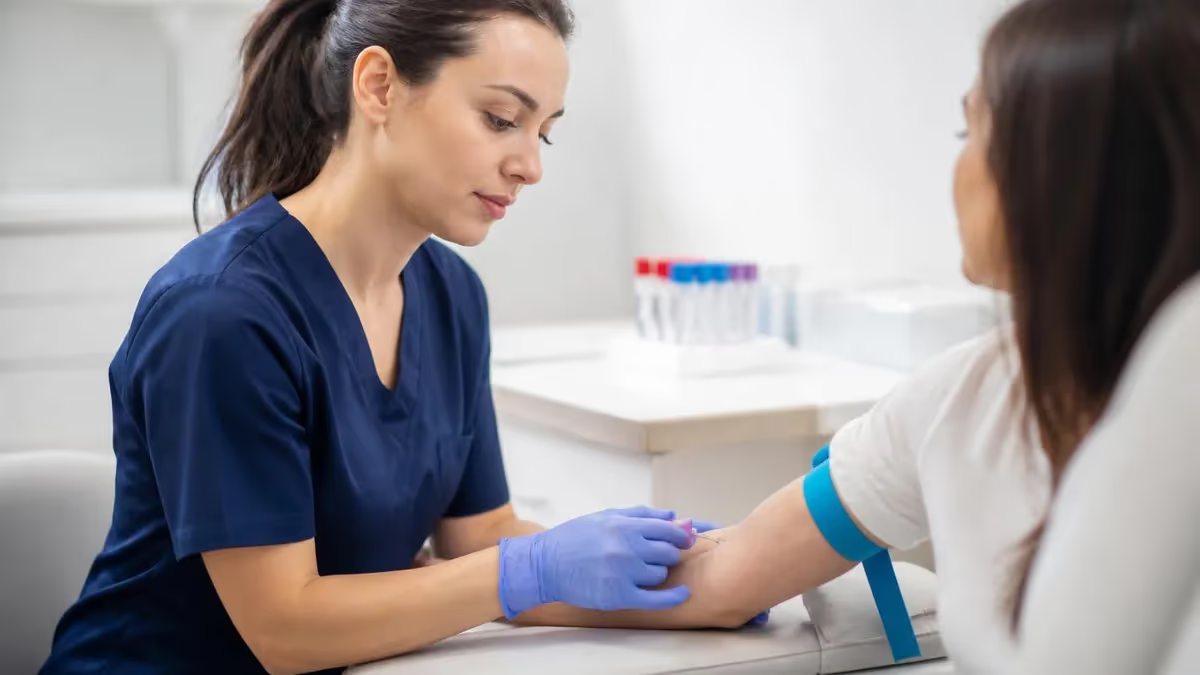
American Red Cross phlebotomy training has long carried weight with employers, students, and certification boards because the brand itself signals careful health-services education. The organization built a national reputation around CPR, first aid, lifeguard certification, and blood donation programs, and that same training infrastructure feeds into modern phlebotomy education through partnerships with community colleges, vocational schools, and approved training providers. Anyone searching for phlebotomy training options will find that Red Cross-affiliated programs frequently appear near the top of recommended lists in nursing forums, allied health blogs, and state board guidance documents.
The structure of these programs typically blends classroom instruction in anatomy and physiology, infection control, and medical terminology with hands-on lab work, simulated venipuncture practice, and a supervised clinical externship at a partner hospital, donation center, or outpatient lab. Students leave the program ready to draw blood safely, identify patients, label specimens, transport samples, and document encounters in an electronic medical record. That breadth matters because employers no longer hire phlebotomists who can only stick a vein. They expect a technician who understands chain-of-custody, can spot a hemolyzed sample, and knows when to escalate a difficult draw.
You should also know up front that the American Red Cross does not, in 2026, operate a single nationwide phlebotomy certification program of its own. The Red Cross brand attaches to training in a few different ways. Some courses are operated under license with Red Cross curriculum oversight, some local chapters host short courses for blood-services volunteers, and many private training schools market themselves using Red Cross logos because they teach Red Cross-aligned CPR and BLS modules alongside phlebotomy. Reading the fine print before you enroll is genuinely important.

Most Red Cross-aligned phlebotomy programs run 4 to 12 weeks, cost between $700 and $2,500, and combine classroom theory with 40 to 120 hours of clinical externship. Graduates are eligible to sit for national exams such as the ASCP, NHA, AMT, or NCCT phlebotomy certifications. The Red Cross brand most often appears bundled with CPR/BLS certification rather than as a standalone phlebotomy credential.
Tuition pricing varies more than most prospective students expect. A four-week accelerated program in Texas may cost around $700, while a 12-week hybrid program in California can run beyond $2,500 once books, scrubs, supplies, background checks, drug screening, and externship insurance are added. Hidden costs catch many students off guard.
Ask the admissions office for the all-in figure including the national certification exam fee, immunization documentation, and any retake fees if you fail the first attempt. Programs that hide these numbers behind a generic tuition figure are usually the ones that surprise students with surcharges in week three. Always insist on a written cost breakdown.
Schedule flexibility separates the better programs from the average ones. Evening cohorts, weekend cohorts, and hybrid online-plus-lab options now exist in most major metropolitan areas. Working adults gravitate toward the hybrid model because they can complete didactic modules at home and reserve weekends for in-person venipuncture practice.
Pure online phlebotomy training does not exist in any legitimate form. Anyone selling a fully online phlebotomy certificate is selling a worthless piece of paper because no state board accepts a program that did not include supervised human-to-human blood draws. The clinical hours are not optional.
What You Learn in Red Cross-Aligned Phlebotomy Training
Detailed coverage of the circulatory system, antecubital fossa anatomy, venous structures of the hand and forearm, and arterial landmarks. Students learn to identify median cubital, cephalic, and basilic veins and avoid nerves, tendons, and arteries during draws.
OSHA bloodborne pathogen standards, hand hygiene, personal protective equipment selection, sharps safety, exposure incident reporting, and proper disposal of contaminated materials. This module includes Red Cross-aligned BLS and CPR certification for most students.
Patient identification, site selection, tourniquet application, evacuated tube system order of draw, syringe technique, butterfly winged collection sets, and capillary collection. Students complete dozens of supervised sticks before moving to externship.
Tube additives and color coding, mixing requirements, centrifugation timing, transport conditions, hemolysis prevention, and rejection criteria. Students learn why a single mishandled specimen can delay a diagnosis by 24 to 48 hours.
Communication with anxious patients, pediatric draws, geriatric considerations, difficult draw escalation protocols, and HIPAA-compliant documentation. The patient-facing skills often determine whether a graduate gets hired or struggles in early employment.
Scope of practice, informed consent, chain of custody for forensic draws, mandated reporting, professional boundaries, and documentation standards. This module satisfies state-required ethics training in jurisdictions that mandate it.
Clinical externship requirements vary by state and by certifying body. California demands 40 hours of clinical externship plus 10 hours of skin punctures and 50 venipunctures for the state-issued Certified Phlebotomy Technician I license. Washington and Nevada have their own state-level requirements. Most other states defer to the certifying agency, which typically demands 100 successful venipunctures and 25 capillary collections before sitting for the exam. Red Cross-aligned programs almost universally exceed these minimums because they want graduates to pass national exams on the first attempt.
Externship placements typically run at a partner hospital, an outpatient draw station, a plasma donation center, or a community blood drive operated by Red Cross Biomedical Services. Donation center placements give students extraordinary volume because a single morning at a busy blood drive can produce 20 to 40 sticks. Hospital placements give students variety, including pediatric draws, geriatric patients, oncology infusion patients with compromised veins, and emergency department trauma scenarios. Each placement type produces a different but equally valuable graduate.
Program Format Options
Accelerated programs compress the entire curriculum into 4 to 6 weeks of full-time daytime instruction. These programs work for students who are not currently employed and who can commit 30 to 40 hours per week to classes and lab work. Expect intense days and homework most evenings. Graduates leave faster but report higher fatigue and lower retention of detailed material. Best suited for career changers with prior healthcare exposure.
Eligibility requirements for Red Cross-aligned phlebotomy programs are intentionally accessible. Most programs require a high school diploma or GED, demonstrated proficiency in English, current immunization records including hepatitis B series, a negative tuberculosis screening, a clean criminal background check, and a passed drug screen. Some programs add a basic reading and math assessment. A few competitive programs require an admissions interview. The barriers are real but not extreme, and most motivated applicants qualify on the first attempt.
The background check trips up more applicants than any other requirement. Phlebotomists handle controlled medical specimens, work with vulnerable patients, and access protected health information. State health departments and hospital systems disqualify candidates with recent felony convictions involving violence, theft, drug trafficking, or healthcare fraud. Older convictions, expunged records, and misdemeanor charges sometimes pass review depending on jurisdiction and time since the offense. Ask the program director for a frank assessment before paying tuition if you have anything in your background that might create a problem.

Verify that any school marketing itself as American Red Cross phlebotomy training is actually licensed, accredited, or in formal partnership with the Red Cross. Some private schools use Red Cross logos because they teach Red Cross CPR modules, not because they operate a Red Cross phlebotomy program. Ask the school for documentation of the partnership and confirm the certification path with your state health department before paying any tuition.
Certification eligibility after completing a Red Cross-aligned program depends on the certifying body you target. The American Society for Clinical Pathology Board of Certification offers the PBT(ASCP) credential, widely considered the gold standard. The National Healthcareer Association offers the CPT credential, the most common entry-level certification at hospital systems. The American Medical Technologists offers the RPT credential, particularly recognized in outpatient laboratory settings. The National Center for Competency Testing offers the NCPT credential, often paired with medical assisting programs.
Exam content across these certifications overlaps substantially. Expect 100 to 200 multiple-choice questions covering specimen collection, processing and handling, safety and infection control, anatomy and physiology, and professional responsibilities. Pass rates run 70 to 80 percent for first-time test-takers from accredited programs and drop sharply for self-study candidates without supervised clinical hours. Comprehensive phlebotomy practice tests remain the single most effective preparation tool because they expose students to the question style and pacing they will face on exam day.
Choosing a Red Cross-Aligned Phlebotomy Program
- ✓Confirm the school is licensed by your state department of education or workforce development agency, not just self-described as Red Cross-aligned
- ✓Verify program accreditation through the National Accrediting Agency for Clinical Laboratory Sciences or a similarly recognized accreditor
- ✓Ask for the most recent national certification exam pass rate of program graduates, and walk away if the school will not share the number
- ✓Confirm clinical externship hours meet or exceed your state minimum and your target certifying body minimum
- ✓Request the complete cost breakdown including tuition, books, supplies, background check, drug screen, immunizations, and exam fees
- ✓Check whether the program offers job placement assistance and what the recent placement rate looks like for graduates
- ✓Visit the campus or training site in person when possible to verify equipment quality, lab space, and instructor presence
Job placement after graduation is one of the most underrated reasons to choose a Red Cross-aligned program over a generic vocational school. Hospital systems, donation centers, and reference laboratories recognize Red Cross-affiliated training and frequently route open positions directly to partner programs. Some students receive employment offers before they finish externship. Compensation for new graduates ranges from roughly $16 to $22 per hour in 2026 depending on geographic market, employer type, and shift differential. Night shift, weekend, and per-diem positions typically pay more but offer less stable schedules.
Career advancement from entry-level phlebotomy follows several common paths. Some technicians pursue lead phlebotomist or training coordinator positions within their first two years. Others transition into laboratory assistant roles, medical assistant positions, or specialty draw teams such as pediatric or oncology phlebotomy. A significant fraction use phlebotomy as a stepping stone toward registered nursing, medical laboratory scientist, or physician assistant programs. The clinical exposure, patient interaction experience, and confirmed ability to work in a clinical setting all strengthen later applications to more advanced programs.
State-specific licensing rules deserve real attention before you enroll because they can dramatically change which program you should pick. California, Washington, Nevada, and Louisiana require state-issued phlebotomy licenses with prescribed minimum classroom and externship hours. The other 46 states defer to national certification or impose no state license at all.
If you train in a state with strict rules and plan to move, your hours and credentials may transfer easily. If you train in a state with no requirements and plan to work in California later, you will likely need additional coursework and externship hours before the state will issue a license. Plan ahead if relocation is on the table.
Reciprocity between states exists for nationally certified phlebotomists in most cases. A PBT(ASCP) credential earned in Texas transfers seamlessly to Florida, New York, or Georgia. The same credential does not automatically grant a California Certified Phlebotomy Technician I license because California demands documentation of specific clinical hours and a state-approved program. Always research the destination state before assuming your training will transfer.
Common Career Paths After Phlebotomy Training
Inpatient and outpatient blood draws across all hospital departments. Variety of patient types, exposure to complex cases, opportunity to develop specialty skills. Often the highest entry-level pay due to shift differential and benefits packages.
Reference lab or physician office lab draws for ambulatory patients. More predictable schedule, less variety, often pleasant daytime hours. Volume can be intense at busy reference labs running 80 to 120 patients per technician per shift.
Whole blood, plasma, or platelet collection at Red Cross or independent donation centers. Larger draw volumes, repeat donors who know the routine, strong team culture, frequent community outreach work. Some technicians stay in donations for entire careers.
Home draws for elderly, immobile, or remote patients. Independent contractor or staff position with home health agencies and concierge medical services. Higher hourly rates but variable schedule and mileage requirements.
Pediatric, oncology, dialysis, or research blood draws within specialized hospital units. Requires experience and additional training but commands premium compensation and offers deep professional development.
Senior phlebotomists move into training coordinator, quality assurance, or compliance roles within larger hospital systems and reference labs. Often a stepping stone toward laboratory management positions.

Equipment and supplies used during training mirror what you will encounter in actual practice. Programs stock evacuated tube collection systems from major manufacturers, butterfly winged collection sets in multiple gauges, safety lancets for capillary collection, tourniquets, alcohol pads, gauze, bandages, sharps containers, and biohazard transport bags. High-quality programs include training mannequins with replaceable vein inserts so students can practice difficult draws without harming peers. The best programs eventually move students to live sticks on consenting volunteers and classmates under instructor supervision.
Order of draw consistently appears as one of the most-tested topics on phlebotomy certification exams. The standard order proceeds from blood culture bottles, light blue citrate tube, gold or red serum tube, green heparin tube, lavender EDTA tube, gray glycolytic inhibitor tube. The sequence prevents cross-contamination of additives that would invalidate test results. Students memorize the order, understand the chemistry behind it, and apply it under timed conditions during testing. The order shows up as a question on essentially every phlebotomy certification exam administered in North America.
Phlebotomy Training and Career Statistics
Financial aid availability surprises some students. Title IV federal financial aid attaches to accredited programs at community colleges and certain career schools. Workforce Innovation and Opportunity Act funding through state workforce boards covers tuition for eligible displaced workers and low-income applicants. Veterans Affairs education benefits cover approved programs for service members and dependents. Some employers, particularly large hospital systems and reference labs, pay tuition reimbursement for phlebotomy training in exchange for employment commitments. The combination means many students complete training with little or no out-of-pocket cost if they research funding options before enrolling.
Comparing Red Cross-aligned training to alternative routes helps clarify the value proposition. Community college phlebotomy certificates take longer and cost more in tuition dollars but produce stackable credits toward associate degrees. Hospital-based on-the-job training programs exist at some large systems but typically require an existing role as a nursing assistant or medical assistant first. Self-study with no clinical hours does not qualify a candidate for any legitimate national certification. Red Cross-aligned programs occupy the sweet spot of faster completion, lower total cost, recognized credential, and direct externship-to-employment pathway.
Red Cross-Aligned Phlebotomy Training Tradeoffs
- + —
- + —
- + —
- + —
- + —
- − —
- − —
- − —
- − —
- − —
Difficulty levels through training are higher than most students expect going in. The reading load includes anatomy and physiology, infection control protocols, OSHA regulations, HIPAA requirements, and tube additive chemistry. The hands-on skills demand fine motor control, anatomy palpation, professional patient communication under stress, and the willingness to inflict a small amount of momentary discomfort on every single patient. Some students discover they cannot tolerate the patient interaction component or the sight of blood and withdraw within the first three weeks. Programs build this attrition into class size planning.
Once students pass the early threshold and complete their first successful supervised sticks, confidence builds rapidly. By week six of a standard program, most students draw smoothly on cooperative adult patients with prominent veins. The challenging draws on pediatric patients, elderly patients with rolling veins, oncology patients with compromised vasculature, and patients with edema or scar tissue take longer to master. Externship exposure to those difficult draws is what separates a competent new graduate from one who struggles for the first year of employment.
Renewal and continuing education requirements continue after initial certification. Most national phlebotomy certifications require renewal every two years with proof of continuing education credits. ASCP demands 12 continuing certification points across two years, NHA demands 10 credits, AMT and NCCT have similar structures.
Continuing education courses cover updates to OSHA standards, new specimen collection technology, changes in regulatory requirements, and refresher content on specialty topics. Most certified phlebotomists complete continuing education through online modules, professional association webinars, and in-house training at their employer.
State license renewal in California, Washington, Nevada, and Louisiana follows separate timelines from national certification renewal. California demands renewal every two years with proof of continuing education and a renewal fee. Failure to renew on time results in license lapse, which prevents legal practice until the license is reinstated.
Always track both your national certification expiration and your state license expiration if you work in a state-licensed jurisdiction because they rarely align on the same calendar. A simple calendar reminder ninety days ahead of each expiration saves real money and real interruption to your work life.
Allow two to four weeks of focused review between finishing externship and your certification exam date. Use a blend of textbook review, flashcards for tube additives and order of draw, and timed practice tests. Track weak topics across practice attempts and drill those specifically in the final week before exam day.
Preparing for the national certification exam after training is its own discipline. Most graduates allow two to four weeks of focused review between finishing externship and sitting for the exam. The strongest candidates use a mix of textbook review, flashcards for tube additives and order of draw, and timed practice tests that match the format of their target credential.
Practice questions matter more than passive reading because the exam pressure rewards pattern recognition. Common weak spots include coagulation studies, special collection procedures such as blood cultures and bleeding times, the difference between serum and plasma, and the reasoning behind specimen rejection criteria.
Building a personal weak-topics list during practice tests and drilling those topics in the final week pays measurable dividends on exam day. Treat the exam as a skill rather than a test of memory. The candidates who simply re-read their textbooks underperform those who actively practice questions under timed conditions every single day for two weeks.
Test-day logistics also affect performance. Arrive early, bring two forms of identification, eat a real breakfast, and avoid heavy caffeine that will spike anxiety mid-exam. Most certification exams allow brief breaks, and using one when fatigue sets in usually beats pushing through and making careless errors on the back half of the test. A short break beats a wrong answer every time.
Sample Phlebotomy Practice Questions
Try these questions from our free Phlebotomy practice tests. The correct answer and an explanation follow each question.
How many continuing education units (CEUs) must NHA-certified phlebotomy technicians complete before renewing their certification?
- A. 10 CEUs
- B. 15 CEUs
- C. 20 CEUs
- D. 25 CEUs
Answer: A. 10 CEUs
NHA CPT holders must complete 10 CEUs every two years to maintain their certification.
What certification is offered by the American Medical Technologists (AMT) for phlebotomy professionals?
- A. Certified Phlebotomy Technician (CPT)
- B. Registered Phlebotomy Technician (RPT)
- C. Licensed Blood Collection Technician (LBCT)
- D. Certified Clinical Specialist (CCS)
Answer: B. Registered Phlebotomy Technician (RPT)
The American Medical Technologists (AMT) offers the Registered Phlebotomy Technician (RPT) certification for phlebotomy professionals. This credential signifies that an individual has met AMT's rigorous standards for competence in phlebotomy. The RPT certification is widely recognized and respected in the healthcare industry.
Which ASCP certification is specifically designed for phlebotomy technicians who have completed an accredited phlebotomy program?
- A. MLT(ASCP)
- B. PBT(ASCP)
- C. MLS(ASCP)
- D. CLSup(ASCP)
Answer: B. PBT(ASCP)
PBT(ASCP) stands for Phlebotomy Technician certified by the American Society for Clinical Pathology.
What is one benefit of earning the AMCA Phlebotomy Technician Certification?
- A. Guaranteed employment in healthcare facilities
- B. Recognition of professional competency by healthcare employers
- C. Automatic eligibility for supervisory roles
- D. Exemption from continuing education requirements
Answer: B. Recognition of professional competency by healthcare employers
Earning the AMCA Phlebotomy Technician Certification provides official recognition of an individual's professional competency in phlebotomy. This credential assures healthcare employers that the phlebotomist has met established standards of knowledge and skill, making them a more desirable candidate for employment. It signifies a commitment to quality patient care and professional excellence.
Phlebotomy Questions and Answers
About the Author

Registered Nurse & Healthcare Educator
Johns Hopkins University School of NursingDr. Sarah Mitchell is a board-certified registered nurse with over 15 years of clinical and academic experience. She completed her PhD in Nursing Science at Johns Hopkins University and has taught NCLEX preparation and clinical skills courses for nursing students across the United States. Her research focuses on evidence-based exam preparation strategies for healthcare certification candidates.