
Online Phlebotomy Programs: Hybrid Training, Cost & Certification Guide
Online phlebotomy programs explained: hybrid format, cost ($700-$2,500), length (8-16 weeks), accreditation, state licensing, and how to choose one 💡
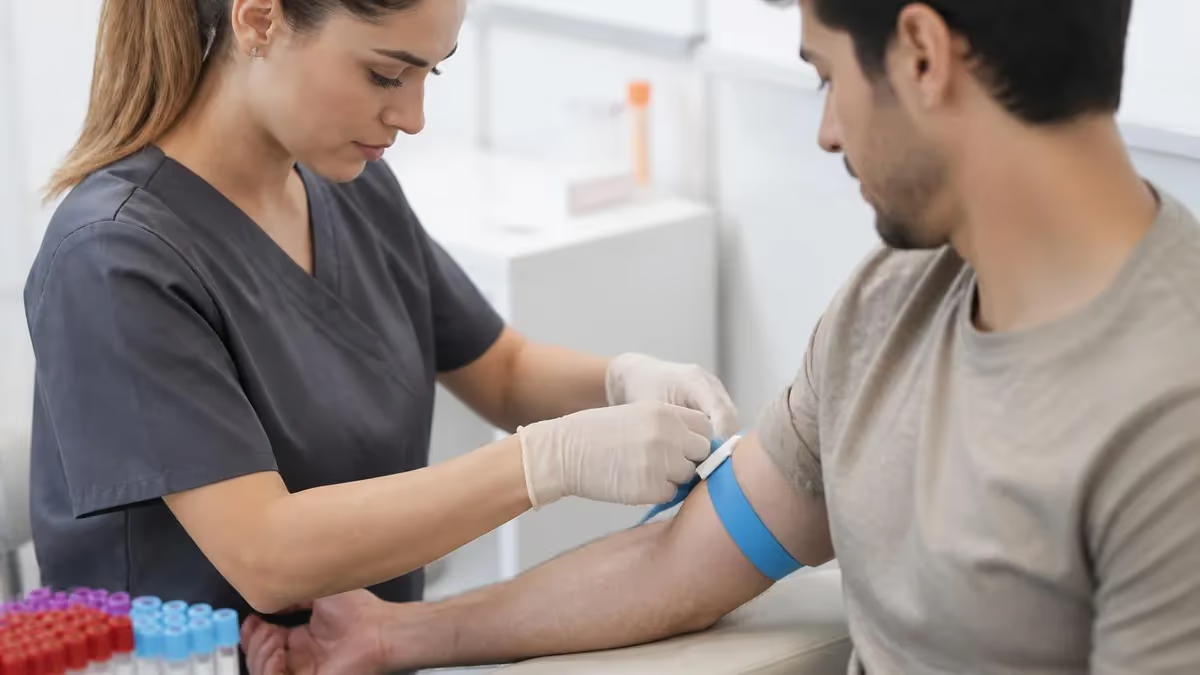
Online phlebotomy programs let you handle the academic side of training from home, then knock out the hands-on parts in a clinical lab or hospital. You're not learning to draw blood through a webcam. What you are learning online is anatomy, infection control, the order of draw, medical terminology, and the legal-ethical rules that show up on every certification exam. The clinical externship and live venipuncture practice happen in person, usually on a compressed schedule the school arranges near you.
This guide breaks down what "online phlebotomy programs" actually means in 2026, which formats are legitimate, what they cost, how long they take, and what to look for before you spend a dollar. We'll also cover certification routes (NHA, ASCP, AMT, NCCT), state quirks (California, Louisiana, Nevada, and Washington have extra licensing), and what employers actually ask about your training when you apply.
If you're juggling a job, kids, or a long commute, an online or hybrid program can compress a 4-month classroom course into 8-12 weeks of self-paced modules plus a one or two-week intensive lab. The trade-off is discipline — nobody's going to chase you to finish week 3. The upside is real: graduates of hybrid programs sit for the same national exams as traditional students, and certified phlebotomists earn $37,000-$48,000 a year nationally with strong demand in hospitals, blood banks, and outpatient labs.
Online Phlebotomy Programs at a Glance

What an Online Phlebotomy Program Actually Includes
Calling a program "online" can mean three different things, and the difference matters. A fully self-paced course delivers everything through a learning portal: video lectures, quizzes, simulated draws, and a proctored final exam. These are cheapest and fastest, but they don't qualify you for most state licenses or national certifications because you never touched a patient. They're fine for hospital aides who want a credential refresher — not for someone trying to get hired as a phlebotomy technician.
Hybrid programs are the real deal. You finish 60-80 hours of theory online — anatomy and physiology, blood collection techniques, capillary puncture, additives and order of draw, specimen handling, OSHA bloodborne pathogen training — and then attend an in-person lab intensive. The intensive runs 1-2 weeks, usually evenings or a weekend block, and that's where you do 30+ successful venipunctures and 10+ capillary sticks on live arms.
After the lab, you complete a 40-120 hour externship at a hospital, clinic, or blood bank the school partners with. Externship hours separate the strong programs from weak ones. A school that places you in a Level I trauma center will graduate a confident phlebotomist who's drawn from chemo ports, hard sticks, and pediatric patients. A program that lines up 40 hours at a small outpatient clinic gets you certified, but you'll feel underprepared on day one of your first hospital job.
The third category is asynchronous community college programs. These run through the regular semester (12-16 weeks) but post lectures online; you show up for scheduled lab days and your externship. They're slower but transcripts transfer if you later pursue an associate degree in medical lab tech or nursing. If your long game is becoming a clinical lab scientist or RN, the community college pathway gives you transferable credits the trade-school options don't.
Online vs. Hybrid: Which Counts for Certification?
Every major certifying body — NHA, ASCP, AMT, NCCT — requires documented hands-on training. That means a 100% online program, no matter how thorough the videos, will not qualify you to sit for the CPT, PBT, RPT, or NCPT exam. You need at least 40 hours of clinical externship plus a minimum number of successful live venipunctures (usually 25-30) and capillary punctures (5-10). When you shop programs, ask for the clinical hours number in writing before you enroll.
Accreditation: The First Thing to Check
Accreditation tells you the program meets industry standards and that its graduates are eligible to sit for national exams. The big two are the National Accrediting Agency for Clinical Laboratory Sciences (NAACLS) and the American Medical Technologists (AMT) approval list. Programs at community colleges and reputable allied health schools usually carry one of these. If a program can't tell you which body accredits it, walk away.
State-approved programs matter too, especially in California, Louisiana, Nevada, and Washington — the four states with phlebotomy-specific licensing. California is the strictest: only programs approved by the California Department of Public Health (CDPH) Laboratory Field Services Branch qualify you for a CPT1 or CPT2 license. A great hybrid program in Texas may not unlock a California job. Check your state board's approved-programs list before paying tuition.
Also look at outcomes data. Reputable programs publish their certification exam pass rates and job placement numbers. A school showing 85% NHA CPT pass rates and 70% placement within 6 months has skin in the game. One that won't share numbers probably has bad ones.
The Four Stages of an Online Phlebotomy Program
60-80 hours of self-paced modules covering anatomy, physiology, infection control, OSHA standards, medical terminology, order of draw, additives, and specimen handling. Includes quizzes and a proctored midterm.
1-2 weeks on campus or at a partner clinical site. You'll perform 25-30 supervised venipunctures, 5-10 capillary sticks, butterfly draws, and learn special collections (blood cultures, glucose tolerance).
40-120 hours unpaid at a hospital, blood bank, outpatient lab, or doctor's office. You draw real patients under a preceptor's eye, log every successful stick, and rotate through morning rounds and outpatient stations.
After completing the program, you sit for a national exam (NHA CPT, ASCP PBT, AMT RPT, or NCCT NCPT). Most pass rates run 75-85% on first attempt; programs often include one paid attempt in tuition.
Cost and Length: What You're Actually Paying For
Tuition for legitimate online phlebotomy programs runs $700 to $2,500 in 2026. The bottom of that range is for short, accelerated 8-week hybrid programs at vocational schools — Phlebotomy Training Specialists, Penn Build Career School, Stepful, and similar. The top is for accredited community college programs that take a full semester and include an associate-degree credit pathway.
Hidden costs catch people. The exam fee itself is $115-$135 (NHA) or $135-$155 (ASCP), and some programs don't include it. Background checks ($35-$75), drug screens ($30-$60), TB tests and hepatitis B titer ($75-$150), and scrubs/safety glasses/closed-toe shoes for clinical add another $150-$300. Books and lab kits are usually bundled, but check. Plan on $1,200 to $3,200 all-in for a complete certification-ready package.
Length matters as much as cost. An 8-week accelerated program looks attractive on paper, but it compresses 80 hours of theory into a tight schedule. If you work full-time, the 12-16 week version with longer evenings gives you breathing room and better retention — which translates directly to your exam score. Ask each school how many hours per week the average student studies; reputable answers fall between 8 and 15.

Certification Routes for Phlebotomy Technicians
The Certified Phlebotomy Technician from the National Healthcareer Association is the most widely recognized credential for new phlebotomists. The exam is 100 questions in 2 hours, costs $135 in 2026, and passes at around 76% first-attempt. You need a high school diploma plus completion of an approved phlebotomy program with at least 30 successful venipunctures and 10 capillary sticks. The NHA's online portal sends digital badges to employers automatically, and recertification runs every two years with 10 continuing-education credits.
State Licensing: Where Online Programs Get Tricky
Most states don't license phlebotomists separately — your national certification is enough to work. Four states are the exception, and each handles online programs differently.
California requires either a Certified Phlebotomy Technician I (CPT1) or CPT2 license issued by CDPH. To qualify you need to graduate from a CDPH-approved phlebotomy program (the approved list is published online), then pass a national exam. Most national online programs are not on California's list. If you live in CA, check the CDPH approved-programs PDF before enrolling. Common approved options include in-state community colleges and certain hospital-based training tracks.
Louisiana requires registration with the State Board of Medical Examiners. Hybrid programs accredited by NAACLS usually qualify, but you'll file documentation showing your clinical hours and exam pass.
Nevada requires an Office of Laboratory Services certificate. The state accepts most national exams (NHA, ASCP, AMT) provided your training program documents the required clinical hours.
Washington uses a Medical Assistant-Phlebotomist (MA-P) credential through the Department of Health. You apply after passing a national exam; online program transcripts are accepted if they show 40+ clinical hours.
For the other 46 states, your certification card from NHA, ASCP, AMT, or NCCT is your license to work. Some employers may require specific credentials — Quest tends to prefer ASCP, while NHA dominates in retail clinics — but state law won't block you.
Any program advertising "complete phlebotomy certification 100% online with no in-person requirements" is misleading you. No nationally recognized certifying body will let you sit for the exam without documented hands-on training. These programs typically issue a certificate of completion that looks like a credential but isn't. Employers and hospitals check certifications against issuing bodies directly — a fake or unrecognized one means no job, period. If a program won't name its clinical partners or provide the lab portion in writing, that's your signal to keep looking.
What Employers Actually Look For
When hospitals, blood banks, and outpatient labs hire entry-level phlebotomists, they screen for three things on a resume: an active certification (CPT, PBT, RPT, or NCPT), documented clinical hours from an accredited program, and any prior healthcare exposure. The school name matters less than the credential and externship site. A graduate from an online hybrid program who completed a 120-hour externship at a major hospital reads stronger than someone from a name-brand campus program who only did 40 hours at a small clinic.
Beyond credentials, hiring managers ask about specific scenarios. How do you handle a fainting patient? What's your protocol for a difficult stick? Which tube goes first in a complete blood count plus coagulation panel? Programs that drill the order of draw and crisis scenarios — not just theory — produce candidates who interview well. Mock interviews are a quiet quality signal of a serious program.
Soft skills count too. Phlebotomists work face-to-face with anxious patients, screaming toddlers, hospice families, and busy nurses. The job is half technical, half customer service. Online programs that include patient-communication modules and recorded role-play exercises usually graduate students who hit the ground running. If your program skips this, supplement with videos and shadowing.
Pre-Enrollment Checklist for Online Phlebotomy Programs
- ✓Verify accreditation through NAACLS or AMT (or your state board if you're in CA, LA, NV, WA).
- ✓Confirm the program includes at least 40 hours of supervised clinical externship.
- ✓Check that the program lists 25+ live venipunctures and 5+ capillary sticks as graduation requirements.
- ✓Ask whether the certification exam fee (NHA $135, ASCP $145, AMT $120, NCCT $90) is included in tuition.
- ✓Request published exam pass rates and 6-month job placement statistics in writing.
- ✓Confirm the school arranges the externship site rather than asking you to find your own.
- ✓Budget for hidden costs: background check, drug screen, immunizations, scrubs ($150-$300 extra).
- ✓Check refund policy: legitimate programs offer at least 7-day full refunds before lab modules begin.

How to Choose the Right Online Phlebotomy Program for You
Start with your goal. If you want to work in a hospital, prioritize programs that partner with hospital systems for clinical placement and that prep you for ASCP or NHA — those are the two credentials hospital HR systems screen for. If you're targeting outpatient labs or physician offices, NHA or AMT is fine, and faster programs work well.
Next, look at your schedule. If you work 40 hours a week, a 16-week program with evening lab options will treat you better than an 8-week accelerated track that demands 25 study hours weekly. Burnout midway costs more than the extra eight weeks.
Geographic location matters for the externship. Online theory is portable, but you'll be commuting to a clinical site for 6-15 weeks. Confirm the school has externship partnerships within a 30-minute drive of you before you enroll. The biggest complaint from online students is being told post-payment that the nearest site is two hours away.
Finally, talk to a graduate. Most programs have alumni or current student ambassadors willing to chat for 10 minutes. Ask: did the lab match what the website promised? How responsive were instructors? Did the externship line up easily? Would they pick this program again? Honest answers beat marketing every time. You can also browse our phlebotomy training overview for additional context on standard curriculum components.
Online Phlebotomy Programs Pros and Cons
- +Flexible scheduling — study at night, on weekends, or between shifts
- +Lower cost than full-time campus programs ($700-$2,500 vs. $3,000-$6,000)
- +Faster completion possible (8-12 weeks accelerated)
- +Same national certifications available as campus students
- +Mobile-friendly modules let you review anywhere
- +Self-paced content lets you slow down on hard topics like coagulation or special collections
- −Requires strong self-discipline — no daily classroom accountability
- −In-person lab and externship still mandatory (can't be skipped)
- −Lab intensive locations may not be near you
- −Networking with classmates is limited
- −Not eligible for some state licenses (notably California) unless state-approved
- −Lower-quality "online-only" programs flood search results and waste money
Pros and Cons at a Glance
| Pros | Cons |
|---|---|
| Flexible scheduling — study at night, on weekends, or between shifts | Requires strong self-discipline — no daily classroom accountability |
| Same national certifications available as campus students | In-person lab and externship still mandatory (can't be skipped) |
| Mobile-friendly modules let you review anywhere | Lab intensive locations may not be near you |
| Self-paced content lets you slow down on hard topics like coagulation or special collections | Networking with classmates is limited |
What to Do Once You Enroll
Treat the online portion like a part-time job. Block 10-12 hours a week on your calendar — same days, same times. Online learners who finish strong tend to have a fixed routine, not random late-night cram sessions. Knock out one module per week minimum, and re-watch lectures on tough topics like the order of draw or anticoagulant additives.
Start practicing the order of draw from week one. It's the most-tested concept on every phlebotomy exam. Memorize it cold: blood cultures, light blue (sodium citrate), red or gold (serum), green (heparin), lavender (EDTA), gray (sodium fluoride). Quiz yourself daily. Programs that score 80%+ on first-attempt exams almost all hammer the order of draw from day one.
Schedule your externship as early as the school allows. The good clinical sites fill up months ahead, and a strong externship is what employers actually evaluate when you apply. Show up early, ask preceptors for feedback after every shift, and document every successful stick in a logbook — you'll need those numbers for your certification application.
Plan for the exam from week one too. The NHA, ASCP, AMT, and NCCT exams all publish content outlines. Map your study time against the topic weights: anatomy and physiology (around 15%), blood collection procedures (35%), specimen processing (20%), safety and infection control (20%), legal and ethics (10%). Spend more time on the heaviest sections. If you're aiming for the CPT, our NHA phlebotomy practice test guide walks through the structure and sample questions.
Once you finish theory and lab, register for the certification exam quickly. Wait too long and the material fades. Most graduates schedule the exam for 2-3 weeks after their last clinical day, while everything is fresh.
Sample Phlebotomy Practice Questions
Try these questions from our free Phlebotomy practice tests. The correct answer and an explanation follow each question.
What organization accredits phlebotomy training programs recognized by the ASCP Board of Certification?
- A. NAACLS
- B. JCAHO
- C. CLIA
- D. CAP
Answer: A. NAACLS
NAACLS (National Accrediting Agency for Clinical Laboratory Sciences) accredits programs accepted by ASCP BOC.
How often should phlebotomy technicians renew their certification to remain current in their field?
- A. Every 2 years
- B. Every 3 years
- C. Every 5 years
- D. Certification does not require renewal
Answer: B. Every 3 years
Phlebotomy technicians certified through organizations like the APT typically need to renew their certification every three years. This renewal process usually involves completing continuing education units (CEUs) to ensure they remain current with best practices and advancements in the field. Regular renewal helps maintain professional competency and patient safety.
What certification does the American Medical Certification Association (AMCA) offer for phlebotomy professionals?
- A. Certified Clinical Laboratory Specialist (CCLS)
- B. Phlebotomy Technician Certification (PTC)**
- C. National Phlebotomy Certification (NPC)**
- D. Licensed Blood Collection Specialist (LBCS)**
Answer: B. Phlebotomy Technician Certification (PTC)**
The American Medical Certification Association (AMCA) offers the Phlebotomy Technician Certification (PTC) for individuals working in phlebotomy. This specific credential signifies that the holder has met AMCA's rigorous standards for competence in blood collection procedures and patient care. It is their distinct certification for phlebotomy professionals.
Which certification is offered by the ASCP for laboratory professionals?
- A. Certified Nursing Assistant (CNA)
- B. Medical Laboratory Scientist (MLS)
- C. Registered Health Information Technician (RHIT)
- D. Certified Professional Coder (CPC)
Answer: B. Medical Laboratory Scientist (MLS)
The American Society for Clinical Pathology (ASCP) offers a range of certifications for laboratory professionals, including the Medical Laboratory Scientist (MLS) certification. This certification signifies a high level of competency and knowledge in clinical laboratory science. It is a widely recognized credential for those working in medical laboratories.
Phlebotomy Questions and Answers
The Bottom Line on Online Phlebotomy Programs
Online phlebotomy programs work — when they're hybrid, accredited, and partnered with real clinical sites. The convenience is real, the cost is reasonable, and the certifications you earn are identical to what campus students get. The risk is choosing a program that overpromises (100% online, no externship, instant certificate) and underdelivers.
Once you understand the structure — theory online, lab and externship in person, certification exam at the end — picking the right program becomes a matter of checking accreditation, clinical hours, exam pass rates, and externship locations. If you've made it this far, you know more than 90% of prospective students who enroll without doing their homework.
Use this guide as a checklist, contact two or three programs that look strong, and ask the specific questions we listed above. The 30 minutes you spend vetting saves months of frustration and thousands of dollars. Phlebotomy careers don't require a four-year degree, but they do reward people who pick the right starting point.
A solid hybrid program, an accredited credential, and a 120-hour externship at a busy clinical site will get you hired within 6 months of completion in most metro areas — sometimes within 6 weeks. Once you're on the job, recertification, continuing education, and lateral moves into specialties like donor phlebotomy, pediatric blood collection, or arterial blood gas open up.
Some certified phlebotomists use the credential as a stepping stone toward becoming a medical lab tech, registered nurse, or even a physician assistant — the clinical exposure counts toward many healthcare admissions packets. The credential is the door; what you do with it is up to you.
Ready to test what you already know? Drop into one of our free practice quizzes above, or browse the full phlebotomy practice test library. The questions match exam content outlines and will tell you fast where your study time should go. If you're still weighing options between training paths, our guides on phlebotomy certification and phlebotomy programs walk through every credential and program type in detail.
About the Author

Registered Nurse & Healthcare Educator
Johns Hopkins University School of NursingDr. Sarah Mitchell is a board-certified registered nurse with over 15 years of clinical and academic experience. She completed her PhD in Nursing Science at Johns Hopkins University and has taught NCLEX preparation and clinical skills courses for nursing students across the United States. Her research focuses on evidence-based exam preparation strategies for healthcare certification candidates.