
Phlebotomy Certification Cost: Complete 2026 October Price Breakdown by State, Agency & Program Type
Phlebotomy certification cost in 2026 October: full breakdown of exam fees, training tuition, supplies, and renewal pricing by state and agency. 🎯
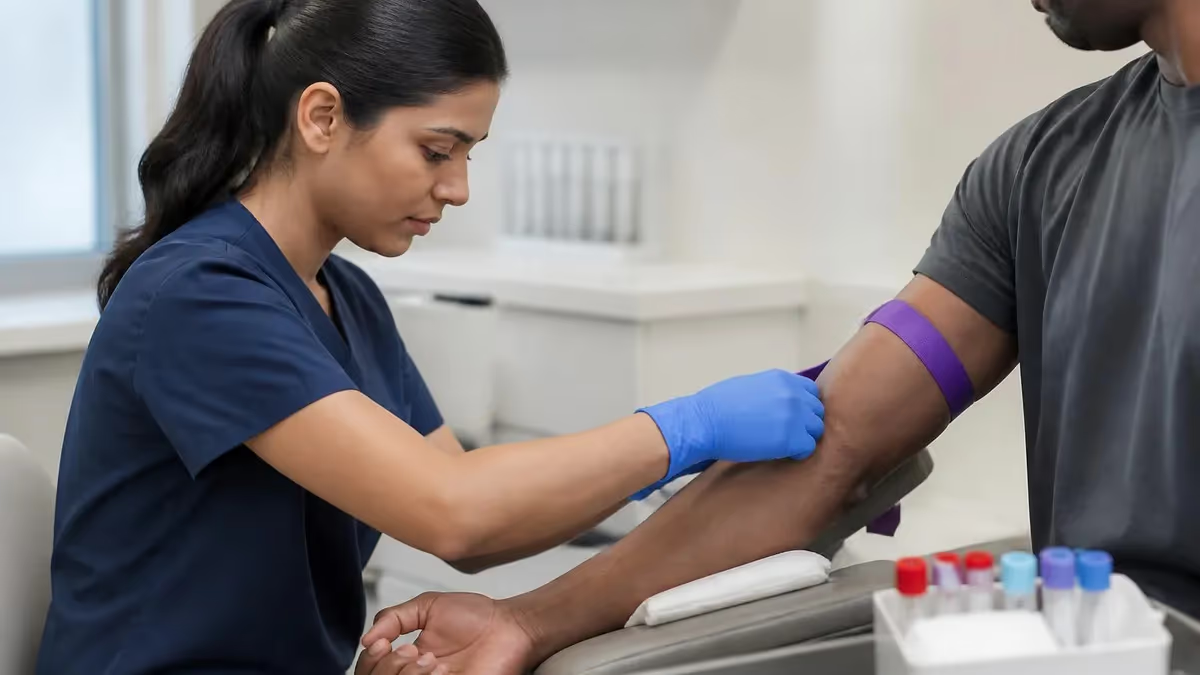
The total phlebotomy certification cost in 2026 typically runs between $700 and $3,500 in the United States, depending on the training program length, the certifying agency you choose, and whether your state requires a separate license. Most students searching for phlebotomy classes near me are surprised to learn that the exam fee itself is only a small slice of the total investment, while tuition, supplies, background checks, and clinical fees often make up 80% or more of the final out-of-pocket price tag.
Understanding the full cost matters because phlebotomy is one of the fastest entry points into healthcare, with most students completing training in 4 to 12 weeks. A clear budget helps you avoid common traps such as paying for a program that does not include externship hours, choosing a certification not recognized by employers in your region, or missing financial aid deadlines. This guide breaks every line item down so you can compare programs apples to apples.
Costs vary widely by setting. A community college phlebotomy program might charge $1,200 to $2,500 for in-state residents, while a private vocational school can run $1,800 to $4,000 for the same content. Hospital-based programs sometimes cost as little as $300, but they are competitive and often require you to commit to working at that facility after graduation. Online hybrid programs sit in the middle, usually $900 to $1,800, with clinical hours arranged locally.
The certification exam itself is surprisingly affordable. National Healthcareer Association (NHA) charges $117, American Medical Technologists (AMT) charges $135, American Society for Clinical Pathology (ASCP) charges $135, and the American Medical Certification Association (AMCA) charges around $125. These fees include one exam attempt and your initial credential, but they do not include study materials, retakes, or the required continuing education for renewal every two years.
State requirements add another layer. California, Washington, Nevada, and Louisiana legally require phlebotomists to hold a state license in addition to national certification, which adds $50 to $200 in licensing fees plus separate continuing education tracking. The other 46 states leave certification voluntary, but more than 90% of hospital employers still require it as a condition of employment, so skipping it is rarely a realistic path.
Hidden costs surprise many students. Expect to pay $80 to $150 for a background check and drug screen, $40 to $90 for required immunizations if you do not already have them, $100 to $250 for scrubs and a watch with a second hand, and $150 to $400 for textbooks if they are not bundled into tuition. Add transportation to clinical sites and time off work, and the true cost climbs another 15% to 20% above the sticker price.
The good news is that the return on investment is fast. With a median entry wage near $19 per hour and overtime widely available, most certified phlebotomy technicians recoup their full training investment within three to six months on the job. This article walks you through every cost category so you can plan accurately and pick the program that matches your budget and career goals.
Phlebotomy Certification Cost by the Numbers

Cost Breakdown by Program Type
Every certifying agency charges a slightly different exam fee, and the agency you pick should match what local employers actually accept. The National Healthcareer Association (NHA) issues the Certified Phlebotomy Technician (CPT) credential for $117 and is by far the most widely recognized credential in retail labs, clinics, and physician offices. American Medical Technologists (AMT) issues the Registered Phlebotomy Technician (RPT) for $135, with strong recognition in hospital systems across the Midwest and Northeast.
The American Society for Clinical Pathology (ASCP) charges $135 for the PBT exam and is considered the gold standard in hospital laboratories, especially academic medical centers. Because ASCP has stricter eligibility routes, fewer students qualify directly out of training, but those who do see preference in competitive hospital roles. The National Center for Competency Testing (NCCT) charges $135 and is popular in vocational school graduates because schools often partner directly with NCCT for on-site testing.
Smaller agencies like the American Medical Certification Association (AMCA) and the Association of Phlebotomy Technicians (ASPT) charge between $100 and $125 and are accepted regionally. Before paying for any exam, search three job postings in your zip code and confirm which credentials they list. Employers often write "NHA, AMT, ASCP, or equivalent," and choosing one outside that list can make you invisible to applicant tracking systems even if your skills are identical.
If you want a credential that travels nationally, locate a phlebotomy certification near me tied to NHA or ASCP because they appear most frequently in hospital job postings nationwide. Regional choices like AMCA work fine if you plan to stay in one metro area, but switching states later can sometimes mean retesting with a different agency, which doubles your total exam spend over a career.
Retake fees are an underappreciated cost. NHA charges $117 for each retake, AMT charges $50 to $75, and ASCP charges the full $135 again. Pass rates hover between 70% and 85% on the first attempt, so a realistic budget should assume a 15% chance you will need to pay a retake fee. Buying a quality study bundle for $40 to $80 is almost always cheaper than gambling on a retake.
Continuing education is built into the long-term cost of every certification. NHA requires 10 contact hours every two years, AMT requires 30 points every three years, and ASCP requires the Credential Maintenance Program with 36 points every three years. Free CE through employer in-services covers most requirements, but expect to spend $25 to $75 per cycle if you need to buy modules online to fill gaps.
Reciprocity between agencies is rare. You generally cannot pay a small transfer fee to switch your NHA credential to ASCP; you must sit for the new exam and pay the full fee. For that reason, picking the right certification the first time saves the most money over a 10-year career, and that decision should be driven by the employers and job titles you actually want, not the lowest sticker price.
Phlebotomy Practice Test Questions
Prepare for the Phlebotomy Test exam with our free practice test modules. Each quiz covers key topics to help you pass on your first try.
Phlebotomy American Medical Certification ...
Phlebotomy Exam Questions covering American Medical Certification Association Phlebotomy. Master Phlebotomy Test concepts for certification prep.
Phlebotomy American Medical Technologists ...
Free Phlebotomy Practice Test featuring American Medical Technologists Phlebotomy. Improve your Phlebotomy Exam score with mock test prep.
Phlebotomy American Society for Clinical P...
Phlebotomy Mock Exam on American Society for Clinical Pathology Phlebotomy. Phlebotomy Study Guide questions to pass on your first try.
Phlebotomy Association of Phlebotomy Techn...
Phlebotomy Test Prep for Association of Phlebotomy Technicians. Practice Phlebotomy Quiz questions and boost your score.
Phlebotomy National Center for Competency ...
Phlebotomy Questions and Answers on National Center for Competency Testing Phlebotomy. Free Phlebotomy practice for exam readiness.
Phlebotomy National Healthcareer Associati...
Phlebotomy Mock Test covering National Healthcareer Association Phlebotomy. Online Phlebotomy Test practice with instant feedback.
Phlebotomy Order of Draw and Additives
Free Phlebotomy Quiz on Order of Draw and Additives. Phlebotomy Exam prep questions with detailed explanations.
Phlebotomy Legal and Ethics
Phlebotomy Practice Questions for Phlebotomy Legal and Ethics. Build confidence for your Phlebotomy certification exam.
Phlebotomy Safety and Infection Control
Phlebotomy Test Online for Safety and Infection Control. Free practice with instant results and feedback.
Phlebotomy Special Collection Procedures
Phlebotomy Study Material on Special Collection Procedures. Prepare effectively with real exam-style questions.
Phlebotomy Specimen Processing and Handling
Free Phlebotomy Test covering Specimen Processing and Handling. Practice and track your Phlebotomy exam readiness.
Phlebotomy Test Arterial Blood Gas Collection
Phlebotomy Exam Questions covering Test Arterial Blood Gas Collection. Master Phlebotomy Test concepts for certification prep.
Phlebotomy Test Capillary and Dermal Puncture
Free Phlebotomy Practice Test featuring Test Capillary and Dermal Puncture. Improve your Phlebotomy Exam score with mock test prep.
Phlebotomy Test Pediatric Blood Collection
Phlebotomy Mock Exam on Test Pediatric Blood Collection. Phlebotomy Study Guide questions to pass on your first try.
Phlebotomy Test Phlebotomy Anatomy and Phy...
Phlebotomy Test Prep for Test Phlebotomy Anatomy and Physiology. Practice Phlebotomy Quiz questions and boost your score.
Phlebotomy Test Phlebotomy Exam Simulation
Phlebotomy Questions and Answers on Test Phlebotomy Exam Simulation. Free Phlebotomy practice for exam readiness.
Phlebotomy Test Phlebotomy Patient Identif...
Phlebotomy Mock Test covering Test Phlebotomy Patient Identification and Communication. Online Phlebotomy Test practice with instant feedback.
Phlebotomy Test Point of Care Testing
Free Phlebotomy Quiz on Test Point of Care Testing. Phlebotomy Exam prep questions with detailed explanations.
Phlebotomy Training Specialists: Tuition Comparison
Community college phlebotomy programs are widely considered the best value for most students, charging $1,200 to $2,500 in tuition for in-state residents and typically including 80 to 120 clinical externship hours, textbooks, and lab supplies. Programs run 8 to 16 weeks and qualify for federal financial aid, including Pell Grants for eligible students, which can cover the entire program for those who meet income thresholds.
The trade-off is scheduling. Community college cohorts often start only once or twice per year and may be waitlisted, especially in California, Texas, and Florida where demand is high. Out-of-state tuition can also triple the cost, so confirm residency requirements before enrolling. Graduates leave with the strongest preparation for ASCP and AMT exams and the best networking with local hospital clinical sites.

Is Paying for Certification Worth It?
- +Average $4,200 starting salary boost over uncertified workers in the first year
- +More than 90% of hospital postings list certification as required or strongly preferred
- +Faster promotion to lead phlebotomist, donor specialist, or lab assistant roles
- +Credential transfers across employers within the same agency without retesting
- +Eligible for tuition reimbursement at most hospital systems after 90 days employed
- +Qualifies you for travel phlebotomy contracts paying $28–$40 per hour
- −Upfront cost of $700–$3,500 before any income is earned
- −Continuing education and renewal fees recur every 2–3 years for life
- −Some states require additional licensure on top of national certification
- −Retake fees of $50–$135 if you fail the exam on the first attempt
- −Background check disqualifications can prevent clinical site placement
- −Time commitment of 4–16 weeks delays entry into the workforce
Budget Checklist Before You Enroll
- ✓Confirm the program is accredited by NAACLS, ABHES, or a state department of education
- ✓Request a written itemized cost sheet including tuition, books, supplies, and exam fee
- ✓Verify which certifying agency the program prepares you for and that local employers accept it
- ✓Ask whether the externship is included or requires you to find your own clinical site
- ✓Check if a background check and drug screen are required and who pays for them
- ✓Confirm immunization requirements including Hepatitis B, MMR, Tdap, and annual flu shot
- ✓Compare in-state versus out-of-state tuition if attending a community college
- ✓Apply for FAFSA at least 60 days before the program start date for federal aid
- ✓Investigate employer tuition reimbursement if you already work in healthcare
- ✓Budget an extra 15% buffer for transportation, scrubs, and unexpected fees
Hospital-Sponsored Training Can Be Nearly Free
Major hospital systems like Quest Diagnostics, LabCorp, HCA Healthcare, and Kaiser Permanente run hire-then-train programs where they pay your tuition and exam fee in exchange for a one-year work commitment. These programs are competitive but can reduce your total out-of-pocket cost from $2,500 to under $400 while paying you a training wage of $14–$17 per hour during instruction.
State licensing adds a layer of cost that catches many out-of-state students by surprise. California has the strictest rules in the country and recognizes three tiers: Limited Phlebotomy Technician, Certified Phlebotomy Technician I, and Certified Phlebotomy Technician II. The state application fee is $100, fingerprinting runs another $60, and you must complete a CDPH-approved 80-hour didactic and 40-hour clinical program before sitting for a nationally recognized exam. Total California cost typically reaches $2,500 to $4,500.
Washington State requires phlebotomists to hold a Medical Assistant–Phlebotomist credential through the Department of Health, with an application fee of $40, a credentialing fee of $115, and renewal every year for $80. Nevada licenses through the Office of Laboratory Services with a one-time $75 fee. Louisiana requires registration through the Louisiana State Board of Medical Examiners. These four states are the most regulated, and the rules change periodically, so always confirm current fees on the official state board website before paying.
The other 46 states do not require a separate license, but knowing the local order of draw phlebotomy standards and employer expectations still matters. New York, Texas, and Florida have no state license but do require certification through one of the major national agencies for hospital employment. Some smaller employers in rural areas will hire uncertified technicians and pay for training, but starting wages run $3 to $5 per hour lower than certified positions, which erases the savings within months.
Hidden costs beyond tuition and exam fees catch nearly every new student. A two-step PPD tuberculosis test runs $30 to $80. The Hepatitis B vaccine series costs $200 to $300 if not covered by insurance, although community health departments often offer it free. CPR certification through the American Heart Association is required by 70% of programs and costs $50 to $90. Drug screens run $35 to $75, and background checks vary from $25 in some states to $80 in others depending on whether fingerprinting is required.
Supplies and personal equipment add up quickly. Two pairs of scrubs typically cost $60 to $120, supportive nursing shoes run $80 to $140, a watch with a second hand is $20 to $50, and a stethoscope, while not always required, costs $30 to $80 if your program needs one. Most programs require a clipboard, penlight, bandage scissors, and a pocket reference card, which together add another $40 to $70. Buying gently used items on classmate Facebook groups can cut these costs in half.
Transportation to clinical sites is a real but invisible cost. Externships often require driving 20 to 45 miles to a hospital or outpatient lab two to four days per week for six to eight weeks. At current fuel prices, that adds $200 to $500 to your real cost of attendance. Some programs partner with sites closer to campus, so ask specifically where past cohorts were placed before committing.
Lost income during training is the largest hidden cost for working adults. A 12-week program meeting weekday mornings can reduce your work hours by 20 per week, costing $4,000 to $6,000 in foregone wages at minimum wage. Evening and weekend programs cost more in tuition but preserve your day-job income, which often nets out as the cheaper overall option. Run the math for your own situation before assuming the lowest sticker price is the lowest total cost.

Several online providers advertise phlebotomy certification for $99 to $300 but do not include the 30 supervised venipunctures most agencies require. Graduates of these programs cannot sit for NHA, AMT, or ASCP exams and end up paying for legitimate training a second time. Always verify accreditation through NAACLS, ABHES, or your state department of education before paying any tuition.
Financial aid for phlebotomy training is more accessible than most students realize. The Free Application for Federal Student Aid (FAFSA) qualifies eligible students for Pell Grants of up to $7,395 per year at any accredited community college or vocational school participating in Title IV. Because most phlebotomy programs cost less than the annual Pell maximum, qualifying students often pay nothing out of pocket and may have leftover aid for books and transportation.
Workforce Innovation and Opportunity Act (WIOA) funding covers tuition for unemployed and underemployed adults at approved training providers in every state. Apply through your local American Job Center, and a case manager will determine eligibility. Many phlebotomy programs at community colleges and vocational schools are on the state Eligible Training Provider List, which means WIOA can cover 100% of tuition plus support services like childcare and transportation stipends.
Veterans receive strong support. The GI Bill covers approved phlebotomy programs at accredited schools, and many states have additional veteran tuition waivers for community college. Active-duty military spouses qualify for the MyCAA scholarship of up to $4,000, which covers most phlebotomy programs in full. The Department of Veterans Affairs also runs a Vocational Rehabilitation and Employment program for service-disabled veterans that pays tuition, fees, and a monthly housing allowance.
Employer tuition reimbursement is the most underused benefit in healthcare. If you currently work as a nursing assistant, medical assistant, EMT, or even in non-clinical hospital roles like housekeeping or transport, ask HR about education benefits. Most hospital systems reimburse $2,500 to $5,500 per year for job-related training, which fully covers phlebotomy certification. Many will pay upfront if you commit to staying employed for 12 to 24 months after completion.
State and local scholarships go unclaimed every year. Search your state's higher education portal for healthcare workforce grants, and check professional associations like the American Society for Clinical Laboratory Science for student awards in the $500 to $2,500 range. Local hospitals, Rotary Clubs, and community foundations also offer small scholarships specifically for healthcare students, and the application pool is often tiny enough that careful applicants have a real chance.
The return on investment math is straightforward and motivating. A typical certified phlebotomist earns $36,000 to $42,000 in the first year, compared to $26,000 to $30,000 for uncertified technicians where they are still hired. That $8,000 to $12,000 annual difference recovers a $2,500 training investment in under four months. Bonus pay for overnight, weekend, and holiday shifts plus optional overtime can push first-year income above $50,000 in high-demand markets like Boston, Seattle, and the San Francisco Bay Area.
Career laddering multiplies the return. After 12 to 18 months on the job, certified phlebotomists move into lead phlebotomist, donor specialist, plasma center supervisor, or medical laboratory assistant roles paying $22 to $30 per hour. Many use phlebotomy as a stepping stone into clinical laboratory science, nursing, or physician assistant programs, where the patient contact hours earned on the job strengthen graduate school applications. Look into a local phlebotomy program near me that articulates credits toward an associate degree to maximize this pathway.
With your budget set and aid in place, the final step is choosing the smartest order of operations so you do not pay for anything twice. Start by identifying the three to five employers you most want to work for, then call their HR or recruiting departments and ask which certifications they accept and which local schools they hire from most often. This 30-minute phone call saves more money than any other research step, because it ensures every dollar you spend points at a real job at the end of the road.
Once you have a target credential and a short list of programs, request a written program disclosure from each school. Federal regulations require accredited programs to disclose tuition, fees, placement rates, completion rates, and median student debt. Compare these documents side by side rather than relying on website marketing. The school with the lowest tuition but a 40% completion rate is almost always more expensive than the school with higher tuition and an 85% completion rate, because dropouts pay full price for partial training.
Time your enrollment to financial aid deadlines and clinical site availability. Programs starting in January, May, and August tend to have the strongest clinical placement options because hospital schedules are predictable. Mid-quarter starts sometimes mean traveling farther for externships or being placed at lower-volume sites where you get fewer sticks. Speak to recent graduates about their externship experience before committing to a start date that does not align with the program's strongest clinical partners.
Buy used textbooks and shared study materials to cut $150 to $300 off the supply line. The most recommended phlebotomy textbooks, including McCall's Phlebotomy Essentials and Garza's Phlebotomy Handbook, are widely available used for $30 to $50 in good condition. Study apps and question banks like Pocket Prep, Mometrix, and Exam Edge offer 30 to 90-day subscriptions for $30 to $60, which is usually enough lead time to pass on the first attempt.
Schedule your certification exam within four weeks of finishing clinicals. Knowledge fades quickly once you stop sticking patients daily, and first-time pass rates drop noticeably for students who wait six months or longer. Pay for the exam as soon as you are eligible, lock in a testing date, and reverse-engineer your study schedule from there. Most students need 40 to 80 hours of focused review to feel confident on test day, which breaks down to two hours per night for four to six weeks.
Negotiate your starting wage. Many new graduates accept the first offer without realizing that healthcare employers expect counter-offers. A typical phlebotomist hire has $1.50 to $3.00 per hour of negotiation room, especially if you have multiple offers or in-demand shift availability such as weekends, overnights, or holidays. Over a one-year period, that negotiation gap is worth $3,000 to $6,000, which is more than most students spent on their entire certification.
Finally, keep clear records of every dollar you spend. Tuition, fees, books, supplies, transportation to clinicals, exam fees, and even some uniform costs may be tax-deductible as education or unreimbursed work expenses depending on your situation. A simple folder with receipts and a one-page summary saves $200 to $600 at tax time for most students, and that refund effectively reduces your certification cost without any additional effort. Talk to a tax professional in your first year of employment to capture every legitimate deduction.
Phlebotomy Questions and Answers
About the Author

Registered Nurse & Healthcare Educator
Johns Hopkins University School of NursingDr. Sarah Mitchell is a board-certified registered nurse with over 15 years of clinical and academic experience. She completed her PhD in Nursing Science at Johns Hopkins University and has taught NCLEX preparation and clinical skills courses for nursing students across the United States. Her research focuses on evidence-based exam preparation strategies for healthcare certification candidates.