
Phlebotomy Exam 2026 October: Complete Certification Study Guide & Practice
Complete phlebotomy exam prep guide covering certifications, order of draw, study schedules, salary outlook, and free practice tests for 2026 October candidates. ✍🏼
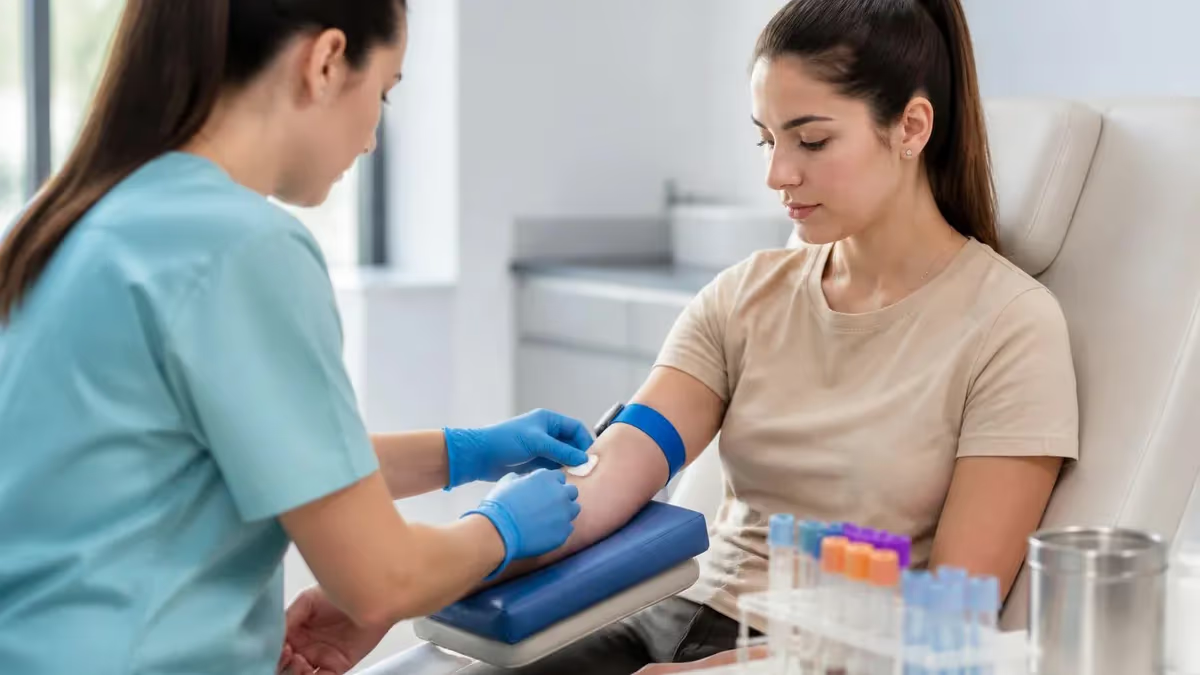
The phlebotomy exam is the final gateway between classroom training and a credentialed healthcare career, and in 2026 it remains one of the most accessible entry points into the clinical laboratory profession. Whether you are searching for phlebotomy classes near me or already enrolled in a hospital-based program, understanding what the certification exam actually tests will shape how you study, how confidently you walk into the testing center, and how quickly you land your first paid draw station role after graduation.
Every nationally recognized phlebotomy exam follows a similar blueprint: anatomy and physiology of the circulatory system, specimen collection procedures, order of draw, patient identification, infection control, and pre-analytical handling errors. The questions are scenario-based, meaning you rarely get a flat definition. Instead, you face a vignette describing a difficult stick, a hemolyzed sample, or a confused geriatric patient, and you must choose the safest, most CLSI-aligned action from four plausible options.
National pass rates hover between 65% and 78% depending on the credentialing body, which means roughly one in four first-time candidates fails. The single biggest predictor of passing is not raw intelligence or how much you liked your instructor — it is the number of practice questions you complete in the final four weeks before your test date. Candidates who finish 800 or more timed practice items pass at nearly double the rate of those who only review their textbook.
This guide walks you through every certifying agency that matters in the United States, the format of each phlebotomy exam, a 12-week study schedule you can copy, the high-yield content areas that appear on virtually every test, and the practical test-day tactics that prevent careless point losses. We have built it for adult learners juggling jobs, families, and clinical externships — not for people with infinite free time.
You will also see how the certification you choose affects your starting wage, your eligibility for hospital versus outpatient roles, and your ability to cross-train into specimen processing, EKG, or medical assisting later. Phlebotomy is a small credential, but it opens disproportionately large doors in a tight healthcare labor market where bedside collectors are chronically understaffed.
Throughout this article we will reference real exam blueprints from the NHA, ASCP, AMT, NCCT, AMCA, and APT, plus current Bureau of Labor Statistics wage data. We will not sugarcoat the difficulty of computer-adaptive testing or the frustration of failing by two points. Instead, we will give you a realistic plan, the high-yield drills, and a free practice question library you can start using today.
By the end, you will know which exam to register for, how many weeks of preparation you genuinely need, what to memorize cold versus what to understand conceptually, and how to convert that credential into a job offer within 30 days of your pass letter. Let's get into it.
Phlebotomy Exam by the Numbers
Key Facts at a Glance
| Item | Value | Details |
|---|---|---|
| Questions on Most Exams | 100-150 | Scored + pretest items |
| Time Limit | 2-3 hr | Computer-based testing |
| Passing Score | 70-80% | Varies by agency |

Phlebotomy Exam Format & Content Weights
| Section | Questions | Time | Weight | Notes |
|---|---|---|---|---|
| Safety & Compliance | 12 | 12 min | 10% | OSHA, HIPAA, PPE |
| Patient Prep & ID | 18 | 18 min | 15% | Two-identifier rule |
| Specimen Collection | 42 | 42 min | 35% | Venipuncture & capillary |
| Specimen Processing | 18 | 18 min | 15% | Centrifugation, transport |
| Non-Blood Specimens | 6 | 6 min | 5% | Urine, throat, stool |
| Lab Operations | 24 | 24 min | 20% | QA, ethics, communication |
| Total | 120 | 2 hours | 100% |
Choosing the right certifying agency is the single most consequential decision you will make before sitting for your phlebotomy exam, and it should not be left to whichever brochure your school happens to hand you. Six national bodies dominate the U.S. market: the National Healthcareer Association (NHA), American Medical Technologists (AMT), American Society for Clinical Pathology (ASCP), National Center for Competency Testing (NCCT), American Medical Certification Association (AMCA), and the Association of Phlebotomy Technicians (APT).
The NHA Certified Phlebotomy Technician (CPT) credential is the most widely accepted by U.S. hospital systems and is the default choice for graduates of Penn Build, Stautzenberger, and most community college programs. It costs about $117, contains 100 scored plus 20 pretest questions, and is delivered at PSI testing centers nationwide. Pass rates sit around 75%, and the question bank emphasizes patient safety scenarios over rote memorization.
The ASCP Phlebotomy Technician (PBT) exam, by contrast, is considered the gold-standard credential in research hospitals, reference laboratories, and academic medical centers. It is shorter — only 80 questions in two hours — but the items are notoriously dense, with multi-step reasoning about tube additives, light-sensitive analytes, and chain-of-custody specimens. If you plan to work at Mayo, Cleveland Clinic, or any pathologist-driven facility, the ASCP carries the most weight.
AMT's Registered Phlebotomy Technician (RPT) credential occupies a useful middle ground. It is accepted nearly everywhere, costs $120, and is offered with both classroom and online proctoring options. Many phlebotomy training specialists recommend AMT for working adults because the eligibility routes include documented work experience, not just formal schooling.
NCCT and AMCA are slightly smaller players but enjoy strong regional recognition, particularly in the South and Mountain West. Their fees run $90-$135, and both accept candidates from accredited training programs with at least 100 hours of didactic instruction plus 100 successful venipunctures. The APT credential is newer and targets phlebotomists who want to specialize in donor centers or therapeutic phlebotomy clinics.
Before you register, call three potential employers in your zip code and ask which credential their HR department actually requires. You will be shocked how often the answer is "NHA or ASCP, no exceptions." Paying $117 for a credential that local hospitals do not accept is the most expensive mistake new phlebotomists make, and it is entirely preventable with two phone calls.
Finally, consider continuing education burdens. NHA and ASCP both require 10-12 CE hours every two years to maintain certification, while AMT requires 45 points over three years. Free CE webinars are abundant, so this is rarely a financial issue, but it does mean your credential is an ongoing commitment rather than a one-time hurdle.
Phlebotomy Practice Test Questions
Prepare for the Phlebotomy Test exam with our free practice test modules. Each quiz covers key topics to help you pass on your first try.
Phlebotomy American Medical Certification ...
Phlebotomy Exam Questions covering American Medical Certification Association Phlebotomy. Master Phlebotomy Test concepts for certification prep.
Phlebotomy American Medical Technologists ...
Free Phlebotomy Practice Test featuring American Medical Technologists Phlebotomy. Improve your Phlebotomy Exam score with mock test prep.
Phlebotomy American Society for Clinical P...
Phlebotomy Mock Exam on American Society for Clinical Pathology Phlebotomy. Phlebotomy Study Guide questions to pass on your first try.
Phlebotomy Association of Phlebotomy Techn...
Phlebotomy Test Prep for Association of Phlebotomy Technicians. Practice Phlebotomy Quiz questions and boost your score.
Phlebotomy National Center for Competency ...
Phlebotomy Questions and Answers on National Center for Competency Testing Phlebotomy. Free Phlebotomy practice for exam readiness.
Phlebotomy National Healthcareer Associati...
Phlebotomy Mock Test covering National Healthcareer Association Phlebotomy. Online Phlebotomy Test practice with instant feedback.
Phlebotomy Order of Draw and Additives
Free Phlebotomy Quiz on Order of Draw and Additives. Phlebotomy Exam prep questions with detailed explanations.
Phlebotomy Legal and Ethics
Phlebotomy Practice Questions for Phlebotomy Legal and Ethics. Build confidence for your Phlebotomy certification exam.
Phlebotomy Safety and Infection Control
Phlebotomy Test Online for Safety and Infection Control. Free practice with instant results and feedback.
Phlebotomy Special Collection Procedures
Phlebotomy Study Material on Special Collection Procedures. Prepare effectively with real exam-style questions.
Phlebotomy Specimen Processing and Handling
Free Phlebotomy Test covering Specimen Processing and Handling. Practice and track your Phlebotomy exam readiness.
Phlebotomy Test Arterial Blood Gas Collection
Phlebotomy Exam Questions covering Test Arterial Blood Gas Collection. Master Phlebotomy Test concepts for certification prep.
Phlebotomy Test Capillary and Dermal Puncture
Free Phlebotomy Practice Test featuring Test Capillary and Dermal Puncture. Improve your Phlebotomy Exam score with mock test prep.
Phlebotomy Test Pediatric Blood Collection
Phlebotomy Mock Exam on Test Pediatric Blood Collection. Phlebotomy Study Guide questions to pass on your first try.
Phlebotomy Test Phlebotomy Anatomy and Phy...
Phlebotomy Test Prep for Test Phlebotomy Anatomy and Physiology. Practice Phlebotomy Quiz questions and boost your score.
Phlebotomy Test Phlebotomy Exam Simulation
Phlebotomy Questions and Answers on Test Phlebotomy Exam Simulation. Free Phlebotomy practice for exam readiness.
Phlebotomy Test Phlebotomy Patient Identif...
Phlebotomy Mock Test covering Test Phlebotomy Patient Identification and Communication. Online Phlebotomy Test practice with instant feedback.
Phlebotomy Test Point of Care Testing
Free Phlebotomy Quiz on Test Point of Care Testing. Phlebotomy Exam prep questions with detailed explanations.
High-Yield Topics: What Is Phlebotomy Really Testing?
The order of draw phlebotomy sequence appears on every single certification exam, usually in three to five questions, and missing it tanks your pre-analytical score fast. The CLSI-mandated order is: blood culture bottles, light blue (citrate), red or gold (serum), green (heparin), lavender (EDTA), and finally gray (fluoride/oxalate). Drawing out of sequence causes additive carryover that invalidates results.
Expect questions that disguise the order inside a clinical scenario — for example, a patient needing a PT/INR plus a CBC plus a glucose. You must mentally sort the tubes and select the correct first stick. Memorize the mnemonic "Boys Love Ravishing Girls Like Glamorous Yelena" or any equivalent that locks the sequence into long-term memory before test day.

Should You Take the Phlebotomy Exam Right After Class?
- +Material is fresh and you remember instructor mnemonics clearly
- +Externship sticks are recent, so technique questions feel intuitive
- +Momentum from training keeps your study discipline high
- +Employers prefer candidates with current credentials on resumes
- +You become eligible for higher-paying certified roles immediately
- +NHA and AMT both offer same-week testing slots in most metros
- −Burnout from finals can sabotage exam performance
- −Limited real-world reps make scenario questions harder to interpret
- −Externship may not have covered geriatric or pediatric draws
- −Test fees stack on top of tuition during a tight financial period
- −Some employers want 6 months experience before hiring certified-only
- −You may not yet know which agency local hospitals actually prefer
Two-Week Pre-Exam Checklist for Certified Phlebotomy Technician Candidates
- ✓Confirm your testing center address and arrival time 48 hours in advance
- ✓Bring two forms of government-issued ID, one with photo and signature
- ✓Complete at least 400 timed practice questions in the final two weeks
- ✓Drill the CLSI order of draw until you can recite it in under 10 seconds
- ✓Memorize tube additives and the analytes each one preserves
- ✓Review OSHA Bloodborne Pathogens Standard and PPE donning sequence
- ✓Practice converting Celsius, milliliters, and gauge sizes without a calculator
- ✓Sleep at least 7 hours the night before — no last-minute cramming
- ✓Eat a protein-rich breakfast 90 minutes before the exam
- ✓Arrive 30 minutes early to check in, lock belongings, and use the restroom

Practice question volume beats textbook re-reading every single time
Studies of NHA and ASCP candidates consistently show that completing 600+ timed practice questions in the final month predicts passing better than any other variable, including GPA in training or instructor recommendations. If you only have two weeks left, abandon passive textbook reading and switch entirely to active question-bank drilling with explanations after every answer.
Passing the phlebotomy exam unlocks immediate earning power, and understanding the wage landscape helps you negotiate confidently the moment your certification letter arrives. According to the most recent Bureau of Labor Statistics data, the median phlebotomy salary in the United States sits at approximately $41,810 per year, or about $20.10 per hour, with the top 10% of certified technicians earning more than $54,000 annually in high-cost metros.
Geography drives the biggest wage swings. California phlebotomists average $52,000-$58,000 because the state requires a separate CPT-1 license layered on top of national certification, creating a smaller candidate pool. New York, Washington, Massachusetts, and Oregon all crack $48,000 on average. Meanwhile, rural Mississippi, Arkansas, and West Virginia phlebotomists often start at $14-$16 per hour, though cost-of-living adjustments narrow that gap considerably.
Employer type matters almost as much as zip code. Reference laboratories like Quest Diagnostics and Labcorp start new certified phlebotomy technicians at $16-$19 per hour but offer aggressive shift differentials and tuition reimbursement. Hospital inpatient roles pay $18-$23 per hour with full benefits and pension contributions. Plasma donation centers like CSL, Grifols, and Octapharma pay $17-$20 per hour plus performance bonuses and are famously flexible with new graduates.
Specialty roles command meaningful premiums. Therapeutic phlebotomy positions — drawing patients with hemochromatosis or polycythemia vera in outpatient infusion suites — typically pay $4-$6 more per hour than routine venipuncture because of the larger volumes, IV-access skills required, and slower patient turnover. Mobile phlebotomy roles serving home-health agencies and insurance physicals offer mileage reimbursement plus $25-$30 per hour for experienced collectors.
Certification level alters the ceiling. A certified phlebotomy technician with the NHA or AMT credential typically tops out around $26 per hour without additional skills. Add EKG certification and you move into patient care technician roles at $24-$29 per hour. Add specimen processing or medical assistant credentials and you become eligible for lead phlebotomist positions paying $28-$34 per hour with supervisory responsibilities.
Experience compounding is real but slow. Most phlebotomists see 3-4% annual raises, plus a meaningful jump at the two-year mark when you become eligible for charge or float roles. The fastest wage growth comes from changing employers every 18-24 months early in your career, particularly when moving from outpatient labs into hospital systems.
Finally, do not overlook the hidden compensation: hospital phlebotomy roles often include 100% employer-paid health insurance, 5-7% 401(k) matches, free continuing education, and meaningful tuition assistance for nursing or medical laboratory science degrees. When you total those benefits, a $42,000 hospital phlebotomist often out-earns a $48,000 commercial-lab phlebotomist on net compensation.
Most certifying agencies require you to sit for your phlebotomy exam within 12 months of completing your training program. Wait longer and you must re-document clinical hours or even retake portions of your coursework. Register your exam date within 30 days of graduation to avoid this trap entirely.
The week before your phlebotomy exam is when most candidates either lock in their passing score or sabotage themselves with last-minute panic. Smart test-takers spend this final stretch tapering — fewer hours of study, more sleep, and laser-focused review of their three weakest content areas, not aimless re-reading of the entire textbook. If you have been searching for phlebotomy certification near me, now is the moment to verify your testing center confirmation email and pre-load directions on your phone.
Build a 20-question diagnostic quiz for yourself in each of these domains: order of draw, tube additives, patient identification, infection control, and complications such as hemoconcentration, hemolysis, and hematoma. Score yourself honestly. Anywhere you fall below 80%, spend two focused hours reviewing — not five. The goal is targeted reinforcement, not heroic marathons that exhaust your working memory.
On test day, arrive 30 minutes early. Bring two government-issued IDs, your registration confirmation, and absolutely nothing else into the testing room. Phones, smartwatches, and even some medical bracelets must go into the proctor's locker. Eat a slow-burning carbohydrate breakfast — oatmeal, eggs, and fruit — about 90 minutes before your scheduled start. Caffeine is fine if you normally drink it, but do not introduce it for the first time on test morning.
Inside the exam, work the questions in two passes. First pass: answer every question you know cold and flag anything that requires real calculation or reasoning. Do not get stuck. A computer-adaptive exam particularly punishes hesitation because it eats your time budget. Second pass: return to flagged items with whatever clock you have left, eliminate clearly wrong distractors first, and then make a confident choice.
When two answer choices look equally correct, ask yourself which one prioritizes patient safety, CLSI standards, and the two-identifier rule. The exam writers almost always reward the answer that is safest for the patient, even if a slightly faster or more efficient choice exists. "Verify, document, then act" beats "act quickly" nine times out of ten.
Watch for distractor patterns. Questions involving the order of draw frequently include a tempting answer that swaps green and lavender. Questions about post-exposure protocol bury the wrong answer in the middle of a long, technically accurate list. Slow down on any question containing the words "first," "next," "most important," or "best initial action" — these are almost always testing your prioritization, not your recall.
If you finish early, do not leave early. Use the remaining time to revisit every flagged question and any item where you made a guess. Research consistently shows that test-takers who use their full allotted time score 4-7 points higher on average than those who finish 20+ minutes early. Phlebotomy exam fees are too expensive to leave points on the table.
After you click submit, most certifying bodies deliver an unofficial pass/fail result within 60 seconds and the official scored report within 24-48 hours via your candidate portal. If you pass, your credential is active immediately and you can list it on job applications the same day. If you fail, do not panic — most agencies allow you to retest after a 30-day cooling-off period, and the retake fee is typically $80-$117 rather than the full original price.
Failure analysis is critical. Your score report will break down performance by content domain — patient prep, specimen collection, processing, and so on. Identify the two weakest domains and spend the entire retake interval focused exclusively on those areas. Candidates who scatter their re-study across all topics fail their retake at much higher rates than those who concentrate on diagnosed weaknesses.
Once you have passed, immediately update your resume, LinkedIn profile, and Indeed account with the credential abbreviation (CPT for NHA, PBT for ASCP, RPT for AMT). Hospital recruiters use Boolean searches that filter by these exact strings, and your application visibility increases dramatically within 48 hours of the update. Add your certification number — it signals legitimacy to applicant tracking systems.
Apply broadly but strategically. Cast a wide net across hospital systems, reference labs, plasma centers, urgent care chains, and mobile collection services in your area. The first job is rarely the dream job; it is the resume-builder that gets you to your second job. Most newly certified phlebotomists land their first paid role within 30-45 days of certification, and the average time-to-hire drops to 14 days for candidates who apply to 15+ positions in their first two weeks.
During interviews, prepare to demonstrate your CLSI knowledge verbally and possibly perform a venipuncture on a phlebotomy training arm. Practice articulating your two-identifier process out loud — "Hi, can you state your full name and date of birth for me?" — because hiring managers explicitly listen for this phrasing. Many phlebotomists with strong technical skills lose offers because they cannot communicate procedural confidence in a structured interview.
Plan your continuing education from day one. Schedule your 10-12 CE hours over the two-year recertification cycle rather than scrambling at the deadline. The NHA, AMT, and ASCP all offer free CE webinars covering pediatric drawing, geriatric venipuncture, point-of-care testing, and updates to CLSI guidelines. Stack these throughout the cycle and you will recertify painlessly while staying clinically sharp.
Finally, think about your next credential before you forget the rhythm of studying. Many phlebotomists add EKG technician certification within their first year, becoming patient care technicians and unlocking $4-$6 per hour raises. Others move toward medical assistant certification, specimen processing, or eventually a Medical Laboratory Science degree. Phlebotomy is rarely the final stop — it is the foundation of a long laboratory career.
Sample Phlebotomy Practice Questions
Try these questions from our free Phlebotomy practice tests. The correct answer and an explanation follow each question.
Which of the following represents a POST-ANALYTICAL quality concern in phlebotomy and laboratory practice?
- A. Using the wrong vacuum tube for the ordered test
- B. Failing to notify the provider of a critical value within the required timeframe
- C. Centrifuging a specimen at the wrong speed
- D. Mislabeling a specimen tube at the bedside
Answer: B. Failing to notify the provider of a critical value within the required timeframe
Critical value notification failure is a post-analytical error—it occurs after the result is generated, in the communication/reporting phase.
The AMCA phlebotomy exam requires candidates to demonstrate competency in which primary area?
- A. Surgical assisting and sterile technique
- B. Specimen collection, processing, and patient safety
- C. Pharmacology and medication administration
- D. Medical coding and insurance billing
Answer: B. Specimen collection, processing, and patient safety
The AMCA Phlebotomy Technician exam focuses on specimen collection procedures, processing protocols, and maintaining patient safety throughout.
The ASCP BOC PBT exam is computer-adaptive, meaning the difficulty of questions changes based on your responses. How many total questions are on the exam?
- A. 80
- B. 100
- C. 120
- D. 60
Answer: B. 100
The PBT(ASCP) exam consists of 100 questions, including 80 scored and 20 pilot items.
What is a primary eligibility requirement for the AMCA Phlebotomy Technician Certification exam?
- A. Completion of a formal phlebotomy training program
- B. Bachelor’s degree in a medical-related field
- C. One year of work experience in a non-medical role
- D. Supervisory experience in a clinical laboratory
Answer: A. Completion of a formal phlebotomy training program
To be eligible for the AMCA Phlebotomy Technician Certification exam, candidates must typically complete a formal phlebotomy training program. This requirement ensures they have received comprehensive instruction and practical experience in venipuncture techniques, safety protocols, and specimen handling. This foundational training is crucial for safe and effective practice.
Phlebotomy Questions and Answers

About the Author

Registered Nurse & Healthcare Educator
Johns Hopkins University School of NursingDr. Sarah Mitchell is a board-certified registered nurse with over 15 years of clinical and academic experience. She completed her PhD in Nursing Science at Johns Hopkins University and has taught NCLEX preparation and clinical skills courses for nursing students across the United States. Her research focuses on evidence-based exam preparation strategies for healthcare certification candidates.