
Phlebotomy Resume Guide: How to Land Your First Phlebotomy Technician Job in 2026 September
Build a winning phlebotomy resume that lands interviews. 🎓 Learn what hiring managers want, plus phlebotomy classes near me, certification, and salary tips.
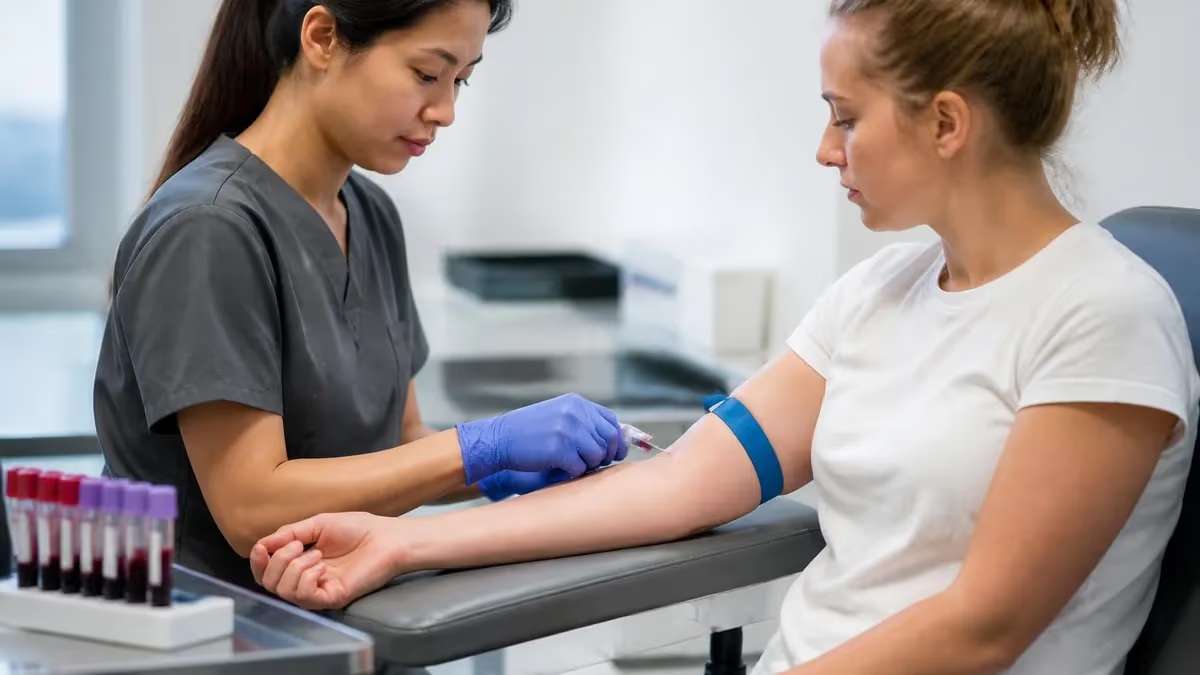
A strong phlebotomy resume is the single most important document standing between you and your first job drawing blood in a clinic, hospital, or laboratory. Hiring managers often spend only six to eight seconds scanning each application, so your resume must communicate your training, certification, and patient-care skills instantly. Whether you just finished phlebotomy classes near me searches and earned your certificate, or you are transitioning from another healthcare role, the way you present yourself on paper decides whether you reach the interview stage.
This guide walks you through every section of a competitive phlebotomy resume, from the professional summary at the top to the certifications you list at the bottom. We cover the specific keywords applicant tracking systems scan for, the measurable accomplishments that impress laboratory supervisors, and the formatting choices that keep your document readable. You will also learn how to highlight clinical hours, venipuncture counts, and specimen-handling competencies that prove you are ready to work independently from day one.
Phlebotomy is one of the fastest-growing entry points into the healthcare field, and demand for skilled technicians continues to climb across hospitals, blood-donation centers, and outpatient labs. The Bureau of Labor Statistics projects strong growth through the decade, which means employers are actively hiring. However, competition for the best positions remains real, and a generic resume rarely survives the first cut. A tailored, results-focused document gives you a measurable edge over candidates who simply list job duties.
Throughout this article we tie resume advice to the broader career picture: what certification employers prefer, how salary expectations should shape your negotiation, and which clinical skills deserve top billing. If you are still preparing for your credential exam, our phlebotomy career training resources can help you pass the first time and add that all-important certification line to your resume sooner rather than later.
By the time you finish reading, you will know exactly how to structure each section, which action verbs carry the most weight, and how to quantify your experience even if you only have student clinical rotations behind you. We include real examples, common mistakes to avoid, and a downloadable checklist you can run through before you hit submit on any application.
Remember that your resume is a marketing document, not an autobiography. Every line should answer the unspoken question in a recruiter's mind: can this person draw blood safely, label specimens accurately, and treat patients with compassion? Keep that filter in mind as you write, and you will produce a phlebotomy resume that opens doors rather than collecting dust in a digital reject pile.
Phlebotomy Resume & Career by the Numbers

Core Building Blocks of a Phlebotomy Resume
Two to three sentences at the top that name your certification, years or hours of experience, and signature strengths like high first-stick success rates and patient comfort.
A dedicated section listing your CPT, PBT, or other credential, the issuing body, and the date earned. This is the first thing many lab managers verify before scheduling an interview.
A scannable list of competencies such as venipuncture, capillary draws, order of draw, specimen labeling, and electronic health record use that match the job posting language.
Reverse-chronological entries with quantified bullet points. Students should include externship rotations, documented draw counts, and the clinical settings where they trained.
Your phlebotomy program, the school name, completion date, and supervised clinical hours. Add relevant high school or college coursework if you lack formal work history.
Writing each section of your phlebotomy resume requires a deliberate strategy rather than a fill-in-the-blank approach. Start with the professional summary, a short paragraph that frames your entire candidacy. A new graduate might write: "Certified phlebotomy technician with 120 supervised clinical hours and a 95 percent first-stick success rate, seeking an outpatient laboratory role." That single sentence delivers certification, measurable competence, and intent. Avoid vague openers like "hardworking individual seeking opportunity," which tell the reader nothing about your actual phlebotomy capabilities or readiness to perform venipuncture safely.
The skills section deserves careful tailoring to each posting. Read the job description, identify the exact phrases the employer uses, and mirror them. If the listing mentions "pediatric draws," "butterfly technique," or "point-of-care testing," include those terms verbatim when they are true of you. Applicant tracking systems rank resumes partly by keyword match, so this mirroring directly improves your odds of reaching a human reviewer. Group skills logically: technical draw skills, specimen handling, safety and compliance, and software or EHR systems you have used.
For the experience section, transform plain duties into achievements with numbers. Instead of "drew blood from patients," write "performed 40-plus venipuncture and capillary draws per shift with a 98 percent acceptable-specimen rate and zero contamination incidents." Numbers prove competence and stick in a recruiter's memory. Mastery of the phlebotomy order of draw is worth calling out explicitly, because incorrect tube sequencing is one of the most common reasons specimens get rejected by the lab.
If you lack paid experience, your externship or clinical rotation carries the weight. List the facility type, the supervising preceptor's department, and concrete output: total draws completed, patient populations served, and any specialized procedures observed or assisted. Many hiring managers value a well-documented student rotation more than unrelated retail or food-service jobs, so give it the prominence it deserves near the top of your experience block.
The education section should clearly state your phlebotomy program, its accreditation if applicable, the credential awarded, and your completion date. Include the number of supervised clinical hours, since some states and employers set minimum thresholds before they will consider an applicant. If you completed CPR or basic life support certification alongside your training, list it here or in a separate certifications block, because many clinical employers require current BLS as a condition of employment.
Finally, pay attention to formatting and length. Entry-level phlebotomy resumes should fit on one page; experienced technicians can extend to two. Use a clean, single-column layout with standard fonts, consistent date formatting, and generous white space. Avoid graphics, photos, and elaborate tables that confuse applicant tracking systems. Save and submit as a PDF unless the employer specifically requests a Word document, and name the file professionally with your full name and the word "resume" included.

Phlebotomy Practice Test Questions
Prepare for the Phlebotomy Test exam with our free practice test modules. Each quiz covers key topics to help you pass on your first try.
Phlebotomy American Medical Certification ...
Phlebotomy Exam Questions covering American Medical Certification Association Phlebotomy. Master Phlebotomy Test concepts for certification prep.
Phlebotomy American Medical Technologists ...
Free Phlebotomy Practice Test featuring American Medical Technologists Phlebotomy. Improve your Phlebotomy Exam score with mock test prep.
Phlebotomy American Society for Clinical P...
Phlebotomy Mock Exam on American Society for Clinical Pathology Phlebotomy. Phlebotomy Study Guide questions to pass on your first try.
Phlebotomy Association of Phlebotomy Techn...
Phlebotomy Test Prep for Association of Phlebotomy Technicians. Practice Phlebotomy Quiz questions and boost your score.
Phlebotomy National Center for Competency ...
Phlebotomy Questions and Answers on National Center for Competency Testing Phlebotomy. Free Phlebotomy practice for exam readiness.
Phlebotomy National Healthcareer Associati...
Phlebotomy Mock Test covering National Healthcareer Association Phlebotomy. Online Phlebotomy Test practice with instant feedback.
Phlebotomy Order of Draw and Additives
Free Phlebotomy Quiz on Order of Draw and Additives. Phlebotomy Exam prep questions with detailed explanations.
Phlebotomy Legal and Ethics
Phlebotomy Practice Questions for Phlebotomy Legal and Ethics. Build confidence for your Phlebotomy certification exam.
Phlebotomy Safety and Infection Control
Phlebotomy Test Online for Safety and Infection Control. Free practice with instant results and feedback.
Phlebotomy Special Collection Procedures
Phlebotomy Study Material on Special Collection Procedures. Prepare effectively with real exam-style questions.
Phlebotomy Specimen Processing and Handling
Free Phlebotomy Test covering Specimen Processing and Handling. Practice and track your Phlebotomy exam readiness.
Phlebotomy Test Arterial Blood Gas Collection
Phlebotomy Exam Questions covering Test Arterial Blood Gas Collection. Master Phlebotomy Test concepts for certification prep.
Phlebotomy Test Capillary and Dermal Puncture
Free Phlebotomy Practice Test featuring Test Capillary and Dermal Puncture. Improve your Phlebotomy Exam score with mock test prep.
Phlebotomy Test Pediatric Blood Collection
Phlebotomy Mock Exam on Test Pediatric Blood Collection. Phlebotomy Study Guide questions to pass on your first try.
Phlebotomy Test Phlebotomy Anatomy and Phy...
Phlebotomy Test Prep for Test Phlebotomy Anatomy and Physiology. Practice Phlebotomy Quiz questions and boost your score.
Phlebotomy Test Phlebotomy Exam Simulation
Phlebotomy Questions and Answers on Test Phlebotomy Exam Simulation. Free Phlebotomy practice for exam readiness.
Phlebotomy Test Phlebotomy Patient Identif...
Phlebotomy Mock Test covering Test Phlebotomy Patient Identification and Communication. Online Phlebotomy Test practice with instant feedback.
Phlebotomy Test Point of Care Testing
Free Phlebotomy Quiz on Test Point of Care Testing. Phlebotomy Exam prep questions with detailed explanations.
Certified Phlebotomy Technician Credentials That Strengthen Your Resume
Listing a recognized credential transforms your phlebotomy resume from hopeful to hireable. Most U.S. employers strongly prefer or outright require candidates to be a certified phlebotomy technician, and several states mandate it by law. Certification signals that an independent body has verified your knowledge of venipuncture, safety protocols, and specimen integrity, reducing the employer's training burden.
When you place certification near the top of your resume, recruiters can confirm your qualifications within their six-second scan. Always include the credential abbreviation, the full certifying organization name, and the date earned so verification is instant and your application clears the first automated screening.
Chronological vs. Skills-Based Phlebotomy Resume: Which Format Wins?
- +Chronological format shows a clear, verifiable work history that employers trust
- +Skills-based format lets new graduates lead with competencies over thin experience
- +Chronological highlights career progression and increasing responsibility over time
- +Skills-based draws attention away from employment gaps or career changes
- +Chronological is favored by applicant tracking systems and most lab managers
- +Skills-based puts venipuncture proficiency and certifications front and center
- −Chronological exposes employment gaps that may raise questions
- −Skills-based can read as evasive if it hides a lack of real experience
- −Chronological underwhelms when you have minimal paid phlebotomy history
- −Skills-based formats sometimes confuse older applicant tracking systems
- −Chronological buries strong skills below a weak or short job timeline
- −Skills-based requires extra effort to prove each listed competency credibly

Phlebotomy Technician Resume Checklist Before You Submit
- ✓Lead with a targeted professional summary naming your certification and key strength
- ✓Place your certified phlebotomy technician credential and date near the top
- ✓Mirror exact keywords from the job posting in your skills section
- ✓Quantify experience with draw counts, success rates, and shift volumes
- ✓Include supervised clinical hours from your training program
- ✓List current CPR or BLS certification if you hold it
- ✓Use strong action verbs like performed, collected, labeled, and processed
- ✓Keep an entry-level resume to a single clean page
- ✓Save and submit as a PDF named with your full name
- ✓Proofread for spelling, grammar, and consistent date formatting
Quantify your first-stick success rate
Lab managers care most about specimen quality and patient comfort. If you can honestly state a first-stick success rate, an acceptable-specimen percentage, or an average draw volume per shift, put that number high on your resume. A single credible metric like "96 percent first-stick success across 500-plus draws" outperforms a paragraph of generic adjectives every time.
Understanding the salary landscape strengthens both your resume strategy and your eventual negotiation. The national median phlebotomy salary hovers around $41,000 per year, but the range is wide. Entry-level technicians in lower-cost regions may start near $32,000, while experienced phlebotomists in major metropolitan hospitals, specialized labs, or travel positions can earn well over $50,000. Knowing where you fall in this spectrum helps you target the right openings and frame your resume's experience level honestly, which prevents wasted applications and disappointing offers.
Several factors push phlebotomy salary upward, and many of them are worth signaling on your resume. Working in a hospital or a 24-hour facility often pays more than a physician's office because of shift differentials for evenings, nights, and weekends. Specialized skills such as arterial draws, pediatric and neonatal collections, or therapeutic phlebotomy command premium pay. If you have performed therapeutic phlebotomy to treat conditions like hemochromatosis or polycythemia, list it explicitly, because relatively few technicians have that experience.
Geography matters enormously. States with higher costs of living and stronger healthcare demand, such as California, Washington, New York, and Massachusetts, consistently report higher average wages for phlebotomists. If you are willing to relocate or commute, researching regional pay data lets you target the markets that reward your skills best. Your resume should reflect any multi-state certifications or willingness to travel, since travel phlebotomy contracts frequently pay significantly above local staff rates.
Career outlook for the role remains encouraging. The aging population, expansion of outpatient and diagnostic services, and ongoing growth of blood-donation and plasma-collection networks all drive steady demand for skilled technicians. Employment is projected to grow faster than the average for all occupations, meaning new graduates entering the field today face a favorable hiring environment. A polished resume positions you to capture the better-paying openings within that growing pool rather than settling for the first offer.
Advancement opportunities also belong in your long-term thinking. Many phlebotomists use the role as a stepping stone toward becoming a medical laboratory technician, registered nurse, or laboratory supervisor. Documenting leadership moments on your resume, such as training new hires, managing inventory, or coordinating mobile draw events, demonstrates the initiative that earns promotions and raises. Employers notice candidates who show they can grow into greater responsibility rather than remain static in an entry-level position.
Finally, treat continuing education as a salary lever. Maintaining your certification, adding endorsements, and completing employer-sponsored training all justify periodic raises and make your resume more competitive at renewal time. When you list ongoing professional development, you signal commitment to the field and to specimen quality. That signal reassures hiring managers that investing in you will pay off, which is exactly the impression a results-focused phlebotomy resume should create from the very first line.
Inflating your draw counts, claiming a credential you have not earned, or overstating clinical hours can end your candidacy instantly and may have legal consequences. Hospitals routinely verify certification with the issuing body and confirm clinical hours with your training program. Always report numbers you can document and defend in an interview.
The skills and keywords you choose can make or break how your phlebotomy resume performs inside an applicant tracking system. These systems scan for specific terms before any human sees your document, so aligning your language with industry vocabulary is essential. Core technical keywords include venipuncture, capillary puncture, butterfly needle technique, vacutainer use, blood culture collection, and point-of-care testing. Including the correct order of draw for phlebotomy as a listed competency reassures employers that you understand tube sequencing and additive carryover.
Beyond draw techniques, employers value specimen-handling and compliance keywords. List specimen labeling, chain of custody, centrifugation, aliquoting, and proper transport temperatures. Add safety terms such as standard precautions, sharps disposal, OSHA bloodborne pathogen compliance, and PPE usage. These phrases prove you understand the regulatory environment of a clinical laboratory and that you can be trusted to protect both patients and yourself from preventable exposure incidents during high-volume shifts.
Soft skills deserve a place too, but frame them with evidence rather than empty adjectives. Patient communication, the ability to calm anxious or pediatric patients, and clear teamwork with nurses and lab staff all matter in daily practice. Instead of simply writing "great communicator," you might write "de-escalated needle-phobic patients to complete draws without incident." That phrasing turns a soft skill into a demonstrated outcome, which carries far more weight with an experienced hiring manager scanning dozens of applications.
Technology and software keywords increasingly influence hiring decisions. Modern labs run on laboratory information systems and electronic health records, so list any platforms you have used, such as Epic, Cerner, or a specific LIS. Familiarity with barcode scanning, specimen tracking software, and electronic requisition systems signals that you can integrate quickly into a digital workflow. If you trained on a system the employer also uses, that overlap can move your resume to the top of the stack.
Tailor your keyword set to each application rather than submitting one universal resume. A blood-donation center prioritizes high-volume collection and donor screening, while a pediatric clinic emphasizes small-gauge technique and patient comfort. Read every posting carefully, highlight the recurring terms, and weave the true ones into your summary, skills, and experience sections. This per-job customization takes a few extra minutes but dramatically improves your interview rate compared with a static, one-size-fits-all document.
To verify you have mastered the underlying knowledge these keywords represent, practice with realistic exam questions before interviews. Working through a nha phlebotomy practice test reinforces order of draw, additives, and complication management, the exact topics interviewers probe to confirm your resume is accurate. Candidates who can confidently explain why the blood culture bottle comes first or how to handle a hematoma turn a paper claim into convincing, hireable expertise during the conversation.
With your resume drafted, the final preparation stage is polishing and positioning it for real-world success. Begin by tailoring the document to each individual posting; a generic resume sent to twenty employers underperforms a customized resume sent to five. Adjust your summary, reorder your skills, and emphasize the experiences most relevant to each role. This focused effort signals genuine interest and dramatically increases your callback rate, especially when you searched phlebotomy courses near me and want every application to count toward landing the position you actually want.
Write a short, targeted cover letter to accompany the resume whenever the employer allows one. Use it to tell a brief story your bullet points cannot, such as why you chose phlebotomy, a memorable patient interaction, or your commitment to specimen quality. Keep it to three short paragraphs, mirror the company's language, and always address it to a specific person when you can find the name. A thoughtful cover letter humanizes the metrics on your resume and sets a professional tone.
Build a clean, complete reference list before you start applying. Strong references include clinical preceptors, instructors from your training program, and former supervisors who can speak to your reliability and draw competency. Contact each person in advance, confirm their preferred contact information, and brief them on the roles you are pursuing. A reference who is expecting the call and knows your goals will speak far more persuasively than one caught off guard months after your rotation ended.
Prepare for the interview as carefully as you prepared the resume, because the two must align perfectly. Expect technical questions about order of draw, tube additives, patient identification, and how you handle a failed stick or a fainting patient. Practice answering aloud so your responses sound confident rather than rehearsed. Bring extra printed copies of your resume, your certification card, and documentation of your clinical hours so you can verify every claim on the spot if asked.
Optimize your online presence to match your resume. Many employers review LinkedIn profiles, so ensure yours lists the same certification, skills, and experience without contradictions. A consistent professional narrative across your resume, cover letter, and online profiles builds trust, while mismatched dates or credentials raise red flags. Remove or privatize any social content that could undermine the responsible, detail-oriented image a clinical employer expects from someone handling patient specimens and sensitive health information.
Finally, treat your job search as an iterative process. Track where you applied, which versions of your resume you sent, and the responses you received. If a particular resume generates few callbacks, revise the summary or reorder your skills and test again. Persistence combined with thoughtful revision almost always produces results in a growing field. Keep your certification current, keep practicing your technical knowledge, and keep refining your document until it consistently earns the interviews you deserve.
Phlebotomy Questions and Answers


About the Author

Registered Nurse & Healthcare Educator
Johns Hopkins University School of NursingDr. Sarah Mitchell is a board-certified registered nurse with over 15 years of clinical and academic experience. She completed her PhD in Nursing Science at Johns Hopkins University and has taught NCLEX preparation and clinical skills courses for nursing students across the United States. Her research focuses on evidence-based exam preparation strategies for healthcare certification candidates.