
How to Get Phlebotomy Certification: Complete Requirements, Programs, Costs & State-by-State Guide
🧠 How to get phlebotomy certification: training hours, costs, top exams (ASCP, NHA, AMT), state rules, and renewal timelines explained in one clear guide.
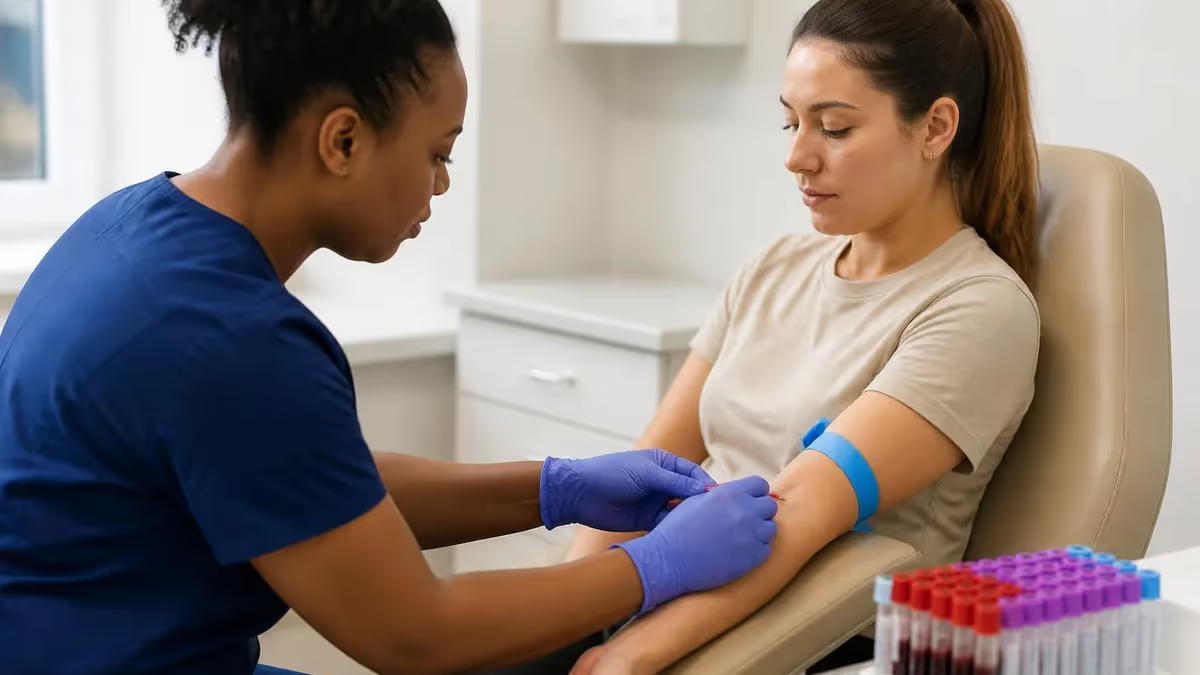
If you've been wondering how to get phlebotomy certification, the short answer is this: finish a state-approved training program of three to six months, log at least 100 successful live blood draws, and pass a national certification exam such as ASCP BOC, NHA CPT, or AMT RPT. The longer answer — the one that actually keeps you from wasting money on the wrong program — depends on where you live, which employer you want to work for, and how quickly you need to be on a hospital floor drawing patients.
Phlebotomy sits in an unusual spot in U.S. healthcare. Only four states (California, Louisiana, Washington, and Nevada) require a state license, yet nearly every hospital, reference lab, and blood center demands a national credential before you ever touch a tourniquet. That gap between "legal to work" and "hireable" is where most candidates get tripped up. So we'll cover both layers — legal minimums and what hiring managers actually want.
This guide walks through every phlebotomy certification route step by step: who's eligible, what training looks like, which accrediting bodies matter (NAACLS, ABHES, NPA), how the six major national exams compare, exact costs, the four state licensing systems, renewal windows, and the career ladder from drawing tubes to running an entire lab.
The typical timeline, start to finish, is four to nine months. Add about $700 to $2,500 in tuition for an accredited program. Plan another $90 to $135 for your exam fee. Salary on day one ranges from roughly $32,000 in lower-cost regions to $50,000 in high-demand metro hospitals. That's a fast, affordable on-ramp to clinical healthcare — but only if you pick the right credential the first time.
We'll also point out the traps. Weekend "certifications" from unaccredited online sellers are not recognized by hospitals. State licensure rules in California in particular tend to surprise out-of-state applicants. And renewal isn't optional — let your certification expire by more than a few months and you'll typically need to retake the whole exam, not just pay a late fee. The good news: with a clear plan, very few people fail this credential on a serious first attempt.
One more practical note before we start. Phlebotomy is almost always a stepping-stone career rather than a final destination. After 12 to 24 months of clinical experience, many phlebotomists ladder up into phlebotomy technician lead roles, then bridge into medical lab tech (MLT) or medical laboratory scientist (MLS) programs that double or triple their salary. Plan for the credential, but also plan for what comes next.
Use the sidebar to jump to any section, and don't skip the FAQ at the bottom — it answers the exact questions our readers email us most often about phlebotomy certification eligibility, cost, and the difference between state licensure and a national credential.
Phlebotomy Certification by the Numbers

Phlebotomy Certification: Who's Eligible to Apply
Every accredited training program and every national certification exam requires proof of high school completion or an equivalent GED. A few employer-sponsored academies will let you enroll while finishing your GED, but the certification exam will not.
Most national exams (ASCP, NHA, AMT, NCCT) require candidates to be 18 by exam day. A handful of training programs admit 17-year-olds, but you'll wait to test until your birthday. California requires 18 to apply for state CPT licensure.
A standard fingerprint-based background check is required by every hospital and reference lab. Most felonies involving violence, theft from patients, or drug diversion are disqualifying. Older misdemeanors are usually reviewed case by case.
Hospitals require documented Hepatitis B series (3 doses), MMR, Tdap, varicella, annual flu shot, and (post-2020) a COVID-19 vaccination or approved exemption. TB skin testing within the past 12 months is standard.
Basic Life Support certification from the American Heart Association or American Red Cross is required by virtually every clinical site. The card is valid for two years and costs $60-$100 to obtain. Most training programs include this in tuition.
Phlebotomy requires standing for long stretches, fine motor control, accurate color vision (for tube identification), and the ability to lift around 25 pounds. Reasonable accommodations are available under the ADA in most states.
Once you've confirmed you meet the eligibility requirements, the next decision is where to actually train. Phlebotomy training typically runs three to six months, costs $700 to $2,500, and combines three things: classroom theory, supervised skills lab, and live clinical hours where you draw real patients under a preceptor. The classroom-only portion can be done online; the clinical hours cannot.
Accreditation is where many candidates make their first costly mistake. Three accrediting bodies matter in U.S. phlebotomy: NAACLS (National Accrediting Agency for Clinical Laboratory Sciences), ABHES (Accrediting Bureau of Health Education Schools), and the National Phlebotomy Association (NPA). Programs approved by at least one of these are accepted by every major national certification body. Programs without any of these stamps are accepted by none.
Community colleges generally offer the best value. A typical community-college phlebotomy certificate runs 12 to 16 weeks, costs $800 to $1,500 including books, and includes both a 40-hour skills lab and a 100-hour externship at a partner hospital. Pass rates on first-attempt national exams tend to sit between 85 and 92 percent at NAACLS-approved community colleges, which is the benchmark to look for.
Private vocational schools are faster — sometimes finishing in eight weeks — but charge $1,500 to $2,500 for the same content. Speed is real, and for working adults who can't wait a semester, that premium can be worth it. Just make sure the program is accredited, and ask in writing for the previous year's first-time pass rate. Reputable schools will share this; the ones that won't share usually have something to hide.
Hospital-sponsored "earn while you learn" programs are the dark-horse option, and they're growing fast. Memorial Hermann, HCA, Banner Health, Kaiser Permanente, and many regional hospital systems run free phlebotomy academies in exchange for a 12-to-24-month employment commitment after certification. You earn a small stipend during training, get hired the day after passing the exam, and skip the job-search phase entirely. If you can find one of these in your metro, take it seriously.
The 100-live-draws rule is the single most important program filter. Most national exams — ASCP BOC, NHA CPT, AMT RPT — require documented proof that you've performed at least 100 successful venipunctures and 5 to 10 capillary (finger or heel) sticks before sitting for the test. A program that doesn't guarantee enough patient access for those draws is, functionally, useless. Always ask: how many live draws does your typical graduate log before exam day?
Online-only certifications deserve a special warning. You'll see them advertised heavily: "Get certified in 5 days, fully online, $99!" These are not real credentials. No accredited program can deliver a recognized phlebotomy certification without supervised live draws, because no hospital will hire someone who's never stuck a real arm. If a program's pitch is "100% online," walk away. Hybrid programs that combine online theory with weekend in-person labs are legitimate; pure-online ones aren't.
Phlebotomy Practice Test Questions
Prepare for the Phlebotomy Test exam with our free practice test modules. Each quiz covers key topics to help you pass on your first try.
Phlebotomy American Medical Certification ...
Phlebotomy Exam Questions covering American Medical Certification Association Phlebotomy. Master Phlebotomy Test concepts for certification prep.
Phlebotomy American Medical Technologists ...
Free Phlebotomy Practice Test featuring American Medical Technologists Phlebotomy. Improve your Phlebotomy Exam score with mock test prep.
Phlebotomy American Society for Clinical P...
Phlebotomy Mock Exam on American Society for Clinical Pathology Phlebotomy. Phlebotomy Study Guide questions to pass on your first try.
Phlebotomy Association of Phlebotomy Techn...
Phlebotomy Test Prep for Association of Phlebotomy Technicians. Practice Phlebotomy Quiz questions and boost your score.
Phlebotomy National Center for Competency ...
Phlebotomy Questions and Answers on National Center for Competency Testing Phlebotomy. Free Phlebotomy practice for exam readiness.
Phlebotomy National Healthcareer Associati...
Phlebotomy Mock Test covering National Healthcareer Association Phlebotomy. Online Phlebotomy Test practice with instant feedback.
Phlebotomy Order of Draw and Additives
Free Phlebotomy Quiz on Order of Draw and Additives. Phlebotomy Exam prep questions with detailed explanations.
Phlebotomy Legal and Ethics
Phlebotomy Practice Questions for Phlebotomy Legal and Ethics. Build confidence for your Phlebotomy certification exam.
Phlebotomy Safety and Infection Control
Phlebotomy Test Online for Safety and Infection Control. Free practice with instant results and feedback.
Phlebotomy Special Collection Procedures
Phlebotomy Study Material on Special Collection Procedures. Prepare effectively with real exam-style questions.
Phlebotomy Specimen Processing and Handling
Free Phlebotomy Test covering Specimen Processing and Handling. Practice and track your Phlebotomy exam readiness.
Phlebotomy Test Arterial Blood Gas Collection
Phlebotomy Exam Questions covering Test Arterial Blood Gas Collection. Master Phlebotomy Test concepts for certification prep.
Phlebotomy Test Capillary and Dermal Puncture
Free Phlebotomy Practice Test featuring Test Capillary and Dermal Puncture. Improve your Phlebotomy Exam score with mock test prep.
Phlebotomy Test Pediatric Blood Collection
Phlebotomy Mock Exam on Test Pediatric Blood Collection. Phlebotomy Study Guide questions to pass on your first try.
Phlebotomy Test Phlebotomy Anatomy and Phy...
Phlebotomy Test Prep for Test Phlebotomy Anatomy and Physiology. Practice Phlebotomy Quiz questions and boost your score.
Phlebotomy Test Phlebotomy Exam Simulation
Phlebotomy Questions and Answers on Test Phlebotomy Exam Simulation. Free Phlebotomy practice for exam readiness.
Phlebotomy Test Phlebotomy Patient Identif...
Phlebotomy Mock Test covering Test Phlebotomy Patient Identification and Communication. Online Phlebotomy Test practice with instant feedback.
Phlebotomy Test Point of Care Testing
Free Phlebotomy Quiz on Test Point of Care Testing. Phlebotomy Exam prep questions with detailed explanations.
What a Phlebotomy Training Program Actually Looks Like
About 40 percent of any accredited phlebotomy program is classroom-based. You'll cover anatomy and physiology of the circulatory system, common laboratory tests and their tube colors, infection control under OSHA bloodborne pathogen standards, medical terminology, HIPAA, professional ethics, and the legal scope of practice for a phlebotomist.
Expect quizzes after each unit. The midterm typically mirrors the question format of whichever national exam your school targets — multiple-choice with single best answer, no penalty for guessing. By the end of theory, you should be able to name every common blood collection tube by stopper color and recite the order of draw without hesitation.

Community College vs Private Vocational Phlebotomy Programs
- +Community college tuition is typically half the cost of private schools
- +NAACLS accreditation is more common at community colleges, raising hireability
- +Larger student support services — financial aid, advising, library access
- +Externship partnerships often include the largest regional hospital systems
- +Credits can stack toward an associate degree later for MLT or nursing bridges
- +Higher reported first-time pass rates (often 85-92% vs 75-85% private)
- −Programs run 12-16 weeks vs 6-10 weeks at private schools
- −Fixed semester start dates mean longer waits between cohorts
- −Class sizes can exceed 25 students, diluting skills-lab time
- −Less aggressive job-placement assistance than private career schools
- −Limited evening or weekend cohorts in smaller markets
- −Administrative bureaucracy can slow enrollment and externship placement
Pros and Cons at a Glance
| Pros | Cons |
|---|---|
| Community college tuition is typically half the cost of private schools | Fixed semester start dates mean longer waits between cohorts |
| NAACLS accreditation is more common at community colleges, raising hireability | Less aggressive job-placement assistance than private career schools |
| Larger student support services — financial aid, advising, library access | Limited evening or weekend cohorts in smaller markets |
| Externship partnerships often include the largest regional hospital systems | Administrative bureaucracy can slow enrollment and externship placement |
Top National Phlebotomy Certifications Compared
The Board of Certification "PBT(ASCP)" credential is preferred by major hospital systems and academic medical centers. Exam fee around $135, 80 multiple-choice questions in 2 hours, requires documented training plus 100+ draws. Considered the most rigorous and most respected.
National Healthcareworkers Association Certified Phlebotomy Technician. Exam fee $117, 100 questions in 2 hours, widely accepted by outpatient labs and physician offices. Slightly easier than ASCP but recognized in all 50 states. Strong choice for community-based draw centers.
American Medical Technologists Registered Phlebotomy Technician. Exam fee around $120, 200 questions over 2 hours, accepted by hospitals, clinics, and the military. AMT's continuing-education tracking system is widely considered the most user-friendly.
American Society of Phlebotomy Technicians. Exam fee around $95, the most affordable of the major credentials. Smaller name recognition than ASCP or NHA but accepted by many regional employers, especially in the South and Midwest. <a href="/aspt-american-society-of-phlebotomy-technicians">ASPT practice test</a> resources are widely available.
National Center for Competency Testing. Exam fee around $90, the lowest barrier to entry among nationally recognized credentials. Widely accepted by physician offices and smaller clinical labs. Good first credential if cost is the deciding factor.
National Phlebotomy Association credential, the oldest of the group (founded 1978). Strong recognition in the Northeast and at federally qualified health centers. <a href="/phlebotomy/national-phlebotomy-certification">National phlebotomy certification</a> through NPA is often paired with their own approved training programs.
Exam Topics: 90% Identical Across All Six Certifications
- ✓Venipuncture procedure — vein selection, tourniquet technique, anchoring, needle angle, and bevel orientation
- ✓Order of draw — memorize the standard 9-tube sequence cold; expect at least 5 questions on this alone
- ✓Infection control — OSHA bloodborne pathogen rules, PPE selection, sharps disposal, exposure incident response
- ✓Anatomy & physiology — circulatory system, common veins of the antecubital fossa, alternative draw sites
- ✓Specimen types — serum vs plasma vs whole blood, additive purposes, light/temperature/timing requirements
- ✓Specimen handling — labeling at bedside, chain of custody, transport conditions, centrifuge basics
- ✓Troubleshooting — hematoma prevention, nerve injury recognition, hemoconcentration, hemolysis causes
- ✓Equipment — needle gauges and lengths, evacuated tube system, butterfly sets, capillary devices
- ✓Patient interaction — identification (two patient identifiers), informed consent, special populations (pediatric, geriatric, oncology)
- ✓Quality assurance — CLIA basics, point-of-care testing rules, documentation, error reporting

California, Louisiana, Washington, and Nevada are the exceptions
The vast majority of states have no state-level phlebotomy license. They rely on the major national certifying bodies to credential phlebotomists. Only four states layer a separate state license on top: California (CDPH-issued CPT-1 and CPT-2), Louisiana, Washington, and Nevada. If you live in those four states, your employer will require both the national certification and the state license. Everywhere else, the national credential is enough on its own.
State licensing is the single most confusing topic in U.S. phlebotomy. Let's break it down clearly by the four states that require state licensure, then summarize the rest.
California is by far the strictest. The California Department of Public Health (CDPH) issues three tiers: Limited Phlebotomy Technician (LPT) for skin punctures only, Certified Phlebotomy Technician I (CPT-1) for skin and venipuncture, and Certified Phlebotomy Technician II (CPT-2) for skin, vein, and arterial draws. To get a CPT-1, you must complete a CDPH-approved training program of 40 hours classroom plus 40 hours practical, perform 50 successful venipunctures and 10 capillary sticks, pass a national exam from one of six approved certifying bodies, and apply directly to CDPH. The license itself costs around $100 and renews every two years.
Louisiana regulates phlebotomy through its Department of Health. Candidates must complete an approved program, pass a national certification exam, and apply for a state license. Renewal is annual. Cost is modest but the paperwork is non-trivial.
Washington State requires Medical Assistant–Phlebotomist (MA-P) certification through the Washington Department of Health. The pathway combines national phlebotomy certification with a state application, fingerprinting, and AIDS education coursework. MA-P credentials renew annually.
Nevada issues a state license through its Bureau of Health Care Quality and Compliance. The state accepts national certifications from ASCP, NHA, AMT, and several others, but requires its own application, background check, and renewal cycle.
In the other 46 states, hiring rules are set by employers rather than state law. Major hospital systems almost universally require ASCP BOC, NHA, or AMT. Smaller clinics and physician offices are more flexible and often accept NCCT or ASPT. If you're unsure which credential your target employer prefers, the most reliable move is to call the hospital's HR or lab supervisor and ask directly — they'll tell you in 30 seconds.
State board verification matters when you move. Many states maintain a license verification database. Texas, for example, doesn't require a license but the Texas Department of State Health Services maintains a registry of nationally certified phlebotomists working in the state. If you move from a non-licensure state into California, expect to apply for CPT-1 from scratch — your national certification helps but does not waive the CDPH application.
Tennessee, Ohio, New York, Texas, Michigan, Minnesota, Mississippi, Utah, Virginia, Wisconsin, and West Virginia all follow the national-certification-only model. There is no separate state license to chase. Your ASCP, NHA, or AMT credential is your ticket to employment in any of those states.
One special case: military and federal employment. The Department of Veterans Affairs, Department of Defense, and Indian Health Service typically require ASCP or NHA specifically, and they verify continuing-education compliance directly with the certifying body. If federal employment is your goal, plan around the ASCP BOC PBT credential from day one.
Now for the part candidates think about first and ask about last: what does phlebotomy certification actually cost from start to first paycheck? Let's build the full number together.
Tuition is the largest single line item. Community college accredited programs cluster between $800 and $1,500 all-in. Private vocational schools charge $1,500 to $2,500. Hospital-sponsored academies are free but tie you to an employment contract afterward. Red Cross programs sit around $1,200 to $1,400 and typically include uniforms, books, and the BLS card.
Ancillary costs catch most students by surprise. Plan to spend $40-$80 on a fingerprint-based background check, $30-$50 on a TB skin test, $60-$100 on BLS certification, $25-$60 on scrubs and supportive shoes, $40-$120 on textbooks (some programs include these), and $50-$200 on immunization documentation or boosters if your records are incomplete. Total ancillary costs run $250 to $600.
The certification exam itself is the smallest piece. ASCP BOC is around $135, NHA CPT $117, AMT RPT $120, ASPT $95, NCCT $90, and NPA varies. Add $35-$75 per section if you fail and need to retake — which is one reason taking the exam seriously the first time pays off.
So a realistic all-in total: $1,200 to $3,200 if you pay out of pocket. Free if you land a hospital-sponsored academy and accept their employment commitment. Between $300 and $800 if you qualify for WIOA workforce development funding through your local American Job Center, which is the single most underused benefit in entry-level healthcare training.
For financial aid, walk this checklist in order. First, contact your local American Job Center and ask about WIOA tuition vouchers — they cover 100 percent of tuition for unemployed or underemployed adults at approved programs. Second, ask about state TANF Employment and Training funds if you receive any cash assistance. Third, check whether your target hospital system runs a free academy. Fourth, ask community colleges about Pell Grant eligibility if the program is part of a longer certificate.
Veterans qualify for GI Bill benefits at many community college phlebotomy programs, though shorter standalone programs sometimes don't make the cut. Reserve and National Guard members can use tuition assistance for approved programs. Workforce boards may also fund childcare and transportation while you're in training.
Renewal is where many phlebotomists drop the ball. The standard renewal cycle is two years, with 10 to 12 continuing-education hours required during that window. ASCP requires 9 CE points every three years through its Credential Maintenance Program. NHA requires 10 hours every 2 years. AMT requires 45 points every 3 years. All bodies charge a renewal fee of $40 to $90.
Let your certification lapse by more than 90 days and you'll almost always need to retake the original exam rather than just renewing — which means another $90 to $135 plus the time. Many phlebotomists set calendar reminders 6 months and 3 months before renewal to avoid this entirely. Most CE hours are free or low-cost: webinars from CDC and OSHA, online modules from your certifying body, and in-service training at your employer.
You'll see ads for $99 phlebotomy certifications you can finish in a weekend, entirely online. They are not real credentials. No hospital, reference lab, or blood bank will hire you with one. Every national certifying body (ASCP, NHA, AMT, ASPT, NCCT, NPA) requires documented supervised live blood draws. If a program advertises 100 percent online certification and skips the externship, walk away — and verify any school's accreditation directly with NAACLS, ABHES, or NPA before paying a dollar.
Phlebotomy certification opens the door to a clinical healthcare career that doesn't end at drawing tubes. Most graduates work as a frontline phlebotomist for 12 to 24 months, then begin laddering up. Understanding that ladder before you certify is one of the best things you can do for your long-term earning potential.
Salary on day one for a newly certified phlebotomist typically falls between $32,000 and $50,000 a year, with hourly rates of $15 to $24. Rural hospitals and smaller physician offices tend to pay near the low end. Major metropolitan hospital systems, blood banks, plasma donation centers, and reference labs pay near the high end. Night shifts, weekends, and on-call premiums commonly add 10 to 20 percent. Phlebotomy salary data from the Bureau of Labor Statistics shows the national median around $41,000 in 2024, with the top 10 percent earning over $52,000.
After 12 months on the floor, lead phlebotomist positions open up. These typically pay $3 to $6 per hour above standard rates and involve training new hires, managing draw schedules, and serving as the lab's troubleshooter for difficult patients. After 24 months, many phlebotomists move into specialty draw roles — pediatric oncology, donor apheresis, therapeutic phlebotomy — which often pay $5 to $12 per hour above baseline.
The most common career bridge is into Medical Lab Technician (MLT). An MLT credential typically requires a two-year associate degree, runs from $5,000 to $20,000 in tuition, and lifts annual salary into the $48,000 to $62,000 range. Many hospitals will tuition-reimburse 50 to 100 percent of MLT coursework for phlebotomists who agree to stay employed through the program. The next step up is Medical Laboratory Scientist (MLS), which requires a four-year bachelor's degree and pushes salary into the $65,000 to $85,000 range, with senior MLS roles routinely topping $90,000.
Other lateral moves are popular too. Many phlebotomists bridge into LPN programs (12-18 months, $5,000-$15,000 tuition, $48,000-$58,000 salary). Others move into nursing assistant or medical assistant roles, then bridge to RN through an associate degree in nursing — a path that typically takes three to four years from your phlebotomy start date and raises salary into the $70,000-$95,000 range.
Free practice resources at PracticeTestGeeks cover every major phlebotomy certification — ASCP, NHA, AMT, ASPT, NCCT, and NPA. Our phlebotomy general knowledge material, full-length practice exams, and skills walkthroughs are designed to mirror real exam blueprints. Many programs also pair candidates with employer-sponsored academies that include practice exam access as part of their orientation.
If you're choosing between hospital systems for your first job, ask three questions at the interview: what's the typical caseload per shift (good answers are 25-40 patients per 8-hour shift), is there a clear lead-phlebotomist promotion track, and does the employer reimburse continuing education and bridge-program tuition? Hospitals that answer yes to all three retain phlebotomists much longer and offer the strongest career growth.
One final reality check. Phlebotomy is hard on the body — early mornings, long stretches of standing, and the emotional weight of working with anxious or seriously ill patients. The people who build long careers in it tend to do two things: they pace their bodies (ergonomic stools, supportive shoes, regular stretching) and they pace their careers (always have the next credential in mind). Get certified, get your live experience, and start planning your next step within your first six months on the job.
Sample Phlebotomy Practice Questions
Try these questions from our free Phlebotomy practice tests. The correct answer and an explanation follow each question.
How many continuing education units (CEUs) must NHA-certified phlebotomy technicians complete before renewing their certification?
- A. 10 CEUs
- B. 15 CEUs
- C. 20 CEUs
- D. 25 CEUs
Answer: A. 10 CEUs
NHA CPT holders must complete 10 CEUs every two years to maintain their certification.
What credential is awarded by the National Center for Competency Testing (NCCT) for phlebotomy professionals?
- A. Certified Phlebotomy Technician (CPT)
- B. National Certified Phlebotomy Technician (NCPT)
- C. Licensed Blood Collection Specialist (LBCS)
- D. Accredited Phlebotomy Specialist (APS)
Answer: B. National Certified Phlebotomy Technician (NCPT)
The National Center for Competency Testing (NCCT) specifically awards the National Certified Phlebotomy Technician (NCPT) credential. This certification validates an individual's competency in phlebotomy practices according to NCCT's national standards. Each certification body has its unique designation, and NCPT is the one associated with NCCT for phlebotomy professionals.
What does 'chain of custody' mean in phlebotomy practice?
- A. The order in which tubes are filled
- B. Documentation tracking specimen handling from collection to result
- C. The sequence of patient identification steps
- D. The hierarchy of phlebotomy staff supervisors
Answer: B. Documentation tracking specimen handling from collection to result
Chain of custody is the unbroken documentation trail ensuring specimen integrity, especially for forensic or drug testing samples.
How often must the NHA CPT certification be renewed?
- A. Every 1 year
- B. Every 2 years
- C. Every 3 years
- D. Every 5 years
Answer: B. Every 2 years
The NHA CPT certification requires renewal every two years to ensure that certified professionals maintain current knowledge and skills. This typically involves completing continuing education units (CEUs) and paying a renewal fee. Regular renewal helps uphold professional standards and adapt to evolving healthcare practices and guidelines.
Phlebotomy Practice Test Questions and Answers
About the Author

Registered Nurse & Healthcare Educator
Johns Hopkins University School of NursingDr. Sarah Mitchell is a board-certified registered nurse with over 15 years of clinical and academic experience. She completed her PhD in Nursing Science at Johns Hopkins University and has taught NCLEX preparation and clinical skills courses for nursing students across the United States. Her research focuses on evidence-based exam preparation strategies for healthcare certification candidates.