
Phlebotomy License: Requirements, Cost, and How to Get Certified 2026 October
Complete phlebotomy license guide: state requirements, certification exams, training programs, costs, and steps to become a certified phlebotomy ⏳
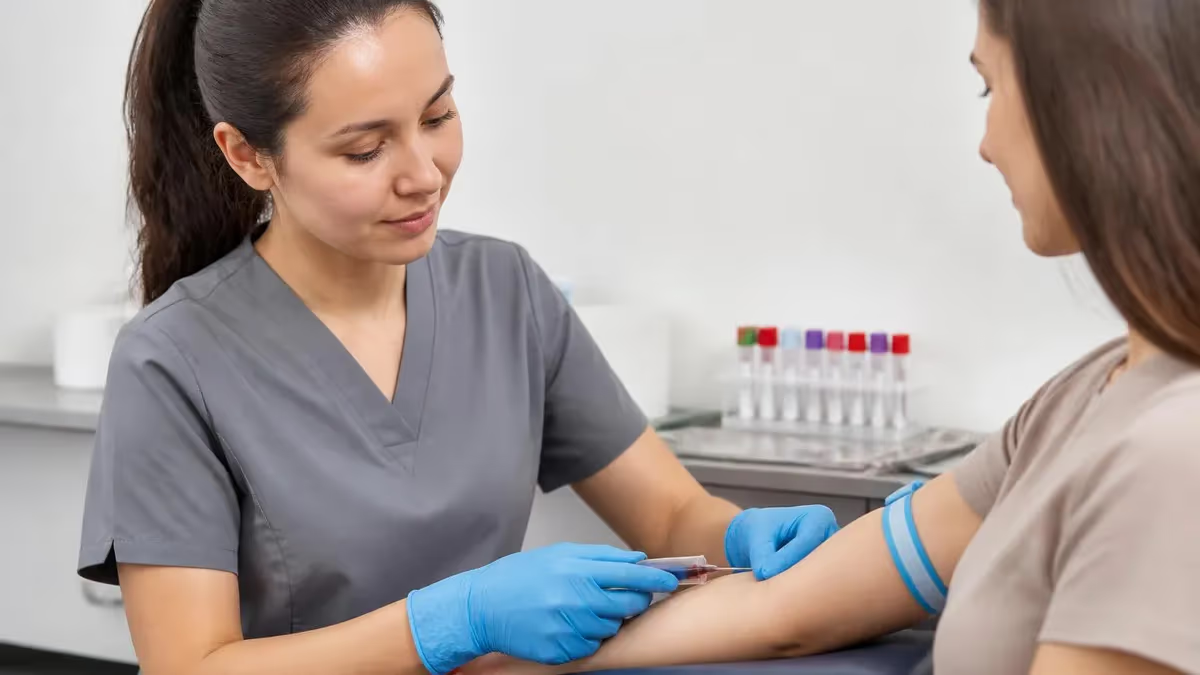
What a Phlebotomy License Actually Is
A phlebotomy license is a state-issued credential or recognized national certification that authorizes a healthcare professional to draw blood for laboratory testing, transfusions, donations, and research purposes. The exact requirements vary widely between states, with only California, Louisiana, Nevada, and Washington requiring formal state licensure as of the current year, while most other states accept national certification from approved agencies as sufficient credentialing for employment.
The phlebotomist role sits at the front line of clinical laboratory work, where accurate specimen collection determines the reliability of every downstream test result. Hospitals, blood banks, doctor offices, urgent care centers, and standalone laboratories all employ certified phlebotomy technicians to perform venipuncture, capillary puncture, and arterial blood gas collection on patients of all ages.
Employers strongly prefer or outright require national certification even in states where licensure is not legally mandated. The credentials most widely recognized include those from the American Society for Clinical Pathology, the National Healthcareer Association, the American Medical Technologists, the American Society of Phlebotomy Technicians, and the National Phlebotomy Association. Each agency administers a written examination plus documentation of training hours and clinical experience.
The line between certification and licensure causes considerable confusion among new candidates. Certification is granted by a private professional agency after passing a knowledge examination and verifying training. Licensure is granted by a state government agency and carries the legal authority to perform the licensed activity within that state. In phlebotomy, certification confirms skill while licensure grants legal practice authority, though the two concepts often overlap in practical hiring decisions made by healthcare employers.
Most phlebotomists work under a clinical laboratory or physician supervision umbrella, which means the supervising professional carries the ultimate licensure responsibility for the laboratory operation. The phlebotomist contributes the technical skill of specimen collection while the supervising pathologist or laboratory director assumes regulatory accountability. This delegation framework explains why states without specific phlebotomy licensure still operate safe laboratory systems through indirect regulation of the supervising professionals.
Phlebotomy License Quick Facts
Four states require state licensure: California, Louisiana, Nevada, and Washington. Most other states accept national certification through one of five recognized agencies. Training programs typically run twelve to sixteen weeks and cost between seven hundred and three thousand dollars, depending on the school and clinical hours included.
Renewal cycles run two to three years with continuing education credits required at each cycle. Reciprocity between states is limited, so phlebotomists planning to relocate should verify destination state requirements before assuming credentials transfer automatically across state lines.
State Licensure vs National Certification
California sets the most rigorous bar through the Department of Public Health, which issues three tiers of phlebotomy certification: Limited Phlebotomy Technician, Certified Phlebotomy Technician I, and Certified Phlebotomy Technician II. The LPT performs only skin punctures and requires twenty hours of classroom instruction. The CPT I performs venipunctures and skin punctures after forty classroom hours, forty practical hours, and fifty successful venipunctures. The CPT II adds arterial punctures with twenty additional hours of training.
Louisiana, Nevada, and Washington each operate their own application processes through respective state boards, accepting completion of an approved training program plus a passing score on one of the recognized national exams. Application fees range from sixty to one hundred fifty dollars, with renewal cycles of two to three years depending on state. Continuing education hours are required at renewal in most licensure states.
In states without licensure, employers act as the gatekeeper. Hospitals consistently require national certification before hire, while smaller clinics sometimes hire on-the-job-trained phlebotomists who later pursue certification within the first ninety days of employment. The pathway through certification typically yields higher starting pay, faster promotion, and broader job mobility than the on-the-job route, making formal training the preferred entry point for most newcomers to the field.
Reciprocity between states is limited because each licensure state operates its own requirements that do not always recognize credentials from another state. A California Certified Phlebotomy Technician moving to Louisiana must complete a Louisiana application with state-specific documentation and may need to pass additional examinations. Verifying reciprocity through the destination state board before relocating prevents disruption of employment that requires active licensure.
Federal employees including those working at Veterans Affairs hospitals, military medical facilities, and Indian Health Service clinics operate under federal credentialing systems that recognize national certification regardless of state of practice. This federal pathway offers mobility for phlebotomists willing to work in federal healthcare settings, often with strong benefits packages and stable schedules compared to private sector positions.

Major Certification Agencies
American Society for Clinical Pathology Board of Certification offers the PBT credential, widely considered the gold standard among hospital employers nationwide. Comparing program features, costs, schedules, and graduate outcomes side by side helps identify the best fit for individual circumstances.
National Healthcareer Association CPT is among the most popular certifications, accepted by hospital systems, urgent care chains, and standalone laboratories alike. Comparing program features, costs, schedules, and graduate outcomes side by side helps identify the best fit for individual circumstances.
American Medical Technologists RPT credential is recognized nationwide and offers a strong professional support network with continuing education resources. Comparing program features, costs, schedules, and graduate outcomes side by side helps identify the best fit for individual circumstances.
American Society of Phlebotomy Technicians offers entry-level certification with reasonable fees and is accepted in most states without licensure requirements. Comparing program features, costs, schedules, and graduate outcomes side by side helps identify the best fit for individual circumstances.
Training Program Requirements
Most certification agencies require completion of a structured training program that includes both classroom instruction and supervised clinical practice. Classroom topics typically include anatomy of the circulatory system, venipuncture techniques, capillary collection, specimen handling, infection control, patient communication, medical terminology, and legal aspects of blood collection. Programs run from four to sixteen weeks depending on intensity, with daytime, evening, and online options available at most schools.
Clinical hours form the most important component of training because pattern recognition for vein selection and needle insertion comes only from repeated hands-on practice. Most programs require between twenty and forty hours of supervised clinical work in a hospital, clinic, or laboratory setting where students perform at least twenty-five to one hundred successful venipunctures on real patients before sitting for the certification exam.
Accreditation matters when selecting a program. Schools accredited by the National Accrediting Agency for Clinical Laboratory Sciences or approved by the relevant state Department of Health produce graduates who consistently pass certification exams at higher rates than graduates of unaccredited programs. Checking the program completion rate, the certification exam pass rate, and the job placement rate before enrolling helps avoid programs that take tuition without delivering employable graduates.
The classroom curriculum at every accredited program includes specific topics required by accrediting bodies. These include detailed venous anatomy of the antecubital area where most draws occur, identification of acceptable draw sites including the median cubital, cephalic, and basilic veins, understanding of vein patterns and which veins to avoid, the order of draw for multiple tube collection to prevent additive contamination, and patient identification protocols using two unique identifiers before any specimen collection.
Infection control training receives heavy emphasis because phlebotomists face daily exposure to bloodborne pathogens including hepatitis B, hepatitis C, and HIV. Programs cover OSHA bloodborne pathogen standards, proper personal protective equipment selection and use, sharps disposal regulations, post-exposure protocols, and the hepatitis B vaccination series that most employers require for new hires before clinical practice begins.
Phlebotomy Training Pathway Options
Public community college programs typically offer the most affordable certificate option, often costing seven hundred to fifteen hundred dollars including textbooks and supplies. Programs run one to two semesters with daytime and evening sections, and most include guaranteed clinical placement at affiliated hospitals or laboratories.
Verifying accreditation status with the relevant accrediting body before enrollment protects the tuition investment and ensures the program produces graduates eligible for the chosen certification examination pathway.
The Certification Examination
Every recognized national certification requires passing a multiple choice exam covering theory, technique, safety, and patient care. Exams typically contain one hundred to two hundred questions delivered on computer at a Pearson VUE or PSI testing center. Time limits range from two to three hours, and passing scores are usually set between seventy and seventy-five percent. Test fees run from eighty to two hundred dollars, with retake fees comparable to the original.
The ASCP exam, considered the most rigorous, includes eighty multiple choice questions delivered in two hours, with a scaled passing score of four hundred out of nine hundred. Topic distribution includes circulatory system anatomy at fifteen percent, specimen collection at thirty-five percent, specimen handling at ten percent, laboratory operations at fifteen percent, non-blood specimens at five percent, and clinical correlations at twenty percent of the total question pool.
The NHA exam covers similar material with one hundred ten scored questions plus twenty unscored pretest items, delivered in two hours with a scaled passing score of three hundred ninety out of five hundred. NHA exam results are available immediately upon test submission, while ASCP releases preliminary unofficial results immediately and official scores within ten business days. Both agencies maintain online accounts where candidates track certification status and renewal deadlines.
Exam preparation typically requires three to six weeks of focused study after completing the training program. Most candidates use a combination of official agency study guides, third-party review books such as those published by Mosby and Elsevier, online practice question banks that mirror the exam format, and study groups with classmates from training. Practice exams scored consistently above eighty-five percent indicate readiness for the actual certification test.
Common failure points include weak knowledge of specimen handling requirements such as light protection for bilirubin samples, temperature requirements for cold agglutinin testing, and timing requirements for glucose tolerance test specimens. Other frequent miss areas include order of draw for complex multi-tube collections, identification of artifactual hemolysis causes, and proper handling of patient identification discrepancies discovered at the bedside before any draw occurs.

All states with licensure and most certifying agencies require a criminal background check before issuing credentials. Felony convictions involving violence, theft, fraud, or drug offenses can disqualify applicants permanently or for several years following conviction. Reviewing personal history with a counselor before investing tuition prevents the costly discovery of disqualification after training completion.
Even applicants with minor offenses should request a personal background check report before applying to identify and address any errors. Disputing inaccuracies on the official record before certification application prevents disqualification based on incorrect data that the candidate could have corrected proactively.
Application Process Step by Step
The application sequence begins with selecting and completing an accredited training program. After completion, the school provides a certificate of completion and documentation of clinical hours that the certifying agency requires with the exam application. Most agencies accept the application online through their website, with required documents uploaded as PDF attachments.
Background check forms, official transcripts from the training school, clinical experience verification signed by a clinical supervisor, photo identification, and the exam fee complete the typical application packet. Processing time ranges from two to six weeks before the agency authorizes the candidate to schedule the examination at a testing center. Some agencies offer expedited processing for an additional fee for candidates needing certification quickly.
After passing the exam, the agency issues an electronic certificate within five business days that the candidate can print and present to employers immediately. The official paper certificate arrives by mail within four to six weeks. State licensure agencies in California, Louisiana, Nevada, and Washington require an additional application with the state board, including the certification as supporting documentation, with separate fees and processing times.
Document organization saves significant time during the application phase. Candidates who maintain a clearly labeled folder with the training certificate, official transcripts, clinical hour verification, photo identification, vaccination records, and prior healthcare experience documentation can complete most agency applications in under an hour. Disorganized candidates often face weeks of delay tracking down missing items, particularly clinical hour verification from supervisors who may have moved on by the time the application is finally submitted.
Communication with the certifying agency through their candidate portal speeds processing significantly. Most agencies provide application status updates online, and proactive candidates who upload corrections within twenty-four hours of receiving deficiency notices avoid the multi-week delays that occur when candidates rely solely on mailed correspondence. Setting email notifications to high priority during the application window prevents missed messages that stall the process.
Phlebotomy License Application Checklist
- ✓Complete an accredited phlebotomy training program with documented classroom and clinical hours
- ✓Obtain certificate of completion and official transcript from the training school
- ✓Gather clinical experience verification signed by a licensed clinical supervisor
- ✓Pass a criminal background check and fingerprinting if required by the state or agency
- ✓Submit application with photo identification, transcripts, and exam fee online
- ✓Schedule and pass the chosen national certification examination at an approved testing center
- ✓Apply for state licensure separately in California, Louisiana, Nevada, or Washington if applicable
- ✓Complete hepatitis B vaccination series at least four weeks before clinical rotations begin
- ✓Maintain a copy of all submitted documents in case the certifying agency requests resubmission
Costs and Time Investment
Total cost from start to certification typically runs between one thousand and four thousand dollars, depending on the training pathway chosen and certification agency selected. Community college programs at seven hundred to fifteen hundred dollars plus certification fees of one hundred fifty to two hundred dollars deliver the most affordable entry. Vocational school programs at two thousand to three thousand dollars plus certification produce faster timelines at higher cost.
The full timeline from enrollment to first paycheck as a certified phlebotomist runs four to six months for most candidates. Training takes one to four months depending on program intensity, the certification exam adds two to four weeks of preparation and application processing, and job search typically completes within four to eight weeks after credential issuance in markets with active healthcare hiring. Rural markets may require relocation or longer search times.
Financial aid options include federal Pell Grants for community college programs, state workforce development grants for displaced workers, hospital employee tuition assistance programs that reimburse training costs upon successful certification, and direct payment plans offered by most vocational schools. Veterans benefits including the GI Bill cover most approved training programs at full cost without out-of-pocket expense to the candidate.
Hidden costs catch many candidates by surprise. Beyond tuition and exam fees, candidates typically pay for hepatitis B vaccination series at one hundred to four hundred dollars if not previously vaccinated, tuberculosis screening at twenty to forty dollars, criminal background check fees of thirty to sixty dollars, fingerprinting at twenty to fifty dollars, professional liability insurance at one hundred to two hundred dollars annually, and uniforms or scrubs that vary by employer dress code requirements.
Return on investment for phlebotomy certification ranks among the highest of any allied health credential. A total investment of two thousand dollars over four months that produces median earnings of thirty-eight thousand dollars annually yields a payback period of under one month of full-time work. This favorable financial profile makes phlebotomy an attractive entry point for career changers from lower-wage occupations seeking healthcare employment.
Career Outlook and Salary
The Bureau of Labor Statistics projects faster than average growth for phlebotomy positions over the next decade, driven by an aging population requiring more diagnostic testing, expansion of outpatient laboratories, and the rise of direct-to-consumer testing services that depend on certified phlebotomy technicians for specimen collection. Job postings consistently outnumber qualified applicants in most metropolitan markets, producing favorable hiring conditions for newly certified candidates.
Median annual wages for phlebotomy technicians sit around thirty-eight thousand dollars nationally, with significant geographic variation. California, Massachusetts, and Washington pay the highest median wages at forty-five to fifty thousand dollars annually, while southeastern states pay closer to thirty-two to thirty-five thousand. Hospital positions typically pay higher than outpatient clinic or laboratory positions, with overnight and weekend shifts adding shift differentials of one to four dollars per hour above base pay.
Career advancement pathways from phlebotomy include moving into medical laboratory technician roles with additional training, transferring into nursing programs that recognize prior healthcare experience, specializing in donor center operations or therapeutic phlebotomy, becoming a phlebotomy instructor at a training school, or moving into laboratory supervisor roles with experience. Each pathway builds on the foundational patient care and laboratory skills developed in the phlebotomy role.
Specialty roles within phlebotomy command premium wages over generalist positions. Pediatric phlebotomists specializing in infant and child draws can earn five to ten percent above general technician wages because the skill set transfers slowly and demand for qualified pediatric specialists exceeds supply at most hospital systems. Donor center phlebotomists, therapeutic phlebotomists for polycythemia patients, and research phlebotomists at clinical trial sites all earn similar premiums for their specialty knowledge.
Travel phlebotomy positions through agencies offering thirteen-week contracts at hospitals nationwide pay significantly above local wages, often forty to sixty dollars per hour with housing allowances added. The travel role suits experienced phlebotomists with at least two years of broad practice who can adapt quickly to new electronic medical records systems, draw protocols, and team dynamics at each contract site. Building travel experience also accelerates career advancement when returning to permanent positions later.

Phlebotomy License By the Numbers
Top Phlebotomy Employers
Large hospital networks employ the highest concentration of phlebotomy technicians for inpatient draws, emergency department collection, and laboratory operations across multiple campuses. Comparing program features, costs, schedules, and graduate outcomes side by side helps identify the best fit for individual circumstances.
National reference laboratories such as those operating drawing centers in retail locations and shopping centers offer steady predictable hours with consistent volume throughout the day. Comparing program features, costs, schedules, and graduate outcomes side by side helps identify the best fit for individual circumstances.
Red Cross and independent blood banks employ phlebotomists specializing in donor collection, where larger gauge needles and longer draws require specific training. Comparing program features, costs, schedules, and graduate outcomes side by side helps identify the best fit for individual circumstances.
Commercial plasma collection centers offer competitive wages with bonuses, often serving as entry-level positions for newly certified phlebotomists building experience. Comparing program features, costs, schedules, and graduate outcomes side by side helps identify the best fit for individual circumstances.
Renewal and Continuing Education
Most national certifications require renewal every two to three years through a combination of continuing education credits, professional practice attestation, and renewal fees. ASCP requires thirty-six continuing education credits over three years, NHA requires ten credits over two years, and AMT requires fifty points over three years with specific category distribution requirements. Renewal fees range from sixty to one hundred fifty dollars per cycle.
Continuing education opportunities include online courses through certifying agencies, conference attendance at state and national meetings, in-service training at the workplace that documents official credit, peer-reviewed journal article completions with associated quizzes, and webinar attendance from approved providers. Maintaining a credit log throughout the cycle prevents the scramble to complete requirements in the final weeks before expiration.
Letting certification lapse triggers reinstatement requirements that often exceed the original certification cost. Many agencies require retaking the full examination after a certification has lapsed for more than ninety days, while others allow grace periods of six months to one year with payment of late fees. Setting calendar reminders six months and three months before expiration ensures timely renewal and uninterrupted employment authorization.
Documentation requirements for continuing education credits vary by agency but generally require keeping certificates of completion for each course, conference, or training event used to fulfill the requirement. Many agencies audit a random percentage of renewal applications each cycle, requesting documentation within a short response window. Failure to produce documentation triggers immediate suspension of certification pending resolution, which can disrupt employment.
Volunteer activities such as teaching at community blood drives, mentoring students at training programs, and participating in professional association committees can count toward continuing education requirements at most agencies. These activities also build professional networks that lead to job opportunities, references for advanced positions, and reputation within the field that accelerates career progression beyond what test scores and certifications alone can produce.
Phlebotomy Career Path Pros and Cons
- + —
- + —
- + —
- + —
- + —
- − —
- − —
- − —
- − —
- − —
Sample Phlebotomy Practice Questions
Try these questions from our free Phlebotomy practice tests. The correct answer and an explanation follow each question.
Which of the following is a primary responsibility of a Certified Phlebotomy Technician (CPT)?
- A. Prescribing medical tests
- B. Drawing blood and ensuring proper specimen labeling
- C. Interpreting laboratory test results
- D. Supervising laboratory operations
Answer: B. Drawing blood and ensuring proper specimen labeling
A Certified Phlebotomy Technician (CPT) holds the primary responsibility for accurately and safely drawing blood samples from patients. A critical aspect of this role is ensuring that all specimens are correctly labeled with patient information and collection details to prevent errors in laboratory testing. This meticulous attention to detail is vital for patient safety and accurate diagnoses.
A test for bilirubin levels has been ordered. What is the most critical handling requirement for this specimen immediately after collection?
- A. Place the tube in an ice slurry.
- B. Keep the tube at body temperature (37°C).
- C. Protect the tube from light.
- D. Centrifuge the tube immediately.
Answer: C. Protect the tube from light.
Bilirubin is a photosensitive analyte, meaning it breaks down when exposed to light. To ensure accurate test results, the specimen must be protected from light by wrapping it in aluminum foil or placing it in an amber-colored tube immediately after collection.
What is a key responsibility of a National Certified Phlebotomy Technician (NCPT)?
- A. Developing lab testing protocols
- B. Drawing blood samples and ensuring proper handling
- C. Supervising other laboratory staff
- D. Prescribing diagnostic tests
Answer: B. Drawing blood samples and ensuring proper handling
A National Certified Phlebotomy Technician (NCPT) is primarily responsible for performing venipuncture and other blood collection procedures accurately and safely. This includes proper patient identification, site preparation, sample collection, and ensuring specimens are correctly labeled and handled according to laboratory protocols. Their role is crucial for obtaining quality samples for diagnostic testing.
A phlebotomist is preparing to draw blood from a patient in an isolation room. Which of the following pieces of Personal Protective Equipment (PPE) is the minimum requirement before entering the room?
- A. Gloves only
- B. Gloves and gown
- C. Gloves, gown, and mask
- D. Gloves, gown, mask, and face shield
Answer: B. Gloves and gown
Standard Precautions require gloves for all phlebotomy procedures. However, when a patient is in an isolation room, there is a higher risk of exposure to infectious agents. Therefore, a gown is also required to protect the phlebotomist's clothing and skin from potential contamination. Masks and face shields are required when there is a risk of splashing or aerosol generation, but a gown and gloves are the minimum for entering an isolation setting.
Phlebotomy Questions and Answers
About the Author

Registered Nurse & Healthcare Educator
Johns Hopkins University School of NursingDr. Sarah Mitchell is a board-certified registered nurse with over 15 years of clinical and academic experience. She completed her PhD in Nursing Science at Johns Hopkins University and has taught NCLEX preparation and clinical skills courses for nursing students across the United States. Her research focuses on evidence-based exam preparation strategies for healthcare certification candidates.