
Forklift Training In Person Near Me: Your Complete Guide to Hands-On Certification in Fresno, CA and Beyond
Find forklift training Fresno CA and nationwide. Compare in-person classes, costs, OSHA requirements, certification timelines, and forklift rental options. ❓
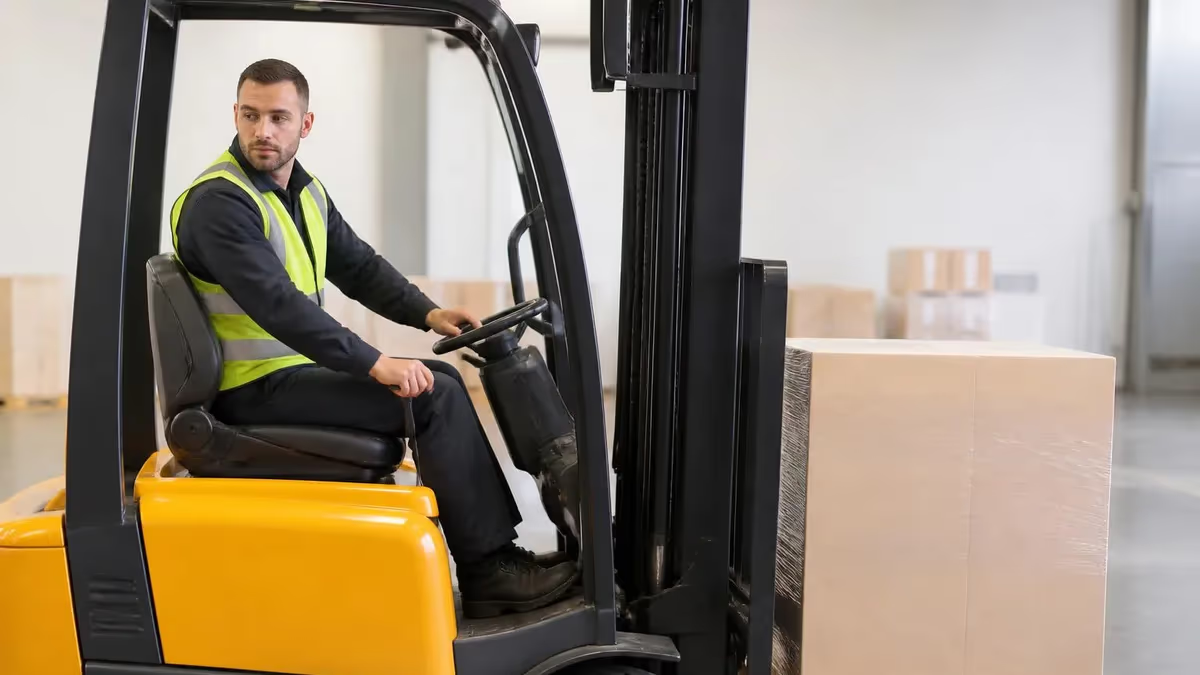
If you have been searching for forklift training fresno ca or in-person classes nearby, you already know that hands-on instruction beats any video course when it comes to operating a real lift truck safely. In-person forklift training combines classroom theory, equipment walk-arounds, and supervised driving evaluations — the three elements OSHA explicitly requires under 29 CFR 1910.178(l). Whether you are a warehouse new-hire, a construction laborer, or a career-changer in California's Central Valley, the path to certification of forklift operation runs through a qualified trainer who can watch you steer, stack, and stop.
Fresno sits at the heart of one of the busiest agricultural and logistics corridors in the country, which means demand for certified forklift operators rarely cools off. Distribution centers along Highway 99, cold-storage facilities in Selma, and packing houses in Reedley all need workers who can safely handle pallets the day they clock in. That is why local forklift training providers typically schedule classes weekly, charge between $150 and $300 for a full certification course, and issue a wallet-sized operator card the same afternoon you complete the practical evaluation.
Beyond Fresno, the in-person model looks remarkably similar across the country. A community college, an OSHA-authorized private trainer, or your employer's safety department will deliver roughly four to eight hours of seat time, depending on your experience. The classroom portion covers load charts, stability triangles, pre-shift inspections, and pedestrian awareness. The practical portion happens on a real forklift — usually a propane-powered sit-down cushion-tire model or an telehandler forklift for outdoor construction applications.
One thing that surprises new students is how much of the day is spent off the machine. Trainers will ask you to identify hazards in photographs, calculate residual capacity from a data plate, and demonstrate how to refuel or swap a battery. These are not academic exercises — they directly map to the citations OSHA writes after warehouse incidents. A class that skips the paperwork in favor of pure driving time is a red flag, because your certification card is only as good as the documentation your trainer retains on file.
The forklift rental industry has also reshaped how training centers operate. Many in-person programs partner with local rental yards to access a rotating fleet of equipment, which means your hands-on hours might cover a stand up forklift, an electric forklift, and a propane sit-down model in a single afternoon. That breadth matters because OSHA requires class-specific certification — passing on a Class IV cushion-tire truck does not qualify you to operate a Class VII rough-terrain machine. A good local provider will tell you up front which classes their evaluation covers.
This guide walks through what to expect from in-person forklift training in Fresno and the rest of the United States: typical course outlines, real prices, OSHA's exact requirements, how to verify a trainer's credentials, and how to prepare so you pass the practical evaluation on your first attempt. You will also find practice quiz links, a side-by-side comparison of in-person versus online options, and answers to the questions most students ask after they enroll but before they show up on day one.
In-Person Forklift Training by the Numbers

Your In-Person Forklift Training Day, Hour by Hour
Check-In & Paperwork
Classroom Instruction
Written Knowledge Test
Equipment Walk-Around
Hands-On Driving Evaluation
Certificate Issuance
Pricing for in-person forklift training varies more than most students expect, and understanding the cost structure helps you avoid overpaying or buying a credential that will not stand up to scrutiny. In Fresno, expect to pay between $150 and $300 for a standard one-day course covering Class IV and Class V sit-down trucks. Specialty classes — narrow-aisle reach trucks, order pickers, and rough-terrain machines — usually add $75 to $150 per class because they require dedicated equipment and additional evaluation time from your trainer.
Employer-paid training is the most common path. If you are hired into a warehouse, distribution center, or manufacturing facility, federal law actually requires your employer to provide and pay for forklift certification before you operate equipment unsupervised. That includes the classroom, hands-on evaluation, and any refresher training. Many California employers contract with local training companies who come on-site, which saves the employer downtime and gives you experience on the exact forklift truck operators use every day.
If you are paying out of pocket — perhaps to make yourself more marketable before applying for warehouse jobs — community colleges in the Central Valley sometimes offer subsidized forklift programs through workforce development grants. Fresno City College and the Workforce Connection occasionally bundle forklift certification with broader logistics certificates. These programs may run longer (one to two weeks) but include OSHA 10, basic warehouse math, and a job-placement component that pure certification courses do not.
Watch out for online-only "certifications" that promise to credential you in two hours for $59. OSHA explicitly requires that an employer evaluate your performance on the type of equipment you will operate, in the workplace where you will operate it. An online course alone never satisfies that requirement. The card you receive is essentially worthless until a qualified evaluator watches you drive — and most employers will simply send you to a real training class anyway, costing you both the original fee and your time.
Forklift rental near me searches often spike alongside training searches, and there is a logical reason. Small businesses that need occasional lift truck work — a contractor unloading a flatbed, a farmer moving bins during harvest — may rent rather than buy. If you operate a rented machine, you still need certification, and many rental yards in Fresno will not release equipment without seeing a valid operator card. Reputable rental companies sometimes partner with local trainers to offer a discount package on rental plus same-day operator training.
For employers buying training in bulk, group rates drop the per-person cost to between $75 and $125 when you certify five or more workers at once. Mobile trainers will travel within roughly a 100-mile radius of Fresno, covering Visalia, Madera, Merced, and Hanford. Ask whether the quoted price includes refresher cards, additional class certifications, or evaluator-train-the-trainer credentials if you want to keep training in-house going forward.
Finally, factor in indirect costs. A full training day means lost wages if you are unpaid during class, transportation to the facility, and sometimes lunch. Some Fresno providers offer evening or Saturday classes specifically for workers who cannot take a weekday off — these slots fill up two to three weeks in advance during peak harvest and holiday-shipping seasons, so book early.

Forklift certification Practice Test Questions
Prepare for the Forklift certification Certification exam with our free practice test modules. Each quiz covers key topics to help you pass on your first try.
Forklift certification Certification Forkl...
Forklift certification Exam Questions covering Certification Forklift certification Maintenance and Repairs. Master Forklift certification Test concepts for certification prep.
Forklift certification Certification Forkl...
Free Forklift certification Practice Test featuring Certification Forklift certification Maintenance and Repairs Questions and Answers. Improve your Forklift certification Exam score with mock test prep.
Forklift certification Certification Forkl...
Forklift certification Mock Exam on Certification Forklift certification Operator Training and Certification Requirements. Forklift certification Study Guide questions to pass on your first try.
Forklift certification Certification Forkl...
Forklift certification Test Prep for Certification Forklift certification Operator Training and Certification Requirements Questions and Answers. Practice Forklift certification Quiz questions and boost your score.
Forklift certification Load Handling and S...
Forklift certification Questions and Answers on Load Handling and Stability. Free Forklift certification practice for exam readiness.
Forklift certification OSHA Regulations an...
Forklift certification Mock Test covering OSHA Regulations and Compliance. Online Forklift certification Test practice with instant feedback.
Forklift certification Pre-Operation Inspe...
Free Forklift certification Quiz on Pre-Operation Inspections. Forklift certification Exam prep questions with detailed explanations.
Forklift certification Refueling and Recha...
Forklift certification Practice Questions for Refueling and Recharging Procedures. Build confidence for your Forklift certification certification exam.
Forklift certification Safe Driving and Ma...
Forklift certification Test Online for Safe Driving and Maneuvering. Free practice with instant results and feedback.
Forklift certification Workplace Hazard Id...
Forklift certification Study Material on Workplace Hazard Identification. Prepare effectively with real exam-style questions.
Forklift certification Forklift Instructions
Free Forklift certification Test covering Forklift Instructions. Practice and track your Forklift certification exam readiness.
Forklift certification Forklift MCQ
Forklift certification Exam Questions covering Forklift MCQ. Master Forklift certification Test concepts for certification prep.
Forklift certification Forklift Employer R...
Free Forklift certification Practice Test featuring Forklift Employer Responsibilities. Improve your Forklift certification Exam score with mock test prep.
Forklift certification Forklift Penalties ...
Forklift certification Mock Exam on Forklift Penalties for Non-Compliance. Forklift certification Study Guide questions to pass on your first try.
OSHA Forklift Training Requirements Explained
OSHA's standard 29 CFR 1910.178(l)(3)(i) lists 21 specific topics that formal classroom instruction must cover when relevant to your workplace. These include operating instructions and warnings from the manufacturer, differences between forklifts and automobiles, controls and instrumentation, engine operation, steering and maneuvering, visibility, fork and attachment use, vehicle capacity, and vehicle stability.
Trainers must also address workplace-specific hazards: surface conditions, load composition and stability, load manipulation, pedestrian traffic, narrow aisles, ramps and slopes, closed environments with poor ventilation, and any hazardous locations. A generic online course rarely covers your specific workplace, which is why in-person, site-specific training closes a critical compliance gap that pure e-learning cannot fill.
In-Person vs. Online Forklift Training: Which Is Better?
- +Hands-on seat time satisfies OSHA's practical evaluation requirement in a single visit
- +Trainer can identify and correct dangerous habits in real time
- +Same-day certificate issuance lets you start work immediately
- +Site-specific hazards are addressed when training happens at your workplace
- +Group classes build camaraderie and reinforce safety culture among coworkers
- +Multiple equipment classes can often be covered in one extended session
- +Networking opportunities with local employers who often hire from training pools
- −Higher upfront cost than online-only programs ($150-$300 vs. $59-$99)
- −Requires scheduling around class availability — popular slots fill weeks ahead
- −Travel time to the training facility eats into your day
- −Some rural areas have limited local providers and require driving 30+ miles
- −Less flexibility than self-paced online theory modules
- −Group classes may move at the pace of the slowest learner
- −Cancellations or weather can push your start date back significantly
Pros and Cons at a Glance
| Pros | Cons |
|---|---|
| Hands-on seat time satisfies OSHA's practical evaluation requirement in a single visit | Requires scheduling around class availability — popular slots fill weeks ahead |
| Trainer can identify and correct dangerous habits in real time | Travel time to the training facility eats into your day |
| Same-day certificate issuance lets you start work immediately | Less flexibility than self-paced online theory modules |
| Site-specific hazards are addressed when training happens at your workplace | Group classes may move at the pace of the slowest learner |
| Group classes build camaraderie and reinforce safety culture among coworkers | Cancellations or weather can push your start date back significantly |

What to Bring to Your In-Person Forklift Training Class
- ✓Government-issued photo ID — driver's license, state ID, or passport
- ✓Closed-toe steel-toe or composite-toe work boots (sneakers are typically rejected)
- ✓Long pants — no shorts, athletic wear, or loose synthetic fabrics that can snag
- ✓Long-sleeve shirt or fitted T-shirt; avoid jewelry, ties, and loose hoodie strings
- ✓ANSI Z87.1 safety glasses if you have a personal pair; trainers usually provide loaners
- ✓High-visibility vest if specified by the training provider in your confirmation email
- ✓Notebook and pen for OSHA citations, load chart math, and inspection checklists
- ✓Bottled water and a small snack — full days can run six to eight hours
- ✓Reading glasses if you need them for load plates and small print on data tags
- ✓Your employer's contact information so the trainer can send certification records directly
Schedule your class for early in the week if you can.
Monday and Tuesday classes in Fresno tend to have smaller groups, giving you more individual seat time during the practical evaluation. By Thursday and Friday, classes are often full, and you may share a forklift with five or six other students — cutting your individual driving time in half. More seat time means better feedback and a stronger pass on your first attempt.
Passing the practical evaluation is where most first-time students get nervous, but the good news is that OSHA evaluators are not looking for racing-driver precision — they want to see safe, deliberate, controlled operation. The single biggest reason students fail is moving too fast. A forklift carrying a 3,000-pound load behaves nothing like a car. Quick stops shift weight forward and can tip a load; sharp turns at speed can tip the truck itself. Slow, smooth, intentional movement passes evaluations almost every time.
Before you ever climb into the seat, you will perform a pre-shift inspection. Memorize the categories: fluid levels, tires, mast and chains, hydraulic lines, forks, data plate visibility, horn, lights, parking brake, and seatbelt. Trainers love to see students physically point at each component, say what they are checking, and document the inspection on a paper or digital form. Going through this routine slowly demonstrates that you understand the equipment — and it gives you 60 to 90 seconds to calm your nerves before the driving portion.
Mounting and dismounting trips up surprising numbers of students. OSHA's three-point contact rule — two hands and one foot, or one hand and two feet — applies every single time. Never jump off a forklift, never exit while it is moving, and never operate without the seatbelt fastened. Evaluators sometimes mark down a student who passes the entire driving portion flawlessly but unbuckled before fully stopping. Build the habit during practice so it becomes automatic during the test.
When picking up a load, square up to the pallet, lower the forks to floor level with a slight forward tilt, drive in until the load contacts the carriage backrest, then tilt back slightly before lifting and traveling. When traveling, keep the load low — typically 4 to 6 inches off the ground — and tilted back enough to keep the center of gravity inside the stability triangle. If your view forward is blocked, drive in reverse and look in the direction of travel. Reputable operators of a crown forklift drill this habit until it becomes second nature.
Stacking and placing loads is where evaluators score precision. Approach the destination square, lift to the correct height, drive forward smoothly until the load is above the rack, level the forks, lower until the pallet sits flat, then back straight out with the forks low. Avoid jerky hydraulic movements, do not turn the steering wheel while the load is elevated, and never lift or lower while moving. These four habits separate competent operators from dangerous ones.
Communication during the evaluation matters. Talk through what you are doing: "Sounding the horn at the blind corner. Checking pedestrian traffic. Stopping at the intersection." This shows the evaluator that your decisions are deliberate rather than lucky. It also slows you down — operators who narrate naturally drive at a safer pace. The handful of seconds you spend explaining is far less than the time you would lose retaking the test.
Finally, treat the evaluation like a normal workday. Bring water, eat a real breakfast, and arrive 15 minutes early to walk the course before testing begins. Watching one or two other students take the test before you can reveal exactly where the evaluator stands, what they call out, and how strictly they score speed and stopping distance. That small intelligence gathering often makes the difference between a 78 and an 88 on your scorecard.
If a website promises a forklift certification card for $49 with no hands-on evaluation, walk away. OSHA inspectors recognize the templates these mills use, and employers face citations up to $16,131 per untrained operator. Worse, your card is invalid the moment an inspector arrives — meaning the money you spent is gone and you still need legitimate training. Always verify the trainer can document your practical evaluation on actual equipment.
Earning your certification is just the start. OSHA requires a fresh performance evaluation every three years, and a triggering event can require a refresher much sooner. Set a calendar reminder for two years and 10 months from your training date so you have time to schedule recertification before your card lapses. Working with an expired card is treated the same as working without certification — and the employer, not the worker, usually absorbs the citation cost when an inspector flags it during an audit.
Many operators broaden their value by getting certified on multiple forklift classes. Starting with a Class IV or V sit-down truck is common, then adding Class II narrow-aisle reach trucks, Class III electric pallet jacks, or Class VII rough-terrain machines like a hyster forklift. Each additional certification typically costs $75 to $150 and takes only a few hours because you already know the foundational classroom material. Multi-class operators earn $2 to $5 more per hour in most California markets.
Document everything. Keep a personal folder with photocopies of every certificate, evaluation form, and refresher record. If you change employers, you may need to provide proof of prior training to avoid retaking the full course — and a new employer is required to evaluate your performance on their specific equipment before letting you operate it, but a documented history shortens that evaluation considerably. Some operators photograph their wallet card and store it in a cloud folder for quick reference.
Career advancement after certification follows a predictable arc. Entry-level operators in Fresno start at $17 to $19 per hour. After one to two years and proven safety performance, lead operator or trainer roles open up at $22 to $26 per hour. Many warehouse supervisors and shipping managers began as forklift operators — the credential is genuinely a foot in the door for logistics careers, not just a one-and-done task. Pay attention to which experienced operators get promoted and what skills set them apart.
If you eventually want to become a trainer yourself, look for "train-the-trainer" programs. These cost $400 to $800, run two to three days, and qualify you to conduct in-person OSHA forklift training for your employer or as a side business. Independent trainers in the Central Valley can earn $75 to $150 per hour conducting on-site evaluations, and some build full-time businesses serving manufacturers, growers, and construction firms. The credentialing path requires documented operating experience plus a structured curriculum review.
Stay current on regulation changes. OSHA periodically updates 1910.178, and ANSI/ITSDF B56.1 — the industry consensus standard — gets revised every few years. Subscribing to a free safety newsletter or following your training provider on social media keeps you ahead of new requirements. Recent updates have addressed lithium-ion battery handling, automated guided vehicle interaction, and pedestrian-detection technology — all topics that will appear in refresher courses over the next decade.
Choosing the right in-person trainer near you comes down to four questions: Does the trainer cover the specific forklift class you will operate at work? Will the evaluation happen on real equipment, not a simulator? Does the documentation meet OSHA's recordkeeping requirements? And will the certificate be issued by an authorized evaluator whose credentials you can verify? If a provider hesitates on any of these, keep looking. Fresno has at least a dozen reputable options, and even rural Central Valley towns usually have a mobile trainer within driving distance.
Verify trainer credentials by asking for the evaluator's training-of-trainers certificate, their insurance documentation, and references from recent corporate clients. Legitimate trainers provide this within minutes — they are proud of it. Vague answers, refusals, or stalling tactics are clear warning signs. The Fresno-area workforce connection office and local chambers of commerce often maintain referral lists of vetted training providers, and Cal/OSHA's consultation service can point you toward compliant programs at no cost.
Prepare for class by reviewing free practice quizzes the week before your scheduled date. Spending 30 minutes a day on sample questions about stability, capacity, and inspection procedures dramatically improves your written-test score. Many students who fail the written portion did not fail because they were unintelligent — they failed because they had never seen the specific phrasing OSHA uses. Practice tests fix that gap quickly and inexpensively, and most quiz sites are free or under $20.
The day of class, eat a real breakfast, hydrate, and arrive early. Bring everything on the checklist above, plus a positive attitude. Trainers notice students who ask questions, take notes, and treat the equipment with respect — and they often write stronger recommendation letters or referrals for those students when employers call asking for new hires. Your training day is also a 30-second job interview, and trainers know which warehouses are hiring this week.
After class, practice if you can. Some employers let new certified operators ride along with experienced drivers for a week before turning them loose solo. Take that opportunity seriously — watch how veterans approach corners, how they sound the horn, how they communicate with pedestrians. Real-world experience builds the muscle memory that classroom training only sketches. Within 90 days of certification, most operators report feeling fully comfortable on equipment they once found intimidating.
Finally, take pride in the credential. Forklift operators move the goods that fill grocery shelves, build homes, and supply manufacturers across California. It is skilled work, it pays better than many entry-level jobs, and it opens doors to logistics careers that did not exist 20 years ago. The few hundred dollars and one day you invest in in-person training pays back many times over — both in immediate hourly wages and in the safety habits that protect you, your coworkers, and the loads you handle for years to come.
Sample Forklift certification Practice Questions
Try these questions from our free Forklift certification practice tests. The correct answer and an explanation follow each question.
In serious injury or fatality cases involving forklifts, what can result beyond monetary fines?
- A. Only a verbal warning
- B. Possible criminal prosecution
- C. Automatic license upgrade
- D. Guaranteed civil immunity
Answer: B. Possible criminal prosecution
Willful violations that cause a worker's death can lead to criminal prosecution in addition to civil penalties.
What happens to the forklift's maximum capacity when the load center distance increases beyond the rated value?
- A. The safe capacity decreases
- B. The safe capacity increases
- C. Capacity is unaffected by load center
- D. Capacity doubles
Answer: A. The safe capacity decreases
A load center farther from the mast increases the tipping moment, so the truck can safely lift less weight.
Which event triggers mandatory refresher training regardless of the 3-year cycle?
- A. A routine shift change
- B. An accident or near-miss involving the operator
- C. A change in company logo
- D. A holiday schedule
Answer: B. An accident or near-miss involving the operator
Refresher training is required when an operator is involved in an accident or near-miss, is observed operating unsafely, or is assigned a different type of truck.
While operating near a loading dock, an operator notices that a truck has pulled away, leaving the dock door open with no barrier in place. This situation primarily creates a severe risk of:
- A. A forklift falling off the dock edge.
- B. Unauthorized personnel entering the facility.
- C. Cargo being exposed to weather.
- D. Poor lighting conditions for the next truck.
Answer: A. A forklift falling off the dock edge.
An unguarded loading dock edge is one of the most dangerous hazards in a warehouse. A forklift can easily be driven off the edge, leading to a fall of several feet, which often results in serious injury or fatality for the operator.
Forklift Questions and Answers
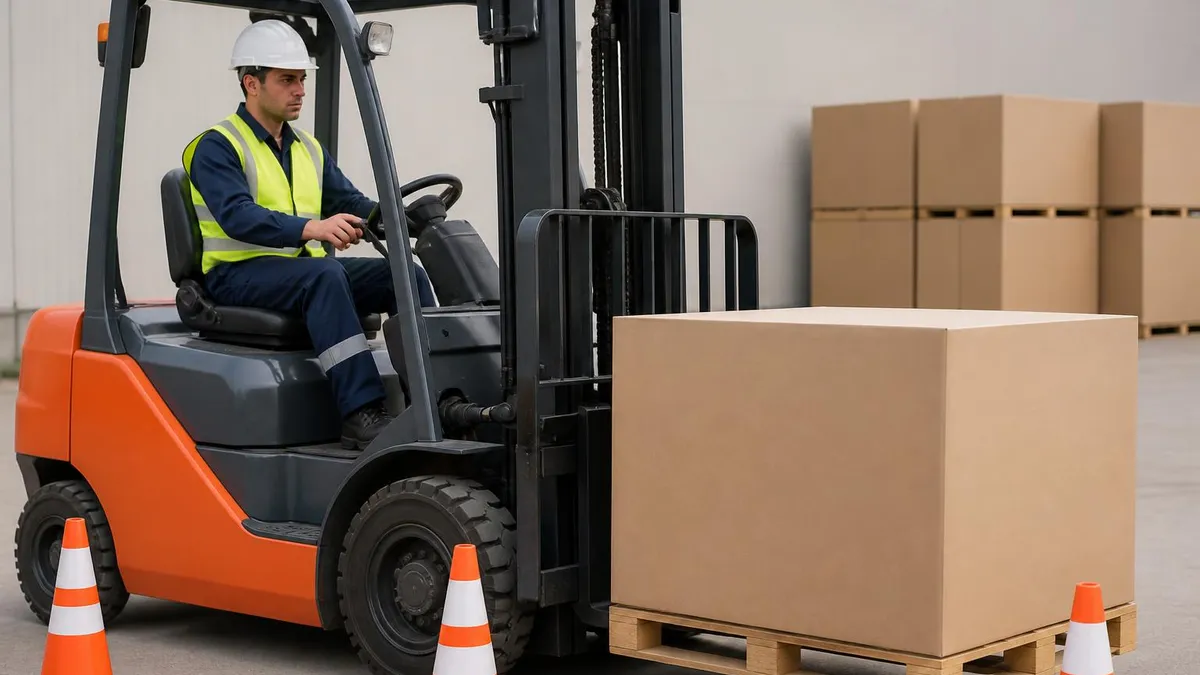
Forklift Tires: Complete Guide to Types, Sizing, Wear Patterns, and Replacement Costs
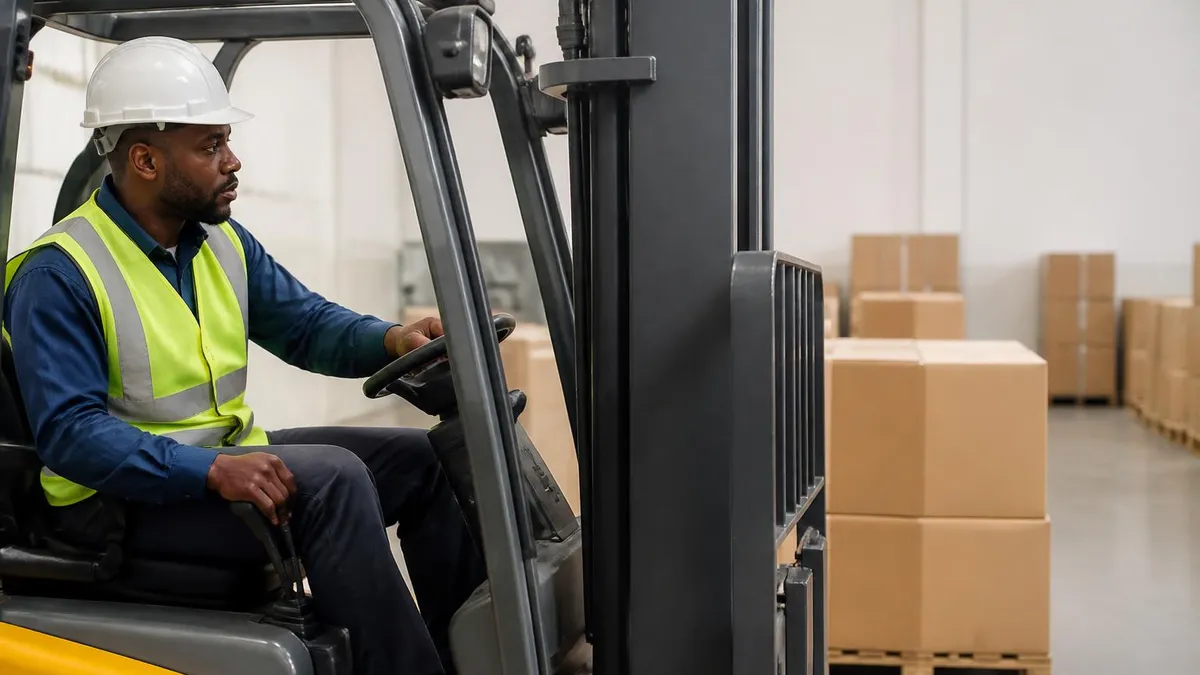
Forklift Accessories: Complete Guide to LED Lights, Attachments, Safety Gear, and Productivity Upgrades for 2026
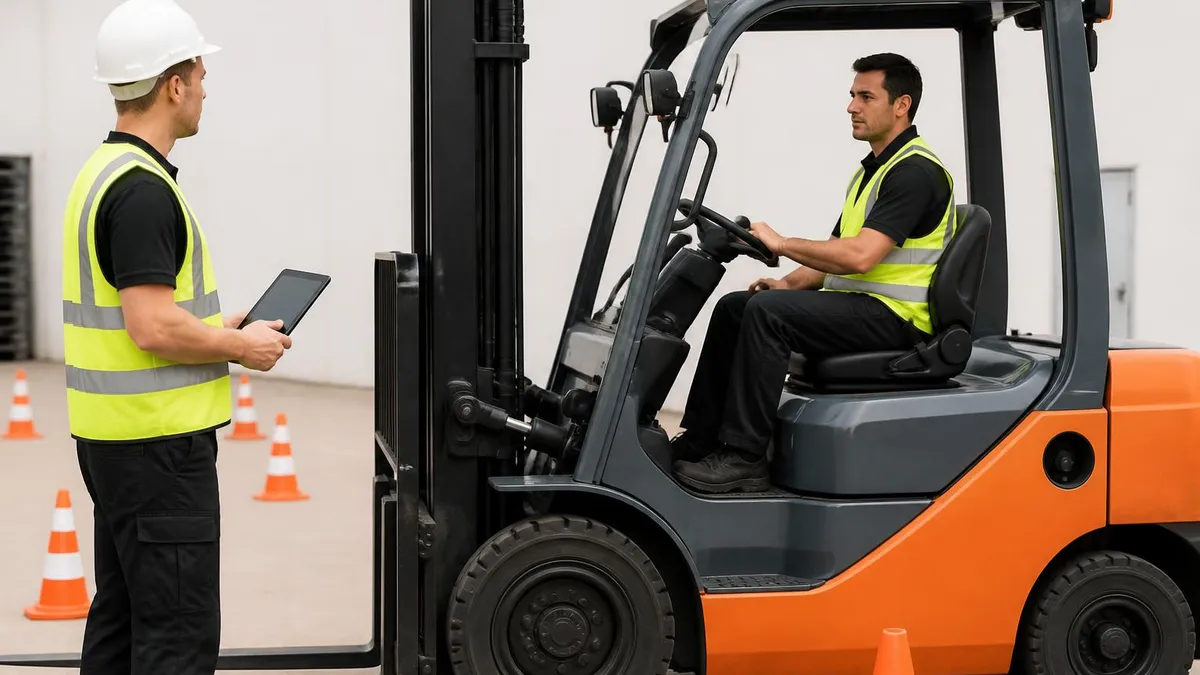
Forklift Safety Training: Complete OSHA Compliance Guide for Operators and Employers
Forklift Repair Service: Complete Guide to Costs, Common Repairs, and Choosing the Right Technician
Forklift Price Guide 2026: New, Used, Rental, and Total Cost of Ownership Breakdown
About the Author
Certified Crane Operator & Skilled Trades Exam Specialist
Ferris State UniversityRobert Martinez is a Journeyman Ironworker, NCCCO-certified crane operator, and forklift trainer with a Bachelor of Science in Construction Technology from Ferris State University. He has 21 years of ironworking, rigging, and heavy equipment operation experience across high-rise and industrial construction sites. Robert prepares candidates for crane operator, rigger, forklift, and skilled trades certification examinations.