
Forklift Classes Near Me: Complete Guide to Local OSHA-Compliant Operator Training, Costs, and Certification in 2026 October
Find forklift classes near me with OSHA-compliant training, 📝 costs from $75-$300, same-day certification options, and tips to choose the right local school.
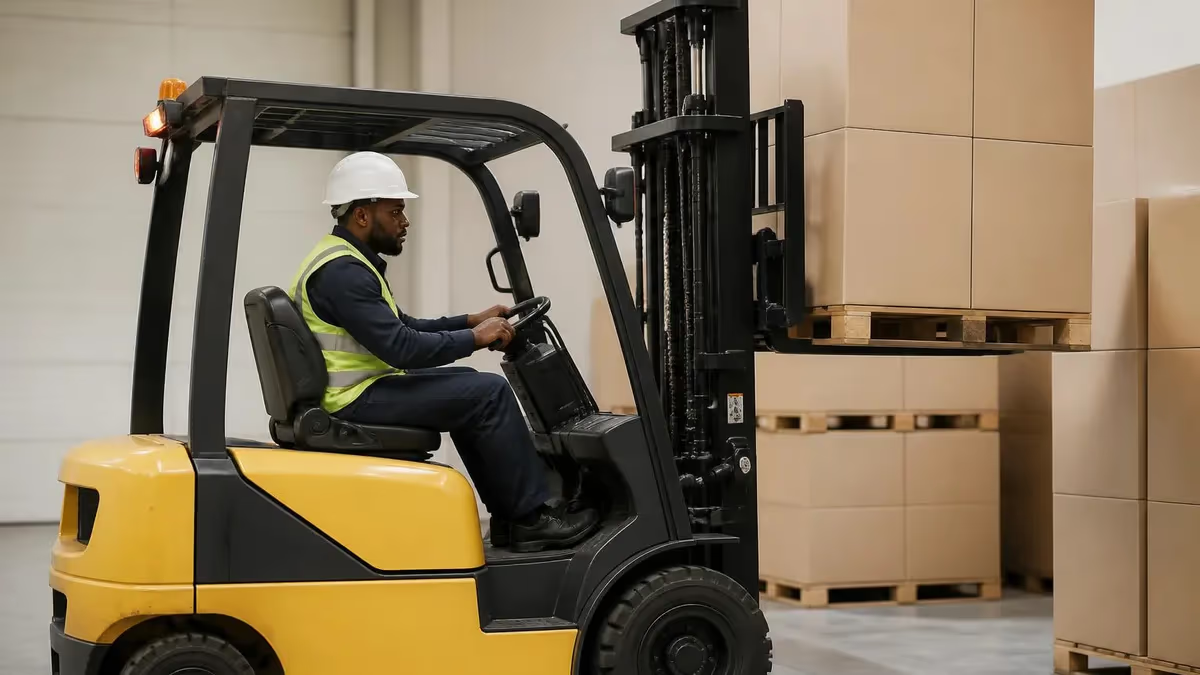
Searching for forklift classes near me is one of the smartest career moves you can make in 2026, with warehouse and logistics employers across the United States actively hiring certified operators at hourly rates between $18 and $28. Local forklift training programs prepare you to safely operate sit-down counterbalance trucks, reach trucks, pallet jacks, order pickers, and even a cherry picker forklift used in elevated stock-picking applications inside distribution centers. Most classes finish in one to three days and include the OSHA-required written test plus a hands-on driving evaluation.
The Occupational Safety and Health Administration mandates under standard 29 CFR 1910.178(l) that every powered industrial truck operator complete formal instruction, practical training, and a workplace evaluation before driving solo. This rule applies to anyone running forklifts on the job, whether you work in a grocery warehouse, lumberyard, manufacturing plant, or retail backroom. Untrained operation can result in OSHA fines exceeding $16,000 per violation, which is why employers prioritize hiring candidates who already hold a valid certification card.
When you search for forklift classes near me, you will typically find three main provider types: community colleges, private training schools, and equipment dealerships that offer on-site courses. Community college programs tend to run longer (16-40 hours) and cost between $200 and $500, while private one-day classes range from $75 to $200. Many employers also pay for in-house training through their safety departments, especially if they already operate a fleet that requires regular operator refreshers every three years.
Beyond the certificate, a quality local class teaches you the physics of load handling, stability triangle theory, pre-shift inspection procedures, pedestrian safety zones, and emergency response. Good instructors also cover battery and fuel handling for electric forklift, propane, and diesel units. You will learn to read the data plate, calculate residual capacity when using attachments, and recognize early signs of mechanical failure that should pull a truck out of service. These skills translate directly into fewer accidents and faster promotions.
Local availability is better than ever because demand for forklift operator talent surged after the e-commerce boom of the early 2020s and never slowed down. The Bureau of Labor Statistics projects steady 4% growth through 2032 for material moving occupations, with more than 130,000 annual openings nationwide. If you live near a major freight corridor like Chicago, Dallas, Atlanta, the Inland Empire, or the Port of Newark, you can usually find a class scheduled within 7-14 days of registration. Smaller metros may require a 30-60 mile drive but still offer at least monthly sessions.
This guide explains exactly how to evaluate local forklift schools, what to expect on test day, the real costs, and how to avoid scams that sell fake online-only certificates. We will also walk through the difference between initial training and refresher training, the seven OSHA truck classes, and how reciprocal certifications work when you change employers. By the end, you will know whether to enroll at a community college, a private school, or directly through your employer for free forklift rentals and equipment time.
Forklift Classes by the Numbers

Types of Forklift Classes You Can Find Locally
Compressed 6-8 hour programs run by certified trainers at industrial parks or rental yards. Includes written exam and hands-on test. Best for fast entry, typically $99-$199.
Longer 16-40 hour programs through workforce development departments. Cover multiple truck classes, OSHA standards in depth, and often include job placement. Cost $200-$500.
Free in-house programs run by your warehouse or factory's safety team. Site-specific and OSHA-compliant. Certifies you only for that workplace unless documented thoroughly.
Toyota, Crown, Hyster, and Raymond dealers offer training at their service centers. Strong on equipment-specific knowledge, often combined with maintenance basics. $150-$350.
Instructor and truck travel to your facility for groups of 4-12 employees. Convenient for businesses; per-student rate drops to $65-$120 when scheduled in bulk.
Cost is usually the first question when comparing forklift classes near me, and the honest answer is that pricing varies more by region than by program quality. Expect to pay $75-$120 in lower-cost markets like rural Texas, Mississippi, and Ohio, while metro areas such as Los Angeles, Seattle, Boston, and the New York tri-state often charge $175-$300 for the exact same one-day curriculum. Always confirm whether the quoted price includes the wallet card, certificate of completion, and tax, because some schools advertise a base rate and tack on $20-$40 in fees at checkout.
Standard local classes include classroom instruction covering OSHA regulations, truck stability, load handling, refueling, and inspection. The hands-on portion uses an actual forklift on a closed course where you complete maneuvers like pallet retrieval, narrow-aisle navigation, ramp driving, and stacking. You take a 25-50 question written exam (passing score is typically 80%) followed by a practical evaluation graded on a checklist. If you fail either portion, most schools allow one free retake within 30 days; a second retake usually costs $25-$50.
Hidden expenses worth budgeting for include steel-toe boots ($50-$120 if you don't already own a pair), safety glasses, a high-visibility vest, and transportation. Some schools require a current government-issued ID, while others ask for proof of employment eligibility (I-9 documentation). Background checks are uncommon for forklift training itself but become relevant when applying for warehouse jobs at large employers like Amazon, Walmart, FedEx, or UPS. Drug testing happens at hiring, not at the training school, in nearly every case.
Financial assistance is widely available. WIOA (Workforce Innovation and Opportunity Act) grants administered through state workforce boards can fully cover tuition for unemployed and underemployed adults. Veterans can use VA education benefits including the GI Bill at approved providers. Trade Adjustment Assistance helps workers displaced by import-related layoffs, and many union locals (Teamsters, UFCW, and the Laborers' International) sponsor members through their joint apprenticeship trust funds. Ask your local American Job Center for a list of approved schools in your county.
Employer reimbursement is another route many people overlook. If you're already working in a warehouse or manufacturing role, ask HR whether the company will pay for or reimburse certification. Many do, especially when the role requires occasional forklift work, because it's cheaper than hiring an outside operator. You may have to sign a one-year retention agreement, but the math usually still works in your favor. The same logic applies to renewals every three years and to specialty endorsements like forklift certification near me for narrow-aisle or rough-terrain equipment.
Finally, beware of online-only "forklift certifications" advertised for $59. OSHA explicitly requires hands-on evaluation by a qualified trainer who physically watches you operate the truck. A purely online course cannot satisfy this rule, and employers who accept such certificates can be cited during inspections. Online theory plus a separate in-person practical works fine when both come from the same provider and are documented together. If something sounds too easy or too cheap, call your state OSHA office or the National Safety Council to verify before paying.
Forklift certification Practice Test Questions
Prepare for the Forklift certification Certification exam with our free practice test modules. Each quiz covers key topics to help you pass on your first try.
Forklift certification Certification Forkl...
Forklift certification Exam Questions covering Certification Forklift certification Maintenance and Repairs. Master Forklift certification Test concepts for certification prep.
Forklift certification Certification Forkl...
Free Forklift certification Practice Test featuring Certification Forklift certification Maintenance and Repairs Questions and Answers. Improve your Forklift certification Exam score with mock test prep.
Forklift certification Certification Forkl...
Forklift certification Mock Exam on Certification Forklift certification Operator Training and Certification Requirements. Forklift certification Study Guide questions to pass on your first try.
Forklift certification Certification Forkl...
Forklift certification Test Prep for Certification Forklift certification Operator Training and Certification Requirements Questions and Answers. Practice Forklift certification Quiz questions and boost your score.
Forklift certification Load Handling and S...
Forklift certification Questions and Answers on Load Handling and Stability. Free Forklift certification practice for exam readiness.
Forklift certification OSHA Regulations an...
Forklift certification Mock Test covering OSHA Regulations and Compliance. Online Forklift certification Test practice with instant feedback.
Forklift certification Pre-Operation Inspe...
Free Forklift certification Quiz on Pre-Operation Inspections. Forklift certification Exam prep questions with detailed explanations.
Forklift certification Refueling and Recha...
Forklift certification Practice Questions for Refueling and Recharging Procedures. Build confidence for your Forklift certification certification exam.
Forklift certification Safe Driving and Ma...
Forklift certification Test Online for Safe Driving and Maneuvering. Free practice with instant results and feedback.
Forklift certification Workplace Hazard Id...
Forklift certification Study Material on Workplace Hazard Identification. Prepare effectively with real exam-style questions.
Forklift certification Forklift Instructions
Free Forklift certification Test covering Forklift Instructions. Practice and track your Forklift certification exam readiness.
Forklift certification Forklift MCQ
Forklift certification Exam Questions covering Forklift MCQ. Master Forklift certification Test concepts for certification prep.
Forklift certification Forklift Employer R...
Free Forklift certification Practice Test featuring Forklift Employer Responsibilities. Improve your Forklift certification Exam score with mock test prep.
Forklift certification Forklift Penalties ...
Forklift certification Mock Exam on Forklift Penalties for Non-Compliance. Forklift certification Study Guide questions to pass on your first try.
Understanding OSHA Forklift Training Requirements
OSHA standard 1910.178(l)(2)(ii) requires formal instruction delivered through lectures, video, written material, or computer-based learning. Topics must include operating instructions specific to the truck type, differences between the truck and an automobile, controls and instrumentation, engine or motor operation, steering and maneuvering, visibility limitations, fork and attachment adaptation, vehicle capacity, vehicle stability, and any inspection and maintenance the operator will perform.
This is the classroom portion and typically takes three to four hours. A qualified trainer must cover workplace-specific hazards too: surface conditions, load composition and stability, load manipulation, stacking and unstacking, pedestrian traffic, narrow aisles, ramps and sloped surfaces, restricted visibility areas, hazardous classified locations where the truck will be operated, and any other unique conditions in the operating environment.

Local In-Person Classes vs. Online Forklift Training
- +Hands-on driving practice satisfies OSHA practical evaluation requirements
- +Immediate trainer feedback corrects bad habits before they become dangerous
- +Networking with classmates and instructors opens job leads in your area
- +Local employers recognize and trust certificates from established schools
- +Same-day completion lets you start applying for jobs within 24 hours
- +Equipment exposure includes propane, electric, and possibly cherry picker units
- +Wallet card and certificate handed to you on the spot, no shipping delays
- −Higher upfront cost than online-only options ($75-$300 vs. $59)
- −Fixed class times require scheduling around work or childcare
- −Travel to the training site can add commuting expense
- −Some markets have limited weekend or evening sessions
- −Class size may exceed 12 students, reducing personal attention
- −Cancellations and reschedules happen during severe weather
- −You still need a workplace evaluation after employer hires you
Pros and Cons at a Glance
| Pros | Cons |
|---|---|
| Hands-on driving practice satisfies OSHA practical evaluation requirements | Fixed class times require scheduling around work or childcare |
| Immediate trainer feedback corrects bad habits before they become dangerous | Travel to the training site can add commuting expense |
| Networking with classmates and instructors opens job leads in your area | Some markets have limited weekend or evening sessions |
| Local employers recognize and trust certificates from established schools | Cancellations and reschedules happen during severe weather |
| Equipment exposure includes propane, electric, and possibly cherry picker units | You still need a workplace evaluation after employer hires you |
What to Bring and Do Before Your Forklift Class
- ✓Bring a valid government-issued photo ID for enrollment verification
- ✓Wear steel-toe or composite-toe safety footwear—required to drive
- ✓Arrive 15 minutes early to complete paperwork and waivers
- ✓Eat a real breakfast; classes run long without scheduled meal breaks
- ✓Bring safety glasses and a high-visibility vest if not supplied
- ✓Review OSHA truck classifications I-VII the night before
- ✓Practice basic math—you'll calculate load capacity and center of gravity
- ✓Confirm whether the certificate will be issued same day or mailed
- ✓Bring a notebook and pen even if slides are provided digitally
- ✓Charge your phone so you can photograph the data plate during inspection
- ✓Dress for outdoor and indoor temperature swings on the practical course
- ✓Avoid loose clothing, jewelry, or dangling lanyards near moving equipment
Ask your trainer to evaluate you on the exact truck model you'll operate at work
OSHA technically requires evaluation on the type of equipment used in your job. If you're hired into a warehouse running stand-up reach trucks but trained only on sit-down counterbalance, your employer must still conduct a site-specific evaluation before you operate solo. Many local schools have multiple truck types on the lot—just ask. Two extra hours of practice on the right model can save you a humiliating restart on day one of a new job.
Choosing the right local school takes more research than most students do, and the difference between a good and a bad program shows up in your first week on a real job. Start by verifying that the school's curriculum maps to OSHA 1910.178 and ANSI/ITSDF B56.1 standards. Reputable providers will display these references openly on their website and welcome questions about their lesson plan. If a school can't explain how it covers the seven OSHA truck classes, the stability triangle, and load-center calculations, keep looking—there are better options nearby.
Read online reviews carefully but read between the lines. A school with 4.8 stars and 400 reviews is more trustworthy than one with 5.0 stars and 12 reviews, especially when the 12 all sound suspiciously identical. Pay attention to comments mentioning whether students felt rushed, whether equipment was modern, whether the trainer answered questions thoroughly, and whether the certificate was accepted by the reviewer's eventual employer. Negative reviews about scheduling or facilities matter less than complaints about inadequate hands-on time.
Visit the training facility in person if possible. A quality school maintains clean, well-marked practice areas with painted lanes, signage, racking, and at least two operational forklifts. The trucks should look maintained—no leaking hydraulic fluid, no missing safety decals, no cracked overhead guards. Modern schools often include both internal-combustion units (LP-gas) and electric models so you experience both fuel systems. Some larger campuses even stock a cherry picker forklift or order picker for elevated platform training, which is a strong signal of curriculum depth.
Trainer credentials matter more than school branding. OSHA requires that training be conducted by persons with the knowledge, training, and experience to train operators and evaluate their competence. Ask how long the instructor has worked in the industry, whether they hold train-the-trainer credentials from the National Safety Council, AmeriQuest, or a similar organization, and whether they actively work in a warehouse or strictly teach. Active practitioners tend to share more relevant, current safety stories than full-time classroom instructors who haven't operated commercially in years.
Job placement assistance can transform the value of a $200 class into a multi-thousand-dollar career move. Many community colleges and regional schools maintain employer partnerships with logistics companies, third-party warehousing firms, and manufacturers. Ask about placement rates, average starting wages of recent graduates, and which companies have hired most recently. The best schools host on-site hiring events where local recruiters interview students before graduation, sometimes with offer letters issued the same week as certification.
Finally, confirm the school's policy on retesting, certificate replacement, and three-year renewals. You will eventually need a refresher, and continuing with the same provider streamlines documentation. Some schools offer lifetime certificate replacement for a small fee; others charge $25-$50 for duplicate wallet cards. A handful provide free annual safety refreshers as a perk, which is excellent insurance against forgetting key procedures. Treat school selection like buying a used forklift for sale—inspect carefully before you commit.
Don't forget to weigh logistics: parking availability, public transit access, parking cost, and surrounding restaurants for the lunch break on full-day classes. A great curriculum at an inconvenient location often loses to a slightly weaker school you can actually reach by 7:30 a.m. without stress. If you're certifying for an existing job, coordinate the date with your employer so they can cover your shift and possibly reimburse you for the class fee on the same week.

OSHA explicitly requires a hands-on practical evaluation by a qualified trainer—a course consisting only of videos and a multiple-choice quiz cannot legally certify you to operate a forklift at work. Employers accepting these certificates can be cited and fined during inspections, and you can be fired or denied workers' compensation after an incident. Always confirm the program includes documented in-person driving evaluation before paying.
Once you pass your local forklift class, the certificate and wallet card you receive are valid for three years from the issue date, but your work isn't done. Your new or existing employer must still conduct a site-specific evaluation under OSHA 1910.178(l)(4) before you operate equipment in their facility solo. This evaluation usually takes 30-60 minutes and confirms that you can handle that company's specific trucks, loads, aisle widths, and pedestrian traffic patterns. Bring your wallet card to your first shift and ask HR exactly how the site evaluation will be documented.
With certification in hand, you can apply to a much wider range of roles. Entry-level warehouse associate jobs that include forklift duties typically pay $2-$4 more per hour than non-certified positions. Specialized roles like reach truck operator, narrow-aisle operator, order picker, and lift truck mechanic pay more still, often reaching $24-$30 per hour with overtime and shift differential. Night-shift and weekend premiums can add 10-15% on top, and large e-commerce fulfillment centers frequently offer signing bonuses of $500-$2,000 for certified operators.
Plan your career path by stacking endorsements. After you've mastered sit-down counterbalance, the next logical step is reach truck or stand-up rider certification—both are in heavy demand at high-density racking warehouses. After that, consider order picker and turret truck training for higher-paying jobs in case picking and very-narrow-aisle operations. Each endorsement typically takes one additional day of training and costs $100-$200, but each one expands your job market and salary ceiling. Within five years, certified multi-truck operators commonly earn $58,000-$72,000 annually.
Refresher training every three years is non-negotiable, but it doesn't have to be expensive. Most schools offer renewal courses at 50-70% of the initial class price, and many take less than a full day because you already know the fundamentals. Some employers run refreshers in-house at zero cost to employees. Mark the expiration date in your phone calendar with a 60-day reminder so you never let certification lapse—an expired card legally blocks you from operating until renewal is complete.
Stay current on industry changes. ANSI standards for powered industrial trucks update periodically, and new technologies like lithium-ion batteries, automated guided vehicles, and lift-assist exoskeletons are reshaping warehouse work. Subscribe to free safety newsletters from the National Safety Council, Industrial Truck Association, and your state OSHA program. Quality schools sometimes invite alumni to free continuing education seminars, especially when major equipment changes occur. Showing up at these sessions also keeps your name in front of trainers who hear about job openings first.
Document everything obsessively. Keep digital and physical copies of every certificate, wallet card, evaluation form, and employer site assessment in a labeled folder. When you apply for a new job, you'll appear far more professional than the average candidate, and you'll have proof if OSHA or your insurance carrier ever asks. If you eventually move into supervision or fleet management, this paper trail also supports your candidacy for roles that oversee equipment purchasing, training programs, and even cherry picker forklift operations.
Practical preparation tips can make the difference between a smooth first-day pass and a stressful retake. Start by sleeping eight hours the night before your class. The combined classroom and practical evaluation runs six to eight hours, sometimes longer with breaks, and fatigue causes more failed practical tests than lack of knowledge. Eat protein at breakfast, bring water, and pack a sandwich or energy bar even if the school promises a lunch break. Test anxiety is real and food helps; never show up running on coffee alone.
Review the OSHA truck classifications the night before so the terminology feels familiar. Class I covers electric motor rider trucks (sit-down counterbalance); Class II is electric narrow-aisle (reach trucks, order pickers); Class III is electric pallet jacks and tow tractors; Class IV is internal-combustion with cushion tires for indoor use; Class V is internal-combustion with pneumatic tires for outdoor or mixed use; Class VI is electric and IC tractors; Class VII is rough-terrain forklifts for construction and lumberyards. Knowing this list cold scores easy written-test points.
Memorize the stability triangle. A counterbalance forklift's center of gravity must stay inside an imaginary triangle formed by the two front wheels and the center of the rear axle. Tilting forward or carrying a load too high shifts the center of gravity forward and can cause a tip-over. Sharp turns at speed shift it sideways. Trainers love asking questions about this concept because it explains 80% of forklift accidents. If you can sketch the triangle and explain how load weight, tilt, and turning affect it, you'll ace the relevant questions.
Practice your pre-operation inspection mentally. The standard walk-around checks tires, forks, mast, chains, hydraulic hoses, data plate legibility, overhead guard, seat belt, horn, lights, backup alarm, fluid levels, battery or fuel, and brakes. Many practical evaluations begin with the trainer asking you to perform this inspection while narrating what you're checking and why. Confidence here sets the tone for the entire driving portion. Slow down, point at each component, and verbalize the condition you're looking for.
On the driving course, the single biggest mistake is going too fast. Forklifts are designed for controlled, deliberate movement. Trainers grade smoothness, awareness, and procedure—not speed. Always sound the horn at blind corners and doorways, look in the direction of travel (yes, that means turning your head fully when driving in reverse), keep forks four to six inches off the ground while traveling, tilt the mast back slightly when carrying loads, and travel up ramps forward when loaded, backward when empty. Park with forks fully lowered and tilted forward.
For the written portion, read each question twice before answering. Many questions include qualifying words like "always," "never," "only," or "except" that flip the correct answer. If you're unsure between two choices, eliminate the obviously wrong options first and pick the safer of the remaining two. OSHA-aligned test items almost always reward the most conservative, safety-focused choice. Pace yourself: a 30-question test gives you roughly one minute per question, which is plenty if you don't second-guess yourself excessively.
After you finish, take notes on any topics you found confusing and review them within the next 48 hours. Your certification doesn't expire for three years, but the skills decay quickly without practice. If you don't start a forklift job immediately, see if your school will let you come back for a one-hour refresher drive in the first month at no charge or for a nominal fee. Many will. Treat the class as the beginning of skill development, not the end—operators who keep learning earn raises faster and stay accident-free longer.
Sample Forklift certification Practice Questions
Try these questions from our free Forklift certification practice tests. The correct answer and an explanation follow each question.
What must forklift training include regarding the specific types of trucks an operator will use?
- A. Training on all possible forklift models worldwide
- B. Training specific to each type of truck the operator will actually operate
- C. Only generic forklift safety concepts
- D. Manufacturer contact information
Answer: B. Training specific to each type of truck the operator will actually operate
Training must be tailored to the exact types of forklifts the operator will use, since different truck types have different operating characteristics.
Can a new forklift operator trainee operate a forklift before completing training?
- A. No, trainees must complete all training before any operation
- B. Yes, but only if they have a driver's license
- C. Yes, with direct supervision by a qualified trainer
- D. Only in storage areas away from other workers
Answer: C. Yes, with direct supervision by a qualified trainer
OSHA allows trainees to operate a forklift during training only under the direct supervision of a qualified trainer.
What three components must be included in a complete forklift operator training program?
- A. Written test, speed trial, and physical fitness evaluation
- B. Formal instruction, practical training, and a performance evaluation
- C. Online video, supervisor observation, and salary review
- D. Safety briefing, maintenance class, and route planning
Answer: B. Formal instruction, practical training, and a performance evaluation
OSHA requires formal instruction (lecture or video), hands-on practical training, and a performance evaluation in the actual work environment.
An operator is maneuvering a forklift in a warehouse and notices a pedestrian walking near their path. According to safety regulations, what is the operator's primary responsibility?
- A. Sound the horn to warn the pedestrian to get out of the way.
- B. Continue driving but slow down significantly.
- C. Stop the forklift and wait for the pedestrian to clear the area.
- D. Yield the right of way to the pedestrian.
Answer: D. Yield the right of way to the pedestrian.
OSHA regulations state that forklift operators must yield the right of way to pedestrians. While sounding the horn and slowing down are important actions, the fundamental rule is that pedestrians have priority in any interaction to prevent accidents.
Forklift Questions and Answers
Forklift Tires: Complete Guide to Types, Sizing, Wear Patterns, and Replacement Costs
Forklift Safety Training: Complete OSHA Compliance Guide for Operators and Employers
Forklift Repair Service: Complete Guide to Costs, Common Repairs, and Choosing the Right Technician
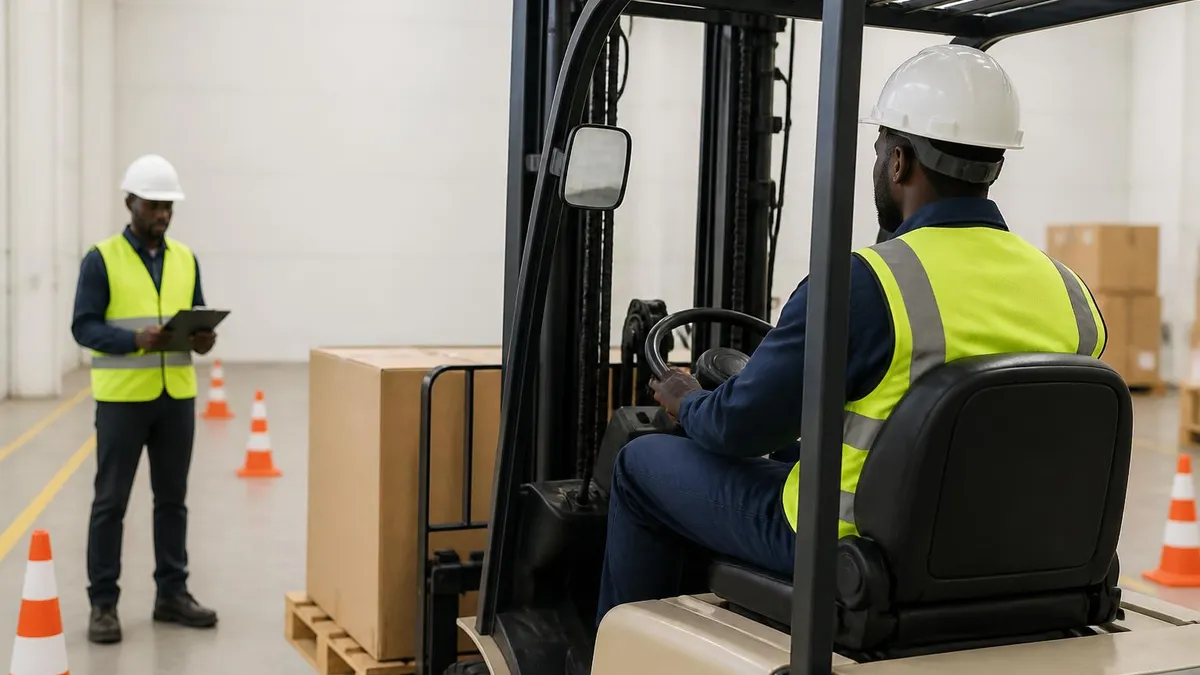
Forklift Certification by State: Complete 50-State Guide to OSHA-Compliant Operator Training, Costs, and Renewal Requirements
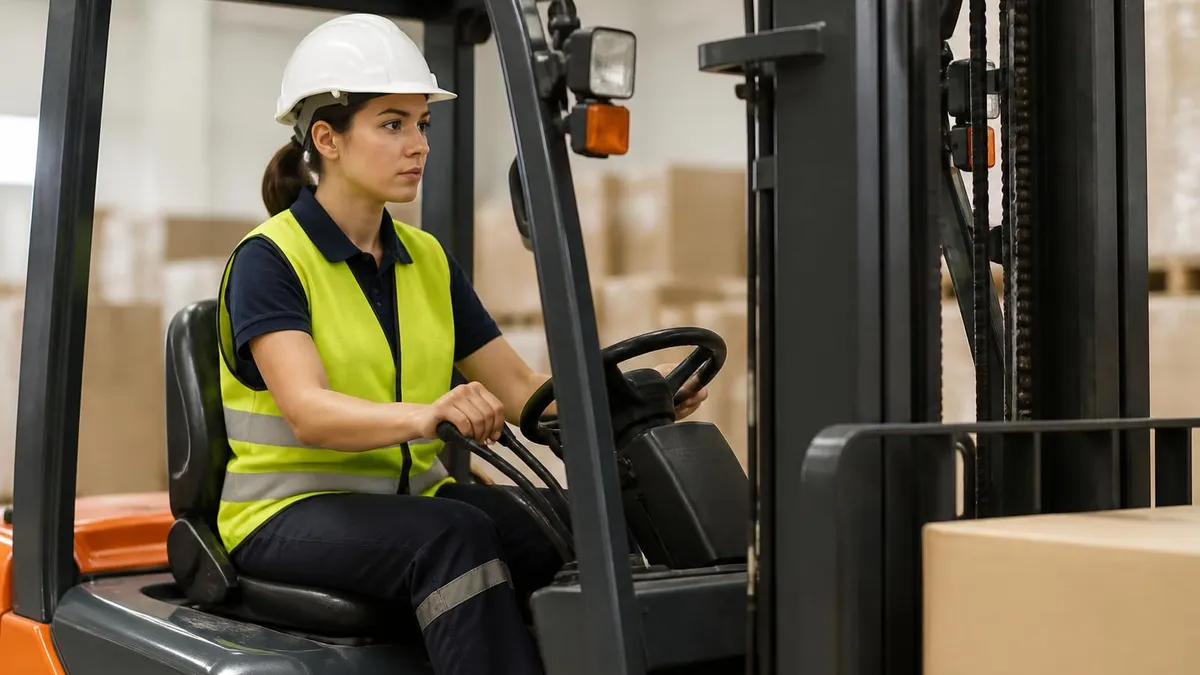
Forklift Price Guide 2026: New, Used, Rental, and Total Cost of Ownership Breakdown
About the Author

Certified Crane Operator & Skilled Trades Exam Specialist
Ferris State UniversityRobert Martinez is a Journeyman Ironworker, NCCCO-certified crane operator, and forklift trainer with a Bachelor of Science in Construction Technology from Ferris State University. He has 21 years of ironworking, rigging, and heavy equipment operation experience across high-rise and industrial construction sites. Robert prepares candidates for crane operator, rigger, forklift, and skilled trades certification examinations.