
Forklift Tine Maintenance, Parts, and Service: The Complete Guide to Forklift Rental, Repairs, and Operator Readiness in 2026
💡 Complete guide to forklift tine inspection, parts replacement, and service schedules. Covers forklift rental options, operator training, and
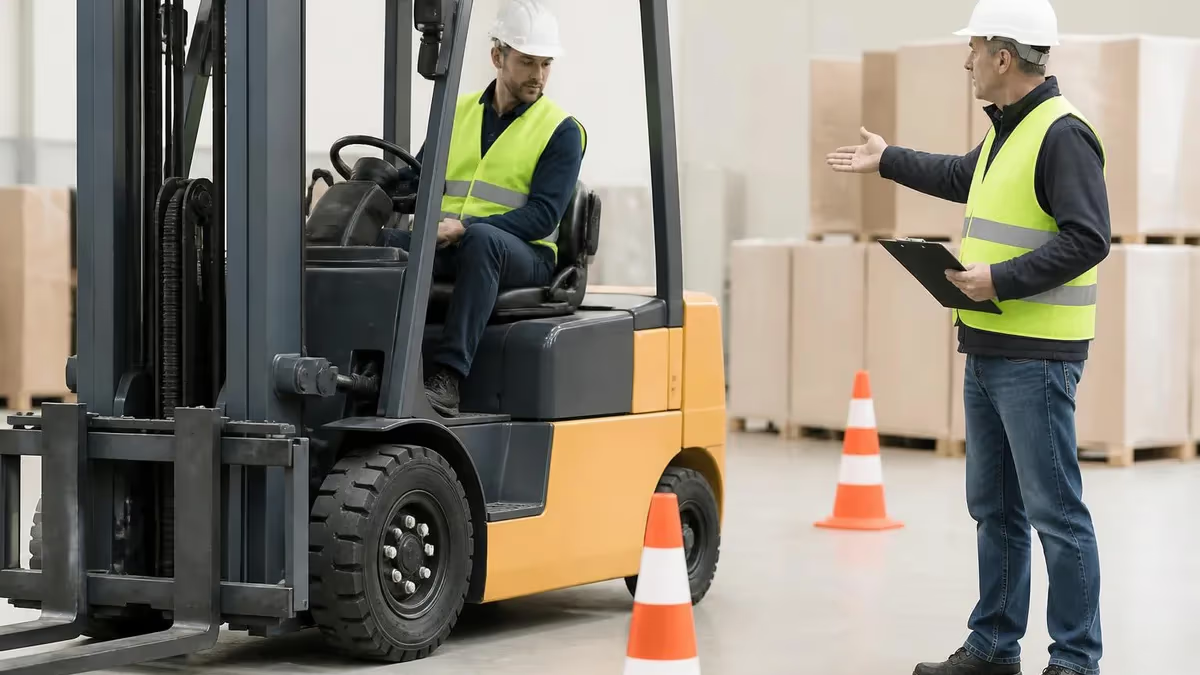
Whether you are considering a forklift rental for a short-term warehouse project or managing a fleet of forklifts for daily distribution work, understanding the critical role of the forklift tine is the first step toward safe and productive operations. The tines—also called forks—are the steel arms that slide under pallets, containers, and loads. Because they bear the full weight of every lift, even minor tine damage can lead to dropped loads, costly product loss, and serious workplace injuries that OSHA investigates aggressively. Practice with the free Forklift certification practice test on PracticeTestGeeks (7 questions with answer explanations).
Forklift parts and service encompass far more than tines alone. Hydraulic hoses, mast chains, carriage rollers, drive axles, braking systems, and electrical components all demand regular attention. Yet surveys of maintenance managers consistently show that tine wear ranks among the most overlooked failure points. A 2024 Industrial Truck Association report found that nearly thirty-eight percent of forklifts inspected at random facilities had at least one tine showing wear beyond the manufacturer's discard threshold, a sobering statistic given that weakened tines can snap under load without warning.
The economics of forklift service deserve equal attention. Organizations that invest in preventive maintenance programs typically spend twenty to thirty percent less on total equipment costs over a five-year period compared with companies that rely on reactive repairs. Preventive service extends the useful life of expensive components, reduces unplanned downtime, and keeps forklift operators safer on the floor. For smaller operations that rely on forklift rentals instead of owned equipment, understanding parts condition is still critical because rental agreements often include damage-liability clauses.
Certification of forklift operators is tightly linked to parts awareness. OSHA Standard 1910.178 requires that every forklift operator complete a pre-shift inspection covering tines, hydraulics, tires, lights, and safety devices before the machine enters service. An operator who cannot identify a cracked tine heel or an excessively worn fork tip is a liability rather than an asset. Forklift training programs therefore dedicate significant classroom and hands-on time to parts identification and defect recognition as core competency requirements.
This guide walks you through every aspect of forklift tine care and broader parts service. You will learn how to measure tine wear accurately, when replacement is mandatory, how different forklift types affect service needs, and how to evaluate whether purchasing a forklift for sale or securing a forklift rental near me listing is the smarter financial decision. We also cover electric forklift maintenance differences, stand up forklift service intervals, and the training a forklift operator needs to keep equipment in peak condition throughout its service life.
By the end, you will have a clear framework for building or improving a forklift maintenance program that satisfies OSHA requirements, protects your workforce, and controls costs. Whether you run a single dock-loading operation or manage dozens of units across multiple sites, the principles of tine inspection, parts sourcing, and scheduled service apply universally and pay dividends in safety and uptime every single shift.
Industry data from the Bureau of Labor Statistics shows that forklift-related workplace incidents still account for roughly eighty-five fatalities and nearly thirty-five thousand serious injuries each year in the United States. A meaningful share of these events trace back to equipment failure rather than operator error, underscoring why parts and service programs matter just as much as forklift training and certification of forklift credentials for every operator on your team.
Free Forklift certification Study Tools
Interactive Forklift certification resources on PracticeTestGeeks, free to start:
- Forklift certification flashcards — review key terms and concepts card by card
- Forklift certification study guide — topic-by-topic overview of what the exam covers
- Forklift certification cheat sheet — one-page printable summary for last-minute review
Forklift Parts and Service by the Numbers

Forklift Tine Inspection and Service Timeline
Daily Pre-Shift Visual Check
Weekly Wear Measurement
Monthly Straightness Test
Quarterly Load Test
Annual Professional Inspection
Replacement and Disposal
Forklift tine specifications vary significantly across equipment classes, and selecting the correct replacement fork requires matching multiple dimensions. The three critical measurements are blade length, blade width, and shank height. A Class II tine typically features a shank height of roughly sixteen inches and accommodates forklifts in the three-thousand to eight-thousand-pound capacity range. Class III tines increase the shank height to approximately twenty inches and serve heavier-duty machines rated up to twelve thousand pounds. Using an incorrect class results in improper mounting and dangerous load instability.
Beyond class sizing, tine profiles differ based on application. Standard taper tines feature a gradual thinning from heel to tip, which makes pallet entry easier in general warehousing. Full-taper tines offer an even sharper profile for operations that frequently handle closed-bottom containers or slip-sheet loads. Block forks, by contrast, maintain a uniform thickness and are designed for extreme heavy lifting in steel mills or lumber yards where the rated capacity must be maximized across the entire blade length.
Material composition also matters. Most forklifts use tines forged from high-strength alloy steel, often conforming to ASTM A572 Grade 50 or equivalent standards. Some specialty forks for the food and pharmaceutical industries are manufactured from stainless steel to prevent product contamination and withstand frequent washdown cycles. When sourcing a forklift for sale, verifying the tine material and heat-treatment process is just as important as checking the engine hours or battery condition of the unit itself.
Tine attachment methods add another layer of complexity. Hook-type mounting is the most common design, where a top hook and bottom heel lock the fork onto the carriage bar. Pin-type mounting uses a locking pin for added security in high-vibration environments such as rough-terrain forklifts used on construction sites. Shaft-mounted tines bolt directly through the carriage and are typically found on specialized clamp attachments. Each mounting style demands its own inspection protocol because wear patterns differ at the connection point.
Weight ratings on tines are stamped or engraved near the heel and include the rated capacity at a specified load center, usually twenty-four inches. Operating beyond the rated center shifts more stress to the heel and dramatically increases the risk of fork failure. Forklift operators must understand that a tine rated at five thousand pounds at a twenty-four-inch center may only safely carry thirty-five hundred pounds at a thirty-six-inch center. This load-center relationship is a foundational concept covered in every forklift training course.
Surface coatings extend tine life in corrosive environments. Powder-coated forks resist chipping and mild chemical exposure, while hot-dip galvanized tines are preferred in cold-storage facilities where moisture and salt exposure accelerate corrosion. Polished forks with low-friction coatings reduce pallet drag in automated storage and retrieval systems. When evaluating forklift rentals for specialized environments, confirming tine coating compatibility with your product line prevents premature wear and potential contamination issues.
Finally, aftermarket tine accessories—such as fork extensions, fork positioners, and side-shift carriages—modify how loads interact with the tine surface. Fork extensions, which slide over existing tines to increase reach, must never exceed one-and-a-half times the original fork length, or they create an unsafe lever arm. Magnetic fork covers protect the tine surface during delicate-load handling. Every accessory adds variables to the inspection equation, so your service program must expand its checklist whenever new attachments are introduced to the fleet.

Forklift certification Practice Test Questions
Prepare for the Forklift certification Certification exam with our free practice test modules. Each quiz covers key topics to help you pass on your first try.
Forklift certification Certification Forkl...
Forklift certification Exam Questions covering Certification Forklift certification Maintenance and Repairs. Master Forklift certification Test concepts for certification prep.
Forklift certification Certification Forkl...
Free Forklift certification Practice Test featuring Certification Forklift certification Maintenance and Repairs Questions and Answers. Improve your Forklift certification Exam score with mock test prep.
Forklift certification Certification Forkl...
Forklift certification Mock Exam on Certification Forklift certification Operator Training and Certification Requirements. Forklift certification Study Guide questions to pass on your first try.
Forklift certification Certification Forkl...
Forklift certification Test Prep for Certification Forklift certification Operator Training and Certification Requirements Questions and Answers. Practice Forklift certification Quiz questions and boost your score.
Forklift certification Load Handling and S...
Forklift certification Questions and Answers on Load Handling and Stability. Free Forklift certification practice for exam readiness.
Forklift certification OSHA Regulations an...
Forklift certification Mock Test covering OSHA Regulations and Compliance. Online Forklift certification Test practice with instant feedback.
Forklift certification Pre-Operation Inspe...
Free Forklift certification Quiz on Pre-Operation Inspections. Forklift certification Exam prep questions with detailed explanations.
Forklift certification Refueling and Recha...
Forklift certification Practice Questions for Refueling and Recharging Procedures. Build confidence for your Forklift certification certification exam.
Forklift certification Safe Driving and Ma...
Forklift certification Test Online for Safe Driving and Maneuvering. Free practice with instant results and feedback.
Forklift certification Workplace Hazard Id...
Forklift certification Study Material on Workplace Hazard Identification. Prepare effectively with real exam-style questions.
Forklift certification Forklift Instructions
Free Forklift certification Test covering Forklift Instructions. Practice and track your Forklift certification exam readiness.
Forklift certification Forklift MCQ
Forklift certification Exam Questions covering Forklift MCQ. Master Forklift certification Test concepts for certification prep.
Forklift certification Forklift Employer R...
Free Forklift certification Practice Test featuring Forklift Employer Responsibilities. Improve your Forklift certification Exam score with mock test prep.
Forklift certification Forklift Penalties ...
Forklift certification Mock Exam on Forklift Penalties for Non-Compliance. Forklift certification Study Guide questions to pass on your first try.
Comparing Electric Forklift, Stand Up Forklift, and IC Engine Service Needs
An electric forklift runs on a rechargeable battery pack—typically lead-acid or lithium-ion—instead of an internal-combustion engine. Service requirements differ dramatically because there are no fuel filters, spark plugs, radiators, or exhaust components to maintain. The primary service focus shifts to battery health, charger calibration, motor brushes, and controller diagnostics. Electric models also generate fewer vibrations, which can extend tine life by reducing metal fatigue over thousands of operating hours in controlled indoor environments.
Battery watering schedules, equalization charges, and terminal cleaning replace oil changes and coolant flushes in the preventive-maintenance calendar. Lithium-ion units require even less routine service but demand specialized diagnostic software for battery-management-system monitoring. Brake systems on electric forklifts often use regenerative braking, meaning pads last significantly longer. Facilities running electric fleets should still inspect tines with the same rigor because load stress remains identical regardless of power source, and worn tines pose the same safety hazards on electric units as on any other machine.
Forklift Rental vs. Purchasing: Which Is Right for Your Operation?
- +Lower upfront capital outlay preserves cash flow for other operational investments
- +Forklift rental agreements often include full maintenance and parts coverage at no extra cost
- +Easy fleet scaling—add or return units as seasonal demand shifts without long-term commitment
- +Access to newer models with updated safety features and improved fuel or battery efficiency
- +No depreciation risk—return the unit when technology advances or your needs change
- +Forklift rental near me searches connect you to local dealers who offer same-day delivery
- −Long-term rental costs can exceed purchase price if the lease extends beyond thirty-six months
- −Limited customization—rental units may not have the specific tine type or attachment your operation requires
- −Mileage and hour restrictions in some agreements can trigger costly overage fees
- −Rental availability fluctuates—peak seasons may leave you without units when demand spikes
- −You build no equity—monthly payments do not contribute to asset ownership
- −Damage-liability clauses may hold you responsible for tine wear or cosmetic issues beyond normal use
Pros and Cons at a Glance
| Pros | Cons |
|---|---|
| Lower upfront capital outlay preserves cash flow for other operational investments | Long-term rental costs can exceed purchase price if the lease extends beyond thirty-six months |
| Forklift rental agreements often include full maintenance and parts coverage at no extra cost | Limited customization—rental units may not have the specific tine type or attachment your operation requires |
| Easy fleet scaling—add or return units as seasonal demand shifts without long-term commitment | Mileage and hour restrictions in some agreements can trigger costly overage fees |
| Access to newer models with updated safety features and improved fuel or battery efficiency | Rental availability fluctuates—peak seasons may leave you without units when demand spikes |
| No depreciation risk—return the unit when technology advances or your needs change | You build no equity—monthly payments do not contribute to asset ownership |
| Forklift rental near me searches connect you to local dealers who offer same-day delivery | Damage-liability clauses may hold you responsible for tine wear or cosmetic issues beyond normal use |

Forklift Operator Daily Maintenance Checklist
- ✓Inspect both tines for visible cracks, chips, bending, or uneven tip wear before starting the shift.
- ✓Check hydraulic fluid level and look for leaks around hoses, cylinders, and fittings.
- ✓Test the parking brake and service brake for proper engagement and stopping distance.
- ✓Verify that the mast raises, lowers, and tilts smoothly without jerking or unusual noise.
- ✓Confirm all lights—headlights, tail lights, and warning strobes—are operational.
- ✓Sound the horn and check the backup alarm for audible function.
- ✓Examine tires or tracks for cuts, chunking, flat spots, and correct inflation pressure.
- ✓Ensure the operator seatbelt or restraint system latches securely and retracts properly.
- ✓Review the load capacity data plate to confirm it matches the loads you will handle today.
- ✓Check coolant level on IC forklifts or battery charge status on electric forklift models.
The 10% Rule: When Tines Must Be Replaced
OSHA and forklift manufacturers agree on a universal discard criterion: any tine that has lost ten percent or more of its original thickness at the heel must be removed from service immediately. A fork originally two inches thick at the heel becomes unsafe at 1.8 inches. This small reduction cuts the rated load capacity by roughly twenty percent—far more than most operators realize—and dramatically increases the probability of catastrophic fork failure under normal loads.
Forklift training is not merely a regulatory checkbox—it is the foundation of safe parts handling and equipment longevity. OSHA Standard 1910.178(l) mandates that every forklift operator receive formal instruction, practical training, and a performance evaluation before operating any powered industrial truck. The training must be specific to the type of equipment the operator will use, which means a driver certified on a sit-down counterbalance unit is not automatically qualified to operate a stand up forklift or a rough-terrain model without additional instruction covering each platform.
Certification of forklift operators follows a three-phase structure. The first phase involves classroom or online instruction covering principles of safe operation, load handling, stability triangle dynamics, and hazard recognition. The second phase requires hands-on practice under the direct supervision of a qualified trainer, where the operator demonstrates pre-shift inspection skills—including tine evaluation—load pickup and placement, maneuvering in aisles, and emergency procedures. The third phase is a formal evaluation where the trainer confirms the operator can perform all required tasks competently.
Refresher training triggers are often misunderstood. OSHA requires recertification at least every three years, but additional training must occur whenever an operator is involved in an accident or near-miss, observed operating unsafely, assigned to a different forklift type, or working in a facility where conditions have changed—such as new racking layouts or different floor surfaces. Understanding these triggers protects both the employer from citations and the operator from preventable incidents that a refresher course could have addressed.
Parts-focused training deserves dedicated curriculum time. Operators who understand how hydraulic systems work—how fluid pressure lifts the mast, how cylinders extend and retract, how relief valves prevent overpressure—make better inspection decisions. They can distinguish between a normal hydraulic hum and the whine of a failing pump. They know that spongy steering may indicate low fluid rather than a mechanical failure. This diagnostic awareness reduces unnecessary service calls and catches genuine problems before they escalate into expensive breakdowns or dangerous failures.
The cost of forklift training varies by provider and format. Employer-conducted programs using in-house trainers typically run two hundred to four hundred dollars per operator when you factor in materials, trainer time, and productivity loss during training hours. Third-party training companies charge three hundred to eight hundred dollars per student for group sessions and up to fifteen hundred dollars for individualized one-on-one certification. Online theory modules can reduce classroom time and cost, but OSHA still requires an in-person practical evaluation—no fully remote certification is valid under federal regulations.
Investing in advanced training beyond minimum OSHA requirements yields measurable returns. Facilities that provide annual parts-identification refreshers, load-center calculation workshops, and hands-on hydraulic-system overviews report fewer maintenance-related downtime events and lower workers' compensation claim rates. A well-trained forklift operator spots a worn tine heel, a leaking tilt cylinder, or a frayed mast chain days or weeks before it becomes a failure event, giving the maintenance team time to source parts and schedule repairs during planned downtime windows.
Documentation of all training activities is legally essential. OSHA inspectors will request records showing the date of training, topics covered, trainer qualifications, and the operator's evaluation results. Maintaining a digital training management system that links each forklift operator to their certification status, refresher schedule, and equipment authorizations simplifies compliance and protects the organization during audits. Incomplete records are treated the same as missing records, meaning the employer faces the same penalties as if no training had occurred at all.
Failing to conduct and document daily pre-shift forklift inspections is one of the most frequently cited OSHA violations in warehouse and manufacturing settings. Penalties for a serious violation can reach $16,131 per instance as of 2026, and willful or repeated violations can exceed $161,323. Ensure every forklift operator completes the inspection checklist and that completed forms are retained for at least twelve months.
Deciding between a forklift rental and an outright purchase depends on several financial and operational variables. A forklift for sale on the new market typically ranges from twenty thousand dollars for a basic three-thousand-pound electric unit to over one hundred fifty thousand dollars for a heavy-duty diesel model with specialized attachments. Used forklifts reduce that outlay by thirty to fifty percent but introduce uncertainty around remaining component life, including tine condition, battery capacity, and hydraulic-system integrity that must be evaluated before committing to the purchase.
Forklift rental near me searches have exploded in recent years as businesses adopt asset-light strategies. National rental companies like United Rentals, Sunbelt, and HERC offer daily, weekly, and monthly rates. A standard five-thousand-pound propane forklift rents for approximately eight hundred to twelve hundred dollars per month on a long-term agreement, while short-term daily rates can reach two hundred fifty to three hundred fifty dollars. Electric models command a slight premium due to higher acquisition costs but lower fuel expenses, and forklift rentals for specialized units—such as telehandlers or narrow-aisle reach trucks—carry higher rate cards.
Maintenance inclusion is a major differentiator in forklift rental contracts. Full-service leases bundle all scheduled maintenance, emergency repairs, and parts replacement—including tines—into the monthly rate. This arrangement transfers the risk of unexpected repair costs to the lessor and simplifies budgeting. Dry leases, by contrast, shift maintenance responsibility to the lessee and offer lower monthly payments but expose the operation to variable repair expenses. Carefully reading the service terms before signing any rental agreement prevents surprises when a tine replacement or hydraulic overhaul becomes necessary.
For operations that choose to purchase, building a relationship with reputable forklift dealers is critical. Authorized dealers stock OEM parts, employ factory-trained technicians, and offer service-level agreements that guarantee response times. Independent service shops may offer lower labor rates but could lack access to proprietary diagnostic software or genuine replacement parts. When the forklift requires a tine replacement, an authorized dealer ensures the replacement fork matches the original class, material specification, and heat-treatment standard required by the manufacturer.
Total cost of ownership analysis should extend beyond the purchase price or rental rate. Factor in insurance premiums, operator training and certification of forklift credentials, annual inspection fees, consumables like tires and filters, facility modifications such as charging stations for electric forklifts, and the opportunity cost of capital tied up in owned equipment. Many financial analysts find that forklift rentals become more cost-effective than ownership when the usage period falls below forty-eight months or when the operation requires frequent fleet-size adjustments.
Tax treatment also influences the buy-versus-rent decision. Purchased forklifts can be depreciated under Section 179 or MACRS schedules, providing tax deductions spread over five to seven years. Rental payments, conversely, are fully deductible as operating expenses in the year incurred. Consult with your accountant to model both scenarios using your organization's specific tax bracket and cash-flow projections before committing to either path, as the optimal choice varies significantly by business size and financial structure.
Regardless of whether you rent or buy, maintaining accurate service records for every unit is non-negotiable. Documenting tine measurements, hydraulic-fluid changes, brake adjustments, and annual inspection results creates a maintenance history that supports warranty claims, strengthens your OSHA compliance posture, and increases resale value if you eventually dispose of owned equipment. Digital fleet-management platforms now integrate with telematics systems to automate much of this record-keeping, reducing administrative burden while improving data accuracy across multi-location operations.
Sourcing forklift parts efficiently keeps your fleet productive and your service costs under control. Original equipment manufacturer parts—commonly called OEM parts—are produced by or for the forklift manufacturer and guarantee exact-fit compatibility. Aftermarket parts from third-party suppliers offer cost savings of twenty to forty percent but vary in quality. When replacing critical safety components like tines, mast chains, or brake cylinders, OEM parts are strongly recommended because they undergo the same testing and quality-control processes as the originals installed at the factory.
Online parts marketplaces have transformed procurement in recent years. Platforms such as Intella Parts, Forklift Parts Company, and ProLift Toyota Material Handling allow maintenance teams to search by forklift model, serial number, or part number and receive next-day shipping on thousands of SKUs. This accessibility reduces the downtime window between identifying a defective tine and installing a replacement. However, verifying that the supplier is an authorized distributor prevents counterfeit or substandard parts from entering your fleet, which is a growing concern in the global aftermarket supply chain.
Establishing par-level inventory for high-wear parts eliminates emergency procurement delays. Every facility should stock at least one spare set of tines in the correct class for each forklift model in the fleet. Hydraulic hoses, filter kits, fuse assortments, and tire assemblies are additional items that benefit from on-site inventory. The carrying cost of maintaining a modest parts stockroom is trivial compared with the cost of a forklift sitting idle on the dock floor while a critical part ships from a distant warehouse over several business days.
Service contracts with forklift dealers or independent maintenance providers formalize your parts and labor coverage. A typical planned-maintenance agreement includes quarterly or semi-annual service visits, priority scheduling for emergency calls, discounted parts pricing, and detailed service reports. Premium agreements add tine inspection and replacement, annual load testing, and safety-system certification to the scope. Comparing at least three service proposals before signing ensures competitive pricing and appropriate coverage for your fleet size and operating environment.
Tracking parts consumption data reveals patterns that inform smarter purchasing decisions. If your facility replaces forklift tines every eighteen months on a particular unit, that accelerated wear rate may indicate an application mismatch—perhaps the tine class is undersized for the loads being handled, or the operating surface is abrasive enough to accelerate tip erosion. Analyzing parts data alongside operator behavior reports and load logs often uncovers root causes that, once addressed, extend component life and reduce total parts spend significantly over time.
Emerging technologies are changing how forklift service is performed. Telematics systems transmit real-time operating data—impact events, hours of operation, battery state of charge, and error codes—directly to fleet managers and service providers. Some advanced systems use vibration sensors mounted near the carriage to detect early-stage tine fatigue before it becomes visible to the naked eye. Predictive-maintenance algorithms process this sensor data to recommend service actions at the optimal time, balancing the cost of early replacement against the risk of in-service failure.
Finally, safety should always take priority over cost savings when making parts decisions. A reconditioned tine that saves three hundred dollars but fails under load can result in a fatality, an OSHA investigation, litigation, and reputational damage that dwarfs any procurement savings. Build a parts-sourcing policy that explicitly prioritizes safety-critical components, requires documented quality certifications from suppliers, and empowers your maintenance team to reject any part that does not meet specifications—regardless of budget pressure from other departments or management directives.
Sample Forklift certification Practice Questions
Try these questions from our free Forklift certification practice tests. The correct answer and an explanation follow each question.
A forklift operator witnesses a co-worker being struck and injured by a forklift in the facility. What is the FIRST action?
- A. Complete the current task, then report the accident
- B. Immediately call for emergency medical help and secure the area
- C. Move the injured worker to a break room before calling for help
- D. Continue operations to prevent further workflow disruption
Answer: B. Immediately call for emergency medical help and secure the area
Life safety takes priority; the operator must immediately call for emergency medical assistance and secure the accident scene to prevent additional injuries.
An operator is maneuvering a forklift in a warehouse and notices a pedestrian walking near their path. According to safety regulations, what is the operator's primary responsibility?
- A. Sound the horn to warn the pedestrian to get out of the way.
- B. Continue driving but slow down significantly.
- C. Stop the forklift and wait for the pedestrian to clear the area.
- D. Yield the right of way to the pedestrian.
Answer: D. Yield the right of way to the pedestrian.
OSHA regulations state that forklift operators must yield the right of way to pedestrians. While sounding the horn and slowing down are important actions, the fundamental rule is that pedestrians have priority in any interaction to prevent accidents.
An operator must leave a forklift to speak with a supervisor who is 30 feet away, but the forklift remains in the operator's direct line of sight. According to OSHA 29 CFR 1910.178(m)(5), the forklift is considered 'unattended'. What specific actions must the operator take?
- A. Lower the forks, set the parking brake, and keep the engine running.
- B. Set the parking brake and turn on the hazard lights.
- C. Neutralize controls, lower the forks, set the brake, and shut off the power.
- D. Lower the forks to the ground and place the controls in neutral.
Answer: C. Neutralize controls, lower the forks, set the brake, and shut off the power.
OSHA defines a forklift as 'unattended' when the operator is 25 feet or more away, or out of sight. The regulations require that when a truck is left unattended, the load engaging means (forks) must be fully lowered, controls neutralized, power shut off, and brakes set.
An operator finds a forklift that has been involved in a collision. Before placing it back in service, what must occur?
- A. A visual inspection by the operator is sufficient
- B. The forklift must be inspected and cleared by a qualified maintenance technician
- C. It can be returned to service immediately if no visible damage is seen
- D. Only the forks need to be inspected after a collision
Answer: B. The forklift must be inspected and cleared by a qualified maintenance technician
After any collision, a qualified maintenance technician must inspect the forklift for hidden structural or mechanical damage before it is returned to service.
Forklift Questions and Answers
Forklift Tires: Complete Guide to Types, Sizing, Wear Patterns, and Replacement Costs
Forklift Operator Duties: Complete Guide to Daily Responsibilities, Safety Tasks, and Career Path for 2026
Forklift Dealers: Complete Guide to Buying, Renting, and Servicing Material Handling Equipment
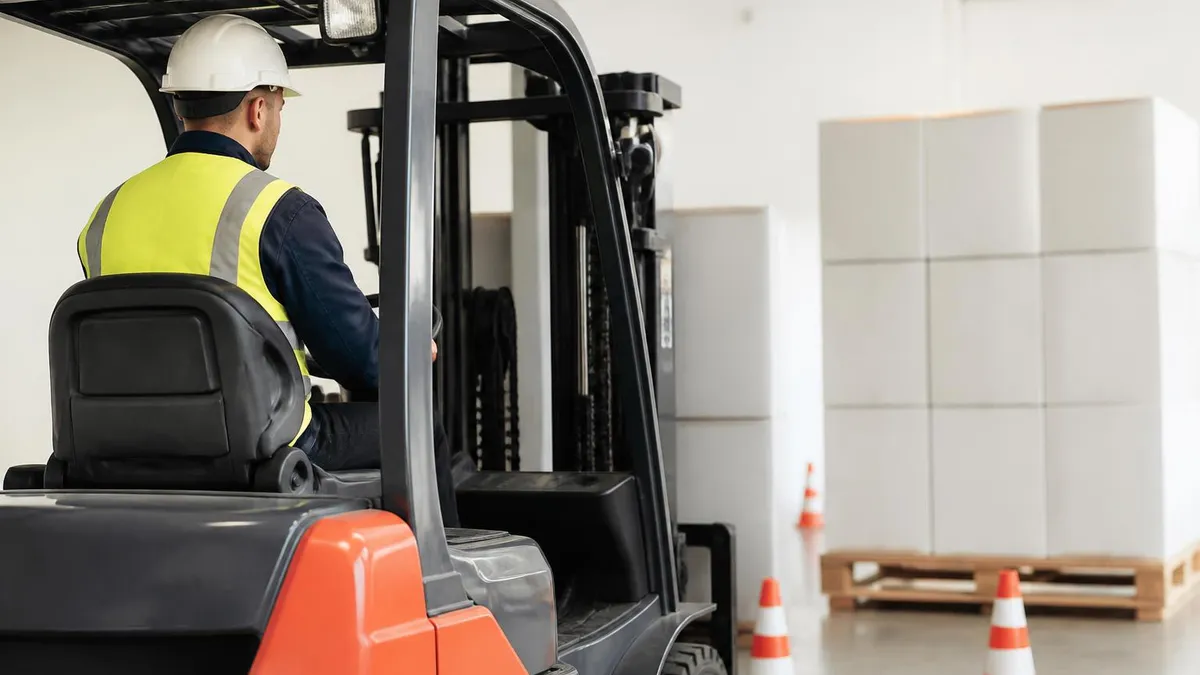
Forklift License Renewal: Complete Guide to Forklift License Expiry, OSHA Recertification, and Operator Requirements for 2026
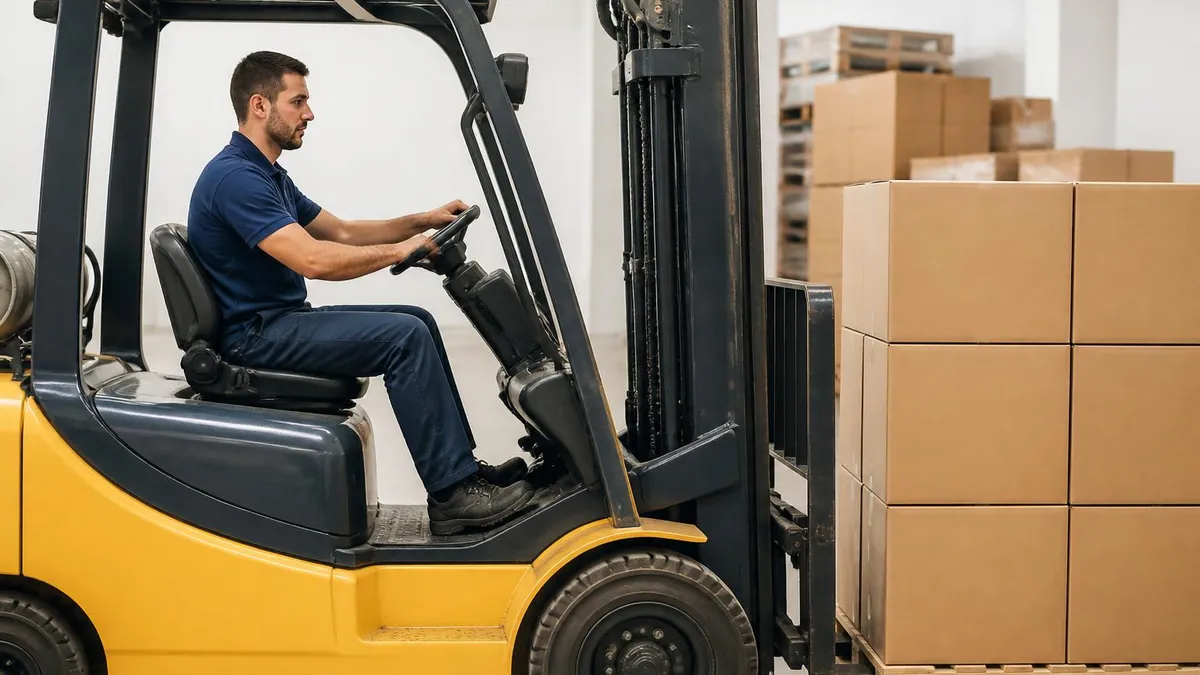
Free Forklift Training Near Me: Complete Guide to No-Cost Certification Programs, Employer-Paid Courses, and OSHA-Compliant Operator Training in 2026
About the Author

Certified Crane Operator & Skilled Trades Exam Specialist
Ferris State UniversityRobert Martinez is a Journeyman Ironworker, NCCCO-certified crane operator, and forklift trainer with a Bachelor of Science in Construction Technology from Ferris State University. He has 21 years of ironworking, rigging, and heavy equipment operation experience across high-rise and industrial construction sites. Robert prepares candidates for crane operator, rigger, forklift, and skilled trades certification examinations.