
Forklift Staffing Agency Guide: Jobs, Operators, Certification, and Rental for 2026 October
Find forklift staffing agency options, rental rates, operator jobs, and certification tips. Complete US guide for 2026 October. ✅

Whether you are searching for a forklift staffing agency to fill warehouse openings fast or looking for your next operator role, understanding how the forklift job market works can save you significant time and money. The US logistics sector employs more than 520,000 forklift operators, and demand continues to climb alongside the growth of e-commerce fulfillment centers, manufacturing plants, and cold-storage facilities. Staffing agencies that specialize in industrial and warehouse placements have become the dominant hiring channel for many employers, processing thousands of temporary and permanent forklift placements every month across the country.
On the equipment side, forklift rental remains one of the most cost-effective ways for companies to scale capacity without committing to a large capital purchase. Whether you need a counterbalance sit-down truck for a short construction project or a fleet of electric pallet jacks for a peak-season warehouse surge, rental programs from national dealers offer flexible daily, weekly, and monthly rates. The decision between renting, leasing, or buying a forklift depends on utilization hours, maintenance budget, and how long you actually need the machine.
The certification landscape is tightly regulated by OSHA under 29 CFR 1910.178, which requires that every forklift operator receive site-specific training and a formal evaluation before operating powered industrial trucks. Without the proper certification of forklift operation, employers face fines that can exceed $15,000 per violation — and operators risk their jobs. Staffing agencies often verify certification status before sending a worker to a client site, making your forklift credential a genuine competitive advantage in the job market.
Understanding the full ecosystem — from forklift training programs to equipment types like the stand up forklift and the electric forklift — helps both job seekers and hiring managers make smarter decisions. A certified operator who understands multiple truck classes commands higher hourly rates and gets placed more quickly by agencies. Employers who understand the staffing landscape can fill openings in days rather than weeks by working with the right partners and maintaining a pool of pre-screened, certified candidates.
This guide covers everything you need to know about working with a forklift staffing agency, navigating the job market as an operator, understanding rental and equipment options, and staying compliant with OSHA certification requirements. We break down salary expectations, equipment classes, staffing agency pros and cons, and the practical steps to land or fill a forklift position in 2026. For a deeper look at equipment availability and pricing, our guide to forklift jobs and staffing covers rental options in detail.
The forklift industry is also undergoing a significant technology shift. Battery-powered electric forklifts now account for more than 60 percent of new unit sales in the US, driven by zero-emission mandates in California and other states, lower total operating costs, and the suitability of lithium-ion models for food-grade and pharmaceutical environments. Operators who gain certification and hands-on experience with electric trucks position themselves at the front of a rapidly expanding segment of the market, and agencies actively seek drivers with this background.
Finally, the seasonal nature of warehousing and logistics creates predictable staffing surges around the fourth quarter holiday period, the spring construction season, and summer agriculture cycles. Knowing when demand peaks in your region — and having your certification and agency relationships in order before those windows open — is one of the most practical strategies for maximizing your earnings or minimizing your company's time-to-fill. The sections below give you the data, frameworks, and action steps to navigate every dimension of the forklift jobs and staffing landscape.
Forklift Jobs and Staffing by the Numbers

Forklift Equipment Types: What Operators and Employers Need to Know
The most common warehouse truck, available in propane, diesel, and electric. Lift capacities range from 3,000 to 15,000 lbs. Widely available for forklift rental and the foundation of most operator training programs across the US.
The stand up forklift is ideal for narrow-aisle warehouses with racking heights above 20 feet. Operators stand in a rear-facing compartment for better sightlines. Requires additional certification training beyond standard counterbalance qualification.
Battery-powered electric forklift models dominate indoor applications, food-grade facilities, and states with strict emissions rules. Lower fuel and maintenance costs offset higher upfront purchase prices, making them attractive for leasing and long-term rental agreements.
Used on construction sites, lumber yards, and agricultural operations. These machines require specialized operator certification and are typically available through equipment-focused forklift rental companies rather than general staffing agencies.
Lower-lift powered pallet trucks are classified as forklifts under OSHA rules and require operator training. They are the entry point for many new operators entering the field through staffing agency temporary placements.
OSHA's Powered Industrial Trucks standard (29 CFR 1910.178) is the foundational rule governing forklift operator certification across every US industry. The regulation requires that operators receive formal instruction covering truck-specific controls, hazards in the operating environment, and the physical operation of the machine under the supervision of a qualified trainer. Training must be completed before an operator works unsupervised, and a formal evaluation must be documented and retained on file by the employer. There is no federal license card or wallet credential — certification is an employer-issued authorization tied to a specific truck type and work site.
The certification of forklift process typically unfolds in three phases: classroom instruction covering OSHA rules and equipment theory, hands-on pre-operation inspection training, and a supervised practical evaluation where the trainer observes the operator driving, picking, stacking, and safely parking the truck. Most structured forklift training programs complete all three phases in one to two days, though some community college and vocational programs spread instruction across a week. Third-party certification schools issue completion cards that many employers and staffing agencies accept as proof of training, though technically the host employer must still conduct a site-specific evaluation.
OSHA requires that operators be re-evaluated at least every three years, or sooner if an operator is observed operating unsafely, is involved in a near-miss or accident, receives a new truck type assignment, or returns to work after a long absence. Many staffing agencies run their own internal refresher programs to keep their operator pools current, since an expired evaluation creates liability exposure for both the agency and the client employer. If you are a job seeker, carrying documentation of your most recent evaluation date is a best practice that speeds up agency onboarding.
Truck classes matter significantly for certification purposes. OSHA and the Industrial Truck Association (ITA) recognize seven truck classes, ranging from Class I electric counterbalanced trucks through Class VII rough terrain vehicles. An operator certified on a Class IV internal combustion sit-down truck is not automatically authorized to operate a Class II electric narrow-aisle truck — separate training and evaluation is required. The more truck classes an operator is certified on, the broader their job eligibility and the higher hourly rates they can command from both direct employers and staffing agencies.
The cost of forklift certification training varies widely. Employer-sponsored training is free to the employee and is the most common pathway. Third-party certification schools charge between $150 and $500 for a full-day course that includes a completion card. Online OSHA-compliant theory modules are available for as little as $30 to $75 and satisfy the classroom component, though they must be paired with a hands-on practical evaluation. Some community colleges in states like Texas, Ohio, and California offer forklift training as part of broader warehouse logistics certificate programs at minimal cost to enrolled students.
From an employer perspective, the cost of not investing in proper forklift training dwarfs the cost of the training itself. OSHA issued more than 2,400 forklift-related citations in fiscal year 2024, with average penalties exceeding $4,000 per citation. Warehouse fires, tip-overs, and pedestrian-forklift collisions generate workers' compensation claims, OSHA investigations, and civil litigation that can cost hundreds of thousands of dollars. A well-documented certification program, including pre-shift inspection checklists and refresher training logs, is one of the most defensible safety investments a warehouse operation can make.
Staffing agencies that specialize in industrial placements typically verify training records during the intake process and may require candidates to complete a practical skills demonstration at the agency's training yard before being placed. Some of the largest national agencies — including those operating in the forklift jobs and staffing niche — maintain their own training facilities and offer free certification refreshers to workers in their pool. This approach benefits both the agency, which can guarantee client sites a higher-quality worker, and the operator, who keeps their credentials current at no personal cost.
Working With a Forklift Staffing Agency: Types, Process, and Pay
Temporary forklift placements are the most common service offered by industrial staffing agencies. Employers contact the agency when they need to cover a peak season, fill in for an absent worker, or staff a short-term project without adding headcount. The agency screens candidates, verifies forklift certification records, checks references, and sends a pre-qualified worker to the site — often within 24 to 48 hours of the initial request. Pay rates for temporary operators typically range from $17 to $24 per hour depending on truck class, region, and shift premium.
From the operator's perspective, temporary placements offer flexibility and the opportunity to gain experience across multiple industries and facility types. Working through a staffing agency also means you can evaluate a potential permanent employer before committing. Many temporary assignments convert to direct-hire offers after 90 days, especially when the client employer is impressed with the worker's reliability, certification breadth, and safety record. Agencies typically charge employers a conversion fee, but for the operator the transition is usually seamless and comes with a pay bump.

Forklift Staffing Agency: Pros and Cons for Operators and Employers
- +Fast placement — agencies can fill open forklift operator roles within 24-48 hours
- +Pre-screened candidates arrive with verified certification and safety records on file
- +Flexible staffing levels allow warehouses to scale up or down for seasonal demand
- +Operators gain exposure to multiple industries, equipment types, and facility environments
- +Temp-to-hire pathways reduce hiring risk for employers and provide stability for workers
- +Many agencies offer free certification refresher training to keep operator pools current
- −Agency markup adds 40-60% above the operator's hourly wage to the total employer cost
- −Temporary workers may have lower facility familiarity and require more supervisor oversight
- −High turnover in temp pools can disrupt team cohesion and productivity on the floor
- −Operators may receive fewer benefits than direct-hire employees doing the same work
- −Site-specific OSHA evaluation still required even for pre-certified agency workers
- −Best candidates often convert to direct hire quickly, leaving agencies to repeatedly backfill
Pros and Cons at a Glance
| Pros | Cons |
|---|---|
| Pre-screened candidates arrive with verified certification and safety records on file | Temporary workers may have lower facility familiarity and require more supervisor oversight |
| Flexible staffing levels allow warehouses to scale up or down for seasonal demand | High turnover in temp pools can disrupt team cohesion and productivity on the floor |
| Operators gain exposure to multiple industries, equipment types, and facility environments | Operators may receive fewer benefits than direct-hire employees doing the same work |
| Temp-to-hire pathways reduce hiring risk for employers and provide stability for workers | Site-specific OSHA evaluation still required even for pre-certified agency workers |
| Many agencies offer free certification refresher training to keep operator pools current | Best candidates often convert to direct hire quickly, leaving agencies to repeatedly backfill |
Forklift Operator Job Search Checklist
- ✓Obtain or renew your OSHA-compliant forklift certification on at least two truck classes before applying.
- ✓Gather documentation of your most recent practical evaluation and keep a copy in digital form.
- ✓Register with at least two industrial staffing agencies that specialize in warehouse and logistics placements.
- ✓Complete a forklift pre-operation inspection course so you can demonstrate competency on day one.
- ✓Update your resume to list each forklift class (Class I, II, IV, etc.) and the equipment brands you have operated.
- ✓Research pay rates in your metro area using BLS Occupational Employment Data and staffing agency job boards.
- ✓Schedule a skills demonstration at the agency's training facility to move to the top of their active candidate pool.
- ✓Obtain your OSHA-10 General Industry card to differentiate yourself from candidates who only hold truck certification.
- ✓Ask each agency specifically about their temp-to-hire client list and typical conversion timelines.
- ✓Set up job alerts on Indeed, ZipRecruiter, and LinkedIn using the keywords 'forklift operator' and your zip code.
Multi-Class Certification Can Increase Your Hourly Rate by $3-$5
Operators certified on three or more OSHA truck classes — particularly those who add stand up forklift reach truck and electric order picker endorsements — consistently command $3 to $5 per hour more than single-class operators in the same market. Staffing agencies prioritize multi-class operators for premium client sites and are more likely to offer them first access to temp-to-hire conversions. The incremental training cost is typically under $200 and pays back within two weeks of placement.
Forklift operator salaries in the United States vary considerably based on geographic market, industry sector, truck class experience, shift differential, and whether the worker is employed directly or through a staffing agency. According to the Bureau of Labor Statistics Occupational Employment and Wage Statistics program, the national median annual wage for industrial truck and tractor operators — the BLS category that includes forklift drivers — was approximately $45,000 in 2025.
However, experienced operators in high-cost-of-living metros like Seattle, San Jose, New York, and Boston routinely earn $55,000 to $75,000 per year, particularly in cold storage, pharmaceutical, and automotive parts distribution environments.
The highest-paying forklift roles are concentrated in industries with specialized equipment requirements or strict safety standards. Aerospace and defense warehouses, where operators handle components worth hundreds of thousands of dollars, frequently pay $28 to $35 per hour. Port and intermodal terminal operators who are certified on container handlers and reach stackers can earn over $80,000 annually with overtime. The automotive supply chain — operating on just-in-time delivery schedules with extremely low tolerance for errors — also pays premium rates for reliable, multi-certified operators who can work at the pace the assembly line demands.
Geographic variation is substantial. An operator earning $18 per hour in rural Mississippi may earn $27 per hour doing identical work in suburban Chicago, reflecting both cost-of-living differences and the concentration of large distribution networks in the Midwest and Mid-Atlantic corridor. The growth of mega-distribution centers operated by major e-commerce companies in markets like Phoenix, Las Vegas, Columbus, and Kansas City has created strong demand and upward wage pressure in those markets. Operators willing to relocate to high-demand markets can significantly accelerate their earnings trajectory.
Shift differentials represent a meaningful income supplement for operators willing to work evenings, nights, or weekends. Most warehouse operations run two or three shifts, and second- and third-shift premiums typically range from $1.00 to $2.50 per hour above the base rate. For a full-time operator, a $1.50 shift differential represents an additional $3,120 in annual gross income — roughly equivalent to the pay raise associated with one additional year of seniority at many employers. Staffing agencies often have more open evening and overnight placements than day shifts, making flexibility a practical strategy for maximizing placement speed.
Career progression for forklift operators typically moves from entry-level operator to lead operator or material handler, then to warehouse supervisor, operations team lead, and ultimately operations manager or logistics coordinator roles. Each step requires demonstrated reliability, multi-class certification, and increasingly, familiarity with warehouse management systems (WMS) like SAP Extended Warehouse Management, Manhattan Associates, and Oracle WMS. Operators who invest in learning basic WMS navigation — even through free YouTube tutorials and employer-provided training — position themselves for the supervisory roles that pay $65,000 to $90,000 and are almost always filled from internal promotions or direct-hire recruiting rather than temp placements.
Benefits packages vary significantly between direct-hire positions and agency placements. Direct-hire operators at large distribution centers typically receive health insurance, paid time off, 401(k) matching, and safety bonuses. Workers placed through a staffing agency are generally employed by the agency itself and may receive a more limited benefits package, though the largest national agencies — Staffmark, ProLogistix, and similar firms — do offer health insurance options to workers who log enough weekly hours. The total compensation gap between direct-hire and agency-placed operators narrows considerably when factoring in the agency's premium pay rates during peak seasons.
For workers considering the forklift for sale market as a path to self-employment or owner-operator contracting, the math requires careful analysis. A used cushion-tire sit-down forklift in serviceable condition costs between $8,000 and $22,000. Adding maintenance, liability insurance, inspection certifications, and transport costs can push total annual operating expenses to $15,000 or more for a single machine. Independent forklift contractors primarily serve construction trades and small manufacturers — a niche market that requires strong sales skills in addition to operator expertise. Most operators are better served by maximizing their earnings as employees before exploring the owner-operator route.

A completion card from a third-party forklift training school proves that an operator received classroom instruction, but it does not satisfy OSHA's full requirement. The standard requires that a qualified person evaluate the operator actually driving the specific type of truck at the specific work site where they will be operating. Employers who skip this site-specific evaluation step are in violation of 29 CFR 1910.178(l) and face citations even if every worker holds a training school card. Document every evaluation with the operator's name, truck type, evaluation date, and evaluator's signature.
The decision to rent, lease, or buy a forklift is one of the most consequential equipment choices a warehouse manager or small business owner will make, and the right answer depends heavily on utilization rate, maintenance capacity, cash flow, and how long the equipment is actually needed.
Forklift rental — short-term agreements ranging from a single day to several months — is the most flexible option and is ideal for seasonal capacity needs, equipment breakdowns while a primary machine is serviced, special projects, and businesses that are evaluating whether to add a truck permanently. Daily rental rates for a standard 5,000-pound LP counterbalance forklift range from $175 to $350 nationally, while monthly rates average $1,400 to $2,200 depending on region and dealer.
When searching for forklift rental near me, the major national equipment rental companies — United Rentals, Sunbelt Rentals, and BlueLine Rental — offer broad geographic coverage with standardized rate structures and delivery service. Regional and independent dealers often offer more competitive pricing and greater flexibility on rental terms, particularly for customers with an ongoing relationship.
Most dealers require a security deposit of one to two months' rental value for new customers and charge additional fees for delivery, fuel, and damage beyond normal wear. Comparing at least three quotes before committing to a rental is a straightforward way to ensure competitive pricing.
Forklift rentals make the most financial sense when annual utilization is below 1,500 hours per year. Above that threshold, a lease or purchase typically offers lower per-hour cost over a three-to-five-year period. Operating leases, which are structured similarly to car leases, allow businesses to use a new or late-model forklift with a fixed monthly payment, maintenance included, and the option to upgrade at the end of the term. This structure appeals to operations that want predictable costs and always-current equipment without the burden of managing maintenance in-house.
Outright purchase — either new or used — makes the most sense for high-utilization operations with in-house maintenance capability and stable, long-term equipment needs. New forklifts from major manufacturers like Toyota, Crown, Hyster, and Yale carry list prices ranging from $20,000 for a basic electric pallet truck to over $100,000 for a large internal combustion counterbalance truck or specialty machine.
Used forklift for sale listings through dealers, auction houses like IronPlanet and Ritchie Bros., and private sellers offer significant price reductions — typically 40 to 60 percent below new — but require careful pre-purchase inspection, particularly for battery condition on electric models and mast integrity on all types.
The rise of the electric forklift is reshaping the rental and purchase market simultaneously. Lithium-ion battery-powered models, while carrying a 20 to 40 percent price premium over comparable lead-acid electric trucks, offer opportunity-charging capability, longer run times, and elimination of the battery room infrastructure required for traditional lead-acid fleets.
Many rental fleets are actively transitioning to lithium-ion models as battery costs decline, and operators who are familiar with lithium-ion charging protocols are increasingly preferred by rental companies seeking to protect their equipment investments. California's Air Resources Board regulations are accelerating the transition in that state, with mandates for zero-emission warehouse equipment in larger facilities taking effect in phases through 2026 and 2027.
Maintenance costs are a critical factor in the rent-versus-buy calculation that is often underestimated by first-time buyers. A new internal combustion forklift in a typical warehouse environment will require approximately $2,000 to $4,000 in annual maintenance during the first three years, rising to $5,000 to $8,000 per year as the machine ages past the 8,000-hour mark.
Rental agreements and full-service leases bundle maintenance into the monthly rate, shifting this unpredictability to the dealer. For businesses without a dedicated maintenance technician, the convenience premium embedded in rental rates is often money well spent relative to the cost of managing repairs and sourcing parts independently.
Fleet management software has made it easier for mid-sized operations to track utilization, maintenance intervals, and per-machine cost-per-hour in real time, helping managers make data-driven decisions about when to retire aging equipment and whether rental supplements make sense during high-demand periods.
Many of the leading forklift dealers now offer telematics packages as standard equipment on new units, providing impact alerts, hourly utilization reports, and predictive maintenance notifications that reduce downtime and extend machine life. Integrating this data with staffing agency deployment schedules allows sophisticated operations managers to align equipment availability with certified operator availability — a coordination discipline that directly improves throughput and safety outcomes.
Preparing for a forklift certification evaluation requires more than sitting through a classroom presentation — it demands genuine hands-on familiarity with the machine you will be assessed on and a solid understanding of the OSHA rules that govern safe operation.
The single most effective preparation strategy is to spend as much supervised practice time as possible on the specific truck class you are being evaluated on, paying particular attention to load handling, travel with improved loads (which is never permitted beyond a few inches off the ground), cornering speed, and pedestrian awareness in shared-use areas. Evaluators are looking for smooth, deliberate operation — not speed.
The pre-operation inspection is a critical component of every forklift certification evaluation and is frequently where inexperienced operators lose points or fail entirely. OSHA requires operators to inspect the truck before each shift using a documented checklist that covers fluid levels, tire condition, forks and carriage, mast chains, warning devices, lights, and controls. Memorizing the inspection sequence and being able to execute it fluently in front of an evaluator — without referring to notes — demonstrates the kind of competence that gets operators certified quickly and creates a strong first impression with supervisors and agency clients alike.
Understanding load capacity and the stability triangle is essential knowledge for both the evaluation and real-world operation. Every forklift has a data plate specifying the rated capacity at a specific load center — typically 24 inches for standard counterbalance trucks. Adding an attachment (like a side-shifter or paper roll clamp) reduces the effective capacity below the data plate rating.
Operators who can explain the stability triangle concept — the three-point system formed by the two front drive wheels and the rear steer axle — and demonstrate how improved forks, heavy loads, and cornering all affect stability are demonstrating evaluator-level knowledge that also makes them genuinely safer operators.
Emergency procedures are heavily tested in both written assessments and practical evaluations. Candidates should know exactly what to do in a tip-over situation (stay in the seat, grip the steering wheel, brace feet, lean away from impact), how to safely park and neutralize a truck during an emergency evacuation, and the correct procedure for refueling or recharging in designated areas only. The OSHA standard and most agency training programs dedicate a full module to these scenarios — practice articulating your responses out loud, since being able to explain what you would do is as important as knowing it internally.
Beyond the technical evaluation itself, job seekers preparing to work with a forklift staffing agency should invest time in building a professional job search package. This includes a one-page resume that lists every truck class certification, the brand names of equipment operated (Toyota, Crown, Raymond, Hyster, Yale, Caterpillar), industries worked in, hours operated annually, and any safety awards or zero-incident recognition.
A brief cover letter — even just three sentences — that addresses the specific facility type the agency is recruiting for (cold storage, automotive, food-grade) can significantly improve the probability of being selected for a premium placement over candidates with similar experience who submit generic applications.
Networking within the forklift and warehouse community is underutilized by most operators but highly effective. Local chapters of the Warehousing Education and Research Council (WERC), community college workforce development programs, and LinkedIn groups focused on logistics and supply chain regularly post job opportunities and host events where operators can connect directly with hiring managers. Operators who develop a reputation for reliability, multi-class certification, and strong safety records tend to receive word-of-mouth referrals that bypass the formal agency process entirely — the highest-quality hiring channel of all.
Finally, staying current with evolving equipment technology is increasingly important for long-term career success in the forklift field. Autonomous mobile robots (AMRs) and semi-automated forklifts are being deployed in large fulfillment centers, and human operators are increasingly being asked to collaborate with these systems, monitor their performance, and intervene when the automation encounters exceptions. Operators who understand basic AMR interaction protocols, battery management for lithium-ion fleets, and telematics data review will be the last to be displaced by automation and the first to be promoted into supervisory and fleet coordination roles as the technology matures over the next decade.
Sample Forklift certification Practice Questions
Try these questions from our free Forklift certification practice tests. The correct answer and an explanation follow each question.
Who is responsible under OSHA for ensuring forklift operators are properly trained?
- A. The employee alone
- B. The employer
- C. The forklift manufacturer
- D. The insurance company
Answer: B. The employer
OSHA places responsibility on the employer to ensure operators are trained and certified.
Which agency issued the powered industrial truck standard operators must comply with?
- A. EPA
- B. OSHA
- C. DOT
- D. NIOSH
Answer: B. OSHA
OSHA (Occupational Safety and Health Administration) issued the powered industrial truck standard.
The overhead guard on a forklift should be inspected to confirm it is:
- A. Painted a bright color
- B. Free of cracks, bends, and secure
- C. Removable for tight spaces
- D. Equipped with a light
Answer: B. Free of cracks, bends, and secure
The overhead guard protects the operator from falling objects and must be structurally sound.
Which of the following is a mandatory requirement under OSHA 29 CFR 1910.178(g) for areas designated for changing and charging forklift batteries?
- A. The area must be kept at a constant temperature below 70°F.
- B. A certified electrician must be present during all charging activities.
- C. Smoking must be prohibited and 'No Smoking' signs posted.
- D. Floors must be carpeted to absorb potential spills.
Answer: C. Smoking must be prohibited and 'No Smoking' signs posted.
OSHA 29 CFR 1910.178(g) lists several safety requirements for battery charging areas. Due to the emission of flammable hydrogen gas during charging, smoking is strictly prohibited, and precautions must be taken to prevent open flames, sparks, or electric arcs in the area.
Forklift Questions and Answers
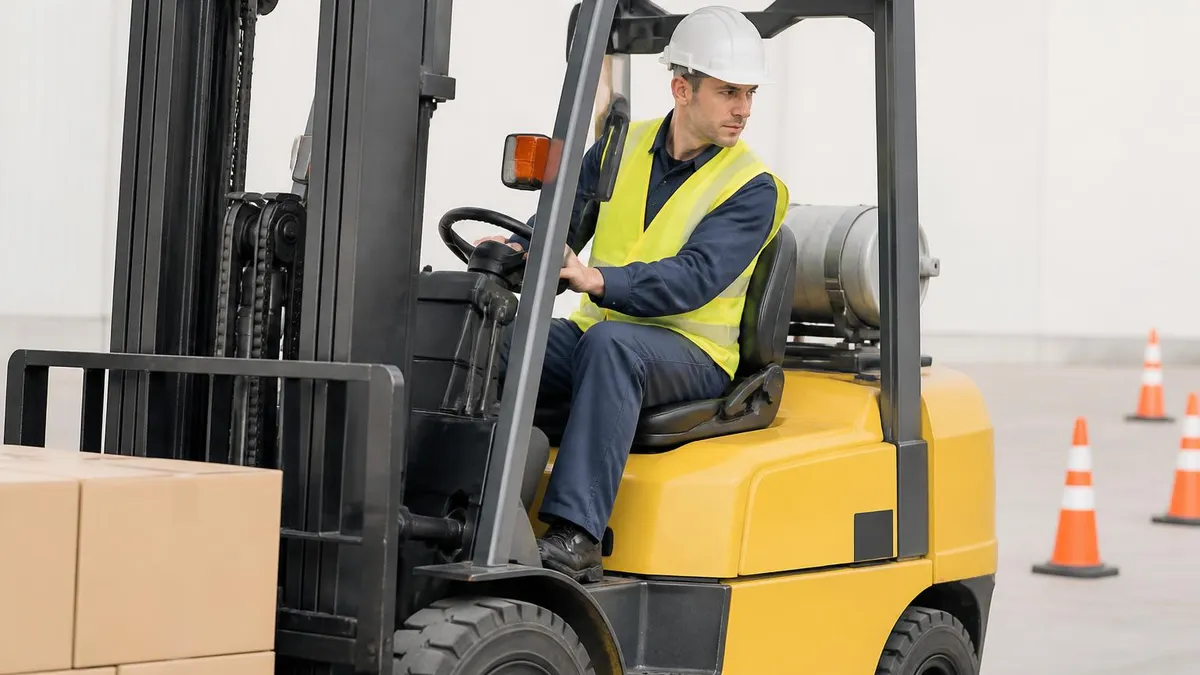
Forklift Rentals: Complete Guide to Pricing, Types, and Operator Requirements
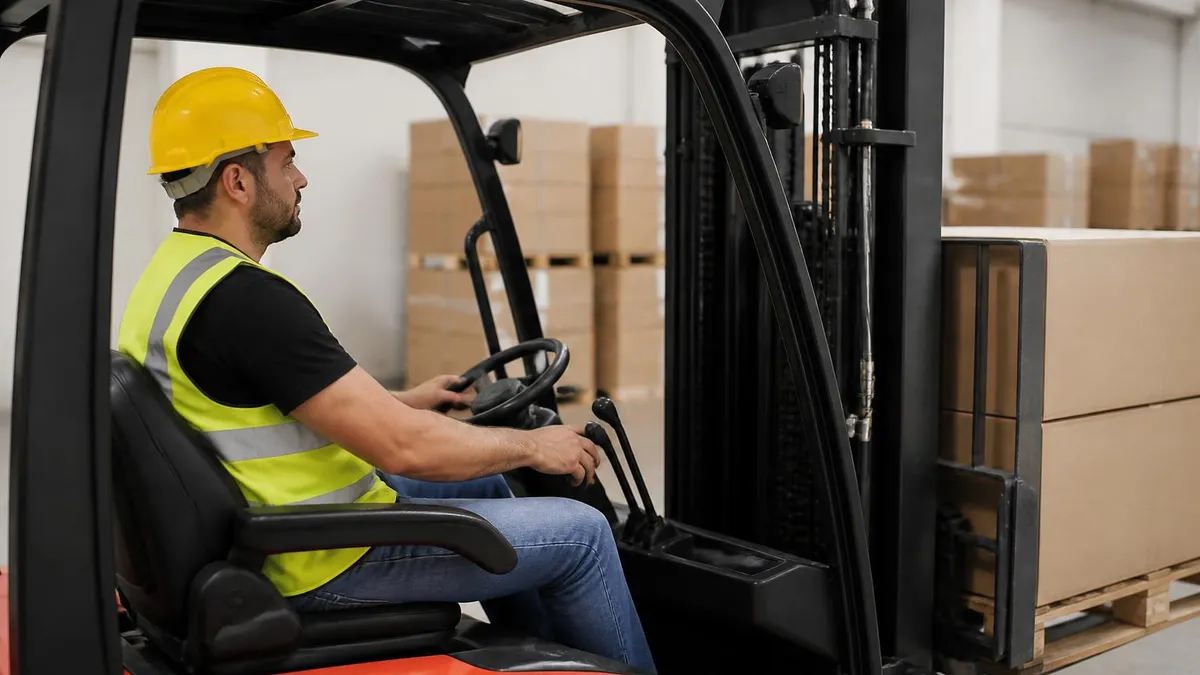
Forklift Hydraulic Fluid: Complete Guide to Types, Specifications, Change Intervals, and Troubleshooting for 2026
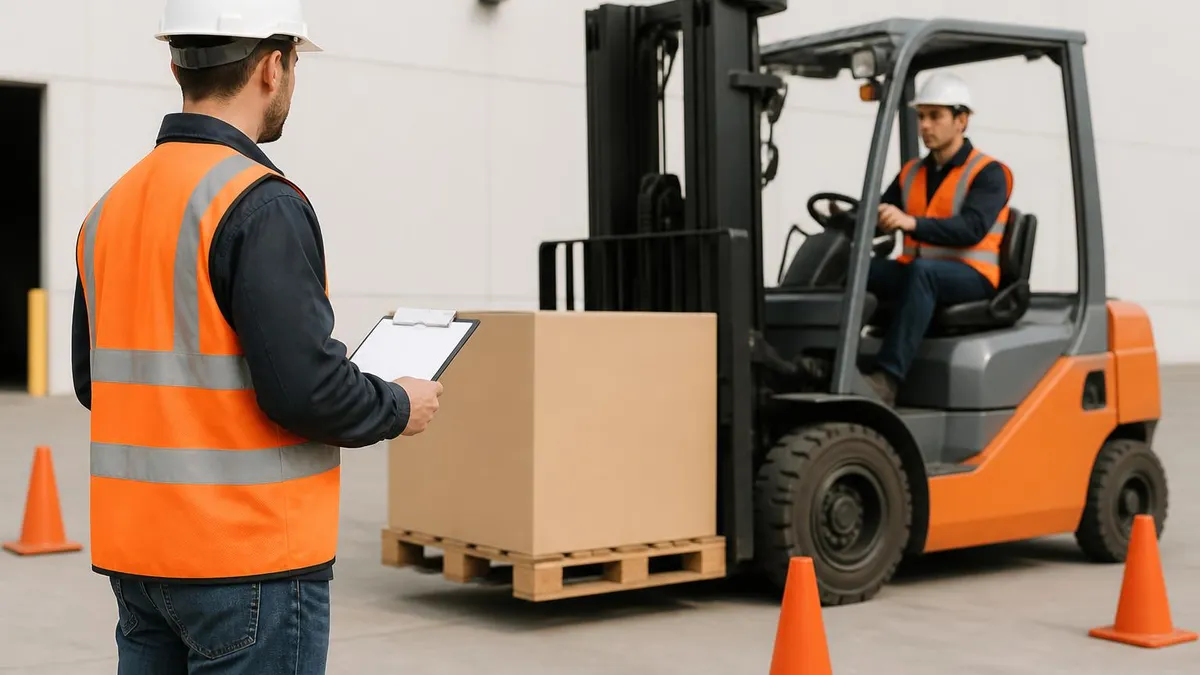
Forklift Parts and Maintenance: Complete Guide to Batteries, Chargers, and Replacement Components
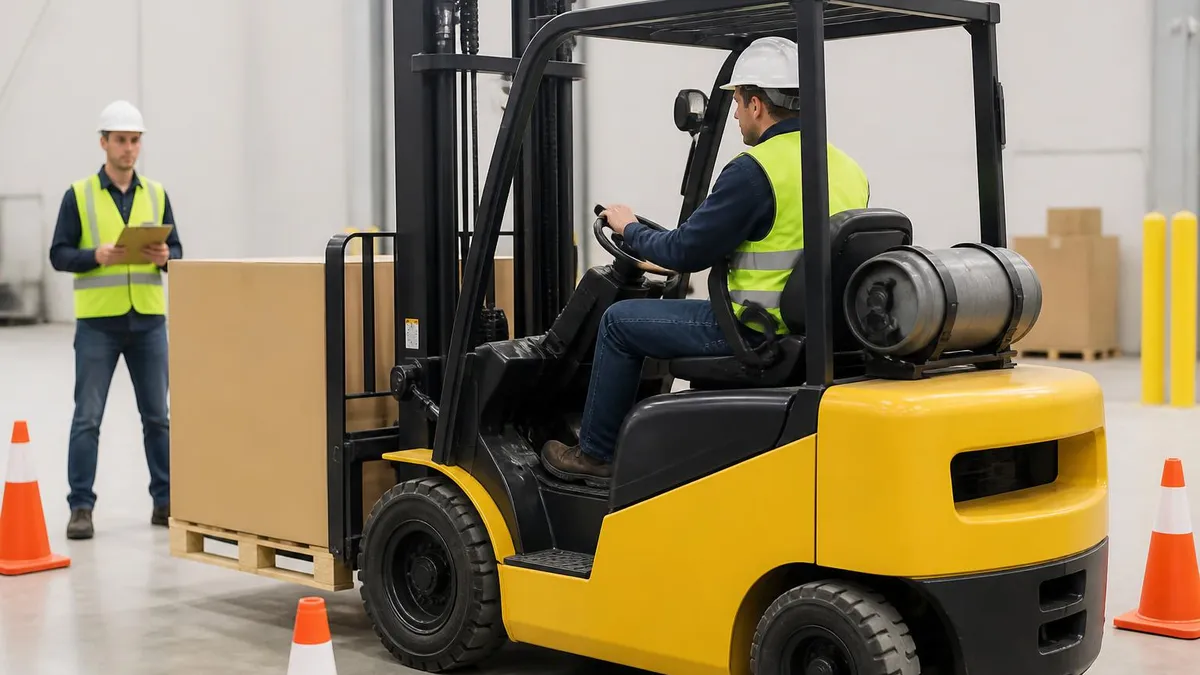
Big Forklift Guide: Heavy-Duty Lift Trucks, Capacity Classes, Rental Costs, and Operator Requirements
Forklift License Renewal: Complete Guide to Forklift License Expiry, OSHA Recertification, and Operator Requirements for 2026
About the Author

Certified Crane Operator & Skilled Trades Exam Specialist
Ferris State UniversityRobert Martinez is a Journeyman Ironworker, NCCCO-certified crane operator, and forklift trainer with a Bachelor of Science in Construction Technology from Ferris State University. He has 21 years of ironworking, rigging, and heavy equipment operation experience across high-rise and industrial construction sites. Robert prepares candidates for crane operator, rigger, forklift, and skilled trades certification examinations.