
Different Types of Forklifts: Complete Guide to Kinds of Forklift Equipment
Explore the different kinds of forklift equipment, from electric to stand up models. 🎯 Compare classes, rental options, and certification requirements.
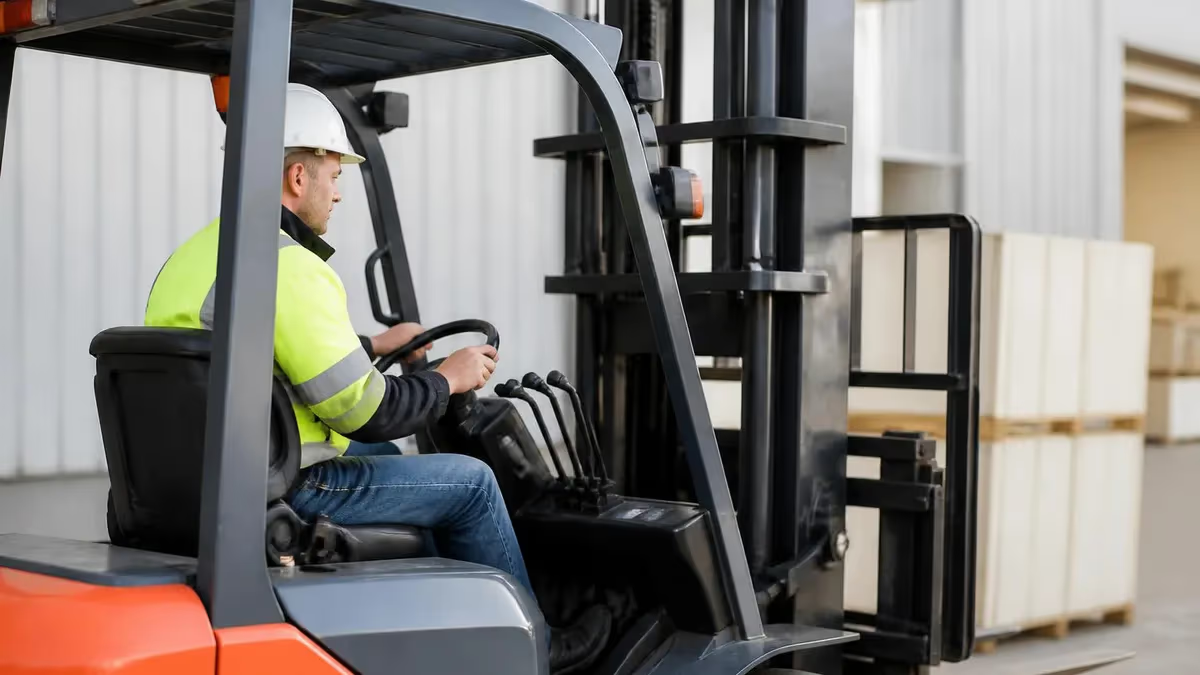
Understanding the different kinds of forklift equipment is essential whether you are pursuing a career as a forklift operator, comparing forklift rental options for a warehouse project, or simply trying to identify the right machine for a specific load. The Industrial Truck Association recognizes seven distinct OSHA classifications, and within those categories you will find dozens of variations designed for indoor warehouses, outdoor lumber yards, narrow aisle distribution centers, and rough terrain construction sites across the United States.
Each forklift type carries unique handling characteristics, weight capacities, and certification requirements. A counterbalanced sit-down lift used in a beverage distribution center handles very differently from a reach truck navigating 12-foot narrow aisles, and operating a rough terrain telehandler on a construction site demands entirely different skills than running an electric pallet jack on a polished concrete floor.
This guide walks through every major forklift classification recognized by OSHA, explaining the practical applications, fuel sources, lift capacities, and operating environments where each machine excels. We will cover Class I electric riders, Class II narrow aisle trucks, Class III electric pallet movers, Class IV and V internal combustion units, Class VI tractors, and Class VII rough terrain machines that dominate outdoor job sites.
For employers and supervisors, knowing the differences helps you specify the right equipment when contacting a forklift rental near me search or evaluating forklifts available through dealers and used equipment markets. Choosing the wrong machine costs money, creates safety hazards, and can stall projects when loads exceed capacity or terrain proves unsuitable for the wheel configuration.
For operators, OSHA 1910.178 requires separate certification on every truck type you operate. A forklift training credential earned on a Class IV sit-down propane lift does not authorize you to run a Class II reach truck or a Class VII telehandler. Employers must evaluate each operator on the specific equipment they will use, document that evaluation, and re-evaluate at least every three years.
By the end of this article you will be able to identify any forklift on sight, match its classification to typical job applications, estimate rental and purchase costs, understand the certification of forklift operators required for each class, and recognize the safety considerations unique to every category. Whether you are budgeting for new equipment or studying for your first operator card, this resource covers what matters.
Industry data from 2024 shows roughly 855,000 forklifts in active US service, with electric models now representing more than 64 percent of new purchases. That shift toward electric power, automation, and lithium-ion battery technology is reshaping which forklift types dominate modern warehouses, and it directly affects the skills new operators need to develop.
Forklift Industry by the Numbers

OSHA Forklift Classes Explained
Sit-down and stand-up counterbalanced electric trucks used in warehouses, food distribution, and clean indoor environments. Capacities range from 3,000 to 12,000 pounds with cushion or pneumatic tires.
Reach trucks, order pickers, and turret trucks designed for aisles under 10 feet. These specialized electric forklifts maximize cube storage in high-bay warehouses and distribution centers.
Walkie pallet jacks, rider pallet movers, and tow tractors. The most common stand up forklift category, used for ground-level pallet transport and dock-to-stock operations.
Class IV uses cushion tires for indoor smooth floors; Class V uses pneumatic tires for outdoor and mixed-surface use. Powered by propane, diesel, or gasoline with capacities to 36,000 pounds.
Heavy-duty pneumatic-tire lifts and telehandlers used on construction sites, lumber yards, and agricultural operations. Capable of operating on uneven, unpaved, and muddy surfaces.
The fundamental choice when selecting any forklift is power source: electric or internal combustion. This decision shapes everything from operating cost to ventilation requirements, charging infrastructure, and where the machine can legally run. An electric forklift produces zero exhaust emissions, runs quieter, and costs less per operating hour, while internal combustion units deliver longer runtime, faster refueling, and superior performance on outdoor terrain and steep grades.
Electric forklifts dominate modern warehouses for good reason. Operating costs typically run 30 to 50 percent lower than propane equivalents once you factor in fuel, maintenance, and downtime. Lithium-ion battery technology has eliminated the old objection that batteries took eight hours to charge and required dedicated charging rooms, since modern lithium packs accept opportunity charging during operator breaks and last three to four times longer than traditional lead-acid units.
Internal combustion forklifts remain dominant in lumber yards, ports, scrap yards, and any outdoor application where pavement is rough or surfaces are dirty. Propane units called LPG forklifts handle indoor and outdoor work, making them popular for facilities with mixed environments. Diesel models deliver the heaviest lift capacities and longest duty cycles, while gasoline units are increasingly rare except in older fleets and specialty applications.
Tire selection matters as much as fuel choice. Cushion tires are solid rubber units designed for smooth concrete and asphalt, providing tight turning radius and excellent maneuverability inside warehouses. Pneumatic tires are air-filled or solid rubber units with deep tread, built for outdoor surfaces, gravel lots, and construction sites where small debris would damage cushion tires.
Before you complete the certification of forklift training that OSHA requires, you must understand which power source and tire combination matches each application. Operating an electric cushion-tire unit on a gravel lot will destroy the tires in hours, while running a diesel pneumatic-tire unit inside a sealed warehouse creates carbon monoxide exposure that can poison workers within minutes.
Hybrid considerations matter for facilities operating mixed fleets. A typical mid-sized distribution center might deploy Class III walkies for receiving, Class II reach trucks for putaway, Class I sit-downs for staging, and a single Class V pneumatic unit for outdoor yard work. Each operator needs separate type-specific training documented in their personnel file, which complicates scheduling and certification renewals.
Capacity ratings also vary significantly. Most warehouse forklifts carry 3,000 to 6,000 pounds, but heavy-duty units handle 15,000 to 80,000 pounds for shipping containers, steel coils, and engine blocks. Always check the data plate before lifting, because capacity decreases as load center distance increases and as attachments like side shifters or fork positioners add weight to the carriage.
The total cost of ownership over a five-year period typically favors electric for indoor warehouse applications running one or two shifts daily, while propane or diesel wins for outdoor work, three-shift operations, or facilities lacking charging infrastructure. Run the numbers carefully before committing to any fleet conversion.
Forklift certification Practice Test Questions
Prepare for the Forklift certification Certification exam with our free practice test modules. Each quiz covers key topics to help you pass on your first try.
Forklift certification Certification Forkl...
Forklift certification Exam Questions covering Certification Forklift certification Maintenance and Repairs. Master Forklift certification Test concepts for certification prep.
Forklift certification Certification Forkl...
Free Forklift certification Practice Test featuring Certification Forklift certification Maintenance and Repairs Questions and Answers. Improve your Forklift certification Exam score with mock test prep.
Forklift certification Certification Forkl...
Forklift certification Mock Exam on Certification Forklift certification Operator Training and Certification Requirements. Forklift certification Study Guide questions to pass on your first try.
Forklift certification Certification Forkl...
Forklift certification Test Prep for Certification Forklift certification Operator Training and Certification Requirements Questions and Answers. Practice Forklift certification Quiz questions and boost your score.
Forklift certification Load Handling and S...
Forklift certification Questions and Answers on Load Handling and Stability. Free Forklift certification practice for exam readiness.
Forklift certification OSHA Regulations an...
Forklift certification Mock Test covering OSHA Regulations and Compliance. Online Forklift certification Test practice with instant feedback.
Forklift certification Pre-Operation Inspe...
Free Forklift certification Quiz on Pre-Operation Inspections. Forklift certification Exam prep questions with detailed explanations.
Forklift certification Refueling and Recha...
Forklift certification Practice Questions for Refueling and Recharging Procedures. Build confidence for your Forklift certification certification exam.
Forklift certification Safe Driving and Ma...
Forklift certification Test Online for Safe Driving and Maneuvering. Free practice with instant results and feedback.
Forklift certification Workplace Hazard Id...
Forklift certification Study Material on Workplace Hazard Identification. Prepare effectively with real exam-style questions.
Forklift certification Forklift Instructions
Free Forklift certification Test covering Forklift Instructions. Practice and track your Forklift certification exam readiness.
Forklift certification Forklift MCQ
Forklift certification Exam Questions covering Forklift MCQ. Master Forklift certification Test concepts for certification prep.
Forklift certification Forklift Employer R...
Free Forklift certification Practice Test featuring Forklift Employer Responsibilities. Improve your Forklift certification Exam score with mock test prep.
Forklift certification Forklift Penalties ...
Forklift certification Mock Exam on Forklift Penalties for Non-Compliance. Forklift certification Study Guide questions to pass on your first try.
Indoor vs Outdoor Forklift Applications
Indoor warehouse operations overwhelmingly favor electric forklifts and stand up forklift designs that emit no exhaust, operate quietly, and navigate tight aisles with precision. Class I sit-down riders handle dock-to-stack work for loads up to 6,000 pounds, while Class II reach trucks extend their forks to retrieve pallets from racks up to 30 feet high in modern high-bay facilities.
Cushion tires are standard indoors because they offer a tighter turning radius and lower entry height. Class III walkies and electric pallet jacks handle ground-level moves and ride-on units called centerstanders excel in case-pick operations. Lithium-ion batteries dominate new purchases because they support opportunity charging without ventilated battery rooms or specialized handling equipment.

Electric Forklift vs Internal Combustion: Pros and Cons
- +Zero emissions allow electric units to operate in food, pharma, and indoor facilities without ventilation
- +Operating costs run 30 to 50 percent lower per hour than propane or diesel equivalents
- +Quieter operation reduces hearing damage risk and improves communication on the floor
- +Lithium-ion batteries support opportunity charging during breaks without dedicated charge rooms
- +Lower maintenance requirements due to fewer moving parts and no oil changes
- +Better for operator health with no exhaust exposure during enclosed work
- −Higher upfront purchase price typically $5,000 to $15,000 more than comparable IC units
- −Limited runtime per charge requires planning for charging cycles or battery swaps
- −Reduced performance on grades over 10 percent and outdoor uneven terrain
- −Lead-acid battery rooms require ventilation, eye-wash stations, and acid spill kits
- −Charging infrastructure investment can exceed $50,000 for a multi-unit fleet
- −Cold storage applications reduce battery capacity by 20 to 30 percent below 32 degrees
Forklift Selection Checklist for Your Application
- ✓Identify the maximum load weight and load center distance you need to handle
- ✓Measure aisle widths and overhead clearance heights throughout your facility
- ✓Determine if operation will be indoor, outdoor, or mixed environment
- ✓Calculate average daily run hours and number of shifts to size battery capacity
- ✓Check floor surface conditions for cushion versus pneumatic tire selection
- ✓Verify available power for charging infrastructure if going electric
- ✓Confirm ventilation capacity if specifying propane or diesel internal combustion
- ✓List any required attachments such as side shifters, fork positioners, or clamps
- ✓Review operator certification requirements for each truck class on your shortlist
- ✓Compare total cost of ownership over five years not just initial purchase price
Match the Truck to the Task — Not the Other Way Around
The single most expensive forklift mistake companies make is buying or renting a versatile general-purpose unit when a specialized machine would do the job faster, safer, and at lower total cost. A Class II reach truck loads twice as many pallets per hour in narrow aisles as a Class I sit-down forced to maneuver in the same space. Always specify the machine that fits your specific application, even if it means operating a small mixed fleet.
Forklift rental costs vary significantly by class, capacity, and rental duration. A typical Class IV 5,000-pound propane cushion-tire forklift rents for $185 to $225 per day, $650 to $850 per week, or $1,800 to $2,400 per month from national rental chains. Searching forklift rental near me will typically surface companies like United Rentals, Sunbelt, Crown, and Toyota Material Handling dealers who all maintain local rental fleets.
Electric forklift rentals run roughly 10 to 15 percent higher than propane equivalents due to battery costs and charger inclusion, but the daily operating savings often offset the rental premium over jobs lasting more than three weeks. Always confirm whether rental rates include the battery and charger, since some operators advertise low headline prices and add battery rental separately at $25 to $40 per day.
For purchase decisions, a new Class IV 5,000-pound propane forklift typically costs $25,000 to $35,000, while a new Class I electric equivalent runs $30,000 to $42,000 plus another $8,000 to $15,000 for the battery and charger. Class VII telehandlers represent the highest-cost segment, with new 10,000-pound 55-foot reach machines retailing $135,000 to $185,000 from manufacturers like JLG, Genie, and Skytrak.
The used forklift market offers substantial savings for buyers willing to inspect carefully. A well-maintained five-year-old Class IV unit typically sells for 40 to 55 percent of new pricing, while three-year-old electric units hold value better at 60 to 70 percent. When evaluating any forklift for sale, demand documented service history, hour meter readings, and a hydraulic system inspection before committing.
Rental versus purchase economics typically favor purchase when utilization exceeds 1,200 hours annually, while rental wins for seasonal work, project-based construction, or backup capacity. Many operators also use rental as a trial period to validate that a specific truck class fits their workflow before committing capital, and most national rental companies will credit a portion of rental fees toward eventual purchase.
Long-term lease structures occupy a middle ground that appeals to many fleet operators. A 60-month lease on a new Class I electric forklift typically runs $475 to $650 per month including full maintenance, which keeps the truck under warranty and shifts repair risk to the leasing company. At lease end you return the equipment, purchase it at residual value, or roll into a new unit.
Operator certification costs also vary by truck class and training format. A single-truck OSHA certification typically costs $50 to $150 for in-person training and $30 to $80 for online programs supplemented by employer-provided hands-on evaluation. Multi-class certification covering several truck types together usually runs $150 to $300 and is most economical when an operator will work across mixed equipment.
Insurance and registration requirements add ongoing costs that vary by state and equipment class. Most warehouse forklifts operate under general liability policies covering the facility, while Class VII rough terrain machines used on public roads or construction sites typically require separate equipment coverage at $400 to $1,200 annually depending on value and use.

OSHA 1910.178(l) requires separate operator certification for each truck type and each significantly different work environment. A certification earned on a Class IV propane sit-down lift does NOT authorize operation of a Class II reach truck, a Class III walkie, or a Class VII telehandler. Employers who fail to document type-specific training and evaluation face citations averaging $14,500 per violation and create unlimited liability if an accident occurs.
Certification requirements differ by forklift class, but the underlying OSHA standard at 1910.178(l) applies uniformly. Every operator must complete formal classroom or online instruction, hands-on practical training on the specific truck type they will operate, and a documented performance evaluation by a qualified evaluator. The complete record must include operator name, training date, evaluator name, and the specific truck type and attachments covered.
Recertification is required every three years minimum, after any accident or near-miss, when an operator is observed operating unsafely, when assigned to a different type of truck, or when workplace conditions change significantly. Many employers conduct annual refresher training as a best practice even though OSHA only mandates three-year cycles, because skill degradation and complacency drive most preventable forklift incidents.
Class I and Class IV sit-down certifications represent the most common training programs and typically run four to six hours of classroom plus two to four hours of practical evaluation. Online classroom modules now satisfy the theory portion in most states, but the hands-on evaluation must occur in person with a qualified evaluator observing the operator perform a defined set of maneuvers.
Class II narrow aisle certifications require additional training on rack interaction, load placement at height, and the unique handling of reach mechanisms that extend forks 8 to 12 feet beyond the truck base. Order picker training adds fall protection requirements because the operator rises with the platform to pick cases from elevated rack positions. The forklift rental near me companies typically include type-specific orientation, but operators still need formal certification from their employer.
Class III walkie certifications are sometimes treated casually, but OSHA enforces the same training and documentation requirements as for ride-on equipment. Pedestrian-walkie incidents cause approximately 36 percent of forklift fatalities according to BLS data, often involving operators pinned between the truck and fixed objects. Training must cover the unique foot placement, control hand grip, and pedestrian zone awareness that walkie operation demands.
Class V and VII outdoor and rough terrain certifications often require additional endorsements depending on the jurisdiction and application. ANSI/ITSDF B56.6 covers rough terrain forklifts and most reputable construction contractors require operators to complete combined OSHA plus ANSI training plus specific manufacturer familiarization on the telehandler model in use. Multi-employer construction sites add general contractor requirements layered on top of OSHA minimums.
Cross-training operators on multiple truck classes provides flexibility but adds documentation complexity. Best practice is to maintain a current evaluation matrix listing every operator and every truck type they are authorized to run, with the date of last evaluation and next recertification due. Cloud-based fleet management systems now integrate this documentation with truck access controls that prevent unauthorized operators from starting equipment.
Practical tips for selecting the right forklift type start with honest workflow analysis. Walk your facility during peak hours and document where bottlenecks occur, which aisles are most congested, what load heights drive your storage decisions, and how often operators move between indoor and outdoor work. Most undersized or oversized forklift fleets reflect decisions made without this baseline observation, leading to chronic inefficiency that costs thousands annually.
When evaluating used equipment, request the hour meter reading and verify it against the engine or controller logs because resellers occasionally swap meters. A typical commercial forklift accumulates 1,500 to 2,500 hours per year in single-shift operation, so a five-year-old unit should show 7,500 to 12,500 hours. Significantly lower numbers suggest light use or possible meter manipulation; much higher numbers indicate accelerated wear that affects remaining useful life.
Test drive every forklift before committing to purchase or long-term lease. Run the truck through a representative cycle including load engagement at typical weights, travel through your tightest aisle, elevation to your highest rack position, and return travel under load. Note any hydraulic shudder, mast deflection, drive train hesitation, or unusual sounds that indicate developing problems and worth negotiating into the price.
For rental decisions, build relationships with at least two local rental companies rather than depending on a single supplier. Equipment availability fluctuates with construction seasons, port disruptions, and economic cycles, and operators with established accounts at multiple suppliers consistently secure equipment when their preferred provider runs short. Negotiate volume discounts based on annual rental spending rather than individual transactions.
Operator training investment delivers measurable returns beyond regulatory compliance. Companies that exceed OSHA minimums with quarterly refresher training, annual recertification, and structured new-operator mentoring typically experience 40 to 60 percent fewer forklift incidents and 25 to 35 percent lower equipment damage costs. The math favors aggressive training even before considering the human cost of preventable injuries.
Maintenance program design varies by fleet size and equipment mix. Single-unit operations typically use dealer service contracts at $1,800 to $3,200 annually for routine preventive maintenance plus parts and labor for breakdowns. Multi-unit fleets often justify in-house technicians around the 8-unit threshold, while large facilities with 25 or more units typically operate dedicated maintenance shops with parts inventory and specialized tooling.
Battery management for electric fleets deserves special attention because batteries represent 30 to 40 percent of lifecycle cost. Lead-acid batteries require equalization charging, watering, and rotation through battery rooms in three-shift operations. Lithium-ion eliminates watering and equalization but demands proper opportunity charging discipline to maximize cycle life. Train operators on battery care just as carefully as truck operation.
Forklift Questions and Answers
Forklift Jobs Near Me: Complete Guide to Finding Best Opportunities
Forklift Operation & Equipment Knowledge Practice Test Video Answer
Forklift Inspection & Maintenance Practice Test Video Answer
30-Day Forklift certification Certification Study Plan — Pass on Your First Try
Forklift Certification 2026
About the Author

Certified Crane Operator & Skilled Trades Exam Specialist
Ferris State UniversityRobert Martinez is a Journeyman Ironworker, NCCCO-certified crane operator, and forklift trainer with a Bachelor of Science in Construction Technology from Ferris State University. He has 21 years of ironworking, rigging, and heavy equipment operation experience across high-rise and industrial construction sites. Robert prepares candidates for crane operator, rigger, forklift, and skilled trades certification examinations.