
ECMO Medical Abbreviation: What ECMO Stands For Complete Guide 2026 October
✅ ECMO medical abbreviation explained: Extracorporeal Membrane Oxygenation, what each word means, why the term matters in clinical charts.
What the ECMO Medical Abbreviation Actually Stands For
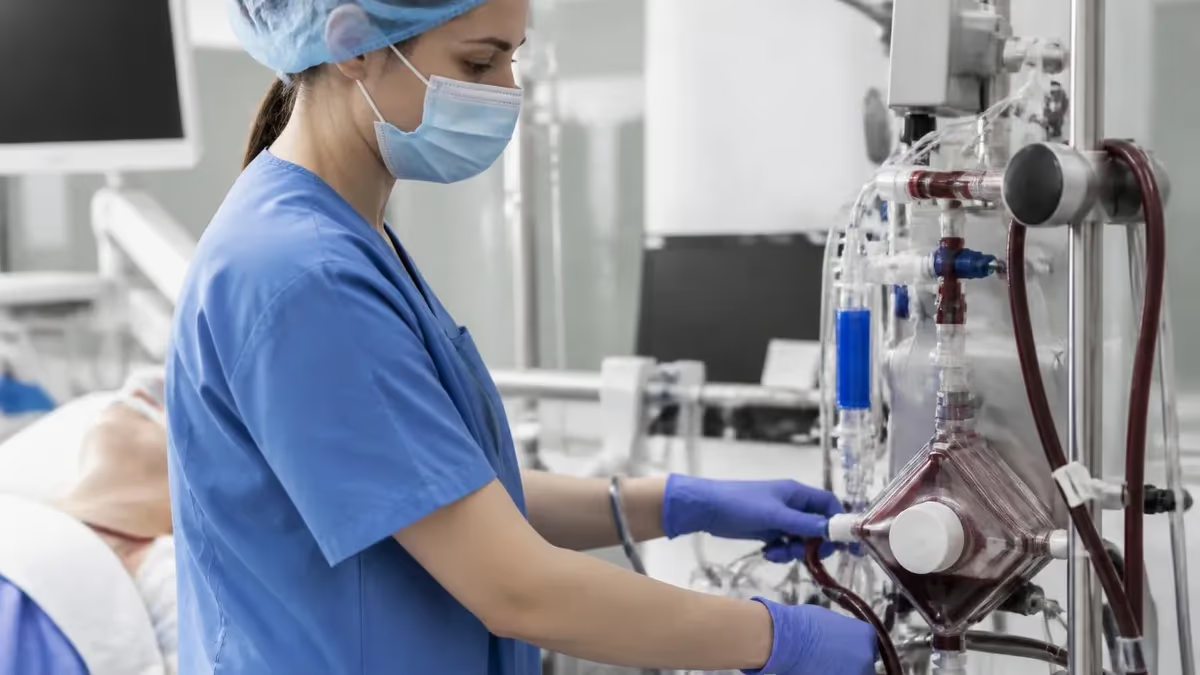
ECMO stands for Extracorporeal Membrane Oxygenation. Three words. Each one carries a specific piece of the machine, and once you understand all three, the whole concept of the therapy clicks into place. The abbreviation appears on hospital whiteboards, in EMR templates, on pump labels, and across ICU rounds — usually written in capital letters, sometimes spoken as a word ("ek-mo"), and almost never spelled out in full at the bedside.
The reason matters. Clinicians use short forms because the full phrase is mouthful — saying "Extracorporeal Membrane Oxygenation" eight times during a code is wasted breath. But for patients, families, and students seeing it for the first time, the abbreviation hides what is actually happening. The machine is doing the work of the lungs (and sometimes the heart) outside the body. That is what each word in the name announces.
This guide unpacks every piece of the term. We explain the meaning of extracorporeal, membrane, and oxygenation. We trace where the abbreviation came from — Robert Bartlett's first successful adult run in the 1970s, the H1N1 pandemic that brought ECMO into mainstream ICU practice, and the COVID-19 era that made the term familiar to nearly every healthcare worker on the planet.
We cover common synonyms (ECLS, ECC), related abbreviations you will see next to ECMO in charts (CPB, IABP, LVAD, ECP), and what to say to a family member who has just heard the word for the first time from a white-coated stranger.
If you want the broader physiology, our ECMO overview covers how the machine actually works. This article is about the word itself — what it means, why it is written that way, and how to translate it for whoever needs to hear it explained.
ECMO Abbreviation at a Glance
Breaking Down Each Word in Extracorporeal Membrane Oxygenation
The full phrase looks intimidating, but every piece carries one job. Unpacking them one at a time turns an unfamiliar abbreviation into a description of exactly what the machine does.
Extracorporeal comes from Latin: extra- meaning outside, and corpus meaning body. Extracorporeal therapies move blood outside the body, do something to it, and return it. Hemodialysis is extracorporeal. Cardiopulmonary bypass during heart surgery is extracorporeal. ECMO is extracorporeal. The word announces that the patient's blood is leaving the vascular system through a cannula, traveling through tubing, and returning to the body after the circuit has done its job.
Membrane refers to the oxygenator — the device inside the ECMO circuit that performs gas exchange. Modern oxygenators use hollow polymethylpentene fibers arranged so that blood flows on one side of a microporous membrane while sweep gas (oxygen, sometimes mixed with air or CO2) flows on the other. Oxygen diffuses into the blood. Carbon dioxide diffuses out. The membrane is the working surface where the patient's lungs would normally do this work — only it is doing it outside the chest, on a piece of medical hardware about the size of a paperback novel.
Oxygenation tells you the primary therapeutic goal. The circuit adds oxygen to deoxygenated blood. In practice it also removes CO2 — and CO2 removal is often clinically more urgent — but the term "oxygenation" stuck historically because the early pioneers focused on raising arterial oxygen content in patients dying of hypoxemic respiratory failure. You will sometimes see the synonym Extracorporeal CO2 Removal (ECCO2R) for circuits configured specifically to clear CO2 with minimal oxygenation support. Same physics, different focus.
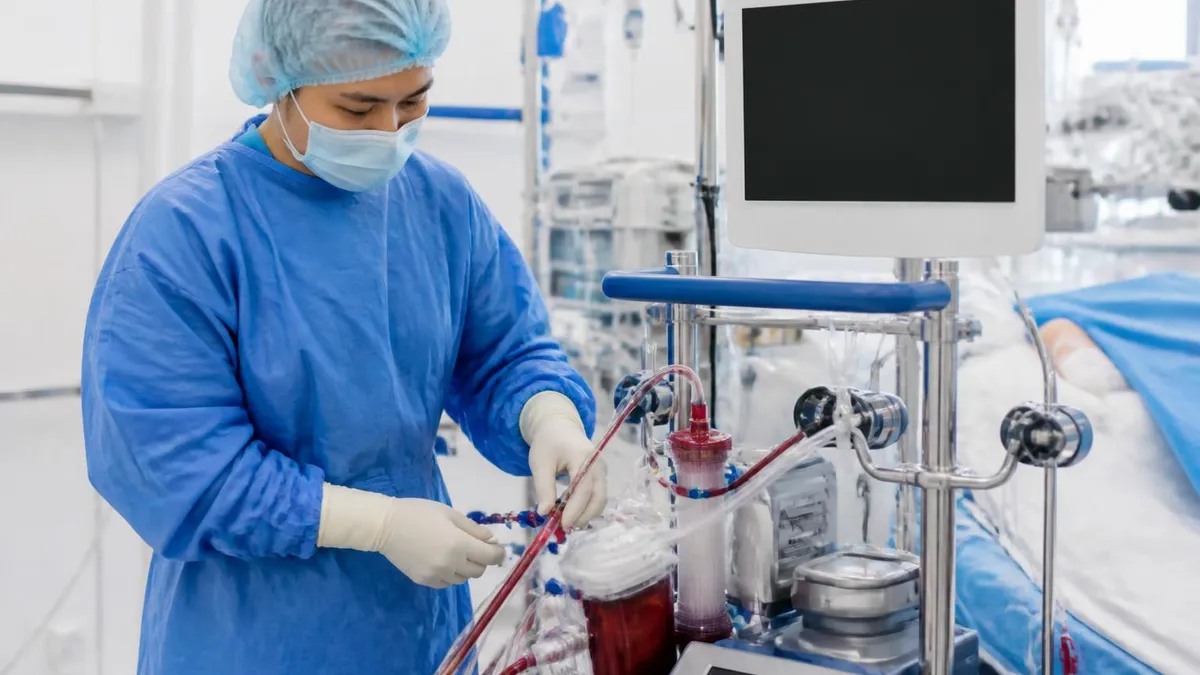
ECMO = a machine that pumps a patient's blood through an artificial lung outside the body, adds oxygen, removes carbon dioxide, and returns it. The native lungs (and in VA ECMO, the native heart) get a chance to rest while the circuit does their job. The abbreviation is shorthand for that entire concept — Extracorporeal (outside the body) Membrane (oxygenator surface) Oxygenation (gas exchange).
Where the Term ECMO Came From
The abbreviation ECMO was coined as the therapy matured in the early 1970s. Before that, the underlying technology — extracorporeal circulation — already existed for cardiac surgery. John Gibbon had performed the first successful open-heart procedure on cardiopulmonary bypass in 1953. But CPB was a short-duration support, measured in hours, with significant blood trauma from the bubble oxygenators of the era. Sustaining a patient outside the operating room, for days at a time, was not yet feasible.
That changed when membrane oxygenators arrived. The membrane design — gas exchange across a thin polymer surface rather than by bubbling oxygen directly through blood — dramatically reduced hemolysis and made longer runs tolerable. In 1972, J. Donald Hill in San Francisco kept a 24-year-old polytrauma patient alive on a membrane-based extracorporeal circuit for 75 hours. The patient survived. That run is usually cited as the first successful adult ECMO case.
Three years later, Robert Bartlett — then at the University of California, Irvine — used the same technology to save a newborn with severe meconium aspiration syndrome. Esperanza, as the baby was named by the nursing staff, lived. Her case opened the door to neonatal ECMO, which is still where the therapy has its strongest evidence base. Bartlett went on to lead the field for decades, helped found the Extracorporeal Life Support Organization (ELSO) in 1989, and is widely regarded as the father of modern ECMO.
The H1N1 influenza pandemic in 2009 pushed ECMO into adult ICUs at scale. The CESAR trial in the UK reported survival benefit for severe ARDS patients referred to an ECMO center. EOLIA in 2018 strengthened that evidence, with Bayesian re-analyses generally favoring ECMO. Then COVID-19 arrived. The abbreviation ECMO went from specialist jargon to common knowledge across the medical workforce — and a lot of family members heard it for the first time.
Each Word in the ECMO Abbreviation Explained
From Latin extra (outside) + corpus (body). Blood physically leaves the circulation, travels through tubing, and returns.
- ▸Marks ECMO as a circulatory-bypass technology, not a ventilator
- ▸Same root used in cardiopulmonary bypass, hemodialysis, ECCO2R
- ▸Implies cannulation: large catheters in a femoral, jugular, or central vessel
- ▸Implies anticoagulation: foreign-surface contact triggers clotting cascades
- ▸Implies a return path: blood must come back to the body after processing
The semipermeable hollow-fiber surface where blood and sweep gas exchange O2 and CO2 by diffusion.
- ▸Material: typically polymethylpentene (PMP) hollow fibers
- ▸Surface area: 1.5–2.5 m² in adult oxygenators
- ▸Blood on one side, sweep gas on the other — no mixing
- ▸Replaced bubble oxygenators of CPB era because it reduces hemolysis
- ▸Limits run length: membrane efficiency declines over days
Adding O2 to deoxygenated blood — though CO2 removal is often the more urgent clinical task.
- ▸Driven by sweep gas FiO2 across the membrane
- ▸CO2 removal is controlled by sweep gas flow rate
- ▸Pump flow as fraction of cardiac output determines arterial SaO2
- ▸Target arterial SaO2 on VV ECMO: usually 85–92%
- ▸Historical name — the term predates emphasis on CO2 clearance
Why the ECMO Abbreviation Matters in Charts and Clinical Documentation
Abbreviations in medicine save time, but they also create blind spots. ECMO is one of the safer abbreviations — it almost never collides with another term — but its appearance in an EMR carries weight that less experienced clinicians sometimes miss. A note that says "patient on ECMO" is announcing that the patient has cannulas in major vessels, a circulating blood volume outside the body, ongoing systemic anticoagulation, and a level of dependence on a machine that ranks somewhere between mechanical ventilation and a heart transplant.
EMR templates vary by institution, but a properly built ECMO documentation suite distinguishes between VA and VV ECMO — two distinct therapies with different cannulation, different physiology, and different complication profiles. Discharge summaries that simply say "ECMO" without specifying the configuration leave receiving teams guessing. Order sets for ECMO patients should call out cannulation site, anti-Xa or aPTT targets, flow rate, sweep gas, and the team-of-record (perfusion, intensivist, surgeon).
The abbreviation also appears in ICD-10 procedure codes (5A1522F, 5A1522G, and 5A1522H for various ECMO configurations) and in CPT codes (33946–33989). Billing teams, registry coordinators, and outcomes researchers depend on consistent use of the term. The ELSO registry depends on it absolutely — every submitted run includes a precise abbreviation-driven taxonomy of configuration, indication, and complications.
Beyond billing and registry use, the abbreviation matters at handoff. A night-shift fellow inheriting an "ECMO patient" needs to know in the first 30 seconds whether that means VA or VV, how long the run has been going, what the anticoagulation strategy is, and what the next-day plan looks like. The ECMO procedure documentation usually carries those answers if the team has built the workflow properly.
ECMO Synonyms and Variants You Will See in Clinical Documentation
ECLS = Extracorporeal Life Support. Many specialists prefer this term because it captures both respiratory and cardiac support without privileging the older oxygenation framing. ELSO itself — the Extracorporeal Life Support Organization — is named after ECLS, not ECMO.
In practice, ECMO and ECLS are used interchangeably in most US centers. European literature leans toward ECLS. Adult cardiac literature often uses ECLS specifically for VA ECMO support of cardiogenic shock.
Other Abbreviations You Will See Near ECMO in Patient Charts
ECMO rarely appears in isolation. A patient on extracorporeal support usually has a small constellation of related abbreviations on their chart — devices, monitoring, scoring systems — and recognizing them matters for both clinical care and exam preparation.
CPB — Cardiopulmonary Bypass. The intraoperative cousin of ECMO. CPB uses a similar circuit but is run in the OR for cardiac surgery and is broken down within hours of operative completion. CPB also includes a cardiotomy reservoir and is typically run at higher anticoagulation targets than ECMO.
IABP — Intra-Aortic Balloon Pump. Often the first-line mechanical support for cardiogenic shock. Sometimes staged before or alongside VA ECMO when escalation is needed.
LVAD / RVAD / BiVAD — Ventricular Assist Devices. Pumps that support specific ventricles. Some are temporary (Impella, Centrimag, TandemHeart) and may be combined with ECMO. Others are durable (HeartMate 3) and implanted long-term.
ECPR — Extracorporeal Cardiopulmonary Resuscitation. The rapid deployment of VA ECMO during ongoing CPR for refractory cardiac arrest. Highly time-sensitive — most successful programs aim for less than 60 minutes from arrest to flow.
ECP — Extracorporeal Photopheresis is a completely different therapy (used in graft vs. host disease and cutaneous T-cell lymphoma) but the abbreviation can be confused with ECMO in poorly formatted notes. Context disambiguates — if the patient is in an ICU with cannulas, it is ECMO; if they are in a hematology clinic, it is photopheresis.
RESP, PRESERVE, SAVE, ENCOURAGE. Scoring systems used to predict ECMO outcomes. RESP and PRESERVE are used in VV ECMO; SAVE is used in VA ECMO. You will see these scores documented at the time of cannulation.
ECMO is not dialysis, and it is not cardiopulmonary bypass. All three are extracorporeal — they all move blood outside the body — but they do very different things. Dialysis (CRRT in the ICU) removes waste and water; it does not oxygenate. CPB is intraoperative and short. ECMO sustains gas exchange (and sometimes circulation) for days to weeks outside the operating room. When you see "extracorporeal" in a chart, read the next word — it tells you which therapy is actually running.
Translating ECMO for Patients and Families
The first time most families hear the word ECMO is during a phone call from an ICU. Sometimes the call comes after a code, sometimes during a deterioration, and almost always at a moment when nobody is in a position to absorb a technical lecture. What they need is a translation, not a glossary.
A short version that works at the bedside: ECMO is a machine that does the work of the lungs (and sometimes the heart) when those organs are too sick to do it themselves. We take blood from a vein, run it through an artificial lung, add oxygen, remove carbon dioxide, and return the blood to your loved one. It buys time for the lungs to heal or for us to figure out the next step. It is not a cure.
That last sentence matters. ECMO does not heal anything by itself — it supports the patient while the underlying problem either resolves (bridge to recovery), gets fixed (bridge to surgery), is replaced (bridge to transplant), or is recognized as irreversible (which leads to withdrawal of support). Families who understand this from day one make better decisions than families who learn it on day fourteen.
Concrete language helps. Instead of "extracorporeal," say "outside the body." Instead of "membrane oxygenator," say "artificial lung." Instead of "cannulation," say "large IVs in the leg or neck." Show the equipment if the family wants to see it. ICUs that allow supervised family visits to ECMO bedside report better trust and earlier consensus on goals of care.
And give the abbreviation back to them. Most families will hear "ECMO" a dozen more times in the next week. Telling them what each letter stands for — even briefly — gives them a hook for every subsequent conversation. They will not remember the polymethylpentene membrane fiber. They will remember that ECMO means a machine outside the body that helps the lungs breathe.
ECMO Abbreviation Documentation Checklist
- ✓Always specify configuration: VA ECMO or VV ECMO, never just "ECMO"
- ✓Note cannulation sites (e.g., right femoral vein drainage, right IJ return) in the same line
- ✓Document run day (Day 0 = cannulation day) on every progress note
- ✓Record anticoagulation target (anti-Xa 0.3–0.7 or aPTT 50–70) and current value
- ✓Document pump flow, sweep gas FiO2, sweep flow rate, and RPM at least q4h
- ✓Note any circuit changes (oxygenator swap, pump head exchange) with dates
- ✓Document ELSO registry entry status if your center participates
- ✓Use precise ICD-10/CPT codes for billing and outcomes reporting
- ✓Update family communication notes with what they have been told and when
- ✓Translate the abbreviation in patient/family-facing materials — never assume comprehension
When Family Members Hear "ECMO" for the First Time
The conversation usually goes the same way. Phone rings. ICU team explains that things are getting worse. The phrase "we are considering ECMO" lands like a bomb. Most family members have either never heard the word, or have heard it once on the news during the COVID-19 pandemic in the context of patients who did not survive. The cultural weight of the abbreviation is heavy before any technical explanation starts.
Honest framing helps from the first sentence. ECMO is not a last-ditch effort in every case — for some patients it is the most appropriate next step in a progression of escalation. For other patients it would not change the outcome. Telling the family which category their loved one is in, with a frank assessment of probable survival, is the kindest thing a team can do. ELSO publishes outcome statistics that allow honest probability conversations, and the RESP, SAVE, and PRESERVE scores can be calculated within minutes.
The other piece is duration. ECMO runs are not 24-hour events. The median adult respiratory ECMO run is around 9–10 days; cardiac ECMO is usually 5–7 days; lung transplant bridges run weeks. Families need to know they are signing up for a marathon, not a sprint. Plan for shift changes, second-opinion consultations, family meetings every 48–72 hours, and probably a withdrawal-of-care discussion at some point if recovery does not happen on the expected timeline.
The abbreviation itself can become a small comfort once the family knows what it means. Knowing that the machine is doing the work of the lungs — and that the lungs sometimes recover when given enough rest — turns an opaque acronym into a story with a possible ending. ECMO is shorthand for that whole story. Used carefully, it lets families participate in care instead of being talked at.
Strengths and Limitations of the ECMO Abbreviation
- +Universally recognized across ICUs, perfusion teams, and registry systems
- +Fits cleanly in EMR templates, ICD-10 codes, and CPT billing rows
- +Same abbreviation used internationally — ELSO, ELSO-EuroAsia, ELSO Latin America
- +Easily distinguished from CPB, IABP, VAD, and CRRT in well-written notes
- +Provides a single anchor term for protocols, education, and research literature
- +Allows family-facing translation while preserving clinical precision
- −Hides the distinction between VA and VV — must be clarified every time
- −Sometimes conflated with ECLS, ECC, or ECCO2R in casual conversation
- −Patients and families rarely know the term and need translation
- −EMR auto-completion sometimes inserts "ECMO" without configuration detail
- −Historical "oxygenation" emphasis underweights CO2 removal indications
- −Confusable with ECP (photopheresis) in unclear handwriting or formatting
Pros and Cons at a Glance
| Pros | Cons |
|---|---|
| Universally recognized across ICUs, perfusion teams, and registry systems | Hides the distinction between VA and VV — must be clarified every time |
| Same abbreviation used internationally — ELSO, ELSO-EuroAsia, ELSO Latin America | Patients and families rarely know the term and need translation |
| Easily distinguished from CPB, IABP, VAD, and CRRT in well-written notes | EMR auto-completion sometimes inserts "ECMO" without configuration detail |
| Provides a single anchor term for protocols, education, and research literature | Confusable with ECP (photopheresis) in unclear handwriting or formatting |
How ECMO Appears in Real-World Charts and Handoffs
A real ECMO entry in a progress note looks nothing like a textbook definition. A representative morning note line: "VV ECMO Day 7. RIJ Avalon 27Fr. Flow 4.2 L/min, sweep 4 L/min on FiO2 1.0. Pre-membrane SvO2 72%, post 96%. anti-Xa 0.45. PaO2 78 SaO2 89% on vent FiO2 0.4 PEEP 10 Vt 4 mL/kg. RESP +5 at cannulation. Plan: continue lung-protective rest, daily sweep-off trial Day 9."
Every abbreviation in that line carries information. VV tells you the configuration. RIJ Avalon tells you the cannulation. Flow and sweep tell you the circuit settings. Pre/post SvO2 confirms the oxygenator is working. anti-Xa tells you anticoagulation is on target. PaO2/SaO2 on a specific ventilator setting gives the team a snapshot of native lung function. RESP +5 contextualizes the patient's prognosis at cannulation. Plan tells the receiving shift what is coming. Whole story in 50 words.
Handoffs use a similar shorthand. "Mr. Garcia, bed 4, VA ECMO day 3 for refractory shock, on Impella for LV vent, anti-Xa within target, weaning trial planned tomorrow morning if pressors stay off." That sentence packs in two device abbreviations, a configuration, a run day, the anticoagulation status, and a plan trigger. Anyone fluent in ICU shorthand has just received a full handoff. Anyone not fluent has just heard noise.
For students and new fellows, the practical advice is to read the abbreviations slowly the first few times. Run them past a colleague. Pull up the ECMO machine reference if any abbreviation is unfamiliar. The shorthand becomes second nature within a few weeks of bedside exposure — but every patient deserves a clinician who knows what every abbreviation in their chart means.
Studying the ECMO Abbreviation: What to Memorize and What to Understand
For exam preparation, three things about the ECMO abbreviation appear repeatedly: the full expansion (Extracorporeal Membrane Oxygenation), the distinction between VA and VV configurations, and the historical context (Robert Bartlett, ELSO, EOLIA). These tend to be testable in single-best-answer format because they are settled — you either know the words or you do not.
For clinical use, the abbreviation is more interesting. Knowing that "oxygenation" is the historical name but CO2 clearance is often the bedside priority changes how you titrate sweep gas. Knowing that "membrane" refers to the oxygenator surface tells you why a rising pressure gradient across the oxygenator predicts circuit failure. Knowing that "extracorporeal" implies a foreign-body anticoagulation requirement tells you why platelets and fibrinogen need to be monitored daily.
Beyond the term itself, the ELSO registry remains the single most useful outcomes resource in the field. Current ELSO data shows adult respiratory ECMO survival to discharge around 58–62%, adult cardiac ECMO around 40–45%, and neonatal respiratory ECMO around 70–80% — numbers that have been remarkably stable across the last decade despite the introduction of new pandemics, new device generations, and new indications. Survival is heavily center-volume dependent. The ELSO website publishes guidelines and outcome reports openly.
If you are preparing for ECMO specialist certification, drill the abbreviation taxonomy, the configuration distinctions, and the basic indications before moving to advanced physiology. Reinforce with our circuit components question set, the patient monitoring questions, and the anticoagulation and hemostasis bank. The abbreviation is the door — the physiology is the building behind it. Both are testable, but only one of them keeps patients alive.
Sample ECMO - Extracorporeal Membrane Oxygenation Practice Questions
Try these questions from our free ECMO - Extracorporeal Membrane Oxygenation practice tests. The correct answer and an explanation follow each question.
Which of the following is the most definitive sign that a patient is failing a VA ECMO weaning trial after ECMO flows have been reduced?
- A. A slight increase in the patient's heart rate from 80 to 95 bpm.
- B. A decrease in central venous pressure (CVP) from 12 to 8 mmHg.
- C. An increase in the patient's native cardiac output by 1 L/min.
- D. A rise in pulmonary capillary wedge pressure (PCWP) to >18 mmHg and a non-opening aortic valve on echocardiogram.
Answer: D. A rise in pulmonary capillary wedge pressure (PCWP) to >18 mmHg and a non-opening aortic valve on echocardiogram.
A rising PCWP indicates increasing left ventricular end-diastolic pressure and pulmonary congestion, while a non-opening aortic valve demonstrates the left ventricle is unable to generate enough pressure to overcome afterload and eject blood. These are clear signs of severe left ventricular failure and an inability to tolerate the reduced ECMO support.
What is the 'oxygen delivery index' (DO2I) target during ECMO, and why is it important?
- A. >600 mL/min/m² to ensure adequate supraphysiologic oxygen reserves
- B. Approximately 520-600 mL/min/m² to match normal physiologic oxygen demand
- C. >1000 mL/min/m² to compensate for ECMO-related hemolysis losses
- D. 300-400 mL/min/m² since ECMO patients have reduced metabolic needs
Answer: B. Approximately 520-600 mL/min/m² to match normal physiologic oxygen demand
Targeting physiologic DO2I (approximately 520-600 mL/min/m²) ensures adequate tissue oxygenation while avoiding excessive flow that could increase hemolysis and recirculation.
What term describes ECMO support initiated specifically to support a patient through a reversible cause of cardiac arrest when conventional CPR has failed?
- A. Bridge-to-recovery ECMO
- B. ECPR (Extracorporeal CPR)
- C. LVAD bridging
- D. Resuscitative ECMO
Answer: B. ECPR (Extracorporeal CPR)
ECPR is the specific term for VA-ECMO deployed as an adjunct to conventional CPR for refractory cardiac arrest.
A sudden decrease in ECMO venous drainage pressure (more negative) with unchanged pump speed most likely indicates:
- A. Hypovolemia or cannula malposition
- B. Pulmonary hypertension
- C. Oxygenator thrombosis
- D. Increased cardiac recovery
Answer: A. Hypovolemia or cannula malposition
Increasingly negative inlet pressures with unchanged RPM suggest inadequate venous return due to hypovolemia, tamponade, or cannula migration causing 'chatter.'
Take the full ECMO - Extracorporeal Membrane Oxygenation practice test
ECMO Questions and Answers
About the Author

Educational Psychologist & Academic Test Preparation Expert
Columbia University Teachers CollegeDr. Lisa Patel holds a Doctorate in Education from Columbia University Teachers College and has spent 17 years researching standardized test design and academic assessment. She has developed preparation programs for SAT, ACT, GRE, LSAT, UCAT, and numerous professional licensing exams, helping students of all backgrounds achieve their target scores.
Join the Discussion
Connect with other students preparing for this exam. Share tips, ask questions, and get advice from people who have been there.
View discussion (9 replies)