
VV ECMO: Veno-Venous Extracorporeal Membrane Oxygenation Guide 2026 October
🧠 VV ECMO supports the lungs when ARDS, severe pneumonia or status asthmaticus fail conventional ventilation. Cannulation, targets, weaning explained.
What VV ECMO Actually Does (and What It Doesn't)
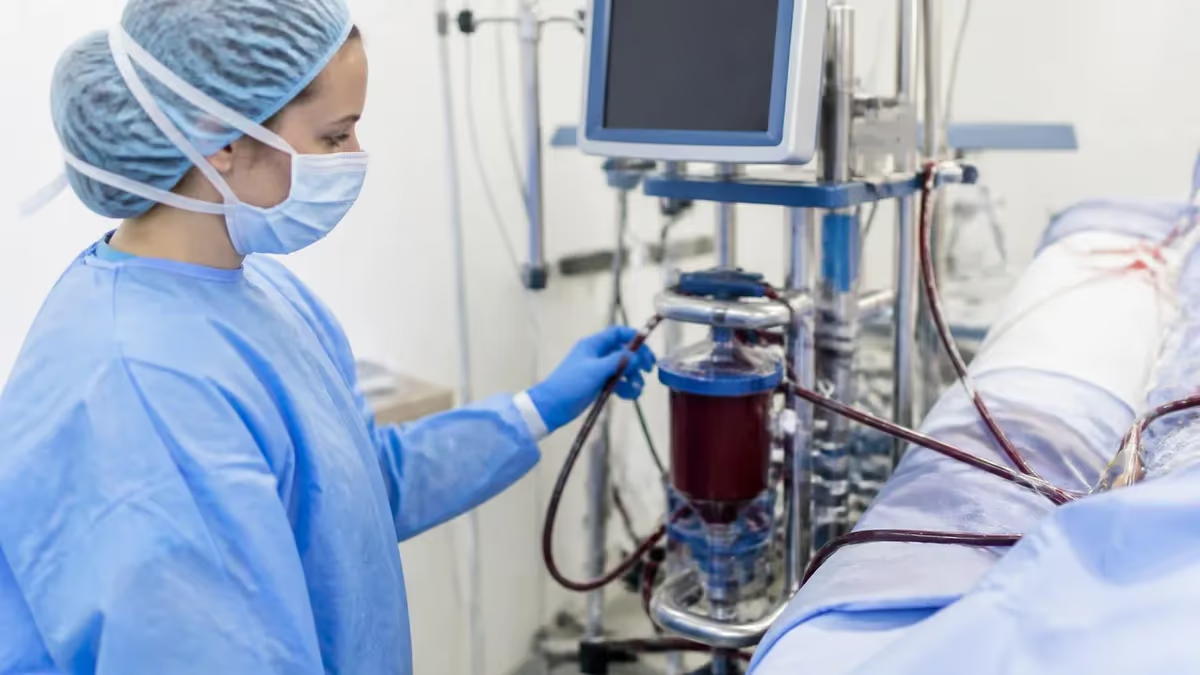
VV ECMO — short for veno-venous extracorporeal membrane oxygenation — pulls deoxygenated blood from a large vein, runs it through an oxygenator and pump, then returns the oxygenated blood back into the venous system. The native heart still does all the cardiac work. The lungs get a chance to rest.
That single sentence carries the whole concept. Drainage is venous. Return is venous. There is no arterial cannula, no retrograde aortic flow, and no direct hemodynamic support. If the heart fails on VV ECMO, you do not have a backup pump — you have a patient. This is the cleanest mental separation from VA ECMO, which adds arterial return and gives the circulation a parallel highway when the heart cannot.
Most adult VV ECMO runs are for severe, reversible hypoxemic or hypercarbic respiratory failure. Think ARDS that is no longer responding to lung-protective ventilation, severe pneumonia (COVID-19 made this familiar to nearly every ICU on the planet), status asthmaticus that cannot be ventilated, or a patient awaiting lung transplant whose oxygenation is collapsing despite every escalation.
You will see VV ECMO described as a bridge. Bridge to recovery is the most common use. Bridge to transplant runs longer — sometimes weeks. Bridge to decision is the polite phrase for "we need 48 hours to figure out whether this is salvageable." None of these are casual decisions. ELSO registry data still shows in-hospital mortality around 40% for adult respiratory VV ECMO, and that number climbs sharply for older patients, immunocompromised hosts, and runs that begin late.
VV ECMO by the Numbers
Who Actually Gets VV ECMO
The indication list is short but the judgement is long. Adult VV ECMO is typically considered when a patient has severe, potentially reversible respiratory failure and conventional therapy is failing — usually after optimal ventilator settings, prone positioning, neuromuscular blockade, and inhaled pulmonary vasodilators have been tried.
Classic triggers:
- Severe ARDS with PaO2/FiO2 < 80 on FiO2 1.0 despite 6 hours of optimal therapy.
- Uncompensated hypercapnia with pH < 7.20 that cannot be corrected by adjusting ventilation safely.
- Severe pneumonia — bacterial, viral (influenza, COVID-19), or aspiration — with refractory hypoxemia.
- Status asthmaticus when dynamic hyperinflation prevents safe ventilation.
- Bridge to lung transplant for end-stage pulmonary disease.
- Trauma or smoke inhalation with rapidly progressive lung injury.
The EOLIA trial and its post-hoc Bayesian re-analyses moved the field toward earlier referral rather than later. Centers using protocolized VV ECMO for severe ARDS report better outcomes than ad-hoc programs. The Extracorporeal Life Support Organization publishes consensus guidelines that most modern ECMO centers follow closely.
What disqualifies a patient? Multi-organ failure that is not lung-driven, age and frailty that make meaningful recovery unlikely, advanced malignancy with poor prognosis, intracranial hemorrhage, and uncontrolled bleeding all push the risk-benefit calculation against cannulation. None of these are absolute, but every one of them lowers the chance the run ends in extubation rather than withdrawal.
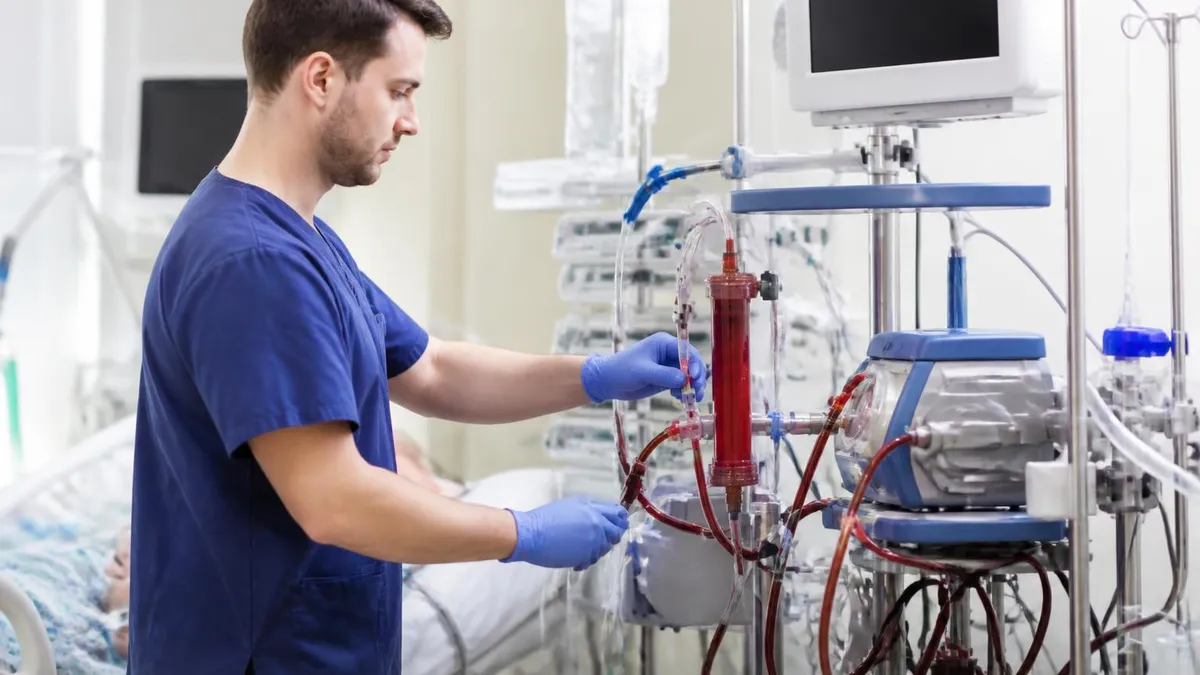
VV ECMO = lungs only. Venous drain, venous return, native heart still pumping. VA ECMO = lungs and heart. Venous drain, arterial return, parallel circulation. If the heart fails on VV, you do not have ECMO support for it — you have a developing emergency. Recognizing this distinction is the most commonly tested concept on certified ECMO specialist exams.
Cannulation Configurations for VV ECMO
VV ECMO can be assembled in three practical configurations. Each carries different recirculation behavior, different mobility tradeoffs, and different anatomical risks. The choice is rarely arbitrary — it is driven by what the patient needs the run to look like over the next two weeks.
Femoral-femoral (bi-femoral) is the workhorse for emergency adult cannulation. A multi-stage drainage cannula sits in the inferior vena cava via one femoral vein, and a return cannula in the other femoral vein delivers oxygenated blood with its tip advanced near the cavo-atrial junction. It is fast, familiar, and bed-side feasible. The cost is recirculation if cannulas overlap and immobility of the patient.
Femoro-jugular places drainage in the femoral vein and return in the internal jugular. This separates drainage and return geographically, which usually drops recirculation below 10%. It permits more upper-body mobility for awake ECMO, and it is the configuration most centers prefer for runs expected to last more than a few days.
Dual-lumen single cannula (Avalon Elite or ProtekDuo) is inserted through the right internal jugular vein and crosses the right atrium so that drainage occurs from the superior and inferior cava while return is directed through the tricuspid valve. Done well, this allows a fully ambulatory patient on ECMO — important for transplant bridging. Done poorly, malposition causes catastrophic recirculation or right-ventricle injury. Echocardiographic or fluoroscopic guidance is mandatory at insertion. Detailed ECMO cannulation technique varies by center but the anatomy does not.
VV ECMO Cannulation Sites Compared
Fastest emergency option. Drain in IVC via one femoral vein, return in the other femoral vein.
- ▸Best for: bedside emergent cannulation, short bridge to decision
- ▸Drainage tip: T8–T10 in IVC, away from hepatic veins
- ▸Return tip: cavo-atrial junction, advanced ~15–20 cm
- ▸Recirculation risk: highest if cannula tips overlap
- ▸Mobility: limited — patient is supine, both groins occupied
Workhorse for runs expected to last more than a few days. Drain from femoral, return via right IJ.
- ▸Best for: standard adult VV ECMO, awake/extubation strategy
- ▸Drainage: IVC at hepatic level via femoral vein
- ▸Return: right IJ tip in upper SVC or cavo-atrial junction
- ▸Recirculation: typically <10% with good positioning
- ▸Mobility: patient can sit, do PT, eventually walk on ECMO
Single 27–31 Fr cannula in right IJ crossing the right atrium. Drainage from SVC+IVC, return toward tricuspid.
- ▸Best for: long bridge to recovery or transplant, ambulatory ECMO
- ▸Placement: under TEE or fluoroscopic guidance, mandatory
- ▸Drainage holes: SVC and IVC simultaneously
- ▸Risk: malposition into RV → injury; migration causes recirculation spike
- ▸Mobility: fully ambulatory once stabilized — patients can walk
The Physiology That Drives Every Decision
On VV ECMO, arterial oxygen content is determined by mixing. The ECMO circuit returns highly oxygenated blood into the venous system. That blood mixes with whatever the native cardiac output is doing and with whatever residual venous return is escaping the drainage cannula. The mixed blood goes through the lungs — which may add nothing — and then to the systemic circulation.
Two numbers drive most bedside thinking. The first is the ratio of ECMO flow to cardiac output. When pump flow approaches or exceeds cardiac output, you maximize the fraction of total venous return that the circuit can oxygenate. Below about 60% of cardiac output, oxygenation stalls because too much native deoxygenated blood bypasses the circuit. This is why a hyperdynamic septic patient with cardiac output of 10 L/min can be very hard to oxygenate on 4 L/min of ECMO flow.
The second number is recirculation — the fraction of oxygenated return blood that re-enters the drainage cannula without ever reaching the body. High recirculation means the circuit is oxygenating its own blood, the patient is starving, and pre- and post-oxygenator saturations look almost identical. Repositioning a cannula by 2 cm under ultrasound can drop recirculation from 50% to under 10%.
This is also why VV ECMO does not need a target SaO2 of 100%. Most centers accept 80–88% saturation if tissue perfusion (lactate, mixed venous saturation, capillary refill) is adequate. The lung-protective payoff of a low FiO2 and a low driving pressure is worth more than chasing a normal SpO2.
Daily Targets and Settings on VV ECMO
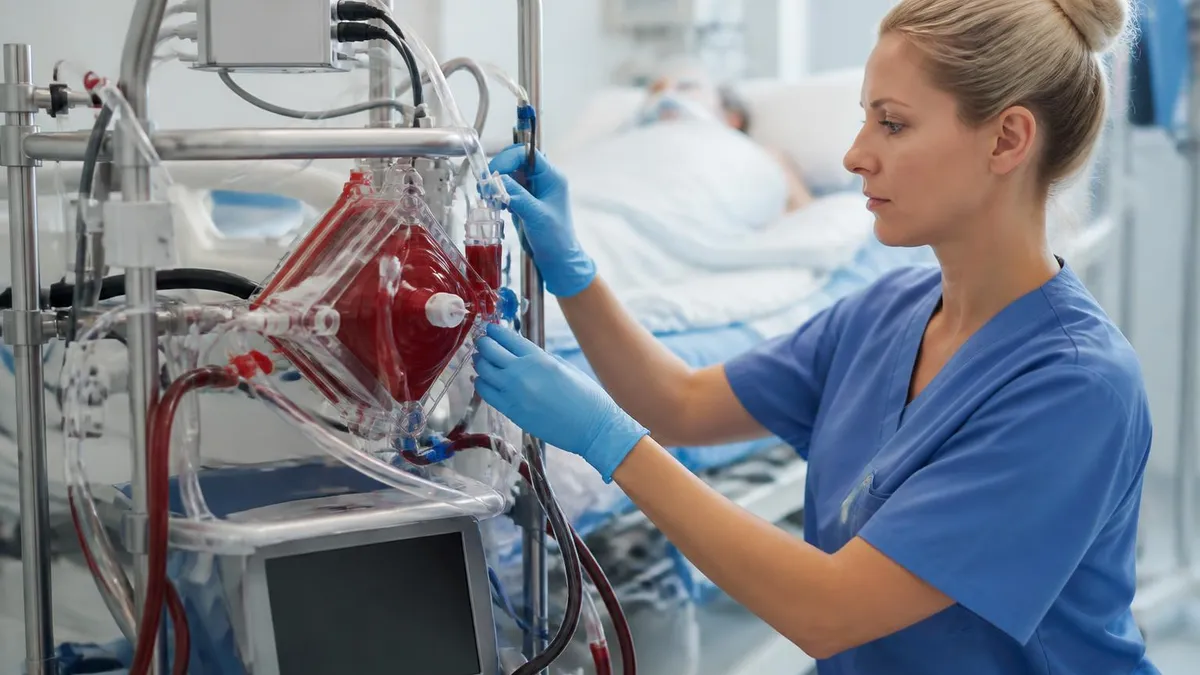
Arterial SaO2 target: 85–92%. Some centers accept 80–85% if perfusion is good. Driven by ECMO flow as a fraction of cardiac output, sweep gas FiO2, and recirculation.
Pre-membrane SvO2 should be 65–75%. Pre/post oxygenator saturation gap <5% suggests recirculation. Lactate trend matters more than the single SpO2 number.
Murray Score, RESP Score, and Patient Selection
Two scoring tools dominate VV ECMO candidacy discussions. They do not replace clinical judgement, but they structure it.
The Murray Lung Injury Score is calculated before cannulation. It uses PaO2/FiO2 ratio, chest radiograph quadrants involved, PEEP, and lung compliance. A Murray score above 3.0 — combined with failure of conventional therapy — places a patient firmly in ECMO-consideration territory. Below 2.5, the evidence for ECMO over optimal mechanical ventilation thins out quickly.
The RESP Score (Respiratory ECMO Survival Prediction) is calculated at cannulation to estimate post-ECMO survival. It uses 12 pre-cannulation variables — age, immunocompromised status, mechanical ventilation duration before ECMO, acute respiratory diagnosis group, central nervous system dysfunction, acute associated infection, neuromuscular blockade, nitric oxide use, bicarbonate, cardiac arrest, PaCO2, and peak inspiratory pressure. The score sorts patients into five risk classes, with class I survival around 92% and class V survival around 18%.
The PRESERVE score performs similarly. The PRESET score is COVID-specific. The point is not to pick a favorite — it is to communicate. A team that documents "RESP score 4, predicted survival 57%" is making a very different conversation possible with a family than "we want to try ECMO." Honest probabilities help the room more than optimism.
Background reading on the broader physiology and indications lives in our ECMO overview.
If SaO2 drops despite high ECMO flow and 100% sweep FiO2, suspect recirculation before anything else. Pull blood from the pre-oxygenator port and post-oxygenator port simultaneously. A gap <5% between them — especially if the pre-oxygenator saturation is unusually high — means the circuit is oxygenating its own return blood. Confirm with bedside ultrasound of cannula tips. Reposition the return cannula a few centimeters away from the drainage cannula. This is the single highest-yield troubleshooting step on VV ECMO and is heavily tested on certification exams.
Running the Patient Day to Day
The daily rhythm of a VV ECMO patient settles into a pattern after the first 24–48 hours. Hourly cannula site checks for bleeding and migration. Pump flow, sweep, RPM, and pre/post-membrane pressures documented at least q1h. Drainage pressure trends watched like an EKG — a sudden swing to more negative values means the patient is volume-down or the cannula is compromised.
Sedation is kept light when possible. The awake ECMO strategy — extubating the patient on ECMO and letting them participate in physical therapy — improves long-term outcomes and shortens runs in selected candidates. It also requires a team that is comfortable with a patient breathing spontaneously on full ECMO support, because the first time a patient asks for water is unsettling if your last ECMO patient was paralyzed and prone.
Fluid balance matters more than most teams initially appreciate. Diuresis to dry weight or below consistently improves oxygenation by reducing pulmonary edema, and the ECMO circuit tolerates lower preload than the native heart would. Daily renal replacement (CRRT) is added in many runs, often through an integrated circuit access port to avoid an additional line.
Nutrition follows standard ICU protocol. Enteral feeding works on ECMO. Bowel rest is not routine. Infection surveillance is aggressive because cannulas are large foreign bodies in critically ill patients — line cultures if temperature spikes, broad-spectrum antibiotics if circuit-associated infection is suspected. Detailed ECMO machine behavior and circuit alarms have their own rhythm too.

VV ECMO Daily Rounding Checklist
- ✓Cannula sites: dressing dry, depth markers documented, no hematoma
- ✓Pump flow target met without excessive negative drainage pressure (>−80 to −100 mmHg)
- ✓Sweep gas FiO2 and flow rate documented; CO2 trend reviewed
- ✓Pre/post-oxygenator pressure gradient — rising gradient signals membrane clot
- ✓Anticoagulation: anti-Xa 0.3–0.7 IU/mL or aPTT 50–70, no active bleeding
- ✓Platelets, fibrinogen, D-dimer, hemoglobin — daily minimum
- ✓Pre- and post-oxygenator SaO2 — gap >5% means oxygenator is working; <5% suspect recirculation
- ✓Ventilator on lung-protective rest settings (Vt 3–4 mL/kg, plateau <25, PEEP 10–14, RR 10, FiO2 ≤0.40)
- ✓Daily SBT/weaning assessment — capacity off ECMO with sweep gas turned off briefly
- ✓Family update — duration of run, current goals, prognosis, decision triggers
Anticoagulation: The Tightrope
The ECMO circuit is a thrombogenic foreign body. Without anticoagulation, clot forms on the oxygenator membrane, in the pump head, and at cannula tips — sometimes within hours. With too much anticoagulation, the patient bleeds — from cannulation sites, the airway, the GI tract, and most worryingly inside the skull.
Unfractionated heparin is the default agent in most adult VV ECMO programs. It is titrated to either aPTT (typical target 50–70 seconds) or anti-Xa (typical target 0.3–0.7 IU/mL). Anti-Xa is increasingly preferred because aPTT can be confounded by coagulopathy of critical illness. ACT (activated clotting time) is monitored at the bedside every 4–6 hours but is not the primary target.
Bivalirudin, a direct thrombin inhibitor, is gaining ground for several reasons: it does not depend on antithrombin, it has a more predictable dose-response, and it bypasses the catastrophe of HIT. Centers using bivalirudin titrate to aPTT 1.5–2.5x baseline or to a specific protocol concentration. Half-life is short (25 minutes), but the drug accumulates in renal failure.
The hardest decisions arrive when the patient is bleeding. A run can continue with sub-therapeutic anticoagulation — sometimes briefly off heparin entirely — if circuit flows are high enough to limit stasis and the team accepts the rising risk of circuit thrombosis. Modern heparin-bonded circuits make this more tolerable than it was a decade ago. Daily reassessment of bleeding vs. clotting risk is non-negotiable. Heparin-induced thrombocytopenia must be screened for any time platelets fall >50% from baseline.
VV ECMO Pros and Cons
- +Provides full oxygenation and CO2 removal when conventional ventilation fails
- +Allows the lungs to rest on ultra-protective ventilator settings
- +No arterial cannulation — lower limb ischemia and stroke rates than VA ECMO
- +Compatible with awake ECMO and patient mobilization in selected cases
- +Strong evidence base for severe ARDS via the EOLIA trial and ELSO registry
- +Bridge options span recovery, transplant, and decision
- −Does not support the failing heart — pure respiratory support only
- −Recirculation can blunt oxygenation if cannulas are poorly positioned
- −Bleeding complications from systemic anticoagulation
- −Cannula-related vascular injury, deep vein thrombosis, and infection
- −Resource-intensive: specialized staff, 24/7 perfusion support, high cost per day
- −Mortality remains 30–50% in adult respiratory ECMO despite optimal care
Pros and Cons at a Glance
| Pros | Cons |
|---|---|
| Allows the lungs to rest on ultra-protective ventilator settings | Does not support the failing heart — pure respiratory support only |
| No arterial cannulation — lower limb ischemia and stroke rates than VA ECMO | Recirculation can blunt oxygenation if cannulas are poorly positioned |
| Compatible with awake ECMO and patient mobilization in selected cases | Bleeding complications from systemic anticoagulation |
| Strong evidence base for severe ARDS via the EOLIA trial and ELSO registry | Cannula-related vascular injury, deep vein thrombosis, and infection |
Weaning VV ECMO: How You Know It's Time
Weaning a VV ECMO patient is conceptually simple. You progressively turn off the sweep gas — the gas flow across the oxygenator — while leaving blood flow unchanged. If the native lungs can carry the oxygenation and CO2 removal load on tolerable ventilator settings, the patient is ready for decannulation. If they cannot, the sweep is restored and weaning is paused.
Typical readiness criteria before a sweep trial: PaO2/FiO2 >150 with the ventilator at FiO2 ≤0.5, PEEP ≤10, plateau pressure <28, and a reasonable spontaneous tidal volume. Lung compliance should be trending up. Chest imaging should show resolution rather than progressive consolidation.
The sweep-off trial: drop the sweep gas to 0 L/min while keeping pump flow constant for 30–60 minutes. Watch the arterial blood gas, ventilator mechanics, work of breathing, and the patient's subjective comfort. If gas exchange is preserved without escalation of ventilator support, you are watching native lung function carry the patient. Document the trial. Repeat at 6–24 hours. If sustainable, plan decannulation.
Decannulation itself is usually bedside for femoral cannulas — pull, hold pressure, suture. Jugular and dual-lumen cannulas may require operative removal. Some centers heparinize down to anti-Xa 0.1–0.3 in the hours before decannulation to lower bleeding while still discouraging fresh thrombosis. Post-decannulation, Doppler ultrasound at 24–48 hours screens for deep vein thrombosis at the cannulation site — incidence is substantial and often clinically silent.
ECPR, the ELSO Registry, and What Outcomes Actually Look Like
ECPR — extracorporeal cardiopulmonary resuscitation — is technically VA ECMO, not VV, but it overlaps with ECMO programs and deserves a mention. ECPR is the rapid initiation of ECMO during ongoing CPR for refractory cardiac arrest, typically when arrest is witnessed, the rhythm is shockable, time-to-flow is short, and the underlying cause is potentially reversible. Survival to neurologically intact discharge is 20–30% in selected centers — far better than conventional CPR for refractory arrest but only with strict patient selection and a system that can establish ECMO within 60 minutes of arrest.
The ELSO Registry — the Extracorporeal Life Support Organization's international database — is the single most useful outcome resource in the field. As of the most recent ELSO report, adult respiratory ECMO survival to discharge sits around 58–62% across reporting centers. The number masks wide variation: high-volume centers (≥30 runs per year) consistently outperform low-volume programs. The same registry has tracked VV ECMO through H1N1, MERS, and COVID-19, providing real-time outcomes data during each.
Long-term outcomes for VV ECMO survivors are sobering. Most have meaningful neurocognitive recovery. Pulmonary function returns toward baseline over 3–12 months in patients who started with previously healthy lungs. Physical reconditioning is slow. PTSD, depression, and post-intensive-care syndrome are common. The decisions made on rounds during day three of a run reach further into a patient's life than they look at the time. The detailed ECMO procedure story does not end at decannulation — rehab and follow-up are part of it.
Takeaways for Anyone Studying or Practicing VV ECMO
VV ECMO is the modality you reach for when the lungs have failed and the heart is still working. The physiology rewards humility — recirculation, cardiac output, and mixed venous saturation matter more than any single arterial gas. The cannulation choice you make on day one defines what the patient's day fourteen looks like. The hardest skill is not knowing when to cannulate but knowing when to wean and when to withdraw, and the team that gets honest about those decisions earlier delivers better care.
If you are studying for a certified ECMO specialist credential, the high-yield concepts cluster around three areas: the difference between VV and VA support, recognizing and managing recirculation, and titrating sweep gas vs. blood flow correctly. Daily rounding pearls — pre/post-membrane saturation gap, anticoagulation targets, oxygenator failure signs, hemodynamic interactions — make up most of the case-based portion of exams. Sharpen these against our ECMO physiology questions and the weaning and decannulation set.
If you are at the bedside, the basics outperform the exotic interventions. Optimize ventilator rest settings. Keep cannulas where you put them. Watch the pre/post saturations and the oxygenator pressure gradient. Reassess every day. Talk to families honestly. Most of what makes VV ECMO work is not glamorous — it is the patient discipline of a team that knows what each number means and what it does not.
Sample ECMO - Extracorporeal Membrane Oxygenation Practice Questions
Try these questions from our free ECMO - Extracorporeal Membrane Oxygenation practice tests. The correct answer and an explanation follow each question.
A patient on Veno-Venous (VV) ECMO for respiratory failure develops worsening hypoxemia despite a high FdO2 of 1.0. The pre-oxygenator saturation (venous blood entering the circuit) is noted to be rising, and the post-oxygenator saturation remains high. Which of the following is the most likely cause?
- A. Inadequate anticoagulation
- B. High patient cardiac output
- C. Significant recirculation
- D. Membrane lung thrombosis
Answer: C. Significant recirculation
Recirculation occurs in VV ECMO when a significant fraction of the newly oxygenated blood returned to the patient is immediately drained back into the ECMO circuit without circulating systemically. This is often due to the proximity of the drainage and return cannulas. A key sign is a rising pre-oxygenator saturation, as the circuit is draining already oxygenated blood, which reduces the efficiency of systemic oxygen delivery and causes patient hypoxemia.
A patient on VV ECMO requires Continuous Renal Replacement Therapy (CRRT). The CRRT circuit is initiated, drawing blood from a pre-pump access port and returning it post-oxygenator. Shortly after initiation, the ECMO circuit's pre-membrane (access) pressure becomes significantly more negative, and the venous line begins to chatter. What is the most probable cause?
- A. The CRRT machine is adding excess volume to the circuit.
- B. A large clot has formed in the ECMO oxygenator.
- C. The CRRT machine's ultrafiltration rate is too high, causing patient hypovolemia.
- D. The sweep gas flow on the ECMO circuit was accidentally increased.
Answer: C. The CRRT machine's ultrafiltration rate is too high, causing patient hypovolemia.
Aggressive fluid removal (ultrafiltration) by the CRRT machine can rapidly deplete the patient's circulating volume. This resulting hypovolemia leads to insufficient venous return to fill the ECMO circuit, causing the drainage cannula to suck against the vessel walls. This is manifested as an increasingly negative pre-membrane pressure and visible 'chatter' in the line.
During routine monitoring of a patient on VV ECMO, you observe 'chatter' or visible shaking in the venous drainage line, and the ECMO flow has intermittently decreased. Which of the following is the LEAST likely cause of this issue?
- A. Excessive pump RPM settings
- B. Hypovolemia or inadequate preload
- C. Cannula migration against a vessel wall
- D. Increased sweep gas flow
Answer: D. Increased sweep gas flow
Chatter in the venous access line indicates access insufficiency, where the pump is trying to drain more blood than is available, causing the vein to collapse around the cannula. This can be caused by hypovolemia, excessive pump speed, or the cannula tip being positioned against a vessel wall. Sweep gas flow is related to gas exchange (CO2 removal) within the oxygenator and does not directly impact venous drainage or cause access insufficiency.
A 55-year-old patient on Veno-Venous (VV) ECMO for severe ARDS has shown significant improvement in lung compliance and chest X-ray findings. The clinical team decides to perform a liberation trial. What is the most appropriate initial step in this process?
- A. Gradually decrease ECMO blood flow to a minimal level (e.g., 1 L/min).
- B. Systematically reduce the sweep gas flow to zero while maintaining ECMO blood flow.
- C. Discontinue all sedation to assess neurological readiness.
- D. Increase the PEEP on the mechanical ventilator to 20 cm H2O.
Answer: B. Systematically reduce the sweep gas flow to zero while maintaining ECMO blood flow.
Weaning from VV ECMO primarily assesses the native lung's ability to perform gas exchange, specifically carbon dioxide removal. This is achieved by reducing and then stopping the sweep gas flow through the oxygenator. ECMO blood flow is typically maintained to prevent thrombosis within the circuit.
Take the full ECMO - Extracorporeal Membrane Oxygenation practice test
ECMO Questions and Answers
About the Author

Educational Psychologist & Academic Test Preparation Expert
Columbia University Teachers CollegeDr. Lisa Patel holds a Doctorate in Education from Columbia University Teachers College and has spent 17 years researching standardized test design and academic assessment. She has developed preparation programs for SAT, ACT, GRE, LSAT, UCAT, and numerous professional licensing exams, helping students of all backgrounds achieve their target scores.
Join the Discussion
Connect with other students preparing for this exam. Share tips, ask questions, and get advice from people who have been there.
View discussion (9 replies)