
Online CPR Recertification: Complete 2026 October Guide to Renewing Your CPR Card Online
📗 Online CPR recertification guide for 2026 October — courses, costs, accepted providers, exam tips, and how to renew your CPR card in under 2 hours.
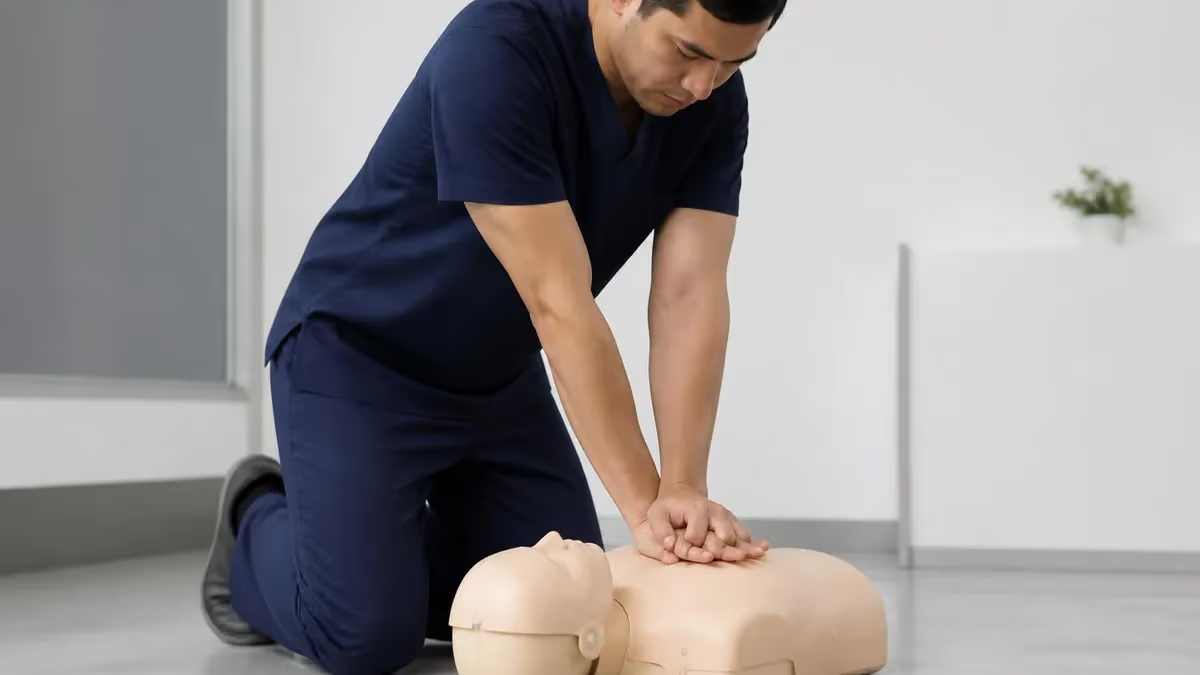
Online CPR recertification has become the fastest and most convenient way for healthcare workers, teachers, lifeguards, daycare providers, and ordinary citizens to keep their lifesaving credentials current in 2026. Instead of taking a half day off work to sit in a classroom, you can log in from home, review the latest 2025-2030 American Heart Association guideline updates, complete a written exam, and download a printable card within a couple of hours. Providers like the national cpr foundation, ProCPR, and ProTrainings now handle hundreds of thousands of renewals annually.
The driving force behind the shift is simple: most renewals are knowledge checks, not first-time skill builds. If you already know the compression depth, the correct respiratory rate for rescue breathing, and how to operate an AED, an online refresher is more efficient than repeating an in-person class. Employers in many industries — corporate offices, gyms, dental practices, and even some nursing units — now accept fully online renewal certificates because the curriculum mirrors the 2025 ECC science update word for word.
That said, not every job accepts a 100% online card. Hospital BLS, pals certification, and ACLS renewals usually require a blended format with an in-person skills check, while a babysitter or office safety officer can typically use a fully remote certificate. Understanding which category you fall into before you pay is the single biggest factor in avoiding a wasted $30. This guide walks you through every step — choosing the right provider, passing the test, and getting your card accepted.
We'll cover the differences between Heartsaver-level recertification (lay rescuer), BLS Provider recertification (healthcare), and advanced renewals like the acls algorithm refresher for nurses and paramedics. You'll see exactly what topics the exam covers, how long each course takes, what the average pass rate is, and where to take legitimate free practice questions before you sit the real thing. We even break down the red flags that signal a sketchy provider.
One of the most common questions we get is whether online recertification is truly valid. The short answer is yes — for most non-clinical jobs — provided you use an OSHA-aligned, ECC-compliant program. The longer answer depends on your state, your employer's policy, and whether your scope of practice includes administering medications during life support. If you're a registered nurse working bedside, fully online renewal almost certainly won't pass your nurse manager's audit. If you're a personal trainer, it almost certainly will.
By the end of this guide, you'll know which provider to choose, how to study for the renewal exam in under three hours, how to handle the AED practical component remotely, and what to do if your card gets rejected. We've also included 10 practice quizzes mapped to the exact topics on the 2026 recertification test, so you can self-assess before you pay. Let's start by understanding why online renewal exists and how it works.
If you're brand new to renewing online, treat the next three sections as your roadmap. Skim the statistics box, jump to the timeline showing the typical 90-minute path, and then bookmark the FAQ at the bottom — it answers the 10 questions our readers email us most often about online CPR recertification, including whether expired cards can be renewed online or whether you must restart from scratch.
Online CPR Recertification by the Numbers

Your 90-Minute Online Recertification Path
Register & Pay
Review Modules
Take Practice Quizzes
Pass the Final Exam
Skills Check (if needed)
Download Your Card
Online recertification is built for the renewer who already passed an initial course within the last 24 months. The assumption baked into every reputable curriculum is that you know how to position a victim, count compressions, and confirm a pulse — what you need is a refresher on the latest science and a way to document your competency. This is fundamentally different from initial certification, which spends most of its time on hands-on practice. If you've never done CPR before, online recertification is not the right entry point for you.
The most important question to answer before paying is what your employer or state regulator will accept. A daycare licensing inspector in California may demand a fully blended program with in-person skills validation; an HR manager at a tech company in Texas may accept any OSHA-aligned certificate. Healthcare employers, hospitals, and EMS agencies almost always require BLS Provider cards issued by the American Heart Association or American Red Cross — and those organizations now offer their own blended renewal pathways that combine online cognitive learning with hands-on skills.
Lay rescuer renewals (sometimes branded Heartsaver, CPR/AED for the Community, or Adult & Pediatric CPR) are where 100% online makes the most sense. These cards cover the same chain of survival as a healthcare card — recognition, activation, compressions, AED, breaths — but at a depth appropriate for non-clinicians. Teachers, build parents, scout leaders, construction supervisors, and gym staff typically fall into this bucket. If you renew at this level online, expect a 25-question exam and roughly two hours total time investment.
BLS Provider renewals are where things get nuanced. Most hospitals require the AHA BLS card, which can now be renewed through the AHA's HeartCode BLS program — an online cognitive portion followed by a hands-on session with an instructor or voice-assisted manikin. Pure third-party online BLS cards may be rejected by hospital compliance offices, even if they look identical on paper. Always check your employer's accepted-provider list before you spend money.
Advanced cards like ACLS and pals certification can technically begin online (again through HeartCode), but the hands-on megacode simulation is mandatory. Plan for a half-day session even if you complete the cognitive piece at home. Renewing these cards is a much bigger time commitment than basic CPR, and most providers expect you to bring a working knowledge of the acls algorithm and pediatric assessment triangle to the in-person session.
For ordinary citizens — parents, grandparents, babysitters, coaches — online recertification is essentially friction-free. There is no employer to satisfy, no compliance officer to convince, and the goal is purely competency. In this case, choose any reputable provider, take the course at your own pace, and treat the certificate as a personal commitment to lifesaving readiness. Many of these renewers have never let their card formally expire — they simply renew every two years as good citizenship.
One emerging category is virtual reality recertification, where you complete compressions on a smart manikin connected to a tablet that scores your depth and rate in real time. A handful of providers now offer this as a premium upgrade for around $90. Acceptance is still limited, but it's the most rigorous fully remote option available, and we expect adoption to spread rapidly in 2026 and 2027 as hospital systems pilot the technology.
If you want the full picture, the online cpr recertification guide walks through it step by step.

CPR Practice Test Questions
Prepare for the CPR Cardiopulmonary Resuscitation Practice exam with our free practice test modules. Each quiz covers key topics to help you pass on your first try.
CPR Basic CPR
CPR Exam Questions covering Basic CPR. Master CPR Test concepts for certification prep.
CPR and First Aid
Free CPR Practice Test featuring and First Aid. Improve your CPR Exam score with mock test prep.
CPR (Cardiopulmonary Resuscitation) Adult ...
CPR Mock Exam on (Cardiopulmonary Resuscitation) Adult CPR and AED Usage. CPR Study Guide questions to pass on your first try.
CPR (Cardiopulmonary Resuscitation) Airway...
CPR Test Prep for (Cardiopulmonary Resuscitation) Airway Obstruction and Choking. Practice CPR Quiz questions and boost your score.
CPR (Cardiopulmonary Resuscitation) Cardio...
CPR Questions and Answers on (Cardiopulmonary Resuscitation) Cardiopulmonary Emergency Recognition. Free CPR practice for exam readiness.
CPR (Cardiopulmonary Resuscitation) Child ...
CPR Mock Test covering (Cardiopulmonary Resuscitation) Child and Infant CPR. Online CPR Test practice with instant feedback.
CPR (Cardiopulmonary Resuscitation) High-P...
Free CPR Quiz on (Cardiopulmonary Resuscitation) High-Performance Team Dynamics. CPR Exam prep questions with detailed explanations.
CPR (Cardiopulmonary Resuscitation) Legal ...
CPR Practice Questions for (Cardiopulmonary Resuscitation) Legal and Ethical Considerations. Build confidence for your CPR certification exam.
CPR for Specific Populations
CPR Test Online for for Specific Populations. Free practice with instant results and feedback.
CPR Airway & Breathing Management
CPR Exam Questions covering Airway & Breathing Management. Master CPR Test concepts for certification prep.
CPR Assessment & Recognition of Cardiac Ar...
Free CPR Practice Test featuring Assessment & Recognition of Cardiac Arrest. Improve your CPR Exam score with mock test prep.
CPR Chest Compressions & Defibrillation
CPR Mock Exam on Chest Compressions & Defibrillation. CPR Study Guide questions to pass on your first try.
CPR Post-Resuscitation Care & Recovery
CPR Test Prep for Post-Resuscitation Care & Recovery. Practice CPR Quiz questions and boost your score.
Comparing Top Online CPR Recertification Providers
The national cpr foundation is one of the longest-running online-only CPR providers and is widely used by personal trainers, dental offices, and security firms. The renewal exam runs $19.95, takes about an hour, and produces an instant digital card. It's OSHA-compliant and references the latest ECC guidelines, including current standards for chest compression depth, ventilation ratio, and AED operation.
The trade-off is that fully online cards from any third-party provider — including national cpr foundation — are usually not accepted at hospitals or EMS agencies that mandate AHA or Red Cross credentials. Confirm with your employer before purchasing. For lay rescuers, school staff, and corporate safety roles, however, this is one of the most affordable and time-efficient options available in 2026.
Is Online CPR Recertification Right for You?
- +Complete renewal in 90 minutes from any device — no commute or scheduling
- +Cost typically 50-70% less than in-person classes ($19-$60 vs. $80-$150)
- +Immediate digital card download — start work or volunteer roles same day
- +Self-paced modules let you skip topics you've already mastered
- +Unlimited exam retakes at most providers with no extra fee
- +Mobile-friendly platforms work on phones, tablets, and laptops
- +Curriculum stays current with 2025-2030 ECC and AHA guideline updates
- −Hospitals and EMS agencies usually reject fully online (non-AHA) cards
- −No hands-on feedback on compression depth, rate, or hand placement
- −State and licensing-board rules vary — some require in-person skills check
- −AED practice is simulated only, not on a physical training device
- −Distractions at home can reduce focus and retention
- −Self-discipline required — no instructor to keep you on pace
Pros and Cons at a Glance
| Pros | Cons |
|---|---|
| Immediate digital card download — start work or volunteer roles same day | Hospitals and EMS agencies usually reject fully online (non-AHA) cards |
| Self-paced modules let you skip topics you've already mastered | No hands-on feedback on compression depth, rate, or hand placement |
| Unlimited exam retakes at most providers with no extra fee | State and licensing-board rules vary — some require in-person skills check |
| Mobile-friendly platforms work on phones, tablets, and laptops | AED practice is simulated only, not on a physical training device |

Pre-Recertification Checklist Before You Pay
- ✓Confirm with your employer or licensing board that fully online cards are accepted
- ✓Locate your existing CPR card to verify expiration date and certifying organization
- ✓Check whether your renewal must be BLS Provider, Heartsaver, ACLS, or PALS level
- ✓Verify the provider is OSHA-aligned and references 2025-2030 ECC guidelines
- ✓Read recent reviews on Trustpilot or BBB to spot scam or unaccredited courses
- ✓Set aside 90-120 uninterrupted minutes with a stable internet connection
- ✓Have a printer or PDF reader ready for your wallet card download
- ✓Review free practice quizzes on adult CPR, choking, and child and infant cpr first
- ✓Confirm the course covers AED use and the correct respiratory rate for rescue breathing
- ✓Save your receipt and certificate ID for future verification or employer audits
Don't pay before confirming your employer's accepted-provider list.
Roughly one in five online renewers we surveyed had their certificate rejected because their hospital or licensing board didn't recognize the provider. The fix is simple but unforgiving: email your HR or compliance contact a screenshot of the provider's logo and ask for written confirmation before checkout. A 30-second email saves $60 and a wasted afternoon.
Once you've picked a provider and paid, the online exam itself is usually the easiest part — provided you've reviewed the modules and taken at least one practice quiz. Most recertification tests run 25-50 multiple-choice questions, with a passing score between 70% and 80%. Questions are drawn from a large bank, so retakes will not show identical items. The exam is open-book on most platforms, which sounds easier than it is: time pressure and the breadth of topics still trip people up.
Expect heavy emphasis on a small number of high-yield topics. Compression rate (100-120 per minute), compression depth (at least 2 inches for adults, about 1.5 inches for infants), the 30:2 compression-to-breath ratio for single-rescuer adult CPR, and the proper respiratory rate for rescue breathing in a victim with a pulse (one breath every 6 seconds, or 10 per minute) appear on virtually every exam. Know these cold and you've handled roughly a third of the test.
AED questions are nearly as common. You'll need to know what does aed stand for (automated external defibrillator), when to apply pads, what to do if the victim is wet or has a pacemaker, and how to coordinate AED use with ongoing compressions. The 2025 guideline update reinforced minimizing pause time around shocks — compressions should resume immediately after a shock is delivered, with no pulse check until the next AED prompt two minutes later.
Choking and airway obstruction questions test recognition (the universal choking sign), the difference between mild and severe obstruction, and technique variations for pregnant or obese victims (chest thrusts instead of abdominal thrusts). Infant choking gets its own questions because the technique is fundamentally different: five back blows alternated with five chest thrusts, never abdominal thrusts. If you haven't reviewed infant cpr recently, spend extra time here.
Many exams now include a question or two on the recovery position — the side-lying position used for an unresponsive but breathing victim. Know which leg crosses over, where the hand supports the head, and when the recovery position is appropriate (and when it isn't — never if you suspect spinal injury). The position recovery questions are usually easy points if you've watched the video module.
For BLS-level renewals, expect additional content on team dynamics, closed-loop communication, and the role of the team leader during life support efforts. There may also be one or two questions on basic ECG rhythm recognition — sinus rhythm versus pulseless electrical activity versus ventricular fibrillation — though deep rhythm analysis belongs to the ACLS curriculum, not basic BLS recertification.
If you fail on the first attempt, don't panic. Almost every reputable provider allows immediate retakes at no extra cost. Use the feedback screen to identify which topics tripped you up, re-watch those specific modules, and then re-test. The pass rate on the second attempt is typically above 98%. The exam is designed to confirm competency, not to catch you out.
If your CPR card has been expired for more than 30 days, certain providers — including the AHA for BLS Provider — require you to take a full initial course rather than the abbreviated renewal. Check the expiration date carefully before paying for a renewal product. Paying for the wrong course type is non-refundable at most platforms, and you'll need to re-enroll in the full initial program to get a valid card.
Once you pass, your digital certificate is usually available within minutes. Download the PDF immediately and save a copy to cloud storage — your provider's portal will retain the record for two years, but local backup protects you from account lockouts or vendor closures. Most cards include a unique verification code or QR link that your employer can scan to confirm authenticity, which has largely replaced the old practice of mailing physical cards.
Some employers still want a physical wallet card. Reputable providers will mail one within 5-7 business days for free, while a few charge $5-$10 for expedited shipping. If your card is lost or damaged, you can reprint the PDF at any time within the validity period. There is no need to repeat the course just because you can't find the plastic card — the digital record is the legal certification.
Acceptance issues are uncommon but real. If your card gets rejected, the most common reasons are: wrong certification level (you took Heartsaver when you needed BLS Provider), unaccredited provider (the platform isn't OSHA-aligned or doesn't reference current ECC guidelines), or employer policy that simply doesn't accept third-party online cards. Ask HR for the exact reason in writing, then either upgrade to a blended/in-person course or switch to the AHA's HeartCode program.
Calendar your next renewal date the moment you receive the new card. Most cards are valid for exactly 24 months from the date of completion, not from the date of your previous card. Set a phone reminder 60 days before expiration so you have a buffer to schedule the renewal without rushing. Lapsed cards are the single biggest source of unnecessary stress in this entire process — and the fix is a single calendar entry.
If your role involves children, consider supplementing your online renewal with additional review of pediatric-specific content. Infant compression depth, infant breath volumes (just enough to make the chest visibly rise), and the differences in pulse-check location (brachial artery in infants, carotid in adults) are easy to forget if you only train every two years. Reading our adult CPR guide alongside pediatric content keeps both skill sets sharp.
For healthcare workers, the renewal cycle is also a good time to refresh peripheral skills you don't use daily. Even if your role doesn't require ACLS, skimming the basic acls algorithm — recognition of cardiac arrest, high-quality CPR, defibrillation, and key medications — keeps you prepared if you ever respond to an arrest outside your usual setting. Many free providers publish summary algorithm cards you can print and tuck into your work badge holder.
Finally, treat recertification as an opportunity, not just a compliance task. The science of resuscitation evolves; the 2025-2030 update changed several long-standing teachings around ventilation and post-arrest care. Skim the change summary on your provider's site, watch the highlighted update modules even if they're optional, and you'll emerge as a more confident and effective bystander rescuer than you were two years ago.
Practical preparation for an online recertification exam is less about marathon studying and more about targeted review. Block out two clean hours and treat the session like a real classroom: close email, silence notifications, and have a glass of water at hand. Distraction is the single biggest reason renewers fail an exam they could otherwise pass — the content itself is rarely the obstacle. Two focused hours beat six hours of half-attention every time.
Start with the highest-yield topics. Re-read the chain of survival, the compression rate and depth standards, the 30:2 ratio, the proper respiratory rate for rescue breathing, and the AED operation sequence. If you can write these out from memory on a sticky note before opening the course, you'll move through the cognitive modules in record time and leave most of your study window for the trickier edge cases like pregnant victims, opioid overdose response, and drowning resuscitation.
Take at least one full practice quiz under timed conditions before sitting the real exam. Use the same device, the same browser, and ideally the same chair you'll use for the actual test. This kind of test-day rehearsal lowers cognitive load on exam day because your environment is already familiar. Aim for a practice score at least five percentage points above the passing threshold to give yourself a comfortable margin.
For BLS-level renewers, spend extra time on team dynamics and closed-loop communication scenarios. These questions are scenario-based and require you to identify the correct action of a team member rather than recall a single fact. Read each scenario twice — once for the clinical picture, once for the specific question being asked. Confusion between "what should the team leader do?" and "what should the compressor do?" trips up many test takers.
If you're renewing a pediatric-heavy credential, build a 15-minute mini-session focused entirely on infant cpr and child resuscitation. The differences from adult CPR — two-finger compressions for infants, two-thumb encircling hands for two-rescuer infant CPR, brachial pulse check, slightly shallower depth — are exam favorites because they're the most common knowledge gaps among adult-trained renewers. Master these once and they'll stick for the full two-year cycle.
Don't underestimate the value of the recovery position questions. Position recovery items look simple but include subtle traps: when not to use it (suspected spinal injury), which arm goes underneath, how often to switch sides on a long wait for EMS. These are easy points if you've watched the module and easy losses if you haven't. The same goes for AED-specific edge cases — pacemaker pads, wet chest, body hair, transdermal medication patches.
When you finally sit the exam, read every question stem completely before looking at the answer choices. Most online exams use distractor answers that are technically true but don't answer the specific question asked. The discipline of finishing the question before scanning the options eliminates this trap. Take your time — there's almost never a strict per-question timer, and rushed wrong answers cost more than careful slow ones.
CPR Questions and Answers
CPR Card Lookup: How to Verify, Replace, and Access Your CPR Certification in 2026
AHA CPR: What It Is, Which Course You Need, and How to Get Certified
BLS CPR Course: Complete Guide to Basic Life Support Certification in 2026
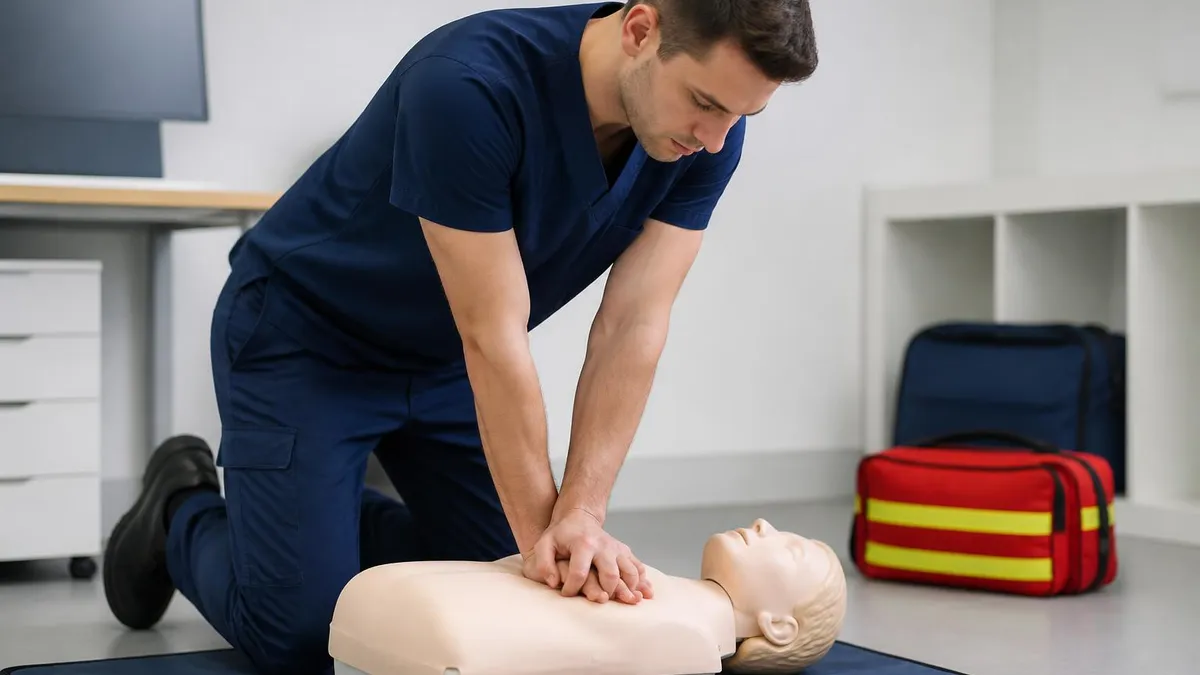
Adult CPR: Complete Step-by-Step Guide to Hands-Only and Standard CPR in 2026

CPR - Cardiopulmonary Resuscitation: Complete Study Guide 2026
About the Author

Registered Nurse & Healthcare Educator
Johns Hopkins University School of NursingDr. Sarah Mitchell is a board-certified registered nurse with over 15 years of clinical and academic experience. She completed her PhD in Nursing Science at Johns Hopkins University and has taught NCLEX preparation and clinical skills courses for nursing students across the United States. Her research focuses on evidence-based exam preparation strategies for healthcare certification candidates.
Join the Discussion
Connect with other students preparing for this exam. Share tips, ask questions, and get advice from people who have been there.
View discussion (5 replies)