
The CPR Guy's Complete Guide to CPR General Knowledge in 2026 October
The CPR Guy breaks down ACLS algorithms, infant CPR, 📗 AED use, BLS certification, and recovery position in one easy 2026 October general knowledge guide.
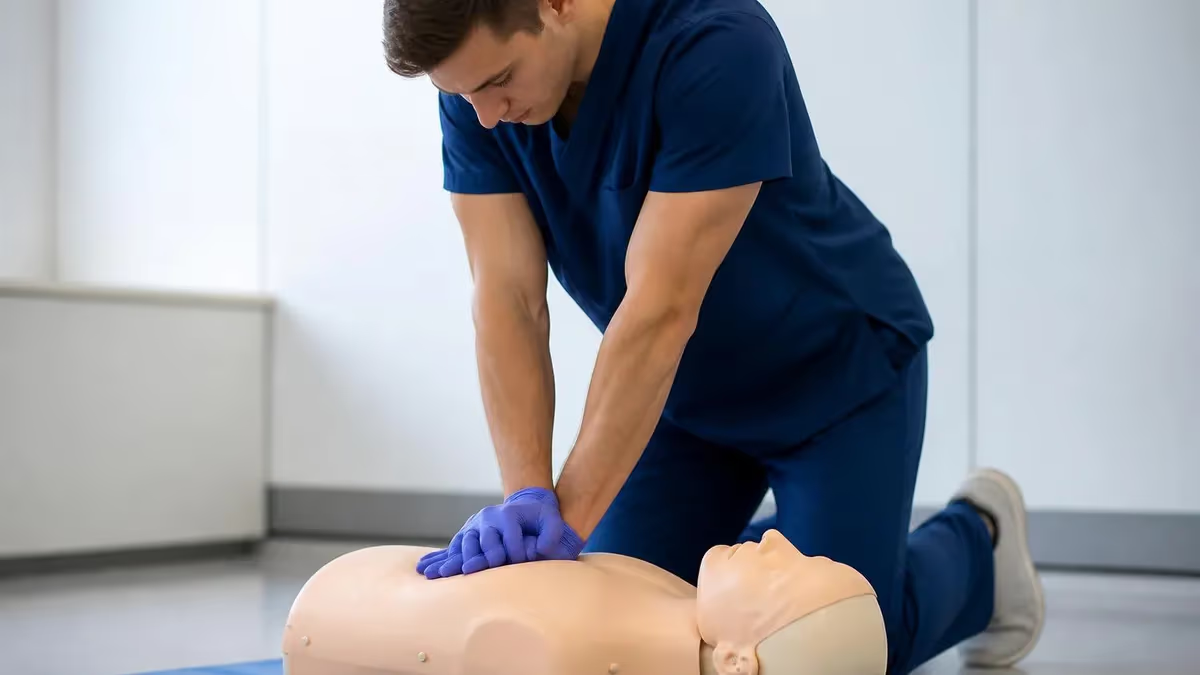
Ask any seasoned instructor and they will tell you the same thing: the cpr guy in every workplace is not the loudest person in the room, but the one who can recall the acls algorithm under pressure, count compressions to the beat of a familiar song, and reassure a panicked bystander while the AED boots up. This guide distills the general knowledge that turns a nervous beginner into that reliable responder, covering every concept you need before your next certification class, refresher, or real emergency.
We will move through the entire landscape of modern resuscitation, from the science of chest recoil to the legal protections offered by Good Samaritan laws. Along the way we will reference the standards published by the American Heart Association, the Red Cross, and the national cpr foundation, because consistent terminology matters when minutes count. Whether you are a teacher, a parent, a lifeguard, or a healthcare worker preparing for pals certification, the fundamentals are identical even when the patient changes size.
Survival from out-of-hospital cardiac arrest in the United States still hovers around ten percent, but communities that train aggressively see numbers two or three times higher. That gap is not about better equipment. It is about ordinary people knowing the sequence, pushing hard and fast, and refusing to stop until professional help arrives. A confident bystander triples the odds of a neurologically intact survivor walking out of the hospital, and that confidence is built one fact at a time.
You will notice we treat CPR as a system rather than a single skill. The chain of survival, the ABCs of patient assessment, the differences between adult and infant cpr, the role of post-resuscitation care, and the way ventilation rate interacts with compression depth all fit together. Miss one link and the chain weakens. Master them and you become genuinely useful in the worst moment of a stranger's life, which is the entire point of getting certified.
This article is also designed for test takers. If you are studying for a Basic Life Support exam, the layout mirrors the way most courses sequence material, and the practice quizzes embedded throughout are pulled from the same question banks used by busy nursing programs.
Finally, a quick note on language. You will see acronyms like AED, ROSC, and OPA appear without warning. We will define each one the first time, then use the short form because that is how providers actually communicate in the field. Read this guide once for context, then return to specific sections as you study. By the end, the vocabulary will feel like a second language rather than a wall of jargon to memorize.
CPR General Knowledge by the Numbers

Core CPR Concepts Every Responder Must Know
Five sequential links: early recognition, immediate CPR, rapid defibrillation, advanced care, and integrated post-arrest treatment. Skipping any link sharply reduces survival odds even when the others are performed perfectly by trained responders.
Push at least two inches deep at 100-120 per minute, allowing complete chest recoil between compressions. Minimize interruptions to under ten seconds and rotate compressors every two minutes to prevent rescuer fatigue.
Use head-tilt chin-lift for uninjured patients and jaw-thrust when spinal injury is suspected. Adjuncts like the oropharyngeal airway help maintain patency once advanced providers arrive on the scene.
Every minute without defibrillation reduces survival by roughly ten percent in shockable rhythms. Apply the AED as soon as it arrives, follow voice prompts, and resume compressions immediately after each analysis.
Return of spontaneous circulation is not the finish line. Monitor airway, breathing, and circulation, place the patient in recovery position if breathing, and prepare a clear handoff report for EMS arrival.
The acls algorithm is the decision tree that guides healthcare providers through cardiac arrest, bradycardia, tachycardia, and post-arrest care. While Basic Life Support focuses on chest compressions and ventilations, Advanced Cardiovascular Life Support layers in rhythm interpretation, vasopressors, antiarrhythmics, and advanced airway placement. Understanding the basic flow, even as a layperson, helps you appreciate why timing matters and why bystander CPR plus early defibrillation is so much more important than any drug given later in the resuscitation.
The cardiac arrest branch splits into shockable and non-shockable rhythms. Ventricular fibrillation and pulseless ventricular tachycardia are shockable, treated with immediate defibrillation followed by two minutes of CPR. Asystole and pulseless electrical activity are non-shockable, treated with continuous compressions, epinephrine every three to five minutes, and an aggressive search for reversible causes. These causes are memorized as the Hs and Ts: hypoxia, hypovolemia, hydrogen ion acidosis, hypothermia, hyperkalemia, tension pneumothorax, tamponade, toxins, thrombosis, and trauma.
Bradycardia algorithms address slow heart rates under fifty beats per minute that cause symptoms like hypotension, altered mental status, or chest discomfort. The first-line drug is atropine, followed by transcutaneous pacing or dopamine infusion if the rhythm fails to respond. Tachycardia algorithms split by stability and QRS width, with synchronized cardioversion reserved for unstable patients and medications like adenosine or amiodarone for stable presentations. These pathways are tested heavily on every ACLS megacode.
Respiratory rate management threads through every arrest scenario. With a basic airway you deliver one breath every six seconds during continuous compressions, which works out to ten breaths per minute. Over-ventilation is one of the most common errors in resuscitation, raising intrathoracic pressure and reducing venous return to the heart. Counting out loud or watching a metronome prevents the natural urge to hyperventilate a patient who looks gray and lifeless on the floor in front of you.
Team dynamics are graded as heavily as clinical knowledge on modern certification exams. The team leader assigns roles, monitors quality, and avoids hands-on tasks so they can think strategically. Members use closed-loop communication, repeating orders back and confirming completion. Knowing your limits and asking for help are considered strengths, not weaknesses. If you want a quick reference for what tools you should know cold, our what does aed stand for primer is a good companion piece.
Finally, ACLS emphasizes systems of care that extend beyond the code itself. Pre-arrival notification to the receiving hospital, coordinated cath-lab activation for STEMI patients, and targeted temperature management after ROSC all live inside the algorithm framework. Even community responders benefit from understanding this big picture, because the chest compressions you start in a parking lot are the foundation on which every subsequent intervention is built. Without quality CPR up front, none of the downstream care has a chance.
The national cpr foundation and the American Heart Association publish slightly different course materials, but the underlying science is identical. Both organizations follow the International Liaison Committee on Resuscitation guidelines, which are updated every five years based on the most current research. Whichever provider you choose for your training, ensure their curriculum aligns with the 2025 ILCOR recommendations so you are not memorizing outdated ratios or sequences when you finally take the exam.

CPR Practice Test Questions
Prepare for the CPR Cardiopulmonary Resuscitation Practice exam with our free practice test modules. Each quiz covers key topics to help you pass on your first try.
CPR Basic CPR
CPR Exam Questions covering Basic CPR. Master CPR Test concepts for certification prep.
CPR and First Aid
Free CPR Practice Test featuring and First Aid. Improve your CPR Exam score with mock test prep.
CPR (Cardiopulmonary Resuscitation) Adult ...
CPR Mock Exam on (Cardiopulmonary Resuscitation) Adult CPR and AED Usage. CPR Study Guide questions to pass on your first try.
CPR (Cardiopulmonary Resuscitation) Airway...
CPR Test Prep for (Cardiopulmonary Resuscitation) Airway Obstruction and Choking. Practice CPR Quiz questions and boost your score.
CPR (Cardiopulmonary Resuscitation) Cardio...
CPR Questions and Answers on (Cardiopulmonary Resuscitation) Cardiopulmonary Emergency Recognition. Free CPR practice for exam readiness.
CPR (Cardiopulmonary Resuscitation) Child ...
CPR Mock Test covering (Cardiopulmonary Resuscitation) Child and Infant CPR. Online CPR Test practice with instant feedback.
CPR (Cardiopulmonary Resuscitation) High-P...
Free CPR Quiz on (Cardiopulmonary Resuscitation) High-Performance Team Dynamics. CPR Exam prep questions with detailed explanations.
CPR (Cardiopulmonary Resuscitation) Legal ...
CPR Practice Questions for (Cardiopulmonary Resuscitation) Legal and Ethical Considerations. Build confidence for your CPR certification exam.
CPR for Specific Populations
CPR Test Online for for Specific Populations. Free practice with instant results and feedback.
CPR Airway & Breathing Management
CPR Exam Questions covering Airway & Breathing Management. Master CPR Test concepts for certification prep.
CPR Assessment & Recognition of Cardiac Ar...
Free CPR Practice Test featuring Assessment & Recognition of Cardiac Arrest. Improve your CPR Exam score with mock test prep.
CPR Chest Compressions & Defibrillation
CPR Mock Exam on Chest Compressions & Defibrillation. CPR Study Guide questions to pass on your first try.
CPR Post-Resuscitation Care & Recovery
CPR Test Prep for Post-Resuscitation Care & Recovery. Practice CPR Quiz questions and boost your score.
Infant CPR vs Child vs Adult Techniques
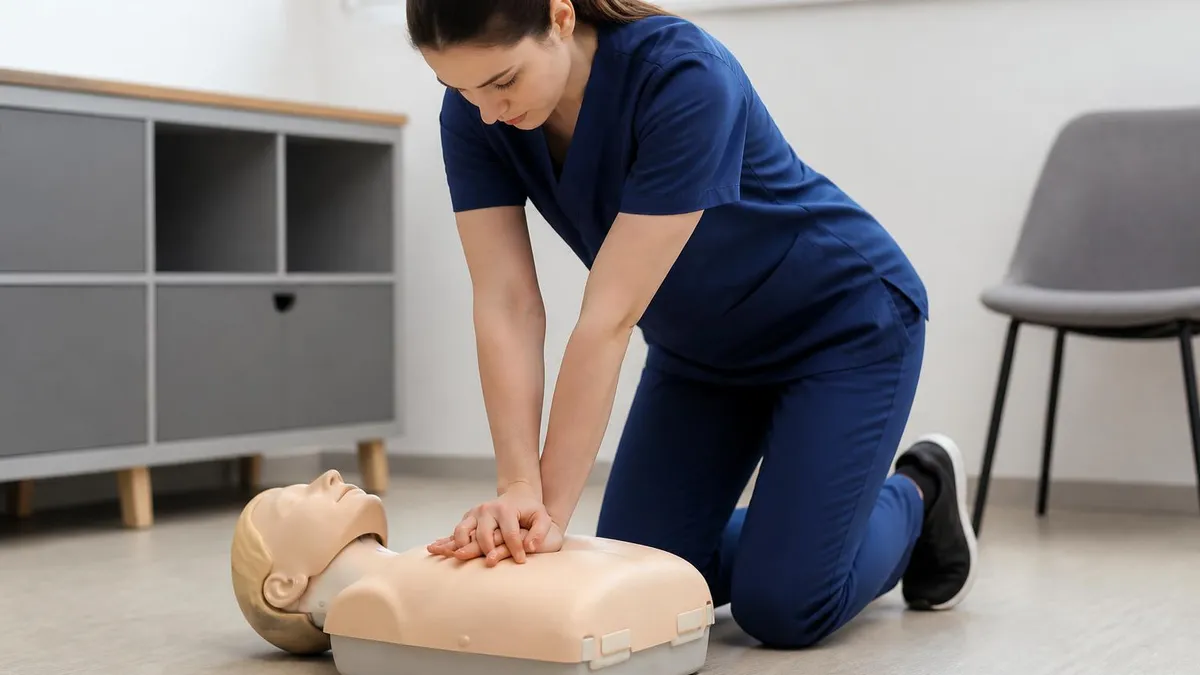
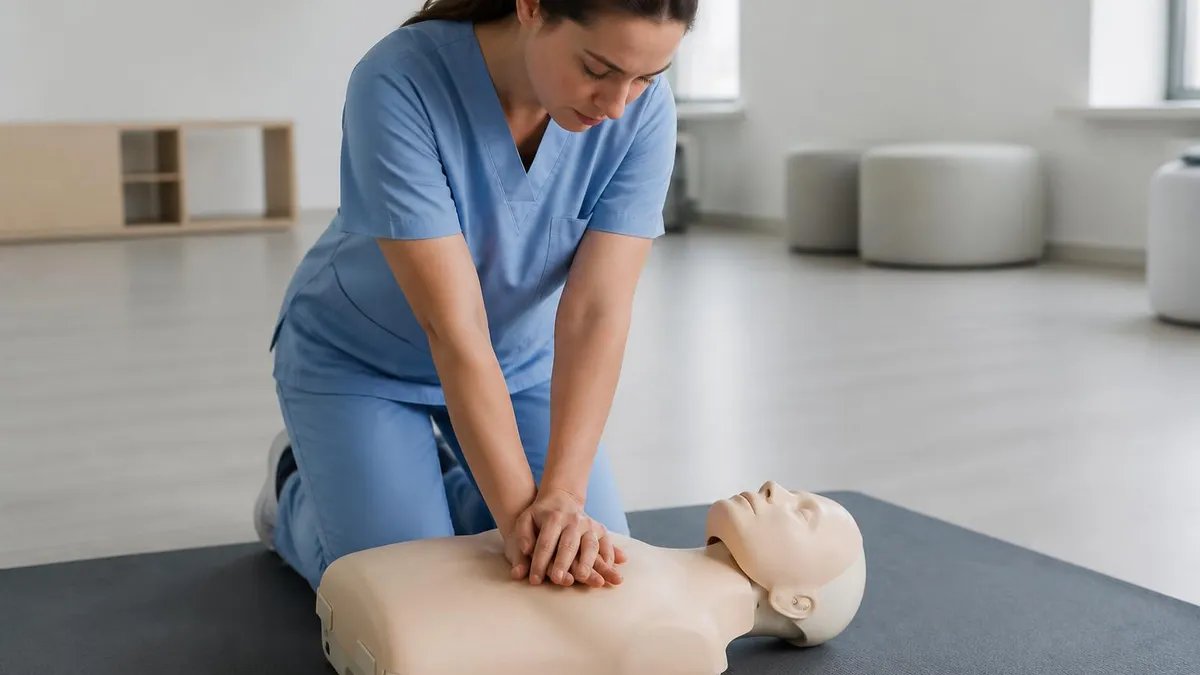
Adult CPR applies to anyone who has reached puberty, regardless of body size. Use two hands stacked on the lower half of the sternum, compress at least two inches but no more than 2.4 inches, and deliver one hundred to one hundred twenty compressions per minute. Single rescuers use a 30:2 ratio with two rescue breaths after every thirty compressions, switching every two minutes to maintain quality.
The most common adult arrest is sudden cardiac arrest from a cardiac cause, so defibrillation is your highest-yield intervention after recognition. Apply the AED the instant it arrives, follow the voice prompts without hesitation, and resume compressions immediately when instructed. Pause only when the device is analyzing or shocking. Never delay compressions to take a pulse if you are uncertain whether one is present in an unresponsive patient.
Online vs In-Person CPR Certification: Which Is Better?
- +Online courses let you study at your own pace around work and family schedules
- +Hybrid programs combine online theory with a short in-person skills check, saving classroom time
- +Digital reference materials remain available after the course for refresher review
- +Lower cost than full in-person courses, often by fifty percent or more
- +Immediate certificate download upon passing the final assessment
- +Accessible for rural learners who lack nearby training centers
- +Multiple attempts allowed on most online quizzes without retaking the entire module
- −Pure online courses without skills verification are not accepted by most healthcare employers
- −Hands-on muscle memory cannot be developed by watching videos alone
- −Some employers and state agencies require AHA or Red Cross branded in-person cards
- −Self-paced format requires discipline; many learners abandon the course before completion
- −Limited opportunity to ask instructors nuanced clinical questions in real time
- −Skill drift happens faster without periodic hands-on practice with manikins
- −Confidence in a real emergency comes from repetition that screens cannot fully replicate
Pros and Cons at a Glance
| Pros | Cons |
|---|---|
| Online courses let you study at your own pace around work and family schedules | Pure online courses without skills verification are not accepted by most healthcare employers |
| Hybrid programs combine online theory with a short in-person skills check, saving classroom time | Hands-on muscle memory cannot be developed by watching videos alone |
| Digital reference materials remain available after the course for refresher review | Some employers and state agencies require AHA or Red Cross branded in-person cards |
| Lower cost than full in-person courses, often by fifty percent or more | Self-paced format requires discipline; many learners abandon the course before completion |
| Immediate certificate download upon passing the final assessment | Limited opportunity to ask instructors nuanced clinical questions in real time |
| Accessible for rural learners who lack nearby training centers | Skill drift happens faster without periodic hands-on practice with manikins |

What Is a BLS Certification Readiness Checklist
- ✓Confirm your training provider is accepted by your employer or licensing board
- ✓Review the current AHA or Red Cross guidelines released in 2025
- ✓Memorize compression depth and rate for adult, child, and infant patients
- ✓Practice the 30:2 single-rescuer ratio and the 15:2 two-rescuer pediatric ratio
- ✓Identify shockable rhythms versus non-shockable rhythms by name
- ✓Know how to operate an AED on wet, hairy, or pacemaker-implanted chests
- ✓Demonstrate proper recovery position placement for breathing unresponsive patients
- ✓Review choking algorithms separately for adults, children, and infants
- ✓Understand Good Samaritan law protections in your specific state
- ✓Bring photo identification and your registration confirmation to the testing site
Deep, full-recoil compressions outperform fast shallow ones every time
Studies from the Resuscitation Outcomes Consortium show that compression depth correlates more strongly with survival than rate, provided rate stays within the 100-120 window. Shallow compressions fail to generate enough coronary perfusion pressure to restart the heart, while incomplete recoil prevents venous return between beats. Push hard, push fast, and let the chest come all the way up.
Defibrillation is the single most impactful intervention for a witnessed adult collapse, which is why AEDs are now found in airports, gyms, and schools across the country. The acronym stands for Automated External Defibrillator, and the device is designed for untrained users. It analyzes the heart rhythm, decides whether a shock is appropriate, and walks the rescuer through every step using clear voice prompts. Even children can operate one successfully, which is why some elementary schools have begun including AED familiarity in health classes.
Pad placement matters. The standard anterior-anterolateral configuration places one pad below the right collarbone and the other on the left lower ribs at the mid-axillary line. For very small children under eight years of age or twenty-five kilograms, place one pad on the chest and one on the back to prevent the electrodes from touching. Wet skin should be dried with a towel before pads are applied, and excessive chest hair may need to be quickly shaved with the razor included in most AED kits.
Recovery position is used for unresponsive patients who are breathing normally and have a pulse. Roll the patient onto their side with the lower arm extended overhead and the upper leg bent for stability. Tilt the head slightly back to keep the airway open and allow fluids to drain from the mouth. This position prevents aspiration of vomit, which is the leading airway complication during transport. Reassess breathing every two minutes until EMS arrives.
Choking emergencies require quick recognition. A conscious adult clutching the throat is using the universal sign of airway obstruction. Ask whether they are choking, and if they nod yes and cannot speak, begin abdominal thrusts. Stand behind the patient, place a fist just above the navel, grasp it with your other hand, and deliver quick inward and upward thrusts. Continue until the object is expelled or the patient becomes unresponsive, at which point you transition to CPR while looking for the object during each breath cycle.
The respiratory rate inside CPR differs from a patient's normal breathing rate. A healthy adult breathes twelve to twenty times per minute at rest, but during compressions you deliver only ten ventilations per minute with an advanced airway in place, or two breaths after every thirty compressions without one. This rate is deliberately slow to avoid hyperinflation, which raises intrathoracic pressure and impedes the very circulation you are trying to restore. Practice this counting cadence with a metronome or a timer until it becomes automatic.
Knowing position recovery, AED operation, and proper ventilation rates together gives you a complete picture of post-collapse care. These three skills are the bridge between high-quality compressions and definitive treatment at the hospital. Without them, even perfect chest compressions can be wasted if the patient aspirates or fails to receive a timely shock. With them, you become the responder that ICU doctors love to inherit, because the airway is clear, the rhythm is documented, and the timeline is clean.
Confidence with the cpr index of clinical concepts comes from practice, not just reading. Each time you rehearse a scenario, your brain encodes the sequence a little deeper, until under stress your body executes before your conscious mind catches up. Schedule a refresher every two years even if your certification is valid for longer, because skill decay is real and measurable within six months of initial training. Hands-on repetition is the only reliable antidote.
Lay rescuers should not attempt to find a pulse on an unresponsive non-breathing patient. Research consistently shows that even trained providers are wrong about pulse presence roughly forty percent of the time under stress. If the patient is unresponsive and not breathing normally, start compressions immediately. The risk of delayed CPR vastly outweighs the negligible risk of compressing a beating heart.
Building a career around resuscitation knowledge has never been easier. Healthcare facilities specifically require Basic Life Support for every clinical role, and many ask for ACLS or pals certification depending on the patient population served. Even non-clinical staff like security, registration, and dietary often need BLS to maintain hospital privileges.
Pals certification adds pediatric-specific algorithms to the ACLS framework, addressing the unique physiology of children and infants. The course covers respiratory distress and failure, shock recognition, cardiac arrest pathways adapted for pediatric weights, and post-arrest stabilization. Providers who work in emergency departments, pediatric units, labor and delivery, or transport teams typically need PALS. The class is two days for initial certification and one day for renewal, with a written exam and skills station that closely mirrors the ACLS format.
The national cpr foundation, American Heart Association, and Red Cross all issue cards accepted by most employers, but acceptance varies by state and facility. Always confirm with your specific employer before paying for a course. Some specialty boards, like ENA's TNCC or the AHA's PEARS program, complement but do not replace your core BLS or ACLS card. Stack credentials thoughtfully based on the population you actually treat, not on what looks impressive on paper.
Skill maintenance between certifications is critical. Many hospitals now use quarterly low-dose, high-frequency drills with manikins that provide real-time feedback on depth, rate, and recoil. Even fifteen minutes of monthly practice improves performance more than a single two-year refresher, and home manikins are affordable for serious students. Apps with metronomes and ventilation timers help you rehearse mentally during downtime, building the cadence into long-term memory rather than short-term cramming.
The legal landscape protects rescuers in nearly every state through Good Samaritan laws, which shield bystanders from civil liability when they act in good faith. These protections do not cover gross negligence, expectation of payment, or actions outside your training scope. Read your state's specific statute, because protections for off-duty healthcare providers vary widely. When in doubt, document what you did, why you did it, and the patient's response so EMS and emergency department staff have a clean handoff narrative.
Test preparation is its own discipline. The most successful students mix reading, video review, and timed practice quizzes that mirror the actual exam format. Our cpr index walkthrough covers test-day tactics, common trick questions, and the high-yield topics that appear on nearly every BLS, ACLS, and PALS exam. Reviewing rationales for every incorrect answer is more valuable than completing additional questions you already know.
Finally, remember that knowledge has a shelf life only if you let it expire. The providers who stay sharp are the ones who teach others, volunteer at community CPR events, and stay curious about evolving research. Resuscitation science changes faster than most disciplines because clinical trials are rapid and outcomes are measurable. Subscribe to a journal alert, follow respected resuscitation researchers on social media, and treat every recertification as an opportunity to learn what is new rather than to dust off what is old.
Practical preparation for your exam day starts the night before, not the morning of. Eat a normal dinner, sleep at least seven hours, and avoid cramming new material after eight in the evening. Stress hormones from sleep deprivation suppress recall, and last-minute panic studying tends to overwrite well-rehearsed information with shallow new associations. Lay out your photo ID, registration confirmation, and any required textbooks the night before so the morning is purely logistical rather than mentally taxing on game day.
During the written exam, read every question twice and underline qualifying words like always, never, first, and except. Multiple-choice questions on resuscitation often hinge on a single word change between two otherwise identical answers. If two options seem correct, choose the one that is more specific or that addresses safety first. When unsure, eliminate obviously wrong answers to improve your odds on the remaining choices, and avoid changing answers without a concrete reason that came from another question.
For the skills station, narrate everything you do. Examiners cannot grade what they cannot see or hear. Announce scene safety, check responsiveness, call for help, request the AED, and verbalize pulse and breathing checks even if you instinctively perform them silently. This narration is not for show. It mirrors how real teams communicate under stress and reduces the chance of missing a critical step the proctor expects you to complete in sequence.
Real-world deployment of your skills will feel chaotic compared to the controlled exam environment. Bystanders panic, lighting is poor, and the patient is rarely on a flat hard surface. Anchor yourself by returning to fundamentals: assess responsiveness, call for help, start compressions, request the AED. Everything else is layered on top of this foundation. If you get lost mid-resuscitation, restart the algorithm from the beginning rather than improvising, because the algorithm exists precisely to prevent panic-induced errors.
Mental rehearsal between certifications keeps your skills sharp. Spend two minutes a day visualizing a scenario from beginning to end, including the noise, the visual chaos, and the physical exertion. Athletes have used this technique for decades to maintain peak performance, and emergency responders are increasingly adopting it. The brain encodes rehearsed scenarios almost as deeply as live practice, making your first real response feel like your tenth rather than your first.
Build a community of practice if your workplace allows it. Monthly fifteen-minute drills with coworkers reinforce muscle memory and surface gaps in equipment readiness like missing pocket masks, dead AED batteries, or unclear emergency call procedures. The best CPR programs are not those with the most expensive equipment but those with the strongest culture of repetition and honest debriefing. Celebrate near-misses as learning opportunities rather than failures to hide.
Once certified, look for opportunities to teach or assist with community training events. Teaching is the single fastest way to deepen your own mastery, because explaining a concept forces you to confront the gaps in your understanding. Many community CPR programs welcome volunteer assistants who can demonstrate techniques and coach beginners through their first awkward attempts on a manikin. Your reward is a steadily expanding network of confident bystanders in your community, which is the entire reason this knowledge exists.
CPR Questions and Answers
About the Author

Registered Nurse & Healthcare Educator
Johns Hopkins University School of NursingDr. Sarah Mitchell is a board-certified registered nurse with over 15 years of clinical and academic experience. She completed her PhD in Nursing Science at Johns Hopkins University and has taught NCLEX preparation and clinical skills courses for nursing students across the United States. Her research focuses on evidence-based exam preparation strategies for healthcare certification candidates.
Join the Discussion
Connect with other students preparing for this exam. Share tips, ask questions, and get advice from people who have been there.
View discussion (5 replies)