
Boise CPR and First Aid Classes Near Me: Complete 2026 September Guide to Local Certification, Costs, and Course Selection
Find boise cpr and first aid classes near me: compare AHA, Red Cross, and National CPR Foundation courses, costs, schedules, and certification ✅
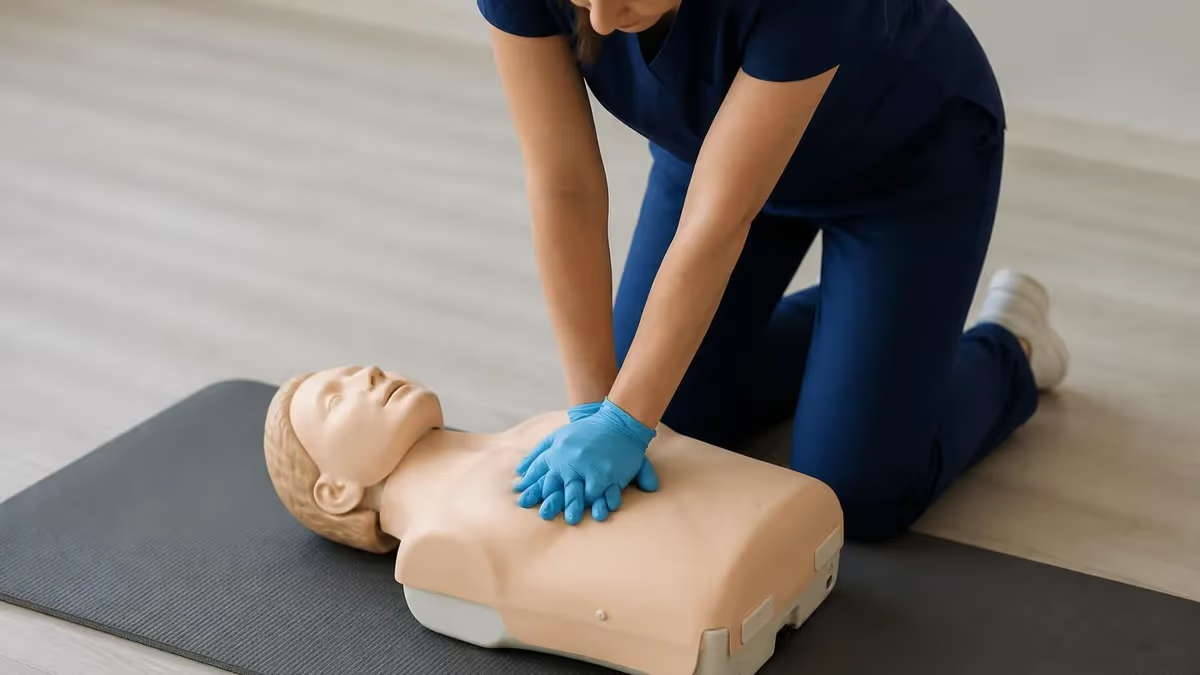
Searching for boise cpr and first aid classes near me can feel overwhelming when you scroll through dozens of providers, course formats, and price points without knowing which certification employers actually accept. Whether you are a new healthcare worker, a daycare teacher, a personal trainer, or a parent who wants the confidence to respond to a cardiac emergency, choosing the right local class is the first concrete step toward becoming someone who can save a life. This 2026 guide walks you through every option available in the Treasure Valley.
The good news is that Boise has one of the densest networks of CPR training centers per capita in the Mountain West. Saint Alphonsus, Saint Luke's, the Boise Fire Department, the American Red Cross Idaho chapter, and dozens of independent instructors all offer in-person and blended classes weekly. You can typically book a seat within seven days, complete the course in three to five hours, and walk out with a two-year certification card the same afternoon.
Beyond convenience, the cost-to-credential math is favorable in Boise compared with bigger metros. Basic adult CPR and AED runs between $45 and $75, while a combined CPR, AED, and first aid course averages $75 to $110. Healthcare-provider-level BLS, which includes adult, child, and infant cpr along with two-rescuer scenarios, sits in the $80 to $130 range. ACLS and pals certification courses cost more, typically $200 to $300, because they include pharmacology and the acls algorithm.
This article explains exactly how to evaluate providers, what each certification covers, how the course day unfolds, what your card looks like, and how to keep it active for the rest of your career. We also debunk a common search-result confusion: people typing "cpr cell phone repair" or "cpr phone repair" are looking for a device-repair franchise unrelated to resuscitation training, so we will clear that up before you accidentally book the wrong appointment.
You'll also learn how the national cpr foundation online option compares with in-person Boise classes, when an employer might require American Heart Association branding specifically, and what to do if your last card has already expired. We compiled pricing, schedules, and pass-rate data from public Idaho training-center calendars between January 2025 and April 2026.
Before you commit to any provider, take a few minutes to test your baseline knowledge. A short practice round on compression depth, position recovery, respiratory rate ranges, and what does aed stand for will tell you whether you can sail through a refresher class or whether you need the full initial certification. Most students underestimate how much they have forgotten since their last renewal, especially around pediatric protocols.
By the end of this guide you will know which Boise course matches your job requirements, how to register in under ten minutes, what to bring on class day, and how to verify your card the moment it is issued. Let's start with a quick snapshot of the local market by the numbers.
Boise CPR Training by the Numbers

Top CPR and First Aid Providers Near Boise
Hosts AHA BLS, ACLS, and PALS classes weekly at the Boise medical campus. Best for nurses, EMTs, and respiratory therapists who need provider-level cards with hospital-recognized branding.
Offers blended learning with online theory plus a 90-minute in-person skills session. Strong choice for teachers, coaches, and lifeguards who need both CPR and first aid in one card.
Runs community Heartsaver classes monthly at firehouses around the Treasure Valley. Hands-on focus with real AED trainers, ideal for parents, neighbors, and citizen-responder programs.
Dozens of small instructor businesses serve specific industries: daycare, dental offices, gyms. Flexible scheduling, on-site group classes, and same-day eCards typically issued before you leave.
Fully online national cpr foundation course accepted by many non-clinical employers. Cheapest path at around $20, instant PDF card, but verify acceptance with your employer before enrolling.
Understanding the certification landscape is the second step after picking a provider. The most common credential in Boise is Heartsaver CPR/AED, designed for laypeople, teachers, fitness instructors, security staff, and anyone whose job description simply says "CPR certified." It covers adult cpr, child and infant cpr, choking relief, and automated external defibrillator use. The classroom hours run three to four, and the card is valid for two years from the issue date.
One level up is Heartsaver First Aid CPR AED, which adds bleeding control, splinting, burns, stings, seizures, diabetic emergencies, and stroke recognition. This is the credential most childcare licensing boards in Idaho require, and it is the one school districts ask substitute teachers to carry. Expect four to five hours of instruction and roughly $90 to $110 in Boise. Make sure your provider issues the combined card rather than two separate ones.
Healthcare workers need Basic Life Support, abbreviated BLS. This course assumes you already know what does aed stand for and moves quickly into two-rescuer scenarios, bag-valve-mask ventilation, and team dynamics. BLS forms the foundation for advanced courses like ACLS and pals certification, both of which build on the acls algorithm taught in formal medical education. Boise hospital systems run BLS classes almost daily, including evening and weekend slots.
Advanced Cardiac Life Support, or ACLS, is required for ICU nurses, ED staff, paramedics, and many anesthesia providers. The 10-to-14-hour curriculum dives deep into rhythm recognition, pharmacology, and the acls algorithm for cardiac arrest, bradycardia, tachycardia, and post-arrest care. Pediatric Advanced Life Support, PALS, covers the same intensity for children, including pediatric respiratory rate norms, shock states, and dehydration. Both cost more but are reimbursed by most Boise employers.
You may also see "life support" listed as a generic term on job postings. In the Treasure Valley this almost always means BLS, but verify with the hiring manager before paying for ACLS unnecessarily. Conversely, a fitness chain that lists "CPR" without specifics usually accepts Heartsaver. Asking before you enroll prevents the awkward conversation where HR rejects your card on day one.
One more category worth knowing: pediatric-specific first aid for childcare providers. Idaho IdahoSTARS-licensed daycares require a pediatric-focused course that covers infant cpr, choking in toddlers, fever protocols, allergic reactions, and position recovery for unresponsive but breathing children. Several Boise instructors specialize in this niche and offer evening classes designed around childcare staff schedules. If you work in early-childhood education, look specifically for a Pediatric First Aid CPR AED course rather than the standard adult Heartsaver.
Finally, do not confuse genuine training with the cpr cell phone repair franchise. "CPR" in that brand stands for Cell Phone Repair, and those storefronts have nothing to do with resuscitation. If a Google Map result shows a phone-repair logo, scroll past it. Authentic Boise training providers will display the AHA torch, the Red Cross emblem, or the national cpr foundation seal, and they will list course codes, instructor numbers, and a class calendar on their site.
CPR Practice Test Questions
Prepare for the CPR Cardiopulmonary Resuscitation Practice exam with our free practice test modules. Each quiz covers key topics to help you pass on your first try.
CPR Basic CPR
CPR Exam Questions covering Basic CPR. Master CPR Test concepts for certification prep.
CPR and First Aid
Free CPR Practice Test featuring and First Aid. Improve your CPR Exam score with mock test prep.
CPR (Cardiopulmonary Resuscitation) Adult ...
CPR Mock Exam on (Cardiopulmonary Resuscitation) Adult CPR and AED Usage. CPR Study Guide questions to pass on your first try.
CPR (Cardiopulmonary Resuscitation) Airway...
CPR Test Prep for (Cardiopulmonary Resuscitation) Airway Obstruction and Choking. Practice CPR Quiz questions and boost your score.
CPR (Cardiopulmonary Resuscitation) Cardio...
CPR Questions and Answers on (Cardiopulmonary Resuscitation) Cardiopulmonary Emergency Recognition. Free CPR practice for exam readiness.
CPR (Cardiopulmonary Resuscitation) Child ...
CPR Mock Test covering (Cardiopulmonary Resuscitation) Child and Infant CPR. Online CPR Test practice with instant feedback.
CPR (Cardiopulmonary Resuscitation) High-P...
Free CPR Quiz on (Cardiopulmonary Resuscitation) High-Performance Team Dynamics. CPR Exam prep questions with detailed explanations.
CPR (Cardiopulmonary Resuscitation) Legal ...
CPR Practice Questions for (Cardiopulmonary Resuscitation) Legal and Ethical Considerations. Build confidence for your CPR certification exam.
CPR for Specific Populations
CPR Test Online for for Specific Populations. Free practice with instant results and feedback.
CPR Airway & Breathing Management
CPR Exam Questions covering Airway & Breathing Management. Master CPR Test concepts for certification prep.
CPR Assessment & Recognition of Cardiac Ar...
Free CPR Practice Test featuring Assessment & Recognition of Cardiac Arrest. Improve your CPR Exam score with mock test prep.
CPR Chest Compressions & Defibrillation
CPR Mock Exam on Chest Compressions & Defibrillation. CPR Study Guide questions to pass on your first try.
CPR Post-Resuscitation Care & Recovery
CPR Test Prep for Post-Resuscitation Care & Recovery. Practice CPR Quiz questions and boost your score.
AHA vs Red Cross vs National CPR Foundation
The American Heart Association is the gold standard for clinical roles. Every Boise hospital, urgent care, dental office, and EMS agency accepts AHA cards without question. The curriculum follows the latest International Liaison Committee on Resuscitation guidelines, includes the full acls algorithm for advanced students, and emphasizes high-quality compressions with audible metronome practice during skills sessions.
AHA classes in Boise run $75 to $130 depending on level. Cards are issued as eCards within 24 hours and can be verified instantly at the AHA's public lookup portal. If your employer mentions "BLS for Healthcare Providers," they specifically mean AHA. Choose this option whenever a clinical or licensed role is on your horizon, even if you don't need it yet.
In-Person Boise Classes vs Fully Online Certification
- +Hands-on practice with manikins builds muscle memory you cannot get from video
- +Instructors correct compression depth, hand placement, and rescue-breath technique in real time
- +Universally accepted by hospitals, schools, daycares, and government employers
- +Same-day card issuance with photo identification on file
- +Opportunity to ask scenario-specific questions about your workplace
- +Group dynamics simulate real two-rescuer responses
- +Local instructors often share Boise-specific 911 dispatch tips
- −Higher cost, typically $45 to $130 versus $20 online
- −Requires travel and a fixed time block of 3 to 5 hours
- −Limited evening and weekend slots fill quickly
- −Group classes move at the slowest learner's pace
- −Manikin sharing concerns remain for immunocompromised students
- −Cancellation policies can be strict, with 48-hour minimums
- −Renewal still requires another in-person skills check

Pre-Class Checklist Before Your Boise CPR Course
- ✓Confirm the certification level your employer or licensing board requires in writing
- ✓Verify the provider is AHA-aligned, Red Cross-authorized, or accepted by your specific employer
- ✓Read recent Google reviews focusing on instructor quality and skills-check rigor
- ✓Register online and screenshot the confirmation email with class date and address
- ✓Complete any pre-course online module at least 24 hours before the skills session
- ✓Bring a photo ID matching the name you want printed on your card
- ✓Wear loose, comfortable clothing you can kneel and move in during manikin practice
- ✓Eat a real meal beforehand because most classes do not include a lunch break
- ✓Charge your phone so you can download the eCard PDF immediately after passing
- ✓Save your card number and provider login credentials in a password manager for renewal time
The two-finger infant compression myth is outdated
Current AHA guidelines for lay rescuers performing infant cpr recommend the two-thumb encircling-hands technique whenever two rescuers are present, and the two-finger technique only for solo rescuers. Many older students still teach the outdated single method to younger family members. Confirm during your skills session that you can perform both, since employers test for the two-thumb version on healthcare provider exams.
Your Boise class day usually starts with a brief sign-in, ID verification, and a short knowledge pre-test that takes about ten minutes. Do not stress about this pre-test. Instructors use it to gauge group experience and pace the lecture, not to gatekeep certification. Even if you score low, you will still complete the same training and skills check as everyone else. Bring a pen, water bottle, and a snack since some classes skip formal breaks.
The lecture portion runs ninety minutes to two hours and follows AHA or Red Cross video modules with instructor commentary. Topics covered include the chain of survival, scene safety, compression depth and rate, position recovery for breathing but unresponsive victims, AED operation, choking response, and respiratory rate assessment for both adult and pediatric patients. Pay attention to the rhythm cues, since you'll need to demonstrate them during the manikin portion that follows.
Skills practice is where the real learning happens. You'll work with adult, child, and infant manikins, performing 30-to-2 compression-to-breath cycles, applying AED pads, clearing airway obstructions, and rolling unresponsive patients into the recovery position. Instructors walk around correcting hand placement, depth, and rate. Expect to do at least three full two-minute compression sets, which is genuinely tiring even if you're in good shape.
For combined first aid courses, the second half adds bleeding control with tourniquets and direct pressure, splinting suspected fractures, treating burns, recognizing stroke with the FAST acronym, responding to seizures, managing diabetic emergencies, and identifying anaphylaxis. Many Boise instructors bring real EpiPen trainers, simulated wound makeup, and SAM splints so students get hands-on time with equipment they would actually use in a workplace first aid kit.
The final skills check is straightforward: perform two minutes of continuous compressions on an adult manikin, demonstrate AED use with proper pad placement, and verbally walk through the choking sequence. Healthcare provider courses add bag-valve-mask ventilation and two-rescuer switches. There is no formal pass-fail anxiety. If you miss something, the instructor will coach you through it and let you retry on the spot.
After the skills check, you'll take a 25-to-35-question written exam. Open-book is common for Heartsaver, closed-book for BLS. Passing score is typically 84 percent, which translates to missing roughly four questions out of twenty-five. Boise pass rates run above 96 percent on first attempt for basic courses. If you do miss the threshold, most instructors offer a free retake within two weeks, no extra paperwork required.
Your card is issued the same day or within 24 hours by email. AHA eCards live in your AHA account at heart.org, Red Cross digital certificates appear in your Red Cross learning dashboard, and NCF sends a PDF immediately. Save copies in cloud storage, your phone wallet, and a printed file at home. Employers occasionally lose digital copies during onboarding, and having a backup prevents delays.
Before leaving the classroom, log into your provider's verification portal on your phone and confirm your card number resolves to your name and certification level. Roughly 1 in 200 cards have data-entry errors that are trivial to fix while the instructor is present but become a multi-week ordeal if you discover the problem after the training site closes the class roster.
Renewal cadence matters more than most students realize. AHA, Red Cross, and the national cpr foundation all issue two-year cards. Mark the expiration date in your calendar with a 90-day advance reminder. Letting your card lapse forces you to take the full initial course again rather than the shorter renewal class, costing both time and roughly $30 to $50 in additional fees. Boise providers will absolutely not honor a card that expired even one day ago.
Renewal classes typically run shorter than initial certification. Heartsaver renewal is two to three hours instead of four, BLS renewal is two hours instead of four, and ACLS renewal is six to eight hours instead of fourteen. The skills checks remain the same, so practice with a free online refresher before walking in. Many students fail their first renewal attempt because they forgot the compression-to-breath ratio and have to retake the practical.
Online-only renewal options have expanded since 2024. The AHA now offers a HeartCode blended renewal where you complete cognitive content online and book a 30-minute skills session at any Boise training center. This format suits busy healthcare workers who can finish theory at home on a Sunday evening and stop by for the skills check during a lunch break. The combined cost is similar to in-person renewal.
Verification is the other half of card management. Employers, schools, and licensing boards frequently audit certifications, especially in childcare, healthcare, and education. Each provider has a public lookup tool: AHA at heart.org/cpr/mycards, Red Cross at redcross.org/take-a-class/digital-certificate, and NCF directly on the foundation's verification page. Save the lookup URLs in your phone for the inevitable Monday morning when HR asks for proof.
If you lose access to your card, recovery depends on the provider. AHA requires you to contact the original training center and may charge a small fee for a reprint. Red Cross lets you recover digital certificates by logging into your account and re-downloading the PDF for free. NCF reissues PDFs immediately on request. Take screenshots and email yourself a backup the moment your card is first issued so you never face this problem.
One increasingly common scenario in Boise: out-of-state cards transferring in. If you moved from California, Texas, or anywhere else, your existing AHA or Red Cross card remains valid in Idaho until its original expiration date. You do not need to recertify with an Idaho instructor specifically. However, if your card came from a provider unfamiliar to Idaho employers, expect to provide documentation showing it meets AHA-equivalent standards or simply retake a local class.
Finally, keep growing. Once you have basic CPR and first aid, consider stacking credentials. Stop the Bleed adds tourniquet and wound-packing training in a 90-minute free class. Naloxone administration training is offered free by the Idaho Department of Health and Welfare. Mental Health First Aid teaches you to recognize and respond to psychological crises. These supplementary skills make you significantly more capable in real emergencies and look strong on resumes for safety-sensitive roles.
Practical preparation tips can turn an average class experience into one where you genuinely retain the skills. Start by watching the official AHA or Red Cross instructional videos on YouTube the night before. They are free, run about twenty minutes total, and prime your brain for the in-class lecture. Students who arrive cold often spend the first hour playing catch-up while peers who previewed the content are already practicing manikin work.
Hydrate aggressively the day of class. Compressions are physically demanding, and many Boise classrooms run warm in summer due to limited HVAC capacity at smaller training sites. Skip caffeine in the hour before class, since the adrenaline of performing in front of an instructor combined with stimulants can make your hands shake during AED pad placement. Pack a light snack like trail mix or a banana for the energy dip that hits around the three-hour mark.
Practice the rhythm of compressions before you arrive. The target is 100 to 120 compressions per minute, which matches the beat of "Stayin' Alive," "Crazy in Love," or "Another One Bites the Dust." Tap on a table for two minutes straight and you'll quickly understand why instructors emphasize rescuer rotation every two minutes. Building this physical stamina before class means you'll nail the skills check without burning out halfway through.
Memorize the universal sequence: check responsiveness, call 911, get an AED, begin compressions, deliver rescue breaths if trained, continue until help arrives. Knowing what does aed stand for, what life support actually means in your job context, and the difference between adult and infant cpr depth (two inches versus one and a half inches) gives you confidence walking in. Confidence reduces test anxiety dramatically.
For combined first aid courses, prelearn the FAST acronym for stroke (Face drooping, Arm weakness, Speech difficulty, Time to call 911), the signs of anaphylaxis (hives, swelling, breathing difficulty, blood pressure drop), and basic bleeding control (direct pressure first, tourniquet for life-threatening limb bleeding). These concepts come up on virtually every Heartsaver written exam in some form, so knowing them cold means more time to focus on harder material.
If you are renewing rather than certifying for the first time, do not skip the practice quizzes. Two years is enough time for protocols to update and for your memory of fine details like respiratory rate ranges and position recovery technique to fade. Even experienced healthcare providers benefit from a one-hour refresher the day before renewal. Going in confident saves the embarrassment of needing remediation on basic skills.
Finally, share your training with family. Within a week of your class, walk a partner, roommate, or older child through what you learned. Teaching reinforces memory better than re-reading the manual, and you create a small network of people who can respond if you are the one who collapses. Boise has roughly 400 out-of-hospital cardiac arrests each year, and bystander CPR doubles survival chances. Your training only matters if you can actually use it under pressure.
CPR Questions and Answers
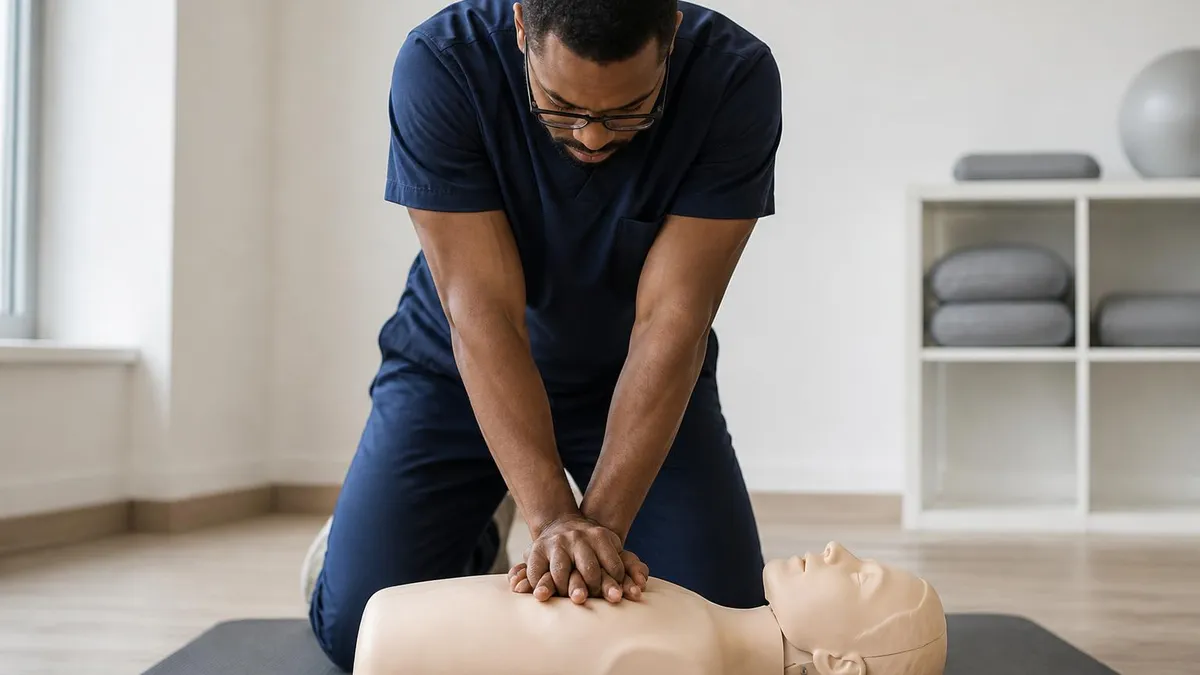
CPR Card Lookup: How to Verify, Replace, and Access Your CPR Certification in 2026
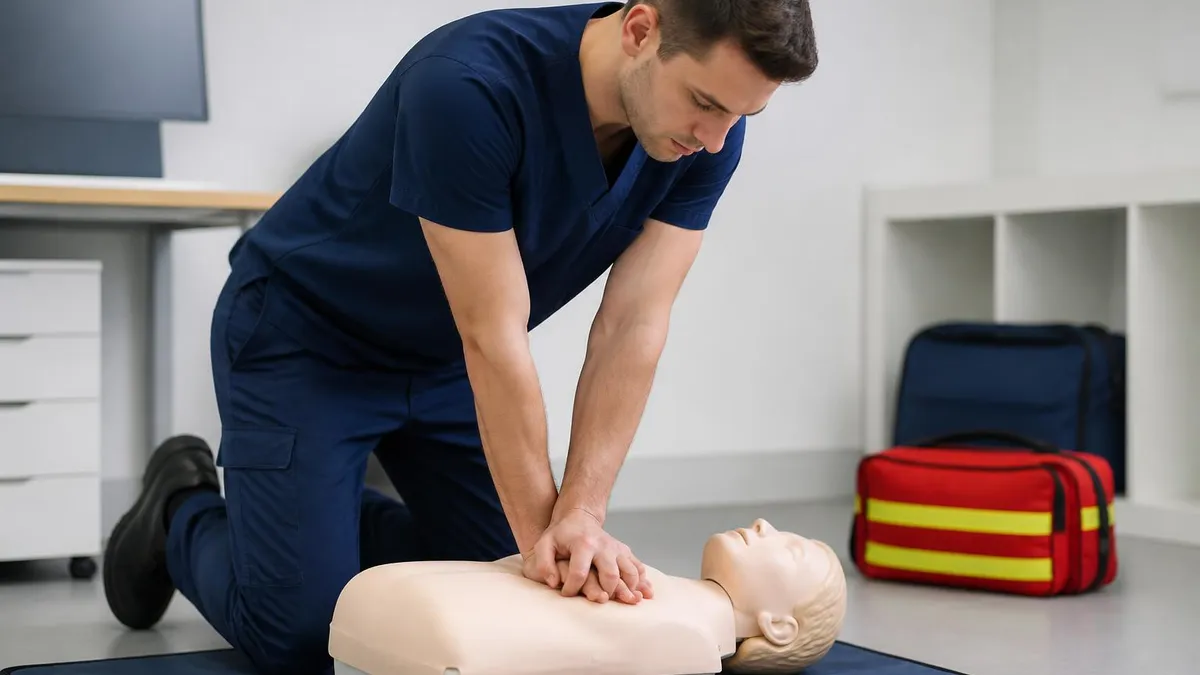
Adult CPR: Complete Step-by-Step Guide to Hands-Only and Standard CPR in 2026
CPR - Cardiopulmonary Resuscitation: Complete Study Guide 2026
Inappropriate CPR Songs: What Not to Play, Why It Matters, and Better Beat-Per-Minute Alternatives
AHA CPR Recertification: How to Recertify CPR Online with the American Heart Association in 2026
About the Author

Registered Nurse & Healthcare Educator
Johns Hopkins University School of NursingDr. Sarah Mitchell is a board-certified registered nurse with over 15 years of clinical and academic experience. She completed her PhD in Nursing Science at Johns Hopkins University and has taught NCLEX preparation and clinical skills courses for nursing students across the United States. Her research focuses on evidence-based exam preparation strategies for healthcare certification candidates.
Join the Discussion
Connect with other students preparing for this exam. Share tips, ask questions, and get advice from people who have been there.
View discussion (5 replies)