
BLS Online Certification: Complete Guide to Getting Certified in Basic Life Support
Learn what is a BLS certification, how BLS online certification works, costs, renewal rules, and AHA vs Red Cross options for healthcare providers. 📚
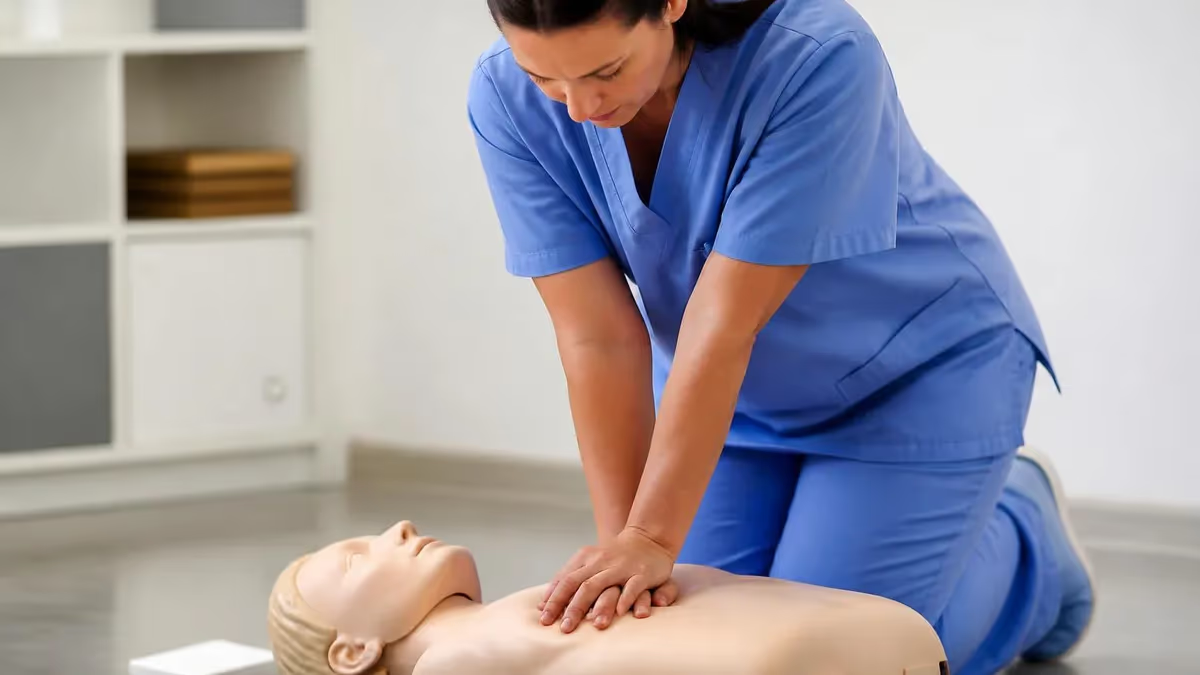
Understanding what is a BLS certification is the first step for any healthcare professional entering clinical practice. Basic Life Support, commonly abbreviated as BLS, is a standardized emergency training program that teaches healthcare providers to recognize and respond to life-threatening cardiac, respiratory, and choking emergencies. BLS online certification has made it easier than ever for nurses, paramedics, physicians, and allied health workers to meet their credentialing requirements without taking time away from busy clinical schedules.
BLS certification is not the same as a general CPR card issued at a community first-aid class. The BLS credential is specifically designed for healthcare providers and is typically required by hospitals, urgent care centers, ambulatory surgery centers, and other clinical employers before a provider can begin working with patients. The course covers high-quality adult, child, and infant CPR, automated external defibrillator (AED) use, relief of foreign-body airway obstruction, and team-based resuscitation using the resuscitation triangle framework.
The two most recognized issuing organizations for BLS certification in the United States are the American Heart Association (AHA) and the American Red Cross. The AHA Basic Life Support exam and corresponding skills evaluation are widely regarded as the gold standard in healthcare settings, and most hospitals specify AHA BLS cards as the minimum acceptable credential. The American Red Cross Basic Life Support program offers comparable content and is accepted at many institutions, though it is worthwhile confirming acceptability with your employer before enrolling.
If you are wondering whether BLS and CPR are the same thing, the short answer is no — but they are closely related. CPR (cardiopulmonary resuscitation) is a core component of BLS, but BLS for healthcare providers extends well beyond chest compressions and rescue breaths. BLS training incorporates 2-rescuer techniques, bag-mask ventilation, team dynamics, and scenario-based decision-making that goes far beyond the scope of a standard lay-responder CPR course.
BLS online certification typically follows a blended learning format endorsed by the AHA: students complete the cognitive portion of the course online through self-paced modules, then attend a brief in-person skills session to demonstrate competency with a certified instructor. Some online-only BLS courses exist, but many healthcare employers do not accept them because they cannot verify hands-on skills. Always confirm your employer's policy before choosing a fully online option.
This guide walks you through everything you need to know about BLS online certification — from understanding what BLS stands for and how it differs from CPR, to navigating the AHA and Red Cross course options, renewal schedules, and test preparation strategies. Whether you are a nursing student preparing for your first clinical rotation or an experienced paramedic approaching your two-year renewal, this resource will help you get certified efficiently and confidently. For details on how long does basic life support certification last, see our dedicated overview article.
Before diving into course details, it helps to appreciate the clinical stakes behind BLS training. Cardiac arrest strikes approximately 350,000 Americans outside of hospital settings each year, and survival rates improve dramatically when bystanders and first responders deliver high-quality CPR within the first few minutes. For healthcare providers, BLS competency is not a bureaucratic checkbox — it is a direct determinant of patient outcomes in the most critical moments of care delivery.
BLS Certification by the Numbers
Key Facts at a Glance
| Item | Value | Details |
|---|---|---|
| Certification Validity | 2 Years | AHA and Red Cross both expire after 2 years |
| Blended Course Length | 3–4 hrs | Online modules + 1–2 hr skills session |
| Typical Course Cost | $30–$90 | Varies by provider and location |
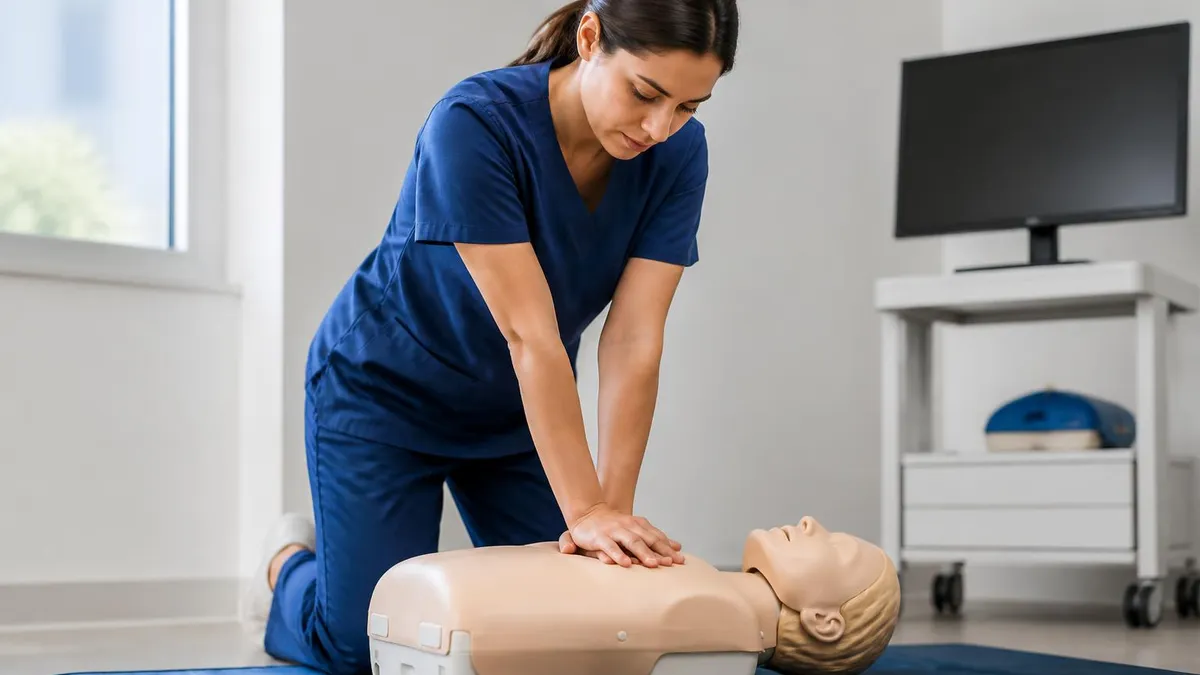
What Does BLS Certification Cover? Core Requirements
Providers learn to deliver compressions at the correct rate (100–120/min), depth (at least 2 inches for adults), and with full chest recoil. Minimizing interruptions and avoiding excessive ventilation are emphasized as critical quality markers throughout the curriculum.
BLS certification requires demonstrated competency in pediatric CPR, including the two-finger infant compression technique, the two-thumb encircling method used in 2-rescuer scenarios, and appropriate ventilation ratios for children and infants under different clinical conditions.
Trainees practice attaching and operating an automated external defibrillator, minimizing pre-shock pauses, and coordinating AED use with ongoing CPR as part of a multi-rescuer resuscitation team. Correct pad placement for adults and pediatric patients is tested.
The BLS provider course introduces bag-mask ventilation, proper head-tilt chin-lift and jaw-thrust maneuvers, and pocket mask use. Providers also learn to recognize inadequate breathing and deliver ventilations at the recommended rate without over-inflating the patient's lungs.
Healthcare settings require coordinated responses. BLS training emphasizes closed-loop communication, clear role assignment within the resuscitation triangle, and the responsibility each team member holds to speak up when errors occur — skills that directly translate to code team performance.
The two dominant providers of BLS certification for US healthcare professionals are the American Heart Association and the American Red Cross, and understanding their differences helps you choose the right course for your situation. The AHA Basic Life Support exam is the most widely required credential across hospital systems nationwide, and the AHA updates its guidelines every five years based on the International Liaison Committee on Resuscitation (ILCOR) evidence review process. The current guidelines reflect the 2020 update, which emphasized systems of care, dispatcher-assisted CPR, and recovery as a sixth link in the chain of survival.
The AHA BLS for Healthcare Providers course is offered in three formats: a traditional classroom course, a blended HeartCode BLS option (online learning plus in-person skills check), and an instructor-led course using the latest AHA curriculum materials. The HeartCode BLS option is the most popular for working professionals because it allows you to complete roughly 2–3 hours of online learning at your own pace before attending a shorter, 1–2 hour skills session with an AHA-certified instructor. Upon successful completion of both components, you receive a digital card valid for two years.
The American Red Cross Basic Life Support program covers the same core competencies as the AHA course and is accepted at a growing number of healthcare facilities. The Red Cross BLS for Healthcare Providers includes a blended online and in-person option as well. One practical difference is that the Red Cross uses slightly different scenario language and manikin setup protocols during skills testing, so if you have trained exclusively under one organization, transitioning to the other requires minor adjustment but is straightforward. The clinical content is functionally equivalent because both organizations follow the same ILCOR evidence base.
For nursing students, the AHA credential is usually specified in clinical site contracts, which means your nursing school's simulation lab likely runs AHA-affiliated courses. Medical students and residents similarly encounter AHA BLS requirements at nearly every residency program. However, if you work in community health, home health, school nursing, or other non-hospital settings, Red Cross BLS is frequently accepted and may be available at lower cost through community training centers or employer-sponsored sessions.
Regarding the question of whether BLS is the same as CPR — or whether BLS and CPR are the same — it is important to distinguish them clearly on your resume and in conversations with employers. A standard adult CPR/AED course (often called Heartsaver CPR or Community CPR) certifies laypersons to perform single-rescuer CPR in out-of-hospital settings. BLS for Healthcare Providers certifies clinical professionals to perform multi-rescuer CPR, manage airways, use bag-masks, and operate AEDs in both in-hospital and pre-hospital settings. Hospitals will not accept a lay CPR card in place of a BLS card.
Knowing how long does it take to get bls certification is important when planning around clinical start dates or license renewal deadlines. The blended AHA HeartCode option typically takes 3–4 hours total from start to certification, while the traditional classroom option runs 4–5 hours. Red Cross blended courses follow a similar timeline. If you need certification quickly — for example, to meet a hospital onboarding deadline — scheduling the skills session within 1–2 days of completing the online modules is entirely feasible at most AHA Training Centers.
One important note for healthcare providers seeking BLS certification: some online-only providers advertise BLS cards that do not require any hands-on skills demonstration. While these may be convenient, the vast majority of hospital credentialing departments explicitly reject certifications that lack a verified skills component. The AHA's position is that skills practice with a qualified instructor is essential to ensure real-world competency. If you are unsure whether an online-only option will be accepted, contact your employer's human resources or credentialing department before purchasing the course.
BLS Practice Test Questions
Prepare for the BLS - Basic Life Support exam with our free practice test modules. Each quiz covers key topics to help you pass on your first try.
BLS High-Quality CPR & Provider Skills
BLS Exam Questions covering BLS High-Quality CPR & Provider Skills. Master BLS Test concepts for certification prep.
BLS Special Situations & Scenarios
Free BLS Practice Test featuring BLS Special Situations & Scenarios. Improve your BLS Exam score with mock test prep.
BLS Adult, Child & Infant Resuscitation
BLS Mock Exam on Adult, Child & Infant Resuscitation. BLS Study Guide questions to pass on your first try.
BLS Airway Management & Ventilation
BLS Test Prep for Airway Management & Ventilation. Practice BLS Quiz questions and boost your score.
BLS Automated External Defibrillator (AED)...
BLS Questions and Answers on Automated External Defibrillator (AED) Use. Free BLS practice for exam readiness.
BLS Certification: Cardiac Arrest
BLS Mock Test covering Certification: Cardiac Arrest. Online BLS Test practice with instant feedback.
BLS Certification: Choking
Free BLS Quiz on Certification: Choking. BLS Exam prep questions with detailed explanations.
BLS Certification: Respiratory Arrest
BLS Practice Questions for Certification: Respiratory Arrest. Build confidence for your BLS certification exam.
BLS Chain of Survival
BLS Test Online for Chain of Survival. Free practice with instant results and feedback.
BLS CPR Techniques & Procedures
BLS Study Material on CPR Techniques & Procedures. Prepare effectively with real exam-style questions.
BLS Legal & Ethical Considerations
Free BLS Test covering Legal & Ethical Considerations. Practice and track your BLS exam readiness.
BLS Post-Resuscitation Care
BLS Exam Questions covering Post-Resuscitation Care. Master BLS Test concepts for certification prep.
Basic Life Support for Healthcare Providers: Course Options Compared
The AHA HeartCode BLS blended learning program is the most widely accepted format for healthcare provider certification in the United States. Students complete self-paced online modules covering cardiac arrest recognition, high-quality CPR science, AED use, and team resuscitation dynamics, then schedule a hands-on skills session at a certified AHA Training Center near them. The online portion typically takes 2–3 hours, and the skills check runs about 60–90 minutes with an AHA-certified instructor observing and correcting technique in real time.
Upon passing both the online cognitive assessment and the in-person skills evaluation, students receive an AHA BLS Provider eCard, which is emailed within 24 hours and valid for two years. HeartCode BLS costs approximately $40–$55 for the online portion alone; the skills session fee is set by each Training Center and typically adds $20–$40. Most hospital credentialing systems accept the digital eCard as proof of certification, eliminating the wait for a physical card. This format is ideal for busy nurses, physicians, and allied health professionals who need certified quickly.
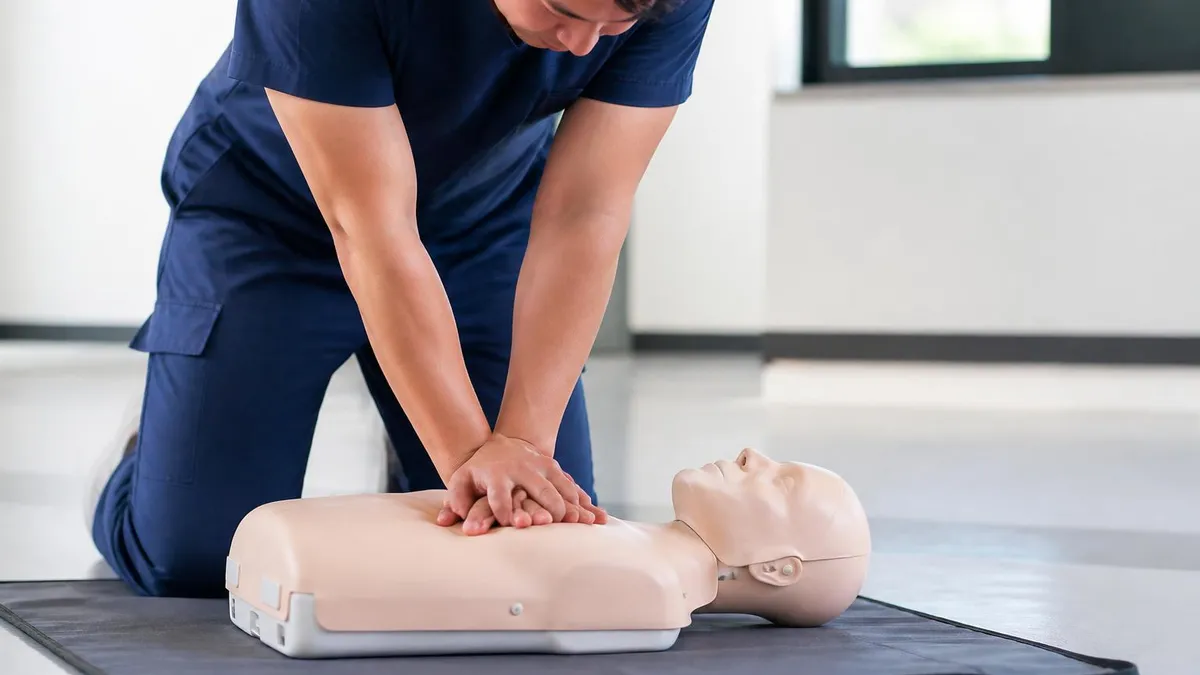
BLS Online Certification: Pros and Cons
- +Complete cognitive modules on your own schedule, 24/7, from any device
- +Blended format reduces total in-person time to just 60–90 minutes for skills check
- +Digital eCard delivered within 24 hours of completing both components
- +Self-paced online learning allows you to review difficult concepts before the skills session
- +Training Centers are widely available nationwide, making skills sessions accessible
- +Blended format meets AHA and Red Cross standards accepted by most hospital credentialing departments
- −Fully online-only BLS cards are rejected by most hospital credentialing systems
- −You must still schedule and attend an in-person skills session, limiting full remote flexibility
- −Cost varies significantly by Training Center, with some charging above-average skills session fees
- −Online modules require a reliable internet connection and compatible device
- −Some learners benefit from hands-on instructor guidance throughout, not just during skills check
- −Certification must be renewed every two years, requiring repeated course completion
BLS Exam Prep Checklist: 10 Steps Before Your Skills Session
- ✓Complete all AHA HeartCode or Red Cross online modules and pass the cognitive assessment with a score of 84% or higher.
- ✓Review the recommended compression rate of 100–120 compressions per minute and practice maintaining that rhythm.
- ✓Memorize the correct compression depth: at least 2 inches for adults, at least 1.5 inches for children, and 1.5 cm for infants.
- ✓Practice the 30:2 compression-to-ventilation ratio for single-rescuer adult and child CPR scenarios.
- ✓Understand the 15:2 compression-to-ventilation ratio used in 2-rescuer infant and child CPR.
- ✓Review AED pad placement for adults (right clavicle, left axilla) and pediatric patients (anterior-posterior if using pediatric pads).
- ✓Study the resuscitation triangle roles — compressor, airway/ventilation provider, and team leader — for 2-rescuer scenarios.
- ✓Practice the head-tilt chin-lift and jaw-thrust maneuvers for opening an airway on both adult and infant manikins.
- ✓Review the correct response to a witnessed versus unwitnessed adult cardiac arrest, including when to call for help.
- ✓Bring your online completion certificate or course confirmation code to the skills session so the instructor can issue your eCard.
84% Is the Passing Threshold for the AHA BLS Written Assessment
The AHA HeartCode BLS online cognitive assessment requires a minimum score of 84% to proceed to the skills session. Most students pass on the first attempt by thoroughly reviewing the online modules, but the assessment is closed-book, so active review of compression rates, depth guidelines, and 2-rescuer ratios before attempting the test significantly improves your score. Practice quizzes that mirror the question format are among the most effective preparation tools available.
BLS renewal is a non-negotiable requirement for healthcare providers, and missing your renewal window can result in loss of clinical privileges, delayed employment onboarding, or even termination of hospital credentials. The standard BLS certification period is two years regardless of which organization issued the card — AHA, Red Cross, or other ILCOR-aligned providers. Your expiration date is printed on your certification card or eCard, and most employers require renewal to be completed before the expiration date, not after. A lapsed BLS card must typically be treated as a new certification rather than a renewal.
The AHA offers a BLS renewal course through its HeartCode platform, which follows the same blended format as the initial certification: online modules plus an in-person skills session. The renewal cognitive assessment covers updates to resuscitation science since your previous certification, and the skills check confirms that your hands-on technique remains proficient. AHA renewal courses are typically shorter than initial certification courses because experienced providers demonstrate competency more quickly. Many AHA Training Centers offer dedicated renewal sessions that run 60–90 minutes total for the skills component.
The American Red Cross also offers a Basic Life Support renewal class that follows the blended learning model. For providers who completed their initial BLS through the Red Cross, renewal through the same organization is typically the most straightforward path. However, providers who switch from AHA to Red Cross or vice versa during a renewal cycle generally find the transition manageable because the clinical content is aligned with the same international guidelines. The key point is to confirm employer acceptance before switching certification organizations at renewal time.
Some healthcare organizations provide on-site BLS renewal training through their education or clinical development departments, sometimes at no charge to staff. If your employer offers in-house BLS renewal, this is often the most convenient option because sessions are scheduled around shift patterns, manikins are available on-site, and the instructors are familiar with the clinical environment in which you work. Check with your manager or human resources department annually to see whether employer-sponsored BLS renewal is available before paying out of pocket.
A common question among providers approaching their renewal window is whether they need to retake the full course or just a skills update. The AHA's current position is that all renewals require both a cognitive component and a hands-on skills evaluation, even for experienced providers. This is because resuscitation guidelines are periodically updated and skills degrade without regular practice. The 2020 AHA guidelines introduced several updates — including stronger emphasis on early defibrillation, the concept of recovery as a chain of survival link, and updated dispatcher-assisted CPR guidance — that justify the full renewal structure.
For providers who want to get ahead of their renewal deadline, it is acceptable to renew BLS early. The AHA and Red Cross both allow early renewal, and your new two-year period typically begins from the completion date of the renewal course, not from your original expiration date. This means renewing several months early may slightly shorten your next certification period.
Most providers find that renewing within 30–60 days of their expiration date strikes the best balance between staying compliant and maximizing the value of each two-year cycle. Check the basic life support online renewal guide for a full breakdown of renewal options and providers.
It is also worth noting that some advanced certifications — such as ACLS (Advanced Cardiac Life Support) and PALS (Pediatric Advanced Life Support) — require current BLS certification as a prerequisite. If you are planning to add ACLS or PALS to your credentials, make sure your BLS card will remain valid through the completion of that course. Certifying organizations will not issue ACLS or PALS cards to providers whose BLS certification is expired, which can create scheduling complications if the two renewals are not coordinated in advance.
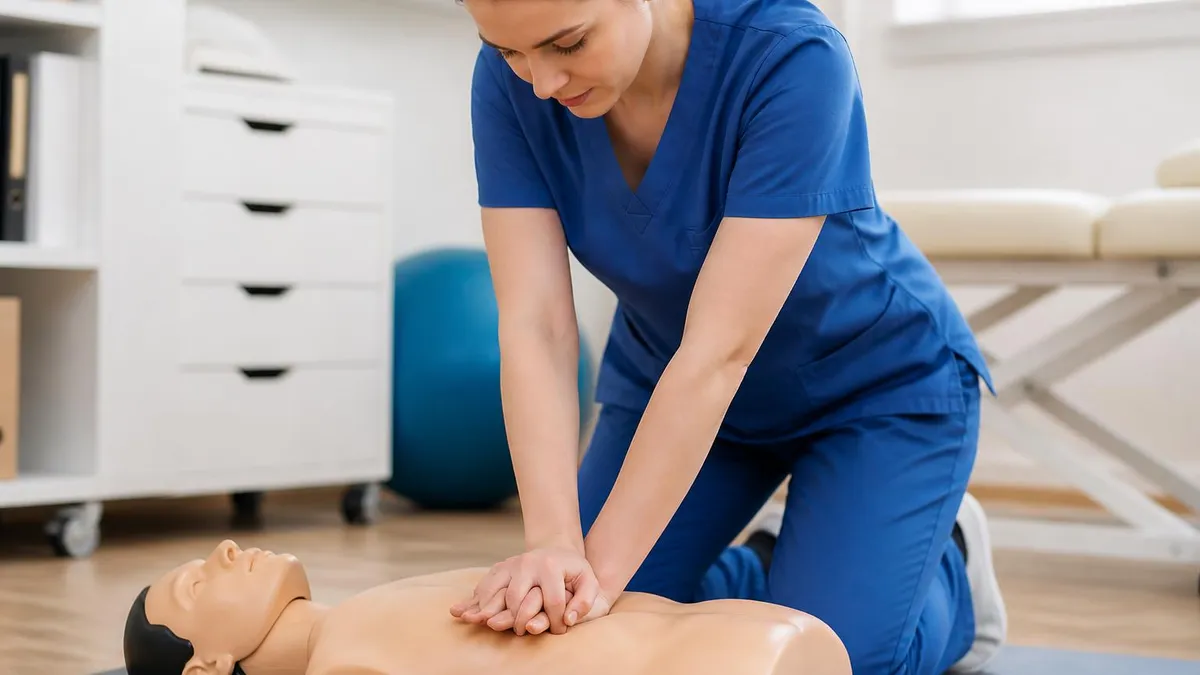
Most hospital credentialing departments and clinical employers require an active, non-expired BLS card on file at all times. If your BLS certification lapses even by one day, you may be removed from the clinical schedule until renewal is complete — which can mean lost income and disrupted patient care assignments. Set a calendar reminder 60 days before your expiration date to schedule your renewal skills session, and keep a digital copy of your eCard accessible for quick submission to employer HR systems.
The cost of BLS certification varies depending on the training organization, the format you choose, and your geographic location, but most providers can expect to pay between $30 and $90 for the complete blended certification process. The AHA HeartCode online module typically costs $40–$55 when purchased directly from the AHA, and the in-person skills session at a Training Center usually adds $20–$40. Red Cross BLS courses offered directly through the organization typically run $50–$80 all-in for the blended option. Employer-sponsored or hospital-run BLS courses are often provided at no cost to staff.
For healthcare students who need BLS certification before entering clinical rotations, some nursing schools and allied health programs include BLS training as part of their curriculum fees, meaning students do not pay separately for the course. If your program does not include BLS, the blended HeartCode format is usually the most cost-effective way to get certified quickly before your clinical start date. Purchasing the online module from the AHA website and booking a local skills session separately often costs less than enrolling in a bundled class through a private training company.
Geographic variation in Training Center pricing can be significant. In major metropolitan areas, the competitive landscape among AHA Training Centers tends to hold prices down, while in rural or underserved areas with fewer Training Centers, the skills session fee may be higher. If you live in a rural area, it may be worth traveling to a nearby city to access more competitive pricing, especially if you are planning to certify multiple staff members at once. Some Training Centers offer group discounts when four or more people book skills sessions together.
Employer reimbursement for BLS certification is common in hospital and clinical settings. Many healthcare organizations include BLS renewal costs in their education benefit packages, which may allow you to submit receipts for reimbursement up to a set dollar limit per year. If your employer does not currently offer this benefit, it is worth asking — particularly if the organization is aware that requiring BLS certification creates a recurring cost burden for staff, since covering that cost is a straightforward retention incentive.
For providers wondering about the cost of basic life support certification cost through the Red Cross specifically, rates vary by region but are generally comparable to AHA pricing for the blended learning option. The Red Cross occasionally runs promotional pricing on its BLS courses, particularly during American Heart Month in February and during periods when demand for healthcare workforce training is elevated. Checking the Red Cross training site directly or signing up for email alerts is the best way to catch discounted rates.
When comparing costs across providers, pay attention to what is included in the advertised price. Some Training Centers quote a skills session fee that does not include the online module cost, while others bundle both components. The digital eCard is typically included in the total fee for AHA HeartCode completions, but some third-party training companies charge an additional administrative fee for card issuance. Reading the fine print before enrolling ensures there are no surprise charges at checkout or after your skills session.
Finally, it is worth investing a few hours in BLS practice test preparation before your skills session, particularly if this is your first certification or if you are returning after a long gap between renewals. Free and low-cost practice resources — including the quizzes available on PracticeTestGeeks — can significantly reduce anxiety on test day and reinforce the key numbers and protocols that instructors look for during the skills evaluation.
Providers who arrive at their skills session already fluent in compression rates, ventilation ratios, and AED protocols consistently perform with more confidence and require fewer instructor corrections during the practical assessment.
Effective preparation for the BLS written assessment and skills session combines active recall practice with a solid understanding of the underlying physiology driving each protocol. Rather than simply memorizing numbers in isolation, connect each guideline to the clinical reason behind it. For example, the reason compressions should reach at least 2 inches in adults is to generate sufficient blood flow to perfuse the coronary arteries and brain — insufficient depth fails to create meaningful cardiac output even when rate and rhythm are correct. Understanding the why makes individual guidelines easier to retain under pressure.
For the AHA HeartCode online modules, work through each section methodically rather than clicking through quickly to reach the assessment. The modules include embedded case scenarios and knowledge-check questions that directly preview the format of the final cognitive assessment. Taking notes on key values — compression rate, depth, ventilation rate, compression-to-ventilation ratio by age group and rescuer count — and reviewing them before the test is one of the simplest and most effective preparation strategies available.
Skills session preparation is equally important. If you have access to a CPR manikin before your official session — through your nursing school simulation lab, your employer's education department, or a community training center — use it. Even 20–30 minutes of manikin practice significantly improves compression quality and comfort with the sequence of steps. If manikin access is not available, reviewing the BLS algorithm flowcharts and visualizing each step in sequence is a useful substitute that many experienced instructors recommend.
The most common errors that instructors observe during BLS skills evaluations include insufficient compression depth, incomplete chest recoil between compressions, ventilation volumes that are too large (causing visible gastric distension on the manikin), and excessive pauses during CPR — particularly during pulse checks and AED rhythm analysis. Being aware of these common pitfalls before your session allows you to self-monitor and self-correct, which instructors view positively as evidence of clinical self-awareness.
For 2-rescuer scenarios, practice the transitions clearly: when the second rescuer arrives and announces their role, the first rescuer on compressions should confirm role assignment using closed-loop communication before continuing. The team leader role in BLS scenarios involves directing the resuscitation, monitoring CPR quality, coordinating AED use, and communicating with incoming advanced life support teams. Practicing these communication behaviors — not just the physical skills — is what differentiates high-performing BLS providers from those who pass the skills test but struggle in real clinical resuscitations.
If you are preparing for a BLS renewal after a two-year gap, consider spending extra time reviewing any guideline updates that occurred during your certification cycle. The AHA publishes guideline highlights documents that summarize key changes, and these are freely available on the AHA website. For the 2020 guidelines cycle, notable updates included elevated emphasis on the recovery phase, strengthened dispatcher-assisted CPR recommendations, and new evidence on resuscitation in special circumstances such as opioid-associated cardiac arrest and COVID-19 precautions during CPR.
Practice quizzes targeting the specific content areas of the BLS exam are among the highest-value preparation tools because they create retrieval practice — the process of actively recalling information from memory — which research consistently shows to be more effective for long-term retention than passive re-reading. The quiz sets on PracticeTestGeeks cover both high-quality CPR provider skills and special situations and scenarios, providing comprehensive coverage of all the content domains that appear on the AHA BLS cognitive assessment and the Red Cross equivalent.
Sample BLS - Basic Life Support Practice Questions
Try these questions from our free BLS - Basic Life Support practice tests. The correct answer and an explanation follow each question.
In the adult out-of-hospital Chain of Survival, which link comes immediately AFTER early CPR?
- A. Rapid defibrillation
- B. Early recognition and activation
- C. Advanced life support
- D. Post-cardiac arrest care
Answer: A. Rapid defibrillation
The adult out-of-hospital chain is: recognition/activation → early CPR → rapid defibrillation → advanced life support → post-cardiac arrest care.
What is the principle of 'patient autonomy'?
- A. Providing treatment based on the healthcare provider’s judgment
- B. Respecting the patient’s right to refuse treatment
- C. Making decisions for the patient if they cannot communicate
- D. Following family member wishes over the patient's
Answer: B. Respecting the patient’s right to refuse treatment
Patient autonomy is a fundamental ethical principle in healthcare, asserting an individual's right to make decisions about their own medical care. This includes the right to refuse treatment, even if it is life-sustaining, provided they are competent to make such a decision. Healthcare providers must respect these choices, upholding the patient's self-determination.
In a suspected opioid overdose victim who is pulseless with absent or agonal breathing, what is the correct BLS action?
- A. Wait for ALS providers before starting CPR
- B. Begin CPR immediately and use naloxone if available
- C. Provide rescue breaths only — no compressions for opioid overdose
- D. Apply AED pads immediately without starting CPR
Answer: B. Begin CPR immediately and use naloxone if available
Standard BLS with CPR must not be delayed; naloxone may be administered as an adjunct if available, but CPR takes priority.
Which technique is used to provide breaths using a bag-valve-mask (BVM)?
- A. Double-hand tilt
- B. E-C clamp technique
- C. Finger sweep
- D. Cross-finger technique
Answer: B. E-C clamp technique
The E-C clamp technique is the standard method for holding a bag-valve-mask (BVM) to a patient's face while providing breaths. This technique involves using the thumb and index finger to form a 'C' shape around the mask for a tight seal, while the remaining three fingers form an 'E' shape to lift the jaw and maintain an open airway. This ensures effective ventilation and minimizes air leakage.
BLS Questions and Answers

Basic Life Support 2026
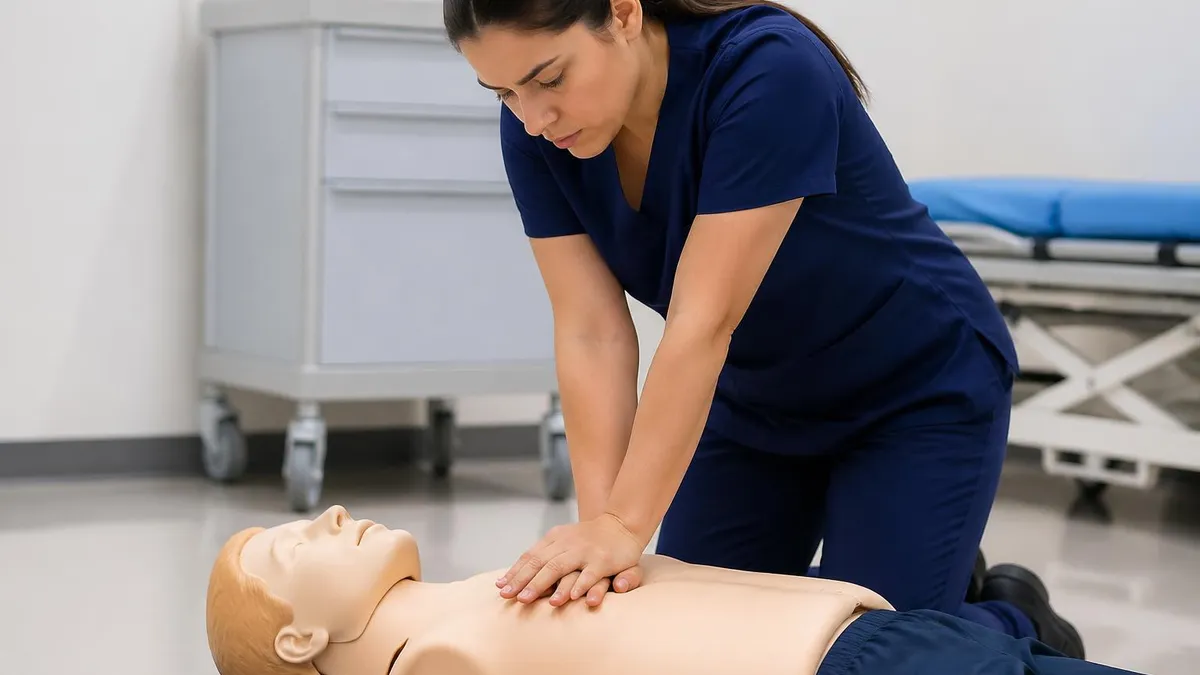
American Heart Association BLS: Certification, Renewal, Cost & What to Expect
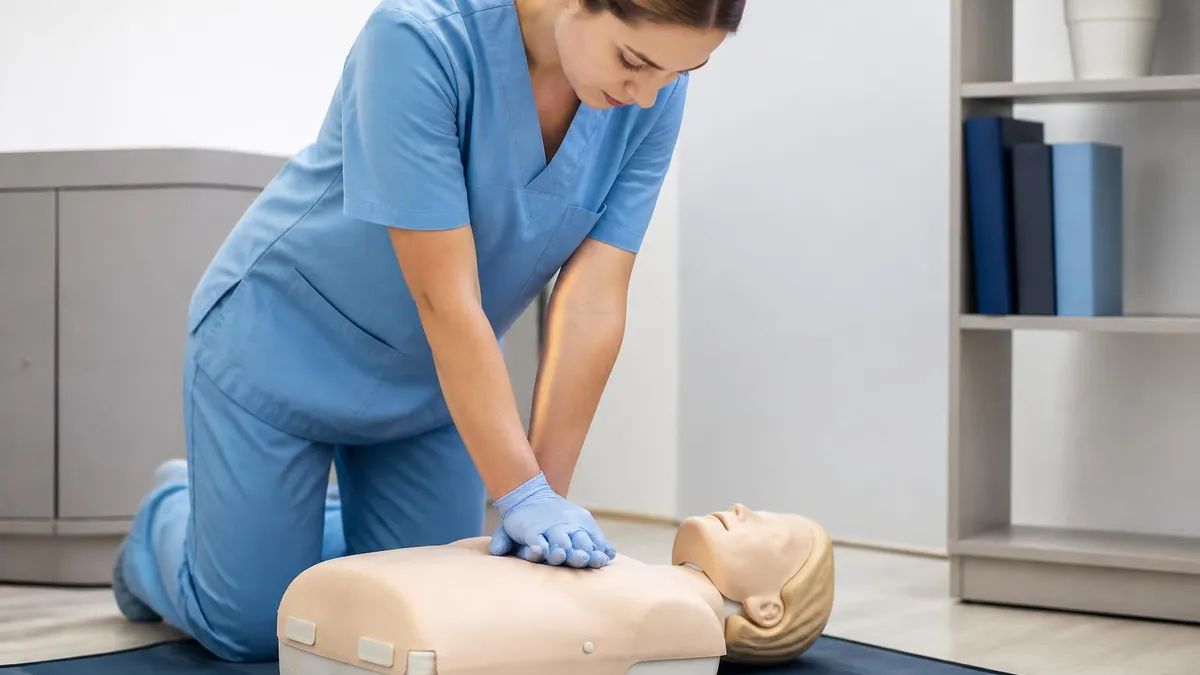
Red Cross BLS Certification: Course, Cost, and Renewal Guide
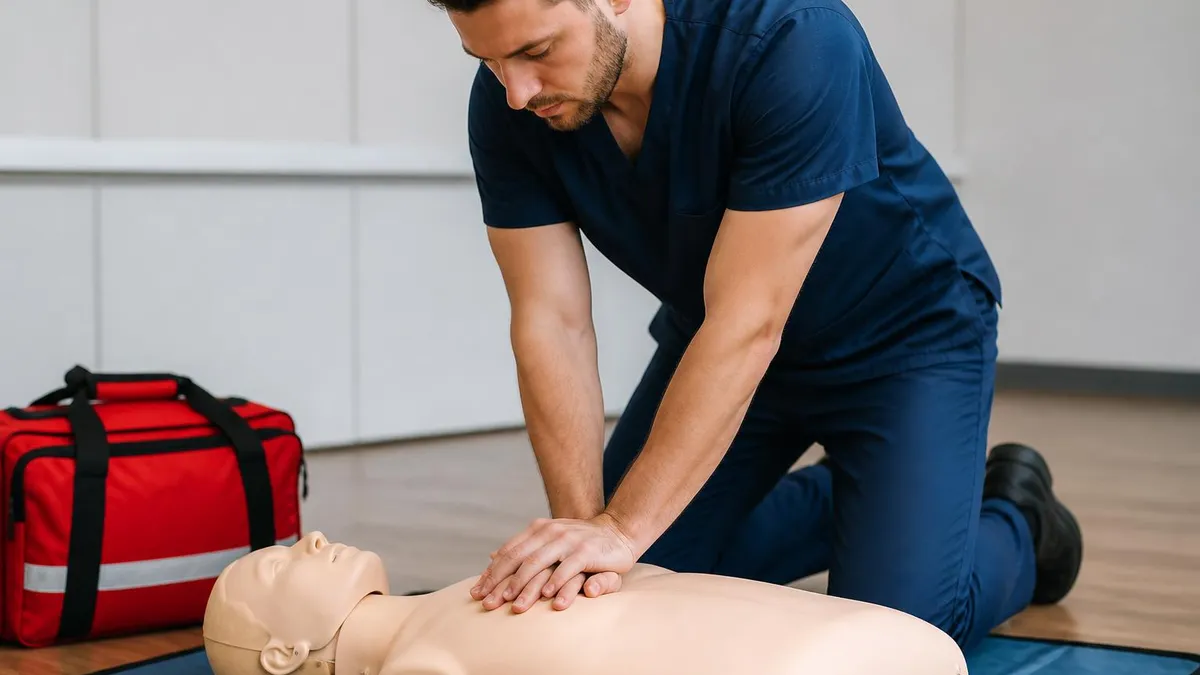
BLS Recertification Guide: Course Options, Online Renewal, Cost, Validity, and How to Maintain Your Certification
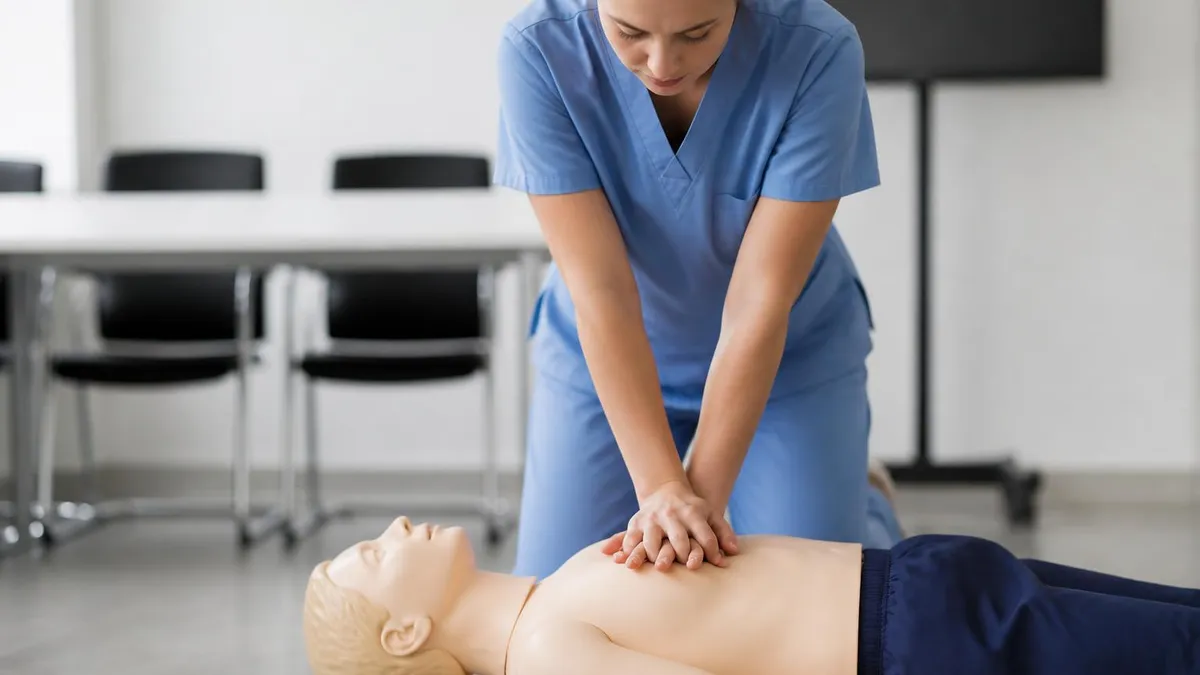
Free BLS Certification: Where to Get It, What's Legitimate, and What to Avoid
About the Author

Registered Nurse & Healthcare Educator
Johns Hopkins University School of NursingDr. Sarah Mitchell is a board-certified registered nurse with over 15 years of clinical and academic experience. She completed her PhD in Nursing Science at Johns Hopkins University and has taught NCLEX preparation and clinical skills courses for nursing students across the United States. Her research focuses on evidence-based exam preparation strategies for healthcare certification candidates.
Join the Discussion
Connect with other students preparing for this exam. Share tips, ask questions, and get advice from people who have been there.
View discussion (8 replies)