
AHA BLS Renewal Online: Complete 2026 October Guide to Recertifying Your Basic Life Support Card
AHA BLS renewal online guide: skills check requirements, cost, study tips, practice tests, and what to expect on the 2026 October Basic Life Support exam. 🟢
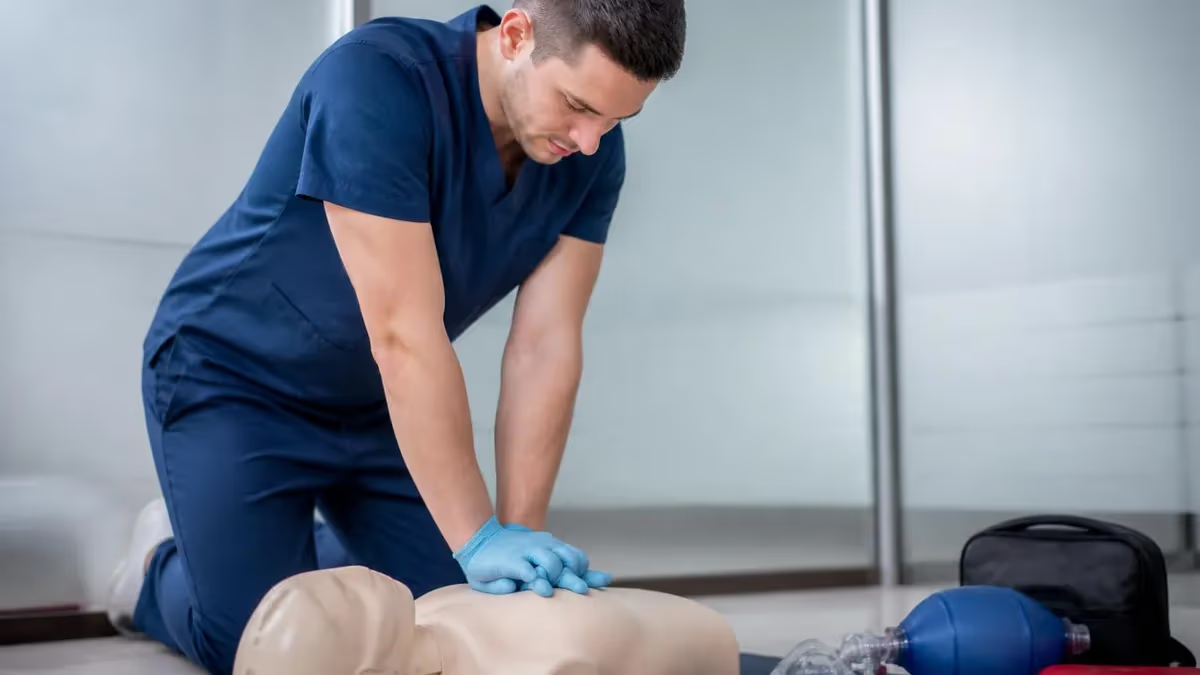
If your provider card is approaching its two-year expiration, completing your AHA BLS renewal online is the fastest, most flexible way to stay current without sacrificing a full workday in a classroom. The American Heart Association now offers a blended learning path called HeartCode BLS that lets you finish all cognitive coursework from your laptop or tablet, then schedule a brief hands-on skills session at a local Training Center. This guide walks healthcare providers through every step of the 2026 renewal process, including timelines, costs, and study strategies.
So what is a BLS certification, and why does it matter so much for clinical staff? BLS, or Basic Life Support, is the foundation-level resuscitation credential required by virtually every hospital, ambulance service, dental office, and outpatient clinic in the United States. It verifies that you can recognize cardiac arrest, deliver high-quality chest compressions, use an automated external defibrillator, manage choking emergencies, and coordinate as part of a high-performance resuscitation team without hesitation.
Many providers ask whether is bls the same as cpr when they compare course catalogs. The short answer is that BLS includes CPR but adds professional-level skills like two-rescuer ventilation, bag-mask technique, pulse checks, and team dynamics that lay-rescuer CPR does not cover. That distinction matters because employers in healthcare settings will not accept a general community CPR card in place of a Provider-level BLS card from the AHA or American Red Cross.
Renewing online appeals to nurses, paramedics, respiratory therapists, dental hygienists, medical assistants, and physicians for one main reason: time. A traditional in-person renewal class consumes four to five hours of your day, while the HeartCode BLS online module averages 90 minutes of focused study followed by a 30-minute skills check at a Training Center. The flexibility lets you study during night shifts, lunch breaks, or on the weekend without rearranging your schedule.
The 2026 renewal process is built around the AHA's most recent science update, which reinforced the importance of minimizing pauses in chest compressions, maintaining a compression depth of at least two inches in adults, and delivering ventilations at a rate of one breath every six seconds during continuous compressions with an advanced airway. These updates appear throughout the online module and the final assessment, so even experienced providers should expect a few questions that test current guidelines rather than older 2015 or 2020 protocols.
Before you commit to a vendor, confirm that the program you select is the official AHA HeartCode BLS course and that it pairs with an in-person skills evaluation. Many low-cost websites sell BLS "certifications" that are not recognized by hospitals, the Joint Commission, or state licensing boards. A legitimate renewal will always require demonstration of psychomotor skills on a manikin in front of an AHA-aligned instructor, no exception.
This guide will help you choose a reputable course, prepare for the cognitive exam, navigate the skills session, and avoid the most common mistakes that cause providers to fail or have their card rejected by employers. By the end, you will know exactly how to renew your card with confidence and without wasted time or money.
AHA BLS Renewal Online by the Numbers
Key Facts at a Glance
| Item | Value | Details |
|---|---|---|
| Total Time Online | ~2 hrs | HeartCode module average |
| Typical Total Cost | $65-110 | Online + skills check |
| Card Validity | 24 months | From issue date |
| Required Score | 84% | Cognitive exam |
Your Renewal Timeline From Start to Card
Verify Expiration Date
Purchase HeartCode BLS
Complete Online Module
Schedule Skills Session
Receive eCard
To understand why renewal matters, it helps to revisit what is a BLS certification at its core. A BLS card from the American Heart Association or American Red Cross certifies that a healthcare provider has demonstrated both cognitive knowledge and hands-on competency in adult, child, and infant resuscitation. The credential is built around the 2020 Guidelines update with periodic science statements, and it serves as the prerequisite for advanced courses like ACLS and PALS.
What does BLS stand for? Basic Life Support. The word "basic" can be misleading because the skills are anything but elementary. Providers must coordinate compressions, ventilations, defibrillation, and team communication within seconds of recognizing arrest. The label "basic" simply distinguishes it from advanced cardiovascular interventions like medications, advanced airways, and rhythm interpretation that ACLS providers handle.
Many providers ask whether is BLS and CPR the same thing. Functionally, BLS contains CPR but is broader. A community CPR class teaches lay rescuers to start compressions and use an AED on adults, often without two-rescuer techniques or bag-mask ventilation. The basic life support exam american heart association requires you to demonstrate two-rescuer adult, child, and infant CPR, plus team-based switching during continuous compressions.
Basic life support for healthcare providers is a specific course track designed for clinicians, students, and first responders who will use these skills professionally. The course is sometimes called BLS Provider or BLS for Healthcare Providers depending on the year and the issuing organization. The American Red Cross basic life support credential and the AHA BLS Provider card are both widely accepted, though some employers explicitly require one or the other.
Renewal is required every two years because skill retention drops sharply after about six months without practice. Studies from the AHA's Resuscitation Quality Improvement program show that compression depth, rate, and recoil accuracy all decline within months, even among experienced ICU nurses. The renewal cycle forces providers to refresh both knowledge and psychomotor skills before performance degrades to a dangerous level.
An online renewal does not lower the bar. The cognitive content is identical to the in-person Provider course, and the skills check requires the same demonstration of high-quality compressions, AED use, bag-mask ventilation, and infant CPR. The only difference is that you absorb the knowledge through interactive video scenarios rather than instructor lectures, which works better for most adult learners.
If your current card has already expired, the AHA does not technically require a full Provider course unless your employer mandates it. Most Training Centers will let you complete the standard HeartCode BLS renewal as long as you can perform the skills competently. However, some hospitals require an extended in-person course for any lapse beyond 30 days, so always check with your compliance department first.
BLS Practice Test Questions
Prepare for the BLS - Basic Life Support exam with our free practice test modules. Each quiz covers key topics to help you pass on your first try.
BLS High-Quality CPR & Provider Skills
BLS Exam Questions covering BLS High-Quality CPR & Provider Skills. Master BLS Test concepts for certification prep.
BLS Special Situations & Scenarios
Free BLS Practice Test featuring BLS Special Situations & Scenarios. Improve your BLS Exam score with mock test prep.
BLS Adult, Child & Infant Resuscitation
BLS Mock Exam on Adult, Child & Infant Resuscitation. BLS Study Guide questions to pass on your first try.
BLS Airway Management & Ventilation
BLS Test Prep for Airway Management & Ventilation. Practice BLS Quiz questions and boost your score.
BLS Automated External Defibrillator (AED)...
BLS Questions and Answers on Automated External Defibrillator (AED) Use. Free BLS practice for exam readiness.
BLS Certification: Cardiac Arrest
BLS Mock Test covering Certification: Cardiac Arrest. Online BLS Test practice with instant feedback.
BLS Certification: Choking
Free BLS Quiz on Certification: Choking. BLS Exam prep questions with detailed explanations.
BLS Certification: Respiratory Arrest
BLS Practice Questions for Certification: Respiratory Arrest. Build confidence for your BLS certification exam.
BLS Chain of Survival
BLS Test Online for Chain of Survival. Free practice with instant results and feedback.
BLS CPR Techniques & Procedures
BLS Study Material on CPR Techniques & Procedures. Prepare effectively with real exam-style questions.
BLS Legal & Ethical Considerations
Free BLS Test covering Legal & Ethical Considerations. Practice and track your BLS exam readiness.
BLS Post-Resuscitation Care
BLS Exam Questions covering Post-Resuscitation Care. Master BLS Test concepts for certification prep.
Online vs. Blended vs. In-Person AHA Basic Life Support Exam Paths
True 100% online renewal is offered by some non-AHA providers and is rarely accepted by hospitals or nursing boards. These programs let you watch videos and pass a multiple-choice exam without any hands-on skills evaluation. While they take only about an hour and cost as little as $40, they fail to meet the AHA standard that requires demonstration of compressions and AED use on a manikin.
If your employer is small, such as a private dental practice or chiropractic office, a 100% online card may technically satisfy state rules. However, the moment you apply for hospital privileges, agency nursing work, or paramedic licensure, you will need to redo the course through an AHA Training Center. Confirm acceptance with your compliance officer in writing before paying for an online-only option.

Should You Renew Online? Honest Pros and Cons
- +Complete cognitive coursework on your own schedule, including nights and weekends
- +Pause and resume the module as many times as you need before the final exam
- +Adaptive learning adjusts difficulty based on your performance and weak areas
- +No commute time for the lecture portion of the course
- +Identical AHA eCard issued at completion, fully accepted by hospitals
- +Cheaper than most in-person renewals when you factor in time saved
- −Still requires an in-person skills check, so you cannot fully skip a Training Center visit
- −Less instructor feedback during cognitive learning compared to live lecture
- −Requires self-discipline to complete the module without procrastinating
- −Technical glitches with the AHA platform occasionally lock learners out
- −Skills sessions in rural areas may have limited weekly scheduling slots
- −Non-AHA online-only cards are widely rejected and waste your money
Pre-Renewal Checklist for the Basic Life Support Renewal Class
- ✓Confirm your current BLS card expiration date and start renewal 30 to 60 days before it lapses
- ✓Verify that your employer accepts AHA HeartCode BLS or specifies American Red Cross instead
- ✓Purchase the course only from shopcpr.heart.org or an authorized AHA Training Center
- ✓Block out 90 to 120 uninterrupted minutes to complete the online module efficiently
- ✓Download and print the BLS Provider Manual reference card for quick review during studying
- ✓Take at least one full-length practice exam before attempting the AHA cognitive assessment
- ✓Schedule your skills session within seven days of finishing the cognitive portion
- ✓Bring photo identification and your printed completion certificate to the skills check
- ✓Wear comfortable clothing that allows you to kneel and perform compressions on a manikin
- ✓Download your AHA eCard immediately after passing and forward it to HR or credentialing
Practice compressions on a real manikin before your skills session.
The single biggest reason providers fail the skills check is inadequate compression depth or rate, not knowledge gaps. If you have not touched a manikin since your last renewal, spend 15 minutes practicing at your hospital's skills lab or borrow a friend's CPR mannequin. Muscle memory degrades fast, and instructors will not pass you if your depth is below two inches or your rate falls outside 100 to 120 per minute.
The skills session is where many providers feel the most anxiety, but it is also the most predictable part of the renewal process. You will arrive at an AHA Training Center, present your photo ID and completion certificate, and meet a single instructor or a small group of fellow renewers. Most sessions last 25 to 35 minutes for a renewal candidate, compared to closer to 60 minutes for first-time learners who need more structured practice on each component.
The instructor begins with a brief warm-up that lets you locate compression landmarks on the adult manikin. You then perform two minutes of high-quality adult CPR while the instructor observes depth, rate, recoil, and minimization of pauses. Expect a real-time feedback device or visual metronome to be running, which helps you stay within the 100 to 120 compression-per-minute window without guessing.
After adult CPR, you switch to bag-mask ventilation as a two-rescuer team. The instructor will play the second rescuer or coach you while another candidate compresses. Achieving visible chest rise without over-ventilating is the critical skill. Common mistakes include squeezing the bag too forcefully or breaking the seal of the mask against the face, both of which cause failed ventilations and require re-demonstration.
The AED portion is next. You will turn on the device, attach pads in the correct adult or pediatric position, follow voice prompts, and deliver a shock while ensuring no team member is touching the patient. Many providers lose points for failing to clear the patient verbally and visually before delivering the shock, so practice saying "I'm clear, you're clear, everyone clear" as a deliberate scripted phrase.
Child and infant CPR follow the adult skills. For the child, you demonstrate one or two-rescuer compressions with one or two hands depending on body size and depth requirements. For the infant, you switch to two-thumb-encircling hands technique during two-rescuer CPR and use two fingers when alone. Infant ventilation requires a smaller mask and significantly smaller tidal volumes to avoid gastric inflation.
The session closes with choking management for both a conscious adult and a conscious infant. You demonstrate abdominal thrusts on the adult manikin or a partner, and back blows alternated with chest thrusts on the infant. The instructor may ask one or two verbal questions, such as when to switch from conscious to unconscious choking protocols, before signing your skills checklist.
If you struggle on any single station, instructors are required to remediate rather than fail you on the first attempt. They will demonstrate the correct technique, let you try again, and only mark a failure if you cannot meet the standard after coaching. Most providers who have done even minimal preparation pass on their first attempt without needing remediation.

While the AHA allows renewal of an expired card through the standard HeartCode pathway, many hospitals and credentialing agencies treat any lapse longer than 30 days as a lapsed credential requiring a full Provider course. That can mean an extra two hours of class time and a higher fee. Always check your employer's policy before letting your card expire, and start the renewal at least 30 days before your expiration date.
Passing the cognitive exam on the first try comes down to understanding three or four high-yield concept areas that the AHA emphasizes every cycle. The first is compression quality. Expect multiple questions on the correct rate (100 to 120 per minute), depth (at least 2 inches in adults, about 2 inches in children, and 1.5 inches in infants), and the importance of full chest recoil between compressions. These are non-negotiable facts that appear in slightly different wording on almost every aha basic life support exam.
The second high-yield area is the compression-to-ventilation ratio across single and two-rescuer scenarios. For adults, the ratio is 30:2 for single rescuer and 30:2 for two rescuers without an advanced airway, switching to continuous compressions with a breath every six seconds once an advanced airway is in place. For children and infants with two rescuers, the ratio shifts to 15:2, which trips up providers who only practice adult CPR in their daily work.
The third focus area is AED use and rhythm recognition at a basic level. You do not need to interpret rhythm strips like an ACLS provider, but you must know that shockable rhythms include ventricular fibrillation and pulseless ventricular tachycardia, while asystole and pulseless electrical activity are not shockable. Many exam questions present a scenario and ask whether you should deliver a shock, so reading carefully for the phrase "no pulse" matters.
The fourth area is team dynamics and high-performance resuscitation. The 2020 Guidelines emphasized clear role assignment, closed-loop communication, and constructive feedback during resuscitation. Questions often describe a chaotic scene and ask which team behavior would most improve outcomes. The answer almost always involves clear role assignment, leader communication, or a structured handoff between rescuers performing compressions.
Special situations make up the remaining content. Opioid overdose has received significant attention, with the AHA now teaching the use of intramuscular or intranasal naloxone alongside CPR when overdose is suspected. Drowning, pregnancy, and hypothermia each have a few key modifications you should memorize. For pregnancy, manual left uterine displacement during compressions improves blood flow back to the heart and is the single most testable modification.
For study materials, the AHA BLS Provider Manual remains the gold standard. It is included with most HeartCode purchases or available as a separate PDF. Combine the manual with two or three full-length practice exams that mirror the real format. Most providers who fail the first attempt did not take any practice exams, while those who took at least one mock exam pass over 90% of the time.
Finally, do not rely on memorization alone. The AHA exam writes questions in scenario format, which means you must apply knowledge rather than recall facts. Reading the manual once and then practicing 50 to 75 scenario questions is far more effective than reading the manual three times. Active recall and scenario application beat passive review every time.
Once your renewal is complete, take a few practical steps to protect your investment. Download your AHA eCard immediately and save it in at least two places, such as your email, a cloud drive, and your phone's secure document folder. Hospital credentialing departments occasionally lose records, and having a backup PDF prevents the hassle of contacting the Training Center months later to reissue a copy.
Forward the eCard verification link directly to your HR or credentialing office. The AHA eCard system includes a unique verification URL that lets employers confirm authenticity without you scanning or printing anything. This is the fastest way to update your compliance file and eliminates any question about whether your card is legitimate, which used to be a real concern with paper cards.
Set a calendar reminder for 22 months from your issue date, not 24, so you have a two-month buffer before expiration to schedule your next renewal. This buffer matters because skills sessions in some regions book out two to three weeks in advance, and any holiday timing or sudden work travel can compress your window. A 22-month reminder turns renewal from a panic into a routine task.
Consider keeping a small CPR practice manikin at home or requesting access to your facility's skills lab between renewals. Even 10 minutes of compressions every two or three months keeps your muscle memory sharp and dramatically reduces the chance of failing or needing remediation at your next skills session. Many providers find that this minimal practice also improves their confidence during real codes at work.
If you supervise other clinicians, encourage your team to renew together. Group bookings through an AHA Training Center often qualify for discounted per-person rates, and arranging the skills session at your workplace eliminates travel time entirely. Many hospitals will even host on-site sessions if you can guarantee a minimum of eight to twelve participants, which makes the logistics dramatically easier.
Watch for AHA science updates between your renewal cycles. The AHA publishes interim science statements that occasionally change protocols, such as the recent emphasis on naloxone administration during suspected opioid overdoses. Subscribing to a free clinical newsletter or following the AHA Resuscitation Twitter or LinkedIn channels keeps you current without requiring you to read full guideline documents.
Finally, remember that the renewal credential is the floor, not the ceiling. If you work in a high-acuity environment, supplementing BLS with regular high-fidelity simulation, code debriefs, and Resuscitation Quality Improvement feedback delivers far better outcomes for actual patients. Is bls and cpr the same question matters less than whether you are continuously refining your skills beyond the minimum every two years.
Sample BLS - Basic Life Support Practice Questions
Try these questions from our free BLS - Basic Life Support practice tests. The correct answer and an explanation follow each question.
In which of the following situations can an emergency medical provider give treatment without consent?
- A. When the person is conscious
- B. If the person is unconscious or unresponsive
- C. When the person is a minor
- D. If the person is under arrest
Answer: B. If the person is unconscious or unresponsive
Emergency medical providers can provide treatment without explicit consent when a person is unconscious or unresponsive, based on the principle of implied consent. In such critical situations, it is presumed that the person would want to receive life-saving care. This allows for immediate intervention to preserve life and prevent further harm.
During CPR on an adult with an advanced airway in place, what is the recommended ventilation rate?
- A. 1 breath every 2–3 seconds (20–30/min)
- B. 1 breath every 6 seconds (10/min)
- C. 1 breath every 3 seconds (20/min)
- D. 2 breaths every 30 compressions
Answer: B. 1 breath every 6 seconds (10/min)
Once an advanced airway is in place during adult CPR, ventilations are delivered at 1 breath every 6 seconds (10/min) without pausing compressions.
Which of the following opioids is most likely to require multiple doses of naloxone due to its potency?
- A. Codeine
- B. Hydrocodone
- C. Fentanyl
- D. Tramadol
Answer: C. Fentanyl
Fentanyl and its analogues are 50–100 times more potent than morphine and often require repeated or higher doses of naloxone to fully reverse respiratory depression.
What is the primary BLS intervention for an unresponsive victim of suspected opioid overdose who is not breathing normally?
- A. Administer naloxone before starting CPR
- B. Begin high-quality CPR immediately
- C. Give rescue breaths only and monitor for pulse
- D. Place in recovery position and call 911
Answer: C. Give rescue breaths only and monitor for pulse
Opioid overdose typically causes respiratory arrest before cardiac arrest, so rescue breathing (ventilation) is the priority intervention.
BLS Questions and Answers
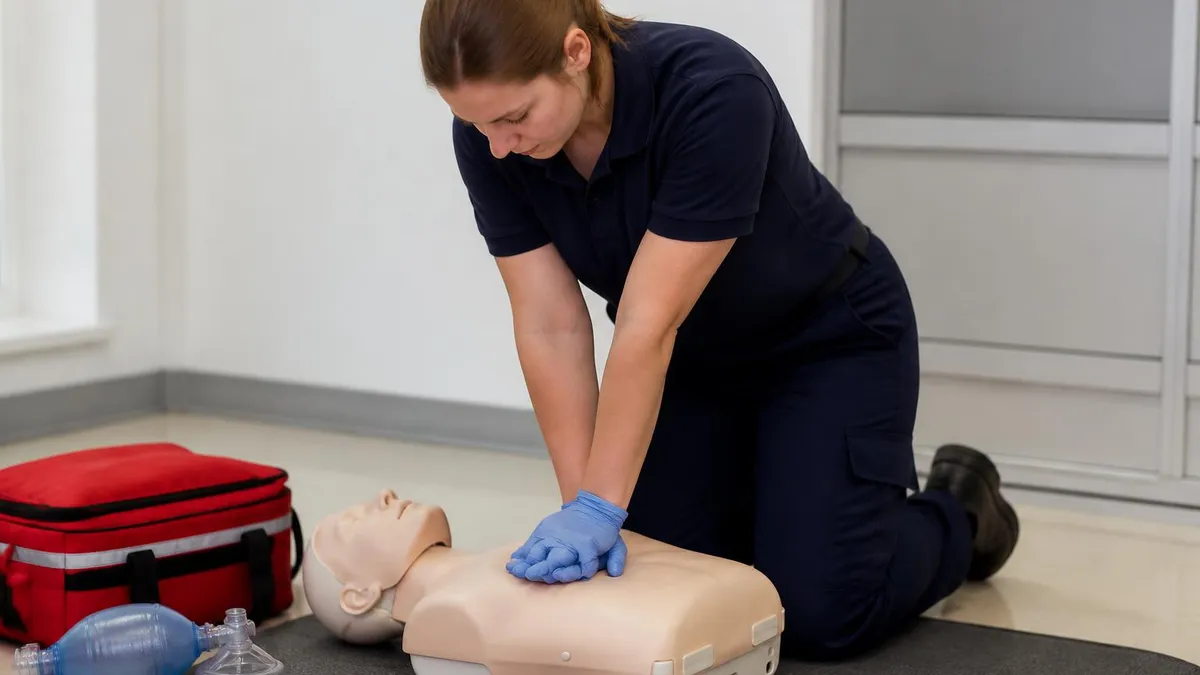
Pediatric BLS Algorithm: Complete 2026 Guide for Healthcare Providers
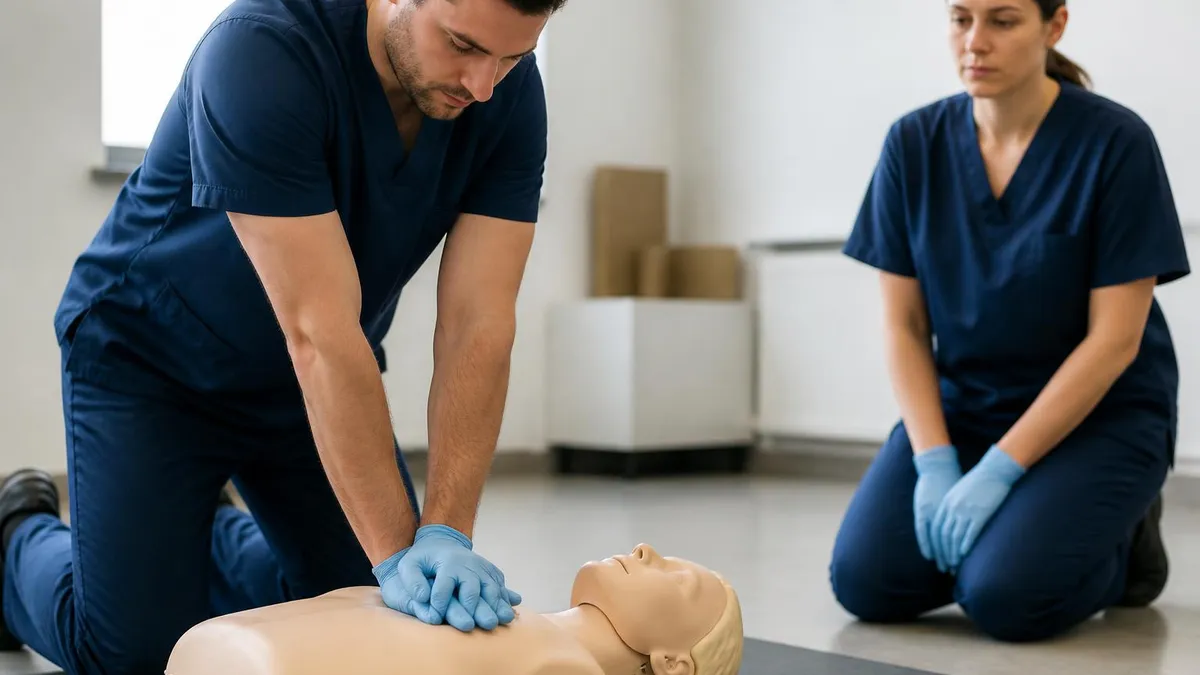
How Long Does BLS Certification Last? Complete 2026 Renewal Guide
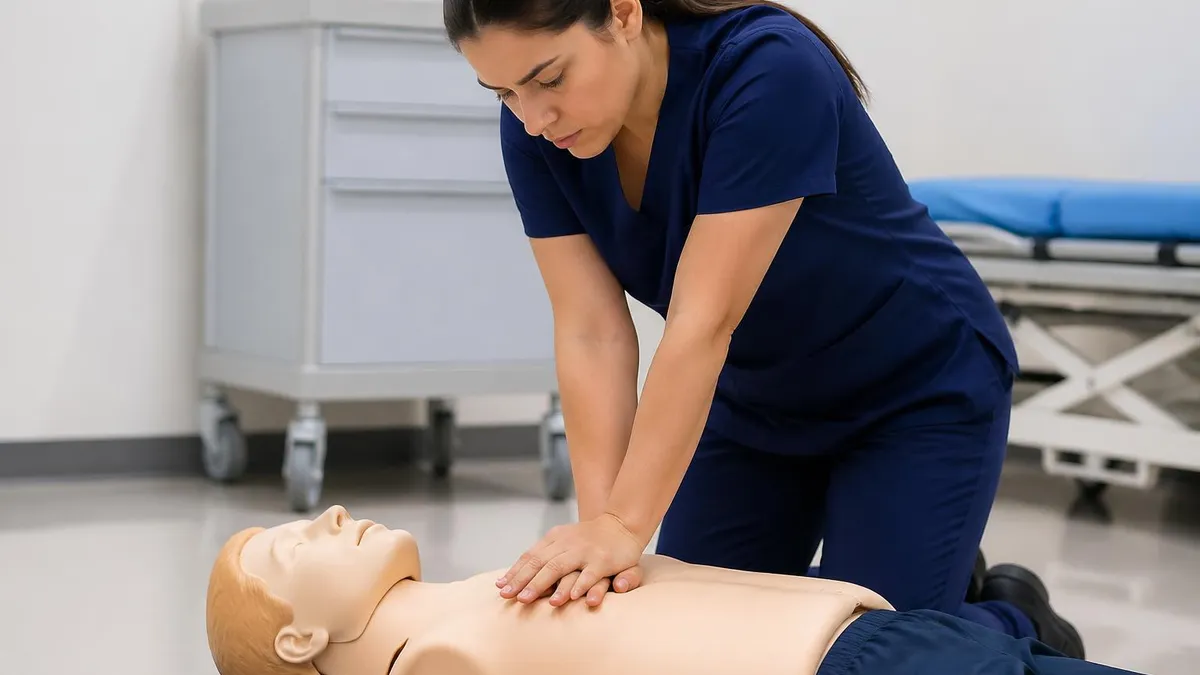
American Heart Association BLS: Certification, Renewal, Cost & What to Expect
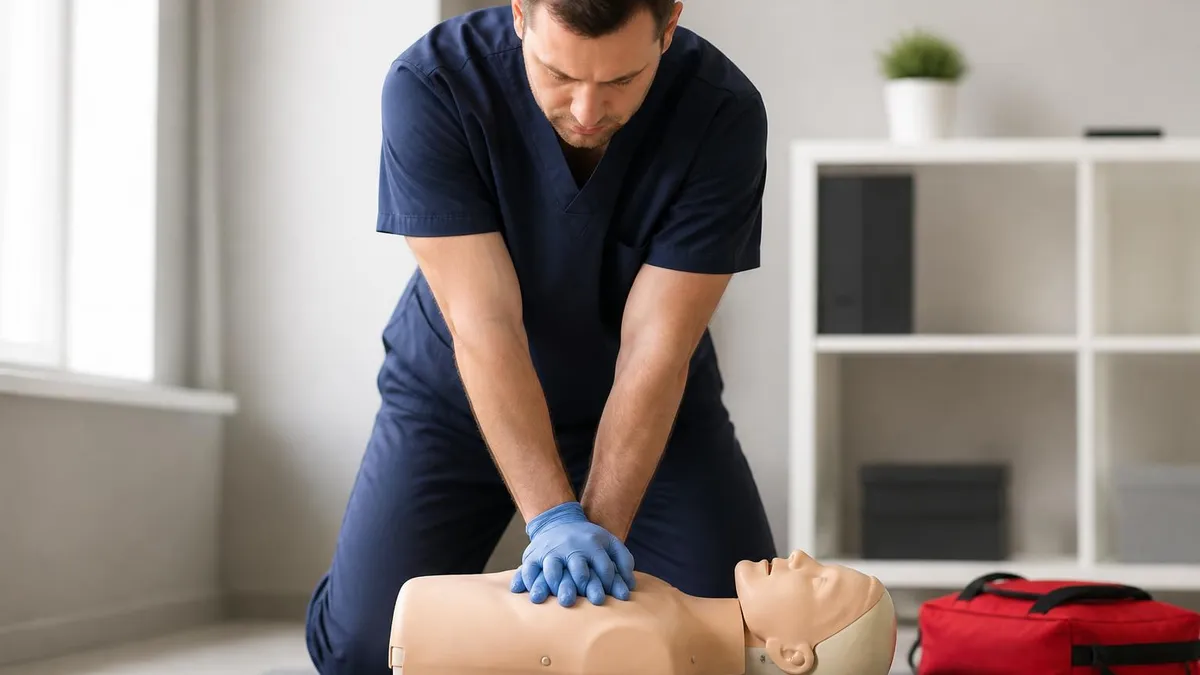
Online BLS Renewal: Complete 2026 Guide to Recertifying Your Basic Life Support Card
BLS Practice Test Video Answers
About the Author

Registered Nurse & Healthcare Educator
Johns Hopkins University School of NursingDr. Sarah Mitchell is a board-certified registered nurse with over 15 years of clinical and academic experience. She completed her PhD in Nursing Science at Johns Hopkins University and has taught NCLEX preparation and clinical skills courses for nursing students across the United States. Her research focuses on evidence-based exam preparation strategies for healthcare certification candidates.
Join the Discussion
Connect with other students preparing for this exam. Share tips, ask questions, and get advice from people who have been there.
View discussion (8 replies)