
How to Study for Anatomy and Physiology: The Complete Study Guide 2026
Learn how to study for anatomy and physiology with proven strategies, ✍🏼 study schedules, and practice tips to ace your exams and build lasting knowledge.
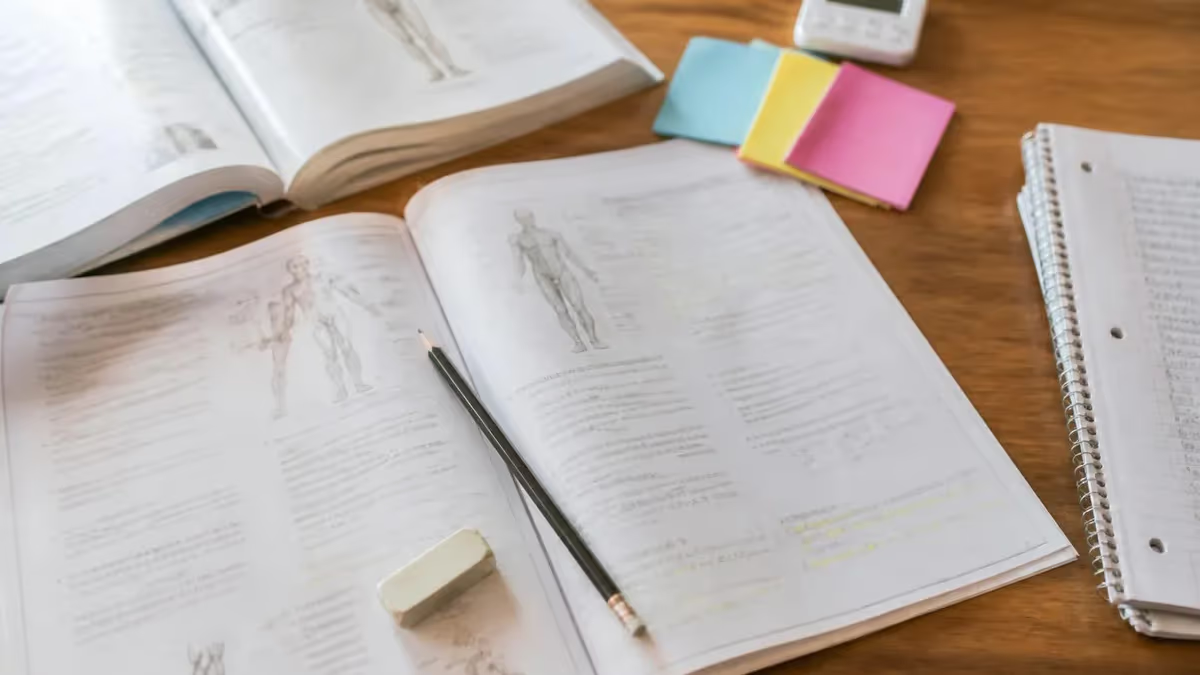
Knowing how to study for anatomy and physiology is one of the most important skills you can develop as a healthcare, nursing, or pre-med student. Anatomy and physiology courses are widely considered among the most challenging in any allied health curriculum, demanding not just memorization but genuine conceptual understanding of how the human body is structured and how it functions as an integrated whole. Students who approach these courses without a clear strategy frequently find themselves overwhelmed by the sheer volume of terminology, the interlocking nature of body systems, and the pace at which new material accumulates each week. Practice with the free Anatomy and Physiology practice test on PracticeTestGeeks (7 questions with answer explanations).
The foundational challenge is that anatomy and physiology are not two separate subjects bolted together — they are deeply intertwined disciplines. Understanding the anatomy of the heart, for example, is nearly meaningless without simultaneously grasping how cardiac muscle contractions generate pressure gradients that propel blood through the circulatory system. This means effective studying requires you to constantly ask not just "what is this structure called?" but "what does it do and why does its shape make that function possible?" That question-driven mindset separates students who earn A grades from those who barely pass.
Most students underestimate how many hours the subject demands. Research on study time in allied health programs consistently shows that successful students in anatomy and physiology invest between 10 and 15 hours per week outside of class — roughly two to three hours for every lecture hour. This is not because the material is impossibly difficult, but because the brain needs repeated, spaced exposures to lock new vocabulary and concepts into long-term memory. A single late-night cram session before an exam simply cannot replicate the learning that accumulates across dozens of shorter, distributed study sessions.
Active learning strategies dramatically outperform passive review for this subject. Highlighting a textbook or re-reading lecture slides gives students a comfortable sense of familiarity without producing durable memory. By contrast, retrieval practice — closing your notes and forcing yourself to recall structures, functions, and relationships from scratch — triggers the cognitive effort that actually consolidates memory. Techniques like self-quizzing, teaching content aloud to an imaginary student, and drawing labeled diagrams from memory are consistently ranked among the highest-yield study methods for anatomy and physiology by both cognitive scientists and experienced instructors.
Your study environment and scheduling habits matter as much as your techniques. Students who study in the same quiet, distraction-free location at consistent times each day build stronger study routines than those who squeeze in review whenever a spare moment appears. Eliminating phone notifications during study blocks, using the Pomodoro technique (25 minutes of focused work followed by a 5-minute break), and reviewing material within 24 hours of a lecture all contribute meaningfully to how well information sticks. These habits are not glamorous, but they form the invisible architecture that separates high performers from average ones.
One of the most underused resources available to anatomy and physiology students is the practice test. Timed practice questions expose gaps in your knowledge, force you to apply terminology in new contexts, and simulate the cognitive pressure of a real exam. Reviewing why wrong answers are wrong is often more instructive than reviewing why correct answers are correct, because it pinpoints the precise misunderstanding that needs to be corrected. For a deeper foundation in core vocabulary, exploring how to study for anatomy and physiology through key term mastery is an essential first step before tackling complex system-level concepts.
This guide walks you through every dimension of effective anatomy and physiology study: how to structure your schedule, which techniques to use for different types of content, how to approach lab practicals versus written exams, and how to sustain focus across a full semester. Whether you are taking your first college-level science course or preparing for a graduate-level anatomy component, the strategies here will help you build the knowledge base you need — and keep it well past finals week.
Free Anatomy and Physiology Study Tools
Interactive Anatomy and Physiology resources on PracticeTestGeeks, free to start:
- Anatomy and Physiology flashcards — review key terms and concepts card by card
- Anatomy and Physiology study guide — topic-by-topic overview of what the exam covers
- Anatomy and Physiology cheat sheet — one-page printable summary for last-minute review
Anatomy and Physiology Study by the Numbers

Build Your Anatomy and Physiology Study Schedule
- ▸Read textbook chapters on anatomical terminology and body planes
- ▸Create flashcards for all directional and regional terms
- ▸Draw and label a cell diagram from memory
- ▸Complete your first practice quiz to establish a baseline score
- ▸Categorize the four tissue types with examples of each
- ▸Sketch cross-sections of skin layers and label all structures
- ▸Review histology slides and describe what distinguishes each tissue
- ▸Self-quiz on tissue identification using unlabeled diagrams
- ▸Memorize the 206 bones using a body-region chunking strategy
- ▸Learn all bone markings, processes, and foramina for the skull and axial skeleton
- ▸Practice identifying bones and features on a 3D model or app
- ▸Complete spaced review of weeks 1–2 vocabulary before new content
- ▸Learn muscle origins, insertions, and actions in region-by-region groups
- ▸Create action summary tables: flexors vs. extensors, adductors vs. abductors
- ▸Practice naming muscles from function descriptions (reverse recall)
- ▸Take a timed practice exam covering all content from weeks 1–4
- ▸Master the neuron anatomy diagram: dendrites, axon, myelin, synaptic terminals
- ▸Trace an action potential step-by-step using your own written narrative
- ▸Map CNS regions and their primary functions on a blank brain outline
- ▸Explain CNS vs. PNS distinctions and give three structural examples of each
- ▸Trace blood flow through the full cardiac and pulmonary circuit
- ▸Label all four heart chambers, valves, and major vessels
- ▸Diagram the process of external and internal respiration
- ▸Create a comparison chart of pulmonary vs. systemic circulation
Active learning techniques are the engine of successful anatomy and physiology study, and understanding which techniques work best for different types of content can save you dozens of hours over a semester. The subject contains two broad categories of knowledge: declarative knowledge (naming structures, defining terms, identifying locations) and procedural or conceptual knowledge (explaining how a process works, predicting what happens when a system is disrupted, tracing pathways). Each type of knowledge benefits from different study approaches, and the best students blend both throughout their preparation.
For declarative knowledge — vocabulary, structure names, and anatomical locations — spaced repetition flashcard systems are among the most evidence-backed tools available. Applications like Anki use an algorithm that shows you cards at precisely the intervals when your brain is about to forget them, maximizing retention with minimal wasted time.
The key to making flashcards effective for anatomy is to write cards that require production, not just recognition. Instead of a card that asks "What is the femur?" write one that says "Name the largest bone in the lower limb and identify its proximal and distal features." Production-style cards force deeper processing and transfer more readily to exam conditions.
Concept mapping is one of the highest-yield strategies for understanding how body systems interconnect. To build a concept map, start with a central term — for example, "homeostasis" — and draw branches outward to every related idea: negative feedback loops, receptor-integrator-effector pathways, specific examples like blood glucose regulation, and failure states like diabetes mellitus.
This visual representation forces you to articulate relationships rather than just recall isolated facts. Research in nursing education has shown that students who use concept mapping as part of their regular study routine score significantly higher on application-level exam questions than those who rely on linear note-taking alone.
The teach-back method is deceptively simple but extraordinarily powerful. After studying a topic, close your materials and explain the concept aloud as if you are teaching a classmate who has never heard of it before. When you stumble — and you will — you have found a gap. Go back, re-read that specific section, then try the explanation again.
This cycle of attempt, fail, target, and retry is exactly what cognitive scientists call deliberate practice, and it is one of the fastest routes to genuine mastery. Study groups can formalize this process: assign each member a body system to teach, then quiz one another on the details.
Drawing from memory is a kinesthetic strategy that works especially well for visual and spatial content. After reading about the brachial plexus, for instance, close your book and attempt to reproduce the entire diagram — nerve roots, trunks, divisions, cords, and terminal branches — from memory on a blank sheet of paper.
Compare your drawing to the textbook version, note every discrepancy, and repeat. The act of drawing forces you to encode spatial relationships that passive reading never can. Over multiple sessions, your drawings will become more accurate and faster to produce, which is exactly the kind of fluency you need for a lab practical.
Color-coded note organization helps the brain create categorical schemas that make retrieval faster. Use one color consistently for all structure names, another for functions, a third for clinical correlations, and a fourth for process steps. When your notes are consistently color-organized, reviewing them triggers the schema rather than just individual facts, making it easier to reconstruct whole concepts from partial cues on an exam. This approach pairs naturally with the anatomy and physiology coloring workbook format, where coloring itself serves as a form of active recall for spatial relationships.
Interleaved practice — mixing questions from different body systems rather than blocking all your cardiovascular review before moving to the respiratory system — is one of the most powerful and counterintuitive strategies in the cognitive science literature.
It feels harder and less productive in the moment because you are constantly switching contexts, but research consistently shows it produces superior long-term retention and better performance on transfer tests. In practical terms, this means your study sessions should deliberately mix old content with new content, forcing your brain to actively identify which retrieval route to use rather than riding the momentum of a single topic.
Studying Each Major Body System
The skeletal system requires you to memorize 206 bones plus their landmarks, foramina, processes, and articulations. The most effective approach is to study bones in regional groups — skull, vertebral column, thoracic cage, pectoral girdle, upper limb, pelvic girdle, lower limb — rather than alphabetically or randomly. For each bone, create a story that links the name to its location and its most clinically important features. The pterygoid process, the ischial tuberosity, the medial epicondyle — each has a functional or positional rationale that makes it memorable when understood rather than rote-memorized.
Muscle study becomes manageable when you organize muscles by action group rather than by region alone. All elbow flexors, for example, share origin-insertion logic that distinguishes them from elbow extensors. Build a master table with columns for muscle name, origin, insertion, action, and innervation, and fill it in system by system. Practice-testing by covering columns forces retrieval. A useful clinical hook: for every major muscle, ask what injury or nerve damage would eliminate its function — this ties anatomy to pathology and dramatically improves retention for students heading into clinical programs.

Active Study Techniques vs. Passive Review: What Actually Works?
- +Spaced repetition flashcards build durable long-term memory for hundreds of terms
- +Drawing diagrams from memory forces spatial encoding that passive reading cannot replicate
- +Teaching content aloud immediately reveals knowledge gaps before the exam does
- +Interleaved practice across multiple systems improves transfer to novel exam questions
- +Concept maps clarify how body systems interact and reinforce systems-level thinking
- +Timed practice tests simulate real exam pressure and improve performance under stress
- −Passive re-reading of notes creates an illusion of mastery without genuine retention
- −Highlighting entire paragraphs does not require retrieval and produces minimal learning
- −Cramming the night before an exam leads to rapid forgetting within 48 hours
- −Studying in noisy or distraction-heavy environments fragments attention and reduces encoding
- −Memorizing isolated facts without connecting them to function leads to poor application scores
- −Skipping lab practicals or ignoring three-dimensional models leaves spatial knowledge weak
Pros and Cons at a Glance
| Pros | Cons |
|---|---|
| Spaced repetition flashcards build durable long-term memory for hundreds of terms | Passive re-reading of notes creates an illusion of mastery without genuine retention |
| Drawing diagrams from memory forces spatial encoding that passive reading cannot replicate | Highlighting entire paragraphs does not require retrieval and produces minimal learning |
| Teaching content aloud immediately reveals knowledge gaps before the exam does | Studying in noisy or distraction-heavy environments fragments attention and reduces encoding |
| Interleaved practice across multiple systems improves transfer to novel exam questions | Memorizing isolated facts without connecting them to function leads to poor application scores |
| Concept maps clarify how body systems interact and reinforce systems-level thinking | Skipping lab practicals or ignoring three-dimensional models leaves spatial knowledge weak |
Anatomy and Physiology Exam Prep Checklist
- ✓Complete all assigned textbook readings before each lecture, not after
- ✓Review your lecture notes within 24 hours of class to reinforce encoding
- ✓Create a new set of practice flashcards for every major body system studied
- ✓Redraw at least one key anatomical diagram from memory each study session
- ✓Use spaced repetition software to review vocabulary across all previous units weekly
- ✓Complete at least one full-length practice test one week before each major exam
- ✓Review every wrong answer on practice tests and identify the specific concept gap
- ✓Form or join a study group and use the teach-back method for at least one topic per week
- ✓Visit your professor or TA during office hours with specific content questions, not general confusion
- ✓Spend dedicated time on lab specimens, models, or digital 3D tools before every lab practical

The 24-Hour Rule Is Non-Negotiable
Cognitive science research consistently shows that reviewing material within 24 hours of first exposure reduces the forgetting that naturally occurs overnight by up to 80%. Students who re-read their lecture notes the same evening — even for just 15 minutes — retain far more content heading into midterms and finals than those who wait until the weekend to review. Make next-day review a non-negotiable habit from the very first week of the course.
Lab practical exams are a distinct challenge from written exams, and they require a dedicated preparation strategy that many students neglect until the week before. A lab practical typically presents you with cadaveric specimens, plastinated models, anatomical charts, or microscope slides, each tagged with a numbered pin or arrow, and asks you to identify the structure within 60 to 90 seconds before rotating to the next station.
The time pressure is intense, and the identification must be precise — calling the brachialis the biceps brachii, or labeling the duodenum as the ileum, costs you full points regardless of how well you understand the broader system.
The most effective preparation for lab practicals is to study from the same types of materials you will be tested on. If your course uses cadaveric specimens, spend time in the cadaver lab outside of scheduled class hours whenever access is permitted.
If it uses plastinated models or anatomical teaching charts, seek out identical or comparable materials in your campus library, anatomy learning center, or through high-quality digital platforms. The key principle is visual and tactile familiarity: structures that you have seen, touched, and named in three dimensions are far easier to identify under timed conditions than structures you know only from textbook illustrations.
A technique that significantly improves practical performance is station simulation. Gather a study partner and a set of anatomical models, then set a timer for 90 seconds per station. One person places tags or points to structures; the other identifies them as quickly and precisely as possible. Rotate roles. After each round, discuss any missed or uncertain identifications and return to those structures specifically.
This simulation not only builds identification speed but also replicates the psychological pressure of the actual exam, which is itself a form of stress inoculation — students who have experienced timed rotations during practice are measurably calmer and more accurate during real practical exams.
Histology slides deserve special attention because microscopic anatomy looks nothing like macroscopic anatomy, and the identification cues are entirely different. For each tissue type and organ, learn the characteristic microscopic features: the pseudostratified columnar epithelium of the trachea with its cilia and goblet cells, the striated banding pattern of skeletal muscle versus the branching intercalated discs of cardiac muscle, the glomerular architecture of the renal corpuscle. Create a slide identification guide with labeled images for each tissue, and practice matching unlabeled images to their correct identification until your accuracy exceeds 90% on review sets.
Regional anatomy integration is a skill that separates high scorers from average performers on both written and practical exams. Rather than studying structures in isolation — this is the femoral artery, this is the femoral nerve, this is the femoral vein — study the femoral triangle as a complete spatial unit: its boundaries (sartorius, adductor longus, inguinal ligament), its contents in lateral-to-medial order (nerve, artery, vein, empty space, lymphatics — remembered with the mnemonic NAVEL), and its clinical significance for femoral pulse assessment and central line placement.
This contextual packaging makes individual structures far easier to retrieve because each one is embedded in a rich associative network.
For written practical components that require you to explain physiological processes — the sequence of events in a muscle contraction, the steps of the clotting cascade, the mechanism of hormone-receptor signaling — narrative writing practice is the best preparation. Before each written practical, select five to eight major processes from the current unit and write out a complete, step-by-step explanation without notes.
Time yourself. After 10 minutes, compare your written explanation to the textbook and note every gap or error. Repeat this exercise twice more before the exam. Students who regularly practice written physiological narration consistently produce more organized, complete answers on exams than those who review by reading alone.
Finally, sleep and physical recovery are not optional variables in anatomy and physiology performance — they are active ingredients in the learning process. The brain consolidates memory during slow-wave and REM sleep, meaning that the material you studied during the day is being organized, cross-linked, and stored overnight.
Sacrificing sleep to squeeze in an extra hour of review is almost always counterproductive: the review itself has diminished value because an overtired brain encodes poorly, and the lost consolidation window means yesterday's learning is partially wasted. Aim for seven to nine hours of sleep every night of exam week, not just the night before the test.
Anatomy and physiology vocabulary is cumulative — terms introduced in unit one appear in the definitions of unit six concepts. Students who fall behind on terminology early in the semester find that the deficit compounds rapidly, making later units feel incomprehensible even when the new content itself is not especially difficult. If you are more than one week behind on vocabulary, schedule a dedicated catch-up session this week and use spaced repetition software daily until you are current. Waiting until finals week is almost always too late to close a multi-unit vocabulary gap effectively.
The right study resources can make the difference between grinding through material inefficiently and moving through a semester with clarity and confidence. Textbooks are the obvious starting point, and for most introductory anatomy and physiology courses, Tortora and Derrickson's Principles of Anatomy and Physiology or Marieb and Hoehn's Human Anatomy and Physiology are the gold-standard references.
These texts are dense but structured for step-by-step learning, with summary tables, clinical application boxes, and end-of-chapter review questions that provide built-in active recall opportunities. Rather than reading every word, use a strategic approach: preview the learning objectives, read the section introductions and summaries first, then fill in the middle with focused reading on your weakest areas.
Digital anatomy platforms have transformed how students engage with three-dimensional spatial content. Applications like Complete Anatomy (by 3D4Medical) and Visible Body provide fully rotatable, layered human body models that allow you to peel back muscle layers to reveal underlying nerves and vessels, or isolate a single organ system against a transparent body for focused study. These tools are especially valuable for visual and spatial learners who struggle to translate two-dimensional textbook illustrations into a mental three-dimensional model. Incorporating 20 to 30 minutes of digital model exploration into your weekly study routine pays substantial dividends on both written and practical exams.
YouTube has become a genuinely excellent resource for anatomy and physiology, with channels like Armando Hasudungan, Professor Fink, and Khan Academy offering detailed, well-illustrated video explanations of complex physiological processes. Video is particularly effective for learning dynamic processes — the cardiac cycle, nerve impulse propagation, the sliding filament theory of muscle contraction — that are difficult to grasp from static diagrams.
The rule for using educational video effectively is to watch actively: pause frequently, attempt to predict what comes next, and summarize each major section in your own words before continuing. Passive video consumption produces almost no learning benefit compared to text reading.
Study guides and workbooks designed specifically for anatomy and physiology can provide structured active learning in a format that textbooks do not. Coloring workbooks, in particular, have strong empirical support for improving spatial memory and structure-function associations because the act of selecting colors and applying them to labeled regions requires deliberate attention to anatomical boundaries and spatial relationships. For a comprehensive look at how these visual tools fit into a complete resource strategy, exploring detailed anatomy and physiology study material guides can help you build a personalized toolkit that matches your learning style and course requirements.
Peer study groups work best when they are structured rather than social. The most productive study groups assign specific preparation tasks before each meeting — member A will teach the renal system, member B will create practice questions on fluid balance, member C will quiz the group on nephron anatomy — so that the meeting time is used for high-intensity review rather than reading notes aloud to each other.
Groups of three to five students tend to be more productive than larger groups, which frequently devolve into off-topic conversation. Establishing a consistent meeting location, a fixed agenda, and a firm end time helps groups maintain discipline across a full semester.
Practice testing is arguably the single most powerful study tool that students underutilize. The testing effect — the well-documented finding that retrieving information from memory strengthens that memory more than any other study activity — is one of the most replicated findings in cognitive science.
For anatomy and physiology, this means that regularly completing practice questions, old exams, and chapter review tests should take up at least 30 to 40 percent of your total study time by the midpoint of the semester. Do not wait until you feel "ready" to start testing yourself; the discomfort of answering questions before you feel confident is precisely what makes practice testing effective.
Finally, connecting anatomy and physiology content to real clinical cases and patient scenarios is one of the most powerful ways to make abstract material feel relevant and memorable. When you read about the lymphatic system, think about what happens during infection — swollen lymph nodes, immune cell proliferation, the lymphatic drainage patterns that determine where cancer metastasizes first.
When you study the kidney, think about what happens during hypertension or chronic kidney disease — which structural components are damaged, how glomerular filtration rate is affected, and why edema develops. Clinical anchoring transforms dry facts into meaningful narratives, and meaningful narratives are dramatically easier to remember and apply on both academic exams and, eventually, in professional practice.
You can continue preparing with the anatomy and physiology 1 practice test, which includes answer explanations for every question.
Building mental stamina for long anatomy and physiology exams requires deliberate training, not just content knowledge. Most anatomy and physiology midterms and finals run between 90 minutes and three hours and include 60 to 150 questions spanning multiple units. Students who have never practiced sitting with focused attention for that duration frequently experience cognitive fatigue during the actual exam — attention drifts, decision-making slows, and questions that seemed clear during review suddenly feel ambiguous. The solution is to include full-length timed practice sessions in your preparation from at least four weeks out, gradually building your exam-day endurance.
Test anxiety is a real and common obstacle for anatomy and physiology students, particularly those in nursing and pre-med programs where the stakes feel extremely high. The evidence-based antidote to test anxiety is not simply "knowing the material better" — though that helps — but rather familiarity with the exam format and repeated exposure to the discomfort of being tested.
The more practice tests you complete under realistic conditions, the more your nervous system learns that the testing situation is manageable rather than threatening. Combining this exposure practice with controlled breathing techniques (a slow 4-count inhale, hold for 4, 6-count exhale) immediately before the exam can meaningfully reduce performance-disrupting anxiety.
Question analysis skills are a distinct competency from content knowledge and are worth developing explicitly. Anatomy and physiology exam questions frequently use specific language cues that guide the correct answer: "most likely" signals that you need to identify the most common or highest-priority option, "EXCEPT" signals that four options are correct and one is not, and "immediately" in a clinical scenario signals that you are looking for the most urgent physiological intervention.
Learning to identify these language cues and process them before reading the answer choices prevents a common error pattern in which students select a factually correct answer that does not answer the specific question asked.
Managing your exam time strategically is a skill that separates good test-takers from great ones. On a 100-question exam with 90 minutes, you have 54 seconds per question — enough for questions you know well, but dangerously short for questions requiring extended reasoning. The best strategy is to move through the entire exam once, answering every question you know immediately and flagging uncertain ones for review. This ensures you capture every easy point before spending time on harder questions, and it often triggers retrieval of initially elusive answers through the incubation effect of completing other questions first.
Nutritional and hydration status on exam day are frequently overlooked performance variables. Research on cognitive performance consistently shows that mild dehydration (as little as 1–2% of body weight) measurably impairs working memory, attention, and processing speed — exactly the cognitive functions most critical for anatomy and physiology exams.
Eating a balanced meal with complex carbohydrates and protein two to three hours before the exam provides sustained glucose availability without the attention-fragmenting effects of a blood sugar spike and crash. Avoid heavy caffeine use on exam day if you are not already a regular caffeine consumer, as the anxiety amplification effect can worsen test performance.
After each major exam, conduct a structured exam review regardless of your score. For every question you missed, write out the correct answer in a complete sentence and identify the specific concept or system it came from. Categorize your errors: are you missing terminology questions (vocabulary gap), application questions (conceptual gap), or detail questions (need more granular memorization)? This error analysis transforms each exam from a one-time performance event into a diagnostic tool that shapes the rest of your semester study plan.
Students who do this consistently find that their error categories shift — early-semester vocabulary gaps give way to more sophisticated conceptual misunderstandings, which are then addressed through deeper concept-mapping and teaching-back sessions.
Remember that anatomy and physiology knowledge is cumulative across your entire academic and professional career. The material you master in this course is not discarded after finals — it forms the biological foundation for pharmacology, pathophysiology, clinical assessment, surgical technique, and patient communication. Investing fully in understanding rather than in short-term exam performance pays dividends for years.
Students who truly understand how the renal system maintains fluid balance, how the autonomic nervous system modulates heart rate, and how cellular respiration produces ATP will find advanced clinical courses dramatically more accessible than those who memorized facts for a grade and forgot them by summer.
Sample Anatomy and Physiology Practice Questions
Try these questions from our free Anatomy and Physiology practice tests. The correct answer and an explanation follow each question.
What is the foundational principle of communication and documentation in the Anatomy and Physiology field?
- A. Maximizing personal advancement
- B. Maintaining competence, integrity, and service to stakeholders
- C. Following the easiest path available
- D. Avoiding all challenging situations
Answer: B. Maintaining competence, integrity, and service to stakeholders
The foundational principles of communication and documentation in Anatomy and Physiology center on maintaining competence, integrity, and quality service.
What is the foundational principle of professional standards and ethics in the Anatomy and Physiology field?
- A. Maximizing personal advancement
- B. Maintaining competence, integrity, and service to stakeholders
- C. Following the easiest path available
- D. Avoiding all challenging situations
Answer: B. Maintaining competence, integrity, and service to stakeholders
The foundational principles of professional standards and ethics in Anatomy and Physiology center on maintaining competence, integrity, and quality service.
What is the foundational principle of assessment and evaluation in the Anatomy and Physiology field?
- A. Maximizing personal advancement
- B. Maintaining competence, integrity, and service to stakeholders
- C. Following the easiest path available
- D. Avoiding all challenging situations
Answer: B. Maintaining competence, integrity, and service to stakeholders
The foundational principles of assessment and evaluation in Anatomy and Physiology center on maintaining competence, integrity, and quality service.
What is the foundational principle of industry best practices in the Anatomy and Physiology field?
- A. Maximizing personal advancement
- B. Maintaining competence, integrity, and service to stakeholders
- C. Following the easiest path available
- D. Avoiding all challenging situations
Answer: B. Maintaining competence, integrity, and service to stakeholders
The foundational principles of industry best practices in Anatomy and Physiology center on maintaining competence, integrity, and quality service.
Anatomy Physiology Questions and Answers
Anatomy and Physiology Definitions: The Complete Beginner's Guide to Key Terms and Concepts

Anatomy and Physiology for Dummies: The Ultimate Beginner's Guide to Understanding the Human Body
Define Anatomy and Physiology: A Complete Guide to Understanding Human Body Structure and Function

Anatomy and Physiology Study Material: Complete Resource Guide
Anatomy and Physiology Coloring Workbook: The Complete Guide to Visual Learning, Active Recall, and Mastering Body Systems
How this page was made: written with AI tools and published by Nathan Beja, founder of Practice Test Geeks, who is responsible for its content. We have not yet matched this exam's facts to an official source, so confirm fees, dates and rules with the exam body. Not reviewed by a subject-matter expert. Editorial policy