
Human Anatomy and Physiology Lab Manual: The Complete Guide to Lab Skills, Exercises, and Exam Success
Master your human anatomy and physiology lab manual with expert tips, ⏳ exercise breakdowns, study strategies, and free practice tests.
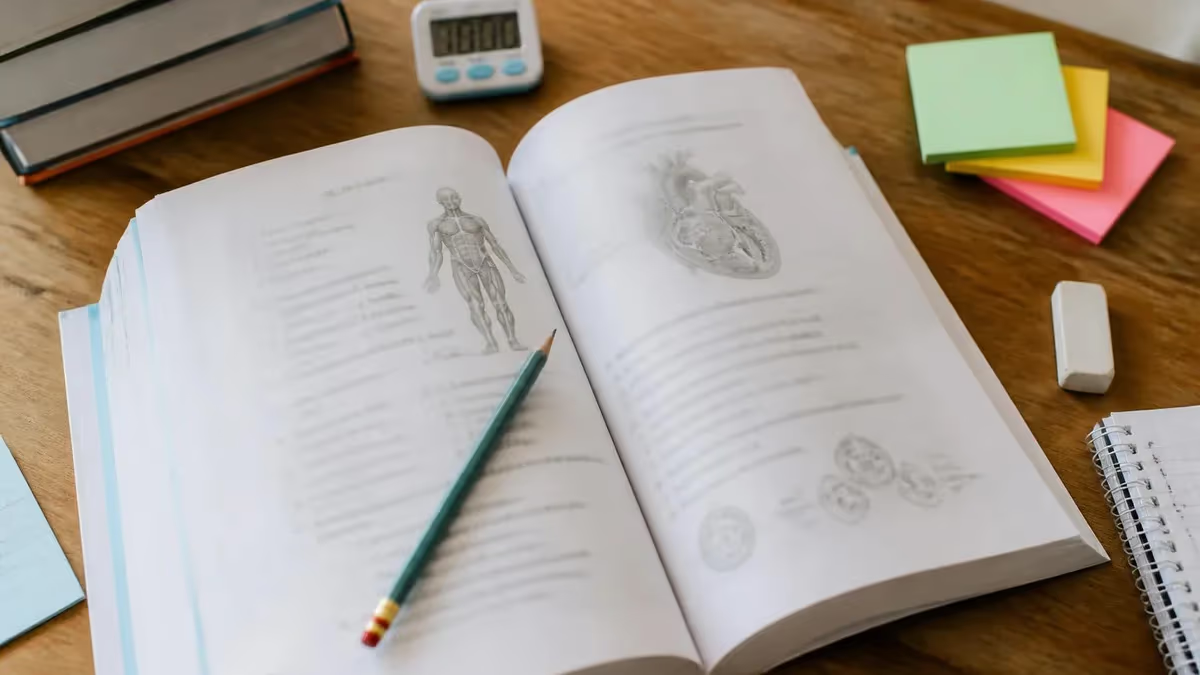
The human anatomy and physiology lab manual is one of the most essential tools a student will use throughout their science education. Whether you are enrolled in a pre-nursing program, a biology degree, or a pre-med curriculum, the lab manual bridges the gap between theoretical knowledge and hands-on understanding. It provides structured exercises that guide you through dissection, microscopy, physiological measurements, and body system analysis in a logical, progressive sequence designed to reinforce lecture content and build lasting comprehension.
Lab manuals for anatomy and physiology courses in the United States typically accompany a core textbook, and the two resources work together as a complete learning system. The manual includes pre-lab exercises, step-by-step procedural instructions, observation recording tables, and post-lab review questions. Each unit is carefully calibrated to match the corresponding lecture material, which means that students who complete every exercise attentively are far better positioned to succeed on both practical lab exams and written assessments than those who treat the manual as optional busywork.
One of the most frequently underestimated aspects of the lab manual is how much it prepares students for clinical thinking. Exercises involving blood pressure measurement, urinalysis interpretation, reflex arc testing, and histological slide identification all reflect real diagnostic and observational skills used by nurses, physical therapists, and physicians every day. Investing serious effort in the lab component of your anatomy and physiology course pays dividends not just on your transcript but in your professional competence years down the line.
Students often struggle with the lab manual not because the content is too difficult, but because they lack a systematic approach to completing each exercise. Rushing through procedural steps, skipping pre-lab reading, or failing to sketch and label diagrams carefully are among the most common errors. Understanding the purpose behind each exercise, knowing which terminology to master, and recognizing which measurements require precision versus estimation can transform your lab experience from stressful to genuinely rewarding and intellectually stimulating.
There are several major editions and publishers of anatomy and physiology lab manuals used across American colleges and universities. Elaine Marieb's lab manual series, the Amerman lab manual, and the Mc-Kay editions are among the most widely adopted. Each offers a slightly different pedagogical approach, but all share the same core structure: a systematic organ-system progression from cellular biology through the major body systems, concluding with reproduction and development. Knowing which edition your course uses matters because exercises, figure numbers, and terminology can vary meaningfully between versions.
Preparing for lab practicals requires a different study strategy than preparing for written exams. Rather than passive reading, you must actively engage with three-dimensional models, microscope slides, and physical specimens. Developing the ability to identify structures under varied lighting conditions, from multiple angles, and on specimens of different sizes is a skill that takes dedicated practice. The lab manual serves as your primary study roadmap, pointing you toward exactly which structures you need to be able to identify, label, and describe functionally for your practical assessments.
This guide will walk you through everything you need to know to use your human anatomy and physiology lab manual effectively, from understanding its structure and key exercises to building a study schedule that maximizes retention. We will cover the most commonly tested topics, provide a breakdown of lab practical formats, and share proven strategies for turning lab exercises into durable anatomical knowledge you can carry into your healthcare career with confidence.
Anatomy and Physiology Lab by the Numbers

Key Sections of a Human Anatomy and Physiology Lab Manual
Completed before each session, these exercises check your foundational knowledge of the topic at hand. They typically include short-answer questions, labeling diagrams, and defining key terms so you arrive at the lab bench prepared to observe and record accurately.
Step-by-step instructions guide you through each lab activity, whether that involves measuring respiratory volumes, identifying bones on a skeleton, preparing a wet mount slide, or testing a sensory receptor. Following these precisely produces reliable, gradeable data and observations.
Structured tables prompt you to record measurements, sketches, and comparative observations systematically. These tables double as study guides because completing them correctly means you have already processed the material once before any formal review session begins.
Higher-order questions appear after each exercise to push your thinking from simple recall toward analysis and clinical application. Instructors often pull exam questions directly from these sections, making thorough post-lab completion one of the highest-yield study habits available.
Most manuals include anatomical diagrams, histology photomicrographs, reference tables for normal physiological values, and summary charts. These references are invaluable during both the lab session itself and in the days leading up to a practical exam.
Mastering the practical skills covered in your lab manual requires consistent, deliberate effort spread across the entire semester rather than intensive cramming before exam week. The first skill to develop is proper microscope technique, since histology exercises appear in virtually every unit of a comprehensive anatomy and physiology lab course. You must be able to focus a slide at low, medium, and high power, calculate total magnification, estimate cell or tissue dimensions using the field-of-view diameter, and sketch what you observe with enough accuracy that labeled drawings are scientifically meaningful rather than vague approximations.
Bone and muscle identification exercises form another major pillar of the lab manual curriculum. For the skeletal system unit, students are expected to identify the 206 bones of the adult human skeleton by name, distinguish proximal from distal surfaces, name major bone markings such as foramina, condyles, trochanters, and processes, and explain the functional significance of these features. Laboratory models and real disarticulated bone sets are commonly used for these exercises, and the key to success is handling every bone repeatedly while simultaneously reciting its name and orientation aloud until the associations become automatic and instantaneous.
Muscular system lab exercises build on skeletal knowledge by requiring students to locate muscle origins and insertions on both skeletal models and cadaveric or plastinated specimens. Understanding how a muscle's attachment points determine its action at a specific joint is a classic laboratory learning objective that tests integrative thinking rather than rote memorization. The lab manual will ask you to complete origin-insertion-action tables for major muscle groups of the upper limb, lower limb, trunk, and head and neck, and completing these tables from memory is an excellent practical exam preparation strategy.
Cardiovascular and respiratory physiology exercises introduce quantitative measurement skills that distinguish anatomy lab from purely observational science. You will measure resting and post-exercise heart rate, calculate pulse pressure from systolic and diastolic readings, interpret a basic electrocardiogram tracing, measure tidal volume and vital capacity using a spirometer, and compare individual values against population norms. These exercises require careful attention to procedure because small errors in technique, such as improper spirometer sealing or incorrect blood pressure cuff placement, produce data that cannot be meaningfully interpreted or compared.
Nervous system labs are frequently the most conceptually challenging portion of the manual because they require integrating anatomy, physiology, and clinical application simultaneously. Exercises typically include drawing and labeling neuron types, tracing reflex arcs from receptor through effector, performing the Romberg test for proprioceptive balance, mapping two-point discrimination thresholds on different body regions, and interpreting the results of cranial nerve function tests.
Each of these activities requires you to connect the structural features of neural tissue to the functional outcomes you are observing in real time, which is exactly the type of applied thinking that distinguishes excellent students from those who merely memorize terminology.
Urinary system exercises in the lab manual commonly include both anatomical identification and physiological analysis. You will be expected to identify kidney structures on models and histological slides, including the glomerulus, Bowman's capsule, proximal and distal convoluted tubules, and collecting duct. Urinalysis exercises ask you to interpret dipstick results for glucose, protein, ketones, and pH, comparing findings to normal ranges and generating differential diagnoses for abnormal values. These clinical simulation exercises are particularly valuable for nursing and allied health students because they mirror real patient assessment workflows encountered in clinical practice settings.
Reproductive system and developmental biology labs round out the full-year sequence with exercises covering gamete histology, fertilization and early embryo development stages, and the identification of male and female reproductive organ structures on models and microscope slides. Many students find these final units both the most personally engaging and the most rapidly forgotten because they come at the end of the semester under maximum academic pressure. Reviewing these materials with the same rigor applied to earlier units ensures that comprehensive final exams and licensing preparation tests do not reveal embarrassing gaps in the body system sequence.
Studying by Body System in Your Lab Manual
The skeletal and muscular systems together account for the largest share of lab practical exam questions in most anatomy and physiology courses. To study these systems effectively, spend time physically handling bone models while using the lab manual's identification tables as a checklist. Cover the label, attempt to name each structure, then verify. Repeat this active recall cycle at least three times per study session, spacing sessions across multiple days for maximum retention and recall durability under timed exam conditions.
For muscle identification, create a custom origin-insertion-action table by covering each column and testing yourself systematically. Pay special attention to muscles with similar names or neighboring locations, such as the biceps brachii versus brachialis, or the three gluteal muscles, because these are frequently confused on practicals. Drawing freehand muscle diagrams and shading the origin and insertion in different colors accelerates the spatial learning that model-based identification demands during a timed lab practical examination.

Lab Manual Learning: Strengths and Limitations
- +Provides a structured, systematic progression through all major body systems in a logical pedagogical sequence
- +Combines anatomical identification with physiological measurement for integrated learning
- +Pre-lab and post-lab questions reinforce lecture content and promote active recall over passive reading
- +Data recording tables teach scientific documentation skills valued in clinical and research settings
- +Hands-on exercises build three-dimensional spatial understanding that textbook figures alone cannot provide
- +Compatible with multiple learning styles through written, visual, kinesthetic, and quantitative activities
- −Physical lab manuals become outdated when new editions are published, making used copies risky for accuracy
- −Exercises assume access to specific specimens, models, or equipment that may not be available at all schools
- −Self-study outside of scheduled lab sessions is limited without access to cadavers or microscope slides
- −Some exercises rely on partner measurements, making solo at-home review difficult or impossible to replicate
- −Terminology variations between different publisher editions can create confusion when using multiple resources
- −Time-limited lab sessions mean students may rush through exercises without achieving genuine mastery of content
Lab Practical Preparation Checklist
- ✓Review all labeled diagrams in the lab manual and redraw them from memory at least twice before the exam.
- ✓Identify every structure on available lab models using only your manual's identification lists as a guide.
- ✓Complete all post-lab review questions in writing, not just mentally, to reinforce processing and recall.
- ✓Create a master terminology list of all bolded terms in each completed unit and self-quiz daily.
- ✓Practice tracing physiological pathways (blood flow, nerve impulse, urine formation) without looking at notes.
- ✓Review your recorded data tables and ensure you can explain any values that fell outside normal reference ranges.
- ✓Form a study group and quiz each other on model identification under timed conditions mimicking the actual practical.
- ✓Photograph specimens or models during lab sessions to use for at-home review when physical access is unavailable.
- ✓Visit open lab hours at least twice before the practical to gain extra time with specimens and instructor feedback.
- ✓Complete at least two full practice tests covering lab-relevant applied methods, techniques, and assessment questions.
Active Recall Beats Re-Reading Every Time
Students who test themselves actively on lab manual content — covering labels, drawing from memory, and reciting functions aloud — consistently outperform those who re-read exercises passively. Research in educational psychology confirms that retrieval practice strengthens long-term retention by up to 50% compared to review-only strategies. Apply this principle to every lab unit, not just the ones you find difficult, to build the comprehensive recall base that lab practical exams demand.
One of the most avoidable pitfalls in lab manual work is incomplete or inaccurate diagramming. Many students lose substantial points on practical exams not because they failed to study the structures but because their in-manual sketches lack sufficient detail, labeling accuracy, or orientation information to be scientifically valid.
Every time the lab manual asks you to draw a microscope field, a dissected organ, or a schematic of a physiological process, treat it as an exam question rather than a box to check. Neat, accurately labeled, and properly oriented diagrams reinforce spatial memory in a way that viewing figures in a textbook simply cannot replicate.
Another common mistake is treating the normal values printed in lab reference tables as irrelevant background information. In reality, knowing that a normal resting heart rate falls between 60 and 100 beats per minute, that a healthy adult blood pressure reads approximately 120/80 mmHg, that normal urine specific gravity ranges from 1.001 to 1.030, and that a typical vital capacity for a young adult male is around 4.8 liters provides the clinical context necessary to interpret your own and your classmates' collected data meaningfully.
Instructors specifically design post-lab questions to test whether students understand what deviations from these norms suggest about underlying physiological conditions.
Rushing through the pre-lab portion of each exercise is a habit that consistently undermines performance in the lab itself. The pre-lab reading and exercises exist to activate prior knowledge and orient your attention toward the specific structures, measurements, or processes the exercise will address.
Students who skip this preparation frequently waste the first fifteen to twenty minutes of a three-hour lab session trying to understand what they are looking at rather than actively observing, recording, and asking meaningful questions. This time loss compounds over the semester because each unit typically builds on the anatomical vocabulary and conceptual frameworks introduced in preceding exercises.
A particularly high-yield error to correct is neglecting the clinical application questions embedded throughout modern lab manuals. Publishers have increasingly shifted away from purely identification-based exercises toward questions that ask students to connect lab observations to patient scenarios.
For example, a question might present a urinalysis result showing high glucose and ask students to explain which endocrine disorder most likely explains this finding. Or a cardiac exercise might ask which heart valve defect would produce the loudest murmur during ventricular systole. Treating these questions as stretching exercises rather than core study material is a significant missed opportunity for students aiming for healthcare careers.
Time management during actual lab sessions is a skill worth developing consciously and early in the semester. The most efficient approach is to read through the entire exercise before touching any equipment, identify which steps require the most precision or will produce the data needed for post-lab questions, and plan your workflow accordingly. For exercises involving multiple measurements or specimen comparisons, recording everything in your manual's tables as you go prevents the common problem of forgetting which value corresponded to which condition when you sit down to complete the post-lab analysis hours or days after the session ends.
Peer learning during lab sessions is one of the most underutilized advantages available to anatomy and physiology students. When a lab partner accurately identifies a structure you cannot locate, asking them to point it out and explain the identifying characteristics is far more effective than passively watching.
Verbalizing your reasoning process aloud while identifying structures, even if only to yourself, engages metacognitive monitoring that helps you detect and correct errors before they become entrenched. Instructors consistently report that students who ask questions during lab sessions perform significantly better on practicals than those who work silently through exercises without seeking clarification on confusing observations.
Finally, never underestimate the value of reviewing your completed lab manual in the week before any major written exam in addition to your standard lecture notes. The data tables, diagrams, and post-lab answers you completed during the semester represent a personalized study guide built directly from your own observations and learning process. Because you generated this content actively rather than receiving it passively, it is encoded more durably in long-term memory and is more accessible under exam pressure than information encountered only through reading or listening to lectures in a classroom or online setting.

Lab manuals are revised frequently, and using an older edition than the one your course requires can put you at a serious disadvantage. Exercise numbers, figure references, and even procedural steps may differ between editions, meaning your pre-lab and post-lab answers may not align with the version your instructor uses for grading. Always confirm the required edition with your instructor or syllabus before purchasing, and if you must use an older copy, cross-reference every exercise carefully before submitting any graded work.
The connection between lab manual mastery and success on standardized anatomy and physiology examinations used for healthcare program admissions and professional licensing is stronger than many students initially appreciate. The HESI A2, TEAS, and NLN PAX examinations all contain anatomy and physiology sections that directly assess the kind of applied structural and functional knowledge built through diligent lab manual work. Students who have genuinely engaged with hands-on identification, physiological measurement exercises, and clinical application questions during their coursework approach these standardized tests with conceptual frameworks that allow them to reason through unfamiliar questions rather than relying solely on memorized facts.
Practical exam formats in anatomy and physiology courses across the United States vary by institution, but most follow one of two models. The station-based practical rotates students through numbered stations, each displaying a specimen, model, or slide with one or more structures marked by pins, tags, or arrows. Students have a fixed time interval at each station, typically 60 to 90 seconds, to record their answer and move on.
The second format is a live identification oral practical where students work directly with an instructor to identify structures and answer functional questions in real time, which requires not only accurate identification but also confident verbal articulation of anatomical terminology and physiological relationships.
Building fluency with anatomical directional terminology is essential for both lab practical success and written exam performance throughout your anatomy and physiology course sequence. Terms such as proximal, distal, medial, lateral, anterior, posterior, superior, inferior, ipsilateral, and contralateral appear constantly in lab manual directions, model identification exercises, and post-lab questions.
A student who needs to pause and mentally translate these terms during a timed practical is at a significant disadvantage compared to one who has internalized them as the default language for spatial description of biological structures. The lab manual itself provides constant practice with this vocabulary because every exercise uses directional terms to describe the orientation of structures, pathways, and relationships.
Understanding the grading criteria your instructor uses for lab reports and data tables can meaningfully improve your performance on submitted lab manual work. Most instructors award points for correct pre-lab answers, accurate data recording, properly labeled diagrams, and thoughtful post-lab analysis.
Knowing that diagram accuracy and labeling typically carry more point value than prose explanations helps students allocate their time wisely during lab sessions. If your instructor has provided a rubric or grading guide for any component of lab manual work, studying it as carefully as you would study exam review materials is a highly efficient use of your limited preparation time.
For students using a digital or hybrid lab manual format, which has become increasingly common since the widespread adoption of online learning management systems, the workflow differs somewhat from traditional print manuals. Digital formats often include embedded videos demonstrating procedures, interactive labeling exercises, and auto-graded pre-lab quizzes. Taking advantage of these features rather than treating them as optional extras can significantly accelerate your learning, particularly for microscopy and dissection exercises where seeing a procedure performed correctly before attempting it yourself prevents costly technique errors that produce unusable data and require redoing the exercise entirely.
Connecting your lab manual work to broader career preparation requires intentional reflection throughout the semester. Each time you complete an exercise on blood typing, for example, ask yourself how a clinical laboratory technician uses this same principle to ensure safe transfusions. Each time you measure blood pressure, consider how a nurse uses serial measurements over time to monitor hypertensive patients.
Each time you complete a urinalysis exercise, think about how an emergency physician interprets these same parameters to diagnose a kidney infection or uncontrolled diabetes. This habit of clinical contextualization transforms lab exercises from academic requirements into genuine professional preparation that motivates deeper engagement with the material at every stage of your coursework.
Students who want to extend their preparation beyond the lab manual itself will find that practice tests covering applied methods, techniques, assessment, and evaluation provide excellent supplementary reinforcement of the same competencies. These practice resources mirror the style of questions encountered on both course exams and healthcare program entrance tests, giving you targeted opportunities to identify knowledge gaps and address them before they affect your grades or standardized test scores.
Combining thorough lab manual completion with regular practice testing creates a study system that addresses both procedural and factual dimensions of anatomy and physiology mastery in a complementary and mutually reinforcing way throughout the academic term.
Practical study tips for lab manual success begin with organization. Before the semester starts, tab or digitally bookmark each unit so you can quickly navigate between sections during study sessions without wasting time. Write the date of each corresponding lecture and lab session on the first page of each unit so you can plan your pre-lab preparation and post-lab review within the optimal memory consolidation window, ideally within 24 hours of the lab session when your procedural memory of the exercise is still fresh and your data tables are most meaningful without additional context reconstruction.
Color-coding your completed diagrams is a simple but highly effective technique for memorizing the functional relationships between anatomical structures. For cardiovascular diagrams, use red for oxygenated blood pathways and blue for deoxygenated pathways, exactly as textbook convention dictates, so your color associations become automatic. For nervous system diagrams, use one color for sensory pathways and another for motor pathways, and a third for interneurons. For muscle diagrams, shade origins and insertions in distinct colors and use arrows to indicate the direction of movement produced. These visual encoding strategies use the brain's strong capacity for spatial and chromatic memory associations.
Creating flashcards from your lab manual's key terms, structure identification lists, and normal reference value tables is one of the highest-yield study strategies available for anatomy and physiology students. Digital flashcard platforms allow you to add images of histology slides, bone markings, and organ models directly to your card sets, creating a rich multimedia review tool that can be used during any spare moment throughout the day.
The cumulative review feature of spaced repetition flashcard systems ensures that you encounter difficult items more frequently, optimizing your study time by directing extra attention toward the material you have not yet fully consolidated into long-term memory.
Group study sessions specifically focused on model identification, where each member takes turns identifying structures and fielding questions from the group, replicate the social pressure and time constraints of actual lab practical exams more faithfully than solo study.
When another student challenges your identification with a counterargument, defending your answer requires you to articulate your reasoning explicitly, which deepens encoding and reveals any gaps in your understanding that passive review would never surface. Organizing these sessions in the week before each practical, with at least two sessions of 90 minutes each, provides both content review and psychological preparation for the test environment itself.
Sleep and spacing are two of the most scientifically validated factors in long-term memory consolidation, yet they are consistently neglected by students under academic pressure. Studying your lab manual content in multiple shorter sessions spread across several days produces far more durable learning than a single marathon session the night before an exam.
Each sleep cycle between study sessions allows your brain to consolidate procedural and declarative memories related to lab content, pruning irrelevant associations and strengthening the correct neural pathways. Building this principle explicitly into your weekly study schedule, rather than treating it as a nice-to-have, is one of the highest-use adjustments any anatomy and physiology student can make to their academic preparation approach.
When your lab course includes a formal cadaver dissection component, approach each session with the lab manual's learning objectives explicitly in mind rather than exploring passively. Know before you enter the lab room exactly which structures you need to identify, which relationships between structures you need to observe, and which post-lab questions those observations will need to inform. This goal-directed attention dramatically increases the informational yield of limited cadaver time, which most programs provide only once or twice per unit due to the practical and logistical constraints of maintaining a cadaver lab in an educational institution.
Finally, remember that the knowledge you build through disciplined engagement with your human anatomy and physiology lab manual extends far beyond your current course. The structural and functional understanding you develop forms the foundation for every advanced science course in your academic pathway, from pathophysiology and pharmacology to nutrition and exercise science. Approaching your lab manual as an investment in this cumulative professional knowledge base, rather than as a series of tasks to complete for a grade, transforms the entire learning experience and positions you to enter your healthcare career with genuine competence and lasting confidence in your scientific foundations.
Anatomy Physiology Questions and Answers
Anatomy and Physiology Definitions: The Complete Beginner's Guide to Key Terms and Concepts

Anatomy and Physiology for Dummies: The Ultimate Beginner's Guide to Understanding the Human Body
Define Anatomy and Physiology: A Complete Guide to Understanding Human Body Structure and Function
Anatomy and Physiology Coloring Workbook: The Complete Guide to Visual Learning, Active Recall, and Mastering Body Systems

Difference Between Physiology and Anatomy: A Complete Guide to Understanding Structure vs. Function
About the Author

Educational Psychologist & Academic Test Preparation Expert
Columbia University Teachers CollegeDr. Lisa Patel holds a Doctorate in Education from Columbia University Teachers College and has spent 17 years researching standardized test design and academic assessment. She has developed preparation programs for SAT, ACT, GRE, LSAT, UCAT, and numerous professional licensing exams, helping students of all backgrounds achieve their target scores.