
Human Anatomy and Physiology Textbook Editions: Which Version Is Right for You?
📚 human anatomy and physiology 11th edition lab manual — compare editions, find the right version, and ace your A&P course in 2026 September.
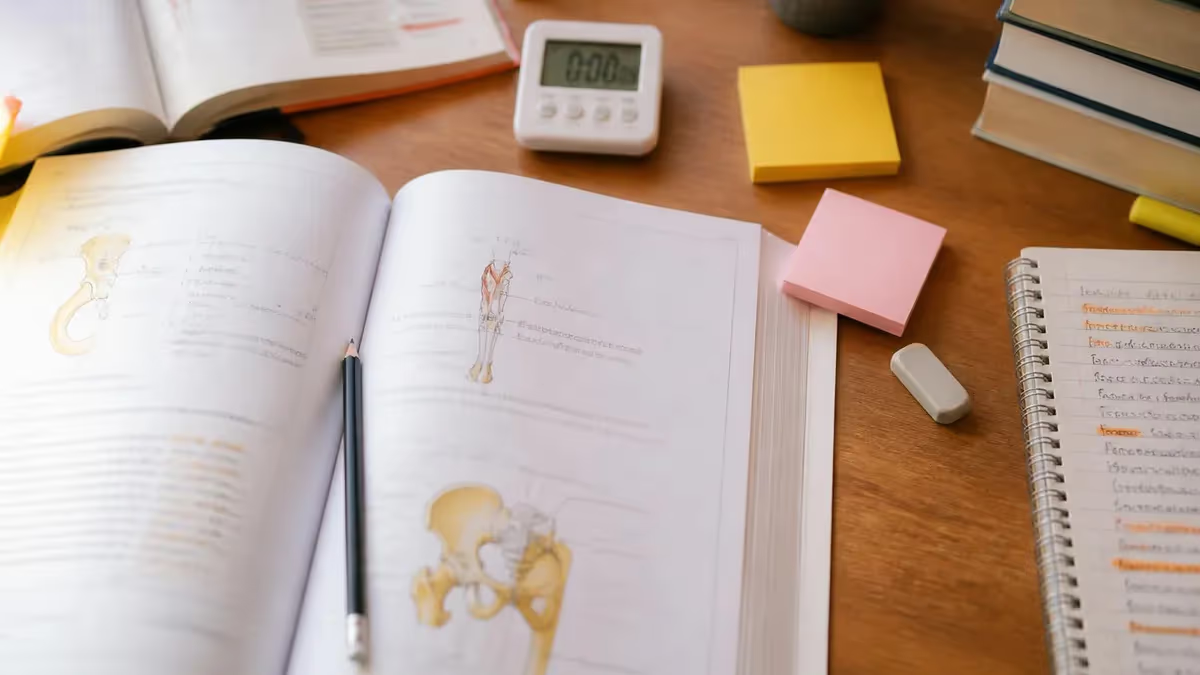
The human anatomy and physiology 11th edition lab manual is one of the most searched resources among nursing students, pre-med undergraduates, and allied health majors across the United States. Choosing the right edition of your core textbook and companion lab manual can meaningfully affect how well you absorb material, how efficiently you study, and ultimately how you perform on exams. Whether you are enrolling in your first A&P semester or revisiting the subject as a returning student, understanding the differences between textbook editions gives you a strategic advantage before you spend a single dollar on course materials.
Human anatomy and physiology textbooks have gone through numerous revisions over the past four decades. Publishers like Pearson, McGraw-Hill, and Cengage update their flagship titles every three to five years to incorporate new physiological discoveries, updated clinical terminology, improved illustrations, and expanded digital learning tools. Each new edition typically introduces reorganized chapters, refreshed case studies, and revised end-of-chapter questions — changes that matter when a professor assigns readings by page number or when you share notes with a classmate using a different printing.
The Marieb and Hoehn series published by Pearson is arguably the most widely adopted human anatomy and physiology textbook in the country, currently in its 11th edition. The accompanying Elaine Marieb lab manual — available in both a full version and a brief atlas version — aligns chapter-by-chapter with the main text, making it an essential purchase for students in courses that include a weekly laboratory component. Lab sections typically account for 20 to 30 percent of your final grade, which means the quality of your lab manual preparation directly impacts your GPA.
Before deciding which edition to buy, it is worth understanding what has actually changed between printings. The jump from the 10th to the 11th edition of Marieb's Human Anatomy and Physiology included updated content on the microbiome, expanded coverage of epigenetics, new clinical application features labeled "Clinical Connections," and a redesigned art program featuring more detailed three-dimensional renderings of body structures. The 11th edition also introduced tighter integration with Mastering A&P, Pearson's online homework platform, which many instructors now require for graded assignments.
Understanding human anatomy and physiology textbook editions is especially important for students who want to save money by purchasing an older used copy. While a 9th or 10th edition may cover 90 percent of the same content, page numbers will not match your professor's syllabus, some figures will differ, and certain digital access codes bundled with the 11th edition will not be transferable. Weigh those trade-offs carefully before assuming that an older edition is a safe budget choice.
Lab manuals deserve special attention because they are consumable — meaning students write directly in them, complete exercises, and record data from dissections and microscopy sessions. Buying a used lab manual is rarely practical unless the previous owner left every page blank, which almost never happens. New editions of lab manuals also update their exercise sequences to reflect current safety standards in academic laboratory settings, new model specimens, and revised histology images that match updated photomicrography technology.
This guide walks you through the major anatomy and physiology textbook editions currently in use across American colleges and universities, explains what changed between versions, helps you evaluate whether to buy new or used, and shows you how to pair your textbook with the best free and paid digital resources — including practice tests — so you are fully prepared for every quiz, lab practical, and cumulative final exam your course throws at you.
Anatomy & Physiology Textbook Editions by the Numbers
Major Human Anatomy and Physiology Textbook Series
The most widely used A&P textbook in the US, now in its 11th edition. Features the Mastering A&P platform, detailed art, and a companion lab manual series available in full and brief versions. Ideal for two-semester courses at community colleges and universities.
Known for its evolutionary and clinical approach, Saladin's text is now in its 9th edition. Praised for its readable prose and integrated case studies. McGraw-Hill Connect provides online homework, and the text pairs with a separate lab manual by Eric Wise.
A comprehensive two-volume option popular in nursing programs, currently in its 16th edition. Tortora's text is notable for its clinical applications, disease coverage, and a rich art program. Often paired with Wiley's own laboratory manual for hands-on activities.
A physiology-forward text aimed at students who need deeper coverage of organ system function over structural anatomy. Less common in two-semester combined courses but widely used in stand-alone physiology courses at four-year universities.
Understanding what actually changed between major textbook editions is essential for students deciding whether to upgrade or stick with an older printing. For the Marieb series, the transition from the 10th to the 11th edition represented the most significant content overhaul in nearly a decade.
Pearson's editorial team reorganized the immune system chapters, inserted a new unit on the lymphatic system's relationship to fluid homeostasis, and replaced dozens of older illustrations with high-resolution three-dimensional anatomical renders that better represent spatial relationships between structures. These are not cosmetic changes — they reflect genuine advances in how educators present complex physiology to undergraduate students.
One of the most practically significant updates in the 11th edition is the expansion of the "Homeostatic Imbalance" feature sections, which appear throughout each chapter and connect normal physiology directly to clinical pathology. In the 10th edition, these were shorter call-outs. In the 11th, they have grown into multi-paragraph case-based explorations that help students connect lecture content to what they will encounter in clinical placements. For nursing students and health science majors, this shift from pure science toward applied clinical reasoning is highly valuable.
The lab manual for the 11th edition also underwent major revisions. Exercise 5 on the microscope, Exercise 14 on histology of connective tissue, and Exercise 32 on cardiac physiology were all substantially rewritten to incorporate new safety protocols mandated by the American Chemical Society and to update photomicrographs using current digital microscopy standards. If your professor assigns specific page-numbered exercises, even a one-edition difference in the lab manual can mean your assigned page differs from what your used copy shows, creating genuine confusion during lab sessions.
For Saladin's text (McGraw-Hill), the shift from the 8th to the 9th edition focused heavily on digital integration. McGraw-Hill's SmartBook adaptive reading tool now embeds within every chapter, highlighting gaps in understanding in real time and adjusting question difficulty based on the student's performance history. The 9th edition also expanded its coverage of microbiomes across organ systems — the gut, skin, respiratory tract, and urogenital system all received updated sections reflecting research published after 2020. These microbiology cross-references make Saladin a particularly strong choice for students who will go on to take microbiology or immunology courses.
Tortora's Principles of Anatomy and Physiology is now in its 16th edition, which tells you something about the longevity and sustained adoption of this title. Major updates in recent editions have included expanded coverage of the enteric nervous system, a thoroughly revised endocrine chapter incorporating the latest knowledge about adipokines and gut hormones, and a cleaner visual presentation of feedback loops. Tortora also remains the go-to text for programs that want especially deep coverage of pathophysiology, making it a favorite among instructors in nursing and clinical medical assisting programs.
When evaluating whether to purchase a new versus older edition, the most important variable is your professor's specific syllabus requirements. If your instructor assigns Mastering A&P homework that must be submitted digitally, you will need a new access code, which typically costs between $60 and $100 even when purchased independently. If the course is purely lecture and lab with no digital platform requirement, a previous edition is often a reasonable alternative — but you should verify this directly with your instructor at least two weeks before the semester begins, not the night before the first class.
It is also worth noting that major test banks used to create classroom exams are typically tied to the current adopted edition. Professors who write exams by pulling questions from the publisher-supplied test bank will be pulling from the 11th edition if that is the assigned text.
Older editions may present concepts in slightly different terms or organize material under different headings, which can create subtle but consequential misalignments between what you studied and how a question is worded on an exam. This is an underappreciated risk of using outdated editions that many students discover only after receiving an unexpectedly low test score.
Comparing Editions: Lab Manual, Digital Tools, and Value
The human anatomy and physiology 11th edition lab manual introduces 47 fully updated exercises, including revised cat dissection guides and new histology photomicrographs captured with digital microscopy. Exercises are clearly marked with safety icons, and each exercise opens with a learning objective checklist that aligns directly with the companion textbook chapter. This alignment makes pre-lab preparation faster and more targeted than in earlier editions, where exercise objectives were presented separately and required cross-referencing.
In contrast, the 9th and 10th edition lab manuals contain many of the same core exercises but present them with older photography and a slightly different organizational logic. Students who are using a 10th edition lab manual in a course that officially assigned the 11th may find that certain figures are numbered differently or that a new exercise — such as the updated Exercise 44 on electrocardiography interpretation — does not appear in their copy at all. Always verify with your instructor which exercises will be assigned before deciding to purchase an older lab manual edition.

Buying the Latest Edition vs. Saving with an Older Edition
- +Page numbers match your professor's syllabus exactly, eliminating confusion during reading assignments
- +Digital access code works immediately without extra purchase or compatibility concerns
- +Updated illustrations reflect current understanding of anatomy and improve spatial learning
- +New clinical case features connect basic science to real patient scenarios relevant for healthcare careers
- +Lab manual exercises are fully compatible with current safety standards and updated photomicrographs
- +Test bank questions drawn by professors align with the terminology and chapter structure you studied
- −New bundled editions cost $300+ which creates a significant financial burden for students on financial aid
- −Content difference between 10th and 11th editions is modest — roughly 90% of core material is identical
- −Digital access codes expire after one year, offering no long-term reference value after the course ends
- −Loose-leaf format of current editions does not hold up well long-term and cannot be resold after use
- −New editions are released on a publishing schedule driven partly by profit, not always by scientific need
- −Older editions can often be found in campus libraries for in-person reference, reducing the need to own a copy
Lab Manual Buying Checklist: Before You Purchase Any Edition
- ✓Ask your professor directly which edition of the lab manual is required — never assume based on the textbook edition alone.
- ✓Check whether your course requires submission through Mastering A&P, Connect, or another digital platform before buying a used copy.
- ✓Inspect used lab manuals page-by-page before purchasing — writing, torn pages, or completed exercises make them unusable.
- ✓Compare your campus bookstore rental price against Chegg and VitalSource rental prices for the same ISBN.
- ✓Confirm whether a loose-leaf or hardcover version is preferred — some lab sections require the hardcover for durability during weekly sessions.
- ✓Verify the ISBN on the publisher's website to ensure the edition you are purchasing matches the one listed on your course syllabus.
- ✓Check whether your library has reserve copies of the lab manual available for short-term checkout before investing in a personal copy.
- ✓Look into whether the publisher offers a free two-week trial of the digital platform before committing to a full access purchase.
- ✓Ask classmates from previous semesters which edition their section used — many professors adopt the same edition for two to three years.
- ✓Factor in the cost of any dissection kit or lab materials your lab coordinator requires, as these are separate from the manual itself.
The Lab Manual Is Not Optional — Even If Your Syllabus Lists It as 'Recommended'
Many A&P course syllabi list the lab manual as "recommended" rather than "required" to avoid creating financial hardship, but in practice, lab exercises are assigned directly from the manual every week. Students without a personal copy consistently underperform on lab practicals, which can account for 25 to 35 percent of the overall course grade. Budget for the lab manual first, and find savings on the lecture textbook if needed.
Developing an effective study strategy around your anatomy and physiology textbook requires understanding the internal architecture of how these books are organized. Marieb's 11th edition, like most A&P textbooks, follows a systems-based approach — meaning each major unit of the book covers one organ system from structural anatomy through physiological function and into clinical pathology. The cardiovascular system, for example, spans roughly three chapters covering heart anatomy, blood vessels and hemodynamics, and blood itself. Understanding this organizational logic helps you plan your reading schedule and anticipate how lab material will connect to lecture topics each week.
Most students make the mistake of reading A&P textbooks passively, as if they were novels. Human anatomy and physiology textbooks are reference texts at heart, and they reward active, interrogative reading. Before you open a chapter, preview the learning objectives listed at the chapter opening, scan all the figure captions, and read the chapter summary at the end.
This gives your brain a structural scaffold before you encounter the detailed explanations, which means the complex content has somewhere meaningful to land rather than flowing through without retention. This approach takes five extra minutes per chapter and can dramatically improve how much you recall during exams.
The lab manual should always be read in parallel with the corresponding lecture textbook chapter, not treated as a separate subject. Most lab exercises begin with a "Pre-Lab" section that recaps the key anatomical and physiological concepts you will be working with during the lab session.
If you read those pre-lab pages carefully before arriving in the laboratory, you will be faster at completing exercises, more accurate in your observations, and better prepared to answer the post-lab questions that many instructors collect for grades. Students who arrive having never opened the lab manual before lab sessions typically take 20 to 30 percent longer to complete exercises and score lower on associated lab quizzes.
End-of-chapter questions in both the textbook and lab manual serve different cognitive purposes, and it is a mistake to skip either. Textbook end-of-chapter questions test conceptual understanding and often require you to integrate information from multiple sections of the chapter. Lab manual post-exercise questions test your ability to interpret data, compare specimens, and connect what you observed under the microscope or on the anatomical model to the physiological principles underlying the observation. Both types of question appear on exams — professors draw from both sources when constructing practicals and unit tests.
One underutilized feature of modern anatomy and physiology textbooks is the online figure question bank. Both Pearson's Mastering A&P and McGraw-Hill's Connect include sets of figure-based questions that display a labeled anatomical illustration and ask you to identify structures, trace physiological pathways, or predict the outcome of a specific clinical scenario. These questions are excellent exam preparation because they mirror the figure identification tasks common on both lecture exams and lab practicals. Students who practice with digital figure questions report higher confidence during practical exams compared to those who studied only from written notes.
Study groups organized around textbook chapter divisions are more effective than study groups organized around lecture slides, because the textbook provides a complete and coherent treatment of a topic rather than the abbreviated snapshot a typical 50-minute lecture delivers. When your group meets, assign each member a different section of the chapter to present in their own words.
The act of explaining a concept — the mechanics of the sodium-potassium pump, or the sequence of events during skeletal muscle contraction — forces a level of cognitive processing that passive reading cannot achieve. Research on learning in health science programs consistently confirms that peer teaching improves exam performance by an average of 8 to 15 percent compared to solo study at equivalent time investment.
Finally, do not neglect the appendices and glossaries in your anatomy and physiology textbook. Marieb's 11th edition includes appendices on periodic table elements relevant to biochemistry, normal physiological values for major clinical measurements, and a detailed A&P word roots glossary covering Latin and Greek prefixes, roots, and suffixes.
Mastering that word roots appendix early in the semester will pay dividends across every subsequent chapter, because A&P terminology is systematic — if you know that "myo" means muscle, "cardio" means heart, and "itis" means inflammation, you can decode dozens of terms you have never encountered before without any memorization, simply by applying word analysis.
Using an edition that differs from your professor's assigned text is a calculated risk, not a safe money-saving strategy. If your instructor builds exams from the publisher's test bank, questions will reflect the terminology, figure labels, and chapter organization of the current edition. A concept described as "excitation-contraction coupling" in the 11th edition may appear under slightly different language in the 10th, and that difference alone can make a correct answer look unfamiliar under exam pressure. Verify your professor's flexibility on editions before the semester begins — not after your first failed quiz.
Digital supplements bundled with modern anatomy and physiology textbooks have become nearly as important as the printed text itself, and understanding what each platform offers helps you get the maximum return on your textbook investment. Mastering A&P, bundled with the Marieb 11th edition, includes access to the A&P Flix library — a set of three-dimensional animation videos that illustrate dynamic physiological processes that static textbook figures cannot adequately capture.
Action potentials propagating along a neuron, the sequence of events during a cardiac cycle, and the mechanics of gas exchange across the respiratory membrane all become far clearer when you can watch them unfold frame-by-frame rather than trying to reconstruct the sequence from a series of static images.
Mastering A&P also includes a pre-built study area with flashcard sets, concept quizzes, and practice tests organized by chapter. Many students do not discover these resources until late in the semester, well after they would have been most useful. Log into the platform during the first week and explore all the available content categories — not just the assigned homework — so you understand the full scope of what you have paid for.
The SmartBook adaptive reading component, available through both Pearson and McGraw-Hill platforms, is particularly valuable for identifying which sections of each chapter you have genuinely mastered versus which sections you only think you understand based on surface-level familiarity.
YouTube channels and open-access video libraries can supplement but should not replace your assigned textbook and lab manual. Channels focused on A&P content vary enormously in accuracy and depth. Some are produced by credentialed anatomists and physiologists and are excellent; others contain factual errors, oversimplifications, or outdated terminology. Always cross-reference video content with your textbook before accepting a claim as accurate, particularly for mechanisms of action involving cell physiology, enzyme kinetics, or pharmacological concepts that have seen active research updates in the past five years.
For students who want to go beyond what any single textbook edition offers, supplementary atlases are a valuable investment. Netter's Atlas of Human Anatomy and Grant's Atlas of Anatomy are the two most widely recommended surgical anatomy atlases used by undergraduate pre-med students.
These atlases do not replace your A&P textbook — they are purely structural references — but they provide the most detailed and clinically accurate depictions of anatomical relationships available in print, and reviewing them alongside your textbook's systemic coverage deepens your three-dimensional mental model of the body in ways that improve both lab practical performance and long-term retention.
Students preparing for the HESI A2, TEAS, or NLN PAX exams should be aware that these nursing entrance examinations draw their anatomy and physiology content from foundational concepts that appear across all current editions of major A&P textbooks. The specific edition of your textbook matters less for entrance exam preparation than it does for your classroom coursework.
What matters for exam preparation is that you can apply core A&P concepts — body organization levels, tissue types, organ system functions, and homeostatic mechanisms — in the context of multiple-choice questions that test understanding rather than memorization of specific page content from any single publisher's edition.
The free practice tests available at PracticeTestGeeks.com are aligned to the level of A&P knowledge expected on nursing entrance exams and allied health certification assessments. These tests cover cardiovascular anatomy, respiratory physiology, neurological concepts, and other high-yield topics that appear repeatedly across all major A&P courses regardless of which textbook series your institution uses. Using these practice tests in the final two to three weeks before a major exam — after you have completed your primary textbook-based review — helps you identify any remaining gaps in applied understanding before the pressure of the real exam.
For students wrestling with the challenge of managing a heavy A&P workload, the insights gathered from comparing human anatomy and physiology textbook editions can reveal that much of the perceived difficulty comes not from the inherent complexity of the content but from inefficient study strategies and misaligned resources. Matching your study tools precisely to your course requirements — using the correct edition, the correct lab manual, and the correct digital platform — eliminates unnecessary friction and lets you direct your full cognitive energy toward actually learning the material rather than compensating for resource gaps.
Practical preparation for anatomy and physiology courses requires more than selecting the right textbook edition — it requires building a sustainable daily study routine that keeps pace with one of the most content-dense subjects in undergraduate health science education.
A&P courses typically introduce 50 to 80 new vocabulary terms per week, require mastery of spatial relationships that take repeated visual exposure to internalize, and demand the ability to apply physiological principles to novel clinical scenarios on timed exams. No single textbook, regardless of edition, can accomplish that learning for you — but the right textbook used with the right strategy gets you there significantly faster.
One of the most effective practical tips experienced A&P students share is the "lecture-lab-text triangle" approach. For every topic covered in lecture, you should cross-reference the corresponding lab exercise and the relevant textbook section within 24 hours. This triangulated review forces you to encounter the same concept in three different formats — the professor's verbal explanation, the hands-on laboratory activity, and the comprehensive written treatment in the textbook — which research on the spacing effect and interleaving confirms accelerates long-term retention. Students who implement this approach report needing significantly less last-minute cramming before major exams.
Active recall practice is the single most evidence-supported study technique for high-volume factual content. After reading a textbook section, close the book and write down everything you can remember without looking. Then open the book, check your recall, and make a note of any items you missed or misremembered. Repeat this process at 24 hours, 72 hours, and one week after the initial reading. This spaced retrieval practice is far more effective than re-reading the same pages multiple times, which creates a false sense of familiarity without building the durable memory traces you need for exam performance under pressure.
For lab practical preparation specifically, physical study models are invaluable supplements to your lab manual. Inexpensive foam or plastic anatomical models of the skull, vertebral column, heart, and major organ systems are available from educational supply vendors for $15 to $60 each.
Using a physical model forces you to identify structures in three dimensions rather than from the flat photographs in your lab manual, which closely simulates the actual lab practical experience where you must identify tagged structures on real specimens or high-quality models. Students who practice identifying structures on physical models consistently outperform those who study exclusively from two-dimensional photographs.
Time management is a frequently underestimated component of A&P success, particularly for students carrying full course loads or working part-time jobs. A typical two-semester A&P sequence expects 9 to 12 hours of study per week per course beyond scheduled class and lab time.
Block-scheduling your study sessions — committing to specific days and times rather than studying "whenever you have time" — is the most reliable way to accumulate the hours necessary to build the depth of knowledge A&P requires. Students who study in irregular, reactionary patterns tend to fall behind early in the semester and struggle to catch up as new content compounds on foundational material they never fully mastered.
Practice exams and old test banks, when available from your professor or campus tutoring center, are among the highest-value resources you can access. Working through past exams under realistic timed conditions — without notes, without pausing — gives you direct experience with the format, difficulty level, and content emphasis your professor favors.
If old exams are not available, the chapter self-tests in your textbook and the online practice questions in your digital platform are the next best alternatives. The goal is not simply to check answers but to simulate the cognitive experience of an exam, including the time pressure and the uncertainty that comes when you encounter a question phrased differently than you expected.
Finally, do not wait until you are struggling to seek help. Both the lecture instructor and the lab instructor for A&P courses are typically willing to schedule office hours appointments or brief after-class conversations with students who are actively engaged with the material.
Arriving at office hours with a specific question — about a mechanism you read in Chapter 9, or about the histological difference between two tissue types you saw under the microscope — signals engagement and often results in explanations tailored to exactly where your understanding is breaking down. Students who attend office hours consistently report higher confidence going into exams and better relationships with instructors whose letters of recommendation may matter for future academic or professional applications.
Anatomy Physiology Questions and Answers

How Hard Is Anatomy and Physiology? The Complete Honest Guide for Students

Anatomy and Physiology Lab Manual PDF: The Complete Guide to Finding, Using, and Mastering Your Lab Resources

Eye Anatomy and Physiology: The Complete Guide to Understanding How Your Eyes Work
Anatomy and Physiology PDF: Complete Free Download Guide for 2026 Students

Best Way to Learn Anatomy and Physiology: A Complete Student Guide
About the Author

Educational Psychologist & Academic Test Preparation Expert
Columbia University Teachers CollegeDr. Lisa Patel holds a Doctorate in Education from Columbia University Teachers College and has spent 17 years researching standardized test design and academic assessment. She has developed preparation programs for SAT, ACT, GRE, LSAT, UCAT, and numerous professional licensing exams, helping students of all backgrounds achieve their target scores.