
Laboratory Manual for Anatomy and Physiology: The Complete Study Guide for Students
🎓 Master your laboratory manual for anatomy and physiology with this complete guide covering lab techniques, body systems, and exam prep strategies.

The laboratory manual for anatomy and physiology is one of the most essential tools a student can have when studying the human body at the college or university level. Unlike a standard textbook, a lab manual is designed to guide you through hands-on exercises, dissections, microscopy work, and clinical observations that reinforce every concept your lecture course introduces. Whether you are a pre-nursing student, a pre-med candidate, or pursuing any allied health profession, your lab manual will serve as the backbone of your practical education in human biology.
Most anatomy and physiology lab courses in the United States follow a structured two-semester format. The first semester typically focuses on cellular biology, tissues, the integumentary system, the skeletal system, the muscular system, and the nervous system. The second semester shifts toward the endocrine system, cardiovascular function, the respiratory system, digestion, the urinary system, and reproduction. Your laboratory manual mirrors this progression, providing discrete exercises for each body system so that you build knowledge incrementally throughout the year.
Understanding how to use your lab manual effectively makes an enormous difference in your final grade. Many students flip through the exercises passively without engaging with the pre-lab questions, the learning objectives, or the post-lab review sections. However, instructors design those components deliberately. Pre-lab questions prime your brain for what you are about to observe, while post-lab reviews consolidate your learning and prepare you for written exams. Students who complete every section of each exercise consistently outperform those who treat the manual as a checklist to rush through.
One of the most significant benefits of working through a lab manual is the development of scientific observation skills. In a lecture course, you read about the structure of a sarcomere or the layers of the epidermis, but in the laboratory you actually see these structures under a microscope or on a model. This direct observation creates a visual memory that is far more durable than information absorbed from a textbook diagram alone. Research in educational psychology consistently shows that active, multi-sensory learning leads to better retention and higher test performance.
Popular lab manuals used across American colleges include those authored by Elaine Marieb, Lori Smith, Michael Wood, and Terry Martin. Each of these manuals has distinct organizational features, but all of them share the same core commitment: giving students a systematic, exercise-by-exercise framework to explore human anatomy and physiology in a supervised setting. Many instructors also supplement with custom lab packets or online virtual labs, especially for courses taught in a hybrid or remote format.
Lab safety is a topic that every anatomy and physiology manual addresses in its opening pages, and it deserves serious attention. You will handle preserved specimens, chemical fixatives such as formalin, sharp dissecting instruments, and biological materials. Knowing how to use personal protective equipment, how to dispose of specimens properly, and how to respond to spills or injuries is not just academic — it protects you and your classmates in real time. Always review the safety section of your manual before the first lab session of every new unit.
This guide will walk you through everything you need to know to get the most out of your anatomy and physiology laboratory experience, from understanding how lab manuals are organized to mastering the most commonly tested skills. Whether you are brand new to the subject or looking for strategies to boost your practical exam performance, the information ahead will give you a clear, actionable roadmap to success.
Anatomy and Physiology Lab by the Numbers

How Anatomy and Physiology Lab Manuals Are Organized
Every exercise opens with a numbered list of learning objectives that tell you exactly what skills and knowledge you must demonstrate by the end of the session. Reading these first helps you focus your attention on the most important structures and concepts rather than trying to absorb everything equally.
Pre-lab sections include reading assignments, vocabulary reviews, and short-answer questions designed to be completed before you arrive in the lab. Instructors often collect these for a grade, and they serve as essential preparation for navigating the hands-on portion of each exercise efficiently.
The core of each manual chapter contains step-by-step procedures for dissection, microscopy, model identification, or physiological measurements. These directions are written to be followed in sequence, and skipping steps almost always leads to missed observations and incomplete data tables.
Lab manuals include structured tables, diagrams to label, and blank spaces for recording measurements such as heart rate, breathing rate, or reflex response times. Accurate data recording is critical because post-lab analysis and graded reports are built directly from these observations.
After completing the hands-on work, post-lab questions ask you to interpret your data, compare results with expected outcomes, and connect the lab activity to lecture concepts. These questions are excellent study material and frequently appear in modified form on written lab exams.
Developing strong core laboratory skills is the foundation of success in any anatomy and physiology lab course. The most fundamental skill is microscopy, which you will use in nearly every unit that involves cellular or tissue-level study. Understanding how to prepare a wet mount slide, how to adjust the condenser and diaphragm to optimize contrast, and how to calculate total magnification by multiplying the objective lens power by the ocular lens power are all non-negotiable competencies. Students who struggle with the microscope in the first few weeks tend to fall behind quickly as the tissue types become more complex.
Histological identification — the ability to look at a stained tissue slide and correctly name the tissue type, its location in the body, and its function — is one of the most tested skills in A&P lab. Common tissue types you must be able to identify include simple squamous epithelium, stratified squamous epithelium, hyaline cartilage, compact bone, skeletal muscle, smooth muscle, cardiac muscle, and the various types of connective tissue. Each of these tissues has distinctive visual features such as cell shape, nuclear arrangement, and the appearance of the extracellular matrix that make identification possible with practice.
Anatomical model identification is equally important. Most anatomy labs stock plastic models of the brain, the heart, the kidney, the eye, the ear, and the complete skeleton. Your lab manual will include diagrams of these models with numbered or lettered structures for you to identify. Professors typically test this skill by setting up a practical exam in which models are arranged on lab benches with numbered pins, and students rotate through stations identifying each structure on a separate answer sheet. Preparing for this type of exam requires repeated, active review of the models rather than passive reading.
Physiological measurement exercises ask you to collect real data from yourself or your lab partners. In a standard A&P lab sequence you will measure resting heart rate and blood pressure, observe changes during exercise, record lung volumes using a spirometer or a simple water displacement device, test knee-jerk and pupillary reflexes, measure reaction time, and analyze urine samples for pH, specific gravity, and the presence of abnormal solutes. These activities teach you that physiology is not an abstract set of facts but a measurable, dynamic set of processes occurring continuously in living bodies.
Dissection is a component of many anatomy lab courses, though its extent varies considerably depending on the institution. Cat dissection is the most common option in American A&P courses, largely because the cat's organ systems are anatomically similar to those of humans. Some programs use fetal pigs, sheep brains, sheep hearts, or cow eyes as standalone specimens rather than a full-body dissection.
Your lab manual will contain detailed dissection guides with photographs and diagrams to help you locate and identify structures. Reading the entire dissection guide before lab — not just the first paragraph — dramatically improves your efficiency and reduces the frustration of searching for structures you did not expect.
Drawing and labeling specimens is an undervalued skill that your lab manual will ask you to practice repeatedly. You do not need artistic talent to create a useful scientific drawing. What matters is accuracy: capturing the correct proportions, showing the spatial relationships between structures, and labeling every part you observe. The act of drawing forces you to look more carefully at what is in front of you than you would if you were simply checking structures off a list. Many students find that their ability to recall structures on written exams improves dramatically after practicing observational drawing.
Proper documentation of your lab work — filling in data tables completely, recording observations with enough detail to be meaningful days later, and answering post-lab questions in your own words — creates a study resource that is uniquely tailored to your own observations and experience. When exam time comes, reviewing your own completed lab manual is often more valuable than re-reading the textbook, because your manual contains the actual specimens, measurements, and observations that your course has focused on.
Body Systems Covered in Your Anatomy and Physiology Lab Manual
The first semester of an A&P lab sequence typically begins with the cell and moves systematically through the major tissue types before addressing organ systems. Students examine epithelial, connective, muscle, and nervous tissue under the microscope, then transition to the integumentary system — studying skin layers, hair follicles, and glands. The skeletal system follows, with emphasis on bone histology, bone markings, and the axial and appendicular skeleton. Students must be able to identify every bone in the body along with their major processes, foramina, and articulating surfaces using real or plastic specimens.
After the skeleton, first-semester labs move into the muscular system, which is one of the most memorization-intensive units in the entire course. Students learn the origin, insertion, action, and innervation of dozens of muscles, using either cat dissection or detailed models. The nervous system rounds out the first semester, with labs covering the histology of neurons, the gross anatomy of the brain and spinal cord, cranial nerve identification, reflex arc testing, and sensory physiology exercises including hearing, vision, and taste assessments.
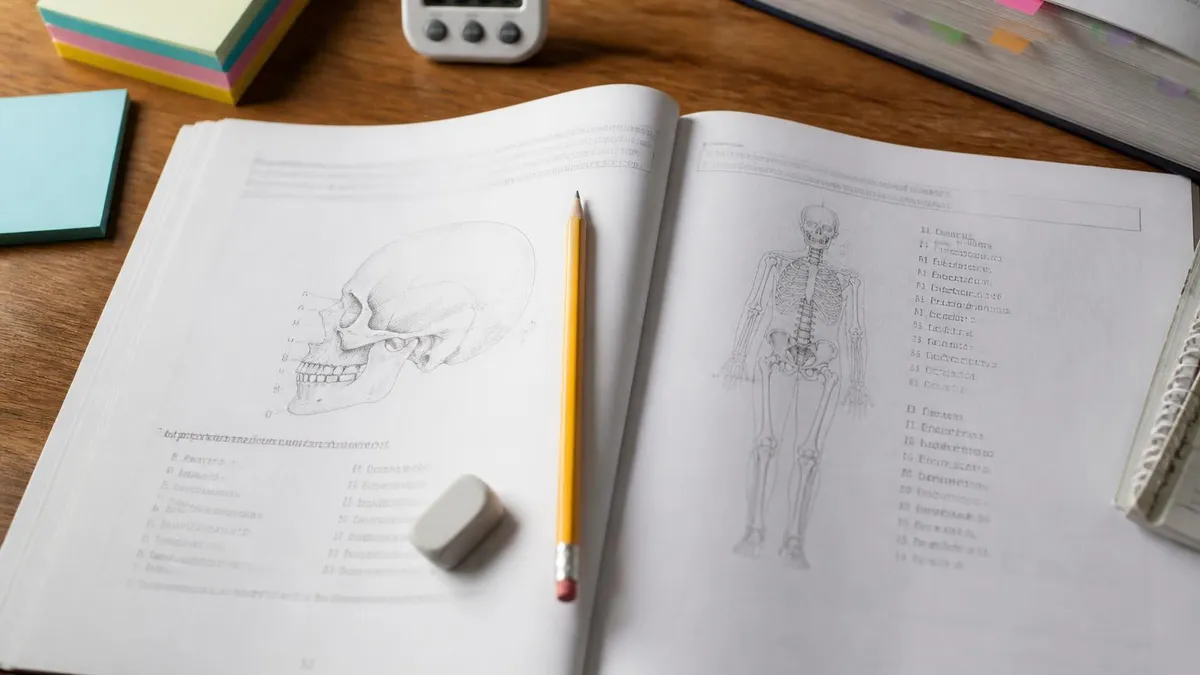
Pros and Cons of Using a Printed vs. Digital Lab Manual
- +Printed manuals allow you to write directly in margins, highlight key structures, and annotate diagrams without switching between apps
- +No battery or connectivity required — printed manuals work in any lab environment including those that restrict electronic devices
- +Physical drawing and labeling by hand has been shown to improve retention compared to typing or clicking
- +Instructors can collect printed manuals for grading without requiring students to submit digital files
- +Printed manuals are easier to flip through quickly during practical exams when you need to confirm a structure's location
- +Many students find it easier to study from a physical book during review sessions, reducing screen fatigue during long study blocks
- −Printed manuals can cost $50–$120 new, adding significant expense to an already costly course
- −Diagrams in printed manuals are static and two-dimensional, limiting the ability to visualize complex three-dimensional structures
- −Digital platforms offer interactive models, zoom capability, and rotation that no printed diagram can replicate
- −Printed manuals become outdated when instructors change editions, and older editions may contain exercises no longer used in the course
- −Carrying a heavy printed lab manual to every class adds to the physical load students already manage
- −Highlighting and annotation made in printed manuals cannot be searched or reorganized the way digital notes can be
Pros and Cons at a Glance
| Pros | Cons |
|---|---|
| Printed manuals allow you to write directly in margins, highlight key structures, and annotate diagrams without switching between apps | Diagrams in printed manuals are static and two-dimensional, limiting the ability to visualize complex three-dimensional structures |
| No battery or connectivity required — printed manuals work in any lab environment including those that restrict electronic devices | Digital platforms offer interactive models, zoom capability, and rotation that no printed diagram can replicate |
| Physical drawing and labeling by hand has been shown to improve retention compared to typing or clicking | Printed manuals become outdated when instructors change editions, and older editions may contain exercises no longer used in the course |
| Instructors can collect printed manuals for grading without requiring students to submit digital files | Carrying a heavy printed lab manual to every class adds to the physical load students already manage |
| Printed manuals are easier to flip through quickly during practical exams when you need to confirm a structure's location | Highlighting and annotation made in printed manuals cannot be searched or reorganized the way digital notes can be |
Lab Exam Preparation Checklist
- ✓Complete all pre-lab questions at least 24 hours before each lab session to arrive prepared
- ✓Review the learning objectives at the start of each exercise and check them off as you master each skill
- ✓Label every diagram in your lab manual in pencil first, then pen once your instructor confirms accuracy
- ✓Practice identifying structures on models without looking at labels at least three times before each practical exam
- ✓Create flashcards for every tissue type with the microscopic appearance, location, and function on each card
- ✓Record all physiological measurements in your data tables with correct units and appropriate significant figures
- ✓Write complete answers to all post-lab review questions in your own words rather than copying directly from the textbook
- ✓Attend any open lab sessions offered by your instructor or department to practice practical skills outside of scheduled class time
- ✓Compare your observations and data with a study partner to catch errors and fill in gaps in your understanding
- ✓Review your entire completed lab manual the week before a written exam, paying special attention to post-lab answers you found difficult
The Practical Exam is Worth More Than Students Realize
In most anatomy and physiology courses, the lab practical exam accounts for 30–50% of your total lab grade. Students who focus exclusively on written lecture exams and neglect hands-on model review frequently find that their overall course grade suffers despite strong lecture performance. Dedicate at least three structured review sessions to practical exam preparation for every unit, starting no later than one week before the exam.
Choosing the right anatomy and physiology lab manual depends on several factors, including the textbook your course uses, your instructor's preferences, your learning style, and whether you are taking the course in a traditional in-person, hybrid, or fully online format. Most instructors will specify a required manual on the course syllabus, and in those cases the decision is made for you. However, if you have flexibility, understanding the differences between major manuals can help you make a more informed choice.
The Marieb and Smith lab manuals are among the most widely used in American colleges. Elaine Marieb's manuals are known for their clinical connections, accessible writing style, and comprehensive coverage of both anatomical identification and physiological experiments. They pair naturally with Marieb's Human Anatomy and Physiology textbook, which is itself one of the most popular A&P texts nationwide. If your lecture course uses the Marieb textbook, using the companion lab manual ensures that terminology, figure numbering, and content sequencing are perfectly aligned.
The Terry Martin lab manuals published by McGraw-Hill are another excellent option frequently adopted at community colleges and technical programs. Martin's manuals are praised for their clear procedural instructions and high-quality photographs of cadaver specimens and histological slides. The photographs are particularly helpful for students who do not have access to cadavers in their own lab, as they provide a realistic reference point for identifying structures that are otherwise only visible in person.
Michael Wood's lab manuals represent a newer generation of materials that integrate QR codes linking to online video demonstrations and virtual lab activities. For students who learn best through multimedia, this integration makes the printed manual feel like a gateway to a much richer digital ecosystem rather than a standalone text. These hybrid manual formats are increasingly popular at institutions that are moving toward blended learning models.
Budget-conscious students should know that older editions of most lab manuals are available at significantly reduced prices through used bookstores, Amazon, or campus textbook exchange programs. In many cases, the differences between editions are minor — a few updated photographs, revised data tables, and new clinical application boxes — and do not significantly affect your ability to complete lab exercises. Always check with your instructor before purchasing an older edition to confirm that the exercise numbering and content are compatible with what your class will be using.
Open-access lab manuals are a growing resource in community college settings, where cost is often a significant barrier to student success. Several institutions have developed Creative Commons-licensed A&P lab manuals that are freely available as PDFs or printable files. While these free resources may not have the polish of commercially published manuals, many of them are pedagogically sound and regularly updated by faculty. If your institution uses an open-access manual, take advantage of the fact that it was specifically designed for your curriculum.
Supplementary resources can enhance whichever lab manual your course requires. Anatomy coloring books, pocket atlases, and three-dimensional anatomy apps all provide additional angles from which to study the same structures your manual addresses. The goal is not to replace your required manual but to reinforce the material through varied formats. Students who engage with at least two or three different types of study resources consistently demonstrate better retention on both practical and written exams than those who rely on a single resource alone.

Most anatomy and physiology lab manuals begin with a safety and orientation exercise that students are tempted to treat as a formality. However, many instructors require a signed safety acknowledgment form before students are permitted to participate in lab exercises, and failure to complete it on time can result in being locked out of the first lab session. Read the safety section thoroughly, ask questions about any procedures you do not understand, and keep your personal protective equipment accessible at all times during lab.
Maximizing your success in an anatomy and physiology lab course requires a combination of consistent preparation, active engagement during lab sessions, and strategic review between class meetings. The students who earn the highest grades in A&P lab are rarely the ones with the strongest prior science background — they are the ones who show up fully prepared, stay focused during the lab session, and review their work before the next meeting rather than waiting until the week before an exam. Building these habits early in the semester creates a compounding advantage that pays dividends through every subsequent unit.
Time management is critical because lab courses add a substantial number of hours to your weekly academic workload on top of lecture, reading assignments, and other coursework. A typical A&P lab session runs two to three hours, but the work does not end when you leave the lab room.
Pre-lab preparation, post-lab question completion, and practical exam review can add another four to six hours per week depending on the complexity of the current unit. Students who plan their weekly schedules to include these blocks from the start of the semester avoid the frantic cramming that leads to poor practical exam performance.
Study groups are an especially effective format for anatomy and physiology lab review because the practical skills lend themselves naturally to collaborative quizzing. One student can hold up a model, point to a structure with a pencil, and ask the group to identify it, while another student can quiz from a stack of histology flashcards.
This kind of peer testing is more demanding than solitary review and therefore more effective at identifying gaps in your knowledge before they cost you points on an exam. Forming a study group with two to four reliable partners during the first week of class gives you a built-in support system for the entire semester.
One of the most overlooked preparation strategies for anatomy and physiology practical exams is timed practice. During the actual exam, you will typically have 60 to 90 seconds at each station to identify a structure indicated by a pin, tag, or colored dot. This is a short window, especially if the structure is unfamiliar or the model is oriented differently from the one you practiced on. Simulating these timed conditions during your study sessions trains you to recall information quickly and accurately, reducing the anxiety that students often experience when they sit down for the first practical.
Office hours are a resource that most A&P students underutilize. Lab instructors and teaching assistants hold regular office hours during which models, microscopes, and specimens are often available for individual review. Arriving during office hours with specific questions — not just a vague request to look at things — signals to your instructor that you are engaged and helps you get targeted feedback on the exact structures or concepts you find most challenging. This direct, individualized interaction is far more efficient than trying to absorb everything from the manual alone.
Digital flashcard platforms such as Anki or Quizlet have large, pre-made decks for anatomy and physiology that include images of histological slides, model structures, and physiological diagrams. While pre-made decks are a useful starting point, creating your own cards from your specific lab manual's diagrams and your own microscope observations produces stronger retention because the act of making the card itself is a learning event. Every structure you draw, label, and describe in your own words is a structure you are significantly more likely to recall under exam conditions.
Finally, connect your lab work to real clinical scenarios as often as possible. When you learn the histology of the alveolar epithelium, think about what happens to that tissue in emphysema. When you study the nephron's filtration membrane, consider why diabetic nephropathy causes proteinuria. These clinical connections are not just interesting — they make the material meaningful, and meaningful material is retained far longer than isolated facts.
Your lab manual may include clinical application boxes to help this thinking, and if it does not, your textbook almost certainly will. Making these connections a regular part of your lab study routine transforms A&P from a memorization exercise into a genuinely illuminating exploration of how the human body works.
Practical tips for getting the most from your anatomy and physiology lab manual start with how you physically interact with the book before, during, and after each lab session. Before lab, read through the entire exercise — not just the introduction — so you have a complete mental map of what you will be doing.
Note which steps require you to observe something under the microscope, which steps involve recording measurements, and which steps ask you to draw or label a specimen. This mental preview reduces the cognitive load during the actual lab and allows you to focus your attention on observation rather than deciphering instructions in real time.
During the lab session, resist the temptation to work too quickly. Students who rush through exercises in order to finish early often record superficial observations, skip drawing exercises, and leave data tables partially blank. These shortcuts feel efficient in the moment but create serious gaps that become apparent at exam time.
Work methodically through each step, read the observation prompts carefully, and make sure your drawings include every labeled structure requested. If you finish a step early, use the remaining time to review your drawings, re-read the relevant post-lab questions, and look more carefully at the structures you are least confident about.
After lab, complete your post-lab questions while your observations are still fresh. Waiting more than 24 to 48 hours to complete post-lab work means you will be relying on increasingly faded memories of what you observed, leading to generic answers rather than specific, accurate ones. If your instructor collects post-lab work for a grade, late completion also puts you at risk of a zero. Completing post-lab questions promptly is one of the highest-return habits you can build in an A&P lab course.
For microscopy-heavy units, creating a reference sheet of tissue types with hand-drawn sketches is one of the most effective study tools available. On a single sheet of paper, draw each tissue type as it appears at 100x and 400x magnification, label the key features (cell shape, nuclear arrangement, basement membrane, intercellular matrix), and note the primary location in the body and the main function. Condensing this information into one visual reference allows you to review all histology in a single sitting and makes pattern recognition faster and more reliable on practical exams.
Physical organization of your lab manual is worth a few minutes of attention at the start of the semester. Using color-coded tabs or sticky flags to mark the beginning of each body system's exercises allows you to navigate quickly during study sessions without wasting time flipping through pages. Some students also create a personal index at the front of their manual listing every structure they are responsible for identifying, organized by system, with a page reference. This self-created index becomes invaluable during the intensive review periods before practical exams.
Repetition over spaced intervals is the most scientifically supported method for retaining anatomical knowledge. Rather than studying for a single marathon session the night before an exam, distribute your review across multiple shorter sessions starting a week in advance. On day one, review the entire unit using your lab manual and flashcards.
On day three, quiz yourself without looking at labels. On day five, do a timed practical simulation. On the day before the exam, do a final quick review focused on the structures you still find challenging. This spaced repetition schedule consolidates information into long-term memory far more effectively than massed practice.
Remember that the skills you build using your anatomy and physiology lab manual extend well beyond the course itself. The ability to observe carefully, document accurately, think analytically about biological data, and apply anatomical knowledge to clinical scenarios are competencies that healthcare professionals use every single day. Every hour you invest in your lab manual is an investment not just in your course grade but in the foundation of your professional career. Approach each exercise with that long-term perspective and you will find that the work becomes genuinely rewarding rather than merely obligatory.
Sample Anatomy and Physiology Practice Questions
Try these questions from our free Anatomy and Physiology practice tests. The correct answer and an explanation follow each question.
What is the role of the spleen in the lymphatic system?
- A. Producing lymph
- B. Filtering blood and removing old red blood cells
- C. Storing fat-soluble vitamins
- D. Producing T cells
Answer: B. Filtering blood and removing old red blood cells
The spleen filters the blood, removes old or damaged red blood cells, and provides an environment for immune cells to respond to blood-borne pathogens.
Which of the following body planes divides the body into left and right halves?
- A. Frontal (coronal) plane
- B. Transverse (horizontal) plane
- C. Sagittal plane
- D. Oblique plane
Answer: C. Sagittal plane
The sagittal plane divides the body into left and right sections. The mid-sagittal plane divides it equally, while other sagittal planes may not be symmetrical.
What ethical standard governs core concepts and principles practice?
- A. Ethics are personal opinions, not professional requirements
- B. Adherence to the profession's code of ethics and applicable laws and regulations
- C. Ethics only apply in academic settings
- D. Ethical standards are optional for certified professionals
Answer: B. Adherence to the profession's code of ethics and applicable laws and regulations
Professional ethics codes and applicable laws provide the framework for ethical practice in every professional field.
How should challenges in assessment and evaluation be addressed?
- A. Avoid challenges and stick to familiar tasks
- B. Apply systematic problem-solving, seek expert guidance when needed, and document decisions
- C. Ignore challenges until they resolve themselves
- D. Delegate all challenges to supervisors
Answer: B. Apply systematic problem-solving, seek expert guidance when needed, and document decisions
Systematic problem-solving combined with appropriate consultation and documentation ensures challenges are addressed effectively.
Anatomy Physiology Questions and Answers
Anatomy and Physiology Definitions: The Complete Beginner's Guide to Key Terms and Concepts

Anatomy and Physiology for Dummies: The Ultimate Beginner's Guide to Understanding the Human Body
Define Anatomy and Physiology: A Complete Guide to Understanding Human Body Structure and Function
Anatomy and Physiology Coloring Workbook: The Complete Guide to Visual Learning, Active Recall, and Mastering Body Systems

Difference Between Physiology and Anatomy: A Complete Guide to Understanding Structure vs. Function
About the Author

Educational Psychologist & Academic Test Preparation Expert
Columbia University Teachers CollegeDr. Lisa Patel holds a Doctorate in Education from Columbia University Teachers College and has spent 17 years researching standardized test design and academic assessment. She has developed preparation programs for SAT, ACT, GRE, LSAT, UCAT, and numerous professional licensing exams, helping students of all backgrounds achieve their target scores.