
ServSafe Ohio: Complete Training Guide, Requirements & Certification (2026 September)
Complete ServSafe Ohio guide: who needs certification, exam requirements, costs, and how to pass the ServSafe manager or food handler test in 2026 September. 💡
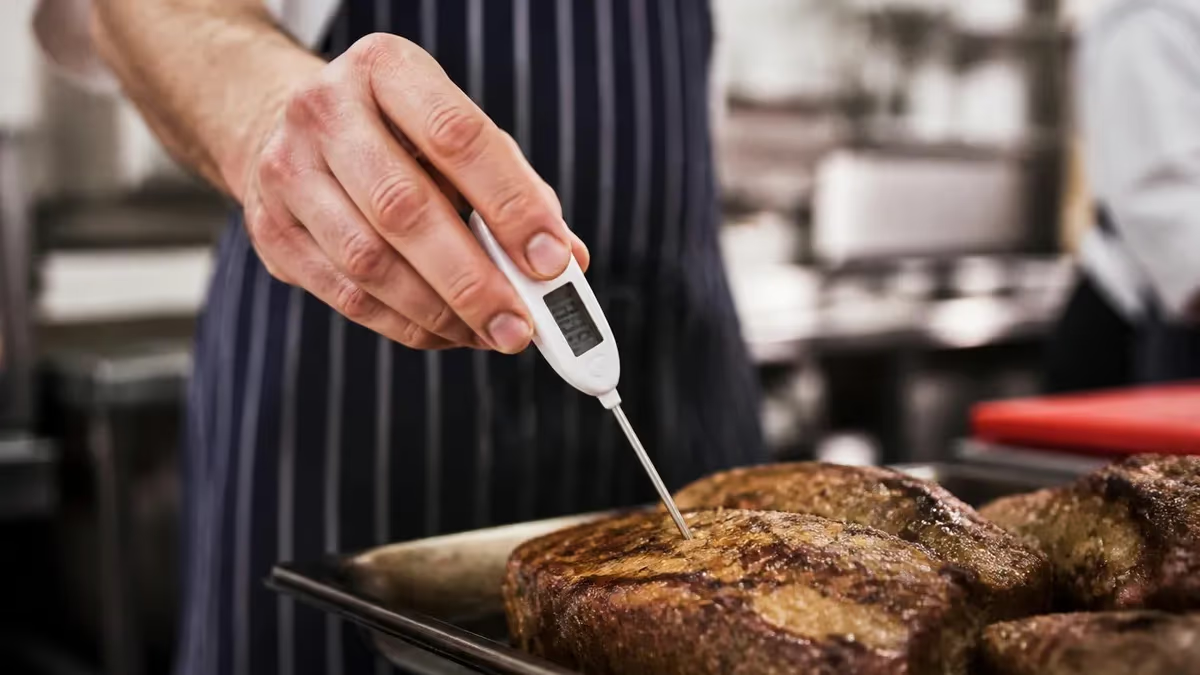
If you work in food service anywhere in Ohio, understanding your ServSafe Ohio obligations is the first step toward a compliant, professional career in the industry. ServSafe is the nation's most widely recognized food safety training and certification program, developed by the National Restaurant Association Educational Foundation. Ohio food service establishments rely on it to meet state and local health department requirements, and employers across Columbus, Cleveland, Cincinnati, and every smaller county in between actively seek workers who hold valid credentials. Getting servsafe certified puts you ahead of the competition from day one.
Ohio does not have a single statewide mandate that every food worker must hold ServSafe certification, but the practical reality looks nearly identical. The Ohio Department of Health and the Ohio Revised Code require that all retail food establishments have at least one certified food protection manager on the premises during operating hours.
The ServSafe Manager certification fulfills this requirement across virtually every Ohio county and city, making it the de facto standard that most employers demand. Many local health departments in Franklin, Cuyahoga, Hamilton, and Summit counties have added their own overlay requirements, so checking with your local authority before training is always wise.
The ServSafe food handler certification addresses a different tier of the workforce: hourly employees, prep cooks, servers, and baristas who need foundational food safety knowledge but are not yet stepping into a manager role. Ohio is one of many states where certain municipalities or employers require food handler cards, even when the state does not issue a blanket mandate. Understanding the difference between the food handler course and the manager course — and which one applies to your specific job — will save you time and money and ensure you are meeting the right standard for your role.
Preparation matters enormously for the ServSafe manager exam, which is a proctored 90-question test administered through the National Restaurant Association's testing partner. The national first-time pass rate hovers around 50–55 percent, which means nearly half of all test-takers need a second attempt. Ohio candidates who invest in focused study using practice tests and review materials consistently outperform their peers who rely on the classroom course alone. Understanding the exam format, the weight given to each of the eight content domains, and the specific food safety principles the NRAEF emphasizes is essential prep work.
This guide covers everything Ohio food service professionals need to know: state and local legal requirements, the differences between food handler and manager certifications, costs and scheduling, what to expect on exam day, and a practical study plan designed to maximize your first-attempt pass rate. Whether you are a seasoned kitchen veteran renewing your credentials or a brand-new employee signing up for your very first ServSafe practice test, the information in this article will give you a clear, actionable roadmap from enrollment to passing score.
Food safety is not just a regulatory checkbox in Ohio — it is a genuine public health matter. The Centers for Disease Control and Prevention estimates that roughly 48 million Americans experience a foodborne illness each year, with improper food handling practices at restaurants accounting for a significant share of those cases. Ohio health departments conduct unannounced inspections and can shut down operations, issue fines, and require retraining when violations are discovered. A team that is properly trained and certified is a team that protects both guests and the business's license to operate.
By the time you finish reading this guide, you will understand exactly what ServSafe Ohio requires, how to register for the right exam, how much you can expect to pay, and what study strategies give you the best shot at passing on the first try. Let's get started.
ServSafe Ohio by the Numbers

Ohio Food Safety Legal Requirements at a Glance
Ohio law requires every retail food establishment to have at least one certified food protection manager. The ServSafe Manager certification satisfies this requirement statewide and is accepted by all Ohio local health departments.
Franklin, Cuyahoga, Hamilton, and Summit counties often impose additional certification requirements beyond the state baseline. Always verify with your local health department before selecting a training program to ensure full compliance.
Some Ohio municipalities require all food service employees — not just managers — to hold a food handler card. Columbus, Cleveland, and Cincinnati periodically update these rules, so check your city ordinances before enrolling in a course.
ServSafe Manager certifications expire after five years. Ohio health inspectors verify that on-file certifications are current during routine inspections. Expired credentials are treated the same as no credential — renewals must be completed before the expiration date.
Ohio food establishments running seasonal or temporary operations at fairs, festivals, and farmers' markets still need a certified manager present. Temporary food service licenses issued by county health departments carry the same requirement as permanent establishments.
The distinction between ServSafe food handler certification and ServSafe manager certification is one of the most common points of confusion for Ohio food service workers, and getting it wrong can mean wasted money or, worse, incomplete compliance with your employer's or local health department's requirements.
The food handler course is designed for frontline, non-supervisory employees: cooks, dishwashers, servers, bussers, and cashiers who handle food but do not make policy or oversight decisions. The course typically runs two to four hours and can be completed entirely online. There is a short assessment at the end, but it is not a formal proctored exam in the same sense as the manager test.
The ServSafe Manager certification is an entirely different tier. It is intended for shift supervisors, kitchen managers, food service directors, and anyone else with responsibility for overseeing safe food handling practices in an establishment.
The curriculum covers all eight content domains mandated by the Conference for Food Protection, including foodborne microorganisms, personal hygiene, temperature control, cross-contamination prevention, cleaning and sanitation, pest control, facility design, and food safety management systems like HACCP. Mastery of these domains is what the 90-question proctored exam tests, and a score of at least 75 percent — meaning 67 or more correct answers — is required to pass.
You can find information about servsafe certification online on the ServSafe website, where both the food handler and manager courses are available in fully digital formats. Online delivery is particularly popular with Ohio candidates who live in rural counties far from training centers, work non-standard shifts, or simply prefer self-paced learning.
The online manager course includes the same content as the instructor-led classroom version and satisfies the same regulatory requirements when paired with a valid proctored exam, but note that the exam itself must be administered by an approved proctor — you cannot take the manager exam entirely on your own without oversight.
One nuance Ohio candidates often miss is that completing the ServSafe Manager course does not automatically mean you are certified. Certification only happens after you pass the proctored exam with a 75 percent or higher score and your results are processed by the NRAEF. Many workers take the course, skip or delay the exam, and assume they have credentials — only to discover during a health inspection that they have training documentation but not a certification. The certificate issued after passing the exam is the document that satisfies state and local requirements, not the course completion record.
Ohio employers in healthcare, school foodservice, and large hotel or catering operations sometimes require ServSafe Manager certification as a condition of employment — not just as a preference. If you are applying for a food service director position at a hospital, a school nutrition program, or a large event catering company, expect the job listing to explicitly require a current ServSafe Manager credential. Some large restaurant chains operating in Ohio have internal policies that require all kitchen management staff to be certified, regardless of what local law mandates.
The food handler card, by contrast, is typically fulfilled through a shorter and less expensive process. Ohio does not have a unified statewide food handler card program the way some other states do. Instead, a patchwork of local ordinances governs whether a food handler card is required, which providers are approved, and how long a card remains valid. In most cases, ServSafe's food handler certification is accepted wherever a food handler card is required in Ohio, but it is always worth confirming this with your specific local health authority before investing in training.
Renewals follow the same two-tier logic. Food handler cards, where required, typically expire after two to three years depending on the issuing jurisdiction. The ServSafe Manager certification has a fixed five-year validity period nationwide. Ohio candidates renewing their manager certification must retake and pass the proctored exam — there is no shorter renewal pathway that bypasses the exam — so building in preparation time before your expiration date is essential.
ServSafe Manager Exam: Topic Breakdown and Study Focus
Foodborne illness and food hazards make up the largest single content area on the ServSafe Manager exam, accounting for roughly 15–17 percent of all questions. Ohio candidates must be able to identify the major pathogens — Salmonella, E. coli O157:H7, Listeria, Norovirus, and Hepatitis A — along with their sources, symptoms, and prevention methods. Understanding the difference between biological, chemical, and physical hazards, and knowing which foods are classified as TCS (Time and Temperature Control for Safety) foods, is critical for this section.
Study strategies for this domain should include memorizing the Big Six pathogens, their symptoms, incubation periods, and the specific food vehicles associated with each. Many exam questions present a scenario — a guest reports illness 24 hours after eating shellfish — and ask you to identify the most likely pathogen. Flashcards, practice quizzes, and the ServSafe textbook's pathogen summary tables are the most efficient tools for this domain. Expect two to four scenario-based questions in this category on the actual exam.

ServSafe Certification Ohio: Advantages and Limitations
- +Accepted by all Ohio local health departments as proof of food safety manager competency
- +Recognized in all 50 states, making it useful if you relocate or work across state lines
- +Online course option is ideal for rural Ohio workers or those with irregular schedules
- +Demonstrates professional commitment to food safety, strengthening your resume and promotion prospects
- +Five-year validity period reduces the frequency and cost of recertification
- +Comprehensive curriculum prepares you for real workplace food safety challenges, not just the exam
- −Exam pass rate of roughly 50–55 percent means many candidates need a costly second attempt
- −Proctored exam cannot be taken entirely online — Ohio candidates must find an approved proctor
- −The official textbook and exam bundle can cost up to $179, which is expensive for hourly workers
- −Certification does not replace local food handler card requirements in some Ohio municipalities
- −Renewal requires retaking the full proctored exam — there is no abbreviated renewal pathway
- −Course content can feel overwhelming for workers with limited formal education or English fluency
ServSafe Ohio Certification: Step-by-Step Checklist
- ✓Confirm with your local Ohio health department whether you need the food handler card, manager certification, or both.
- ✓Visit the ServSafe website and create a free account to access course enrollment and exam registration.
- ✓Purchase the ServSafe Manager textbook (7th edition) — either the standalone book or the bundle with the exam voucher.
- ✓Choose your delivery format: online self-paced course, live online instructor-led class, or in-person classroom session.
- ✓Complete the full course curriculum, covering all eight content domains before your exam date.
- ✓Schedule your proctored exam through the ServSafe portal, selecting an approved proctor in your area or a remote online proctoring option.
- ✓Spend at least two weeks taking ServSafe practice tests daily, tracking which domains produce the most errors.
- ✓Review all practice test errors using the ServSafe textbook — do not just note the correct answer, understand why it is correct.
- ✓Arrive at the exam location (or log into remote proctoring) at least 15 minutes early with valid government-issued photo ID.
- ✓After passing, download and print your digital certificate from the ServSafe portal — this is the document health inspectors verify.
Passing the Exam ≠ Instant Certification
Many Ohio candidates do not realize that certification is not instant — after passing the proctored exam, results are processed by the NRAEF and a digital certificate is issued within one to two business days. Do not schedule health inspections or present yourself as certified until you have received and downloaded your official ServSafe certificate from the portal.
Understanding the full cost picture for ServSafe certification in Ohio helps you budget accurately and avoid surprise expenses that trip up many first-time candidates. The pricing structure has several components, and the total you pay depends heavily on how you choose to study and whether you pass on the first attempt. Let's break down every cost category you should account for before you enroll.
The ServSafe Manager textbook, which is the official study resource published by the National Restaurant Association Educational Foundation, costs approximately $75–$80 if purchased alone. The textbook is the 7th edition as of 2026 and covers all content domains tested on the current exam. Many candidates purchase the textbook bundled with an exam answer sheet or exam voucher, which typically runs $130–$179 depending on the retailer and any applicable discount codes. The bundle is almost always a better value than purchasing the components separately, especially if you plan to take the exam at a hosted class rather than scheduling it independently.
The proctored exam itself, when purchased separately from the textbook, costs approximately $36–$42. If you register for an instructor-led course through an approved ServSafe instructor, the course fee — which can range from $50 to $150 depending on the instructor and location in Ohio — often includes the exam. Community colleges across Ohio, including Columbus State Community College, Cuyahoga Community College, and Cincinnati State, periodically offer ServSafe Manager courses at competitive rates, sometimes subsidized for students enrolled in culinary arts or hospitality programs.
One often-overlooked cost is the retake fee. If you do not pass on the first attempt — which happens to roughly half of all test-takers nationally — you must pay the exam fee again, typically around $36–$42. You do not need to repurchase the textbook or retake the full course, but the exam fee is non-refundable and non-transferable, so treating the first attempt as a serious, prepared effort is financially important. Some employers in Ohio cover the cost of the initial exam and one retake as part of their onboarding benefits; ask your HR department before paying out of pocket.
Online course access fees vary depending on the platform. The ServSafe website offers the online manager course for approximately $15 as a standalone digital resource when you already have the textbook. Third-party training providers and continuing education platforms may bundle digital course access with practice exams for $30–$60. Free practice resources — including the quizzes on sites like PracticeTestGeeks — can supplement paid materials and significantly reduce the total amount you need to spend on test preparation without sacrificing quality.
For the servsafe certificate renewal cycle, Ohio managers need to budget for a fresh exam fee and potentially a new textbook edition every five years. If a new edition of the ServSafe textbook has been published since your original certification, you will want the updated version to ensure your study materials align with current exam content. The NRAEF typically updates the textbook and exam content every four to six years to reflect changes in the FDA Food Code and emerging food safety science, so staying current on edition changes is important for renewal candidates.
Employers who run food service operations in Ohio and want to send multiple employees through ServSafe training at once should look into group pricing and hosted exam sessions. ServSafe offers volume pricing for employers who purchase exam answer sheets in quantities of 25 or more. Hosting an on-site class with an approved ServSafe instructor can reduce the per-person cost to $60–$80 all-in for large groups, compared to $130–$179 per person for individual enrollment. Restaurant groups, hotel chains, and school food service operations in Ohio commonly use this model to certify their entire management teams in a single training event.

ServSafe exam vouchers purchased online expire 90 days from the date of purchase. If you buy your exam voucher but do not schedule and complete the test within that window, you will forfeit the fee and need to repurchase. Set a calendar reminder the moment you buy your voucher and schedule your exam date at least two weeks out to allow time for adequate preparation.
Effective study strategies separate first-time passers from repeat test-takers in Ohio, and the gap between the two groups is almost entirely attributable to preparation quality rather than raw intelligence or prior food service experience. Veterans who have worked in kitchens for decades sometimes struggle on the ServSafe Manager exam because food safety knowledge gained on the job does not always align with the specific terminology, temperature thresholds, and procedural frameworks the exam tests. A structured study approach beats experience alone every time.
Start by taking a full-length ServSafe practice test before you begin studying. This diagnostic approach helps you understand your baseline knowledge, identify your weakest content domains, and prioritize your study time accordingly. If your diagnostic test reveals significant weaknesses in foodborne illness identification, for example, you should allocate more review time to chapters two, three, and four of the ServSafe textbook before moving on to other sections. Candidates who study without a diagnostic baseline often spend equal time on topics they already understand and miss the focused review that weaker areas require.
Active recall is significantly more effective than passive re-reading for ServSafe exam prep. Instead of highlighting text in the textbook and re-reading your notes, use flashcards, practice quizzes, and the end-of-chapter review questions in each ServSafe chapter. The act of retrieving information from memory — even when you get the answer wrong — strengthens retention far more effectively than passive review. Research in cognitive science consistently shows that students who test themselves regularly outperform students who study the same amount of time through re-reading alone.
Temperature numbers deserve dedicated memorization sessions because they appear in multiple question formats across different content domains. You need to know not just the danger zone (41°F–135°F) but also the cooking temperatures for every major protein, the cooling requirements (135°F to 70°F within two hours, then 70°F to 41°F within the next four hours), the reheating requirement for potentially hazardous foods (165°F within two hours), and the hot-holding and cold-holding thresholds. A laminated temperature reference card that you review every morning during your two-week prep period will cement these numbers in memory more reliably than any other single study technique.
For understanding what is servsafe certified and the temperature principles behind it, the ServSafe temperature danger zone guide is an excellent deep-dive resource. Knowing why each temperature threshold exists — the biology of pathogen growth and destruction — helps you answer scenario-based questions even when the specific temperature is not explicitly stated, because you can reason from first principles rather than just recalling a number.
Group study sessions with coworkers preparing for the same exam can accelerate learning, particularly for content like HACCP principles and the seven-step process. Talking through scenarios with a study partner — role-playing as a health inspector asking you to explain your HACCP plan — forces you to articulate knowledge in a way that exposes gaps you would not notice during solo reading. Many Ohio food service operations encourage coworkers to study together and even offer time during slower shifts for group review sessions.
In the 48 hours before your exam, shift your strategy from learning new material to consolidating what you already know. Avoid cramming large amounts of new information the night before — this typically increases anxiety without meaningfully improving performance. Instead, review your temperature reference card, skim through the end-of-chapter review questions in any domain where you feel shaky, and get a full night of sleep. Exam performance is significantly impaired by fatigue, and a well-rested candidate consistently outperforms an exhausted one who studied an extra three hours the night before.
Exam day logistics matter more than most Ohio ServSafe candidates anticipate, and small logistical mistakes can derail an otherwise well-prepared candidate. Whether you are sitting for a hosted class exam, scheduling your own proctored session at a testing center, or using the remote online proctoring option, understanding exactly what to expect on exam day eliminates unnecessary stress and lets you focus entirely on demonstrating your knowledge.
For in-person exams — whether at a community college, a hosted employer session, or an independent testing center in Ohio — you must bring a valid, government-issued photo ID that matches the name on your registration. Accepted forms of ID include a driver's license, state ID, passport, or military ID.
Some proctors also accept employee IDs with photos, but this varies by location. Arrive at least 15 minutes before your scheduled start time; late arrivals may be turned away and forfeit their exam fee. Turn off your cell phone before entering the testing room — exam rules prohibit electronic devices, and violations can result in score cancellation.
Remote online proctoring through ProctorU is available for Ohio candidates who cannot easily reach a physical testing center or who prefer the convenience of testing from home or a private office. The remote proctoring process requires a computer with a functioning webcam, microphone, and a stable internet connection.
You will be asked to show the proctor your ID via webcam and to do a 360-degree pan of your testing environment to confirm there are no unauthorized materials or additional people present. Clear your desk of everything except the items the proctor specifically permits — typically just your ID and a blank sheet of scratch paper if the exam allows it.
The ServSafe Manager exam consists of 90 questions and must be completed within three hours. Questions are multiple-choice with four answer options each. There is no penalty for guessing, so leaving any question unanswered is never the right move. If you are unsure of an answer, eliminate any options you know are wrong, make your best selection, and flag the question for review if time permits. Most candidates with adequate preparation complete all 90 questions within 90–120 minutes, leaving 60–90 minutes for review. Do not rush through the exam — use the full time available.
After you submit your exam, your score may be displayed immediately on-screen depending on the testing format, or it may be communicated via email within 24–48 hours. A score of 75 percent or higher — meaning at least 67 correct answers out of 90 — constitutes a passing score. If you pass, you will receive your ServSafe Manager certification via email as a downloadable PDF certificate that you can print for your employer and personal records. If you do not pass, the score report will show your performance by content domain, which is invaluable information for planning your retake preparation.
Ohio health inspectors verify ServSafe Manager certifications by checking the certificate's issuance date and expiration date. They may also cross-check certificates against the NRAEF's online verification system, which allows anyone to look up a certified individual by name and certificate number. Make sure your name on the certificate matches exactly what your employer and health department records show — discrepancies can cause unnecessary complications during inspections. If your legal name has changed since your last certification, update your information with the NRAEF before your next inspection.
Post-exam, whether you passed or need to retake, the smart move is to log your experience while the questions are fresh. Note which content domains felt most challenging, which question formats tripped you up, and what topics you wish you had reviewed more thoroughly. This debrief — done within 24 hours of leaving the exam — becomes your roadmap if a retake is needed and reinforces your learning if you passed and want to build on your knowledge in a managerial role.
ServSafe Questions and Answers

ServSafe Coupon Code: How to Save Money on Your Certification in 2026

ServSafe Promo Code 2026: Real Discounts (Not Coupon Scams)

ServSafe Certification Online 2026 — Cost, Time & How to Pass

ServSafe Temperature Danger Zone: The Complete 41°F–135°F Food Safety Guide for Certification

ServSafe Customer Service: How to Get Help With Certification, Testing, and Account Issues
About the Author

Registered Sanitarian & Food Safety Certification Expert
Cornell University College of Agriculture and Life SciencesThomas Wright is a Registered Sanitarian and HACCP-certified food safety professional with a Bachelor of Science in Food Science from Cornell University. He has 17 years of experience in food safety auditing, regulatory compliance, and foodservice management training. Thomas prepares food industry professionals for ServSafe Manager, HACCP certification, and state food handler examinations.
Join the Discussion
Connect with other students preparing for this exam. Share tips, ask questions, and get advice from people who have been there.
View discussion (7 replies)