
HVAC Gauges and Tools: The Complete Equipment Guide for Technicians
💡 Master HVAC gauges and essential tools with this complete equipment guide. Learn manifold sets, vacuum pumps, recovery machines, and meters.
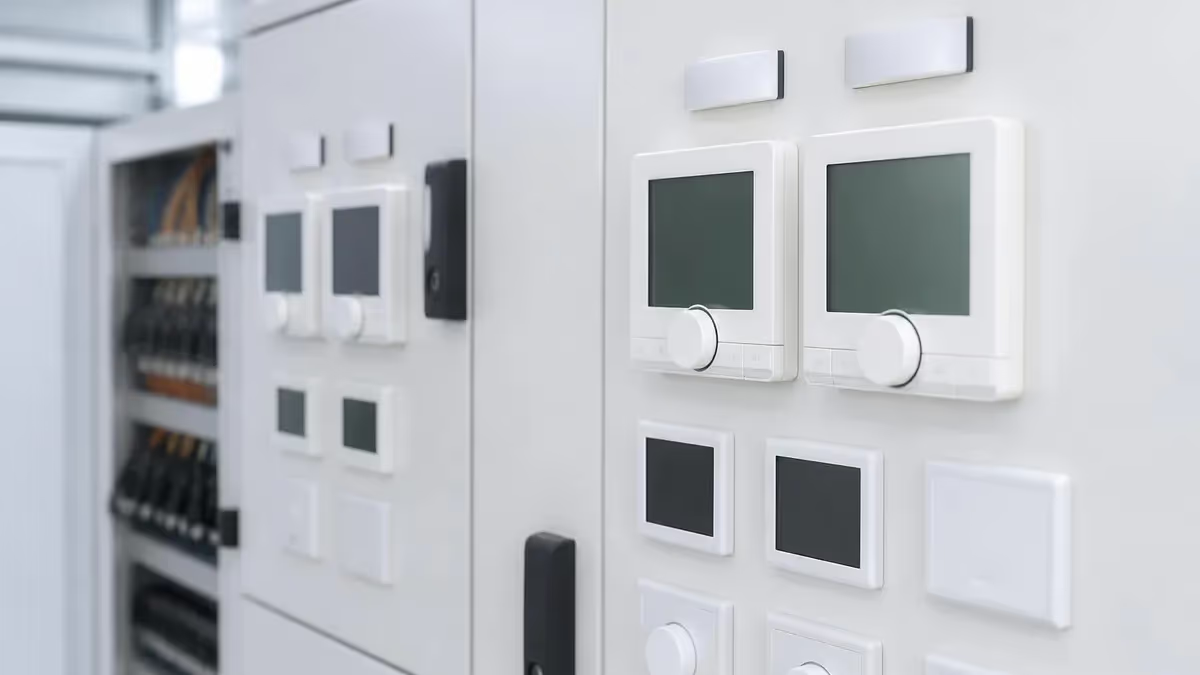
HVAC guages are the single most important diagnostic tool in a technician's truck, and understanding how to read, connect, and maintain them separates rookies from seasoned professionals. Whether you are charging a split system on a 95-degree Phoenix afternoon or troubleshooting a low-suction call in a Minnesota basement, your manifold set tells you exactly what the refrigerant circuit is doing. Modern HVAC work demands precision, and the right gauges deliver it down to the half-PSI.
This guide walks through every category of tool an HVAC technician needs, from analog manifold sets and digital micron gauges to recovery machines, leak detectors, and clamp meters. We cover what each tool does, when to use it, what to spend, and which features actually matter on a service call. By the end you will know exactly what belongs in your tool bag for residential service, light commercial, and refrigeration work.
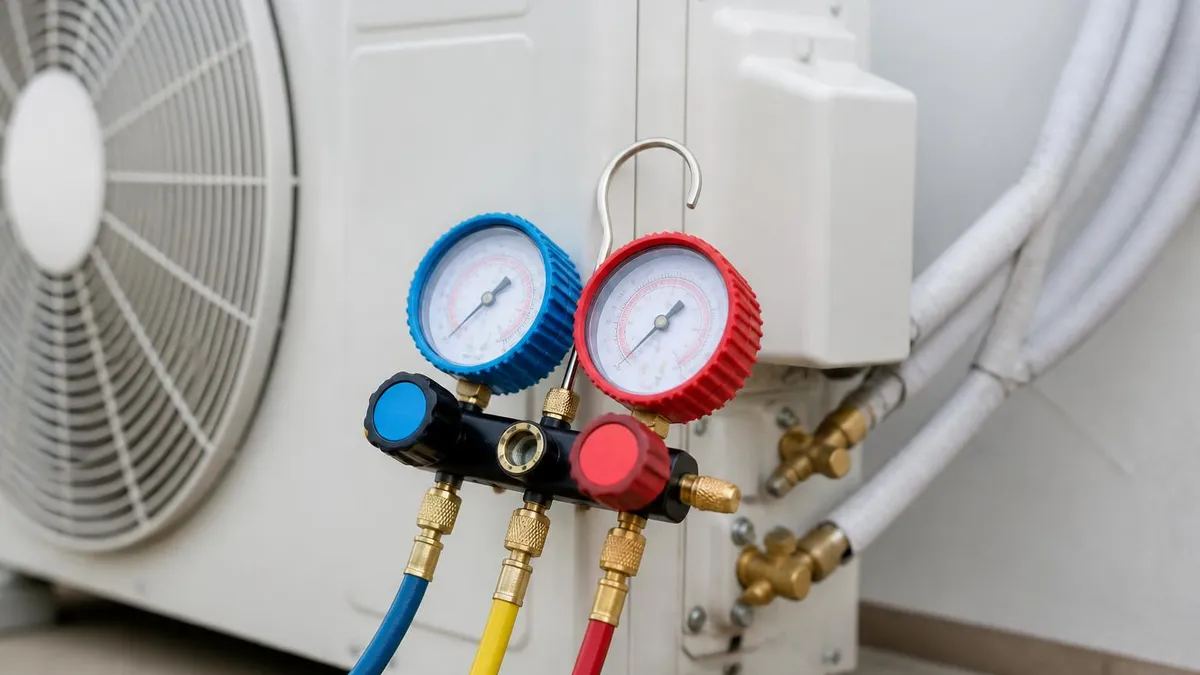
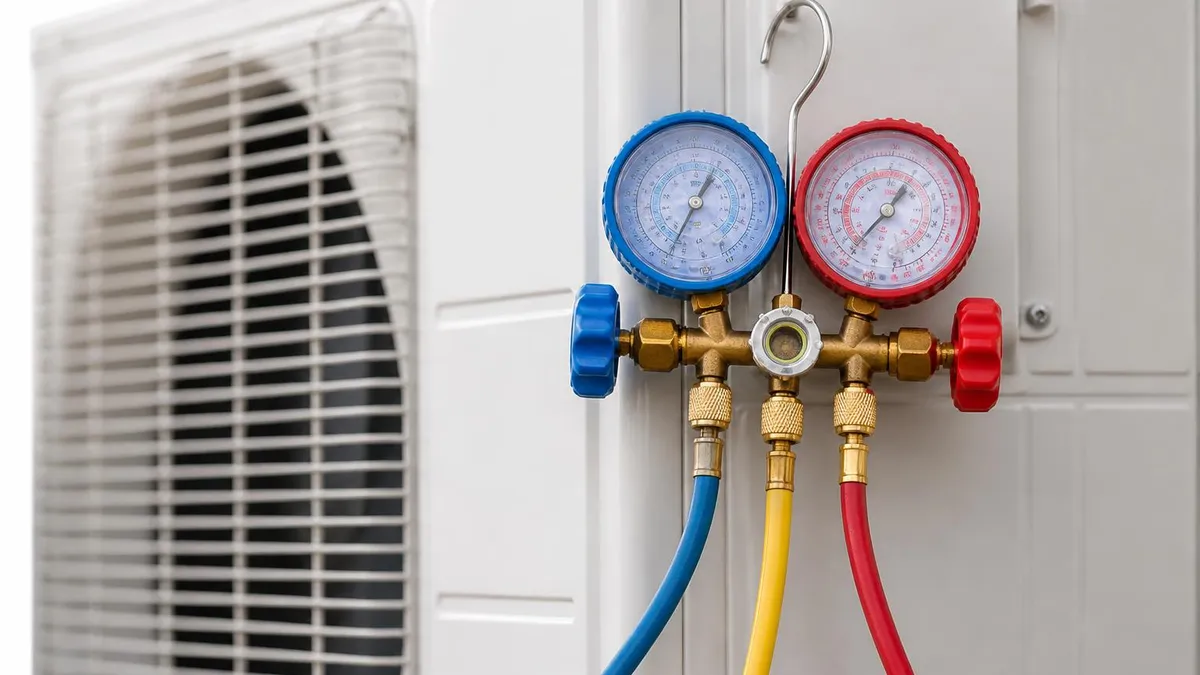
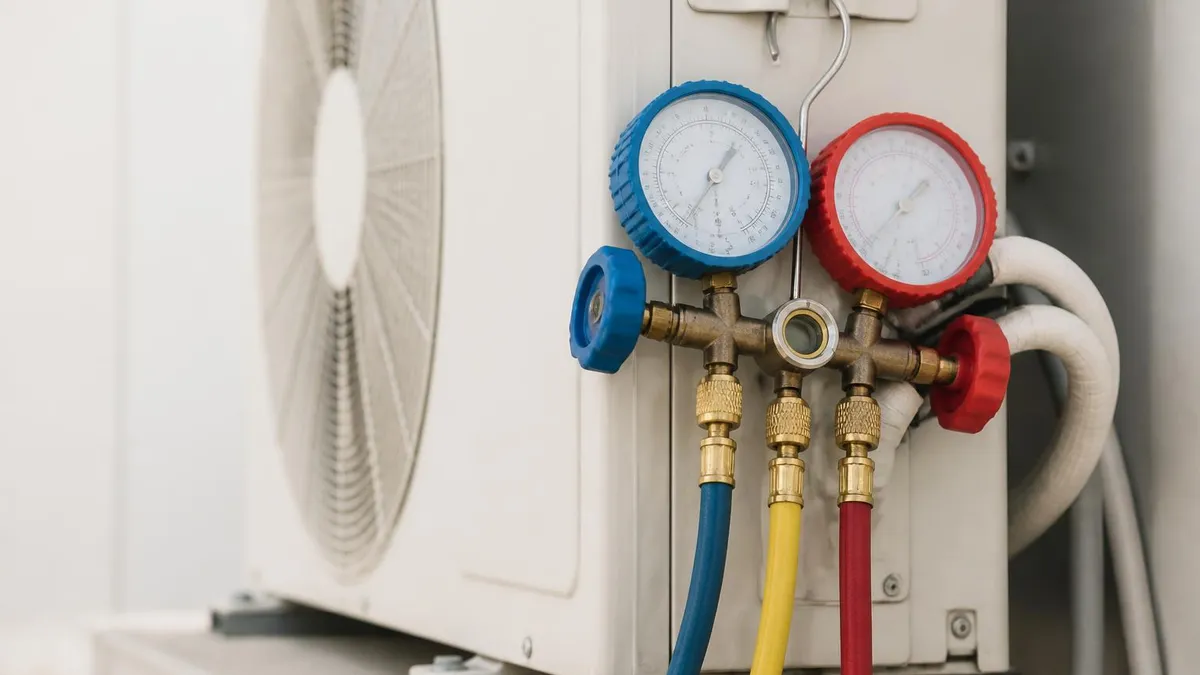
HVAC gauges come in two main flavors: analog manifolds with bourdon tubes and color-coded faces, and digital manifolds with pressure transducers and temperature clamps that calculate superheat and subcooling automatically. Both have a place. Analog sets are bulletproof, cheap to replace, and easy to read in bright sun. Digital sets cut diagnostic time roughly in half once you trust the readings and learn the menu structure on your specific model.
Beyond gauges, the modern HVAC tool kit includes a deep-vacuum pump capable of pulling below 500 microns, a digital micron gauge to verify the pull, a recovery machine and tank for refrigerant compliance under EPA Section 608, and a torch kit for brazing copper joints. Add a quality multimeter, an amp clamp, a leak detector, and a combustion analyzer if you touch gas equipment, and you have the core diagnostic arsenal.
Cost matters. A new tech can outfit themselves with reliable tools for around $1,500 to $2,500. A fully kitted senior tech truck with digital manifolds, scales, recovery, vacuum, combustion analysis, and electrical test gear runs $4,000 to $7,000. Smart buyers invest first in safety, then accuracy, then convenience features like Bluetooth and on-screen charging calculators.
Tool selection also depends on what work you do. A residential install tech needs different gear than a commercial chiller mechanic or a refrigeration specialist running CO2 transcritical racks. We will flag which tools matter for each track so you can build a kit that pays for itself fast, instead of buying gadgets that gather dust in your van.
Finally, tools are only as good as the technician using them. The best digital manifold in the world will give you garbage readings if your hoses leak, your access ports are clogged, or you forget to zero the pressure transducer at altitude. Throughout this guide we share the small habits and calibration routines that keep your readings honest and your callbacks low.
HVAC Tools by the Numbers

Essential HVAC Tool Categories Every Tech Needs
Manifold gauge sets, refrigerant hoses, recovery machines, recovery tanks, vacuum pumps, micron gauges, and refrigerant scales for charging, recovery, and evacuation work on sealed systems.
Digital multimeters, amp clamps, capacitor testers, non-contact voltage detectors, and insulation resistance meters used to diagnose motors, contactors, control boards, and capacitors safely.
Combustion analyzers, manometers, gas leak detectors, and draft gauges required for gas furnaces, boilers, and water heaters to verify safe combustion and tune for efficiency.
Tubing cutters, flaring blocks, swage tools, reamers, deburring tools, torch kits with oxy-acetylene or MAP-Pro, brazing rods, and nitrogen regulators for refrigerant line work.
Anemometers, hot-wire probes, static pressure tips, hygrometers, and infrared thermometers used to balance duct systems, measure CFM, and confirm proper temperature splits across coils.
The debate between analog and digital HVAC gauges has been raging in supply houses for over a decade, and both sides have valid points. Analog manifolds like the classic Yellow Jacket 41215 or Ritchie titan series have been on trucks for fifty years. They are accurate enough for most service work, cost under $200, and you can drop them in a snowbank and still trust the reading the next morning. There are no batteries to die, no firmware to update, and no menu trees to memorize.
Digital manifolds, on the other hand, calculate superheat and subcooling automatically once you clip on the temperature probes and select the refrigerant. A Fieldpiece SMAN460, Testo 550, or Yellow Jacket Mantooth shaves easily 10 minutes off every charging job because you stop doing pressure-temperature chart lookups in your head. They also log data, send results to your phone via Bluetooth, and produce service reports you can email to the customer before you leave the driveway.
Accuracy is comparable on quality units, but resolution differs. A good analog gauge reads to about 1 PSI on a 2.5-inch face. A digital reads to 0.1 PSI and shows actual saturation temperature in real time. For tight tolerances on variable-speed inverter systems and low-charge mini-splits, that resolution matters. A 5 PSI error on a small ductless head can mean the difference between rated capacity and a callback.
The biggest argument against digital is cost and durability. A four-port digital manifold with wireless probes runs $500 to $900. Drop it off a ladder onto concrete and you may be buying a new one. Hoses still leak the same way, batteries die in cold weather, and Bluetooth connections drop in older homes with thick plaster walls. Many shops issue a digital to senior techs and keep analog backups in every truck for that reason.
There is also a hybrid approach gaining popularity: wireless probe sets like the Testo Smart Probes or the Fieldpiece JobLink series. These clamp directly onto the service ports and stream data to a phone or tablet, eliminating the manifold body entirely on quick diagnostic calls. You get digital precision and superheat math without lugging a brick around the attic.
For new technicians, the smart play is to start with a quality four-valve analog manifold, learn pressure-temperature relationships cold, then upgrade to digital after two years in the field. You will be a better diagnostic tech for having done the math by hand first, and you will know instantly when a digital reading does not match what you would expect.
Whatever you choose, always buy four-valve manifolds over two-valve. The extra ports for the vacuum line and recovery hose mean you do not have to disconnect under pressure during an evacuation, which saves time and protects your hoses. Look for 1/4-inch SAE fittings on residential gear and 5/16 or 1/2-inch ACME for R-410A and HFO refrigerants.
HVAC Practice Test Questions
Prepare for the HVAC - Heating Ventilation and Air Conditioning exam with our free practice test modules. Each quiz covers key topics to help you pass on your first try.
HVAC Air Conditioning
HVAC Exam Questions covering Air Conditioning. Master HVAC Test concepts for certification prep.
HVAC Code Compliance
Free HVAC Practice Test featuring Code Compliance. Improve your HVAC Exam score with mock test prep.
HVAC Electrical Controls
HVAC Test Prep for Electrical Controls. Practice HVAC Quiz questions and boost your score.
HVAC Energy Efficiency
HVAC Questions and Answers on Energy Efficiency. Free HVAC practice for exam readiness.
HVAC Heating Systems
HVAC Mock Test covering Heating Systems. Online HVAC Test practice with instant feedback.
HVAC Load Calculations
Free HVAC Quiz on HVAC Load Calculations. HVAC Exam prep questions with detailed explanations.
HVAC Tools and Equipment
HVAC Practice Questions for HVAC Tools and Equipment. Build confidence for your HVAC certification exam.
HVAC Refrigeration
HVAC Test Online for Refrigeration. Free practice with instant results and feedback.
HVAC Safety Practices
HVAC Study Material on Safety Practices. Prepare effectively with real exam-style questions.
HVAC System Design
Free HVAC Test covering System Design. Practice and track your HVAC exam readiness.
HVAC Thermodynamics
HVAC Exam Questions covering Thermodynamics. Master HVAC Test concepts for certification prep.
Manifold Sets and HVAC Gauges Explained
Two-valve manifolds are the budget-friendly classic, featuring a low-side blue gauge and a high-side red gauge connected by a center service port. They cost $80 to $150 and work fine for basic charging, recovery, and pressure testing when you do not mind disconnecting hoses under pressure. Most apprentices start here, and many service techs keep one as a backup.
Drawbacks become obvious during evacuations. Pulling vacuum through a two-valve set means routing through the charging hose, which slows the pull and traps moisture in the hose itself. They are also harder to use for recovery because you must close and disconnect carefully to avoid losing charge. Suitable for light residential work but limiting for serious diagnostics.
Buying Digital HVAC Gauges: Worth the Investment?
- +Automatic superheat and subcooling calculations save 10 minutes per call
- +Higher resolution readings down to 0.1 PSI for inverter systems
- +Bluetooth connectivity sends reports directly to customers
- +Built-in pressure-temperature charts for every common refrigerant
- +Data logging for warranty claims and commissioning documentation
- +Vacuum gauge function eliminates separate micron gauge purchase
- +Backlit displays for attic and crawlspace work
- −Three to five times the cost of analog manifold sets
- −Batteries die in cold weather and need replacement
- −Fragile electronics break if dropped on hard surfaces
- −Firmware updates and menu navigation steepen learning curve
- −Bluetooth connections drop in homes with thick walls
- −Calibration drift over years requires periodic verification
- −Limited resale value compared to mechanical gauges
Complete HVAC Tool Kit Checklist for New Technicians
- ✓Four-valve manifold gauge set rated for R-410A and R-32
- ✓Four-valve manifold gauge set rated for R-410A, R-32, and R-454B
- ✓Set of 60-inch charging hoses with ball-valve depressors on each end
- ✓Two-stage vacuum pump rated at minimum 6 CFM for residential service
- ✓Digital micron gauge capable of reading down to 50 microns accurately
- ✓EPA-approved refrigerant recovery machine and DOT recovery tank
- ✓Digital refrigerant scale with 220-pound capacity and tare function
- ✓True-RMS digital multimeter with capacitance and temperature functions
- ✓600-amp clamp meter with inrush current capture for compressor testing
- ✓Oxy-acetylene or MAP-Pro torch kit with multiple brazing tip sizes
- ✓Tubing cutter, deburring tool, swaging set, and 45-degree flaring block
- ✓Electronic refrigerant leak detector with heated diode or infrared sensor
- ✓Combustion analyzer if servicing gas furnaces, boilers, or water heaters
Always verify your micron gauge against a fresh vacuum
Micron gauges drift over time and contamination can throw readings off by hundreds of microns. Before every critical evacuation, pull your gauge down to atmosphere, then connect it directly to a known-good pump with a clean tee. If it does not pull below 100 microns on a fresh sensor and clean oil, replace the sensor or service the gauge before trusting any system evacuation reading.
Vacuum pumps and micron gauges work together to remove moisture and non-condensables from refrigerant systems before charging, and getting this step right prevents 80 percent of premature compressor failures. A proper deep vacuum below 500 microns boils off any water trapped inside the lines, oil, and components, leaving a dry system ready to accept refrigerant without forming acids or sludge over time.
Two-stage vacuum pumps are the industry standard, with 6 CFM being the sweet spot for residential service work. Larger 8 to 12 CFM pumps speed up evacuations on commercial systems and long line sets, but they cost more, weigh more, and burn through oil faster. Brands like Yellow Jacket Bullet, Fieldpiece VP85, JB Eliminator, and Robinair CoolTech have proven track records on contractor trucks across the country.
Vacuum pump oil is the consumable nobody thinks about until evacuations start taking three hours. Fresh, clear oil is essential because the pump literally pulls moisture into the oil during operation. After every service call where you broke the system open, check the sight glass. If the oil looks milky, cloudy, or amber, change it before the next job. A quart of vacuum pump oil costs around $15 and saves hours of frustration.
Micron gauges replaced the old trick of watching a manifold needle pin to 30 inches of vacuum and calling it good. A manifold gauge cannot resolve below about 25,000 microns, but moisture still boils at 5,000 microns and above. Without a digital micron gauge reading down to at least 500 microns, you have no way of knowing whether the system is actually dry or just empty of measurable pressure.
Connection technique matters as much as the equipment. Always connect the micron gauge with a short, rigid copper tee directly to the service port, not through a long hose. Long hoses contain trapped air and outgas slowly, giving false high readings. Mount the gauge upstream of the pump, and isolate the system with a core depressor valve so you can verify the system holds vacuum after the pump is stopped.
A solid evacuation procedure follows the triple-evacuation method on systems that have been open to atmosphere for extended periods. Pull to 500 microns, break the vacuum with nitrogen to 5 PSIG, pull again to 500 microns, break with nitrogen, then pull a final time and hold below 500 microns for at least 10 minutes with the pump isolated. If the reading climbs above 1,000 microns during the hold, you have a leak or remaining moisture.
Common evacuation killers include leaking hoses, schrader cores that should be removed during the pull, dirty pump oil, undersized hoses on long line sets, and ambient temperatures below 50 degrees Fahrenheit that slow moisture evaporation dramatically. On cold-weather installs, warming the indoor coil with a hair dryer or working in a heated space can cut evacuation times in half.
Federal law requires technicians who service equipment containing refrigerants to hold an EPA Section 608 certification. This applies whether you are recovering, evacuating, or charging a system. Operating without certification carries fines up to $44,539 per violation. Type I covers small appliances, Type II is high-pressure systems including residential AC, Type III is low-pressure, and Universal covers all three. Get certified before touching a manifold professionally.
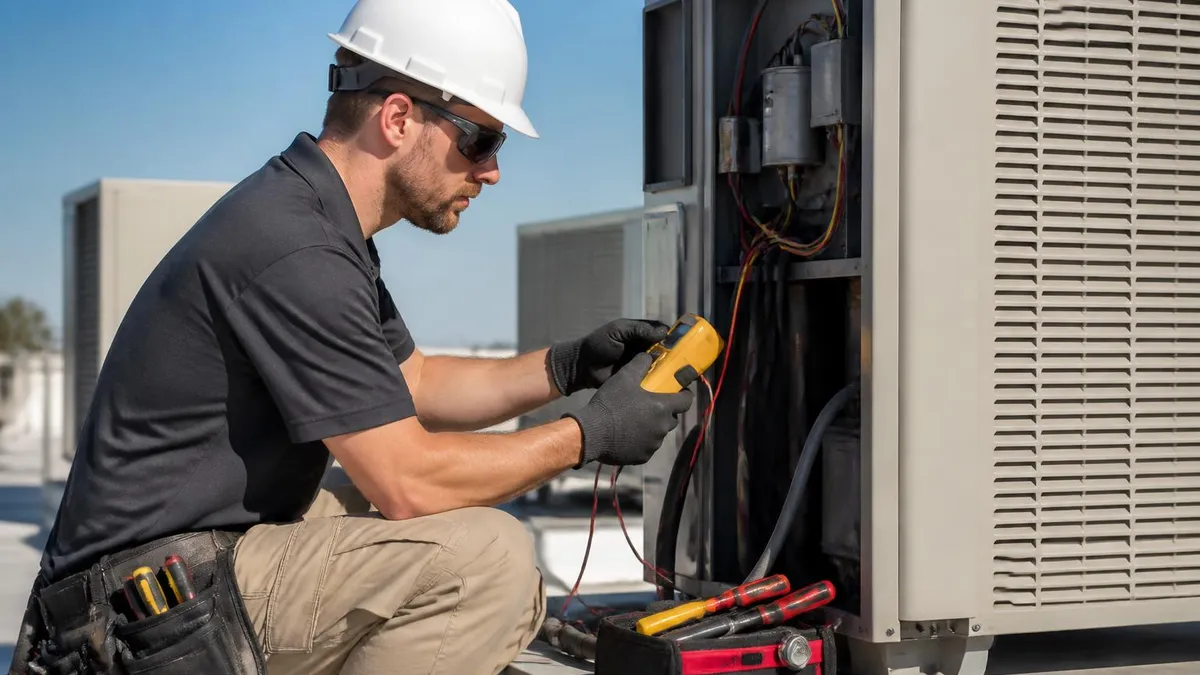
Electrical test equipment is the other half of HVAC diagnostics, because at least 60 percent of service calls turn out to be electrical rather than refrigerant-related. A failing capacitor, open contactor, dead transformer, or burnt motor winding will all present as a no-cool complaint, and only your meters can tell you which one is the real culprit. Building competence with electrical testing pays dividends every single day.
A true-RMS digital multimeter is the foundation. True-RMS matters because variable-speed motors and inverter compressors produce distorted waveforms that fool average-responding meters into giving low readings. Fluke, Klein, Ideal, and Fieldpiece all make solid options in the $150 to $400 range. Look for capacitance measurement up to at least 1,000 microfarads so you can test run and start capacitors without a separate tester.
The amp clamp is the second must-have. A 600-amp clamp meter with inrush current capture catches the locked-rotor amp draw of a failing compressor, which average meters miss because it lasts only a fraction of a second. Compare measured running amps to the nameplate FLA on the compressor or motor to spot bearing wear, overheating, or restricted airflow long before the unit fails completely on the next 95-degree afternoon.
Non-contact voltage testers are cheap insurance. A simple Fluke 1AC or similar pen-style tester verifies a disconnect is truly dead before you put fingers on a contactor or wire nut. Spend $25 on one and clip it to your shirt pocket every day. Static electricity, induced voltage, and miswired disconnects have killed enough technicians that you should never trust a breaker alone.
Insulation resistance testers, often called megohm meters, become essential when diagnosing compressors and ECM motors. A reading below 1 megohm to ground typically indicates winding insulation breakdown, and you can confirm a grounded compressor or motor in seconds rather than guessing. Brands like Megger, Fluke, and AEMC make field-rugged versions in the $200 to $600 range that pay for themselves on the first commercial diagnostic.
Combustion analyzers are mandatory for any technician touching gas equipment. A Testo 320, Bacharach Fyrite, or UEi Eagle measures stack temperature, oxygen, carbon monoxide, and calculates combustion efficiency. Tuning a furnace by analyzer rather than by eye saves customers 5 to 15 percent on gas bills and confirms the heat exchanger is not leaking flue gas into the supply air, which is a life-safety issue you cannot afford to miss.
Finally, do not skimp on test leads and accessories. Silicone leads stay flexible in cold weather, alligator clips free up your hands for measurements, and a fused current shunt protects your meter from $400 amp-draw mistakes. Your meter is the diagnostic tool you use most, so treat it well, keep the leads in a case, and replace probe tips when they wear.
Building a professional HVAC tool kit is a multi-year process, not a one-time purchase, and the smartest approach is to buy quality tools as you need them rather than dropping $5,000 at a supply house your first week on the job. Start with the bare essentials, prove yourself on calls, then upgrade as specific tools prove themselves indispensable or as the limits of your current gear become obvious during diagnostic work.
Take care of your tools and they last decades. Wipe down manifold gauges after every refrigerant call to keep oil residue from gumming up the valves. Coil hoses loosely rather than tight, since sharp bends crack the inner liner and create slow leaks that ruin evacuations. Store your vacuum pump indoors during winter, drain the oil between long storage periods, and run it briefly with fresh oil before stashing it on the shelf.
Calibration matters more than most techs realize. Have your combustion analyzer factory-calibrated annually because oxygen and CO sensors drift with age. Verify your micron gauge against a known-good reference once a year. Check your multimeter against a calibrated voltage reference if you do commercial work where accuracy is contractually required. Documentation of calibration also protects you if a job goes sideways and a customer or insurance company challenges your readings.
Insurance and theft prevention are real concerns once your tool bag exceeds $3,000 in value. Photograph every serial number, etch your driver license number into pump bodies and manifold frames, and store the worst-case high-value gear inside the building or shop overnight rather than in the truck. Many regions have organized HVAC tool theft rings that target service vans in hotel parking lots and apartment complexes.
Investing in HVAC inspection skills pays off hvac emergency repair mc lean tools are sharp. A technician who can read combustion numbers, micron readings, static pressure, superheat, and subcooling can charge premium rates and command real respect from customers and contractors alike. The tools enable the diagnosis, but the brain interpreting the numbers is what customers actually pay for. Sharpen both consistently.
Many techs underestimate how much organization affects productivity. A rolling tool cart for the shop, a structured tool bag for daily service, and labeled bins for refrigerant fittings, schrader cores, and brazing rods saves 15 to 30 minutes per day in hunting time. That recovered hour per week translates to roughly an extra service call, which more than pays for a $300 Veto Pro Pac or Klein bag over its lifetime.
Finally, never stop learning your tools. Read the manual on your digital manifold once a quarter, watch manufacturer training videos for your combustion analyzer, and practice using your insulation tester on dead equipment in the shop before you need it on a stressful no-heat call. The technicians who get promoted and earn the most are the ones who actually know every function of every meter on their truck, not just the two or three settings they use most often.
HVAC Questions and Answers
About the Author

NATE Certified HVAC Technician & Licensing Exam Trainer
Universal Technical InstituteMike Johnson is a NATE-certified HVAC technician and EPA 608 universal-certified refrigerant handler with a Bachelor of Science in HVAC/R Technology. He has 19 years of commercial and residential HVAC installation and service experience and specializes in preparing technicians for NATE certification, EPA 608, A2L refrigerant safety, and state HVAC contractor licensing examinations.