
HVAC Digital Gauges: The Complete 2026 October Guide to Digital Manifold Gauges for Refrigeration and Air Conditioning Service
HVAC digital gauges explained: 🎯 top models, accuracy specs, wireless features, calibration tips, and how to use them on AC and refrigeration jobs.
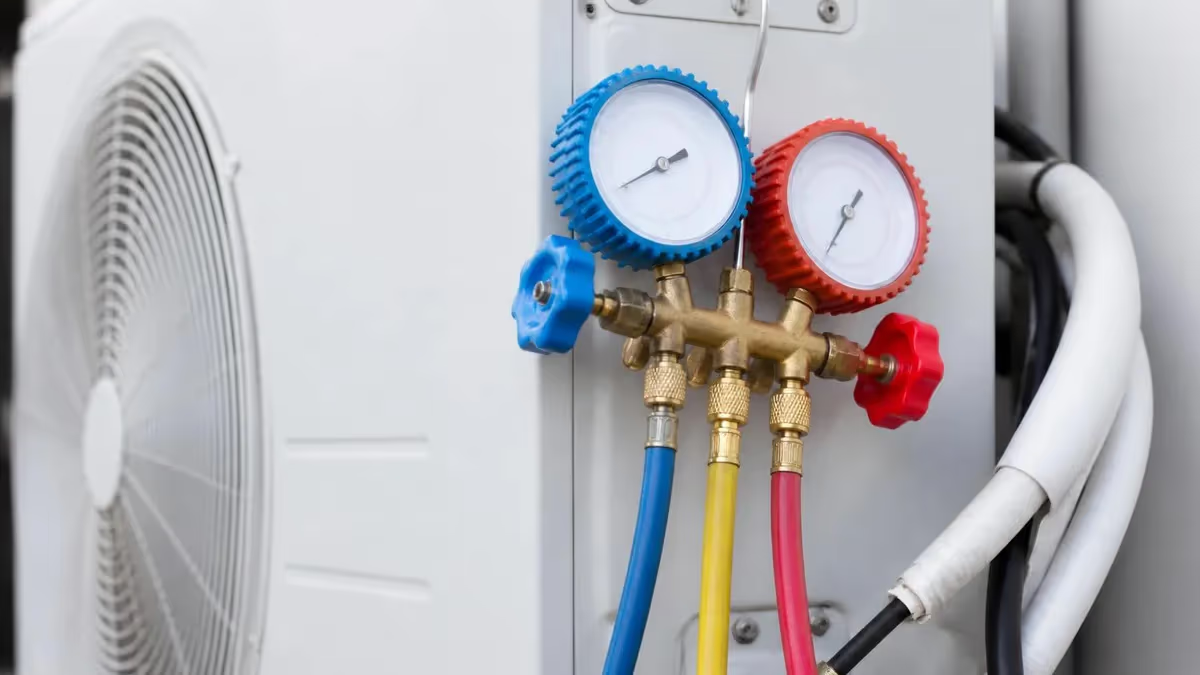
HVAC digital gauges have rapidly replaced traditional analog manifold sets as the preferred diagnostic tool for refrigeration and air conditioning technicians across the United States. Unlike mechanical Bourdon-tube gauges, digital manifolds use precision pressure transducers, integrated temperature clamps, and onboard microprocessors to calculate superheat, subcooling, target evaporator temperature, and even system efficiency in real time. For technicians servicing R-410A, R-32, R-454B, R-22 retrofits, and emerging A2L refrigerants, this level of accuracy isn't a luxury — it's quickly becoming a job requirement.
The shift toward digital manifolds accelerated dramatically between 2022 and 2026 as the EPA's AIM Act phasedown forced contractors to handle more refrigerant blends, each with different pressure-temperature curves. A typical analog gauge displays only saturation temperature scales for two or three refrigerants printed directly on its face. A modern digital gauge stores 80 to 130 refrigerant profiles in firmware, eliminating the need for paper P/T charts and reducing the most common rookie diagnostic error: pulling a chart for the wrong refrigerant.
This guide walks through everything a working technician, apprentice, or service manager needs to know about choosing, calibrating, and using digital manifold gauges in 2026. We cover the leading brands — Fieldpiece, Testo, Yellow Jacket Mantooth, CPS, Refco, and Inficon — along with wireless probe ecosystems, Bluetooth app integrations, and the new pressure ratings required for A2L-rated tools. You'll also find pricing benchmarks, calibration intervals, and the most common mistakes that lead to inaccurate superheat readings.
If you're a homeowner trying to understand what your technician is doing during a service call, or a contractor evaluating whether to spend $300 on a basic digital gauge versus $900 on a fully wireless system, this article gives you concrete numbers to base that decision on. We also link to broader resources covering professional hvac maintenance service protocols so you can see exactly where pressure readings fit into a complete maintenance visit.
Digital gauges aren't just for diagnosis. They've become central to compliance documentation, warranty claims, and proof-of-service reports that insurance companies increasingly require after refrigerant leak repairs. Many modern digital manifolds export PDF reports directly to a phone or tablet, time-stamped and signed, which protect technicians from callback disputes and help homeowners verify the work performed.
Finally, this guide reflects 2026 pricing, 2026 firmware capabilities, and the EPA Section 608 requirements that apply to anyone handling refrigerant in the field. Whether you're studying for your EPA certification, preparing for a state HVAC license exam, or simply upgrading your truck inventory, the information below will help you make smarter, faster, and more accurate decisions on every service call you run this year.
By the end, you'll understand how the sensor technology works, which features actually matter day-to-day, which features are marketing fluff, and how to integrate a digital manifold into a workflow that pays for the tool within the first thirty service calls.
Free HVAC Study Tools
Interactive HVAC resources on PracticeTestGeeks, free to start:
- HVAC practice test — 750+ questions with instant scoring and answer explanations
- HVAC flashcards — review key terms and concepts card by card
- HVAC study guide — topic-by-topic overview of what the exam covers
- HVAC cheat sheet — one-page printable summary for last-minute review
HVAC Digital Gauges by the Numbers

Types of HVAC Digital Manifold Gauges
Entry-level digital gauge with high-side and low-side ports, integrated display, and built-in pressure transducers. Best for residential service techs who want digital accuracy without app dependency. Typical price: $280–$420.
Adds a vacuum port and a charging port, allowing simultaneous evacuation monitoring and charging without disconnecting hoses. Standard configuration for full-time service work on residential and light commercial systems.
Individual Bluetooth pressure and temperature probes that pair with a phone app. Eliminates the manifold body entirely, reducing refrigerant loss during connection. Ideal for mini-split and VRF service.
Physical manifold with onboard display plus Bluetooth connectivity for app-based logging and reporting. Best of both worlds — works without a phone but unlocks advanced features when paired.
Built for ammonia, CO2 transcritical, and high-pressure refrigerants up to 1,600 psi. Heavier construction, stainless wetted parts, and certified for use on supermarket racks and industrial chillers.
Understanding how HVAC digital gauges actually work helps you recognize their limits and use them more effectively. At the heart of every digital manifold is a piezoresistive pressure transducer — a small silicon chip that changes electrical resistance proportionally to the pressure applied to its diaphragm. A microprocessor reads this resistance hundreds of times per second, applies a calibration curve stored in nonvolatile memory, and displays the corrected pressure on the screen.
The temperature side uses Type-K thermocouples or NTC thermistors clipped onto the suction line and liquid line. The processor then takes the pressure reading, looks up the saturation temperature for the selected refrigerant from a built-in P/T table, and subtracts the line temperature reading to calculate superheat or subcooling automatically. What used to take three minutes of chart-reading and math now updates in real time as the system stabilizes.
Accuracy depends on three factors: transducer quality, calibration drift over time, and the resolution of the analog-to-digital converter. Premium gauges from Testo and Fieldpiece typically advertise 0.5% of full-scale accuracy, meaning a gauge rated to 800 psi could be off by ±4 psi anywhere in its range. Budget gauges often quote 1.0% to 1.5%, which translates to ±8 to ±12 psi — enough to misdiagnose a marginal subcooling reading on a TXV system.
Modern digital manifolds also include features that pure mechanical gauges never could. Real-time target superheat calculations using outdoor dry bulb and indoor wet bulb, system efficiency calculations comparing measured capacity to nameplate capacity, leak-rate testing during pressure decay holds, and automatic detection of non-condensable gases through subcooling anomalies are all standard on mid-range and up. These tools fit into broader HVAC solutions workflows that emphasize data-driven diagnostics rather than guess-and-replace troubleshooting.
One often-overlooked advantage of digital gauges is hose management. Because the transducer reads pressure inside the manifold body, hoses can be shorter and the entire system can use low-loss anti-blowback fittings without affecting accuracy. Analog gauges require longer hoses to accommodate their physical needles, and every connection point introduces potential refrigerant loss. A typical residential service call using digital gauges releases roughly 30% less refrigerant during hookup and removal than the same call with analog gauges.
The microprocessor also enables data logging. Most digital manifolds record pressures, temperatures, and calculated values at 1-second to 60-second intervals throughout a service call, then export the log as a CSV file or PDF report. This becomes critical evidence in warranty disputes, EPA leak repair documentation, and energy efficiency rebate verification — all of which increasingly require time-stamped pressure data to be processed.
Finally, firmware updates extend the life of a digital manifold far beyond a mechanical gauge. When EPA approves a new refrigerant blend or a manufacturer ships a new equipment line with different operating pressures, manufacturers push firmware updates over USB or Bluetooth that add the new refrigerant profile. A digital manifold purchased in 2023 today supports R-454B, R-32, and dozens of A2L blends that didn't exist when it was sold — capability that no analog gauge can ever match.
HVAC Practice Test Questions
Prepare for the HVAC - Heating Ventilation and Air Conditioning exam with our free practice test modules. Each quiz covers key topics to help you pass on your first try.
HVAC Air Conditioning
HVAC Exam Questions covering Air Conditioning. Master HVAC Test concepts for certification prep.
HVAC Code Compliance
Free HVAC Practice Test featuring Code Compliance. Improve your HVAC Exam score with mock test prep.
HVAC Electrical Controls
HVAC Test Prep for Electrical Controls. Practice HVAC Quiz questions and boost your score.
HVAC Energy Efficiency
HVAC Questions and Answers on Energy Efficiency. Free HVAC practice for exam readiness.
HVAC Heating Systems
HVAC Mock Test covering Heating Systems. Online HVAC Test practice with instant feedback.
HVAC Load Calculations
Free HVAC Quiz on HVAC Load Calculations. HVAC Exam prep questions with detailed explanations.
HVAC Tools and Equipment
HVAC Practice Questions for HVAC Tools and Equipment. Build confidence for your HVAC certification exam.
HVAC Refrigeration
HVAC Test Online for Refrigeration. Free practice with instant results and feedback.
HVAC Safety Practices
HVAC Study Material on Safety Practices. Prepare effectively with real exam-style questions.
HVAC System Design
Free HVAC Test covering System Design. Practice and track your HVAC exam readiness.
HVAC Thermodynamics
HVAC Exam Questions covering Thermodynamics. Master HVAC Test concepts for certification prep.
Top HVAC Digital Gauges Brands Compared
Fieldpiece dominates the U.S. residential service market with the SMAN series and the newer Job Link wireless probe ecosystem. The SMAN460 is the workhorse 4-port digital manifold, offering 0.5% accuracy, 90+ refrigerant profiles, and a strong rubber boot rated for daily truck abuse. Most apprentices learn on a Fieldpiece because parts and service centers are widely available in every state.
The Job Link system breaks the manifold into individual wireless pressure and temperature probes paired through the Fieldpiece app. This approach eliminates manifold cross-contamination between refrigerants and lets one technician monitor multiple systems simultaneously. Job Link probes cost roughly $130 each, and a complete two-pressure two-temperature kit runs about $620 — competitive with traditional 4-port digital manifolds.
Digital Manifold Gauges vs. Analog: Honest Comparison
- +Automatic superheat and subcooling calculation eliminates math errors
- +80–130 refrigerant profiles stored in firmware — no paper P/T charts needed
- +0.5% accuracy is roughly 4× better than typical analog gauges
- +Data logging creates time-stamped service records for warranty claims
- +Firmware updates add new refrigerants like R-454B without buying new tools
- +Wireless probes reduce refrigerant loss during hookup and disconnection
- +Bluetooth reporting impresses customers and reduces callback disputes
- −Initial cost is 3–5× higher than a quality analog manifold set
- −Batteries die at inconvenient moments — always carry spares or charger
- −Drops onto concrete can damage transducers permanently, not just bend a needle
- −Firmware bugs occasionally require updates mid-service call
- −Learning curve for app pairing and feature menus adds 1–2 weeks for new techs
- −Resale value drops faster than analog gauges as new models release annually
Pros and Cons at a Glance
| Pros | Cons |
|---|---|
| Automatic superheat and subcooling calculation eliminates math errors | Batteries die at inconvenient moments — always carry spares or charger |
| Data logging creates time-stamped service records for warranty claims | Drops onto concrete can damage transducers permanently, not just bend a needle |
| Wireless probes reduce refrigerant loss during hookup and disconnection | Firmware bugs occasionally require updates mid-service call |
| Bluetooth reporting impresses customers and reduces callback disputes | Resale value drops faster than analog gauges as new models release annually |
HVAC Digital Gauges Field Use Checklist
- ✓Verify the correct refrigerant is selected in the menu before connecting hoses
- ✓Inspect hose o-rings and Schrader cores for damage before pressurization
- ✓Zero the gauge to atmospheric pressure at the job site elevation
- ✓Clip suction-line thermistor 6 inches from the compressor on insulated copper
- ✓Allow the system to run at least 15 minutes for stable superheat readings
- ✓Compare measured superheat to target superheat from outdoor and indoor temps
- ✓Log the full service call data set before disconnecting from the system
- ✓Use low-loss fittings to minimize refrigerant release during disconnection
- ✓Recover any refrigerant trapped in hoses before storing the manifold
- ✓Recharge batteries or replace AAs before the next morning's first call
The 30-Call ROI Rule
A $600 digital manifold typically pays for itself within 30 service calls through reduced diagnostic time, fewer parts replaced unnecessarily, and the ability to charge for accurate efficiency reports. The average tech saves 12–18 minutes per call versus analog — at $135/hour shop rate, that's roughly $30 of recovered productivity per visit.
Calibration and ongoing maintenance separate a digital manifold that lasts ten years from one that fails after eighteen months. Unlike analog gauges that you can visually verify against ambient pressure, digital transducers drift slowly and silently. A gauge reading 2 psi high at zero will read approximately 2 psi high across its entire range, leading to systematic subcooling errors that affect every charge on every call until the drift is caught and corrected.
Manufacturer recommendations vary, but most professional shops calibrate digital manifolds annually. The simplest check requires nothing more than opening both valves to atmosphere and confirming the display reads 0.0 psig within the gauge's accuracy spec. If a gauge rated 0.5% of 800 psi full scale shows more than ±4 psi at zero, it needs a firmware-driven zero-offset reset or a return to the manufacturer for full recalibration.
For NIST-traceable accuracy required in pharmaceutical, semiconductor, and federal contract work, send the manifold to a calibration lab every twelve months. A traceable certificate costs $85–$150 per gauge and documents accuracy at five or more pressure points across the range. Without this paperwork, technicians servicing critical-environment HVAC systems cannot legally certify their pressure readings, regardless of how new or expensive the gauge is.
Battery management deserves more attention than most techs give it. Lithium-ion packs in wireless probes lose capacity in cold weather, sometimes failing entirely below 20°F. Service vans in northern states should keep probes inside the heated cab between calls during winter. Replaceable AA gauges (common on Fieldpiece SMAN models) benefit from quality lithium AAs rather than alkaline cells, which leak when stored at high temperatures inside a hot truck.
Hose maintenance affects gauge readings indirectly but significantly. A hose with a damaged o-ring or worn Schrader core will leak slowly during a service call, producing pressure readings that appear stable but drift downward. Replace all hose o-rings annually and keep a packet of spare Schrader cores in the gauge case. Premium 60-inch hoses with anti-blowback fittings cost about $120 per set but reduce refrigerant loss by 40–60% per call.
Firmware updates should be part of monthly tool maintenance. Set a recurring calendar reminder on the first day of each month to check Fieldpiece, Testo, or Yellow Jacket apps for firmware releases. Manufacturers push critical accuracy fixes and new refrigerant profiles through these updates, and a gauge running 18-month-old firmware may not recognize an R-454B system installed last week. Updates typically take three to five minutes per device over Bluetooth.
Finally, store the manifold in a hard case with custom foam cutouts. Tossing a $600 digital manifold loose into a service bin alongside wrenches and crescent pliers cracks LCDs, breaks rotary valves, and shocks transducers into permanent calibration drift. The hard case pays for itself the first time it prevents a single drop, and most shops require it before issuing a digital manifold to a new technician.
If you service R-454B, R-32, or other A2L refrigerants, your digital manifold must be rated for 800 psi minimum working pressure and certified for use with mildly flammable refrigerants. Using a legacy R-22-era manifold on an A2L system violates EPA and ASHRAE 15 safety requirements and can void warranties on new equipment. Verify your gauge's UL or ETL listing before connecting.
Pricing for HVAC digital gauges spans a wider range than most tools in a technician's bag, and the right choice depends entirely on what kind of work you do. Entry-level 2-port digital manifolds start around $280 — usually unbranded or budget brands like Elitech and Vivisun. These work for occasional residential service or for HVAC students learning the fundamentals, but lack the firmware hvac regulations variety, and durability needed for full-time professional use.
Mid-range 4-port digital manifolds from established brands cost $450–$650. This is the sweet spot for residential service contractors. The Fieldpiece SMAN460, Testo 557s, and Yellow Jacket P51-870 all fall in this range and include the features most techs actually use: Bluetooth app reporting, 80+ refrigerants, low-loss fittings, and rubber drop protection. Pricing has actually decreased slightly since 2023 as more manufacturers entered the market.
Wireless probe ecosystems represent the premium tier at $750–$950 for complete kits. Fieldpiece Job Link, Testo Smart Probes, and Yellow Jacket Mantooth all offer modular probe-based systems where each pressure or temperature sensor is independent. The premium buys flexibility — one tech can monitor multiple systems simultaneously, and there's no manifold body to limit hose routing on cramped condensers or mini-splits.
For shops serving commercial, industrial, or critical-environment clients, expect to spend $1,200–$2,500 on a complete commercial-grade kit with NIST-traceable calibration certificates, micron vacuum integration, and high-pressure ratings for ammonia or CO2 systems. These investments make sense when a single contract — a supermarket chain, hospital, or data center — generates $40,000+ in annual service revenue and demands traceable documentation. Pair these tools with verified hvac contractors credentials when bidding institutional work.
Return on investment is easier to calculate than most tool purchases. A digital manifold that saves 12 minutes per service call across 250 calls per year recovers roughly 50 hours of billable time annually. At a $135/hour shop rate, that's $6,750 in recovered productivity — more than ten times the cost of a premium digital manifold in a single year. Even halving that estimate to account for some overlapping efficiency gains, the payback period is under two months for any full-time service technician.
Financing options are worth considering for new technicians or apprentices building their first toolkit. Many HVAC distributors offer 6-month no-interest financing on tool purchases over $500, and several brands run rebate promotions during the spring AC pre-season and fall heating pre-season. Watch ACCA, RSES, and major distributor newsletters in February and September for the best discount windows of the year.
Finally, factor in resale value when evaluating brands. Fieldpiece and Testo manifolds hold approximately 50–60% of their original value on the used market after three years, while budget brands often sell for 15–25% of original retail. If you upgrade frequently or plan to expand your tool inventory over time, the established brands effectively cost less than their sticker price after factoring in eventual resale to apprentices or independent techs.
Beyond the hardware itself, getting the most out of HVAC digital gauges comes down to workflow discipline. The most accurate manifold in the world produces garbage readings if the technician doesn't let the system stabilize, clips the thermistor in the wrong spot, or selects the wrong refrigerant in the menu. Building consistent habits during your first month with a new digital gauge pays dividends for the entire decade you'll own it.
Start every service call by confirming the refrigerant type on the equipment nameplate before powering on the gauge. Mismatched refrigerant selection is the single most common cause of bad readings on digital manifolds. Modern systems may use R-410A, R-32, R-454B, or even retrofit blends, and the saturation pressures differ enough that a wrong selection can swing calculated superheat by 8–15 degrees. Take the extra ten seconds to verify.
Use the data logging feature on every call, not just complicated diagnostic visits. Even a routine maintenance check benefits from a logged report — it documents baseline performance, creates a paper trail for warranty disputes, and trains your eye to recognize abnormal patterns over time. Most digital manifold apps store data for at least 90 days, giving you a reference point for the next visit to the same customer.
Train apprentices on digital gauges with the system running, not just on a workbench demonstration. Real-world variables — ambient conditions changing, equipment cycling, suction line frost forming and melting — affect how readings should be interpreted. Workbench training teaches button presses; field training teaches diagnosis. The two skills are not interchangeable, and shops that skip the field component produce techs who can read a screen but can't actually fix a problem.
Integrate the digital manifold with other diagnostic tools rather than treating it as a standalone device. A modern service call uses the manifold alongside a clamp meter, anemometer, combustion analyzer, and infrared camera. Workflow apps from Fieldpiece, Measurequick, and Bluon now combine readings from multiple tools into a single diagnostic report, dramatically reducing the time required to identify the root cause of poor performance.
Document and share unusual readings with the broader technician community. HVAC-Talk forums, the Refrigeration School subreddit, and several Facebook groups for working techs share screenshots of digital manifold data weekly, and the collective knowledge speeds diagnosis for everyone. A weird superheat pattern that takes you two hours to figure out today may take ten minutes next time because someone else posted the same screenshot last year. For sourcing replacement parts during these diagnostics, refer to our HVAC parts and supply guide for vetted distributors and component identification tips.
Finally, keep notes on your own most common diagnostic patterns. hvac terms develops mental shortcuts — a particular suction pressure pattern that always means a restriction, or a subcooling reading that always means overcharge on a specific brand of condenser. Writing these down in a job journal or in the notes field of your service app turns individual experience into transferable expertise, and accelerates the development of every apprentice or new hire who works alongside you.
Sample HVAC Practice Questions
Try these questions from our free HVAC practice tests. The correct answer and an explanation follow each question.
What is the most important professional competency for HVAC certification in air conditioning?
- A. Speed of task completion
- B. Deep knowledge combined with practical application skills
- C. Ability to work alone exclusively
- D. Memorization of all reference materials
Answer: B. Deep knowledge combined with practical application skills
Professional competency requires both deep knowledge of the subject matter and the ability to apply that knowledge in practical situations.
In HVAC practice, what is the best approach to quality improvement in air conditioning?
- A. Make changes without measuring results
- B. Use data-driven methods with measurable outcomes
- C. Wait for problems to occur before acting
- D. Copy what other organizations do without analysis
Answer: B. Use data-driven methods with measurable outcomes
Data-driven quality improvement with measurable outcomes ensures that changes actually produce the intended improvements and can be verified.
Which professional attribute is most valued in air conditioning within the HVAC field?
- A. Working in isolation
- B. Accountability and commitment to standards
- C. Avoiding challenging situations
- D. Prioritizing personal convenience
Answer: B. Accountability and commitment to standards
Accountability and commitment to professional standards build trust and ensure consistent, high-quality practice.
What does a digital manifold gauge set provide that an analog set does not?
- A. Higher pressure range
- B. Superheat and subcooling calculations
- C. Compatibility with all refrigerants
- D. Ability to recover refrigerant
Answer: B. Superheat and subcooling calculations
Digital manifold sets calculate superheat and subcooling automatically when connected to temperature clamps, eliminating manual chart lookups.
HVAC Questions and Answers
HVAC Repair Portland: The Complete 2026 Homeowner's Guide to Furnace, AC, and Heat Pump Service in the Rose City
HVAC Tune Up Service: The Complete Guide to Professional HVAC Maintenance and Why It Pays for Itself
HVAC Solutions: The Complete Guide to Heating, Cooling, and Indoor Air Quality Systems for Homes and Buildings
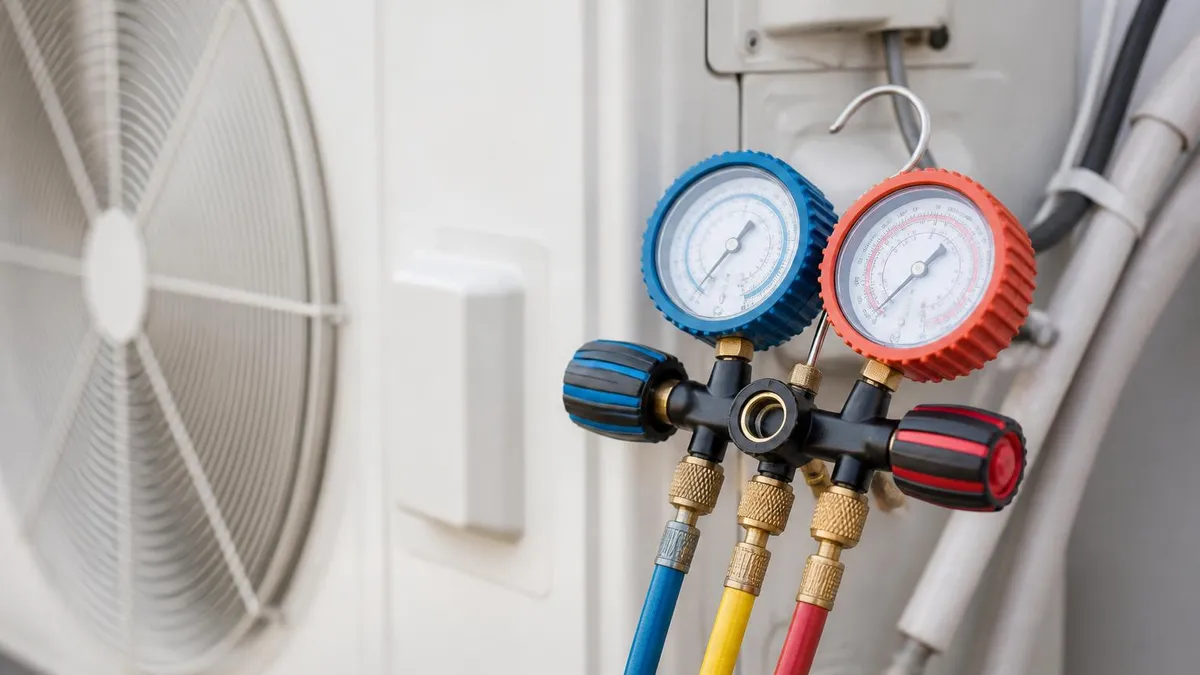
Certified HVAC Contractors: How to Find, Vet, and Hire the Right Professional for Your Home or Business
HVAC Parts and Supply: The Complete Guide to Sourcing, Identifying, and Buying Heating and Cooling Components in 2026
About the Author

NATE Certified HVAC Technician & Licensing Exam Trainer
Universal Technical InstituteMike Johnson is a NATE-certified HVAC technician and EPA 608 universal-certified refrigerant handler with a Bachelor of Science in HVAC/R Technology. He has 19 years of commercial and residential HVAC installation and service experience and specializes in preparing technicians for NATE certification, EPA 608, A2L refrigerant safety, and state HVAC contractor licensing examinations.