
Tax Credit for Installing New HVAC: 2026 October-2026 October Rules
Tax credit for installing new HVAC: claim up to $2,000 on heat pumps and 30% on geothermal. Eligibility, Form 5695, and 2026 October PIN rules explained. 🏆
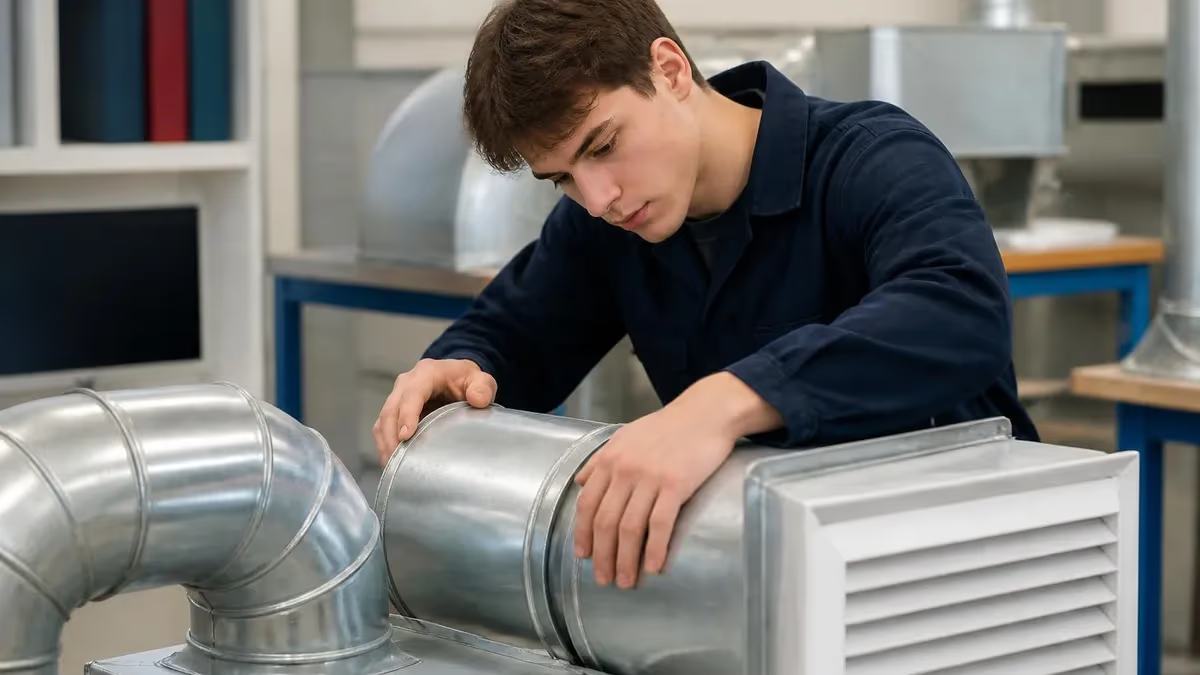
Thinking about a new heat pump or central air system? You're in luck. The federal government still hands out real money to homeowners who upgrade to qualifying HVAC equipment, and the credits run through 2032. The tax credit for installing new HVAC falls under the Energy Efficient Home Improvement Credit (Section 25C) and the Residential Clean Energy Credit (Section 25D) - two separate programs, two different rules, and a lot of confusion about which one applies to your install.
Here's the short version. If you bought a qualifying heat pump, central AC, furnace, or boiler in 2024 or 2025 and put it in your primary residence, you can claim back a chunk of the cost on Form 5695. The math isn't complicated. The eligibility rules trip people up. SEER2, HSPF2, AFUE - the alphabet soup matters, because picking the wrong tier means zero dollars back.
This guide walks through who qualifies, how much you'll get, what paperwork to keep, and the deadlines you absolutely can't miss. Whether you're a homeowner doing the install yourself or a tech advising a client, you'll leave with a clear plan. And if you're prepping for licensing or technician exams, you'll want to brush up on the standards behind these credits - start with our hvac training resources for the deeper technical side.
What Is the HVAC Tax Credit?
The federal HVAC tax credit isn't one thing - it's two. The Inflation Reduction Act of 2022 reshuffled the deck, and most homeowners installing a new heating or cooling system today claim under one of these programs:
- Energy Efficient Home Improvement Credit (25C) - covers heat pumps, central AC, furnaces, boilers, biomass stoves, and electric panel upgrades. Annual cap, not lifetime.
- Residential Clean Energy Credit (25D) - covers solar, geothermal heat pumps, solar water heaters, and battery storage. Bigger credit, no annual cap, runs at 30% through 2032.
Both programs run concurrently. You can claim both in the same tax year if you installed eligible equipment in both buckets. The geothermal heat pump is the one item that straddles the two - it falls under 25D (30% with no cap), not 25C, because the IRS classifies it as renewable energy.
Tax Credit for Installing New HVAC: How Much Can You Get?
Numbers first, rules after. For 2024 and 2025 installs under Section 25C, the caps look like this:
- Heat pumps and heat pump water heaters: 30% of cost, up to $2,000 per year
- Central AC, furnaces, boilers: 30% of cost, up to $600 per year (combined across these categories)
- Electric panel upgrade tied to the install: 30%, up to $600
- Home energy audit: 30%, up to $150
Total 25C cap per year is $3,200. That breaks into $1,200 for the general bucket (AC, furnace, panel, audit, insulation) and $2,000 specifically for heat pumps and biomass stoves. The cap resets every January 1 - meaning a heat pump in 2024 and a new furnace in 2025 each get their own credit, fully separate.
Under Section 25D, geothermal heat pumps grab a flat 30% of the total installed cost - equipment plus labor plus piping plus everything - with no annual ceiling. A $40,000 geothermal job? That's $12,000 back. The 30% rate holds through 2032, drops to 26% in 2033, and 22% in 2034.
Sample HVAC Practice Questions
Try these questions from our free HVAC practice tests. The correct answer and an explanation follow each question.
When installing a rooftop HVAC unit in a seismic design category D zone, which additional requirement applies per the International Mechanical Code?
- A. Painted bright orange
- B. Seismic bracing and anchorage
- C. Double insulation wrap
- D. Dual disconnect switches
Answer: B. Seismic bracing and anchorage
The IMC requires that mechanical equipment in high seismic zones be anchored and braced to resist seismic forces as specified in the International Building Code.
Which regulation requires HVAC electrical work to follow specific wiring methods, box fill calculations, and grounding rules?
- A. ASHRAE 90.1
- B. NFPA 70 (National Electrical Code)
- C. EPA Section 608
- D. UL 1995
Answer: B. NFPA 70 (National Electrical Code)
NFPA 70 (NEC) governs all electrical installations including HVAC equipment wiring, disconnect sizing, conductor ampacity, and grounding requirements.
When installing a new HVAC system that requires brazing in a space with existing insulation, what precaution must be taken to prevent fire?
- A. Work quickly so the insulation does not have time to ignite
- B. Use a heat shield or wet cloth to protect surrounding materials and have a fire watch
- C. Spray the insulation with water immediately after brazing
- D. Remove insulation only within 1 inch of the work area
Answer: B. Use a heat shield or wet cloth to protect surrounding materials and have a fire watch
A heat shield or wet cloth protects flammable surrounding materials, and a fire watch ensures any smoldering materials are caught after the torch is extinguished.
Which professional attribute is most valued in troubleshooting within the HVAC field?
- A. Working in isolation
- B. Accountability and commitment to standards
- C. Avoiding challenging situations
- D. Prioritizing personal convenience
Answer: B. Accountability and commitment to standards
Accountability and commitment to professional standards build trust and ensure consistent, high-quality practice.
Which HVAC Equipment Qualifies?
Not every box from the supply house counts. The IRS requires the equipment to meet the Consortium for Energy Efficiency (CEE) highest efficiency tier - not just any ENERGY STAR label. Here's the breakdown by climate zone and equipment type.
Air-Source Heat Pumps
South: SEER2 at or above 15.2, EER2 at or above 11.7, HSPF2 at or above 7.8. North: SEER2 at or above 15.2, EER2 at or above 9.0, HSPF2 at or above 8.1 (ducted) or higher for ductless splits. Packaged units have their own threshold. Confused? You should be. The standards changed in 2023 when SEER2 replaced SEER, so older spec sheets are worthless. Ask your installer for the AHRI certificate matching your exact indoor and outdoor coil combo.
Central Air Conditioners
Split systems must hit SEER2 of 16.0 with EER2 of 12.0. Packaged units need SEER2 of 15.2. Yes, that's higher than the federal minimum efficiency standard - the credit is meant to push you above baseline. A SEER2 14.3 unit (the floor for new installs in the South) won't qualify even though it's perfectly legal to sell.
Gas Furnaces
AFUE of 97% or above. That's tight. Most contractor-grade furnaces sit at 90-95% AFUE, so the credit pushes you toward premium condensing units. Oil furnaces qualify at AFUE of 90% or above if rated to use certain biodiesel blends.
Boilers
Gas boilers need AFUE of 95% or higher. Oil boilers need AFUE of 90% with the biofuel requirement.
Need help picking the right unit? Look up the CEE Tier and ENERGY STAR Most Efficient lists before you commit. Don't trust the installer's word - verify on the manufacturer's site or via the AHRI directory. If you're researching the technical side of installs, check our hvac duct guide for ductwork specs that affect efficiency ratings too.
Step-by-Step: How to Claim the Tax Credit
The IRS won't chase you down to give you money. You have to file for it. Here's the workflow that actually works.
1. Buy and install qualifying equipment
Before signing the contract, get the model numbers in writing. Run them through the AHRI directory at ahridirectory.org. Confirm the SEER2, HSPF2, EER2, or AFUE meets the CEE Highest Tier - that's the IRS standard. The ENERGY STAR "Most Efficient" label works as a fast proxy, but the AHRI certificate is the legal proof.
2. Save every piece of paper
You'll need an itemized invoice (equipment cost broken out from labor), the manufacturer's certification statement, the AHRI certificate for your specific coil match, and starting in 2025 - the PIN. Some installers automatically provide these. Most don't. Ask before they leave the driveway.
3. File Form 5695 with your tax return
Part I covers Section 25D (geothermal, solar). Part II covers Section 25C (heat pumps, AC, furnaces). The form does the math - you fill in the cost, it spits out the credit. Carry the credit to Schedule 3, then to your 1040. TurboTax, H&R Block, FreeTaxUSA - they all support it.
4. Hold records for at least 3 years
IRS audits go back three years routinely, sometimes seven if they smell something off. Scan the paperwork to PDF, back it up, and don't lose the original certificates. If audited, you'll need to produce the AHRI certificate and the manufacturer's statement.
Common Mistakes That Cost People Money
I've seen homeowners blow their credit in dumb ways. Watch for these.
Buying a unit that's just below the threshold. SEER2 15.0 doesn't qualify when the minimum is 15.2. Two-tenths of a point - no credit. Always verify the spec sheet before buying.
Trusting the contractor's word. "Yeah, this one qualifies" isn't proof. Get the AHRI certificate. Some installers want to push older, cheaper inventory that doesn't make the cut.
Mismatched coil and condenser. A high-SEER2 outdoor unit paired with the wrong indoor coil tanks the actual system rating. The AHRI certificate covers a specific combo - if your tech swaps the coil at install, your paperwork is invalid.
Forgetting the PIN for 2025+ installs. Manufacturers issue a Product Identification Number tied to the QPL (Qualified Products List). No PIN on Form 5695 starting tax year 2025? IRS kicks the credit back.
Claiming labor on 25C. Pure rookie mistake. Labor counts for solar and geothermal only. Trying to claim furnace install labor will trigger an audit flag.
What's Changing in 2025 and Beyond?
The biggest 2025 change is the PIN requirement. Every piece of qualifying equipment installed January 1, 2025 or later needs a four-digit manufacturer-issued PIN reported on Form 5695. This is the IRS's anti-fraud measure - too many people were claiming credits on non-qualifying gear.
The dollar caps stay the same through 2032: $2,000 for heat pumps, $600 for AC and furnaces, $3,200 annual ceiling under 25C. The 30% rate under 25D holds through 2032, then steps down. Congress could still tweak this - the IRA is law, but caps and percentages get litigated every budget cycle. Don't bank on the program lasting forever; if you're planning an install, doing it sooner protects you from rule changes.
State-level incentives stack on top. New York's NYSERDA rebates for cold-climate heat pumps. California's TECH initiative. Massachusetts Mass Save. Check your local utility too - many offer $500-$2,000 rebates that combine with the federal credit (though they reduce your basis).
For the technical depth behind why these efficiency tiers matter - refrigerant flow, compressor staging, ductwork sizing - explore our broader hvac certification resources. The credits exist because efficient installs save grid load and lower carbon emissions, and understanding the engineering behind the ratings makes you a better buyer or installer.
Bottom Line
The tax credit for installing new HVAC is real, generous, and still active through 2032. Heat pumps get the biggest annual chunk under 25C - $2,000 - while geothermal grabs 30% with no cap under 25D. Eligibility lives or dies on the CEE efficiency tier and the AHRI certificate, not on what the installer tells you. Keep your paperwork, file Form 5695, and don't forget the PIN starting in 2025.
One smart upgrade can cut your tax bill by thousands and slash your utility costs for the next 15 years. That's a rare double win - and it's sitting on the table waiting for you to claim it. If you're studying for technician work or planning a career around installing this equipment, our HVAC school resources walk through training, licensing, and the certifications that put you on the job site.
About the Author

NATE Certified HVAC Technician & Licensing Exam Trainer
Universal Technical InstituteMike Johnson is a NATE-certified HVAC technician and EPA 608 universal-certified refrigerant handler with a Bachelor of Science in HVAC/R Technology. He has 19 years of commercial and residential HVAC installation and service experience and specializes in preparing technicians for NATE certification, EPA 608, A2L refrigerant safety, and state HVAC contractor licensing examinations.