
HVAC Refrigerant News: What Technicians, Contractors, and Homeowners Need to Know in 2026
Stay current on HVAC refrigerant news: 📚 R-22 and R-410A phaseouts, R-32 and R-454B alternatives, EPA rules, and what technicians must know in 2026.
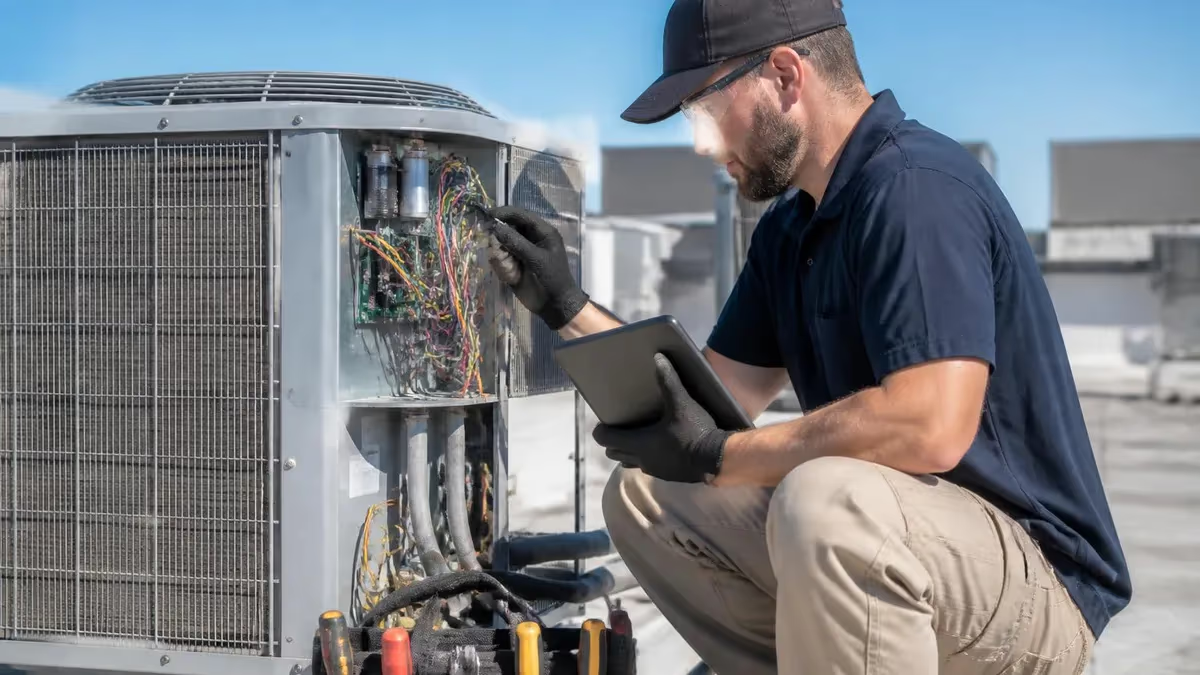
Staying current on hvac refrigerant news has never been more critical for technicians, contractors, and building owners across the United States. The refrigerant landscape is undergoing its most sweeping transformation in a generation, driven by the American Innovation and Manufacturing (AIM) Act, evolving EPA regulations, and a global push to reduce the climate impact of high global-warming-potential (GWP) chemicals. Whether you work on residential split systems, large commercial chillers, or supermarket refrigeration racks, the refrigerants you stock, certify for, and install are changing — and the timeline is compressed. Practice with the free HVAC practice test on PracticeTestGeeks (750+ questions with answer explanations).
The phasedown of R-410A, one of the most widely used refrigerants in North American residential air conditioning, officially began in 2025. Equipment manufacturers stopped producing R-410A-based systems at the start of 2025, meaning new residential and light-commercial unitary equipment must now use lower-GWP alternatives such as R-454B, R-32, or R-466A. For technicians in the field, this creates an immediate practical challenge: existing R-410A systems will remain in service for years, requiring ongoing maintenance, while new systems demand familiarity with entirely different refrigerants, pressures, flammability classes, and handling procedures.
Understanding the regulatory timeline is not just a compliance issue — it directly affects your business model. Contractors who anticipated the shift stocked transition refrigerants early, trained their crews on A2L handling requirements, and updated their equipment manifolds and recovery machines. Those who waited are now scrambling to source refrigerants, update their EPA Section 608 certifications, and educate customers on why their next replacement system will look and cost differently than the one being removed. The refrigerant transition is, at its core, a business readiness challenge as much as a technical one.
From a homeowner perspective, the refrigerant transition raises legitimate questions about repair costs, system longevity, and whether it makes sense to repair an aging R-410A system or replace it with a new A2L unit. Contractors are fielding these questions daily, and the answers are nuanced. A five-year-old R-410A system with a minor refrigerant leak may be worth repairing, while a ten-year-old system with a failing compressor in a market where R-410A prices are rising sharply probably tips toward replacement. Knowing how to guide customers through that analysis builds trust and differentiates your service offering.
The broader refrigerant news cycle also includes developments in commercial refrigeration, where natural refrigerants like CO2 (R-744), ammonia (R-717), and propane (R-290) are gaining traction in supermarkets, cold storage warehouses, and convenience stores. These systems are more energy-efficient over their lifespan but require specialized training and safety protocols that go beyond typical HVAC certification. Technicians who invest in natural refrigerant training now are positioning themselves for a premium segment of the market that will grow substantially through the end of the decade.
Policy developments at the federal and state level add another layer of complexity. California's Air Resources Board (CARB) has historically set standards that precede federal rules, and several other states follow California's lead under EPA waiver provisions. Technicians operating in California, Colorado, Washington, and other early-adopter states may face restrictions on certain refrigerants that are still permissible elsewhere. Tracking both federal EPA guidance and state-level regulations is essential for any HVAC professional who wants to stay compliant and avoid costly violations.
This article synthesizes the most important developments in HVAC refrigerant news for 2026, covering the R-410A phasedown timeline, the leading A2L replacements, safe handling requirements, commercial refrigerant trends, certification updates, cost implications for contractors and homeowners, and what to expect in the years ahead. Whether you are preparing for an EPA 608 exam, updating your company's refrigerant management policy, or simply trying to understand what your next service truck should carry, the information below gives you a comprehensive, up-to-date foundation.
Free HVAC Study Tools
Interactive HVAC resources on PracticeTestGeeks, free to start:
- HVAC practice test — 750+ questions with instant scoring and answer explanations
- HVAC flashcards — review key terms and concepts card by card
- HVAC study guide — topic-by-topic overview of what the exam covers
- HVAC cheat sheet — one-page printable summary for last-minute review
HVAC Refrigerant Transition by the Numbers
R-410A Phasedown: Key Regulatory Milestones
AIM Act Signed (2020)
EPA Final Rule Published (2023)
R-410A Equipment Production Ends (Jan 2025)
A2L Systems Dominate New Installations (2025–2026)
HFC Allowance Caps Tighten (2028–2029)
85% HFC Reduction Target (2036)
The transition away from R-410A has produced a crowded field of replacement refrigerants, each with distinct characteristics that technicians must understand before touching a new system. R-454B, sold commercially as Opteon XL41 by Chemours and as Solstice 454B by Honeywell, has emerged as the dominant replacement for residential and light-commercial split systems.
With a GWP of 466 — roughly 78% lower than R-410A — and operating pressures close enough to R-410A that equipment can be engineered with familiar design parameters, R-454B has become the refrigerant of choice for most major OEMs including Carrier, Trane, Lennox, and Daikin in their US product lines.
R-32 is the other major contender, already dominant in Asia-Pacific markets and gaining ground in the United States. Mitsubishi Electric and Daikin have been producing R-32 equipment for years in international markets, and their US product lines are increasingly built around this refrigerant. R-32 has a GWP of 675 and higher energy efficiency potential than R-454B in some applications, but it also has a higher flammability risk within the A2L category, which has made some installers cautious. Proper training on A2L flammability protocols effectively addresses these concerns, and R-32's slightly simpler single-component chemistry is attractive for service work.
R-466A is a non-flammable alternative that several manufacturers have championed as a safety-first option, particularly for applications where A2L flammability restrictions are a concern — dense urban high-rises, hospitals, and other sensitive environments. Chemours developed R-466A with a GWP of approximately 733 and classified it as A1 (non-toxic, non-flammable), which simplifies installation requirements and avoids the need for A2L-specific equipment and procedures. However, adoption has been slower than R-454B and R-32 because the compressor technology to support R-466A at scale took longer to commercialize.
In the commercial refrigeration space, R-448A and R-449A have been widely adopted as replacements for R-404A in medium- and low-temperature rack systems. Both refrigerants offer substantial GWP reductions while operating in existing equipment with minor adjustments, making them popular retrofit options for supermarkets and cold storage operators who cannot justify full system replacement. R-448A has a GWP of 1,273 and R-449A has a GWP of 1,397 — significant improvements over R-404A's GWP of 3,922, though still subject to future restrictions as HFC allowances tighten.
Natural refrigerants are also entering mainstream commercial HVAC discussions in ways that would have seemed unlikely just a decade ago. CO2 transcritical systems have become standard in new Whole Foods, Target, and Aldi supermarket construction across the US, driven by state-level regulations in California and by corporate sustainability commitments.
R-290 (propane) is the refrigerant of choice for new residential heat pump water heaters and small self-contained commercial units. R-717 (ammonia) remains the benchmark for large industrial refrigeration. Each of these natural options offers near-zero or zero GWP, but requires specialized training, safety systems, and in some cases structural modifications to equipment rooms.
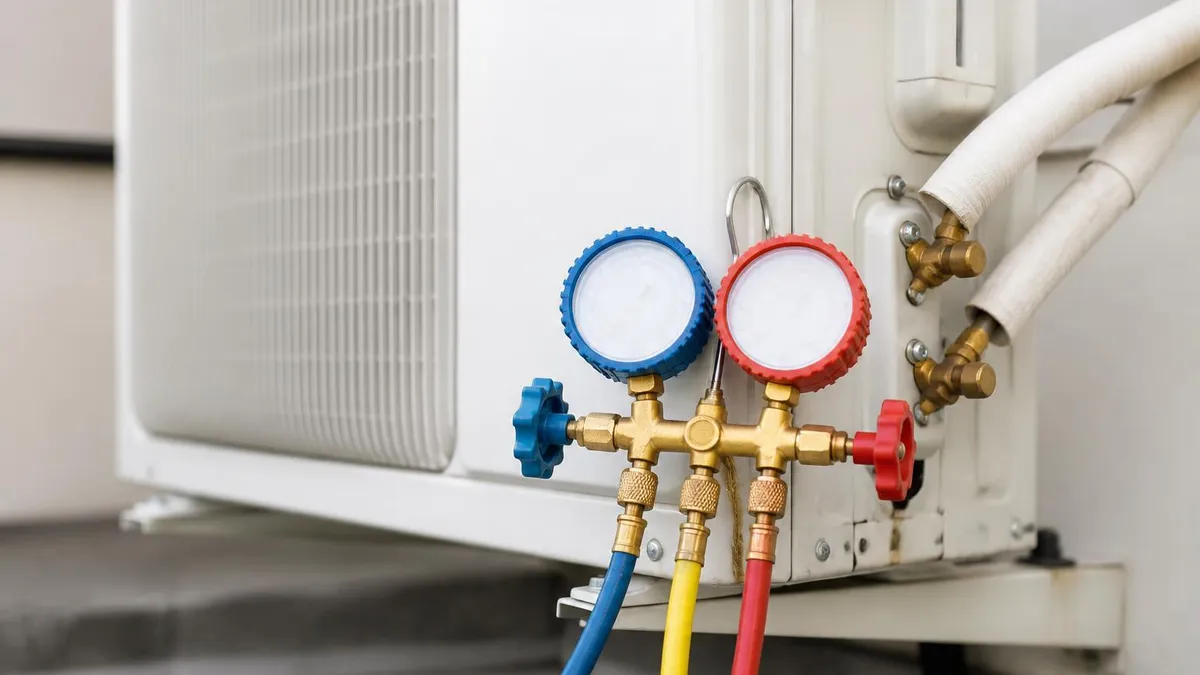
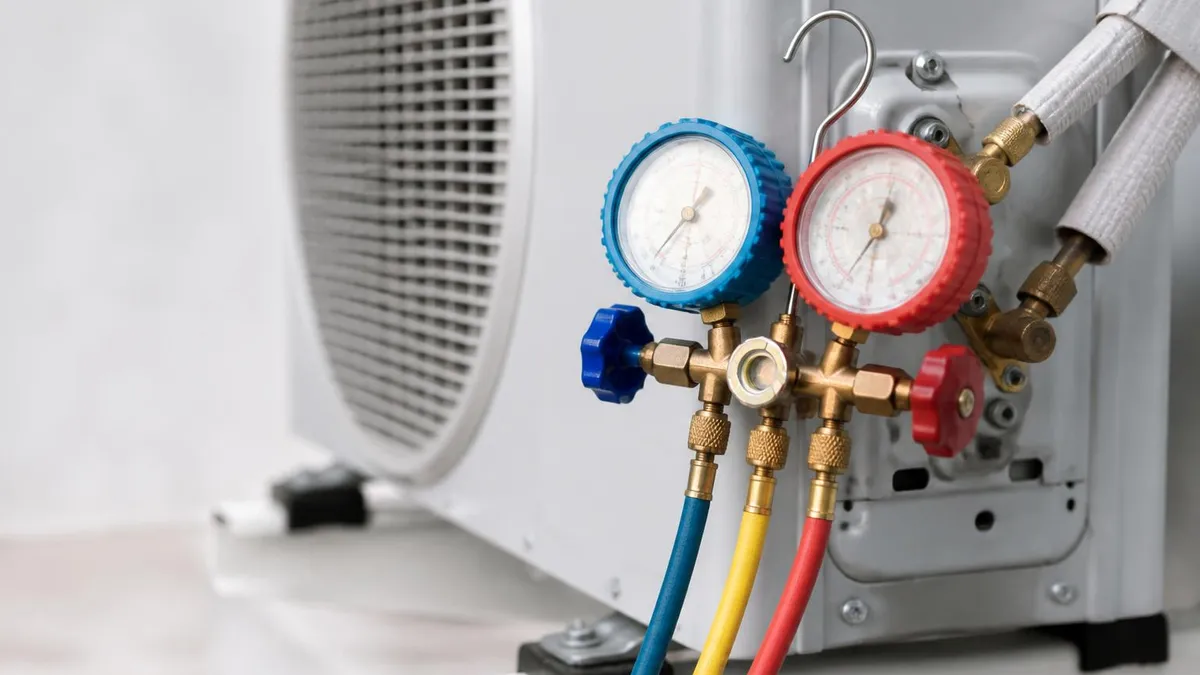
For technicians, the most pressing practical question is tooling compatibility. Most legacy manifold gauge sets, recovery machines, and vacuum pumps designed for R-410A are not directly compatible with A2L refrigerants without modification or replacement. A2L refrigerants require recovery machines rated for flammable refrigerants, leak detectors capable of sensing the specific chemical signatures of R-454B or R-32, and manifold gauges with updated pressure scales. The industry recommends that shops retiring R-410A equipment invest in purpose-built A2L tool kits rather than attempting to adapt existing tools, reducing both safety risk and measurement error during service work.
Staying connected to manufacturer technical bulletins and distributor training events is one of the best strategies for keeping up with refrigerant developments as they unfold. Distributors like Ferguson, Wittichen, Johnstone, and Gemaire regularly host factory-sponsored training days when new refrigerant lines arrive. ASHRAE, ACCA, and RSES (Refrigeration Service Engineers Society) all publish technical resources and offer continuing education units on refrigerant transitions. Technicians who commit to ongoing education in this area consistently report faster, more confident service work and better customer outcomes on new-refrigerant systems.
HVAC Practice Test Questions
Prepare for the HVAC - Heating Ventilation and Air Conditioning exam with our free practice test modules. Each quiz covers key topics to help you pass on your first try.
HVAC Air Conditioning
HVAC Exam Questions covering Air Conditioning. Master HVAC Test concepts for certification prep.
HVAC Code Compliance
Free HVAC Practice Test featuring Code Compliance. Improve your HVAC Exam score with mock test prep.
HVAC Electrical Controls
HVAC Test Prep for Electrical Controls. Practice HVAC Quiz questions and boost your score.
HVAC Energy Efficiency
HVAC Questions and Answers on Energy Efficiency. Free HVAC practice for exam readiness.
HVAC Heating Systems
HVAC Mock Test covering Heating Systems. Online HVAC Test practice with instant feedback.
HVAC Load Calculations
Free HVAC Quiz on HVAC Load Calculations. HVAC Exam prep questions with detailed explanations.
HVAC Tools and Equipment
HVAC Practice Questions for HVAC Tools and Equipment. Build confidence for your HVAC certification exam.
HVAC Refrigeration
HVAC Test Online for Refrigeration. Free practice with instant results and feedback.
HVAC Safety Practices
HVAC Study Material on Safety Practices. Prepare effectively with real exam-style questions.
HVAC System Design
Free HVAC Test covering System Design. Practice and track your HVAC exam readiness.
HVAC Thermodynamics
HVAC Exam Questions covering Thermodynamics. Master HVAC Test concepts for certification prep.
A2L Refrigerant Safe Handling, Certification, and Equipment Requirements
A2L refrigerants are classified as mildly flammable under ASHRAE 34, meaning they can burn under specific conditions but have a much higher lower flammability limit (LFL) than propane or other A3 refrigerants. For residential split systems, this means equipment must be designed with charge limits, spark-protected components, and leak detection provisions per UL 60335-2-40 and relevant mechanical codes. Technicians must not use open flames, unprotected spark-generating tools, or non-rated recovery equipment near A2L systems during service.
Building codes in most jurisdictions now reference UL 60335-2-40 for A2L equipment installation requirements, including requirements for minimum room volumes in certain indoor applications, installation height considerations for refrigerants heavier than air, and mandated leak detection in commercial settings. ASHRAE 15 and ASHRAE 15.2 provide system safety standards covering machinery room requirements, refrigerant monitors, and emergency ventilation. Technicians should verify which edition of these standards their local jurisdiction has adopted before specifying equipment for sensitive applications like server rooms or hospital mechanical spaces.
A2L Refrigerants vs. Legacy HFCs: Pros and Cons for HVAC Professionals
- +Dramatically lower GWP reduces environmental impact and long-term regulatory exposure for HVAC contractors and building owners
- +R-454B and R-32 offer comparable or superior energy efficiency to R-410A in optimized equipment designs, reducing customer operating costs
- +Lower projected long-term refrigerant costs as A2L production scales and legacy HFC supplies tighten under AIM Act allowances
- +New A2L equipment lines carry better warranty terms and longer expected service lives as OEMs optimize for the new refrigerant chemistry
- +Technicians trained on A2L handling command higher service rates and can differentiate from competitors still working only with legacy refrigerants
- +Natural refrigerant options like R-290 and CO2 offer near-zero GWP with long-term regulatory stability and no phasedown risk
- −A2L mildly flammable classification requires new tools, equipment upgrades, and updated safety protocols that represent significant upfront investment
- −R-410A systems in the field will require ongoing service for years, meaning technicians must maintain proficiency in both legacy and new refrigerant systems simultaneously
- −Refrigerant prices for legacy HFCs like R-410A are rising sharply as production allowances shrink, increasing repair costs for older residential systems
- −Code adoption timelines vary by jurisdiction, creating compliance uncertainty for contractors working across multiple states or counties
- −Customer education burden is higher: homeowners often do not understand why their new system costs more or uses a different refrigerant than the one being replaced
- −A2L system charge limits in certain confined spaces may require building modifications or engineering review before installation, adding project cost and time
HVAC Technician Refrigerant Compliance Checklist for 2026
- ✓Verify your EPA Section 608 certification is current and covers the refrigerant types you service (Universal certification recommended).
- ✓Confirm your recovery machine is rated for A2L flammable refrigerants before servicing any R-454B, R-32, or R-466A system.
- ✓Update manifold gauge sets to models with pressure scales calibrated for the specific A2L refrigerants in your service area.
- ✓Carry a refrigerant identifier on every service truck to detect contaminated or mislabeled refrigerant before charging a system.
- ✓Review your state and local mechanical code adoption status for UL 60335-2-40 and ASHRAE 15.2 A2L requirements.
- ✓Check EPA SNAP approval status for any refrigerant retrofit you plan to use in commercial or industrial equipment.
- ✓Train all technicians on A2L flammability protocols including no-open-flame rules, ventilation requirements, and emergency procedures.
- ✓Update your company refrigerant log and tracking system to include cylinder ownership, purchase dates, and disposal records for AIM Act compliance.
- ✓Review R-410A cylinder inventory and develop a plan for usage, proper recovery, and disposal as legacy service work winds down over coming years.
- ✓Complete at least one manufacturer-sponsored A2L training course annually to stay current with system-specific service procedures and warranty requirements.
The A2L Transition Is Already Here — Not Coming
As of January 2025, new residential split systems must use A2L refrigerants like R-454B or R-32. If your technicians are not yet trained on A2L handling, your service team is already behind the market. Contractors who invested in A2L tool upgrades and training in 2024 are winning bids on new construction and replacement work that competitors are forced to decline or subcontract. The time to act is now, not when the next busy season arrives.
Commercial refrigeration is experiencing its own parallel refrigerant transition, and the scale and complexity of these changes dwarf the residential sector in many respects. Large supermarket chains, convenience stores, food service distributors, and cold storage operators collectively account for a massive share of HFC consumption in the United States. The EPA's GreenChill partnership program has documented that commercial refrigeration systems leak an average of 25% of their charge annually in poorly maintained installations, making them a disproportionate contributor to HFC emissions relative to their installed base.
The commercial sector response has been a rapid acceleration toward lower-GWP systems, often driven by corporate sustainability commitments rather than regulatory compulsion alone. Walmart committed to transitioning its entire US refrigerated case portfolio to sub-150 GWP refrigerants ahead of federal mandates. Kroger, Albertsons, and Ahold Delhaize have all published similar commitments and are actively specifying CO2 transcritical and R-290 equipment for new stores. This creates both a growing market for technicians trained on natural refrigerants and a shrinking market for those who specialize exclusively in legacy HFC systems in the commercial segment.
CO2 transcritical booster systems have emerged as the dominant technology for new supermarket refrigeration in the US, following a path pioneered earlier in Europe and Canada. These systems circulate CO2 (R-744) at very high pressures — sometimes exceeding 1,400 psi in the gas cooler — which requires specialized training, pressure-rated components, and a different diagnostic mindset than conventional HFC rack systems. The efficiency of transcritical CO2 systems improves significantly in cooler climates, and advances in adiabatic gas cooler technology and ejector optimization have made them economically competitive in warm southern climates as well, accelerating adoption nationwide.
R-290 propane systems are gaining ground in standalone commercial equipment: reach-in display cases, under-counter refrigerators, ice cream cases, and similar self-contained units. Because these are factory-sealed systems with small charges (typically under 150 grams), the flammability risk is managed through factory design rather than field service protocols. However, technicians servicing these units still need awareness of propane handling requirements and must never attempt to service the sealed refrigerant circuit without proper training and recovery equipment. The EPA has approved R-290 for a growing list of commercial refrigeration applications, and charge size limits have been relaxed in recent regulatory updates.
Ammonia systems, long the workhorse of large industrial refrigeration in food processing plants, cold storage warehouses, and distribution centers, are also seeing renewed interest as the industry seeks ultra-low-GWP solutions at scale. Modern ammonia systems are much safer than legacy designs, incorporating advanced secondary loop configurations, reduced charge systems, and automated safety shutoffs that address the acute toxicity concerns that historically limited ammonia to dedicated industrial facilities.
The IIAR (International Institute of Ammonia Refrigeration) has developed comprehensive safety standards and offers certification programs for ammonia technicians, and demand for these credentials is growing as more commercial operators consider ammonia for large-scale applications.
For contractors looking to expand into commercial refrigeration or upgrade their capabilities in this area, the investment in natural refrigerant training pays dividends quickly. Projects involving CO2 transcritical systems, R-290 standalone units, or ammonia secondary loops typically command higher labor rates than conventional HFC work, and the pool of qualified contractors is still relatively small compared to demand. Trade organizations like ASHRAE, IIAR, and ACCA offer training resources, and several refrigerant manufacturers have established dedicated commercial refrigeration training centers with hands-on equipment. The learning curve is real, but so are the margins for qualified contractors.
State and local regulations are also reshaping the commercial refrigerant market in ways that will eventually affect the national baseline. California's cap-and-trade program places a price on HFC consumption, effectively adding a carbon cost to high-GWP refrigerant use in large commercial systems. Several other states are developing similar mechanisms, and the federal government is monitoring these state programs as potential models for broader policy. Contractors and building owners in regulated states who transition to natural refrigerants early avoid these ongoing compliance costs and position themselves ahead of rules that are likely to spread geographically in the coming years.
New R-410A equipment production ended January 1, 2025. While existing R-410A inventory can still be sold and installed from stock, supply is tightening and prices are rising as production allowances shrink under the AIM Act. Contractors who rely heavily on R-410A for service work should develop a written refrigerant procurement and inventory plan, including acceptable price thresholds and a strategy for transitioning service customers to new A2L equipment when repair costs exceed the economic tipping point.
The financial impact of the refrigerant transition is a central concern for both contractors and their customers, and the numbers are significant enough to warrant careful planning. For contractors, the upfront investment in A2L-rated tools, recovery equipment, and training represents a real cost that must be managed against an uncertain timeline for when A2L service calls will represent a large enough share of the workload to justify the full investment.
Industry estimates put the cost of fully equipping a single service technician for A2L work — including recovery machine, manifold gauges, leak detector, and refrigerant identifier — at between $2,500 and $4,500 depending on brand and features selected.
Refrigerant cost dynamics are shifting in ways that affect both new installation pricing and repair economics. R-410A, which sold for approximately $100–$120 per 25-pound cylinder as recently as 2020, has seen wholesale prices spike dramatically as production allowances shrink. By late 2024, contractors in some regions were paying $300–$400 per cylinder, and further price increases are expected as the remaining production allowances are consumed.
This price inflation directly affects the repair-vs-replace calculation for aging R-410A systems: a system that previously required a $200 refrigerant top-off now costs $400–$600 for the same repair, accelerating the economic case for early replacement with a new A2L system.
New A2L equipment pricing has been a concern for contractors and consumers alike. When R-410A equipment production ended, manufacturer pricing on A2L replacement systems initially came in 10–20% higher than equivalent R-410A models, reflecting the cost of new compressor designs, component upgrades, and factory retooling.
However, as production volumes have ramped through 2025 and into 2026, prices have moderated, and many product lines are approaching cost parity with what R-410A systems sold for at peak production. Tax credits available under the Inflation Reduction Act for high-efficiency heat pumps and air conditioners help offset the cost differential for qualifying homeowners, making the upgrade economics more attractive.
The Inflation Reduction Act's 25C tax credit deserves special attention from contractors who discuss equipment options with residential customers. Homeowners who install qualifying high-efficiency heat pumps can claim a credit of up to $2,000 per year, while qualifying central air conditioning installations may be eligible for a credit up to $600.
To qualify, equipment must meet specific SEER2 and EER2 thresholds that vary by climate zone. Many new A2L systems are designed to meet or exceed these thresholds, making the combination of refrigerant transition and IRA incentives a powerful argument for replacement over repair on aging equipment. Contractors who understand and communicate these incentives close more replacement sales.
For commercial building owners and facility managers, the refrigerant transition intersects with broader sustainability reporting requirements that are becoming standard in the corporate sector. SEC climate disclosure rules, while still subject to legal challenges as of early 2026, have pushed many large companies to inventory and report their refrigerant-related emissions as part of Scope 1 greenhouse gas reporting. This has created demand for refrigerant tracking software, leak detection systems, and professional emissions audits — all of which represent new service revenue opportunities for forward-thinking HVAC contractors who can offer these capabilities alongside traditional installation and maintenance work.
Staying informed about the latest developments in refrigerant pricing, regulatory changes, and equipment availability is a competitive advantage that separates top-performing contractors from average ones. Resources like the Air Conditioning Contractors of America (ACCA), ASHRAE, and industry publications including ACHR News, The HVAC Insider, and Refrigeration & Air Conditioning Magazine publish regular updates on refrigerant market conditions. Distributor newsletters and manufacturer technical portals are also valuable real-time sources. Contractors who build habits around regular industry reading are consistently better positioned to advise customers, price jobs accurately, and make procurement decisions that protect their margins.
The refrigerant transition is ultimately a long-term structural shift in the HVAC industry, not a temporary disruption. Contractors, technicians, and building owners who understand the regulatory timeline, the economics of new refrigerants, and the training investments required will be better prepared to navigate the next decade of change.
Those who treat it as a crisis rather than an opportunity may find themselves squeezed by rising legacy refrigerant costs on one side and technically complex new systems on the other. The professionals thriving in this environment are those who leaned into the transition early, invested in their teams, and positioned their companies as the experts customers trust when the refrigerant landscape shifts beneath them.
If you want the full picture, the hvac refrigerant news guide walks through it step by step.
Readers who want more detail usually continue with hvac refrigerant news.
Preparing for EPA 608 certification or renewing your knowledge of refrigerant regulations requires more than memorizing a list of refrigerant names and GWP values. The most effective technicians combine classroom knowledge with hands-on practice, using real service scenarios to cement their understanding of the principles underlying refrigerant selection, system charging, leak detection, and recovery procedures. If you are studying for the first time or refreshing your skills, start with the fundamentals of refrigerant thermodynamics — understanding why certain refrigerants have the properties they do helps you reason through service situations that are not covered in any study guide.
The EPA 608 exam covers four certification types: Type I (small appliances), Type II (high-pressure refrigerants), Type III (low-pressure refrigerants), and Universal (all types). Most HVAC technicians pursue Universal certification, which requires passing all four sections and demonstrates comprehensive knowledge across the full range of refrigerant systems encountered in commercial and residential work. Study materials from ESCO Institute, NATE, and HVAC Excellence are widely available and regularly updated to reflect current refrigerant regulations and A2L-specific content. Online practice exams are an efficient way to identify knowledge gaps before the real test.
Beyond the 608 exam, NATE (North American Technician Excellence) certification is increasingly valued by employers and customers as a mark of professional competency. NATE offers specialty certifications in air conditioning, heat pumps, commercial refrigeration, and other HVAC disciplines, each requiring demonstrated technical knowledge and periodic recertification. Technicians who combine EPA 608 Universal certification with one or more NATE specialty credentials are well positioned for advancement within service companies and for independent contractor work where customer trust is built on verifiable credentials.
Apprenticeship programs through HVAC trade unions and non-union training programs provide structured multi-year pathways that combine on-the-job training with classroom instruction, typically culminating in journeyman status and eligibility for state licensing where required. These programs increasingly incorporate refrigerant transition content, A2L handling modules, and natural refrigerant awareness into their curricula, reflecting the industry's recognition that today's apprentices will spend most of their careers working with next-generation refrigerants rather than legacy HFCs. If you are early in your career, selecting an apprenticeship program that has updated its curriculum for current refrigerant realities is a meaningful differentiator.
State licensing requirements for HVAC work vary considerably and affect the scope of refrigerant work a technician can legally perform without supervision. Some states require a master HVAC license to pull permits and oversee installations, while others have journeyman-level licensing that permits independent work within defined parameters. Several states specifically address refrigerant handling certifications in their licensing statutes, and failure to hold the required credentials can result in license suspension, fines, and voided equipment warranties. Technicians who work across state lines should verify licensing reciprocity agreements and any state-specific refrigerant handling requirements before taking on jobs in new jurisdictions.
The HVAC industry's ongoing evolution creates a genuine premium for technicians who commit to continuous learning. Refrigerant technology, building automation systems, heat pump efficiency standards, and indoor air quality requirements are all advancing simultaneously, and the technicians who master multiple domains command the highest rates and have the most career flexibility.
Manufacturer training programs are often free or low-cost and provide the most current information on specific equipment lines. Distributor training events, trade show sessions at AHR Expo and ACCA conferences, and online platforms like The HVAC Learning Solutions all offer accessible pathways for professional development regardless of where you are in your career.
Practice tests and certification preparation tools are among the most time-efficient ways to build exam readiness. Research consistently shows that retrieval practice — answering questions from memory rather than re-reading study materials — produces better long-term retention of technical knowledge.
Using high-quality practice questions that mirror the format and content of actual EPA 608, NATE, and state licensing exams helps technicians identify weak areas, build confidence, and approach the actual exam with reduced anxiety. The investment of a few hours per week in structured practice test preparation pays off not just on exam day but in faster, more accurate diagnostic work in the field.
Sample HVAC Practice Questions
Try these questions from our free HVAC practice tests. The correct answer and an explanation follow each question.
What is the primary reason technicians should never mix different types of refrigerant oils in an HVAC system?
- A. Different oils have different colors which causes confusion
- B. Mixing oils can cause chemical reactions, sludge formation, and compressor failure
- C. Mixed oils void the warranty but are otherwise safe
- D. Different oil viscosities are the only concern
Answer: B. Mixing oils can cause chemical reactions, sludge formation, and compressor failure
Incompatible oil mixtures can cause chemical reactions, form sludge that clogs the system, and lead to premature compressor failure.
What does Manual S (ACCA) provide for HVAC technicians and designers?
- A. Duct sizing procedures
- B. Residential equipment selection based on Manual J loads
- C. Ventilation rate requirements
- D. Commercial load calculation methods
Answer: B. Residential equipment selection based on Manual J loads
ACCA Manual S guides technicians in selecting properly sized heating and cooling equipment that matches the Manual J calculated loads within acceptable tolerance ranges.
At what refrigerant purity level must recovered refrigerant meet before it can be returned to a different owner's equipment without reclamation?
- A. It can never be transferred to different equipment without reclamation
- B. ARI 700 purity standards
- C. 90% purity
- D. 80% purity
Answer: A. It can never be transferred to different equipment without reclamation
Recovered refrigerant cannot be transferred to equipment owned by a different entity without first being reclaimed to ARI 700 (now AHRI 700) standards. It can be returned to the same owner's equipment after recovery.
In a commercial HVAC system, what does 'DOAS' stand for and what is its primary purpose?
- A. Dual Output Air System — splits heating and cooling
- B. Dedicated Outdoor Air System — provides ventilation air separately from sensible cooling
- C. Direct Outdoor Air Supply — bypasses air handlers in summer
- D. Distributed Output Air System — serves multiple zones from one unit
Answer: B. Dedicated Outdoor Air System — provides ventilation air separately from sensible cooling
A DOAS handles ventilation (outdoor air) requirements separately, allowing zone equipment to focus on sensible load control.
HVAC Questions and Answers
HVAC Sales: The Complete Guide to Selling Heating and Cooling Systems, Building Customer Trust, and Closing More Deals
HVAC Air Duct Sealing: The Complete Homeowner and Contractor Guide to Sealing Ductwork for Efficiency, Comfort, and Indoor Air Quality
HVAC Solutions: The Complete Guide to Heating, Cooling, and Indoor Air Quality Systems for Homes and Buildings

Commercial HVAC Repair: Systems, Costs, and Service Strategies
HVAC Apprenticeship Programs: Your Complete Guide to Starting a Hands-On Career in Heating, Ventilation, and Air Conditioning
About the Author

NATE Certified HVAC Technician & Licensing Exam Trainer
Universal Technical InstituteMike Johnson is a NATE-certified HVAC technician and EPA 608 universal-certified refrigerant handler with a Bachelor of Science in HVAC/R Technology. He has 19 years of commercial and residential HVAC installation and service experience and specializes in preparing technicians for NATE certification, EPA 608, A2L refrigerant safety, and state HVAC contractor licensing examinations.