
HVAC License by State: Texas Requirements, Costs, Career Duties, and How to Get Licensed
🆕 HVAC license Texas guide: requirements, costs, exam steps, and how rules differ by state. Learn duties, salary, and how to get licensed fast.
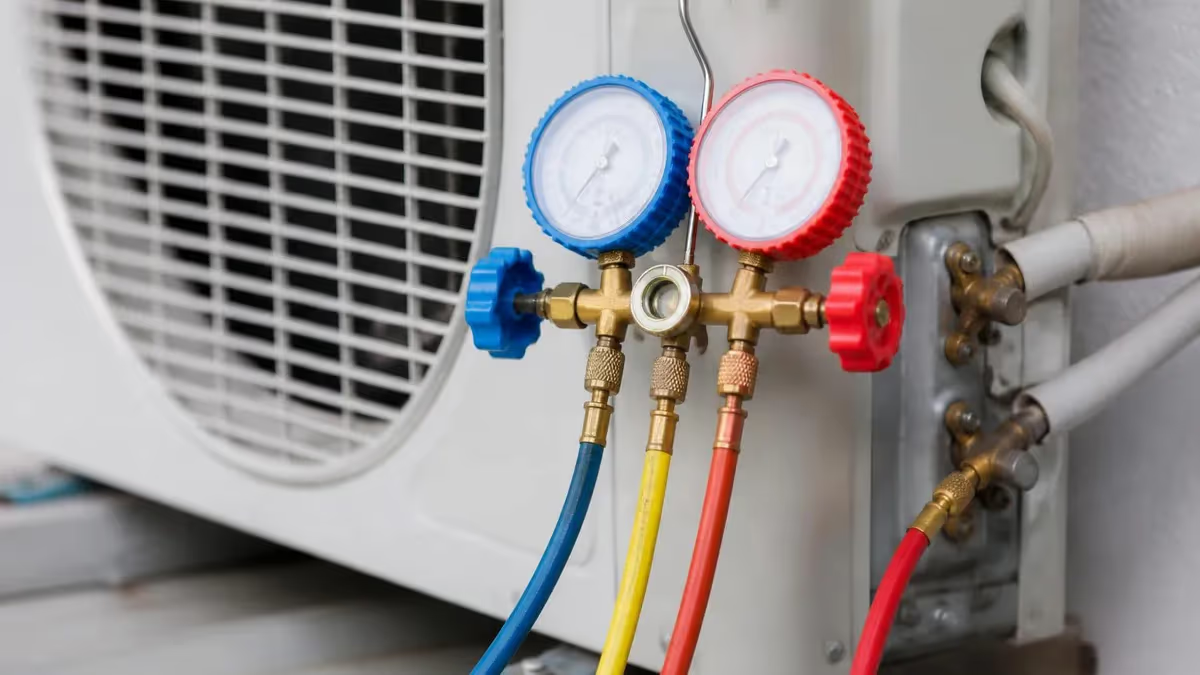
Getting an hvac license texas employers actually respect is the single biggest career decision a heating and cooling technician makes in the Lone Star State, because Texas treats HVAC contracting as a regulated trade under the Texas Department of Licensing and Regulation. Unlike states that leave licensing to local municipalities, Texas runs a centralized program with clear tiers, defined work hours, and a mandatory exam. Understanding that structure before you spend money on schools or tools saves you months of confusion and protects you from working illegally. Practice with the free HVAC practice test on PracticeTestGeeks (35 questions with answer explanations).
The phrase "HVAC license by state" matters because requirements swing wildly across the country. A technician fully licensed in Texas cannot simply cross into Louisiana or Oklahoma and keep working without checking reciprocity rules and local registration. Some states require nothing at the state level and defer entirely to cities. Others, like Texas, demand documented experience, insurance, and a passing exam score. Knowing where your home state sits on that spectrum is the foundation of every smart career plan in this field.
This guide focuses on Texas as the anchor example while explaining how the broader patchwork works, so you can map your own path no matter where you live. We cover the two main Texas license types, the experience hours each requires, exam content, fees, insurance obligations, and the day-to-day duties that define the job once you are licensed. Whether you are a brand-new apprentice or a seasoned tech finally going independent, the milestones are the same.
Texas issues two primary credentials: the Air Conditioning and Refrigeration Technician registration and the Air Conditioning and Refrigeration Contractor license. The technician registration lets you legally perform work under a licensed contractor, while the contractor license lets you pull permits, bid jobs, run a business, and supervise others. Most careers begin with hands-on apprentice time, move to technician registration, and culminate in the full contractor license after the required years of verifiable field experience are logged.
Money is a real motivator, and the numbers justify the effort. Licensed HVAC contractors in Texas routinely earn more than registered technicians, and self-employed contractors who build a client base can far exceed both. Beyond pay, the license unlocks freedom: you choose your jobs, set your rates, and own the relationships. Many techs treat licensing as the gateway from hourly labor to genuine ownership, and the data on small-business HVAC income backs up that ambition year after year.
Licensing also opens adjacent career lanes that pay surprisingly well. A licensed background is a strong launchpad into estimating, project management, and even hvac license by state roles where technical credibility closes bigger deals. Employers trust a licensed candidate to speak accurately about load calculations, refrigerant handling, and code compliance, and that trust translates directly into higher compensation and faster promotion. The credential is rarely wasted, even if you eventually move off the tools entirely.
Before diving into the step-by-step process, it helps to understand why states regulate this trade so tightly. HVAC work involves high-voltage electricity, combustible gas, pressurized refrigerant, and confined-space hazards, plus federal EPA rules on refrigerant recovery. A poorly installed furnace can leak carbon monoxide; a botched line set can vent ozone-depleting gas. Licensing exists to protect homeowners and the public, which is exactly why a credential carries weight and why earning it deliberately pays off across an entire career.
Free HVAC Study Tools
Interactive HVAC resources on PracticeTestGeeks, free to start:
- HVAC EPA 608 Refrigerant Certification — 35 questions with instant scoring and answer explanations
- HVAC flashcards — review key terms and concepts card by card
- HVAC study guide — topic-by-topic overview of what the exam covers
- HVAC cheat sheet — one-page printable summary for last-minute review
HVAC Licensing in Texas by the Numbers

Texas HVAC License Types and Tiers
Lets you legally perform HVAC work while employed under a licensed contractor. Requires registration with TDLR but no separate state exam. It is the ideal first credential for apprentices entering the field.
The full license allowing you to pull permits, bid jobs, run a business, and supervise technicians. Requires 48 months of practical experience plus passing the state contractor exam and carrying insurance.
Class A covers systems of any size with no tonnage limit. Class B caps cooling at 25 tons and heating at 1.5 million BTU per hour. Choose based on the market you intend to serve.
Texas separates Environmental Air Conditioning from Commercial and Industrial Process Cooling and Heating endorsements. You select the endorsement matching the work you intend to perform and legally bill customers for.
Eligibility for the Texas contractor license rests on documented, verifiable experience, and this is where many applicants stumble. TDLR requires 48 months of practical experience in the type of work covered by your chosen license within the 72 months immediately preceding your application. That experience must be supervised and confirmable, meaning a licensed contractor or qualifying employer signs off on your hours. Keep careful records from your first day on the job, because reconstructing four years of timesheets at the last minute is painful and sometimes impossible.
The experience must match your endorsement. If you want the Environmental Air Conditioning endorsement, your hours must reflect comfort-cooling and heating work in residential and light commercial settings. If you pursue Commercial Process Cooling and Heating, your documented work needs to involve industrial process applications. Mixing the two without proper documentation can trigger a rejection, so plan your apprenticeship around the endorsement you ultimately want rather than discovering a mismatch when you finally apply for licensure.
Beyond experience, Texas requires proof of insurance before issuing a contractor license. You must carry commercial general liability coverage with minimum limits of $300,000 per occurrence for bodily injury and property damage, $300,000 aggregate, and $60,000 for property damage. The state will not activate your license until you submit a certificate of insurance naming the required coverages. Budget for this ongoing cost, because the policy must remain active for the entire life of your license or it lapses.
Federal certification sits on top of state requirements. Anyone who handles refrigerant must hold EPA Section 608 certification under the Clean Air Act. This is separate from your Texas license but practically mandatory, since almost no real HVAC work avoids refrigerant entirely. The 608 exam has four types covering small appliances, high-pressure, low-pressure, and universal certification. Most working techs pursue Universal so they are never blocked from a job, and employers strongly prefer it when hiring.
Age and basic qualifications round out eligibility. Applicants must be at least 18, demonstrate the documented experience, and pass the licensing exam. There is no formal college degree requirement in Texas, which keeps the trade accessible, but completing an accredited HVAC program at a community college or technical school can shorten your learning curve dramatically and often counts toward experience hours when structured correctly under a licensed supervisor.
The path from zero to contractor is a deliberate climb, and skipping rungs rarely works. A typical progression starts with enrollment in a training program or a direct apprenticeship, followed by technician registration so you can legally work, then four years of logged field experience, EPA 608 along the way, and finally the contractor exam and insurance. Understanding this sequence early lets you treat every job as a step toward independence rather than just a paycheck, which is the mindset that separates career techs from people who drift.
If you are weighing whether the climb is worth it against a different lane in the industry, remember that the same documented competence that earns a license also makes you credible in hvac license by state and management tracks. The investment in eligibility never evaporates. Even technicians who stall on the contractor exam find that registered status plus EPA certification opens stable, well-paid employment, so the requirements you satisfy now keep paying dividends regardless of which direction your career eventually turns.
Texas HVAC License Exam Format and Topics
The Texas ACR contractor exam is a computer-based, open-book test administered through the state's approved vendor. It blends a trade knowledge section with a business and law section, and you must pass both. The trade portion focuses on system design, installation, and service, while the law portion covers TDLR rules, permitting, and Texas mechanical statutes that govern how you operate as a licensed contractor.
You generally need a minimum score of 70 percent to pass. Because it is open-book, success depends less on memorization and more on knowing your reference materials cold and navigating them quickly under time pressure. Candidates who tab their code books and practice locating answers fast consistently outperform those who rely on raw recall, even when the second group genuinely knows the underlying material well.

Is Getting an HVAC Contractor License Worth It?
- +Legally pull permits and bid jobs in your own name
- +Substantially higher earning ceiling than registered techs
- +Freedom to set rates and choose your own clients
- +Ability to hire and supervise other technicians
- +Credibility that wins commercial and warranty contracts
- +A credential that transfers into sales and management roles
- −Four years of documented experience required first
- −Ongoing cost of liability insurance and renewals
- −Must pass both trade and law exam sections
- −Personal liability for code violations and callbacks
- −Business overhead, taxes, and bookkeeping responsibility
- −Rules differ by state, complicating out-of-state work
Pros and Cons at a Glance
| Pros | Cons |
|---|---|
| Legally pull permits and bid jobs in your own name | Four years of documented experience required first |
| Substantially higher earning ceiling than registered techs | Ongoing cost of liability insurance and renewals |
| Freedom to set rates and choose your own clients | Must pass both trade and law exam sections |
| Ability to hire and supervise other technicians | Personal liability for code violations and callbacks |
| Credibility that wins commercial and warranty contracts | Business overhead, taxes, and bookkeeping responsibility |
| A credential that transfers into sales and management roles | Rules differ by state, complicating out-of-state work |
Your HVAC License Texas Action Checklist
- ✓Enroll in an accredited HVAC training program or apprenticeship.
- ✓Register as a technician with TDLR to work legally under a contractor.
- ✓Start logging supervised, verifiable experience hours from day one.
- ✓Earn EPA Section 608 Universal refrigerant certification.
- ✓Confirm your experience matches your intended endorsement type.
- ✓Accumulate the full 48 months within the 72-month window.
- ✓Choose Class A or Class B and the correct endorsement.
- ✓Study both the trade and law sections of the contractor exam.
- ✓Schedule and pass the state exam with at least 70 percent.
- ✓Secure the required commercial general liability insurance policy.
- ✓Submit your application and certificate of insurance to TDLR.
- ✓Set a renewal reminder and complete continuing education on time.
Document your experience hours from day one
The most common reason Texas HVAC license applications stall is incomplete experience documentation. TDLR wants verifiable proof of 48 months of supervised work, and reconstructing that record years later is brutal. Start a dated log on your very first job, keep signed verification from licensed supervisors, and save pay stubs as backup. This single habit can shave months off your timeline to becoming a licensed contractor.
The reason understanding HVAC license requirements by state matters so much is that the rules genuinely have no national standard. The federal government regulates only refrigerant handling through the EPA; everything else falls to states or even individual cities. This creates a patchwork where a technician's legal standing literally changes when they cross a state line. Texas runs a strong centralized program, but its neighbors and the rest of the country approach the same trade in dramatically different ways that you must research before relocating or expanding.
Some states regulate at the state level much like Texas. North Carolina, Georgia, and California require state licensing with experience and exams. California's CSLB issues a C-20 HVAC contractor license demanding four years of journeyman-level experience and a two-part exam covering trade and business law, mirroring the Texas philosophy. In these states, the credential is portable within state borders and carries real legal weight, and operating without it exposes you to fines and stop-work orders that can ruin a young business.
Other states deliberately stay hands-off. Several have no statewide HVAC license at all and leave regulation entirely to municipalities. In those places, you might need a city permit and a local registration to work in one town and a completely different set of approvals in the next county. Technicians in these states must research each jurisdiction they serve, which sounds chaotic but often means lower barriers to entry and faster paths to legal independent work for motivated newcomers.
Reciprocity is the wildcard that determines whether your hard-earned license travels. A handful of states maintain reciprocity agreements that let a licensed contractor from one state skip part of another state's process. These agreements are narrow, frequently limited to neighboring states, and change over time. Never assume your Texas license will be honored elsewhere; always contact the destination state's licensing board directly and confirm in writing what your existing credential actually exempts you from before you commit to a move.
The financial and legal stakes of these differences are real. Working without a required license can mean civil penalties, voided contracts, denied insurance claims, and an inability to legally collect payment for completed work. Homeowners increasingly check license status online before hiring, and a missing credential is an instant disqualifier on larger jobs. Understanding exactly where your state sits on the regulation spectrum protects both your income and your professional reputation as you grow.
For technicians planning a multi-state career, the smart approach is to over-document everything and treat licensing as portable proof of competence. Keep your EPA certification, experience logs, exam records, and insurance certificates organized and ready. Even when a new state requires a fresh exam, strong documentation accelerates the process and demonstrates seriousness to licensing boards. The technicians who navigate the state patchwork successfully are simply the ones who plan ahead and refuse to treat compliance as an afterthought.
It is also worth tracking how states handle continuing education, because that obligation does not stop once you pass. Texas, like many states, requires ongoing education to renew your license, ensuring you stay current on code changes, new refrigerants, and evolving efficiency standards. States vary in how many hours they demand and how often, so building a habit of annual training keeps you compliant everywhere and, more importantly, keeps your technical skills genuinely sharp in a field that changes constantly.

Performing HVAC work without the proper Texas license or outside your specific endorsement can trigger civil penalties, license denial, and voided contracts that leave you unable to collect payment. Insurance claims may also be denied. Always confirm your credential covers the exact work and jurisdiction before you start a job, especially when crossing state lines.
Once licensed, the day-to-day duties of an HVAC professional are far broader than swapping out broken parts, and understanding them helps you see why the license carries such value. On a typical service day, a technician diagnoses system faults, measures superheat and subcooling, checks electrical components, inspects ductwork, and verifies safe combustion in gas appliances. Each task draws on the exact knowledge the licensing exam tests, which is precisely why states tie the credential to demonstrated competence rather than handing it out for showing up.
Installation work is where licensed contractors prove their worth. Sizing a system correctly using a Manual J load calculation, designing duct runs for proper static pressure, setting refrigerant charge to spec, and commissioning the equipment all determine whether a homeowner gets comfort and efficiency or endless callbacks. An oversized air conditioner short-cycles and fails to dehumidify; an undersized one runs constantly. The licensed pro who gets sizing right protects both the customer's wallet and their own reputation in a referral-driven business.
Compensation reflects this responsibility. In Texas, registered technicians commonly earn in the mid-to-high five figures, while licensed contractors running their own crews can push well past six figures once they build steady commercial and residential accounts. Pay scales with skill, license tier, and willingness to handle complex commercial systems, refrigeration, or controls work. The trade rewards specialists, and the techs who invest in advanced knowledge consistently out-earn generalists who never push past basic residential service.
Beyond the wrench, licensed professionals shoulder administrative duties that surprise many newcomers. Pulling permits, scheduling inspections, ordering equipment, managing warranties, and documenting every job for liability purposes all fall on the contractor. Strong record-keeping is not optional; it is the difference between a clean inspection and a failed one, between a warranty claim honored and denied. The same discipline that builds your experience log carries straight into running a compliant, profitable operation day after day.
Customer interaction is an underrated core duty. Technicians explain problems, justify repair-versus-replace decisions, and earn the trust that closes jobs. This is where technical credibility shades into hvac license by state skills, because a homeowner facing a multi-thousand-dollar replacement wants confidence as much as a competitive price. Licensed pros who communicate clearly and honestly convert more estimates and generate the referrals that keep a service business growing without expensive advertising or constant lead-buying.
Safety duties never take a day off. HVAC techs work around high voltage, pressurized refrigerant, combustible gas, and rooftop or attic hazards. Proper lockout-tagout, refrigerant recovery to avoid venting, carbon monoxide testing, and ladder safety are daily responsibilities, not occasional concerns. The licensing process drills these because real lives depend on them. A technician who treats safety as routine protects customers, coworkers, and the long-term viability of their own license and livelihood.
Finally, licensed professionals carry the responsibility of staying current. Refrigerants are being phased down, efficiency standards keep rising, and smart controls are reshaping the field. Continuing education requirements force a baseline of currency, but the best techs go further, pursuing manufacturer training and advanced certifications voluntarily. This commitment to ongoing learning is what separates a technician who plateaus from one who keeps climbing into higher-paying specialties, supervisory roles, and eventually full business ownership.
With the requirements and duties clear, the final piece is preparing effectively so you pass the exam on your first attempt and avoid the cost and delay of a retake. Start by gathering the exact reference materials the Texas exam allows, since it is open-book. Knowing your code books and reference texts intimately matters more than rote memorization. Tab the sections you will use most, practice locating answers under a timer, and build the speed that turns an open-book test from a trap into an advantage on exam day.
Build a realistic study schedule rather than cramming. Most successful candidates spend eight to twelve weeks preparing, dedicating focused sessions to trade topics like load calculations, refrigerant cycles, and electrical controls, while reserving separate blocks for the law and business section that trips up so many strong technicians. Spacing your study over weeks lets the material settle and surfaces weak spots early, when you still have time to fix them instead of discovering gaps in the testing center.
Practice questions are the single highest-use prep tool available to you. Working through realistic items reveals how the exam phrases problems, exposes topics you only thought you understood, and builds the test-taking stamina you need for a multi-hour session. Treat every missed question as a study assignment: look up the correct answer, understand the underlying principle, and note the reference location. This loop of testing and reviewing compounds quickly and is far more efficient than passive reading alone.
Do not neglect the EPA 608 certification in your prep timeline. Because it is effectively required for refrigerant work, schedule it before or alongside your state exam study rather than treating it as a separate afterthought. Many of the refrigerant-handling concepts overlap with the state trade content, so preparing for both at once creates useful reinforcement. Aim for Universal certification so no employer or job ever turns you away over a certification gap you could have closed early.
On exam day, manage your time deliberately and protect your confidence. Read each question fully before reaching for a reference, answer the questions you know cold first, and flag harder items to revisit. Because the passing threshold sits at 70 percent, you can miss a meaningful number and still pass, so do not panic over a few tough items. Steady pacing and trust in your preparation beat frantic second-guessing every single time in the testing center.
After you pass, move quickly to activate your license. Submit your application, attach the required certificate of insurance, and confirm TDLR has everything it needs before your exam result window expires. Set a calendar reminder for your renewal date and continuing education well in advance, because a lapsed license forces you back through hoops you already cleared. Treating the administrative finish line with the same seriousness as the exam keeps your hard-won credential active and trouble-free.
Finally, think beyond the single exam to the career it unlocks. The same disciplined preparation that earns your license builds habits that make you a better contractor: organized records, current knowledge, and a respect for code and safety. Whether you stay on the tools, move into commercial work, or branch into sales and management, the foundation you build preparing for licensure pays off for decades. Approach it as the launch of a career, not just a test to survive, and the effort returns far more than it costs.
Sample HVAC Practice Questions
Try these questions from our free HVAC practice tests. The correct answer and an explanation follow each question.
Which document provides the minimum ventilation requirements adopted by most US state and local building codes for commercial buildings?
- A. SMACNA HVAC Systems and Equipment
- B. ASHRAE 62.1
- C. ACCA Manual Q
- D. NFPA 90A
Answer: B. ASHRAE 62.1
ASHRAE 62.1 'Ventilation for Acceptable Indoor Air Quality' is the industry standard referenced by the International Mechanical Code and adopted by most US jurisdictions.
Which law of thermodynamics states that heat will not spontaneously flow from a cold body to a hot body?
- A. Zeroth Law
- B. First Law
- C. Second Law
- D. Third Law
Answer: C. Second Law
The Second Law of Thermodynamics establishes the natural direction of heat flow and the concept of entropy.
When installing a rooftop HVAC unit in a seismic design category D zone, which additional requirement applies per the International Mechanical Code?
- A. Painted bright orange
- B. Seismic bracing and anchorage
- C. Double insulation wrap
- D. Dual disconnect switches
Answer: B. Seismic bracing and anchorage
The IMC requires that mechanical equipment in high seismic zones be anchored and braced to resist seismic forces as specified in the International Building Code.
Which combustion efficiency rating measures only the steady-state efficiency of a furnace while it is actively firing?
- A. AFUE
- B. SEER
- C. COP
- D. Thermal efficiency
Answer: D. Thermal efficiency
Thermal (combustion) efficiency measures real-time burner performance, while AFUE accounts for cycling losses over an entire heating season.
HVAC Questions and Answers
HVAC Sales: The Complete Guide to Selling Heating and Cooling Systems, Building Customer Trust, and Closing More Deals

HVAC Air Duct Sealing: The Complete Homeowner and Contractor Guide to Sealing Ductwork for Efficiency, Comfort, and Indoor Air Quality

HVAC Solutions: The Complete Guide to Heating, Cooling, and Indoor Air Quality Systems for Homes and Buildings

Commercial HVAC Repair: Systems, Costs, and Service Strategies
HVAC Evaporator: Complete Guide to How It Works, Common Problems, and Maintenance
How this page was made: written with AI tools and published by Nathan Beja, founder of Practice Test Geeks, who is responsible for its content. We have not yet matched this exam's facts to an official source, so confirm fees, dates and rules with the exam body. Not reviewed by a subject-matter expert. Editorial policy