
How to Get Your HVAC License in Texas: Complete Step-by-Step Guide 2026
Learn how to get your HVAC license in Texas — exams, fees, experience hours, and tips to pass. ✅ Complete 2026 guide.
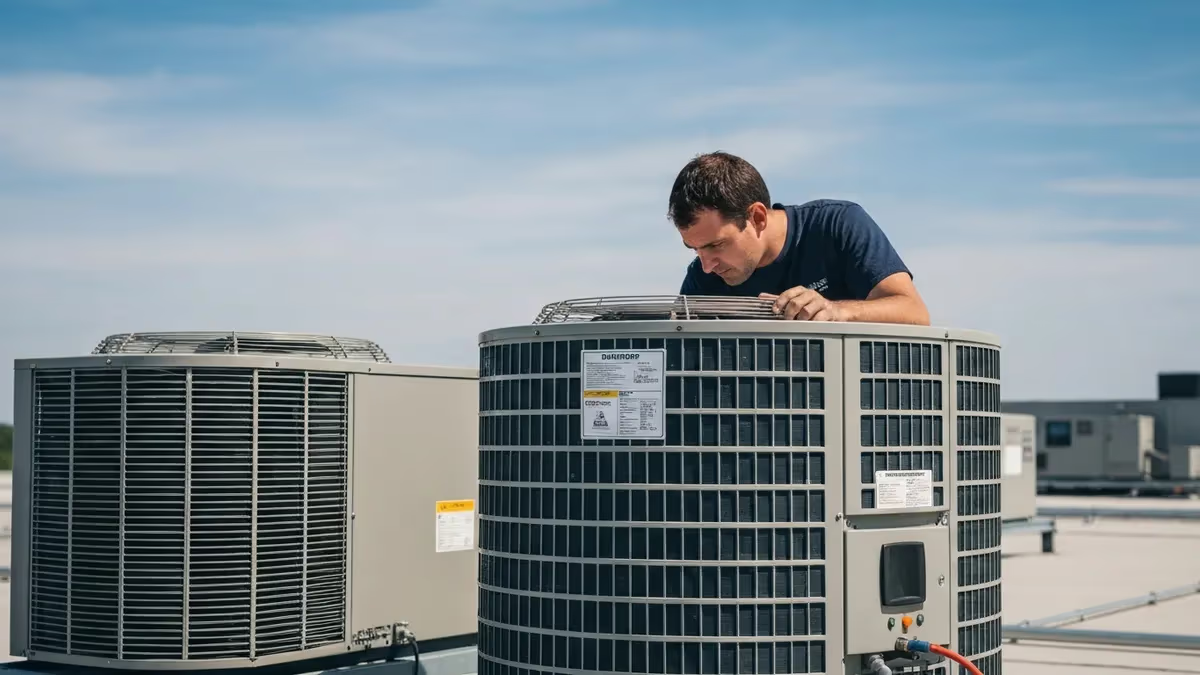
Knowing how to get your HVAC license in Texas is the essential first step toward building a rewarding career in one of the state's fastest-growing skilled trades. Texas regulates HVAC work through the Texas Department of Licensing and Regulation (TDLR), and every technician who installs, maintains, or repairs heating, ventilation, air conditioning, or refrigeration equipment must hold a valid state license. Without it, you cannot legally work on most residential or commercial systems, and contractors face stiff fines for employing unlicensed technicians.
The licensing pathway in Texas is structured in tiers: Apprentice, Technician, Journeyman, and Master. Each level unlocks greater job responsibilities and earning potential. Apprentices work under direct supervision while accumulating the hands-on hours they need to advance. Technicians can perform most field tasks independently. Journeymen can supervise apprentices, and Masters are authorized to pull permits and run their own HVAC contracting businesses. Understanding where you fit in this hierarchy — and what it takes to climb it — is the foundation of your career plan.
Texas has a strong labor market for HVAC professionals. The U.S. Bureau of Labor Statistics projects HVAC employment to grow 9 percent through 2033, and Texas consistently ranks among the top five states for total HVAC jobs. Cities like Houston, Dallas-Fort Worth, San Antonio, and Austin have year-round demand driven by extreme summer heat, an expanding construction sector, and an aging building stock that needs ongoing mechanical system upgrades. This demand translates into above-average wages and steady overtime opportunities for licensed technicians.
The licensing process involves meeting education and experience requirements, passing written and practical examinations administered by the TDLR, and paying the applicable fees. The path can feel complex at first glance, but it follows a logical progression. Most candidates who prepare systematically — attending an accredited HVAC program, logging their on-the-job hours carefully, and using quality study materials — pass their exams on the first attempt and hold their licenses within two to three years of starting their apprenticeship.
One area that trips up many candidates is the exam itself. The Texas HVAC Journeyman and Master exams test knowledge of refrigeration theory, electrical fundamentals, airflow calculations, code compliance, and safety regulations. These are not simple multiple-choice quizzes — they require applied problem-solving under timed conditions. Candidates who treat exam prep as an afterthought often find themselves retaking tests and delaying their careers by months. Building a structured study plan is just as important as accumulating work hours.
If you already have an hvac license texas or are planning to obtain one, understanding the full regulatory landscape will help you avoid common pitfalls like incomplete applications, missed renewal deadlines, and scope-of-work violations. This guide walks you through every stage of the Texas HVAC licensing journey — from choosing the right training program to submitting your final application — so you can move forward with confidence and clarity.
Texas HVAC Licensing by the Numbers
Key Facts at a Glance
| Item | Value | Details |
|---|---|---|
| Hours for Journeyman License | 4,000 | Required field experience |
| Typical Trade School Duration | 1 yr | Accelerated HVAC programs |
| Passing Score Required | 75% | Texas TDLR exam minimum |
Texas HVAC License Tiers Explained
Apprentice Registration
HVAC Technician License
Journeyman License
Master HVAC License
Choosing the right education and training program is one of the most consequential decisions you will make on the path to your Texas HVAC license. The state does not mandate formal schooling as a prerequisite for licensure — technically, you can accumulate all your required hours through on-the-job training alone — but candidates who complete an accredited HVAC program consistently pass their exams at higher rates and enter the workforce with broader foundational knowledge. Trade schools, community colleges, and apprenticeship programs each offer distinct advantages depending on your learning style, schedule, and financial situation.
Community college HVAC programs typically run eight months to two years and lead to a certificate or associate degree. Schools like Houston Community College, Dallas College, San Antonio College, and Austin Community College all offer TDLR-aligned HVAC curricula that cover refrigeration cycles, electrical systems, airflow and load calculations, EPA 608 certification, and code compliance. Tuition ranges from $2,000 to $8,000 depending on program length and whether you qualify for financial aid. The structured classroom environment suits candidates who learn best with instructor feedback and peer interaction.
Employer-sponsored apprenticeship programs are another strong pathway. Organizations like the Associated Builders and Contractors (ABC) and the Air Conditioning Contractors of America (ACCA) run multi-year apprenticeship programs that pair classroom instruction with paid on-the-job training. These programs are especially attractive because you earn while you learn — apprentices typically start at 40 to 50 percent of journeyman wages and receive annual raises as they advance. In Texas, many large commercial HVAC contractors partner with these organizations to recruit and train their future workforce.
Independent trade schools offer accelerated programs that can be completed in as little as six months. These programs are intensive and cover all the core topics you need to pass state exams. However, verify that the school is accredited by a recognized body — such as the Commission of the Council on Occupational Education (COE) — before enrolling. Some unaccredited programs provide poor exam preparation and offer little value when it comes time to apply for your license. Ask each school directly about its graduates' TDLR exam pass rates.
Regardless of which training path you choose, EPA Section 608 certification is a mandatory parallel requirement. This federal certification, administered by the Environmental Protection Agency, allows technicians to purchase and handle refrigerants. Without it, you cannot legally recover, recycle, or charge refrigerants on any system with more than five pounds of refrigerant. The 608 exam is offered by several approved certifying organizations and covers the four core type categories: Type I (small appliances), Type II (high-pressure systems), Type III (low-pressure systems), and Universal (all types). Most HVAC employers in Texas require Universal certification.
Once you are enrolled in a training program or working as a registered apprentice, keep careful records of your work hours. TDLR requires that your supervising Journeyman or Master sign off on your hours using the agency's official documentation forms. Gaps in documentation are one of the most common reasons license applications are delayed or rejected. Create a habit of logging hours weekly rather than trying to reconstruct months of work from memory. Many experienced technicians recommend using a dedicated notebook or digital spreadsheet that records the date, job site, type of work performed, and supervisor name for every shift.
Online self-study resources can supplement formal training but should never replace it entirely. While video courses, practice exams, and technical manuals are valuable review tools, the hands-on component of HVAC work cannot be replicated digitally. Diagnosing a refrigerant leak, brazing copper fittings, or troubleshooting an electrical control board requires physical practice under the guidance of an experienced mentor. Plan your education to include substantial field hours from the earliest possible stage of your training.
HVAC Exam Topics and Study Strategies for Texas
The Texas HVAC Journeyman exam is administered by the TDLR and covers five major knowledge domains: refrigeration fundamentals, electrical systems and controls, air distribution and load calculations, mechanical codes and safety, and installation and service procedures. The exam typically contains 100 questions and must be completed within a set time limit. Candidates must score at least 75 percent to pass. Many questions are scenario-based, requiring you to diagnose a problem or select the correct code-compliant approach for a given installation situation.
Effective preparation for the Journeyman exam requires a combination of textbook study, code review, and timed practice tests. Obtain a copy of the current International Mechanical Code (IMC) and familiarize yourself with the sections most likely to appear on the exam. Work through practice questions daily in the final four to six weeks before your test date. Focus extra attention on electrical troubleshooting and refrigerant cycle calculations, as these areas generate the most errors among first-time test takers. Scheduling your exam date three to four weeks after you feel ready creates a healthy deadline without unnecessary pressure.
Is Getting a Texas HVAC License Worth It?
- +Above-average earnings: licensed Texas HVAC technicians earn a median of $58K with strong overtime potential
- +Year-round job security driven by Texas's extreme summer heat and cold winters
- +Multiple career pathways: residential service, commercial installation, refrigeration, industrial maintenance
- +Master license allows you to open your own contracting business and generate significant income
- +Growing demand: new construction and an aging building stock create consistent work for licensed technicians
- +Federal and state incentives for energy-efficient HVAC installations create upsell opportunities for licensed contractors
- −Significant upfront time investment: 4,000 hours of documented field experience before Journeyman eligibility
- −Exam fees, school costs, and tool purchases create a financial barrier for new entrants
- −Physically demanding work involving confined spaces, extreme temperatures, and heavy equipment
- −Regulatory complexity: TDLR rules change periodically and require ongoing attention to stay compliant
- −Continuing education is required at renewal, adding recurring time and cost commitments
- −Competition from unlicensed operators can create pricing pressure in some residential markets
Texas HVAC License Application Checklist
- ✓Register as an HVAC Apprentice with TDLR before beginning work under supervision
- ✓Complete an accredited HVAC training program or accumulate required on-the-job hours with documentation
- ✓Obtain EPA Section 608 Universal certification from an approved testing organization
- ✓Log all work hours on TDLR-approved forms with your supervising Journeyman or Master's signature
- ✓Verify you meet the minimum experience threshold (4,000 hours for Journeyman, additional 1,000 for Master)
- ✓Create a MyLicense Office account on the TDLR website and start your online application
- ✓Upload all required documents: proof of experience hours, EPA 608 certificate, and valid ID
- ✓Pay the applicable examination and license application fees through the TDLR online portal
- ✓Schedule your exam at an approved Pearson VUE testing center in Texas
- ✓Pass the written exam with a minimum score of 75 percent and receive your official license
Start Documenting Hours from Day One
The single most common reason HVAC license applications are delayed in Texas is incomplete or improperly documented work hours. TDLR auditors review hour logs carefully, and unsigned, incomplete, or retroactively created records are rejected. Set up a documentation system on your first day as a registered apprentice and never let logs fall more than one week behind. Digital spreadsheets with supervisor e-signatures are accepted and are far easier to organize than paper forms.
Understanding the full cost picture for obtaining your Texas HVAC license helps you budget accurately and avoid financial surprises that derail your progress. The total out-of-pocket investment varies considerably depending on whether you pursue formal schooling, how many exam attempts you require, and which tools and resources you purchase along the way. Planning conservatively and building a dedicated savings fund before you start your apprenticeship is far better than scrambling for cash when application deadlines arrive.
Trade school tuition is typically the largest single expense. Community college certificate programs in Texas cost between $2,000 and $8,000 in tuition and fees. Private trade schools may charge $10,000 to $15,000 for comprehensive programs that include tool kits and certification prep. Financial aid, Pell Grants, and workforce development grants through the Texas Workforce Commission can offset a substantial portion of these costs for qualifying students. Many employers also offer tuition reimbursement programs for employees who complete relevant training while working for the company.
TDLR charges separate fees for registration, examination, and license issuance. As of 2026, apprentice registration costs $30, the Journeyman exam fee is approximately $60, and the license issuance fee is $46. Master license fees are slightly higher. These fees are subject to change, so always verify current amounts on the TDLR website before submitting payment. If you fail an exam and need to retake it, you pay the examination fee again — another reason thorough preparation on the first attempt is financially prudent.
The EPA 608 exam costs between $20 and $60 depending on the certifying organization and whether you test in person or online. Study materials — textbooks, online prep courses, and practice exam subscriptions — typically add another $50 to $200 to your budget. Professional membership in organizations like ACCA or RSES is optional but provides access to technical resources, networking opportunities, and discounted continuing education that can pay for itself quickly once you are working as a licensed technician.
Timeline is equally important to understand. Most candidates complete the full Journeyman licensing process in two to three years when counting the time spent in training and accumulating work hours. Candidates who attend full-time trade school and begin working as registered apprentices immediately after graduation often reach the 4,000-hour threshold in approximately two years. Those who work part-time or in jobs that offer limited HVAC-specific hours may take three to four years to qualify. Planning your career timeline around realistic hour accumulation rates prevents frustration and helps you set appropriate salary and advancement expectations.
One timeline accelerator worth considering is seeking employment with a large commercial HVAC contractor rather than a smaller residential shop. Commercial projects typically involve longer continuous shifts and more diverse work — chiller startups, VAV system commissioning, controls integration — that counts toward your hours and exposes you to the types of scenarios tested on the Master exam. Residential service experience is valuable, but commercial exposure broadens your technical foundation and often leads to faster wage growth as your skills expand.
The Master license adds roughly one to two additional years to the total journey. After earning your Journeyman license, you need 1,000 additional hours of supervisory experience before you can apply for the Master exam. Many technicians use this period to specialize in a high-demand area — such as commercial refrigeration, building automation systems, or energy auditing — that positions them for premium compensation once they hold their Master credentials. The most successful HVAC professionals in Texas treat every year of their career as a preparation for the next level, not just as a path to the current one.
Texas HVAC licenses expire every two years and must be renewed through the TDLR online portal before the expiration date. Operating with an expired license is illegal and can result in fines, work stoppages, and mandatory re-examination in some cases. TDLR requires eight hours of continuing education per renewal cycle. Set a calendar reminder 90 days before your expiration date to confirm your CE hours are complete and your renewal application is submitted on time.
Preparing strategically for the TDLR exam is what separates candidates who pass on the first attempt from those who spend extra months and money on retakes. The exam is not designed to trick you, but it does test applied knowledge rather than rote memorization. Understanding the difference between these two things is the foundation of effective study. Rote memorization will help you answer basic definition questions, but the majority of exam points come from scenario-based questions that require you to analyze a situation and select the best code-compliant or technically sound course of action.
Begin your formal exam preparation at least eight to twelve weeks before your scheduled test date. Divide your study sessions by topic domain rather than studying randomly. Spend the first two weeks reviewing electrical fundamentals — Ohm's Law, series and parallel circuits, motor controls, and thermostat wiring — because electrical questions appear heavily across all sections of the Journeyman and Master exams. Week three and four should focus on refrigeration cycles: compression, condensation, expansion, evaporation, and the thermodynamic properties of common refrigerants including R-410A, R-32, and R-454B, the newer low-GWP alternative now entering widespread use.
Code compliance study deserves a dedicated two-week block. Texas HVAC work is governed primarily by the International Mechanical Code (IMC) and the International Fuel Gas Code (IFGC) as adopted and amended by the state. Pay particular attention to clearance requirements, venting specifications for gas furnaces, refrigerant quantity limits for occupied spaces, and duct construction standards. These are frequently tested topics where candidates who have not reviewed the actual code text — rather than just summaries — make costly errors on the exam.
Practice tests are your most powerful study tool in the final four weeks before exam day. Take at least three full-length timed practice exams under realistic conditions: no notes, no phone, seated at a desk for the full exam duration. Review every question you get wrong, not just to learn the correct answer but to understand why your original answer was wrong. This pattern-recognition approach trains your brain to avoid the same reasoning errors on the actual exam. Resources like the ones available through PracticeTestGeeks are specifically designed to mirror the difficulty level and question style of the TDLR exam.
On exam day itself, arrive at the Pearson VUE testing center at least 30 minutes early with your government-issued photo ID and your scheduling confirmation. You are not permitted to bring notes, reference materials, or electronic devices into the testing room. The exam is computer-based with a built-in timer. If you encounter a question you are unsure about, flag it and move on rather than spending disproportionate time on it. Complete all the questions you know confidently first, then return to flagged questions with whatever time remains.
After passing your exam, the license issuance process is straightforward if your application documents are complete. TDLR reviews submitted applications within 30 to 45 business days in most cases, though processing times can vary during high-volume periods. You can check the status of your application through your MyLicense Office account. Once approved, your license will be issued electronically and you will receive a printed wallet card by mail. Keep your license number readily accessible — contractors and inspectors will ask for it on job sites and permit applications.
Career advancement after licensure is primarily driven by specialization and reputation. Technicians who develop expertise in emerging technologies — variable refrigerant flow (VRF) systems, building automation and controls integration, geothermal heat pumps, and energy efficiency auditing — command premium wages and are rarely without work even during economic downturns. Manufacturers like Daikin, Carrier, and Trane offer factory certification programs that pair well with your state license and signal to employers and customers that you have advanced technical competency beyond the baseline licensing standard.
Once you hold your Texas HVAC Journeyman or Master license, the renewal and continuing education requirements keep your credentials active and your knowledge current. TDLR requires eight hours of approved continuing education (CE) every two-year renewal period. CE courses are offered by trade associations, community colleges, equipment manufacturers, and online providers. Topics vary each cycle and often reflect changes in refrigerant regulations, updated code editions, or emerging technology standards. Staying engaged with CE is not just a regulatory obligation — it is one of the best investments you can make in your long-term earning power.
The renewal process itself is handled entirely online through the TDLR MyLicense Office portal. Log in before your expiration date, confirm your CE hours are recorded in the system by your approved CE provider, pay the renewal fee, and submit. Renewals that lapse for more than one year may require additional steps, including re-examination in some cases. TDLR sends email reminders to the address on file, but do not rely solely on those reminders — add your expiration date to your personal calendar and treat it as a hard deadline.
For technicians who aspire to become contractors and run their own business, the Master license is the critical gateway. Texas law requires HVAC contractors to hold or employ a Master license holder responsible for the quality and code compliance of all work performed under the company's permits. This means that the Master licensee is personally and legally accountable for every installation and service call performed by employees. Understanding the scope of this responsibility — and carrying appropriate contractor liability insurance and a surety bond — is essential before hanging out your own shingle.
Specialization after licensure can dramatically increase your income. Commercial refrigeration specialists, for example, work on supermarket display cases, cold-storage warehouses, and food-processing facilities. These systems operate at low temperatures and high pressures that require advanced technical skill, and they pay accordingly — experienced commercial refrigeration technicians in Texas commonly earn $70,000 to $90,000 annually plus benefits. Building automation and controls is another high-growth specialty, as smart building systems that integrate HVAC, lighting, and security controls are standard in new commercial construction.
Networking within the Texas HVAC industry accelerates career growth in ways that technical skills alone cannot. Joining your local ACCA chapter, attending the annual AHR Expo when it comes to a nearby city, and participating in manufacturer training days put you in contact with contractors, suppliers, engineers, and inspectors who can refer business, offer job opportunities, or provide mentorship.
Many of the best HVAC jobs in Texas are filled through professional networks before they are ever posted publicly. Being known as a skilled, reliable, and licensed professional within your local market is one of the most durable competitive advantages you can build.
For those considering the entrepreneurial path, starting an HVAC business in Texas requires more than just a Master license. You will need a business entity registration, a contractor bond (typically $10,000), general liability insurance with minimum coverage of $300,000, and in some municipalities, a local business permit. Building a customer acquisition strategy — through online reviews, referral programs, and local advertising — is equally important as the technical and regulatory groundwork. Resources on HVAC business development, including marketing strategies and financing options for equipment and vehicles, are available through industry associations and platforms like PracticeTestGeeks.
Whether your goal is to be the best field technician in your market, to lead a team as a Journeyman supervisor, or to build a multi-truck contracting operation, the Texas HVAC licensing system provides a clear and achievable framework for professional growth. The investment in training, exam preparation, and ongoing education pays dividends over a career that can span 30 or more years in a trade that will always be essential — because no matter what technology changes, the people of Texas will always need heating, cooling, and ventilation in their homes and businesses.
Sample HVAC Practice Questions
Try these questions from our free HVAC practice tests. The correct answer and an explanation follow each question.
What is the recommended first step when a HVAC professional identifies a compliance violation?
- A. Ignore it if minor
- B. Document and report through proper channels
- C. Discuss on social media
- D. Wait for someone else to report it
Answer: B. Document and report through proper channels
All compliance violations should be documented and reported through established channels to ensure proper investigation and resolution.
What is the recommended approach for treating water chemistry in a closed-loop hydronic system?
- A. Use tap water without treatment—closed systems don't need it
- B. Add inhibited glycol solution and use corrosion inhibitors to prevent scale, corrosion, and microbiological growth
- C. Continuously flush with fresh water to prevent scale buildup
- D. Use only distilled water and no chemical additives
Answer: B. Add inhibited glycol solution and use corrosion inhibitors to prevent scale, corrosion, and microbiological growth
Closed hydronic systems require inhibited glycol plus corrosion inhibitors to protect metals from galvanic corrosion, prevent scale deposition, and control pH.
What does a high EER (Energy Efficiency Ratio) value on a heat pump indicate?
- A. The unit has a high heating capacity at low outdoor temperatures
- B. The unit provides more cooling output per watt of electrical input at a specific test condition
- C. The unit operates efficiently at high outdoor humidity levels
- D. The unit has a long compressor life expectancy
Answer: B. The unit provides more cooling output per watt of electrical input at a specific test condition
EER measures cooling efficiency at a single test condition (typically 95°F outdoor / 80°F indoor), with higher values indicating more BTUs of cooling delivered per watt consumed.
HVAC Questions and Answers
FCU HVAC: The Complete Guide to Fan Coil Units, How They Work, Where They Excel, and How to Choose the Right System
Finance a New HVAC System: 2026 Loans, 0% APR, and Rebates
HVAC Duct Repair: Common Issues, Costs, and DIY vs Professional

HVAC School -- Programs, Costs, and Career Paths in 2026
HVAC Advertising: The Complete Playbook for Generating Leads, Booking Calls, and Growing Your Heating and Cooling Business
How this page was made: written with AI tools and published by Nathan Beja, founder of Practice Test Geeks, who is responsible for its content. We have not yet matched this exam's facts to an official source, so confirm fees, dates and rules with the exam body. Not reviewed by a subject-matter expert. Editorial policy