
HVAC License: State Requirements, EPA 608 and Career Path Guide 2026
🔎 HVAC license — federal EPA 608 vs state contractor licensing, journeyman and master tiers, NATE certification, exam content and reciprocity rules.
What an HVAC License Actually Is
An HVAC license is the legal credential that authorises a person to install, service, repair or replace heating, ventilation and air conditioning equipment as a paid trade. Practice with the free HVAC practice test on PracticeTestGeeks (750+ questions with answer explanations).
The confusing thing about HVAC licensing in the United States is that there is no single national license — instead, there is a federal certification on top of a patchwork of state-level credentials, with each state writing its own rules about who can pull permits, supervise apprentices and run a contracting business. Knowing which credentials you actually need depends on where you intend to work and what kind of HVAC work you intend to do.
The federal layer is the EPA Section 608 Technician Certification, which applies anywhere in the country to anyone who opens a sealed refrigerant system. Without it, you cannot legally recover, recharge or modify a system containing refrigerant.
The state layer is the contractor or trade license, which varies dramatically — California and Florida run rigorous testing programs, Texas requires a state license through the Department of Licensing and Regulation, and a handful of states leave HVAC unlicensed at the state level and rely on city or county permits instead. This guide walks through every part of the licensing pipeline so newcomers and out-of-state movers know what they are actually facing.
The economic case for licensing is straightforward. Licensed HVAC contractors earn substantially more per hour than unlicensed handymen performing the same work, both because regulated work commands higher prices and because licensed contractors can pull permits and operate independently. The trade also offers one of the more reliable upward paths in the construction sector — apprentice to journeyman to contractor takes about six to eight years for most people, and the contractor tier opens the door to running a business with employees rather than working as a single technician.
Free HVAC Study Tools
Interactive HVAC resources on PracticeTestGeeks, free to start:
- HVAC EPA 608 Refrigerant Certification — 35 questions with instant scoring and answer explanations
- HVAC flashcards — review key terms and concepts card by card
- HVAC study guide — topic-by-topic overview of what the exam covers
- HVAC cheat sheet — one-page printable summary for last-minute review
HVAC license at a glance
Federal layer: EPA Section 608 universal certification (mandatory for anyone handling refrigerant). State layer: contractor / journeyman / master licenses (varies — about 40 states require some level of state HVAC license). Typical experience requirement: 2–5 years (4,000–8,000 hours) before taking journeyman or contractor exam. Renewal cycles: 1–3 years with continuing education hours required in most states.
EPA Section 608: The Federal Layer
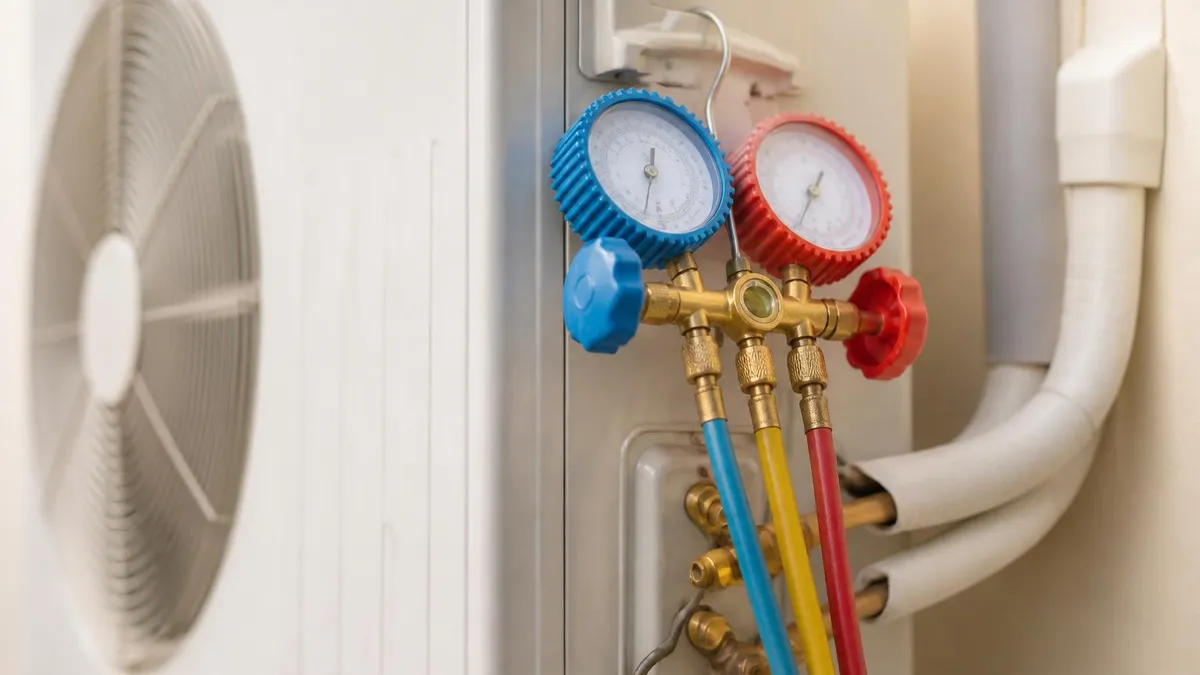
Every HVAC technician working with refrigerant in the United States must hold an EPA Section 608 certification. The rule applies regardless of state and regardless of whether the technician otherwise holds any state license — even an unlicensed apprentice cannot legally connect manifold gauges to a residential air conditioner without it. The certification comes in four flavours: Type I covers small appliances, Type II covers high-pressure systems, Type III covers low-pressure systems, and the Universal certification covers all three. Most working technicians pursue the Universal because almost every job site requires it.
The Section 608 exam is delivered by EPA-approved organisations including ESCO Institute, ferris.edu, Mainstream Engineering and Lakeland College. Cost is typically $25 to $75 per exam attempt. The test is closed-book, primarily multiple-choice, and covers refrigerant handling, recovery procedures, leak repair rules, the phase-down of high-GWP refrigerants and ozone-protection theory. There is no expiration on the credential itself, but the underlying regulations are tightened periodically — the recent transition from R-22 phase-out to R-410A phase-down has changed exam content substantially.
Candidates can prepare for the Section 608 exam using study materials. Preparation books or online courses can help first-time takers prepare for the exam. The combination of a closed-book format, the publicly available study guide and the relatively predictable question pool makes preparation manageable. Failed attempts almost always trace back to candidates who skipped studying entirely rather than to genuine difficulty with the content.

EPA Section 608 Certification Levels
Hermetically sealed systems with up to 5 lb of refrigerant. Covers domestic refrigerators, window air conditioners, vending machines and similar small equipment. Most limited certification.
Required for residential split systems, packaged rooftop units, heat pumps and most commercial HVAC equipment using high-pressure refrigerants like R-410A and R-32. Most common certification for working HVAC technicians.
Required for chillers and other equipment using low-pressure refrigerants like R-123 and R-1233zd. Specialised certification needed for centrifugal chiller technicians and large commercial work.
Combines Type I, Type II and Type III into a single credential. Most working technicians pursue Universal because employers prefer the broader scope. Slightly higher exam fee than individual types.
Apprentices may work with refrigerant under the direct supervision of a Section 608-certified technician without holding their own card. The exemption ends as soon as work is performed unsupervised.
Mobile vehicle air conditioning is regulated separately under Section 609. Required for technicians servicing automotive AC. Cheaper to obtain and unrelated to the building-trade Section 608.
State HVAC Licensing: Where the Real Variation Is
State-level HVAC licensing is where things get complicated. Roughly 40 states require some level of HVAC contractor license; the remainder leave it to local jurisdictions. California issues C-20 Warm-Air Heating, Ventilating and Air-Conditioning contractor licenses through the Contractors State License Board, with an exam covering trade knowledge, business and law, and a four-year journey-level experience requirement.
Florida runs a Class A Air Conditioning Contractor license that allows unlimited work plus a Class B Limited license restricted to small systems. Texas issues licenses through the Texas Department of Licensing and Regulation with an Air Conditioning and Refrigeration Technician registration plus a contractor license for those running independent businesses.
States with lighter regulation include Wyoming, South Dakota, Kansas and a few others where licensing is handled at the city or county level rather than statewide. Even in those states, federal Section 608 still applies to refrigerant work, and most municipalities require permits for installation and replacement work. The practical reality is that nearly every working HVAC technician in the United States needs both the federal Section 608 certification and some local authorisation to work — the only question is whether the local layer is a state license, a city license or a registration.
Some states tie HVAC licensing to mechanical contractor licensing more broadly, which is why a single license may also authorise plumbing or sheet-metal work depending on jurisdiction. Other states keep HVAC strictly separate from related trades. Reading the exact scope of the license is critical before assuming it covers any specific job — for example, several states require a separate refrigeration contractor license for commercial refrigeration work even though the underlying equipment overlaps heavily with HVAC.
License Tiers in a Typical State
Entry tier. Works under direct supervision of a journeyman or master. No exam required. Usually registered with the state but not formally licensed. Earning hours toward eventual journeyman exam eligibility — typically 4,000 to 8,000 hours of documented field experience required.
The Apprenticeship Path
Most HVAC professionals start as apprentices. The traditional path involves a four- or five-year registered apprenticeship combining on-the-job training with classroom instruction. Federal Department of Labor apprenticeship programs and state-approved programs both exist; the most common sponsors are local chapters of unions like SMART (Sheet Metal, Air, Rail, Transportation) and the United Association of Plumbers and Pipefitters, or non-union trade associations like ABC and PHCC.
Apprentices earn progressively higher wages — typically 50 percent of journeyman pay in year one rising to 90 percent or more by year four — while logging the 4,000 to 8,000 hours of supervised work needed for journeyman eligibility.
The faster alternative is a community college HVAC program. These run 6 to 24 months and cover the core technical curriculum — refrigeration theory, electrical, controls, indoor air quality, codes and basic ductwork. A graduate of an accredited HVAC program may receive credit toward state apprentice hour requirements. The downside is that classroom training does not fully replace field experience, and most state licensing boards still require a substantial number of supervised work hours before any journeyman exam can be taken. Combining a one-year community college program with a structured apprenticeship is common.
Apprenticeship pay has improved noticeably over the past five years as labour shortages have pushed sponsors to compete for talent. Starting hourly wages of $18 to $22 are now common in many markets, with periodic raises tied to documented hours and skill milestones. Health insurance, retirement contributions and tuition support for related coursework are increasingly standard in unionised apprenticeships, although less consistent in non-union sponsor programs. The total compensation package matters more than headline hourly rate when comparing programs.
Performing licensed HVAC work without the required state credential can trigger fines from the contractor board, voiding of your homeowner's insurance if a claim arises, and personal liability for damages caused by unlicensed work. Some states make repeat unlicensed contracting a misdemeanor or felony. The risk falls on both the worker and the customer, which is why reputable employers require licensure verification at hire.
What's on the Exam
State HVAC license exams cover a predictable set of topics, with the depth and weighting varying by state and license tier. Refrigeration theory — the vapour compression cycle, superheat and subcooling, refrigerant pressure-temperature relationships — usually accounts for the largest single block of questions. Electrical content covers single-phase and three-phase circuits, capacitor and contactor diagnosis, motor protection and basic controls wiring. HVAC-specific topics include load calculation, duct design fundamentals, indoor air quality standards and combustion safety for gas furnaces.
Business and law content appears on master and contractor exams but rarely on journeyman exams. Topics include contract law, lien procedures, mechanical code interpretation, OSHA safety regulations and basic accounting principles. The business portion trips up many technicians who excel at the trade content because they have not studied liability, contract structure or workers' compensation rules. Most states publish a candidate handbook listing exam topic weights, recommended reference books and the specific code editions in force — reading the handbook before booking the exam is the single highest-yield piece of preparation.
Code references vary state to state. Most states use the International Mechanical Code (IMC) as the technical foundation, but some retain the Uniform Mechanical Code (UMC) or have state-specific amendments layered on top. The exam will almost always reference a specific code edition — for example, IMC 2021 or 2024 — and questions are written against that edition. Studying with the current code book is therefore essential rather than relying on older copies that may differ in critical sections.
HVAC License Application Checklist
- ✓Confirm which credential you actually need — federal EPA 608 plus state license tier
- ✓Verify which state's license applies — based on where the work will be performed, not where you live
- ✓Document your apprenticeship or work hours with employer attestations
- ✓Gather proof of any HVAC training program completion
- ✓Pay the application fee — typically $50–$500 depending on state and tier
- ✓Complete background check and fingerprinting where required
- ✓Verify continuing education and pre-license course hours required
- ✓Schedule the exam through the state's testing vendor (Pearson VUE, PSI, ProV)
- ✓Bring approved calculator, government ID and exam-day documents
- ✓Plan for re-examination policies if first attempt fails — most states allow 2-3 retakes
NATE Certification and Other Voluntary Credentials
The most recognised voluntary HVAC credential is NATE — North American Technician Excellence. NATE certifications cover specific equipment categories: air conditioning, heat pumps, gas furnaces, oil furnaces, hydronics and several specialty areas. Each certification requires passing a core exam plus a specialty exam. NATE is not a licensing requirement in any state — it is a private industry credential — but many employers prefer NATE-certified technicians and pay them higher hourly rates. Customer-facing branding (look for the NATE logo on service vans) also signals quality to homeowners.
Other voluntary credentials include HVAC Excellence, BPI (Building Performance Institute) for energy auditing, and manufacturer-specific factory training programs from Trane, Carrier, Lennox, Rheem and Daikin. These add to a technician's marketability without changing legal authority to perform work. They become more important at the higher end of the trade — commercial controls technicians, energy auditors and large-system specialists are often expected to hold multiple voluntary credentials in addition to state licensing.
The financial value of voluntary credentials is most visible in commercial and industrial work, where building owners increasingly require contractors to staff projects with credentialed technicians as part of contract specifications. A residential service technician may rarely encounter a job that demands NATE certification, but a commercial maintenance contractor bidding on a corporate office portfolio will almost certainly need NATE-certified staff to win the work. Investing in voluntary credentials early in a career often pays back through expanded job opportunities later.
License Renewal and Continuing Education
Most state HVAC licenses renew on a one-, two- or three-year cycle. Renewal requires payment of a renewal fee, documented continuing education hours, and a confirmation that the licensee has not been the subject of disciplinary action. CE requirements typically run 8 to 16 hours per renewal period, covering code updates, refrigerant transitions, safety topics and best practice changes. Failing to complete CE on time triggers a delayed renewal at minimum and can void the license entirely if neglected for too long.
EPA Section 608 itself does not formally expire, but the regulations behind it change. Major recent changes include the phase-down of R-410A in favour of lower-GWP refrigerants like R-32 and R-454B, the requirement for leak repair within set timeframes for systems above certain refrigerant charge levels, and the tightening of recordkeeping requirements for refrigerant purchase and disposition. Technicians who got certified ten years ago and have not engaged with continuing education may legally still be certified but technically out of date — many employers require periodic refresher training as a result.
Some states have moved toward online renewal portals that simplify the documentation process. The technician logs in, certifies CE completion against an approved provider list, pays the renewal fee and receives an updated wallet card by mail. Other states still require paper applications. Either way, setting calendar reminders 60 to 90 days before expiry is the simplest way to avoid the cascade of late fees and reinstatement procedures that follow a missed deadline.
HVAC License Numbers
Key Facts at a Glance
| Item | Value | Details |
|---|---|---|
| Typical EPA Section 608 exam fee | $25–$75 | |
| Field hours typical for journeyman eligibility | 4,000+ | |
| State license application fee range | $50–$500 | |
| Typical CE hours per renewal cycle | 8–16 hr | |
| License renewal cycle range | 1–3 yr |
Sample State Licensing Snapshots
Issued by Contractors State License Board. Requires 4 years of journey-level experience, two-part exam (trade plus business and law), surety bond and workers' comp coverage. Strong reciprocity with Arizona, Nevada, Utah.
Class A allows unlimited work, Class B limited to small systems (15 tons cooling, 500,000 BTU heating). 4 years of experience, financial responsibility check and exam through the DBPR. Reciprocity case-by-case.
Technicians register with Texas Department of Licensing and Regulation. Independent contractors need Air Conditioning and Refrigeration Contractor License with 48 months of practical experience and exam pass.
Class I (unrestricted) and Class II (restricted to under 175,000 BTU heating, 22 tons cooling). Requires 4 years of experience and exam. Reciprocity with several southeastern states.
Three classes covering different scope (heating only, AC only, full HVAC). Each requires experience and exam through the State Board of Examiners of Plumbing, Heating and Fire Sprinkler Contractors.
Issued by Department of Licensing and Regulatory Affairs. Requires 3 years of experience (or trade school equivalent), pre-license course and contractor exam. Surety bond required at issuance.
Reciprocity, Mobility and Multi-State Work
Reciprocity between states is the single biggest convenience question for HVAC professionals planning to relocate or take cross-border work. Some state pairs have formal reciprocity agreements that allow license transfer with minimal additional testing — California and Arizona, Texas and Louisiana, Georgia and Tennessee are common pairs. Others require an out-of-state endorsement application that recognises some experience but still requires a local exam on state-specific code and law. A handful of states require a full new application as if you were unlicensed.
The practical strategy for technicians planning multi-state work is to research state contractor board websites before applying. Each board publishes its current reciprocity table. Confirming reciprocity in writing before paying transfer fees avoids the surprise of a denied application after months of paperwork. Some experienced technicians maintain active licenses in two or three states simultaneously to handle work near state borders or to support travel across regional service territories. The annual fees for additional licenses are usually modest compared with the income they enable.
Border markets create some interesting mobility patterns. A contractor based in Memphis, Tennessee may regularly take work in northern Mississippi and eastern Arkansas, which means three separate state licenses are economically worthwhile despite the duplicate paperwork. The same applies in the New York-New Jersey-Connecticut tri-state area, the Washington DC metro spanning Maryland and Virginia, and the Kansas City area straddling Missouri and Kansas. Planning license geography around the actual service territory rather than the home state is part of running a successful regional business.
Insurance considerations also influence licensing decisions for contractors operating in multiple jurisdictions. General liability and workers compensation policies are often tied to specific licensed states, and adding states to a policy mid-cycle can trigger premium recalculations. Carriers want to see the licence number on file before extending coverage, so the licensing paperwork and the insurance paperwork tend to move together rather than separately.
Becoming a Licensed HVAC Pro
- +Strong job market with steady demand across all regions
- +Median wages around $52,000 with top quartile above $75,000
- +Path from apprentice to business owner is well-defined
- +Federal Section 608 plus state license combination is portable
- +NATE and manufacturer credentials boost earning potential further
- −Federal-plus-state-plus-local licensing creates paperwork complexity
- −Apprenticeship hour requirements stretch path to journeyman by 2–4 years
- −Continuing education burden recurs every 1–3 years
- −Working without a license carries fines, civil and criminal exposure
- −Reciprocity gaps between states make cross-border moves a process
Sample HVAC Practice Questions
Try these questions from our free HVAC practice tests. The correct answer and an explanation follow each question.
Which document provides the minimum ventilation requirements adopted by most US state and local building codes for commercial buildings?
- A. SMACNA HVAC Systems and Equipment
- B. ASHRAE 62.1
- C. ACCA Manual Q
- D. NFPA 90A
Answer: B. ASHRAE 62.1
ASHRAE 62.1 'Ventilation for Acceptable Indoor Air Quality' is the industry standard referenced by the International Mechanical Code and adopted by most US jurisdictions.
Which energy code compliance path allows a trade-off between building envelope and HVAC efficiency?
- A. Performance path (energy modeling to meet a total energy budget)
- B. Prescriptive path (meeting fixed minimum values for each component)
- C. Climate zone exemption path
- D. Simplified prescriptive path for small buildings
Answer: A. Performance path (energy modeling to meet a total energy budget)
The performance compliance path uses whole-building energy modeling, allowing a less efficient envelope to be offset by a more efficient HVAC system as long as total energy use meets the budget.
Which document typically outlines the compliance requirements for HVAC professionals?
- A. Employee handbook
- B. Marketing brochure
- C. Standards of practice and code of conduct
- D. Annual financial report
Answer: C. Standards of practice and code of conduct
Standards of practice and codes of conduct define the professional and ethical requirements practitioners must follow.
HVAC Questions and Answers
How this page was made: written with AI tools. We have not yet matched this exam's facts to an official source, so confirm fees, dates and rules with the exam body. Not reviewed by a subject-matter expert. Editorial policy