
HVAC Trade Schools: The Complete Guide to Training Programs, Costs, Certifications, and Launching Your Career
📝 HVAC trade schools guide: compare program types, tuition costs, certifications, EPA 608, and how to launch a high-paying heating and cooling career.

HVAC trade schools have become one of the fastest, most affordable routes into a stable, well-paying skilled trade, and demand for trained technicians keeps climbing as aging buildings, stricter efficiency codes, and a wave of retiring workers reshape the field. Whether you want to repair residential air conditioners, install commercial rooftop units, or eventually move into hvac trade schools and consulting roles, formal training gives you the foundation employers expect. This guide walks through every realistic path so you can choose the program that fits your budget and timeline.
The heating, ventilation, and air conditioning trade rewards hands-on learners who enjoy diagnosing mechanical and electrical problems. Unlike a four-year degree that buries you in debt, most HVAC programs run between six months and two years, and many students work paying jobs while they study. You will learn refrigeration cycles, electrical theory, airflow design, controls, and the safety practices that keep both technicians and customers protected from gas leaks, electrical hazards, and refrigerant exposure on every single service call you run.
Choosing a school is not just about cost. Accreditation, EPA Section 608 preparation, employer partnerships, and the quality of the hands-on lab matter enormously. A cheap program that never lets you touch a manifold gauge or wire a contactor leaves you unprepared for your first day on the job. Throughout this guide we point out the questions to ask, the red flags to avoid, and the credentials that genuinely move your resume to the top of an employer's growing pile of applicants.
You also have more options than a traditional classroom. Community colleges offer low-cost certificates and associate degrees, private technical institutes run accelerated tracks, and registered apprenticeships pay you a wage while you learn under a licensed contractor. Each path has trade-offs in price, speed, depth, and job placement support. Understanding those differences before you enroll prevents the expensive mistake of picking a flashy program that does not match how you actually learn or how quickly you need to start earning a real income.
The financial picture is encouraging. According to the U.S. Bureau of Labor Statistics, HVAC mechanics and installers earned a median wage well above the national average for all occupations, and the field is projected to add tens of thousands of jobs this decade. Skilled technicians who add certifications in commercial refrigeration, building automation, or energy auditing can push their income substantially higher, especially in metropolitan areas with heavy construction activity and dense aging building stock that constantly needs service.
This article is built for someone making a real decision. We cover program formats, typical tuition ranges, the certifications you must earn, a realistic timeline from enrollment to licensed technician, the pros and cons of trade school versus apprenticeship, and a practical checklist for evaluating any school. We also include free HVAC practice questions so you can test your knowledge as you study. By the end you will know exactly what to look for and what your concrete next step should be.
Before you commit a dollar or an hour, it helps to understand that HVAC is a regulated trade. Federal law requires certification to handle refrigerants, most states license contractors, and many municipalities enforce mechanical codes that govern installation. A good trade school does not just teach you to swap a capacitor; it prepares you to pass these exams and work legally and safely. Keep that regulatory backdrop in mind as you read, because it shapes every recommendation that follows throughout this entire guide.
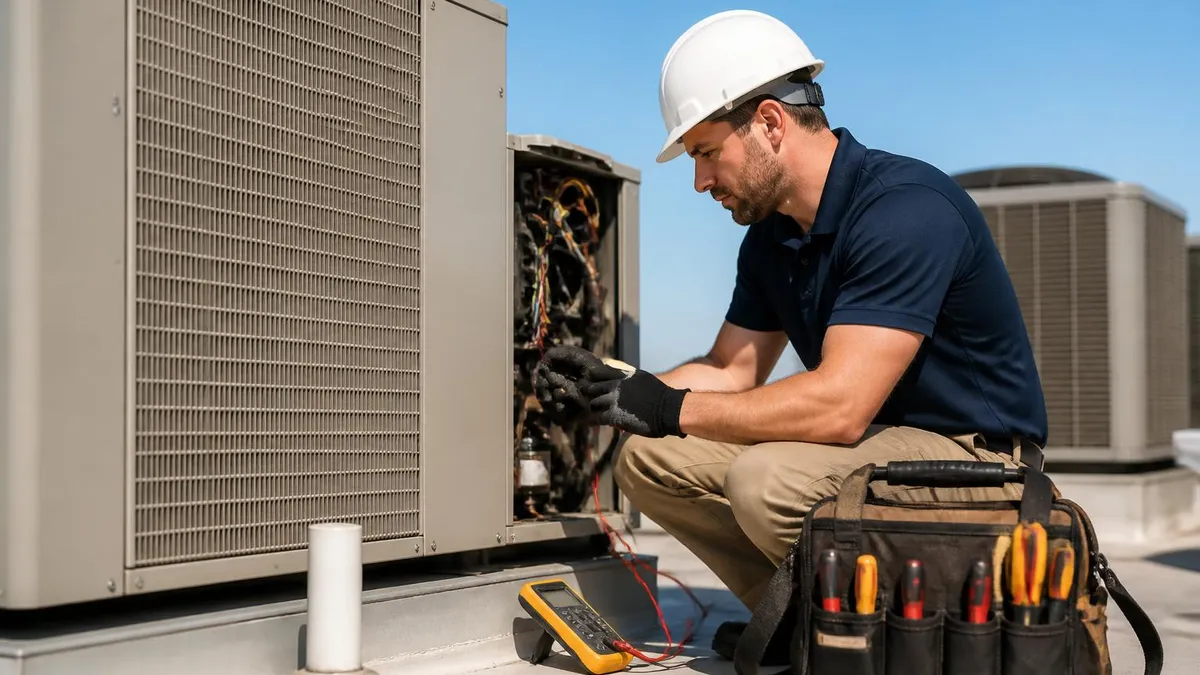
HVAC Trade Schools by the Numbers
Types of HVAC Training Programs
The fastest route, usually 6 to 12 months. Focuses tightly on core skills like refrigeration, electrical basics, and EPA prep. Ideal if you want to start working quickly and learn the rest on the job.
A two-year option at community colleges covering deeper theory, system design, building science, and general education. Stronger for supervisory roles, commercial work, or future transfer into engineering technology programs.
A paid earn-while-you-learn model combining classroom hours with thousands of on-the-job training hours under a licensed contractor. Typically three to five years and ends with journeyman-level competency.
Short manufacturer courses and hybrid online programs supplement core training. Online theory works, but you still need a hands-on lab or job site to master tools, gauges, and real diagnostics.
Cost is usually the first question prospective students ask, and the honest answer is that HVAC training spans a wide price range depending on the institution. Public community college certificates can cost as little as $1,200 to $4,000 for an entire program, while private technical institutes frequently charge $10,000 to $15,000 or more for an accelerated diploma. Associate degrees fall in between, often $5,000 to $12,000 across two years at in-district tuition rates, which makes the public option remarkably affordable compared with most other forms of career training.
Tuition is only part of the budget. You should plan for tools, safety gear, textbooks, an EPA 608 exam fee, and sometimes a uniform or lab deposit. A starter tool kit with a quality manifold gauge set, multimeter, tube cutters, and hand tools can run $300 to $800. Some schools bundle tools into tuition, which sounds convenient but can hide a markup. Always ask for an itemized cost sheet so you can compare programs on equal footing rather than on headline price alone.
The good news is that financial aid is widely available. Public colleges and many accredited private schools accept federal student aid through the FAFSA, including Pell Grants that never require repayment. Veterans can often use GI Bill benefits, and many states fund workforce grants specifically for high-demand trades like HVAC. Workforce development boards, union scholarships, and even employer tuition reimbursement programs can dramatically reduce what you pay out of pocket if you take the time to research and apply for them.
Apprenticeships flip the financial equation entirely. Instead of paying tuition, you earn an hourly wage that rises as you gain skill, while your sponsoring employer or union often covers the related classroom instruction. The trade-off is a longer commitment, typically three to five years, and a slower path to full earning potential. For someone who cannot afford to stop working or take on debt, an apprenticeship is frequently the smartest financial choice even though it takes longer to complete than a certificate.
Be cautious with for-profit schools that advertise aggressively and quote a single large number. Some deliver excellent hands-on training and strong placement; others charge premium prices for outcomes you could get far cheaper at a community college. Read the enrollment agreement carefully, ask about the true all-in cost, and verify graduation and job placement rates. A program that costs three times more should demonstrate three times the value through better labs, employer connections, or credentials, not just slicker marketing materials.
When you compare total return on investment, HVAC training looks excellent. A student who spends $4,000 on a community college certificate and lands a job paying $45,000 to $55,000 recovers tuition within weeks of starting work. Even a $14,000 private program pays back quickly given the trade's solid wages and steady demand. Few career fields offer this combination of low entry cost, short training time, and reliable employment, which is exactly why HVAC remains one of the most consistently recommended skilled trades.
Finally, factor in the cost of licensing and continuing education after you graduate. Most states require a contractor license to run your own business, and many require periodic continuing education to renew. Refrigerant regulations evolve, new equipment arrives, and codes update on a regular cycle. Budgeting a few hundred dollars annually for ongoing certification keeps your skills current and your credentials valid, protecting the investment you made in your initial schooling and keeping you genuinely competitive in a changing field.
Comparing HVAC Trade Schools Formats
Community colleges deliver the best value in the entire trade. In-district tuition is low, instructors are often working professionals, and credits may transfer toward a degree later. Programs typically run two to four semesters and prepare you for EPA 608 and entry-level employment. Class sizes can be larger, and you may wait a semester for an opening, but the affordability and accreditation make this the default recommendation for most new students.
The main limitation is pace. A community college follows a fixed academic calendar, so you cannot start whenever you want or accelerate dramatically. If you need to begin earning within a few months, the slower semester structure may frustrate you. Still, for cost, credibility, and financial aid access, public colleges are hard to beat and should be the first option every prospective HVAC student investigates before paying for anything else.
Trade School vs. Apprenticeship: Which Is Better?
- +Trade school gets you job-ready in 6 to 24 months
- +Structured curriculum covers theory you might skip on the job
- +Financial aid, grants, and GI Bill benefits are widely available
- +Modern labs let you practice before facing real customers
- +A recognized credential strengthens your resume immediately
- +Many schools offer job placement assistance and employer connections
- −Tuition can reach $15,000 at private institutes
- −Classroom learning lacks the volume of real-world repetition
- −You earn no wage while studying full time
- −Quality varies widely, especially among for-profit schools
- −Some programs skimp on critical hands-on lab time
- −A certificate alone may not meet state licensing hour requirements
Pros and Cons at a Glance
| Pros | Cons |
|---|---|
| Structured curriculum covers theory you might skip on the job | Classroom learning lacks the volume of real-world repetition |
| Financial aid, grants, and GI Bill benefits are widely available | You earn no wage while studying full time |
| Modern labs let you practice before facing real customers | Quality varies widely, especially among for-profit schools |
| A recognized credential strengthens your resume immediately | Some programs skimp on critical hands-on lab time |
| Many schools offer job placement assistance and employer connections | A certificate alone may not meet state licensing hour requirements |
How to Evaluate HVAC Trade Schools Before Enrolling
- ✓Confirm the school is accredited by a recognized agency.
- ✓Verify the program prepares you for EPA Section 608 certification.
- ✓Ask for documented graduation and job placement rates.
- ✓Tour the hands-on lab and count working training units.
- ✓Check that instructors hold current industry credentials.
- ✓Request an itemized total cost including tools and exam fees.
- ✓Confirm the school accepts federal financial aid via FAFSA.
- ✓Ask whether credits transfer toward an associate degree.
- ✓Find out how the school connects graduates with employers.
- ✓Read the full enrollment agreement and refund policy carefully.
EPA 608 certification is non-negotiable
Federal law requires EPA Section 608 certification before you can legally purchase or handle refrigerants. Any HVAC trade school worth your money builds this exam directly into its curriculum. If a program cannot tell you how it prepares students for the 608, treat that as a serious warning sign and look elsewhere.
A strong HVAC program teaches far more than swapping parts. It starts with the science: thermodynamics, the refrigeration cycle, heat transfer, and the pressure-temperature relationships that govern every air conditioner and heat pump. Understanding why refrigerant boils in the evaporator and condenses in the condenser is what separates a parts-changer from a true diagnostician. Schools reinforce this theory with psychrometrics, the study of air properties, so you can measure humidity, airflow, and comfort the way seasoned professionals do on real installations.
Electrical training forms the second pillar. HVAC equipment is full of motors, capacitors, contactors, relays, transformers, and control boards, and a huge share of service calls trace back to electrical faults. You will learn to read wiring diagrams, use a multimeter safely, measure voltage and amperage, and trace control circuits from the thermostat to the compressor. This skill set overlaps heavily with the knowledge tested in our electrical controls practice material, and mastering it makes you dramatically more employable on day one.
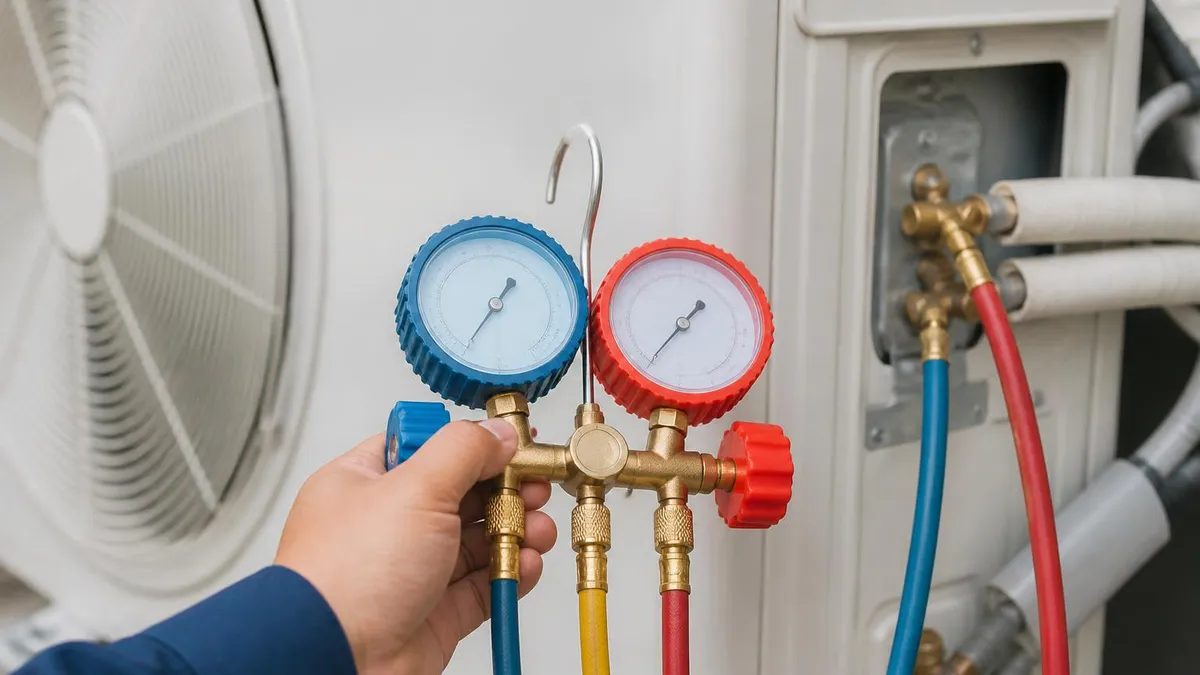
Refrigerant handling is both a technical and a legal subject. Programs teach you to recover, recycle, evacuate, and charge systems correctly, along with leak detection and the environmental rules that govern these chemicals. This is where EPA 608 preparation lives. You will practice connecting manifold gauges, pulling a deep vacuum with a micron gauge, and weighing in a precise charge. Doing this wrong damages equipment and breaks federal law, so schools spend serious lab time drilling correct procedures until they become second nature to you.
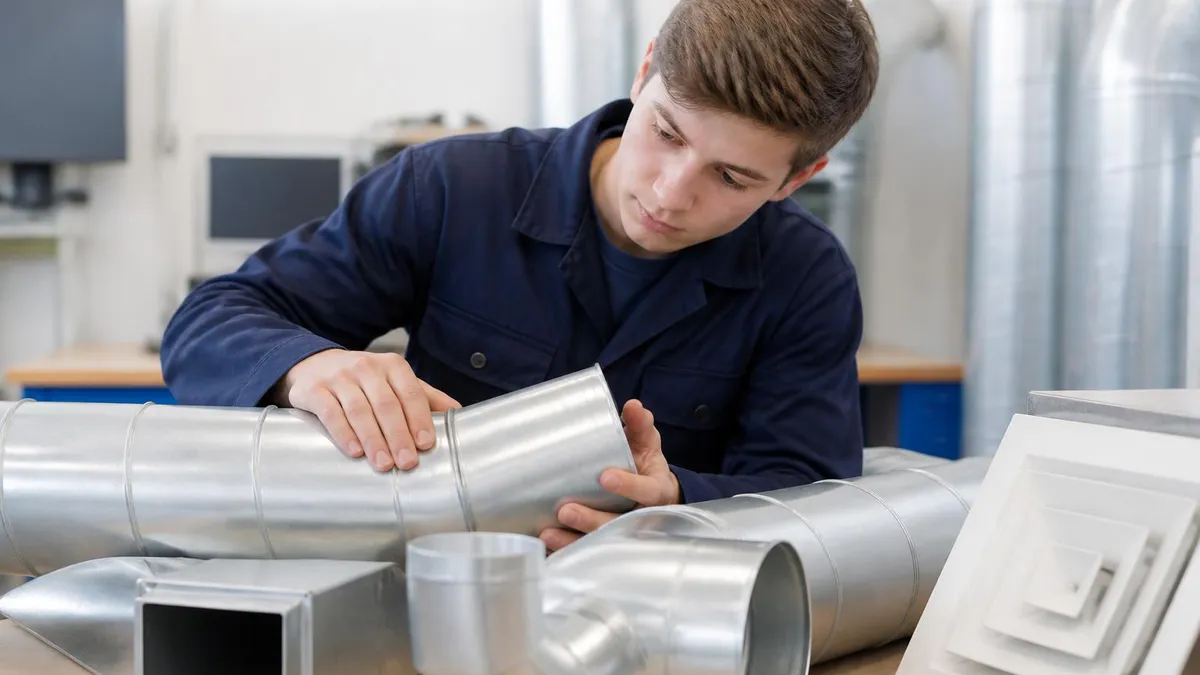
Airflow and ductwork round out the core. A system can be charged perfectly and still fail to keep a house comfortable if the ducts are leaky, undersized, or poorly designed. You will learn duct sizing, static pressure measurement, balancing, and sealing techniques that directly affect efficiency and comfort. Good programs connect this to building science, showing how insulation, infiltration, and load calculations determine what equipment a home actually needs rather than relying on guesswork or outdated rules of thumb.
Heating systems deserve equal attention. Depending on your region you will study gas furnaces, heat pumps, boilers, and electric resistance heat, along with the combustion safety practices that prevent carbon monoxide hazards. You will learn to test gas pressure, inspect heat exchangers, set burners, and diagnose ignition faults. Heat pump training has grown especially important as electrification accelerates, and technicians comfortable with modern variable-speed inverter equipment command a clear premium in the current job market.
Finally, the best schools weave in professionalism and controls. Modern thermostats, zoning systems, and building automation require comfort with low-voltage wiring, configuration menus, and increasingly with networked devices. You will also practice customer communication, written documentation, and the soft skills that turn a competent technician into one customers request by name. Employers consistently say attitude, reliability, and clear communication matter as much as raw technical ability, so treat these lessons with the same seriousness as the wrench work.
Throughout the program, hands-on repetition is what cements everything. Reading about a TXV is useless until you have actually felt a flooded evaporator and watched superheat respond to a charge adjustment. The strongest schools run trainer units that break in realistic ways, so students diagnose faults under instructor supervision before they ever bill a customer. When you evaluate programs, prioritize lab hours above almost everything else, because that practical fluency is precisely what your first employer is paying for.
If you want the full picture, the hvac trade schools guide walks through it step by step.
A trade school certificate alone may not satisfy your state's contractor licensing requirements, which often demand documented field experience hours. Before enrolling, check your state board's exact rules so you know whether you will also need apprenticeship or journeyman hours after graduation. Planning this early prevents an unwelcome surprise when you try to get licensed.
The career payoff is what draws most people to HVAC, and the numbers support the optimism. Entry-level technicians commonly start in the $40,000 to $50,000 range, with experienced service techs earning $60,000 to $80,000 and specialists or those running their own businesses earning well into six figures. Overtime during peak cooling and heating seasons is plentiful, and skilled technicians rarely struggle to find work because every home and building eventually needs service. This steady demand creates remarkable job security across economic cycles.
Your first job out of school is usually as an installer or service helper, learning the rhythm of real work under a seasoned lead. From there you can advance to lead service technician, then to roles like service manager, project estimator, or commercial specialist. Many technicians eventually transition into hvac trade schools and comfort consulting, where strong technical knowledge combined with people skills can produce excellent income through commissions and larger system sales to homeowners and businesses.
Specialization is the surest way to raise your ceiling. Commercial refrigeration technicians who service supermarkets and cold storage are perpetually in demand and well paid. Building automation and controls specialists who program and network large building systems command premium wages. Energy auditors and efficiency consultants tap into the growing retrofit market driven by utility rebates and decarbonization goals. Each specialty builds on the same trade school foundation, so choosing a school that exposes you to several areas keeps your future options wide open.
Geography matters too. Hot, humid regions like the South and Southwest run air conditioning year-round and support enormous service demand, while northern markets emphasize heating and increasingly heat pumps. Major metropolitan areas with dense aging building stock offer the highest wages and the most commercial opportunity. If you are willing to relocate or work in a high-cost market, your earning potential rises accordingly, though so does competition and the cost of living you must carefully weigh against it.
Entrepreneurship is a realistic long-term goal in this trade. Many technicians spend several years building skill and a customer reputation, then start their own company. The barriers are modest compared with other industries: a contractor license, a van, tools, insurance, and a willingness to handle the business side. Owners who manage scheduling, marketing, and a small crew well can build genuinely lucrative companies, and HVAC businesses are attractive acquisition targets when an owner eventually decides to sell and retire.
The trade also offers stability that office jobs increasingly lack. HVAC work cannot be offshored or fully automated; someone has to physically be in the building turning the wrenches and reading the gauges. As construction continues and existing equipment ages, the work simply does not disappear. Combined with low training costs and short time to employment, this durability is why career counselors and labor economists repeatedly highlight HVAC as one of the smartest skilled-trade choices available to new workers today.
Finally, think about the lifestyle that fits you. Residential service offers variety and direct customer contact, with seasonal intensity in summer and winter. Commercial and industrial work tends toward larger projects, more predictable hours, and complex systems. New construction installation is physically demanding but steady, while maintenance contracts provide recurring, lower-stress work. A good trade school exposes you to several of these worlds so you can steer your career toward the daily rhythm and customer mix that genuinely suits your personality.
Once you have chosen a school, a little preparation makes the experience far more productive. Brush up on basic math, especially fractions, decimals, ratios, and simple algebra, because you will use these constantly for sizing, pressures, and electrical calculations. A few hours reviewing arithmetic before classes start pays off quickly. Reading a beginner electricity primer also smooths the steep early learning curve, since electrical theory tends to be the subject new students find most intimidating during their very first semester.
Invest early in your own quality tools rather than relying solely on shared lab equipment. A reliable multimeter, a decent manifold gauge set, and well-fitting hand tools become extensions of your hands, and getting comfortable with your own gear during training means you arrive on the job site already fluent. Take care of these tools; a technician who maintains their equipment signals reliability to employers. Many schools recommend specific kits, so ask before buying to avoid duplicating items already bundled into tuition.
Treat the EPA 608 exam as a priority from day one rather than a last-minute scramble. Study the differences between Type I, Type II, Type III, and Universal certifications, and use practice questions repeatedly until recovery procedures, pressure relationships, and regulatory limits feel automatic. The Universal certification, covering all equipment types, is worth the modest extra effort because it removes a hiring barrier and signals seriousness to employers. Passing it before graduation lets you start handling refrigerant immediately on the job.
Practice tests are one of the most efficient study tools available, and not just for the EPA exam. Working through realistic questions on air conditioning, heating, ductwork, electrical controls, energy efficiency, and code compliance reveals exactly where your understanding is thin. Spaced repetition, reviewing material at increasing intervals, dramatically improves retention compared with cramming. Build a weekly habit of timed practice quizzes, then revisit every question you missed and trace the underlying concept until it genuinely clicks rather than just memorizing the answers.
Show up to lab sessions ready to do the work, because hands-on time is the most valuable part of any program. Volunteer to wire the circuit, pull the vacuum, or run the diagnostic while classmates hang back. Ask your instructors about the weird failures they have seen in the field; these war stories teach pattern recognition you cannot get from a textbook. The students who graduate most job-ready are invariably the ones who treated every lab session as if a paying customer were watching them work.
Start building professional relationships before you graduate. Attend any employer events, job fairs, or guest lectures your school hosts, and connect with local contractors through industry associations. Many students land their first job through an instructor's recommendation or a classmate's tip rather than a cold application. A clean resume listing your EPA 608, hands-on lab hours, and any tool proficiency, combined with a reputation for showing up and working hard, opens doors faster than credentials ever could alone.
Finally, plan for continuous learning beyond graduation. HVAC technology evolves constantly, from new refrigerants and variable-speed equipment to smart controls and tighter efficiency codes. Commit to manufacturer training, keep your certifications current, and stay curious about emerging areas like heat pumps and building automation. The technicians who earn the most and enjoy the longest careers are lifelong learners who treat their initial trade school education as a strong foundation rather than the finish line of their professional development.
Sample HVAC Practice Questions
Try these questions from our free HVAC practice tests. The correct answer and an explanation follow each question.
How often should HVAC compliance training be conducted?
- A. Only during initial orientation
- B. Every five years
- C. At regular intervals as required by regulations
- D. Only when violations occur
Answer: C. At regular intervals as required by regulations
Compliance training must be conducted at regular intervals as specified by applicable regulations to keep practitioners current.
Which energy code compliance path allows a trade-off between building envelope and HVAC efficiency?
- A. Performance path (energy modeling to meet a total energy budget)
- B. Prescriptive path (meeting fixed minimum values for each component)
- C. Climate zone exemption path
- D. Simplified prescriptive path for small buildings
Answer: A. Performance path (energy modeling to meet a total energy budget)
The performance compliance path uses whole-building energy modeling, allowing a less efficient envelope to be offset by a more efficient HVAC system as long as total energy use meets the budget.
If an HVAC system has a higher outdoor ambient temperature, what typically happens to the condensing pressure?
- A. It decreases
- B. It remains unchanged
- C. It increases
- D. It drops to evaporating pressure
Answer: C. It increases
Higher ambient temperatures reduce the temperature difference available for heat rejection, requiring higher condensing pressure and temperature.
HVAC Questions and Answers
HVAC Sales: The Complete Guide to Selling Heating and Cooling Systems, Building Customer Trust, and Closing More Deals

HVAC Air Duct Sealing: The Complete Homeowner and Contractor Guide to Sealing Ductwork for Efficiency, Comfort, and Indoor Air Quality
HVAC Solutions: The Complete Guide to Heating, Cooling, and Indoor Air Quality Systems for Homes and Buildings

Commercial HVAC Repair: Systems, Costs, and Service Strategies
HVAC Evaporator: Complete Guide to How It Works, Common Problems, and Maintenance
About the Author

NATE Certified HVAC Technician & Licensing Exam Trainer
Universal Technical InstituteMike Johnson is a NATE-certified HVAC technician and EPA 608 universal-certified refrigerant handler with a Bachelor of Science in HVAC/R Technology. He has 19 years of commercial and residential HVAC installation and service experience and specializes in preparing technicians for NATE certification, EPA 608, A2L refrigerant safety, and state HVAC contractor licensing examinations.