
Forklifts for Sale: New, Used, Classes and Buying Guide 2026 October
Forklifts for sale guide — 📚 new vs used vs lease pricing, OSHA classes, top brands like Toyota and Caterpillar, where to buy, inspection and financing.
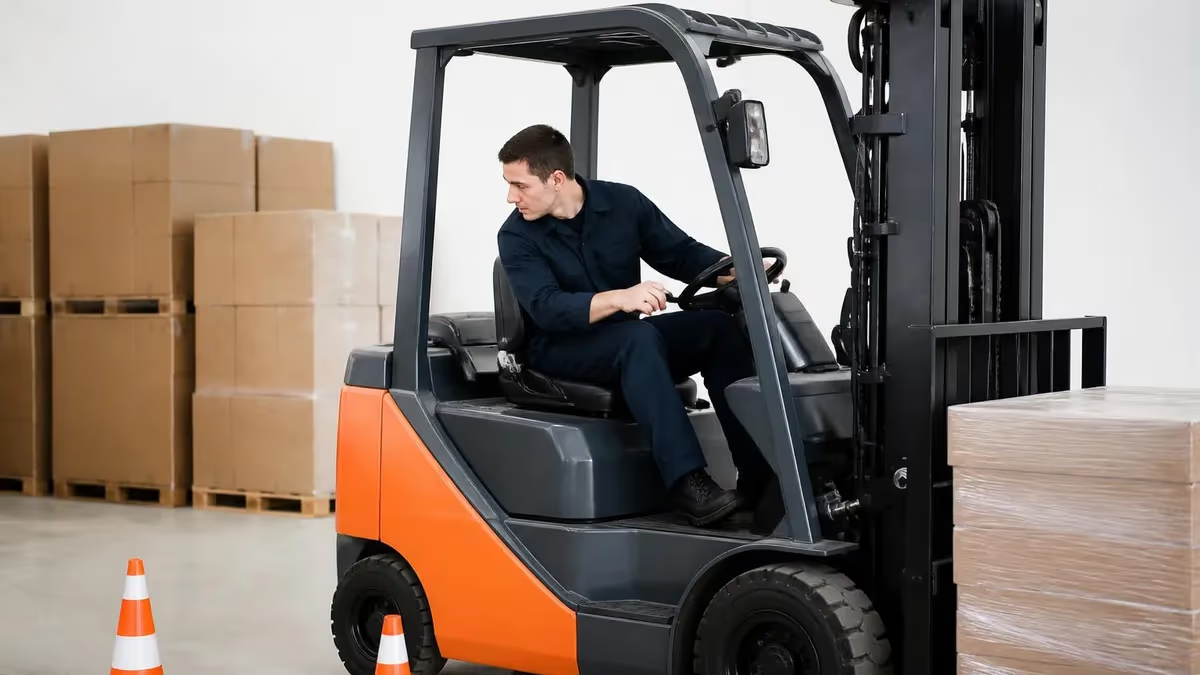
Forklifts for sale come in dozens of configurations across power sources, capacities, lift heights and OSHA-defined classes. Whether you are running a warehouse, a lumber yard, a port operation or a small distribution business, the right forklift purchase depends on what you are lifting, where you are lifting it, how often, and how the equipment fits into your overall fleet strategy. New forklifts in 2026 typically cost $25,000 to $70,000 for standard 5,000-pound-capacity units, with specialty models like rough-terrain and high-reach lifts running well above $100,000.
The decision between new, used and lease is the first big choice. New forklifts come with full manufacturer warranty, the latest safety and emission technology, financing programs through the dealer and predictable maintenance for the first several years. Used forklifts trade at 30% to 70% of new prices and can be excellent value if inspected properly, but bring questions about hour readings, prior maintenance and remaining life. Leasing combines aspects of both — predictable monthly cost, included maintenance, but no ownership at the end.
The OSHA classification system divides forklifts into seven classes based on power source, application and design. Class I is electric counterbalanced trucks (the most common warehouse forklift); Class II is electric narrow-aisle reach trucks; Class III is electric pallet jacks and hand trucks; Class IV and V are internal combustion (IC) engine cushion-tire and pneumatic-tire forklifts; Class VI is electric and IC tow tractors; and Class VII is rough-terrain forklifts. Knowing your class determines training requirements, replacement parts ecosystem and resale market.
This guide walks through the buying process step by step — pricing for new and used across the major capacity ranges, the OSHA classification system, the leading manufacturers and what they are known for, where to find forklifts for sale (dealers, auctions, online marketplaces), how to inspect a used forklift before buying, financing and lease options, and the OSHA training requirements that kick in immediately after purchase regardless of who in your operation will operate the truck.

Forklift buying in 30 seconds
New 5,000-lb forklifts cost $25,000 to $70,000 depending on power source and brand. Used machines run $5,000 to $30,000. Lease payments typically $400 to $1,200 per month. Top brands include Toyota, Caterpillar, Hyster-Yale, Crown, Komatsu, Mitsubishi and Linde. Buy from authorized dealers, certified used programs, online marketplaces (MachineryTrader, IronPlanet) or industrial auctions. OSHA training is required for any operator before the truck is used in the workplace.
Pricing for new forklifts depends primarily on capacity, power source and brand tier. A new electric 3,000-pound capacity forklift from a mid-tier brand starts around $25,000 in 2026. The same capacity from a premium brand (Toyota, Crown, Linde) runs $35,000 to $45,000. A 5,000-pound electric counterbalance — the warehouse standard — runs $30,000 to $50,000 mid-tier and $45,000 to $65,000 premium. Internal combustion (LP gas, diesel) forklifts run roughly $5,000 to $10,000 less than electric equivalents at the same capacity.
Specialty forklifts cost substantially more. A 10,000-pound capacity warehouse truck runs $60,000 to $90,000. A 15,000-pound IC outdoor truck runs $80,000 to $110,000. Reach trucks (Class II) for narrow-aisle work cost $50,000 to $80,000. Order pickers (high-reach man-up trucks) cost $40,000 to $70,000. Rough-terrain telehandlers cost $80,000 to $200,000+ depending on lift height and capacity. Heavy-capacity port equipment can exceed $500,000 for a single unit.
Used forklift pricing follows a roughly predictable depreciation curve. A 3-year-old used forklift typically sells at 60% to 70% of new price. A 5-year-old at 40% to 50%. A 10-year-old at 20% to 30%. Beyond 10 years the value floor is closer to scrap or core value, with usable units selling for $3,000 to $8,000 depending on condition. Hour readings matter as much as years — a 5-year-old truck with 8,000 hours has been worked harder than a 10-year-old with 3,000 hours, and prices differ accordingly.
Lease pricing typically runs $400 to $1,200 per month for a 36 to 60 month term, depending on capacity, brand and whether maintenance is included. Full-maintenance leases bundle scheduled service, tire replacement, planned battery replacement (for electric) and emergency repair into the monthly fee. Operating leases keep the equipment off the balance sheet for accounting purposes; capital leases treat the truck as an asset acquisition for tax purposes. Most fleet managers prefer full-maintenance leases for predictability of cash flow.
OSHA forklift classification
Electric counterbalanced forklifts with cushion or pneumatic tires. The most common warehouse forklift type. Capacities typically 2,000 to 12,000 pounds. Quiet, emission-free, ideal for indoor use. Battery replacement every 5 to 8 years adds substantial total cost of ownership; lithium-ion conversions reduce maintenance.
Electric reach trucks, double-deep reach trucks and order pickers designed for narrow warehouse aisles. Operator stands or sits up high to reach upper rack levels. Common in distribution centers with high-density storage. Capacities typically 3,000 to 5,500 pounds. Higher purchase price than Class I but maximizes warehouse cube utilization.
Electric pallet jacks and hand trucks for ground-level horizontal pallet movement. Capacities 4,500 to 8,000 pounds. Walkie versions are walked behind; rider versions have a small platform. Lowest-cost class with prices from $3,000 used to $12,000 new. Essential for any operation moving pallets across floor distances.
IC engine forklifts running on LP gas, diesel or gasoline. Class IV uses cushion tires for indoor smooth-floor use; Class V uses pneumatic tires for indoor/outdoor mixed environments. Lower purchase cost and faster refueling than electric, but emission and ventilation requirements affect indoor use and ongoing fuel costs.
The choice between electric and internal combustion is the second biggest decision after capacity. Electric forklifts have lower fuel costs (electricity vs LP/diesel), lower routine maintenance, zero tailpipe emissions and quieter operation. The downside is the battery — a typical lead-acid forklift battery costs $5,000 to $8,000 and lasts 5 to 8 years. Lithium-ion forklift batteries cost $15,000 to $30,000 but last 10+ years, charge faster and tolerate opportunity charging.
Internal combustion forklifts have lower purchase price (about $5,000 to $10,000 less than electric equivalents), faster refueling (a few minutes vs hours for battery swap), better suited to outdoor use and rough surfaces, and stronger lift performance for heavy-capacity applications. The downside is emissions — LP gas IC trucks emit carbon monoxide and require ventilated workspaces; diesel trucks emit particulates and are typically restricted to outdoor use only. Fuel cost runs $5 to $15 per shift for typical use.
Top forklift manufacturers split the global market. Toyota Material Handling has been the global market leader for over 20 years with a reputation for reliability and a comprehensive dealer network. Caterpillar / Mitsubishi (jointly owned through Mitsubishi Forklift Trucks since 1992) offers the CAT and Mitsubishi-branded IC forklifts that dominate construction-related markets. Hyster-Yale Group makes the Hyster and Yale brands focused on commercial and industrial applications.
Crown Equipment specializes in electric forklifts and is widely respected for their narrow-aisle reach trucks and order pickers. Komatsu Forklift offers the second-largest installed base in North America after Toyota. Linde (German) and Jungheinrich (German) are dominant in European markets. Doosan Industrial Vehicle (Korean, now part of HD Hyundai) is growing in North American markets. Each brand has its strengths; the best choice depends on your specific application and the local dealer network.
Where to buy forklifts
The standard channel for new forklifts and certified used equipment. Local dealers carry one or two brand lines, provide warranty service, finance and trade-in programs. Best for first-time buyers and operations that need ongoing service relationships. Pricing is typically MSRP minus negotiated discounts of 5 to 15% for fleet customers.

Inspecting a used forklift before purchase is essential. Start with the engine hour meter — it shows how many hours the truck has been operated, the equivalent of mileage on a car. A typical forklift is rated for 10,000 to 12,000 hours of operation; trucks at 8,000+ hours are nearing major overhaul territory. Check the tilt cylinders and lift cylinders for leaking hydraulic oil. Test the lift, tilt and side-shift functions through the full range. Listen for unusual noises during operation.
For battery-powered forklifts, the battery is half the value of the truck. Always test the battery's state of charge (specific gravity for lead-acid, voltage for lithium-ion) and check the cell voltages for inconsistency. Confirm the battery's age — most lead-acid forklift batteries are stamped or have records showing the manufacture date. A truck listed at $15,000 with a battery near end of life essentially comes with a $7,000 surprise expense soon after purchase.
For internal combustion trucks, check the exhaust under load — heavy smoke or persistent rough idle indicates engine wear. Pull the dipstick to confirm oil level and condition. Check the radiator coolant level and color. Inspect the air filter, fuel filter and any exhaust treatment systems for visible damage or contamination. Modern Tier 4 diesel forklifts have sophisticated emission control systems whose repair costs can exceed $10,000 if neglected.
Tires are a major wear item often overlooked. Pneumatic tires for outdoor IC trucks cost $300 to $600 each, with full sets running $1,200 to $2,400. Cushion tires for indoor electric trucks are press-on solids that cost $500 to $1,500 per set installed. Worn or chunked tires immediately add to the purchase cost. Inspect for cuts, deep wear, missing tread blocks and uneven wear patterns indicating alignment issues.
OSHA 29 CFR 1910.178 requires that every powered industrial truck operator be trained, evaluated and certified by the employer before operating a forklift in the workplace. The requirement applies regardless of whether the truck is new, used, leased or borrowed; whether the operator has prior experience or is brand new; and whether the workplace is a warehouse, construction site, port or retail backroom. Training must be re-conducted every 3 years and after any incident or change of equipment.
Financing for forklift purchases comes from several sources. Dealer financing through partners like Wells Fargo Equipment Finance, GreatAmerica or Ascentium Capital is the most common path, with rates typically 6% to 12% APR depending on credit profile. Manufacturer captive finance arms (Toyota Industries Commercial Finance, Crown Credit Company) offer aggressive promotional rates for in-brand purchases. SBA loans are an option for small business buyers, with potentially lower rates but longer approval cycles.
Lease versus purchase analysis should consider total cost of ownership, not just monthly payment versus purchase price. A typical forklift used 5 to 8 hours per day for 5 years accumulates 6,000 to 12,000 operating hours, requires periodic battery replacement (electric) or engine service (IC), needs tire replacements every 2,000 to 4,000 hours, and has scheduled maintenance running $1,500 to $5,000 per year. A full-maintenance lease bundles all of this; a purchase requires the buyer to budget separately for each line item.
Tax treatment differs between purchase and lease. Section 179 of the tax code allows businesses to deduct the full purchase price of qualifying equipment in the year placed in service, up to a substantial limit ($1.16 million in 2026). Bonus depreciation provides additional acceleration for many purchases. Operating leases produce monthly rent expense rather than depreciation; capital leases are treated as financed purchases for tax purposes. Consult a tax advisor for the specific impact in your situation.
Trade-in value should also factor into the purchase decision. A new forklift purchased through a dealer typically has 25% to 40% trade-in value at the 5-year mark. The same equipment bought used at auction may have a smaller trade-in market because dealers prefer to take in their own brands. Operations that plan to refresh the fleet on a regular cycle benefit from buying through dealers who will take the trade-in; operations that plan to run the equipment until end of life can prioritize lowest acquisition cost.
Forklift purchase checklist
- ✓Define lift capacity needed (rated load × load center distance)
- ✓Determine indoor / outdoor / mixed-use environment
- ✓Choose power source: electric, LP gas, diesel
- ✓Identify required mast type (standard, free-lift, full free-lift)
- ✓Confirm aisle width and ceiling height constraints
- ✓Get quotes from at least 3 dealers or sellers
- ✓For used: verify hour reading, test all functions, inspect tires
- ✓Confirm warranty coverage and service availability
- ✓Schedule OSHA operator training before delivery
Capacity selection is the single most important specification. Rated capacity is the maximum weight the forklift can lift safely at the standard load center distance — typically 24 inches from the heel of the forks. Lifting heavier loads or loads with extended center distances substantially reduces effective capacity. A 5,000-pound rated forklift may only safely lift 3,000 pounds at a 36-inch load center. The data plate on every forklift specifies the safe capacity envelope.
Mast type determines lift height and overhead clearance behavior. Standard masts have a fixed maximum lift height with the inner mast extending above the outer mast as the load rises — limiting use under low ceilings. Triple-stage and quad-stage masts allow higher lifts in shorter overall mast lengths. Free-lift and full free-lift masts allow the forks to rise without the inner mast extending, useful for working under racks, in trailers and in low-ceiling spaces. Match the mast to the actual operating environment.
Attachments and modifications can dramatically expand a forklift's utility but add cost and complicate the OSHA capacity calculation. Side-shifters cost $1,500 to $3,000 and are now standard equipment on most forklifts. Fork positioners cost $3,000 to $5,000 and let the operator adjust fork spacing without dismounting. Drum clamps, paper roll clamps, carton clamps, push-pulls and other specialty attachments cost $5,000 to $25,000 and require capacity de-rating per OSHA. Each attachment must have its own data plate.
Cabin and operator comfort options matter for any forklift used 4+ hours per shift. Suspension seats, climate control (heat for cold storage, AC for outdoor), LED work lights, backup alarms, blue safety spots, fork cameras and ergonomic controls all reduce operator fatigue and improve productivity. Premium brands include many of these as standard; budget brands offer them as options that can add $3,000 to $8,000 to a new truck price.

For small businesses needing a forklift but not justifying a full-time machine, rental is often the right answer. Daily rental rates run $150 to $400 for typical 5,000-pound capacity trucks. Weekly rates run $400 to $1,200. Monthly rates run $800 to $3,000 with delivery and pickup included. Major rental companies include United Rentals, Sunbelt Rentals, RDO Equipment and the rental divisions of forklift dealers. Keep rental in mind for occasional or seasonal use rather than committing to ownership.
Used dealer programs add another option to the new versus used decision. Toyota Certified, Crown Certified, Hyster-Yale Re-Marketed and similar programs sell used forklifts with manufacturer-backed inspection, refurbishment and limited warranty coverage. Prices typically run 60% to 80% of new for equivalent models, but the warranty and inspection records substantially de-risk the purchase. For buyers wanting used pricing with new-truck peace of mind, certified pre-owned is often the best balance.
Forklift pricing quick reference
Key Facts at a Glance
| Item | Value | Details |
|---|---|---|
| New 5,000-lb forklift price range | $25K–$70K | |
| Used forklift price range | $5K–$30K | |
| Hours of typical service life | 10,000–12,000 |
Top forklift manufacturers
Global market leader for over two decades. Comprehensive lineup from Class I electric to Class V IC and Class VII rough-terrain. Strong reputation for reliability and resale value. Extensive North American dealer network supports purchase, lease, service and parts. Toyota Certified Used Program backs select used trucks with warranty coverage.
Caterpillar Forklift and Mitsubishi Forklift Trucks share manufacturing under Mitsubishi Logisnext (since 1992 partnership). CAT-branded forklifts dominate construction-related markets; Mitsubishi-branded trucks compete across general industrial. Strong heavy-capacity offerings up to 35,000 pounds. Solid dealer support in industrial markets.
Holds the Hyster and Yale brand names. Hyster targets heavy industrial and big-truck applications. Yale focuses more on warehouse and distribution. Joint manufacturing platform with substantial parts commonality. Strong global presence including industrial, port and big-truck applications. Public company traded on the NYSE.
Privately held US manufacturer specializing in Class I electric counterbalance and Class II narrow-aisle reach trucks. Reputation for innovation in operator ergonomics and InfoLink fleet management. Particularly strong in beverage, food, retail and distribution markets. Higher purchase price than budget brands but excellent total cost of ownership.
For operations adding forklifts to existing fleets, brand consistency reduces parts inventory, simplifies operator training and produces volume discounts on service. Mixing brands works fine but adds complexity. Many large warehouses standardize on a single manufacturer for primary fleet equipment, with one or two specialty brands for niche needs (Crown for narrow-aisle reach if the primary fleet is Toyota IC, for example). The decision is more about fleet management economics than equipment performance.
Total cost of ownership over 8 to 10 years typically runs 2 to 3 times the initial purchase price. Acquisition is roughly one-third of total cost; the remaining two-thirds covers fuel or electricity, maintenance, parts, tires, batteries (for electric), operator training and insurance. The lowest-purchase-price option often does not produce the lowest total cost; brand choice, planned utilization and maintenance program quality matter as much as the sticker price. Build the TCO model before signing a purchase order.
For first-time forklift buyers in particular, the simplest path is often to engage two or three local dealers, share the operating environment in detail (loads, hours, indoor or outdoor, aisle widths) and let them propose specific trucks. Compare the proposals side by side on capacity, capability, total cost of ownership and warranty. The dealer relationship matters as much as the equipment itself; the company answering your questions on a Saturday after a breakdown is the one whose service network you depend on.
Forklift certification Certification: Pros and Cons
- +forklift — structured Forklift certification Certification training builds a solid foundation of skills
- +Multiple training formats available: online, in-person, and hybrid
- +Hands-on practice prepares you for real-world job scenarios
- +Training programs often include job placement assistance
- +Continuing education keeps your skills current with industry changes
- −Training programs can be time-intensive (weeks to months)
- −Quality varies significantly between training providers
- −Costs for comprehensive programs can be substantial
- −Hands-on components may require travel or in-person attendance
- −Self-paced learning requires strong discipline and motivation
Sample Forklift certification Practice Questions
Try these questions from our free Forklift certification practice tests. The correct answer and an explanation follow each question.
Why are there counterweights on forklifts?
- A. To ensure the vehicle does not overheat
- B. To ensure the vehicle does not cause damage to surrounding structures
- C. To ensure the fuel levels in the tank remain stable
- D. To ensure the vehicle remains stable whilst lifting loads
Answer: D. To ensure the vehicle remains stable whilst lifting loads
Counterweights are heavy masses strategically placed at the rear of a forklift, opposite the forks. Their primary purpose is to counterbalance the weight of the load being lifted at the front of the machine. This design ensures the forklift remains stable and prevents it from tipping forward, especially when handling heavy loads at height, thereby maintaining operational safety.
Which of these is a struck-by hazard commonly linked to forklifts?
- A. Falling loads from overhead racking
- B. Ergonomic strain from typing
- C. Poor indoor air quality from copiers
- D. Excessive computer screen glare
Answer: A. Falling loads from overhead racking
Loads falling from height or off the forks are classic struck-by hazards around forklift operations.
The standard load center used on most forklift data plates is measured at what distance?
- A. 24 inches
- B. 12 inches
- C. 36 inches
- D. 48 inches
Answer: A. 24 inches
Most rated capacities assume a 24-inch load center, meaning the center of gravity is 24 inches from the face of the forks.
In serious injury or fatality cases involving forklifts, what can result beyond monetary fines?
- A. Only a verbal warning
- B. Possible criminal prosecution
- C. Automatic license upgrade
- D. Guaranteed civil immunity
Answer: B. Possible criminal prosecution
Willful violations that cause a worker's death can lead to criminal prosecution in addition to civil penalties.
FORKLIFT Questions and Answers
About the Author

Certified Crane Operator & Skilled Trades Exam Specialist
Ferris State UniversityRobert Martinez is a Journeyman Ironworker, NCCCO-certified crane operator, and forklift trainer with a Bachelor of Science in Construction Technology from Ferris State University. He has 21 years of ironworking, rigging, and heavy equipment operation experience across high-rise and industrial construction sites. Robert prepares candidates for crane operator, rigger, forklift, and skilled trades certification examinations.