
Forklift Operator Job Description: Complete Guide to Duties, Skills, Pay, and Career Path for 2026
The complete job description for forklift operator: daily duties, required skills, certification, pay ranges, and career path. Everything you need 🗨️
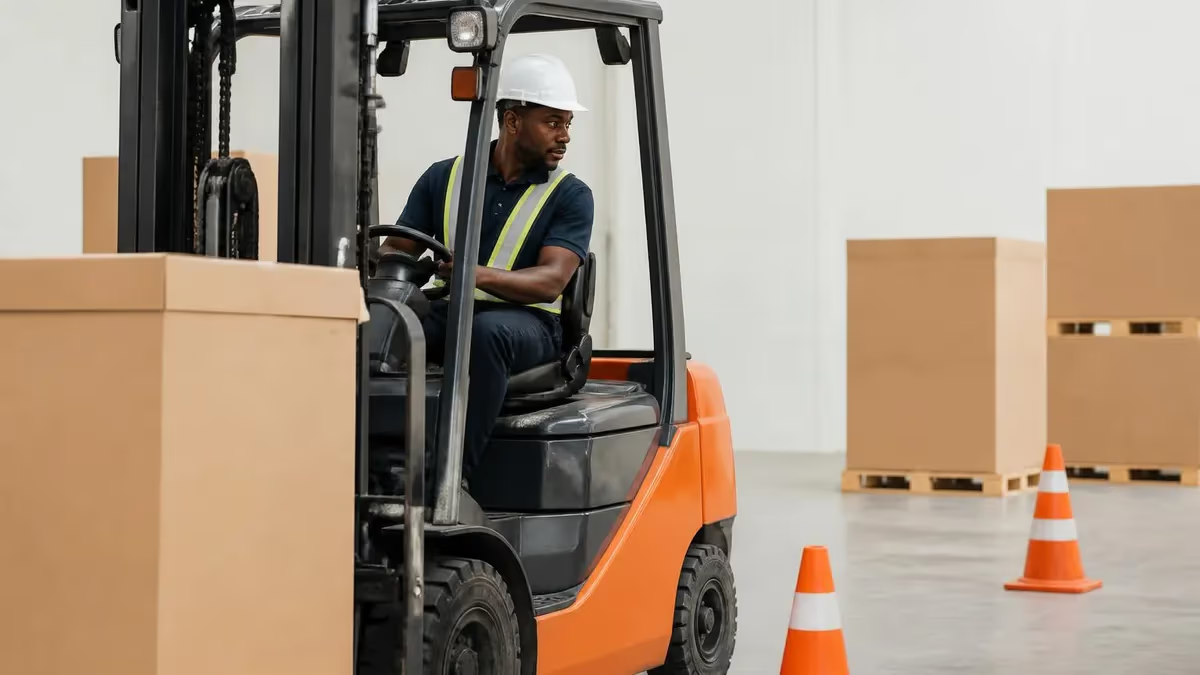
A clear job description for forklift operator roles is the foundation of every warehouse, distribution center, and manufacturing floor in the country. Whether you are applying for your first material handling position or writing a posting to attract qualified candidates, understanding exactly what the role demands matters. A forklift operator moves, stacks, and transports goods using powered industrial trucks, and the duties stretch far beyond simply driving. Employers expect safe load handling, accurate inventory work, equipment inspections, and strict adherence to federal safety rules every single shift. Practice with the free Forklift certification practice test on PracticeTestGeeks (7 questions with answer explanations).
The demand for skilled operators continues to grow alongside e-commerce fulfillment and just-in-time supply chains. Companies running fleets of forklifts need dependable people who can pass a forklift training program, earn proper certification, and show up ready to handle pallets weighing thousands of pounds. The role blends physical work with attention to detail, and the best operators become trusted team members who reduce product damage, prevent injuries, and keep loading docks running on schedule. It is a career with real upward mobility.
This guide breaks the position down completely. You will learn the core responsibilities employers list, the certification of forklift operators required by OSHA, the equipment types you may run, and the pay you can expect in 2026. We cover sit-down counterbalance trucks, reach trucks, and the increasingly common stand up forklift used in narrow-aisle warehouses. We also explain how electric forklift adoption is reshaping the job and what skills set top earners apart from entry-level hires.
If you are an employer, a strong job posting filters out unqualified applicants and sets expectations early. If you are a job seeker, knowing the full scope helps you tailor your resume and interview answers. Either way, clarity benefits everyone. Vague postings lead to mismatched hires, frustrated managers, and high turnover. A detailed description that lists physical demands, shift schedules, certification requirements, and growth opportunities attracts serious candidates who stay longer and perform better on the job.
Forklifts come in many configurations, and the specific machine you operate shapes your daily routine. A worker in a cold-storage facility handles different challenges than someone loading flatbed trucks in a lumber yard. Some operators run a single forklift all day, while others rotate between equipment depending on the task. Many warehouses also keep a forklift rental on hand during peak seasons, so flexibility across brands and models is a valuable trait that hiring managers actively look for.
Throughout this article we reference real salary data, OSHA requirements, and the practical skills that separate reliable operators from the rest. We have also linked free practice questions so you can test your safety knowledge before an interview or certification exam. By the end, you will have a complete picture of what the role involves, how to qualify, and how to advance from entry-level driver to lead operator or warehouse supervisor over the course of a rewarding material handling career.
- OSHA requires forklift operators to undergo a performance evaluation at least once every three years. (Occupational Safety and Health Administration (OSHA), U.S. Department of Labor; employers certify operators)
- Forklift operator certification under OSHA requires formal and practical training and an employer evaluation of the operator's workplace performance. (Occupational Safety and Health Administration (OSHA), U.S. Department of Labor; employers certify operators)
- For forklift operator certification, the employer must evaluate the operator's performance and determine that the operator can operate safely before workplace operation. (Occupational Safety and Health Administration (OSHA), U.S. Department of Labor; employers certify operators)
Facts verified Oct 15, 2026 against Occupational Safety and Health Administration (OSHA), U.S. Department of Labor; employers certify operators. Dates that have passed are removed automatically.
Forklift certification Certification Exam at a Glance
| Item | Detail | Official source |
|---|---|---|
| Renewal | Performance evaluation at least every three years | Occupational Safety and Health Administration (OSHA), U.S. Department of Labor; employers certify operators |
| Delivery | Formal instruction, practical training and workplace evaluation | Occupational Safety and Health Administration (OSHA), U.S. Department of Labor; employers certify operators |
| Eligibility | Training and demonstrated competence before workplace operation | Occupational Safety and Health Administration (OSHA), U.S. Department of Labor; employers certify operators |
Facts verified Oct 15, 2026 against Occupational Safety and Health Administration (OSHA), U.S. Department of Labor; employers certify operators. Dates that have passed are removed automatically.
Free Forklift certification Study Tools
Interactive Forklift certification resources on PracticeTestGeeks, free to start:
- Forklift Instructions 1 — 7 questions with answer explanations
- Forklift certification flashcards — review key terms and concepts card by card
- Forklift certification study guide — topic-by-topic overview of what the exam covers
- Forklift certification cheat sheet — one-page printable summary for last-minute review
Forklift Operator Roles by the Numbers

Core Duties and Responsibilities of a Forklift Operator
Safely lift, move, stack, and unload pallets, crates, and materials using powered industrial trucks while respecting load capacity limits and maintaining stable, balanced loads at all times.
Complete documented daily checks of forks, tires, brakes, horn, lights, hydraulics, and battery or fuel levels before operating, removing any unsafe equipment from service immediately.
Scan barcodes, record quantities, verify shipments against orders, and update warehouse management systems to keep stock accurate and traceable through the supply chain.
Position trailers, secure dock plates, and transfer freight between docks and storage with precision to prevent product damage and avoid costly shipping delays.
Follow OSHA rules, wear required PPE, keep aisles clear, report hazards, and maintain a clean work zone that protects pedestrians and fellow operators on the floor.
The skills section of any job description for forklift operator postings carries the most weight with hiring managers. At minimum, employers require a valid OSHA-compliant operator certification, because federal law prohibits anyone from operating a powered industrial truck without proper training and evaluation. The certification of forklift operators covers formal instruction, hands-on practice, and a workplace evaluation on the specific equipment type. Without this credential, a candidate cannot legally drive, no matter how much informal experience they claim to have gained elsewhere.
Beyond certification, physical capability is essential. Operators frequently sit or stand for long shifts, twist to check loads behind them, and climb on and off equipment dozens of times per day. Many postings specify the ability to lift 50 pounds, tolerate cold storage temperatures, or work in dusty environments. Good depth perception, spatial awareness, and hand-eye coordination help operators place loads precisely in tight racking. These physical demands should appear clearly in the description so applicants understand the realities before accepting an offer.
Attention to detail separates average operators from valuable ones. Reading order sheets correctly, scanning the right SKU, and stacking pallets in the proper sequence prevents expensive errors. Employers also prize reliability and punctuality, since a missing operator can stall an entire loading dock. Strong candidates communicate clearly with supervisors, dock workers, and truck drivers, coordinating movements in busy spaces. These soft skills rarely get the attention they deserve, but they directly affect productivity and workplace safety on every shift.
Technical familiarity with different machines adds value. An operator comfortable on a sit-down counterbalance truck, a reach truck, and an electric forklift can fill more roles and command higher pay. Some warehouses use radio-frequency scanners, warehouse management software, and automated guided systems, so basic technology comfort helps. Candidates who keep their forklift training current and pursue additional endorsements stand out in a competitive hiring market and position themselves for faster advancement into lead roles.
Experience requirements vary widely. Entry-level postings may accept candidates with zero experience and provide on-site training, while specialized roles in high-bay or hazardous environments demand years of proven performance. A clear description states the minimum experience honestly to avoid wasting time on both sides. Many employers list one to two years preferred but remain open to certified newcomers who demonstrate the right attitude, safety mindset, and willingness to learn the specific workflows of the facility.
Finally, documentation skills round out the profile. Operators log inspection results, complete incident reports when needed, and sometimes record cycle counts during inventory. Legible handwriting or accurate data entry keeps records clean for audits and OSHA compliance. A job description that mentions these administrative tasks gives candidates a realistic preview. Operators who treat paperwork seriously protect both themselves and their employers, creating a documented trail that proves safe, compliant operation across every shift they work.

Forklift certification Practice Test Questions
Prepare for the Forklift certification Certification exam with our free practice test modules. Each quiz covers key topics to help you pass on your first try.
Forklift certification Certification Forkl...
Forklift certification Exam Questions covering Certification Forklift certification Maintenance and Repairs. Master Forklift certification Test concepts for certification prep.
Forklift certification Certification Forkl...
Free Forklift certification Practice Test featuring Certification Forklift certification Maintenance and Repairs Questions and Answers. Improve your Forklift certification Exam score with mock test prep.
Forklift certification Certification Forkl...
Forklift certification Mock Exam on Certification Forklift certification Operator Training and Certification Requirements. Forklift certification Study Guide questions to pass on your first try.
Forklift certification Certification Forkl...
Forklift certification Test Prep for Certification Forklift certification Operator Training and Certification Requirements Questions and Answers. Practice Forklift certification Quiz questions and boost your score.
Forklift certification Load Handling and S...
Forklift certification Questions and Answers on Load Handling and Stability. Free Forklift certification practice for exam readiness.
Forklift certification OSHA Regulations an...
Forklift certification Mock Test covering OSHA Regulations and Compliance. Online Forklift certification Test practice with instant feedback.
Forklift certification Pre-Operation Inspe...
Free Forklift certification Quiz on Pre-Operation Inspections. Forklift certification Exam prep questions with detailed explanations.
Forklift certification Refueling and Recha...
Forklift certification Practice Questions for Refueling and Recharging Procedures. Build confidence for your Forklift certification certification exam.
Forklift certification Safe Driving and Ma...
Forklift certification Test Online for Safe Driving and Maneuvering. Free practice with instant results and feedback.
Forklift certification Workplace Hazard Id...
Forklift certification Study Material on Workplace Hazard Identification. Prepare effectively with real exam-style questions.
Forklift certification Forklift Instructions
Free Forklift certification Test covering Forklift Instructions. Practice and track your Forklift certification exam readiness.
Forklift certification Forklift MCQ
Forklift certification Exam Questions covering Forklift MCQ. Master Forklift certification Test concepts for certification prep.
Forklift certification Forklift Employer R...
Free Forklift certification Practice Test featuring Forklift Employer Responsibilities. Improve your Forklift certification Exam score with mock test prep.
Forklift certification Forklift Penalties ...
Forklift certification Mock Exam on Forklift Penalties for Non-Compliance. Forklift certification Study Guide questions to pass on your first try.
Forklift Types Operators Use Every Day
The sit-down counterbalance is the most common forklift in American warehouses and yards. The operator sits facing the forks, and a heavy counterweight in the rear balances the load up front. These versatile machines handle pallets on flat floors and outdoor surfaces, making them the workhorse of loading docks, manufacturing plants, and lumber yards across the country.
Available in both internal-combustion and electric forklift versions, counterbalance trucks suit operators who move heavy loads over longer distances. Propane and diesel models dominate outdoor work, while battery-powered units run quietly indoors with zero emissions. Many facilities keep a forklift rental of this type on standby during peak shipping seasons to handle surges in volume without buying additional equipment outright.
Is a Forklift Operator Career Right for You?
- +Steady demand across warehousing, manufacturing, retail, and logistics
- +Entry-level friendly with short certification timeline
- +No college degree required to start earning
- +Clear path to lead operator and supervisor roles
- +Overtime and shift-differential pay opportunities
- +Transferable skills valued nationwide across industries
- −Physically demanding with repetitive motion and long shifts
- −Exposure to cold storage, heat, dust, or loud environments
- −Strict safety responsibility with serious consequences for errors
- −Night, weekend, and rotating shifts are common
- −Certification must be renewed at least every three years
- −Risk of injury without constant safety vigilance
Pros and Cons at a Glance
| Pros | Cons |
|---|---|
| Steady demand across warehousing, manufacturing, retail, and logistics | Physically demanding with repetitive motion and long shifts |
| Entry-level friendly with short certification timeline | Exposure to cold storage, heat, dust, or loud environments |
| No college degree required to start earning | Strict safety responsibility with serious consequences for errors |
| Clear path to lead operator and supervisor roles | Night, weekend, and rotating shifts are common |
| Overtime and shift-differential pay opportunities | Certification must be renewed at least every three years |
| Transferable skills valued nationwide across industries | Risk of injury without constant safety vigilance |

Daily Forklift Operator Safety and Inspection Checklist
- ✓Inspect forks, mast, and chains for cracks, bends, or excessive wear
- ✓Check tire condition and proper inflation before each shift
- ✓Test service brakes, parking brake, and steering for full response
- ✓Confirm horn, lights, and backup alarm function correctly
- ✓Verify hydraulic fluid, oil, coolant, and battery or fuel levels
- ✓Examine seatbelt and overhead guard for damage or defects
- ✓Look for leaks under the truck and around hydraulic lines
- ✓Review the data plate and never exceed rated load capacity
- ✓Wear required PPE including hi-vis vest and steel-toe boots
- ✓Remove any unsafe forklift from service and report it immediately
OSHA requires a documented evaluation every three years
Under 29 CFR 1910.178, every forklift operator must be evaluated at least once every three years, and refresher training is mandatory after any accident, near-miss, or assignment to a new truck type. Employers who skip this face citations and liability, so a strong job description always states that certification must stay current.
Pay, schedule, and work environment shape whether a forklift operator role fits your life. In 2026, the U.S. median sits near $42,000 per year, but the range is wide. Entry-level operators in lower-cost regions may start around $16 to $18 per hour, while experienced operators in high-demand markets, cold storage, or specialized equipment can earn $25 to $32 per hour. Union positions, hazardous-material handling, and night shifts often add premiums that push annual earnings well above the national median figure.
Shift structure varies dramatically by industry. Distribution centers serving e-commerce frequently run around the clock, offering first, second, and third shifts. Night and weekend shifts typically pay differentials of one to three dollars per hour above base rate. Manufacturing plants may follow more predictable daytime schedules, while seasonal retail warehouses ramp up dramatically before holidays. A clear job description states expected hours, overtime expectations, and shift rotation so candidates can plan around family and personal commitments before accepting.
The physical environment differs by setting. Refrigerated and frozen warehouses require operators to work in temperatures well below freezing, with employers providing insulated gear. Outdoor yards expose workers to heat, cold, and weather year-round. Manufacturing floors can be loud and dusty, while clean e-commerce fulfillment centers stay climate-controlled and well-lit. Understanding the environment helps candidates judge fit, since someone who thrives in an active outdoor lumber yard may dislike a cold, repetitive freezer operation.
Benefits increasingly factor into total compensation. Full-time operators commonly receive health insurance, paid time off, and retirement contributions, and many large employers add performance bonuses, attendance incentives, and tuition assistance. Some companies cover the cost of certification and ongoing forklift training, which represents real savings for workers. When comparing offers, candidates should weigh hourly rate alongside benefits, shift differentials, and advancement potential rather than focusing on the base wage figure in isolation.
Job stability is a major draw. Because nearly every industry that moves physical goods relies on forklifts, operators enjoy transferable skills that travel well across employers and regions. A certified operator who loses one job can usually find another quickly, since warehouses, retailers, and manufacturers constantly recruit. This resilience makes the career attractive to people seeking dependable employment without a four-year degree, and it explains why the field continues to grow faster than the average occupation.
Location influences both pay and availability. Major logistics hubs near ports, interstates, and population centers concentrate the most openings and often the highest wages. Cost of living matters too, so a higher nominal wage in an expensive metro may not stretch further than a moderate wage in a smaller market. Researching regional demand, typical pay, and the mix of industries nearby helps candidates target the markets where their skills will be most valued and rewarded.
Operating a forklift without current OSHA certification puts you and your coworkers at serious risk and exposes your employer to heavy fines. If your credential has lapsed, complete recertification before your next shift. Employers should verify every operator's certification status during onboarding and before assigning any new equipment type.
The career path for a forklift operator offers more upward movement than many people expect. Most workers begin in an entry-level driving role, mastering one or two equipment types and learning the facility's workflows. After proving reliability and safety over time, operators often advance to lead operator positions, where they train new hires, coordinate equipment assignments, and troubleshoot problems on the floor. This step usually comes with a pay bump and signals readiness for greater responsibility within the operation.
From lead operator, the next rung is typically a supervisory or team-lead role overseeing a shift, a zone, or a department. Supervisors manage schedules, enforce safety standards, track productivity metrics, and serve as the bridge between frontline operators and warehouse management. These positions reward operators who developed strong communication and organizational skills alongside their equipment expertise, proving that soft skills genuinely matter for long-term advancement in material handling careers across every industry sector.
Beyond supervision, ambitious operators move into warehouse management, inventory control, logistics coordination, or operations planning. Some transition into equipment maintenance, becoming technicians who service and repair the fleet. Others pursue safety officer roles, using their hands-on knowledge to lead training programs and compliance audits. Each of these paths builds on the foundation laid as an operator, and many do not require a college degree, only demonstrated competence and a willingness to keep learning.
Cross-training accelerates advancement. An operator certified on counterbalance trucks, reach trucks, a stand up forklift, and specialty equipment becomes far more valuable than a single-machine driver. Employers prioritize versatile workers for promotions because they can flex across the operation. Pursuing additional certifications, attending refresher forklift training, and volunteering for varied assignments all signal initiative that managers notice when they decide who deserves the next opportunity that opens up.
Some operators use their experience into related fields entirely. Knowledge of forklifts, fleet management, and material handling translates well into equipment sales, where understanding customer needs around a forklift for sale or a forklift rental drives success. Others move into dealership service departments, parts distribution, or training companies. The hands-on credibility of having operated equipment professionally gives these career changers an edge over candidates who only learned the industry from a classroom or sales brochure.
Continuing education seals long-term growth. Certifications in OSHA safety, supply chain management, or warehouse software set operators apart. Community colleges and trade programs offer logistics credentials that pair well with floor experience. Workers who invest in these add-ons position themselves for management roles that can pay $60,000 or more annually. The forklift operator job is rarely a dead end; for motivated people, it is a launching pad into a stable and rewarding logistics career.
Whether you are writing a job posting or preparing to apply, a few practical tips make the difference between a smooth hire and a frustrating mismatch. Employers should open the description with a concise summary of the role, then list duties, requirements, physical demands, schedule, and pay range. Transparency about wages attracts more qualified applicants and reduces wasted interviews. Including the specific equipment types and certification requirements up front filters out candidates who lack the right experience before they ever apply for the position.
Job seekers should tailor their resume to mirror the language in the posting. If the description emphasizes reach trucks and cold storage, highlight any matching experience prominently near the top. List your certification status, the equipment types you are evaluated on, and your renewal date so hiring managers see immediately that you are compliant. Quantify achievements where possible, such as zero accidents over a period, high pick rates, or experience handling specific load weights and volumes in past roles.
Interview preparation matters more than many candidates realize. Expect questions about load capacity calculations, stability principles, pre-shift inspection steps, and how you respond to hazards or near-misses. Review OSHA fundamentals and the data plate concept so you can answer confidently. Demonstrating a genuine safety mindset reassures employers more than anything else, because a single careless operator can cause injuries, product loss, and liability that far outweigh any productivity gains from cutting corners on the floor.
Keep your certification current and treat renewal as non-negotiable. Because OSHA requires evaluation at least every three years, mark the date on your calendar and arrange recertification well before it lapses. If you take a job operating new equipment, expect additional training and evaluation on that specific machine. Operators who proactively manage their credentials avoid awkward gaps in employment and signal professionalism that employers reward with trust and better assignments over the course of their tenure.
Practice tests are an underused preparation tool. Working through forklift safety, maintenance, and certification questions before an exam or interview builds confidence and exposes knowledge gaps while there is still time to fix them. The free quizzes linked throughout this guide cover maintenance, repairs, and certification requirements in a realistic format. Spending even an hour reviewing these questions can sharpen your recall of the exact details that interviewers and certification evaluators commonly probe during the hiring process.
Finally, think about fit beyond the paycheck. Consider commute, shift timing, work environment, growth opportunities, and company safety culture. A slightly lower wage at an employer with strong training, modern electric forklift equipment, and clear promotion paths may serve your career better than a higher hourly rate at a high-turnover operation. The best forklift operator roles combine fair pay, manageable demands, and a genuine commitment to safety that lets you build a long, healthy, and rewarding career.
Sample Forklift certification Practice Questions
Try these questions from our free Forklift certification practice tests. The correct answer and an explanation follow each question.
A pedestrian unexpectedly walks into the path of a moving forklift. What should the operator do?
- A. Swerve sharply to avoid the pedestrian
- B. Sound the horn, apply the brakes smoothly, and stop the forklift
- C. Speed up to pass before the pedestrian reaches the path
- D. Flash the lights and continue at reduced speed
Answer: B. Sound the horn, apply the brakes smoothly, and stop the forklift
The operator must immediately sound the horn to warn the pedestrian and apply brakes smoothly to bring the forklift to a controlled stop.
If a forklift starts to tip over, the operator should:
- A. Jump clear of the machine
- B. Stay in the seat, brace, and lean away from the fall
- C. Grab the forks
- D. Stand up quickly
Answer: B. Stay in the seat, brace, and lean away from the fall
Stay seated, hold the wheel, brace your feet, and lean away from the point of impact rather than jumping.
When checking the mast and lift chains, the operator is looking for:
- A. Correct color
- B. Proper lubrication, and no kinks, wear, or damage
- C. The manufacturer's logo
- D. Extra length
Answer: B. Proper lubrication, and no kinks, wear, or damage
Lift chains should be properly lubricated and free of kinks, wear, or damage to lift loads safely.
During an emergency facility evacuation, what should a forklift operator do with the forklift?
- A. Drive the forklift toward the nearest exit for use in the evacuation
- B. Lower the forks, shut off the engine, set the brake, and evacuate on foot
- C. Leave the forklift running to allow quick repositioning when the alarm ends
- D. Park the forklift in front of emergency exits for easy access
Answer: B. Lower the forks, shut off the engine, set the brake, and evacuate on foot
The operator must lower the forks, shut off the engine, apply the parking brake, and then evacuate on foot — blocking exits with a forklift creates an additional hazard.
Forklift Questions and Answers
Forklift Operator Duties: Complete Guide to Daily Responsibilities, Safety Tasks, and Career Path for 2026
Sit Down Forklift Jobs: Complete Guide to Careers, Pay, Training, and Hiring in 2026
Forklift License Renewal: Complete Guide to Forklift License Expiry, OSHA Recertification, and Operator Requirements for 2026
Forklift Dealers: Complete Guide to Buying, Renting, and Servicing Material Handling Equipment
Forklift Tires: Complete Guide to Types, Sizing, Wear Patterns, and Replacement Costs
How this page was made: written with AI tools and published by Nathan Beja, founder of Practice Test Geeks, who is responsible for its content. Exam facts are checked against the official sources listed below. Not reviewed by a subject-matter expert. Editorial policy
Sources & references
Exam facts on this page (fees, format, dates, passing scores) are checked against these official sources; the date is our last check. Editorial policy
- osha.gov — Test delivery, eligibility, renewal · verified Oct 2026