
Forklift Certification Jobs: Career Guide to Becoming a Forklift Operator in 2026
Explore forklift certification jobs, training paths, and salary data. Learn how certification opens doors to operator roles. 🎓 Full 2026 US career guide.
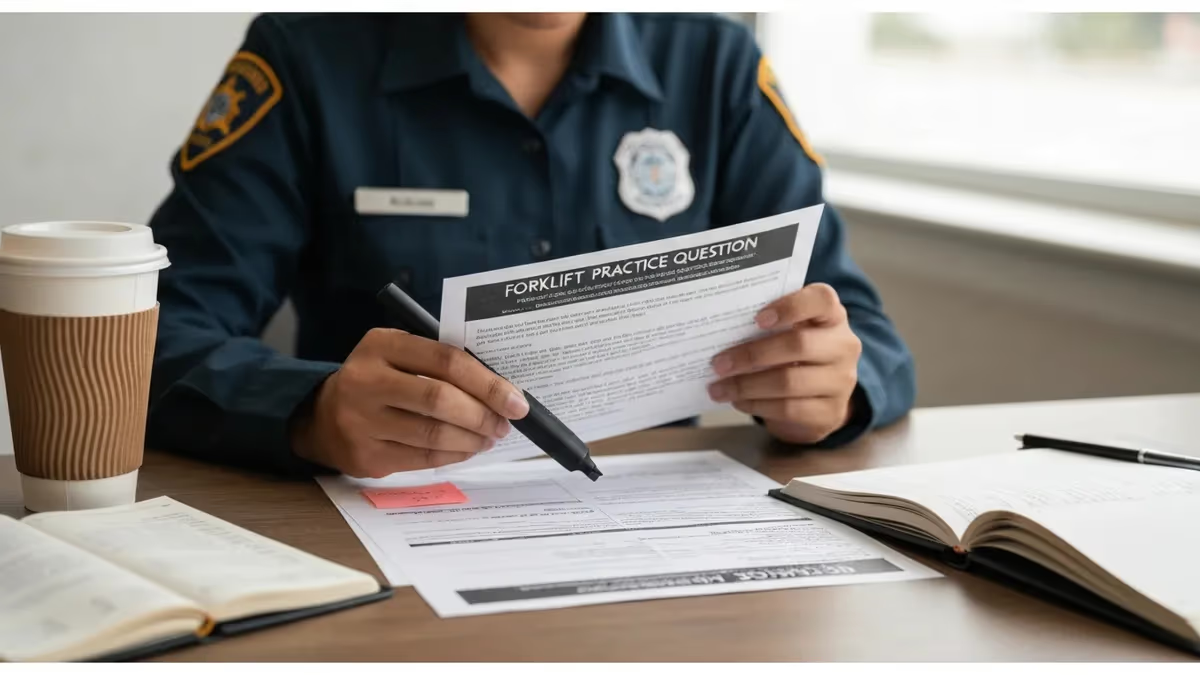
Forklift rental companies, warehouses, and distribution centers across the United States are actively hiring certified forklift operators, and demand for skilled workers has never been stronger. The Bureau of Labor Statistics projects steady growth in material-moving occupations through 2030, and employers consistently list forklift certification jobs as priority openings because a certified operator can legally work unsupervised from day one. Whether you are entering the workforce for the first time or transitioning from another trade, earning your certification is the fastest route to a stable, well-paying warehouse career.
Understanding what employers look for in forklift certification jobs starts with knowing the difference between operator types. Sit-down counterbalanced riders, stand up forklift models, reach trucks, and order pickers each require distinct skills, and many job postings specify experience on a particular class of equipment. OSHA mandates that all powered industrial truck operators complete formal training and evaluation before working independently, which means a certification card is not optional — it is a legal prerequisite that every reputable employer will verify before putting you behind the controls.
The forklift industry itself is vast. Beyond traditional warehouse roles, certified operators work in lumber yards, cold-storage facilities, automotive plants, ports and rail yards, and even outdoor construction sites. Each environment carries its own set of hazards, load types, and surface conditions, so the breadth of settings means that once you hold a valid certification of forklift operation, you can pivot across industries without starting your career over. That flexibility is one of the most compelling arguments for investing in proper training early.
Salary expectations for forklift operators vary by location, shift, and specialization. Entry-level positions in lower cost-of-living regions typically start around $16 to $18 per hour, while experienced operators running electric forklift equipment in major distribution hubs like Chicago, Dallas, or Los Angeles can earn $24 to $28 per hour or more. Add overtime, shift differentials, and benefits packages — including health insurance, 401(k) matching, and paid time off — and a full-time forklift career easily clears $50,000 annually for workers with two or more years of experience.
Forklift training programs range from one-day courses offered by equipment dealers and community colleges to comprehensive multi-week apprenticeships embedded within union contracts. The investment is modest compared to the return: most certification programs cost between $150 and $400, and many employers reimburse tuition for workers who pass evaluation within a set probationary period. Some staffing agencies that specialize in logistics and warehousing provide free training as an incentive to join their worker pool, making certification accessible even to candidates without upfront funds.
The rise of e-commerce has dramatically reshaped demand for forklift operators. Fulfillment centers operated by major retailers now run three shifts per day, 365 days per year, creating a near-constant need for certified lift truck drivers. Amazon, Walmart, FedEx, UPS, and regional third-party logistics providers regularly rank among the top employers of forklift operators in the country. These companies typically offer structured advancement paths, so operators who add certifications on multiple equipment classes can move into lead operator, trainer, or supervisor roles within two to four years.
This guide walks you through everything you need to know about forklift certification jobs in 2026 — from the training process and certification requirements to salary benchmarks, job search strategies, and the types of equipment you will likely encounter on the job. Whether you are comparing forklift for sale listings because you plan to start your own business, or simply want to understand what the certification process involves before enrolling in a course, the sections below provide a complete, practical roadmap.
Free Forklift certification Study Tools
Interactive Forklift certification resources on PracticeTestGeeks, free to start:
- Forklift certification flashcards — review key terms and concepts card by card
- Forklift certification study guide — topic-by-topic overview of what the exam covers
- Forklift certification cheat sheet — one-page printable summary for last-minute review
Forklift Certification Jobs by the Numbers

How to Get Your Forklift Certification
Choose an OSHA-compliant course at a community college, equipment dealer, or employer-sponsored program. Programs cover pre-shift inspections, load handling, stability principles, and workplace hazard recognition. Most classroom components take four to eight hours.
Operate the specific class of forklift you will use on the job under a qualified trainer's supervision. Practice maneuvering, stacking, ramp navigation, and refueling or recharging procedures until you demonstrate consistent competency on the actual equipment.
OSHA requires both a written knowledge test and a practical performance evaluation. Your trainer scores each component and signs off on your certification card. Keep the card and your training records — employers and OSHA inspectors may request documentation during audits.
OSHA mandates recertification at minimum every three years, or sooner after an accident, near-miss, or observed unsafe operation. Renewals are typically shorter than initial training and can often be completed in a single day with the same employer-approved trainer.
Salary is one of the first questions candidates ask when exploring forklift operator careers, and the numbers are genuinely encouraging. According to the most recent Bureau of Labor Statistics data, the median hourly wage for industrial truck and tractor operators sits around $20.80, translating to roughly $43,000 per year for a standard 40-hour work week. However, that median understates what many operators actually take home once overtime, shift premiums, and employer-paid benefits are factored into total compensation.
Geography has an outsized effect on forklift operator pay. States with large logistics corridors — California, Texas, Illinois, Pennsylvania, and Washington — tend to pay significantly above the national median. An operator working a second-shift position at a fulfillment center in the Inland Empire region of Southern California, for example, can reasonably expect base pay of $22 to $26 per hour, plus a shift differential of $1 to $2 per hour on top of that. When a distribution center is running peak-season overtime, weekly earnings can jump by 30 to 50 percent above the regular base rate.
Specialization drives even larger pay differences. Operators certified on electric forklift models used inside food-grade cold storage facilities frequently earn more than general warehouse counterparts because the environment requires additional safety awareness and the physical demands are higher. Similarly, operators trained to handle hazardous materials, oversized loads, or specialized attachments like clamps and rotators command premium wages because far fewer candidates hold those qualifications. Adding a second or third equipment class certification to your resume is one of the most reliable ways to negotiate a higher starting wage at a new employer.
Union membership is another significant wage variable. The International Brotherhood of Teamsters and the International Longshore and Warehouse Union both represent large numbers of forklift operators, particularly at ports, rail yards, and major distribution facilities. Union scale wages for certified operators can reach $28 to $35 per hour in high-cost metropolitan areas, with defined annual step increases, strong benefits, and pension contributions that non-union positions rarely match. The tradeoff is that union jobs in competitive markets can be harder to land initially, often requiring placement on a referral list before a permanent position becomes available.
Benefits packages at large logistics employers have improved substantially as competition for skilled operators intensified following the e-commerce boom. It is now common for full-time certified operators at companies like Amazon, Kroger Distribution, and XPO Logistics to receive health, dental, and vision insurance from their first day, a 401(k) with employer matching starting after 90 days, paid time off accruing from week one, and tuition assistance for further certification or education.
When you calculate the total value of these benefits, a forklift operator earning $20 per hour at a company with a strong benefits package may be financially better off than a $24-per-hour contractor with no benefits at all.
Entry points into the field also affect starting compensation. Candidates who arrive with a forklift rental company background — where they operated multiple equipment types across diverse customer sites — are often considered more versatile than candidates trained exclusively on one machine at one warehouse. Rental company experience teaches operators to adapt quickly to unfamiliar layouts and equipment quirks, a skill that hiring managers at large distribution centers value because it reduces on-boarding time significantly.
Career progression timelines for forklift operators vary by employer size and internal structure, but a realistic four-year path looks like this: year one as a general operator at $18 to $20 per hour, year two adding a second equipment class and moving to $21 to $23, year three being tapped for a lead operator or trainer role at $23 to $26, and by year four having the credentials and experience to apply for a warehouse supervisor position at $55,000 to $70,000 annually.
This progression is attainable without a college degree, which makes the forklift career path one of the most accessible routes to a middle-class income available in the current US labor market.
Types of Forklift Operator Jobs and Work Environments
Warehouse and distribution center roles represent the largest single category of forklift operator employment in the United States. Operators in these settings use sit-down counterbalanced riders and stand up forklift models to receive incoming freight, stock rack locations, fulfill outbound orders, and load outbound trailers. Shifts typically run eight to twelve hours, with productivity quotas measured by units moved per hour, and operators are expected to complete full pre-shift inspections on every piece of equipment they operate.
Large e-commerce fulfillment centers add complexity because inventory moves at an extremely high pace, often with voice-directed picking systems or wearable scanners guiding the operator through tasks in real time. Operators in these environments must be comfortable working around automated conveyor systems and robotic sortation equipment without disrupting the flow of goods. OSHA compliance is strictly enforced at major fulfillment centers, and operators who demonstrate consistent safe behavior and high productivity are prioritized for advancement into lead or supervisor roles within twelve to eighteen months.

Pros and Cons of Pursuing Forklift Certification Jobs
- +Low barrier to entry — certification typically takes one to three days and costs under $400
- +Strong and consistent job demand driven by e-commerce growth and supply chain expansion
- +Multiple industries hire certified operators, providing career flexibility and job security
- +Clear advancement path from operator to lead, trainer, and supervisor without a college degree
- +Competitive hourly wages with overtime opportunities, especially during peak seasons
- +Many large employers offer full benefits packages including health insurance and 401(k) matching
- −Physically demanding work with prolonged sitting, vibration exposure, and repetitive motion risk
- −Certification must be renewed every three years and after any incident or observed unsafe operation
- −Wages in rural or low-demand markets can be significantly below the national median
- −Night and weekend shifts are common at 24/7 distribution centers, affecting work-life balance
- −Entry-level positions may require a probationary period before full benefits kick in
- −Advancement into management typically requires additional soft skills and leadership training beyond certification
Pros and Cons at a Glance
| Pros | Cons |
|---|---|
| Strong and consistent job demand driven by e-commerce growth and supply chain expansion | Physically demanding work with prolonged sitting, vibration exposure, and repetitive motion risk |
| Multiple industries hire certified operators, providing career flexibility and job security | Certification must be renewed every three years and after any incident or observed unsafe operation |
| Clear advancement path from operator to lead, trainer, and supervisor without a college degree | Wages in rural or low-demand markets can be significantly below the national median |
| Competitive hourly wages with overtime opportunities, especially during peak seasons | Entry-level positions may require a probationary period before full benefits kick in |
Forklift Operator Job Search Checklist
- ✓Obtain a valid OSHA-compliant forklift certification card before submitting any job applications.
- ✓List every equipment class you are certified to operate clearly on your resume and application.
- ✓Highlight the total number of hours you have logged operating powered industrial trucks.
- ✓Gather reference letters from past trainers, supervisors, or lead operators who can verify your safe work habits.
- ✓Research the specific forklift makes and models used by your target employer before the interview.
- ✓Complete a refresher or practice inspection walkthrough so you can demonstrate pre-shift check procedures on demand.
- ✓Register with logistics-focused staffing agencies such as ProLogistix, Staffmark, and Kelly Services.
- ✓Set up job alerts on Indeed, ZipRecruiter, and LinkedIn using search terms like forklift operator and warehouse associate.
- ✓Check directly with large local employers — Amazon, Walmart, Target, and regional 3PL providers — for open requisitions.
- ✓Prepare to pass a background check and drug screening, as both are standard requirements for forklift operator roles.
Certification on Multiple Equipment Classes Can Boost Starting Pay by 15–25%
Employers in competitive logistics markets routinely offer higher starting wages to candidates who arrive certified on two or more OSHA equipment classes. If you have time before your job search, adding a stand-up reach truck or order picker certification to your counterbalanced rider card costs little extra but signals to hiring managers that you are a more versatile and self-directed candidate — exactly the profile that leads to faster advancement and better initial compensation offers.
Understanding the different classes of forklifts is essential for any operator who wants to maximize their job opportunities. OSHA divides powered industrial trucks into seven classes based on their design and power source, and employers often specify which class or classes are required in their job postings.
Class I covers electric motor rider trucks — the sit-down counterbalanced forklifts most people picture when they think of a warehouse. Class II covers electric motor narrow-aisle trucks, including the reach trucks and order pickers used in high-density storage facilities. Class III covers electric motor hand trucks and pallet jacks, which are common in retail backrooms and smaller warehouses.
Classes IV and V are the internal combustion engine forklifts — Class IV uses cushion tires for smooth indoor surfaces, while Class V uses pneumatic tires for outdoor and rough-terrain applications. Class VI covers electric and internal combustion tractors, which are used to tow trains of material carts in manufacturing plants and airports. Class VII is the rough-terrain forklift, designed for construction sites and lumber yards where the ground surface is unpredictable. An operator certified on all seven classes is exceptionally rare but exceptionally employable across virtually every industry that moves physical goods.
The electric forklift segment has grown dramatically as warehouses modernize their fleets to reduce carbon emissions and eliminate propane storage requirements indoors. Lithium-ion powered forklifts in particular are proliferating because they can be opportunity-charged during breaks without the memory-loss issues associated with older lead-acid batteries. Operators who understand lithium battery charging protocols and can manage battery state-of-health reporting are already distinguishing themselves in job interviews at facilities that have made the switch from internal combustion equipment.
Stand up forklift models — specifically the stand-up reach truck — are the dominant equipment type in modern high-density distribution centers. These machines can reach pallet positions 30 feet or higher, operate in aisles as narrow as 8.5 feet, and travel at speeds that keep pace with demanding order-fulfillment workflows.
Operating a reach truck requires a different set of physical skills than a sit-down rider: the operator stands and turns sideways to look down the forks while traveling in reverse, which takes deliberate practice to master safely. Operators who are comfortable on reach trucks command higher wages than those limited to counterbalanced sit-down equipment alone.
Attachments also expand what a certified operator can do and earn. Fork positioners, clamps, rotators, push-pulls, and side-shifters each require additional training because they change the load capacity, center of gravity, and visibility of the truck. Operators trained to use specialized attachments in industries like paper, beverage, or consumer goods manufacturing can earn an additional $1 to $3 per hour premium over operators running standard forks. Some employers pay for attachment-specific training in-house; others expect candidates to arrive with that knowledge already documented on their training records.
Electric forklift technology is also intersecting with automation. Autonomous mobile robots and semi-automated lift trucks are being deployed in newer facilities, and certified human operators are increasingly needed to oversee these systems, intervene when the automation fails, and perform manual operations in zones the robots cannot access. Far from making human operators obsolete, automation is creating a new tier of higher-skilled, higher-paid forklift technician-operator roles that blend traditional driving skills with basic programming and system monitoring responsibilities.
Whether you are evaluating a forklift for sale as a future business asset, exploring forklift rentals to understand the equipment landscape before committing to a specialty, or simply trying to identify which certification class to pursue first, understanding the full equipment ecosystem will make you a more informed and confident candidate in every job interview you attend.

OSHA 29 CFR 1910.178 requires that every forklift operator be formally evaluated and certified before operating a powered industrial truck independently. Operating without certification exposes both you and your employer to significant fines — OSHA penalties for serious violations start at $16,131 per incident as of 2026. If your employer asks you to operate a forklift before your training is complete, you have the right to refuse without retaliation under Section 11(c) of the OSH Act.
Career advancement in the forklift industry follows several distinct paths, and understanding them early helps you make smarter decisions about which certifications to pursue, which employers to target, and how to position yourself when promotion opportunities arise. The most direct path leads from operator to lead operator, a role that involves coordinating a team of drivers during a shift, troubleshooting minor equipment issues, and communicating between the floor and warehouse management. Lead operators typically earn $2 to $4 more per hour than standard operators and often work a set schedule rather than rotating shifts.
Becoming a certified forklift trainer is another high-value career move that does not require leaving the warehouse floor. OSHA requires that trainers have the knowledge, training, and experience to train operators, which typically means several years of incident-free operation plus completion of a train-the-trainer course. Internal trainers at large distribution centers can earn $25 to $30 per hour and are considered essential personnel whose schedules are protected during staffing crunches. Trainer credentials also transfer well across employers and make your resume stand out in a competitive applicant pool.
Warehouse supervisor and operations manager roles represent the next tier, and many companies actively recruit from their certified operator pool because internal candidates already understand the equipment, the workflow, and the safety culture. A warehouse supervisor at a mid-sized 3PL or national retailer typically earns $55,000 to $75,000 per year, and operations manager roles at large facilities can exceed $90,000. Reaching these levels usually requires adding soft skills — scheduling, conflict resolution, basic budgeting — that are developed through on-the-job leadership experience, not just additional forklift certifications.
The maintenance and repair pathway offers yet another direction. Operators who develop a mechanical aptitude and interest in how forklifts actually work can transition into forklift technician roles, where salaries commonly range from $24 to $38 per hour. Technicians diagnose and repair hydraulic systems, electrical components, mast chains, and drive motors, and they are in especially short supply at companies that run large electric forklift fleets.
Formal training for this path typically involves an apprenticeship or a manufacturer-sponsored technical program, but starting as a certified operator gives you a major advantage because you already understand how the equipment behaves under load.
Starting your own forklift business is a long-term goal for some experienced operators. Options include a forklift rental company serving construction contractors and small businesses, a forklift sales and refurbishment operation sourcing equipment at auction, or a third-party training and certification provider serving small employers who lack in-house trainers. Each of these paths requires capital and business knowledge, but experienced operators have the technical credibility to build customer trust quickly. Understanding the forklift rental market — including daily, weekly, and monthly rates for different equipment classes — is essential preparation for anyone considering this entrepreneurial route.
Networking within the industry accelerates advancement regardless of which direction you choose. The Industrial Truck Association, the Material Handling Industry association, and local Chamber of Commerce logistics groups all provide access to employers, equipment vendors, and industry publications that keep you informed about hiring trends, technology changes, and salary benchmarks. Attending a local trade show or equipment demonstration event is one of the easiest ways to meet hiring managers and get on the radar of companies that do not always post openings on public job boards.
For operators who want to build a long-term career rather than just hold a job, documenting your performance metrics is a habit worth starting on day one. Track your incident-free days, your productivity averages, the equipment classes you have operated, and any special projects or process improvements you contributed to. This documentation becomes the foundation of a compelling career narrative that differentiates you from other candidates with identical certifications when you are competing for a lead, trainer, or supervisor role.
Practical preparation for the forklift certification exam and the job search that follows requires a structured approach. Many candidates underestimate the written component of the evaluation, assuming that hands-on experience alone will carry them through. In reality, OSHA-aligned written tests cover topics that experienced operators sometimes take for granted — load capacity plate interpretation, stability triangle physics, battery charging safety protocols, and the correct response sequence for tip-over emergencies. Reviewing these concepts systematically in the days before your evaluation significantly improves your score and demonstrates the kind of professional commitment that trainers and employers notice.
Pre-shift inspection procedures are among the most tested topics on certification evaluations and among the most scrutinized behaviors by OSHA compliance officers during facility audits. A thorough pre-shift check covers fluid levels, tire condition, fork tine wear and bend, mast chain lubrication and integrity, battery charge level or fuel level, warning lights and horn function, seat belt operation, and overhead guard condition.
Memorizing this sequence and practicing it in the correct order — not just knowing the items exist — is the difference between a confident evaluation performance and a nervous one that causes you to miss a step under observation.
Physical conditioning is an underappreciated aspect of forklift operator readiness. Twelve-hour shifts require sustained focus, and fatigue is one of the leading contributing factors in forklift incidents. Operators who maintain good sleep hygiene, limit alcohol consumption before shifts, and report health concerns that might affect their alertness not only perform better but also demonstrate the safety-first mindset that employers promote in their best workers. If you are coming off a shift or feel unwell before an evaluation, it is always better to reschedule than to perform below your capability.
Interview preparation for forklift operator positions goes beyond showing up with your certification card. Hiring managers and staffing coordinators frequently ask behavioral questions: describe a time you identified a safety hazard before it caused an incident, explain how you handle a situation where a supervisor asks you to carry a load that exceeds the capacity plate rating, or walk me through how you would respond if a load shifted dangerously mid-carry.
Preparing specific, truthful examples from your training or previous experience for each of these scenarios demonstrates safety awareness and practical judgment that sets you apart from candidates who give generic textbook answers.
Background check and drug screening readiness is a practical matter that many first-time job seekers handle poorly. Nearly every forklift operator position at a national employer requires both, and failing either will disqualify you regardless of how strong your certification credentials are. Know what is on your background check, address any outstanding issues before applying, and avoid cannabis use even in legal states if you are pursuing positions where federal contracts require a drug-free workforce — transportation, defense, and food processing facilities frequently fall into this category.
Reference selection matters more than many candidates realize. Rather than listing former coworkers as references, prioritize direct supervisors, certified trainers who evaluated your performance, or safety officers who observed your work. A reference from a qualified forklift trainer who can speak specifically to your technical skills and safety habits carries far more weight with a warehouse hiring manager than a general character reference from a friend or family member. Prepare your references by sharing the job description with them so they can tailor their comments to the specific requirements of the position you are pursuing.
Finally, approach your first forklift operator role as an investment in a long-term career, not just a paycheck. Show up early, complete every pre-shift inspection without being reminded, volunteer for cross-training on additional equipment classes, and build relationships with your trainer and lead operator from day one. The forklift industry rewards operators who combine technical competence with consistent professionalism, and the workers who advance fastest are almost always those who treated their very first certified shift with the same seriousness they bring on day one thousand.
Sample Forklift certification Practice Questions
Try these questions from our free Forklift certification practice tests. The correct answer and an explanation follow each question.
What should an operator do if they notice a hydraulic fluid leak during operation?
- A. Continue working until the shift ends
- B. Report it at the next scheduled maintenance date
- C. Stop operation immediately and report the leak
- D. Add more hydraulic fluid and keep working
Answer: C. Stop operation immediately and report the leak
Hydraulic fluid leaks can cause sudden mast or load failure, so the forklift must be stopped and reported right away.
What documentation should an employer maintain to prove forklift operator certification compliance?
- A. No documentation is required under OSHA
- B. Records showing each operator was trained and evaluated, including dates and trainer identity
- C. Only a signed statement from the operator
- D. A general training log with no individual names
Answer: B. Records showing each operator was trained and evaluated, including dates and trainer identity
Employers must keep records that identify the operator, confirm training and evaluation were completed, and show when they occurred.
A forklift operator is working in an area where both forklifts and pedestrians share the same aisles. Which of the following is considered a primary engineering control to mitigate the hazard of collisions?
- A. Requiring pedestrians to wear high-visibility vests.
- B. Training operators to always yield to pedestrians.
- C. Installing physical barriers to create designated walkways.
- D. Posting signs that warn of forklift traffic.
Answer: D. Posting signs that warn of forklift traffic.
While training, PPE, and signs are important administrative controls, the most effective way to prevent collisions is to physically separate forklift traffic from pedestrian traffic. Installing guardrails or barriers is an engineering control that removes the hazard by design.
Under OSHA 29 CFR 1910.178(l), who is responsible for ensuring forklift operators are trained and evaluated?
- A. The forklift manufacturer
- B. The employer
- C. The local government
- D. The forklift operator themselves
Answer: B. The employer
OSHA places the legal responsibility on employers to ensure all forklift operators receive proper training and evaluation before operating powered industrial trucks.
Forklift Questions and Answers
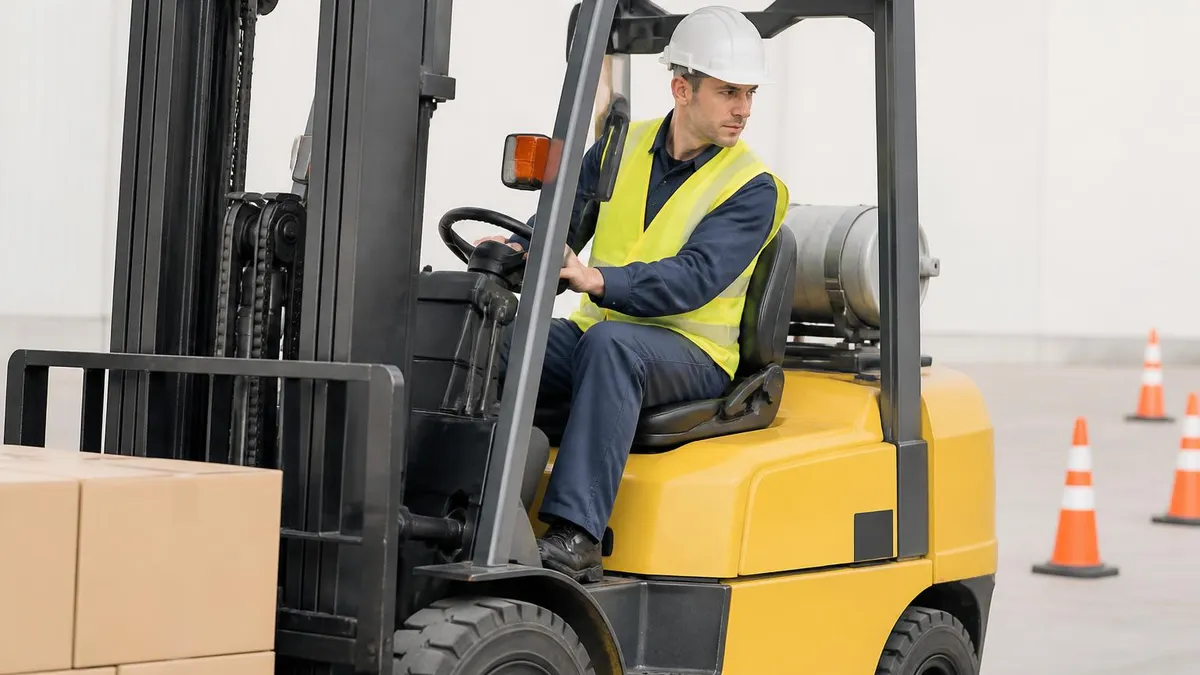
Forklift Rentals: Complete Guide to Pricing, Types, and Operator Requirements
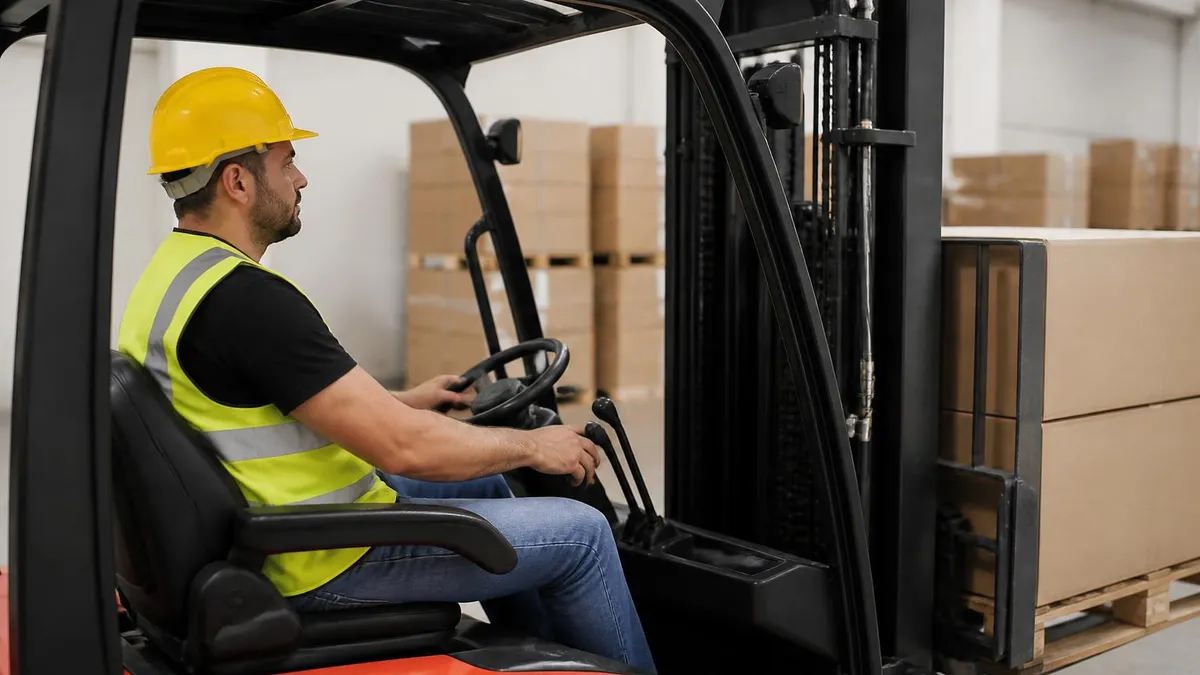
Forklift Hydraulic Fluid: Complete Guide to Types, Specifications, Change Intervals, and Troubleshooting for 2026
Forklift Certification 2026
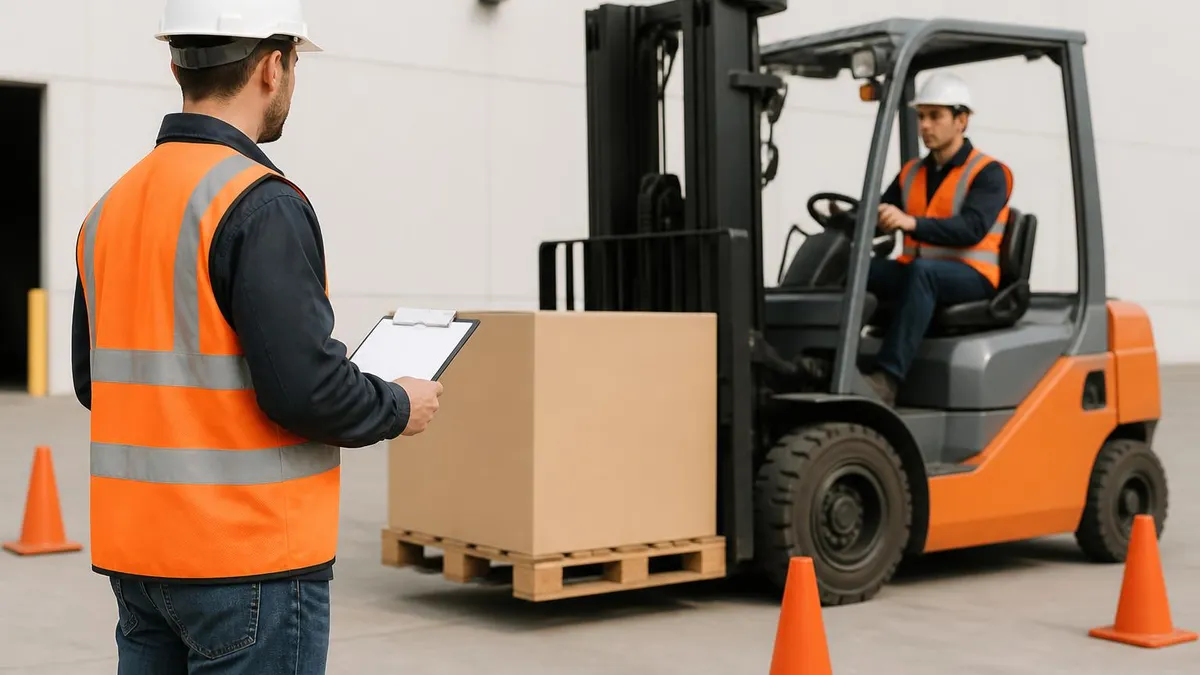
Forklift Parts and Maintenance: Complete Guide to Batteries, Chargers, and Replacement Components
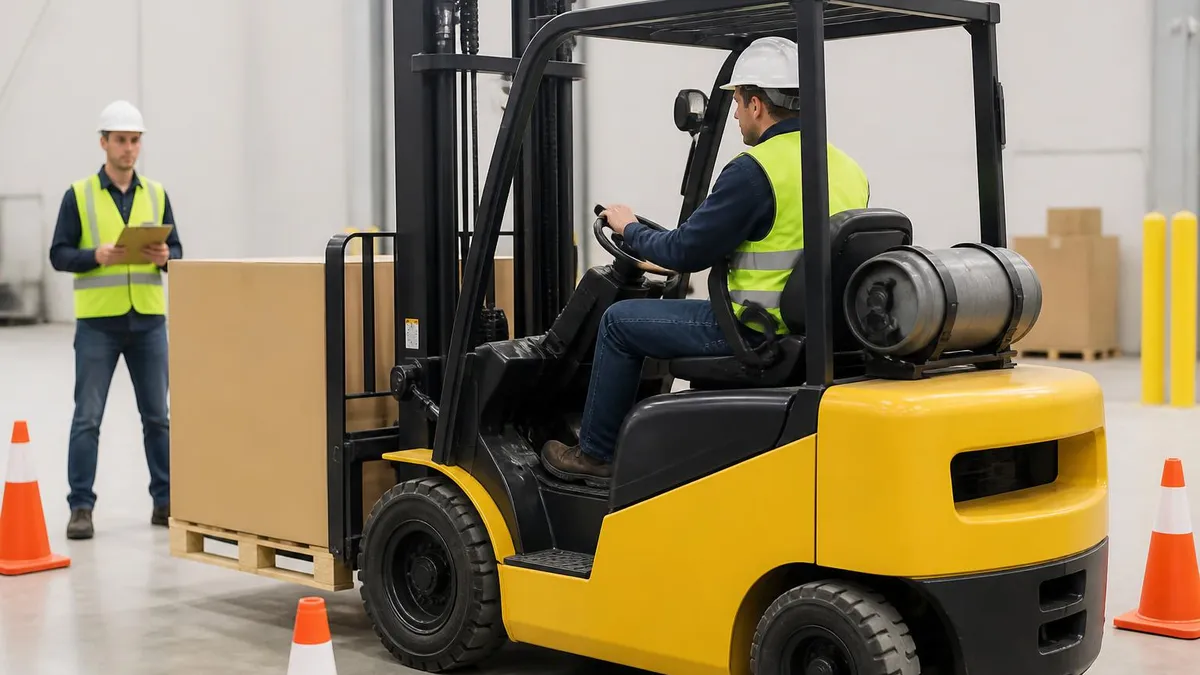
Big Forklift Guide: Heavy-Duty Lift Trucks, Capacity Classes, Rental Costs, and Operator Requirements
About the Author

Certified Crane Operator & Skilled Trades Exam Specialist
Ferris State UniversityRobert Martinez is a Journeyman Ironworker, NCCCO-certified crane operator, and forklift trainer with a Bachelor of Science in Construction Technology from Ferris State University. He has 21 years of ironworking, rigging, and heavy equipment operation experience across high-rise and industrial construction sites. Robert prepares candidates for crane operator, rigger, forklift, and skilled trades certification examinations.