
UK Driving Theory Test: Format, Topics, and How to Pass 2026 September
Everything about the UK driving theory test: 💡 two-part format, what's tested, how to book, test day procedure, pass mark, results, and what to do if
What Is the UK Driving Theory Test?
The UK driving theory test is a mandatory exam administered by the DVSA (Driver and Vehicle Standards Agency) that all learner drivers must pass before they can book or sit their practical driving test. You can't skip it or substitute any other qualification for it — holding a full driving licence from another country, completing a driving course, or having any amount of driving experience does not exempt you from the requirement to pass the DVSA theory test.
The theory test has two parts taken on the same test day in the same test centre sitting. The first part is a multiple choice exam — 50 questions drawn from the official DVSA question bank, with 57 minutes to answer them. You need 43 out of 50 correct (86%) to pass this section.
The second part is the hazard perception test — 14 video clips filmed from a driver's perspective, where you click to identify developing road hazards as early as possible. You need 44 out of a maximum 75 points to pass this section. Both parts must be passed on the same day. Passing one but not the other means you've failed the test overall.
The theory test is not a driving skill assessment — it tests knowledge. Specifically, it tests knowledge of the Highway Code, road safety rules, vehicle safety, environmental factors, and the ability to recognise hazardous situations developing in real road conditions. Most of this content comes from the Official Highway Code, which is the primary study resource for the theory test.
When you pass the theory test, you receive a theory test pass certificate with a unique reference number. This certificate is valid for two years from the date of the test. You must pass your practical driving test within that two-year window — if you don't, the theory certificate expires and you have to retake the theory test before you can book another practical.
This two-year limit is one of the most commonly misunderstood aspects of the UK licensing process for new drivers. For comprehensive practice resources covering both parts of the theory test, the driving theory test practice page has questions covering all topic areas.
- Part 1 — Multiple Choice: 50 questions, 57 minutes, need 43/50 (86%) to pass
- Part 2 — Hazard Perception: 14 video clips, scored 0-5 per hazard, need 44/75 to pass
- Both parts: Must pass both on the same day — fail one and you've failed the whole test
- Fee: £23 for car and motorcycle theory tests (2026)
- Results: Given immediately at the test centre after both sections
- Certificate validity: 2 years from test date — must pass practical within this window
- Minimum age: 15 years 9 months to book; must be 17 to take the practical test
- Required ID: UK photocard driving licence (provisional) — no other ID accepted
- Rebooking after fail: Must wait at least 3 working days before rebooking
Theory Test Process: From Booking to Results
Step 1: Get Your Provisional Licence
Step 2: Book the Theory Test Online
Step 3: Prepare and Study
Step 4: Attend on Test Day
Step 5: Receive Your Results
Multiple Choice Section: What to Expect
The multiple choice section presents 50 questions one at a time on a computer screen. Most questions have four answer options and require you to choose the single correct answer. Some questions show images — photographs of road signs, junction layouts, or vehicle instrument panels — and ask you to identify what they mean or what action to take. A small number of questions (typically 1-3 per test) allow you to select multiple correct answers from a list, and those questions specify how many answers to choose.
You have 57 minutes for the 50 questions — just over a minute per question on average. The test allows you to flag individual questions and return to them later, so if you're unsure about a question it's better to move on and come back than to sit stuck on one item while time runs out. The flagging system is clearly explained in the tutorial before the test begins.
Questions draw from 14 topic areas, each weighted roughly according to how frequently the knowledge applies in real driving. Hazard Awareness and Rules of the Road together make up the largest portion of the question bank. Road and Traffic Signs is a substantial category that many candidates underestimate — you need to recognise signs by shape, colour, and meaning, and some questions test subtle distinctions (speed limit vs. maximum speed advisory, no entry vs. no through road). Motorway rules and vulnerable road users round out the most heavily tested areas.
The pass mark of 43/50 means you can afford to answer seven questions incorrectly and still pass. However, this buffer disappears quickly when candidates have weak areas in multiple topic categories rather than concentrated gaps. Spreading study across all 14 topic areas rather than focusing only on familiar ones is the best strategy. The theory test practice page has questions broken down by topic category so you can identify and target your weakest areas specifically.
Time management in the multiple choice section is rarely an issue for most candidates — 57 minutes for 50 questions gives ample time for careful reading. Where candidates run into trouble is spending too long on one genuinely difficult question and getting anxious about the time spent. The flag-and-return system is specifically designed to prevent this. Flag any question you're uncertain about, answer your best guess, move on, and return at the end.
With 7 minutes of buffer built into the timing, you have meaningful time to review flagged questions at the end. The risk of not finishing is low for nearly all candidates — the real time risk is spending the final minutes on a single hard question rather than reviewing flagged items across multiple categories where you might change an incorrect guess to a correct answer.
14 Theory Test Topic Areas
Right of way, speed limits, stopping distances, junction procedures, overtaking, lane discipline, road markings. The largest category — forms the foundation of both the theory test and the practical test.
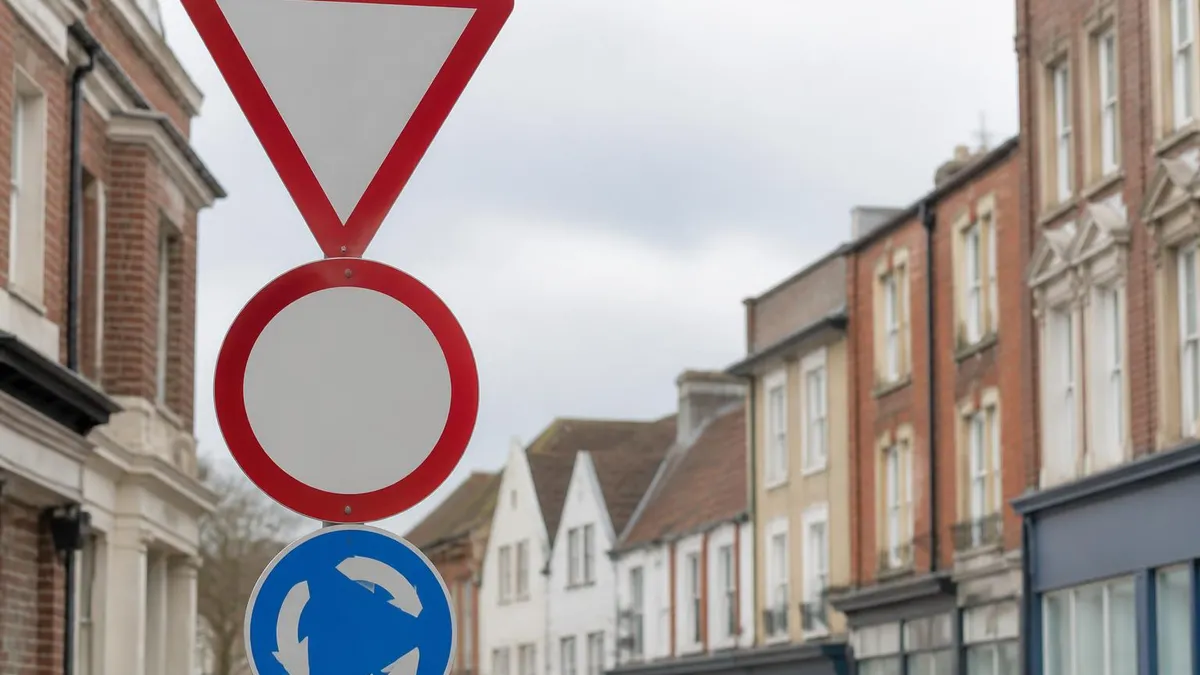
Warning signs (triangular, red border), regulatory signs (circular), information signs (rectangular). Recognition and meaning of common and less-common signs — tested by image and by text description.
Identifying developing hazards from descriptions and scenarios — wet roads, fatigue, blind spots, road rage, vulnerable users. Also tested via the separate hazard perception video clip section.
Tyre pressures, warning lights, seatbelts, fuel efficiency, engine idling, eco-driving techniques, loading and towing limits. Frequently underestimated — worth specific study time.
Hazard Perception, Booking, and Test Day
After completing the multiple choice section, you'll have an optional break of up to 3 minutes before the hazard perception section begins. Most candidates skip the break and proceed directly.
The hazard perception test shows 14 video clips filmed from a driver's perspective. Each clip is approximately 1 minute long and contains at least one 'developing hazard' — a situation that would cause a driver to change speed or direction. One of the 14 clips contains two scorable hazards rather than one, so stay alert throughout all clips rather than relaxing after clicking for the first hazard.
Click the mouse button (or screen for touchscreen versions) when you see a hazard beginning to develop. The scoring system rewards early detection — clicking at the earliest point of hazard development scores 5 points, slightly later scores 4, 3, or 2, very late scores 1, and clicking after the hazard is fully developed scores 0. The total maximum is 75 points across all clips; you need 44 to pass.
Critical rule: Clicking repeatedly in quick succession during a clip is detected as an attempt to game the system. The entire clip is automatically scored zero if pattern clicking is detected. Click only when you genuinely see a developing hazard — one deliberate click per hazard, not rapid-fire clicking.
What to Study for the UK Theory Test
The Official Highway Code is the primary study resource for the theory test. Everything in the theory test derives from the Highway Code — there are no questions about topics not covered there. The DVSA also publishes The Official DVSA Theory Test for Car Drivers (a book containing the full official question bank) and an official app with practice questions. Using official materials is strongly recommended because the question bank is specific and third-party questions occasionally contain inaccuracies.
The most commonly failed topic area is stopping distances, which require memorising specific numbers rather than just understanding the concept. At 30 mph, the overall stopping distance is 23 metres (thinking distance 9m + braking distance 14m). At 70 mph, it's 96 metres — roughly 24 car lengths. Wet or icy conditions significantly multiply stopping distances: braking distance doubles in wet conditions and multiplies by 10 on ice. These specific values appear in questions regularly and require deliberate memorisation rather than casual reading.
Road signs are another high-failure area, particularly less common signs that candidates encounter rarely in practice. The theory test includes signs for unusual situations: signs for level crossings, airport areas, lanes with special restrictions, and advisory speed limits. Working through sign recognition flashcards (freely available on the DVSA app) is effective — the visual recognition skill develops through repeated exposure to sign images, not through reading descriptions of them.
Motorway rules trip up many learner drivers because they haven't yet driven on a motorway. The Highway Code's motorway chapter covers smart motorway operations (including emergency refuge areas and variable speed limits on all-lane-running motorways), rules for joining and exiting motorways, what to do in a breakdown, and regulations around lanes, overtaking, and minimum speeds. This chapter typically requires more careful study than topics candidates are already familiar with from observing traffic.
Vulnerable road users — cyclists, pedestrians, horse riders, and motorcyclists — form another category that deserves specific attention. Questions in this area test whether drivers understand the additional care, speed reduction, and clearance distances required when passing or approaching vulnerable road users.
The 2022 Highway Code updates significantly strengthened protections for these groups, and updated questions reflecting those changes now appear in the test. Candidates who studied from an older edition of the Highway Code may have gaps specifically in this area. For practice questions targeting the hazard perception format specifically, the hazard perception test guide explains the scoring system and how to practice effectively.
Theory Test Preparation Checklist
- ✓Get your provisional driving licence before booking the theory test — you can't book without a licence number
- ✓Read the Official Highway Code from cover to cover at least once before taking practice tests
- ✓Book early if you have a target date — popular test centres fill weeks in advance
- ✓Memorise stopping distances: 23m at 30mph, 53m at 50mph, 96m at 70mph
- ✓Study all road sign categories: warning (triangle), regulatory (circle), information (rectangle)
- ✓Study the motorway chapter specifically — most learners haven't driven on one yet
- ✓Practice hazard perception using video clips, not just reading about it
- ✓Aim for consistent 47+/50 on practice tests before sitting the real test
- ✓Bring only your UK photocard provisional driving licence on test day — no other ID is accepted
- ✓Arrive 10-15 minutes early and review the confirmation email for the test centre address
Theory Test: Common Pass vs. Fail Patterns
- +Candidates who read the Highway Code fully before taking practice tests typically have a wider knowledge base that handles unfamiliar question phrasings
- +Regular practice test takers perform better because they're familiar with the question format and time pressure
- +Candidates who specifically study stopping distances and road signs — the two most commonly failed areas — score significantly better than those who skip them
- +Starting preparation 4-6 weeks before the test date gives time for two learning cycles: initial study plus a review pass
- +Taking the hazard perception section seriously (practicing with actual video clips) is the single biggest factor in avoiding a split result where multiple choice passes but hazard perception fails
- −Candidates who rely on memorising specific questions (rather than understanding the underlying rules) get caught out by rephrased questions or unfamiliar scenarios
- −Underestimating hazard perception — treating it as an afterthought after passing practice multiple choice tests — is the most common cause of overall test failure
- −Studying only familiar topics and skipping 'boring' chapters (motorways, vehicle loading) creates unexpected gaps in the test
- −Booking before adequately prepared to meet a specific date (a job start, peer pressure) results in failure and a second fee
- −Ignoring the 2-year certificate validity and assuming there's plenty of time — then having to retake when the practical test is delayed

Theory Test Results, Passes, and Failures
You receive your result immediately at the test centre in a printed letter. The letter shows whether you passed or failed the overall test, your score on each individual section, and — if you failed — a breakdown of which topic areas you answered incorrectly. Keep this letter regardless of the outcome. For passes, it includes the theory test certificate reference number you'll need to book the practical driving test. For fails, the topic breakdown is valuable study guidance for your next attempt.
If you pass, book your practical driving test promptly using the certificate reference number on your result letter. You have two years before the certificate expires, but practical test waiting times have been lengthy in recent years (6-12 months in some areas), so booking early is prudent. The longer you wait to book the practical, the more likely you are to be pushed close to or past the two-year expiry of your theory certificate.
If you fail, the minimum rebooking wait is 3 working days. However, rushing back in the minimum time usually produces the same result — the time between attempts is best spent addressing your specific weak areas based on the topic breakdown on your result letter. Most candidates who fail narrowly (by 1-3 marks) can address their gaps with a week of targeted study and pass on the next attempt. Candidates who fail significantly in one section — particularly hazard perception — typically need more time to build the specific skill required.
There's no limit on how many times you can retake the theory test, but each attempt costs £23 and requires a minimum 3-working-day wait. A failed attempt is genuinely useful diagnostic information about exactly what you need to study — use the topic breakdown analytically and methodically rather than treating it as simply a discouraging setback.
Candidates who use failed attempts to guide more focused preparation pass on subsequent tries at higher rates than those who repeat the same preparation approach. Your printed result letter is a personalised study guide — treat it as such and act on it specifically rather than simply resolving to study harder in general. For targeted mock test practice that simulates real test conditions, the mock theory test guide covers how to use practice tests most effectively in the weeks before your actual test date.
UK Theory Test: Key Statistics
Theory Test Eligibility and Special Requirements
To take the UK driving theory test, you must hold a valid provisional driving licence for the vehicle category you're testing in. For cars (category B), you must be at least 17 years old to take the practical test, but you can take the theory test from the age of 15 years and 9 months — which means some candidates sit the theory test before they're old enough to apply for their practical.
This can be useful if you're starting driving lessons early and want to get the theory out of the way, but be mindful of the 2-year certificate validity if you're booking the theory test significantly before your 17th birthday.
For motorcycles (category A), the theory test is required before any practical modules. Motorcycle theory tests use the same question bank as the car theory test, with the addition of some motorcycle-specific questions. The hazard perception clips are also shared between car and motorcycle theory tests. The pass marks are identical: 43/50 for multiple choice and 44/75 for hazard perception.
Candidates with special educational needs, disabilities, or conditions that affect reading ability can apply for reasonable adjustments when booking the theory test. Available adjustments include extra time (for dyslexia and similar), a voiceover reading questions aloud, a translated version of the test (available in several languages), and a lip speaker or British Sign Language interpreter for deaf candidates.
These must be requested and approved before the test date — adjustments can't be applied on the day without prior arrangement. Contact the DVSA directly when booking to request adjustments and provide supporting documentation. The booking a theory test guide covers the booking process including how to request special arrangements and what to expect after your booking is confirmed.
Your theory test pass certificate expires exactly 2 years after the test date — and the DVSA does not send reminders. If your practical test is delayed (due to instructor availability, test centre waiting times, or personal circumstances) and your theory certificate expires before you pass the practical, you must retake the theory test from scratch before booking another practical. Theory test centres currently have waiting times of a few days to a few weeks; practical test centres in busy areas can have waiting times of 6-12 months or more. Book your practical test as soon as possible after passing your theory, and track the expiry date in your calendar. If your practical approaches the 2-year limit, consider retaking the theory test proactively rather than risking expiry.
After Passing: Using Your Theory Certificate to Book the Practical
Once you've passed the theory test, you receive a certificate reference number on your result letter. This number is required to book the practical driving test at GOV.UK. The practical test for cars costs £62 for weekday daytime tests and £75 for evenings, weekends, and bank holidays (2026 rates). Most candidates opt for standard weekday daytime tests to reduce cost.
Practical test waiting times vary enormously by location and season. Urban test centres in major cities often have waiting times of several months. Rural test centres may have appointments within a week or two. If your preferred test centre has a long wait, check nearby centres — driving to a test centre 30 miles away is often worth it to get an earlier date. Many candidates book a distant centre for an early date while monitoring their local centre for cancellations that open up sooner.
Continue studying and practising between passing the theory test and taking the practical. The theory test knowledge should be kept fresh — the practical test examiner can ask verbal questions about vehicle safety and the Highway Code during the driving assessment, and practical driving incorporates all the rules and knowledge tested in the theory.
The two-test structure is designed so that both tests reinforce each other: theory knowledge makes you a safer practical driver, and practical experience reinforces theory knowledge. For ongoing practice resources covering the full range of DVSA theory test topics, the DVSA driving theory hub has practice materials for all sections of the theory test.
UK Driving Theory Test Questions and Answers
About the Author

Licensed Driving Instructor & DMV Test Specialist
Penn State UniversityRobert J. Williams graduated from Penn State University with a degree in Transportation Management and has spent 20 years as a certified driving instructor and DMV examiner consultant. He has personally coached thousands of applicants through written knowledge tests, skills assessments, and commercial driver licensing programs across more than 30 states.