
Motorcycle Theory Test: Format, Topics, and How to Pass 2026 September
Everything you need to pass the DVSA motorcycle theory test — format, multiple choice topics, hazard perception tips, pass marks, booking, and study ✍🏼
What Is the Motorcycle Theory Test?
The motorcycle theory test is a mandatory exam set by the DVSA (Driver and Vehicle Standards Agency) that every learner motorcyclist in England, Scotland, and Wales must pass before booking a practical motorcycle test. You can't sit your Module 1 or Module 2 practical until you hold a valid theory test pass certificate, so the theory test is genuinely the first gate on the path to a full motorcycle licence — not an optional or introductory step.
The test is split into two distinct parts taken in the same sitting at a DVSA-approved test centre: a multiple choice section and a hazard perception section. You must pass both parts in the same session to receive an overall pass — passing one part and failing the other means you failed the whole test and must rebook and retake both parts from the start.
The theory test applies to all motorcycle licence categories, whether you're going for a moped licence (AM), a small motorcycle licence (A1, up to 125cc), an intermediate motorcycle licence (A2, up to 35kW), or a full motorcycle licence (A). The question bank is the same across motorcycle categories — what changes is the practical test requirement, not the theory exam itself.
The test fee is £23 and is paid when you book online through the official DVSA booking service. Once you pass, your theory test pass certificate is valid for two years. If you don't pass your practical test within that two-year window, your theory certificate expires and you'll need to pass the theory test again before booking another practical attempt.
This time limit is easy to forget and catches plenty of candidates who delay their practical training. Start booking your Module 1 training promptly after passing — don't assume two years is plenty of time, because practical test waiting times and training availability can eat into that window faster than expected.
- Multiple choice: 50 questions, 57 minutes, pass mark 43/50 (86%)
- Hazard perception: 14 video clips, maximum score 75, pass mark 44/75
- Both parts in one sitting: Must pass both — failing either part means failing the test overall
- Test fee: £23, booked via the official DVSA booking service (gov.uk)
- Pass certificate valid: 2 years from test date
- ID required at centre: Valid UK photocard driving licence or passport + UK paper driving licence
- Test language: English, Welsh, or voiceover in 20+ languages available on request
- Applies to: All motorcycle categories — AM, A1, A2, and A
Motorcycle Theory Test Format
| Section | Questions | Time |
|---|---|---|
| Multiple Choice | 50 questions | 57 minutes |
| Hazard Perception | 14 video clips | No fixed time limit per clip |
How to Book and Take the Motorcycle Theory Test
Step 1: Hold a valid provisional motorcycle licence
Step 2: Book your test online through gov.uk
Step 3: Study using official DVSA materials
Step 4: Arrive at the test centre with valid ID
Step 5: Complete both test parts in sequence
What the Multiple Choice Section Covers
The 50 multiple choice questions are drawn from a large bank of questions covering topics that directly relate to motorcycle safety and road use. The DVSA publishes the complete topic list, and it's worth understanding where the questions come from so you can focus your revision effectively.
Highway Code rules account for a significant portion of the questions — give way rules, speed limits, road markings, road signs, stopping distances, and safe following distances. These aren't abstract knowledge items; they're the rules motorcyclists need every single time they ride, which is why the DVSA tests them thoroughly.
Motorcycle-specific safety topics are weighted heavily in the question bank: braking distances for motorcycles (which differ from cars due to weight and tyre contact), the dangers of skidding and how to handle a skid, motorcycle stability in crosswinds and adverse weather, the particular vulnerability of motorcyclists in low-visibility situations, and the safety value of high-visibility clothing and helmet standards.
Vehicle safety questions cover tyre condition and pressure, checking brake fluid, chain maintenance, and motorcycle checks before a journey — the kind of pre-ride inspection that prevents mechanical failures on the road. The DVSA expects riders to know their vehicle's basic maintenance requirements and what to check before each ride.
Attitude and hazard awareness questions test your understanding of defensive riding: anticipating the actions of other road users, the dangers of riding when fatigued or under the influence of medication, and the role of awareness in avoiding accidents. These questions often deal with scenarios rather than pure fact recall, which is where candidates who've only memorised answers sometimes struggle.
Environmental topics include fuel economy, emission-related questions, and the environmental impact of riding behaviour — a smaller category but one that appears consistently in the test.
Motorcycle Licence Categories Covered by the Theory Test
Covers mopeds and light quadricycles with a maximum speed of 45 km/h and an engine size up to 50cc (or 4kW for electric). Minimum age 16. The AM category is the entry point for young riders and covers urban commuting vehicles. The theory test applies equally to AM candidates — the same question bank, same pass marks.
Motorcycles up to 125cc with a maximum power output of 11kW and a power-to-weight ratio not exceeding 0.1 kW/kg. Minimum age 17. A1 is the classic 'learner legal' motorcycle category for riders who want more than a moped but aren't ready for a full licence. A1 holders can ride without L-plates or a supervisor after passing both Module 1 and Module 2.
Motorcycles with a maximum power output of 35kW and a power-to-weight ratio not exceeding 0.2 kW/kg. Minimum age 19. A2 is the intermediate licence for riders who want more power than A1 allows but haven't met the requirements for a full A licence. After 2 years on A2, riders can upgrade to a full A licence via a simple practical test (no theory retake required).
No restriction on engine size or power output. Available from age 24 via direct access (DA) or from age 21 after 2 years on an A2 licence. The full A category covers all motorcycles including large-capacity bikes. Passing the theory test is the same requirement for all routes — direct access candidates still need the theory test certificate before booking any practical test modules.
Preparing for Each Part of the Test
The most effective approach is to work through the complete official question bank systematically. The DVSA theory test app contains every question you could be asked, and the questions in the actual test are drawn directly from this bank — sometimes word for word, sometimes with minor wording changes.
- Go through topics in order: Work category by category — Highway Code, then vehicle safety, then attitude and awareness, then environmental topics. Structured revision is more efficient than random practice questions.
- Learn the reasons, not just the answers: If you understand why a particular answer is correct — why that stopping distance, why that give-way rule applies — you'll handle slight rewording in the test without being thrown off.
- Use mock tests: Once you've covered all topics, do full 50-question timed mock tests. The DVSA app includes mock tests in test conditions. You're aiming to score 46-50 consistently before your test date to have a comfortable margin over the 43/50 pass mark.
- Focus revision on weak areas: Track which topics you're getting wrong repeatedly. Highway Code distances and measurements (stopping distances, following distances, speed limits in specific conditions) trip up many candidates and reward focused repetition.

Study Resources and How to Use Them
The official DVSA resources are the most direct route to the question bank you'll face in the test. The DVSA Theory Test Kit app (available on iOS and Android) contains the complete question bank with explanations, mock tests, and hazard perception clips. If you use only one preparation resource, this is the one — it's what the test is built from.
The Highway Code is the primary reference document underpinning the multiple choice questions. It's free to read on gov.uk and worth a complete read-through before drilling practice questions — understanding the rules in context makes revision faster and stickier than trying to memorise answers without the underlying framework.
The DVSA publication 'Motorcycle Riding: The Essential Skills' provides deeper context for motorcycle-specific questions and is particularly useful for understanding the reasoning behind vehicle safety and riding attitude questions. It's not required reading for every candidate, but riders who are newer to motorcycles generally benefit from it.
Third-party revision sites and apps offer additional practice question sets in similar formats to the official test. These can be useful for variety once you've worked through the official question bank, but treat them as supplementary — occasionally third-party questions contain errors or cover topics not in the official bank, which can cause unnecessary confusion close to your test date.
Theory test study groups and online forums (particularly motorcycle-focused communities) are useful for sharing tips on which topics trip people up and how others structured their revision. Hearing that a lot of people found highway code measurements difficult — stopping distances, tyre tread depths, speed limits in specific conditions — can help you allocate revision time more wisely.
Motorcycle Theory Test Day Checklist
- ✓Bring your valid photocard driving licence — this is mandatory ID; the test centre will refuse entry without it
- ✓If no photocard licence yet, bring both your paper licence and a valid passport together
- ✓Arrive at least 10 minutes early to complete registration and settle in before the test begins
- ✓Leave your phone and notes in your bag or locker — they're not permitted in the test room
- ✓During the multiple choice section, use the flag feature to mark questions you're unsure about and return to them before submitting
- ✓Take the short tutorial before the hazard perception section seriously — it explains the scoring system and shows what counts as a hazard
- ✓During hazard perception, click once or twice when you see a hazard developing — don't click repeatedly or in a pattern
- ✓Remember one hazard perception clip contains two scorable hazards — keep watching after your first click
- ✓After completing both sections, you'll see your results immediately on screen before leaving
Official DVSA Resources vs Third-Party Apps
- +Official DVSA theory test app contains the exact question bank used in the real test — questions in the real test are drawn directly from this bank
- +DVSA hazard perception clips match the real test format exactly in terms of clip length, scoring windows, and two-hazard clips
- +The Highway Code on gov.uk is free, always up to date, and is the definitive reference for Highway Code questions
- +Official mock tests in the DVSA app replicate actual test conditions including the 57-minute time limit and 50-question count
- −Third-party revision apps sometimes include questions not in the official bank or questions with incorrect answers — check any third-party resource's accuracy before relying on it heavily
- −Free third-party sites vary in quality and may not reflect the most recent question bank updates from the DVSA
- −Some revision sites emphasise memorising answers over understanding reasons — this approach can fail when question wording changes slightly in the real test
Common Reasons Candidates Fail the Motorcycle Theory Test
The multiple choice failure rate is driven largely by three areas: stopping distances and other numerical Highway Code values, motorcycle-specific safety rules that differ from car driving rules, and attitude and awareness questions where candidates pick the most obvious-sounding answer rather than the technically correct one.
Stopping distances catch out a lot of candidates because there are multiple distance values to learn — thinking distance, braking distance, and overall stopping distance at different speeds — and the values need to be known precisely. At 30 mph, the overall stopping distance is 23 metres (6 metres thinking distance + 14 metres braking distance). These values appear frequently in the test and can't be guessed; they need to be memorised.
At 60 mph, the overall stopping distance increases to 73 metres — over half the length of a football pitch. This dramatic increase illustrates why the DVSA tests these values explicitly: motorcyclists who misjudge stopping distances at speed face a disproportionately high risk of serious injury compared to car drivers, because motorcycles offer no crumple zone protection in a frontal collision. The question bank reinforces these values repeatedly because getting them right on the road genuinely matters.
Hazard perception failures are often caused by two opposite errors: clicking too late (not spotting the hazard until it's already obvious) or clicking too early and too often (triggering the anti-cheat detection). Candidates who haven't practised with video clips before their test tend to be surprised by how early the scoring window for a hazard actually opens — the hazard starts developing well before the situation becomes dangerous, and scoring requires clicking during that early development window.
A less obvious failure cause is assuming that motorcycle knowledge from CBT or practical riding experience transfers directly to the theory test. The DVSA test tests knowledge of rules and values as they're written in the Highway Code, not just whether you know how to ride. Practical riding ability and the ability to answer Highway Code questions correctly are different skills that require different preparation.
Underestimating revision time is another common factor in failure. Candidates who take the test after only a few days of casual revision often find that the question bank is broader and more specific than they expected — particularly on topics like vehicle safety checks, tyre regulations, and the Highway Code rules around road markings and signs. Most instructors suggest a minimum of 20-25 hours of dedicated revision for candidates with no prior knowledge of the Highway Code.
Motorcycle Theory Test: Key Facts
What Happens After You Pass
Passing the motorcycle theory test gives you a pass certificate that must be presented when booking your practical motorcycle test. The practical test for most motorcycle categories is split into two modules: Module 1 (off-road manoeuvres at an approved DVSA test site) and Module 2 (on-road riding assessed by a DVSA examiner). You must pass Module 1 before booking Module 2.
You'll also need to complete your Compulsory Basic Training (CBT) before riding on public roads as a learner. The CBT is a one-day training course at an approved training school and is a legal requirement for riding with L-plates. CBT doesn't expire as a prerequisite for the practical test, but the CBT certificate itself expires after 2 years if you haven't passed your full practical test — at which point you'd need to redo CBT before riding on the road again.
The standard route after passing the theory test is to start regular motorcycle training with a DVSA-approved instructor (ADI or DVSA-registered motorcycle instructor). Training on a proper track for Module 1 manoeuvres — U-turns, figure-of-eight, emergency stop, and avoidance exercise — is much more efficient than trying to practise these on public roads. Most training schools offer structured programmes that take candidates from CBT level through to full practical test readiness.
For candidates going for a direct access A licence (the route available from age 24 with no prior motorcycle licence required), the theory test is exactly the same. Direct access candidates typically take an intensive week-long training programme that covers both Module 1 and Module 2 preparation, though spreading training over a few weeks with a regular instructor is often more effective for skill retention and building genuine riding confidence.
Module 1 fees are currently £15.50 for the off-road manoeuvres test, and Module 2 fees are £75 for the on-road riding test. These fees are separate from training school fees, which vary considerably depending on your location, the number of training hours you need, and whether you choose an intensive or spread-out programme. Budgeting realistically for both the testing fees and adequate training time is worth doing before you start — rushing practical training to save money is one of the main reasons candidates fail Module 1 or Module 2 on their first attempt.
After passing both practical modules, your full motorcycle licence is issued by the DVLA automatically — your provisional licence is upgraded without any additional application needed. For A2 licence holders who later want to upgrade to a full A licence after 2 years, the process requires only a Module 2 practical test (no Module 1 retake, and no theory test retake), making the progression to a full licence relatively straightforward once the foundation qualifications are in place.
Your motorcycle theory test pass is valid for exactly 2 years from the date you passed. If you don't successfully complete both Module 1 and Module 2 of the practical motorcycle test within that 2-year window, your theory certificate expires and you'll need to pass the theory test again before booking any further practical test attempts. This catches a significant number of candidates who pass the theory test but then delay starting practical training. Book your Module 1 training promptly after passing the theory test and treat the 2-year window as a firm deadline — not a comfortable buffer. The same expiry rule applies to car theory test certificates as well.
Frequently Misunderstood Topics in the Motorcycle Theory Test
Stopping distances are the single most misunderstood area of the Highway Code in theory tests. Many candidates know the overall stopping distance at 30 mph is 23 metres but confuse the breakdown — 6 metres thinking distance, 14 metres braking distance — when a question asks specifically about one component rather than the total. Wet roads double the braking distance; icy roads multiply the braking distance by ten. These multipliers appear regularly in the question bank and require explicit memorisation.
Motorcycle tyre tread depth is another area where candidates often give an incorrect answer with confidence. The legal minimum tread depth for motorcycles over 50cc is 1mm across three-quarters of the tyre width in the central part of the tread pattern — not 1.6mm, which is the car and van minimum. This distinction is specifically tested in the motorcycle question bank.
Speed limits for motorcycles on different road types is an area where candidates sometimes apply car knowledge incorrectly. On a single carriageway in a built-up area, the limit is 30 mph unless signed otherwise. On a single carriageway outside a built-up area, it's 60 mph for motorcycles.
On a dual carriageway or motorway, it's 70 mph. These are the same as cars — but the question bank also tests awareness that these limits apply unless a lower limit is signed, which is a nuance that trips up candidates who know the national default limits but not that local signed limits override them.
The hazard perception scoring window is misunderstood by many candidates. You don't score by clicking when the hazard is at its worst — you score by clicking when it's developing. A car signalling to pull out is a developing hazard; once it's actually blocking your path, it's fully developed and you'd score lower or zero. Practising with the official DVSA clips makes this timing intuitive; reading about it doesn't fully prepare you for the actual timing in the test.
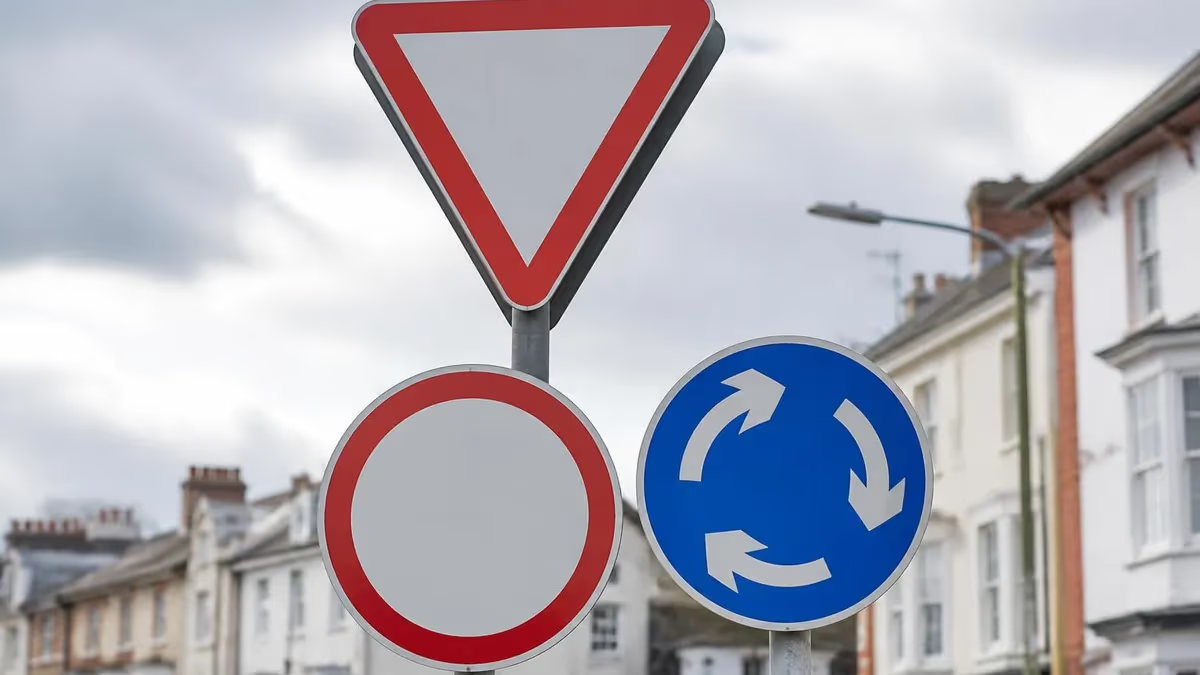
Road sign recognition is broader than most candidates expect. The DVSA question bank includes questions on warning signs, regulatory signs, information signs, and road markings that riders might see daily without consciously registering what they mean. A triangular sign with a red border is a warning; a circular sign with a red border is a prohibition. Knowing the underlying logic of the sign system — rather than memorising individual signs in isolation — makes the related questions considerably more manageable and helps you answer confidently when an unfamiliar sign appears in the test.
Motorcycle Theory Test Questions and Answers
About the Author
Licensed Driving Instructor & DMV Test Specialist
Penn State UniversityRobert J. Williams graduated from Penn State University with a degree in Transportation Management and has spent 20 years as a certified driving instructor and DMV examiner consultant. He has personally coached thousands of applicants through written knowledge tests, skills assessments, and commercial driver licensing programs across more than 30 states.